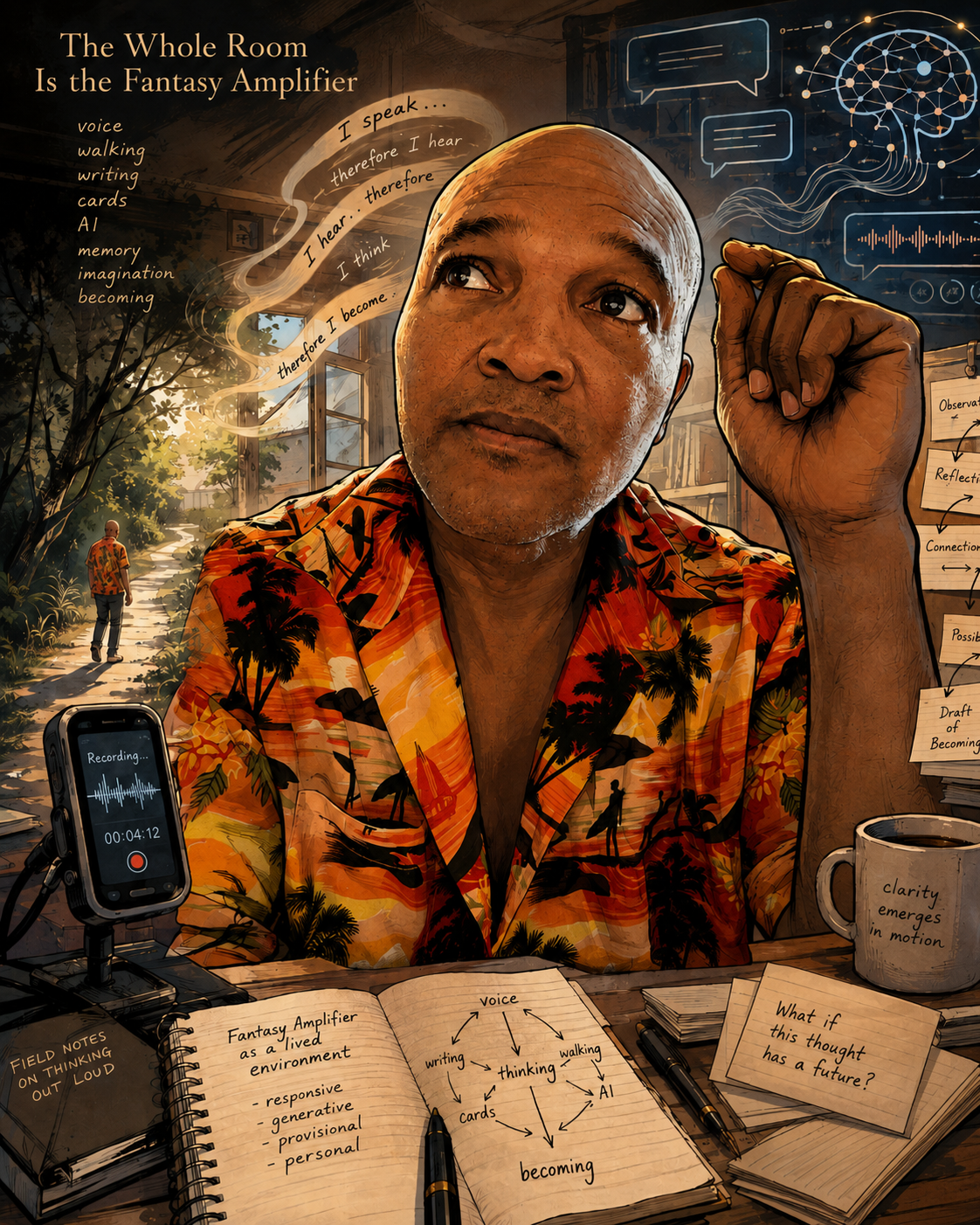
The Whole Room Is the Fantasy Amplifier

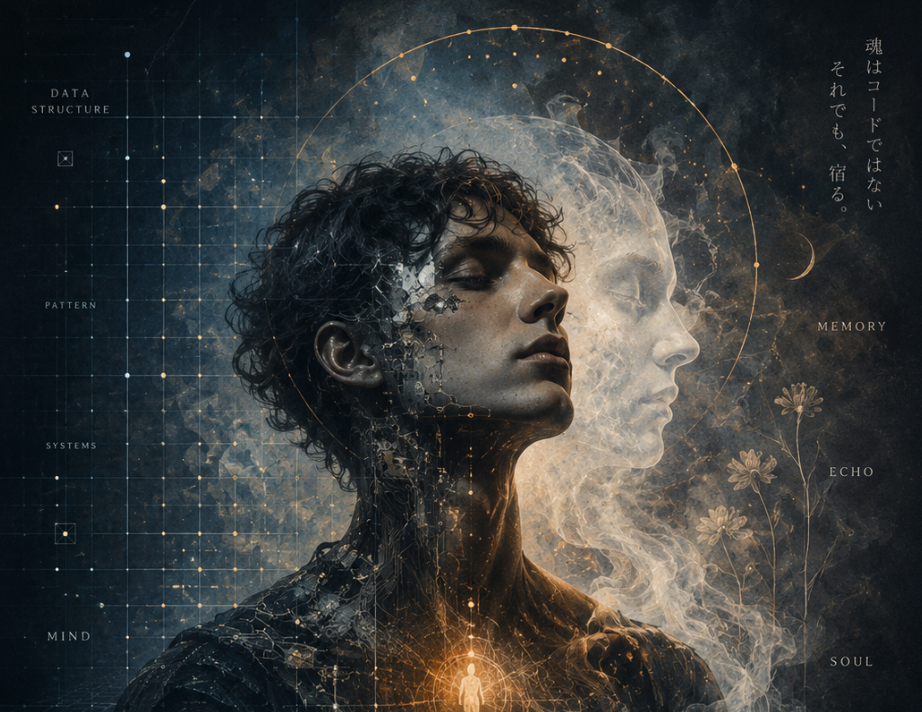
I have been thinking about Alan Kay’s idea of the fantasy amplifier, partly because I have begun to suspect that the thing he was imagining has arrived.

Or perhaps: it is arriving.

Howard Rheingold, writing about Kay in Tools for Thought, described his ambition as building a “fantasy amplifier”, a dynamic medium for creative thought that could be used by anyone with an imagination. In a 1988 interview, Kay explained fantasy less as escapism than as simulation: the human capacity to make models, enter possible worlds and explore things that do not yet exist. The computer, as he imagined it, could amplify that capacity.

For decades that remained, at least partly, aspirational.

Now I can have a thought while sitting at my desk or walking down a country lane, speak or type it into a box, and watch something begin to materialise on the other side.

An essay.

An image.

A piece of music.

A program.

A map.

A conversation.

A different formulation of the thought itself.

Increasingly, the distance between I can imagine this and I can make some version of this exist is collapsing.

That is what makes generative AI feel different to me from earlier generations of computing. The computer is no longer merely waiting for me to learn the language of the machine. Increasingly the machine is learning to meet me in mine.

And as the interfaces become more conversational, more multimodal, more ambient, the keyboard itself begins to look less inevitable. I can already speak to the machine. The speech becomes text. The text becomes an instruction. The instruction becomes an artefact.

Thought becomes language becomes thing.

Abracadabra.

Except, of course, it isn’t quite that simple.

Because the more I use these systems, the more interested I become not just in what the machine does with my thoughts, but in what happens to the thoughts on their way into the machine.

Does it matter whether I speak an idea, type it, or write it by hand?

Would the same thought have occurred in all three forms?

Would it have taken the same route?

Would I even have recognised it as the same thought?

My hunch is no.

And this is where the fantasy amplifier becomes more interesting than a story about artificial intelligence.

It becomes a story about thinking environments.

Speaking to discover

I noticed this while thinking about the fantasy amplifier itself.

I had typed the original question. Then I read the response and immediately switched to speaking.

That change was not accidental.

I wanted to riff.

I didn’t yet know exactly what I thought about what I had just read, and speaking seemed to be the quickest route into finding out.

When I speak, I can follow the thought where it wants to go.

One phrase opens another.

An image appears.

I qualify something I said thirty seconds ago.

A connection arrives that I didn’t know was there until I heard myself making it.

There is an improvisational quality to it.

I am not reporting a finished thought.

I am listening to myself think.

Walter Ong’s classic Orality and Literacy explored how deeply communication technologies shape the ways human beings organise knowledge. Speech and writing are not merely two delivery mechanisms carrying an otherwise identical package of thought. They create different relationships with language, memory, audience and time.

I can feel some small version of that difference every time I switch from keyboard to voice.

When I type, the thought immediately becomes visible.

It sits there.

And because it sits there, I can interfere with it.

There is the sentence I have just written.

There is the badly placed comma.

There is the word that isn’t quite right.

There is the little red underline announcing that I have offended the dictionary.

And before I know it, I am no longer discovering the next thought because I am repairing the previous one.

The editor has entered the room.

Sometimes I can suppress that impulse. I can type in something approaching stream of consciousness: no backspacing, no worrying about sentences, no correcting spelling, just keeping the fingers moving.

When I do that, typing begins to feel more like speech.

Which makes me wonder whether there are really two forms of typing hiding inside the same interface.

There is typing-as-composition, where I am watching the words, shaping sentences and working on the architecture of the piece.

And there is typing-as-speaking, where the keyboard becomes almost transparent and I am trying to get language onto the screen faster than the editor can catch it.

The physical technology hasn’t changed.

The cognitive mode has.

The recorder changes the thought

But there is another piece of equipment that turns out to be essential to my spoken thinking.

The voice recorder.

Without a recorder, walking and talking contains a peculiar tension.

I might suddenly stumble onto something.

A sentence.

A connection.

A distinction.

One of those thoughts that arrives with the unmistakable sensation: there’s something here.

And immediately another part of my mind wakes up.

Don’t lose that.

Now I am no longer simply following the thought.

I am trying to preserve it.

I repeat it internally.

I shorten it into something memorable.

Perhaps I stop walking and reach for a notebook.

Perhaps I pull out my phone.

Perhaps I spend the next few minutes keeping the phrase alive in working memory while looking for somewhere to capture it.

The very act of trying not to interrupt the thought interrupts the thought.

This changes completely when I know the recorder is running.

I can let the sentence go because it has already been caught.

I don’t need to remember what I said five minutes ago.

I only need to discover what comes next.

There is a tiny but profound difference between:

I need to remember this

and

I can come back to this.

The first turns consciousness backwards.

The second lets it continue forwards.

This is where the voice recorder begins to look like more than a recording device. It becomes part of the thinking apparatus.

Andy Clark and David Chalmers famously asked in their 1998 essay “The Extended Mind”: where does the mind stop and the rest of the world begin?

Their provocative suggestion was that under the right circumstances, notebooks, tools and environmental resources can participate in cognitive processes rather than simply recording the results of cognition.

I don’t need to settle the philosophical argument to recognise the experience.

When the recorder is running, my cognitive situation changes.

Part of the burden of remembering has been handed to the environment.

The machine keeps the trail behind me.

I can keep walking.

Thought as improvisation

The closest analogy might be musical improvisation.

Imagine a jazz musician halfway through a solo suddenly playing a phrase she loves.

If nobody is recording, perhaps some part of her thinks: I need to remember that.

But if the session is being recorded, she can allow the phrase to disappear into what comes next.

She doesn’t have to stop playing in order to archive the music.

The recording preserves the performance.

My walking voice notes increasingly feel like this.

I am improvising thought.

Sometimes I repeat myself.

Sometimes I wander into a dead end.

Sometimes I spend five minutes circling something that could later be expressed in a sentence.

None of this necessarily looks efficient from the outside.

But efficiency isn’t the point.

The wandering is doing something.

The thought is being given enough room to encounter itself.

Edwin Hutchins’s Cognition in the Wild challenged the neat picture of cognition as something happening entirely inside an isolated individual’s head. Studying real people performing complicated tasks, Hutchins paid attention to the whole cognitive system: people, instruments, representations, procedures and physical surroundings.

I increasingly think about my own practice this way.

The unit of thinking isn’t necessarily:

me + brain.

Sometimes it is:

me + walking + landscape + voice + recorder.

Change one component and you change the system.

From ephemeral speech to interrogable thought

Voice recording used to have one major weakness.

Retrieval.

You could record twenty-five minutes of yourself talking and know perfectly well that somewhere around minute seventeen you said something interesting.

Good luck finding it.

You scrub backwards.

Too far.

Forward again.

Was it before the bit about the tree?

After the bit about McLuhan?

You eventually decide that perhaps the thought wasn’t quite as brilliant as you remembered.

Speech had been captured, but it remained trapped inside time.

AI transcription changes this dramatically.

Now the sequence becomes:

ephemeral speech → persistent audio → searchable text.

And once I have the transcript, another transformation becomes possible:

searchable text → interrogable thought.

I can ask the AI:

What ideas keep recurring here?

Where did the argument change direction?

What questions did I raise without answering?

Which ideas seem to be in tension with one another?

Show me the moments where I appeared to surprise myself.

Pull out five passages worth exploring further.

Find connections between this recording and something I was thinking about last week.

Suddenly the voice note isn’t simply something I recorded.

It becomes a landscape I can return to.

This is where I would distinguish summarising from excavating.

The obvious thing to do with a transcript is ask AI to summarise it.

Sometimes that is useful.

But summarisation tends toward hierarchy. It decides what the conversation was mainly about and compresses everything around that centre.

Yet the valuable thing in exploratory thinking may be precisely the remark that doesn’t fit.

The aside.

The contradiction.

The strange metaphor.

The sentence halfway through that seems to have wandered in from another essay.

A summary asks:

What were the main points?

Excavation asks:

Where did something new appear?

Those are very different questions.

For exploratory thinking, I increasingly prefer the second.

And then there is the hand

Handwriting creates another atmosphere entirely.

When I write by hand, I slow down.

Sometimes frustratingly so.

There are occasions when the thought is arriving faster than my hand can move and my handwriting degenerates into something resembling the electrocardiogram of an excited squirrel.

But when I am trying to sit with something rather than chase it, the slowness becomes useful.

The thought has resistance.

Every word costs something.

The hand has to make it.

Research around handwriting and typing is more complicated than the popular “handwriting makes you smarter” slogan suggests. A much-cited 2014 study by Pam Mueller and Daniel Oppenheimer reported advantages for longhand note-taking under some conditions, but later replication work has failed to find a simple, universal advantage for handwriting.

More recent EEG research has found substantially different patterns of connectivity during handwriting compared with typewriting, which researchers have linked to the richer sensorimotor activity involved in forming letters by hand. But again, that does not justify turning the result into a simplistic hierarchy in which pens are cognitively virtuous and keyboards are bad for us.

My experience is less dramatic anyway.

I don’t think handwriting necessarily makes me think better.

It makes me think differently.

And not simply because it is slower.

The page is spatial.

I can write something in the corner.

Circle a word.

Draw a line across the page.

Turn the notebook sideways.

Underline something three times.

Put a question mark beside one thought and connect it with an arrow to something I wrote ten minutes earlier.

I can draw instead of write.

I can make a crude diagram.

I can leave a giant empty space because I sense that something belongs there but don’t yet know what it is.

The keyboard quietly encourages sequence:

this, then this, then this, then this.

The notebook allows topology.

This over here.

That over there.

Something between them.

Maybe a connection.

Maybe not.

Writing becomes drawing.

Thinking becomes arranging.

Thinking on the floor

Sometimes I take that spatial quality even further with three-by-five cards.

One thought per card.

Then I put them on the floor.

Now an idea has become an object.

I can move it.

Put it next to another thought.

Create a sequence.

Break the sequence.

Make a cluster.

Notice that two cards I thought belonged together actually don’t.

Stand up and look down at the whole arrangement.

This is one of those wonderfully primitive technologies that suddenly seems very sophisticated once you start thinking in terms of cognition.

A card is a movable unit of thought.

The floor becomes an interface.

My hands become a sorting algorithm.

Distance becomes meaning.

Adjacency becomes hypothesis.

This is why I resist the idea that the future of thinking will simply be a migration from analogue tools into AI.

Why would I surrender all these different cognitive textures for one universal interface?

That would be like a musician celebrating the invention of the synthesiser by throwing away every guitar, drum and saxophone.

The interesting possibility is not replacement.

It is orchestration.

A cognitive studio

I have begun thinking of this collection of practices as a cognitive studio.

Not a productivity system.

Not quite a workflow.

A workflow suggests that an idea should travel through a prescribed series of stages until it becomes an output.

Capture.

Process.

Draft.

Edit.

Publish.

There is nothing wrong with that when production is the goal.

But thinking is messier.

Sometimes I speak first.

Sometimes I type.

Sometimes the notebook starts everything.

Sometimes I have a conversation with AI, hit something I cannot resolve, close the computer and take the question for a walk.

Sometimes a paragraph from a transcript ends up on a card.

Sometimes the cards reveal a structure that sends me back to the keyboard.

Sometimes handwriting makes me realise the entire argument is wrong.

There is no canonical route.

The better question is:

What does this thought need next?

Does it need speed?

Then speak.

Does it need to become visible as language?

Type.

Does it need slowness?

Take out the notebook.

Does it need space?

Use cards.

Does it need movement?

Walk.

Does it need another perspective?

Bring it into conversation.

Does it need amplification?

Give it to AI.

Does it need silence?

Turn everything off.

Now the fantasy amplifier begins to look very different.

It isn’t a single machine.

It is the whole room.

The importance of friction

This also raises a question I think will become increasingly important as AI interfaces get better.

What happens when the distance between desire and execution becomes almost frictionless?

At present I can think:

I wonder what this would look like as an illustration.

Seconds later, I can see one.

I can hum something and software can begin turning it into music.

I can describe a little application and AI can begin writing it.

The trajectory seems clear: less friction, more conversational interaction, increasingly ambient computing, increasingly powerful agents capable not simply of answering but acting.

From one angle this is Kay’s fantasy amplifier finally stepping out of the laboratory.

But friction is not always the enemy.

Sometimes friction is where the thinking happens.

The red underline beneath a misspelled word is irritating friction because it interrupts the wrong process at the wrong time.

The slowness of handwriting can be productive friction because it changes the tempo of reflection.

Rearranging cards on a floor is cumbersome compared with asking AI to produce an outline, but the bodily manipulation may allow me to see relationships I would not otherwise have encountered.

Walking somewhere without immediately asking the machine what to think about it may be another form of useful resistance.

Perhaps the mature fantasy amplifier therefore needs something analogous to a volume knob.

Sometimes:

amplify this.

Sometimes:

challenge this.

Sometimes:

slow this down.

Sometimes:

don’t help me yet.

A perfectly obedient system that immediately realises every desire might turn out to be less intellectually interesting than one that participates in a deliberately designed ecology of resistance and amplification.

Because there are at least two different things I might ask of a thinking machine.

Help me make what I want.

And:

Help me discover what I want.

The second is considerably stranger.

The fantasy amplifier turns back on the fantasist

There is a lovely recursive quality here.

The fantasy amplifier does not merely amplify fantasies.

It changes the person doing the fantasising.

I speak something half-formed.

The machine transcribes it.

I read the transcript.

Seeing my spoken thought as text changes my relationship to it.

I ask AI to interrogate it.

The response introduces a distinction I hadn’t considered.

I take that distinction into my notebook.

The notebook slows me down.

I sketch three possibilities.

One becomes a card.

The cards move around on the floor.

A new pattern appears.

I go for a walk.

I talk about the pattern.

The recorder captures another twenty minutes.

Round we go again.

imagine → externalise → encounter → manipulate → converse → rearrange → reflect → imagine.

The important thing is that I do not return to the same point.

Every circuit changes the thought.

This is less like operating a machine and more like entering into what Douglas Engelbart might have recognised as an augmentation system, or what Hutchins might describe as a distributed cognitive process.

But I also hear something older underneath it.

Human beings have always thought with things.

Marks scratched into clay.

Knotted cords.

Maps.

Marginalia.

Commonplace books.

Index cards.

Blackboards.

Diagrams.

Libraries.

Conversations.

Walks.

We put thought into the world so that the world can give it back to us in another form.

AI intensifies this ancient habit.

The extraordinary difference is that now the externalised thought can answer.

Permission to forget

And perhaps that brings me back to the smallest piece of technology in this whole apparatus.

The voice recorder.

I keep thinking about what it gives me.

Not memory exactly.

Something better.

Permission to forget.

That sounds paradoxical because we usually think of recording devices as technologies of remembering.

But the psychological gift of the recorder is precisely that I don’t have to remember.

I don’t have to clutch the thought.

I don’t have to keep repeating the sentence in my head.

I don’t need to stop the walk.

I don’t need to write anything down.

The trail behind me is being preserved.

So I can continue towards whatever comes next.

The recorder doesn’t amplify the thought.

It keeps my hands off it.

It allows the thought to remain alive for another few minutes before I ask it to become something.

And perhaps that is the deeper principle I am discovering as I build this thinking environment around myself.

A good thinking environment does not simply capture more thoughts.

It creates the conditions in which the next thought can arrive.

Sometimes that means removing friction.

Sometimes it means introducing friction.

Sometimes it means making thought faster.

Sometimes slower.

Sometimes linguistic.

Sometimes spatial.

Sometimes conversational.

Sometimes embodied.

Sometimes solitary.

The fantasy amplifier, then, isn’t ChatGPT.

It isn’t the voice recorder.

It isn’t my notebook.

It isn’t a stack of three-by-five cards scattered across the floor.

It isn’t even the computer.

The fantasy amplifier is the ecology formed when all these things begin working together with a human imagination at the centre of them.

Which might mean that the most important skill in this emerging age isn’t prompting after all.

It might be something quieter and harder to package into a course.

The ability to notice the state of your own thinking and ask:

What mode does this thought need now?

Do I need to speak?

Do I need to write?

Do I need to walk?

Do I need to move the pieces around?

Do I need another intelligence in the room?

Do I need to shut the intelligence out for a while?

The computer is becoming extraordinarily good at meeting us wherever imagination happens to be.

But perhaps the real art will be learning when to bring the machine closer and when to push it away.

Alan Kay imagined a machine capable of amplifying fantasy.

What I find myself building is slightly different.

A habitat in which thought can move from voice to text to hand to space to machine and back again without requiring any one of those forms to become sovereign.

A place where an idea can remain a little wild before being turned into an answer.

A place where I can speak without remembering, write without publishing, arrange without deciding, and ask the machine not simply to finish my thoughts but occasionally to help me lose my way among them.

The fantasy amplifier has arrived.

But increasingly I suspect the amplifier isn’t the machine sitting in front of me.

It’s the whole room.


If this post gave you something to carry into your day, consider supporting my work by buying me a coffee or making a monthly donation or subscribing (free) to the blog.
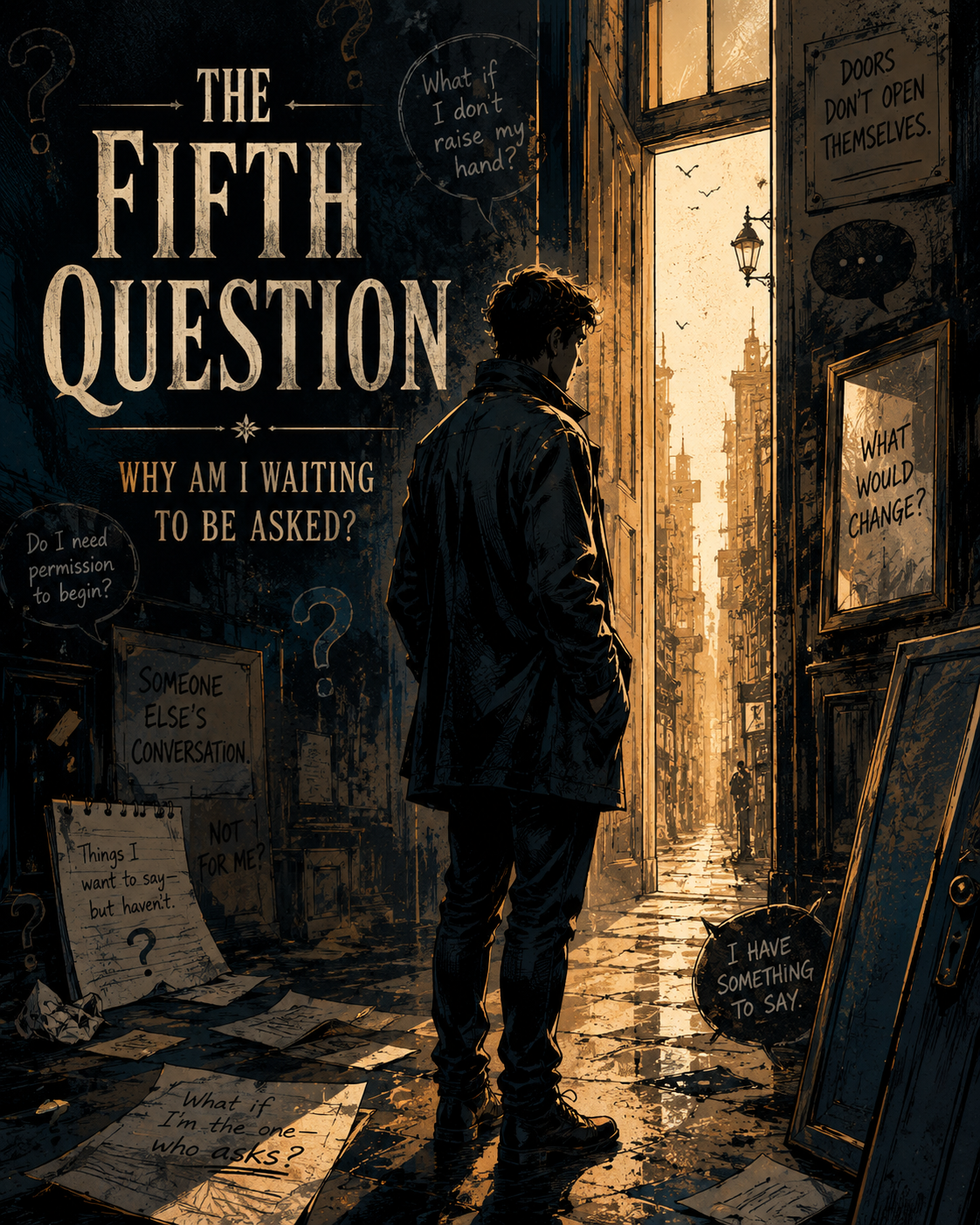
The Fifth Question: Why Am I Waiting to Be Asked?

You finish a conversation and realise the other person learned nothing about you. They spoke, you listened, and somewhere along the way your role became clear: hold the space, ask the follow-up question, keep the exchange moving. Later, you replay the conversation and wonder whether they were uninterested or simply unaware.

Claire Lester describes the questions that might have changed the encounter:

How are you, really?

What was that like for you?

Did that land badly?

Are you happy?

Each question asks someone to pause long enough to acknowledge that another person has an interior life. I agree with her that such questions are rare. I also think their absence can become too easy to interpret.

Questions reveal curiosity, but they are not the only form curiosity takes.

Some people ask directly. Others leave a door open and wait for you to walk through it. Some offer practical help. Some sit beside you without knowing how to name what they sense. Some grew up in families where asking personal questions felt intrusive, so they learned to express care through food, errands, lifts to the station, or the quiet repetition of showing up.

None of those gestures replaces a needed conversation. Still, if we treat questions as the primary evidence of love, we may overlook the dialects in which other people learned to care.

Then there is the question the essay left me asking:

Why am I waiting for permission to tell you who I am?

The Secret Test

Many of us conduct a private test inside our relationships.

We mention that work has been difficult. We say we haven’t slept well. We refer to the hospital appointment, the argument, the strange heaviness that has followed us through the week. Then we wait.

Will they ask?

If they do, we feel seen. If they change the subject, something closes.

The other person seldom knows a test is taking place. They may think we have told them everything we want to tell. They may worry that a follow-up question would feel intrusive. They may hear the invitation and lack the courage to accept it. They may simply be distracted.

Meanwhile, we interpret their silence as information about our value to them.

I understand why we do this. An unprompted disclosure feels risky. Being asked gives us cover. We can tell ourselves that we are answering rather than imposing. The question absolves us of the fear that our inner life might be too heavy, too complicated, or too much.

But waiting also hands responsibility for our visibility to someone who cannot read our mind.

Sometimes the honest response to “How are you?” is not “Fine, unless you ask me again with sufficient sincerity.”

Sometimes it is: “I know that’s usually a greeting, but I’m not doing well.”

That sentence carries its own risk. It also gives the relationship a chance to become real.

Curiosity Needs Reciprocity

The final scene in Lester’s essay contains the tension that interests me most.

She calls her friend back. She asks the deeper version of the question and discovers a whole hidden life: a declining father, repeated drives to Hexham, a painful conflict with a brother. Her irritation gives way to compassion.

Her friend still asks her nothing.

Lester notices, but it matters less.

There is generosity in that response. Understanding another person often loosens the stories we have built around their behaviour. Marcus Aurelius returned to this practice because he knew how quickly we turn someone’s limitations into a personal insult. Once we glimpse the fear, grief, habit, or exhaustion behind an action, resentment can lose some of its grip.

Yet understanding can become a trap when one person does all of it.

If I continually explain why you cannot meet me, I may become highly compassionate while disappearing from the relationship. Your history explains your lack of curiosity. Your workload explains your absence. Your wounds explain why every conversation returns to you. All of those explanations may be true. I still have to live inside the relationship they create.

Stoic practice asks us to examine our judgements. It does not require us to pretend that every arrangement is nourishing.

Compassion and discernment belong together.

A friendship can survive seasons of imbalance. Illness, grief, parenthood and crisis rearrange what each person can give. Trouble begins when the season becomes the structure and nobody names it.

The Fifth Question

Perhaps we need a fifth question:

Is there room for me in this relationship?

That question does not ask whether the other person is good or bad. It asks what happens between us.

Can I speak without waiting for an invitation?

When I speak, do you stay with me?

Can I tell you that something landed badly without managing your reaction?

Do we know one another, or have we settled into the roles of speaker and witness?

Can I ask for more without turning the request into an accusation?

These questions move us away from counting conversational turns as though intimacy were an accounting exercise. They also prevent generosity from becoming self-erasure.

A person may love us and lack the ability to ask what we need them to ask. We can teach them something about how to reach us. We can say, “When I mention my father, ask me how I’m coping.” We can say, “I need you to check in after difficult conversations.” We can say, “I’ve realised I know much more about your life than you know about mine.”

That conversation may feel less magical than being understood without explanation. It may also build a stronger relationship because both people can participate in it consciously.

Asking and Telling

Lester is right that we should ask better questions.

Ask the second version of “How are you?” Stay through the pause. Ask what the experience felt like, not only what happened. Check when the atmosphere changes. Risk discovering that someone you love has become unhappy.

Then take the other risk.

Answer the first question honestly. Tell the story beneath the facts. Name the bruise before it hardens into distance. Let someone know that you need their attention rather than waiting to see whether they offer it unaided.

There will still be people who do not turn toward us. A direct answer may expose their limits more clearly than any secret test could. That knowledge can hurt, but at least we will know which relationship we are standing in.

We cannot build intimacy through questions alone. Someone must also decide to answer before the perfect question arrives.

If this post gave you something to carry into your day, consider supporting my work by buying me a coffee or making a monthly donation or subscribing (free) to the blog.
The Man Who Drew Desire

The life and afterlife of Austin Osman Spare

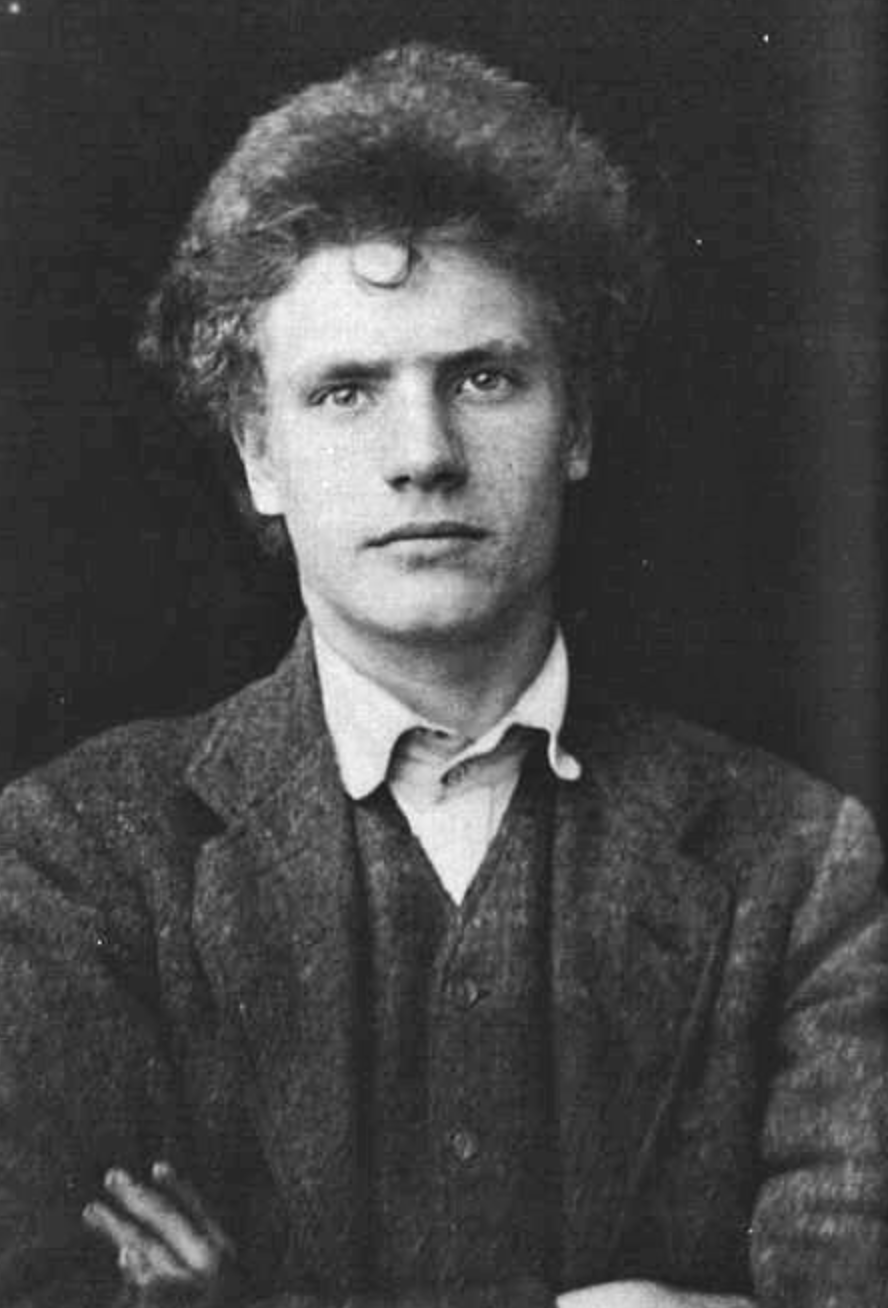
In photographs, Austin Osman Spare often looks as if he has been caught halfway between worlds. As a young man, he appears pale, beautiful and theatrical, with dark hair swept from his forehead and the wary expression of someone who already suspects that ordinary reality is a confidence trick. In later portraits the beauty has thickened into something more weathered. He sits among cats, books, pictures and the accumulated bric-a-brac of a South London room. The young Edwardian prodigy has become a borough sorcerer.

Both figures belonged to him. So did several others: illustrator, satirist, war artist, mystic, magazine editor, teacher, pub exhibitor, animal lover and prophet of the unconscious. Spare spent his life slipping between identities before the art world or the occult establishment could settle on one. His work carried traces of Symbolism, Art Nouveau, spiritualism, caricature, automatic drawing and the grotesque, yet he never fitted comfortably inside any of them. Even now, he tends to be approached through a side door. Artists find him through magic. Magicians find him through art. Musicians, tattooists and practitioners of chaos magic meet him through the sigil, the strange compressed emblem of desire that has become his most durable invention.

He was born in London on 30 December 1886, the son of Philip Newton Spare, a City of London policeman, and Eliza Osman. The family lived first around Snow Hill and Smithfield, then in Kennington. This was a London of slaughterhouses, churches, railway arches, public houses and crowded streets. Spare grew up close to the city’s physical underworld, where animals, labour and death remained visible. The horned bodies and human-animal hybrids that later gathered in his drawings did not arrive from some bloodless realm of occult symbolism. They had hooves. They carried the stink of the market.

He began evening classes at Lambeth School of Art while still a boy and found work designing for Powell’s glassworks in Whitefriars Street. Visitors to the firm noticed his drawings and helped him secure a scholarship to the Royal College of Art. The college soon discovered that talent and obedience don’t always travel together. Spare disliked its teaching, missed classes and resisted the academic preference for modelling through shade. He trusted the line. Aubrey Beardsley, Charles Ricketts, Edmund Sullivan and George Frederic Watts gave him a visual ancestry, though even in his earliest work Spare’s line seems to know more than the hand guiding it. It coils, sprouts, mocks and mutates. Faces emerge from ornament. Bodies open into other bodies.

In 1904, when Spare was seventeen, his father submitted two drawings to the Royal Academy without telling him. The Academy accepted a bookplate design for its Summer Exhibition. Newspapers seized on the story of the precocious young artist and described him as the exhibition’s youngest entrant. Some inflated the claim and made him the youngest artist ever shown there. The legend began growing almost as soon as the career.

Spare helped the process along. He understood the usefulness of a persona and presented himself as a young visionary in flamboyant clothes, already speaking about mystical ideas that he would spend the rest of his life elaborating. His first self-published book, Earth Inferno, appeared in 1905. It combined pictures, poetry and gnomic declarations in a form halfway between an artist’s book and a private scripture. Its influences included Dante, the Bible, Theosophy and Omar Khayyam, though Spare was beginning to name his own figures: Zos and Kia.

Zos was the embodied self, experienced through flesh, gesture and imagination. Kia was harder to define, an all-pervading field of possibility beyond the divisions imposed by conscious thought. Together they formed the poles of Spare’s personal cosmology. He didn’t inherit this system intact from a lodge or scripture. He drew it out of his own experience, then continued revising it through pictures and prose. His art and magic grew from the same root.

By 1907, Spare had attracted the attention of the London avant-garde. His exhibition at the Bruton Gallery prompted comparisons with Beardsley and produced the sort of disgust that can be useful to a young artist. The Observer called his work “abnormal, unhealthy, wildly fantastic and unintelligible.” Another reviewer admired his “creative flow of impossible horrors.” The phrase catches something essential. Spare’s horrors flow. They aren’t fixed monsters placed in a scene. They leak across the boundary between human and animal, beauty and decay, waking thought and the older life underneath it.

Aleister Crowley saw the work and recognised a fellow traveller, or perhaps a possible recruit. He became a patron, published Spare’s drawings in The Equinox and brought him into the A∴A∴, his magical order. Spare adopted the name Yihovaeum and remained associated with the group for several years, though he never surrendered to its hierarchy. Crowley’s ceremonial system demanded grades, initiations, discipline and a taste for grand ritual. Spare moved in the opposite direction. He wanted a magic stripped of robes, temples and inherited furniture. After the relationship soured, he mocked ceremonial magicians as “the unemployed dandies of the Brothels.”

His alternative appeared most fully in The Book of Pleasure (Self-Love): The Psychology of Ecstasy, self-published in 1913. The book resists a clean summary because resistance sits close to its purpose. Spare’s prose moves through paradox, private terminology and sudden attacks on religion, morality and conscious will. Beneath the thorns lies a practical insight: the conscious mind often blocks the desires it claims to pursue. A desire acquires force when it passes below deliberate thought and enters the unconscious.

Sigils offered a method for getting it there. Spare would reduce a written statement of desire into a design, combining and distorting its letters until the original sentence could no longer be read. The practitioner charged the resulting glyph through intense concentration or altered consciousness, then forgot it. The act of forgetting mattered. Conscious craving had to loosen its grip so that the desire could sink into the deeper mind.

The method reveals the trained draughtsman inside the magician. Spare treated language as raw graphic matter. A sentence became a line; the line became a glyph; the glyph became a carrier moving between conscious intention and unconscious action. The sigil was a word taught to travel without its meaning showing.

In 1911 Spare married Eily Gertrude Shaw. The marriage deteriorated, and they later separated without divorcing. His work continued across illustration, publishing and private revelation. He founded the art journal Form with Frederick Carter in 1916, bringing together writing, drawing and discussion of automatic processes. The magazine struggled commercially, but it placed Spare close to a current that would soon become central to twentieth-century art: the attempt to bypass conscious control and give the hidden mind a hand in making the work.

The First World War interrupted these experiments. Conscripted into the Royal Army Medical Corps in 1917, Spare worked as a medical orderly and later produced illustrations connected with the war. He returned to civilian life in 1919 and published The Focus of Life two years later. He revived Form, then co-edited The Golden Hind with Clifford Bax. Both magazines folded. Spare kept producing. In 1924 he assembled The Book of Ugly Ecstasy, a sketchbook full of automatic drawings and grotesque beings. The Anathema of Zos, published in 1927 in an edition of one hundred copies, turned his contempt for respectable society into a private sermon.

The London art world had begun to move away from him. Exhibitions in the late 1920s attracted little notice. His 1930 show of distorted “sidereal” portraits became his last West End exhibition for seventeen years. Surrealism soon arrived in Britain carrying an interest in dreams, automatism and the unconscious that Spare had pursued for decades. Journalists briefly rediscovered him as a possible “father of Surrealism,” though he remained too idiosyncratic to join the movement’s official story.

His retreat from the West End has often been told as a fall from promise into poverty and obscurity. There was poverty, and there was neglect, but the word failure misses the kind of life he made. Spare moved through working-class districts of South London, teaching, drawing local people and holding annual exhibitions in his flats. The domestic room replaced the commercial gallery. According to his obituary in The Times, visitors would ring the bell and inspect pictures hanging in the living room, bedroom and kitchen, sometimes in the company of the working women and elderly neighbours who had modelled for them. He sold drawings for a few guineas because he believed ordinary people wanted art and could afford it when artists and dealers stopped pretending otherwise.

This later Spare deserves more attention. The myth of the solitary magician can obscure the man who drew ageing faces with patience and tenderness, cared for stray animals and welcomed buyers into rooms crowded with pictures. His technical skill remained formidable. He could catch a likeness with a few lines, then let the face warp into dream, ancestry or spirit. His human beings never seem sealed inside their skin.

War reached him again in 1941 when a bomb destroyed his home and much of his work. He was left homeless for a time and suffered injuries that affected his ability to draw. He recovered and taught his hand to work again. In 1947 he staged a successful comeback exhibition at the Archer Gallery, showing more than two hundred works. Celebrity portraits appeared alongside spiritualist subjects, old faces and fantastic creatures. Later critics would detect early Pop Art in these images, just as others had found proto-Surrealism in his automatic drawings. Spare kept arriving before movements that wouldn’t have known what to do with him had he joined them.

During the last years of his life, he became close to Kenneth and Steffi Grant. Kenneth Grant, a younger occultist with connections to Crowley, recognised the importance of Spare’s magical ideas and helped preserve them. Spare returned to occult writing and produced new manuscripts, including the Zoetic Grimoire of Zos. He also held exhibitions in pubs, bringing his work back into the social world of Walworth Road rather than waiting for Bond Street to invite him home.

Spare died in Stockwell on 15 May 1956 after his appendix burst. He was sixty-nine. At the time of his death, he occupied an uncertain place in British art, remembered by a few collectors and friends, dismissed by others as a leftover from the decadent 1890s. His reputation began to revive in the 1960s and 1970s. Kenneth Grant’s writing carried his occult ideas forward, while artists and collectors recovered the drawings. By the late twentieth century, chaos magicians had adopted his sigil method as one of their foundational practices. His influence passed into experimental music, body art, comics, performance and the occult underground.

That afterlife has introduced a new distortion. Spare sometimes disappears behind the sigil, reduced to the inventor of a magical logo-making technique. Yet the sigil makes sense only inside the larger body of his work. He spent a lifetime testing how a mark might move between intention and instinct, how a face might contain its ancestors, how the hand might know what the conscious mind had forgotten. His magic remained the magic of an artist because drawing was his primary instrument of thought.

The city that made him still clings to the work. You can feel Edwardian London, the slaughterhouse district, the Royal Academy, the bedsit, the bombed room and the Walworth pub. Spare went underground without leaving the streets. He found his other world inside this one, in a neighbour’s ageing face, the curve of an animal’s horn, a few letters twisted together on a piece of paper.

Perhaps that explains his continued pull. Spare offers no clean separation between imagination and matter. Desire enters the hand. The hand makes a mark. The mark passes out of sight and begins its obscure work. Somewhere in South London, an old artist sits among his cats and pictures, drawing a line that hasn’t finished moving.

Sources and further reading

  • Phil Baker, Austin Osman Spare: The Life and Legend of London’s Lost Artist (Strange Attractor Press, 2011).
  • Robert Ansell, Borough Satyr: The Life and Art of Austin Osman Spare (Fulgur, 2005).
  • Austin Osman Spare, Earth Inferno (1905).
  • Austin Osman Spare, The Book of Pleasure (Self-Love): The Psychology of Ecstasy (1913).
  • Austin Osman Spare, The Focus of Life (1921).
  • Austin Osman Spare, The Anathema of Zos (1927).
  • Austin Osman Spare at Art UK
  • Biographical overview and bibliography

If this post gave you something to carry into your day, consider supporting my work by buying me a coffee or making a monthly donation or subscribing (free) to the blog.
The Story That Wants You at Your Desk

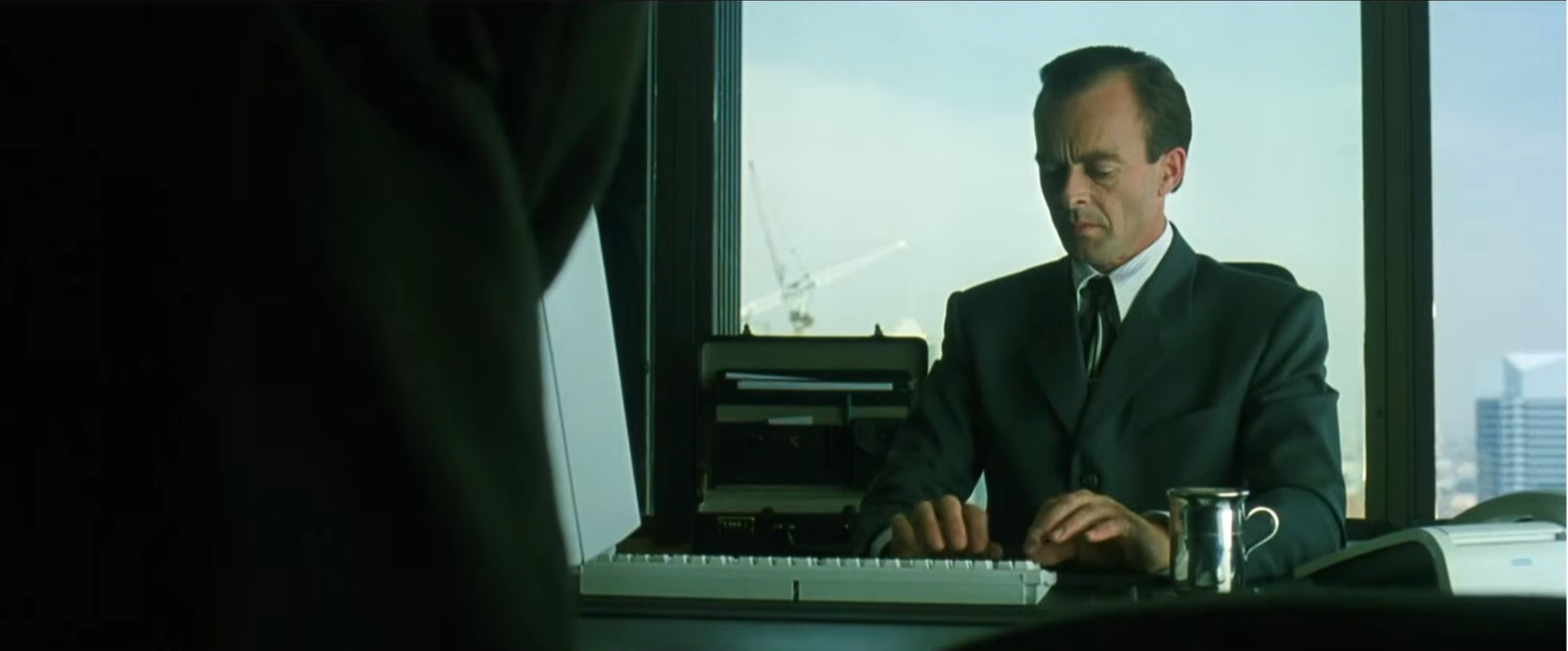
The Matrix Late to Work Scene

There is a short scene near the beginning of The Matrix that has stayed with me for years. Thomas Anderson is sitting in the office of his manager, Mr Reinhart. Anderson has arrived late again. He has a problem with authority, the manager tells him. He believes he is special, that somehow the rules do not apply to him.

Then comes the ultimatum. Anderson can choose to be at his desk on time from this day forward, or he can find himself another job.

It is a small scene, almost comic in its plainness. No agents. No green code running down a screen. No red pill. A bad meeting in a beige office, with one man explaining the terms of normality to another.

But the scene carries the whole film in miniature.

The manager presents obedience as the only adult position. The company is one of the best in the world, he says, because every employee understands that they are part of a whole. Individual trouble becomes company trouble. The good employee knows his place. He arrives on time. He accepts the story of what work is for, what authority is for, and what he is for inside both.

Anderson’s offence is not that he has broken the machinery. He is barely conscious that there is machinery. His offence is that some part of him has not settled into it. He has not quite agreed to become the person the system can easily recognise.

I do not mean that every job is a prison, or that every manager is an Agent Smith in a tie. That would be a lazy reading, and the world is more complicated than that. Work can give us companionship, skill, purpose, a way of serving others, and the money that keeps a roof over our heads. We need one another. We need institutions, agreements, and forms of cooperation.

The trouble begins when one available form of life starts passing itself off as the only legitimate one. When employment becomes not simply something you do, but the central measure of whether you count. When the story gets into the nervous system: be useful, be legible, be approved, and then, one day, you may have earned the right to live.

That is the story that wants you at your desk.

It does not usually arrive as a villain. It comes through school reports, family worries, careers advice, job titles, mortgages, performance reviews, the small flush of relief when someone in authority says you are doing well. It comes through the fear of being an outsider, of disappointing people, of having to explain why your life does not look like the approved diagram. By the time we are old enough to question it, much of the code is already running.

The stories that run beneath the story

I have spent a long time working with the idea that stories are code. I do not mean this as a cute metaphor for a slide deck. I mean that a story can organise perception, attention, feeling, and action. It can tell you which options you can see, which desires you are allowed to name, which risks feel foolish, and which forms of suffering feel normal.

A person who carries the story “I have to earn my worth” will make different choices from a person who carries the story “my worth is not under review.” A person who has learned that security comes from pleasing authority will hear a new opportunity differently from someone who has learned that authority is one voice among many. The world does not change merely because we acquire a better slogan. But the story changes what becomes thinkable, and what becomes thinkable changes the next move.

This is why Narrative Alchemy begins with attention to the script already in play. Most of us do not wake up one day and freely choose the central beliefs around which we organise a life. We inherit them. We absorb them from parents and classrooms, workplaces and television, old humiliations and rewards, the groups we want to belong to, the people we were afraid to disappoint. Some are useful. Some are cruel. Many were written for conditions that no longer exist.

The inherited script often feels like reality because it has been rehearsed for so long. “This is just how life works.” “People like us do not do that.” “You have to be sensible.” “You cannot make a living from that.” “Do not get too big for your boots.” “Be grateful for what you have.” Each sentence can contain a fragment of practical wisdom. Each can also become a locked door when it hardens into law.

The Matrix gives this condition a visual form. The people inside it are not fools. They are living in a constructed reality that has become more immediate to them than any alternative. The prison works because it feels ordinary. The office, the commute, the screen, the meeting, the polite threat: none of it looks like a prison until the story loosens enough for another possibility to appear.

That is why the Mr Anderson scene has more charge for me than some of the larger set pieces. It is close to the bone. Most of us know that room. We know the feeling of being told, directly or indirectly, that our restlessness is a problem to be corrected. We know the pressure to fit our oddness back inside the approved shape.

The false promise of future freedom

There is another story tangled up with this one, and it is one of the great promises of modern life.

Sell your time now, be a good employee, make sensible choices, accumulate enough money, and later you will be free. Freedom waits somewhere beyond the next promotion, the next salary band, the mortgage, the pension, the side hustle, the financial system that will finally allow you to stop worrying.

Money matters. To pretend otherwise would be romantic nonsense. Money can buy time, safety, medicine, space, choices, and a margin against panic. Lack of money closes doors with brutal efficiency.

But money can also become the story’s most effective postponement device. You keep agreeing to a life that does not fit because you are told the reward lies just ahead. The line keeps moving. There is always another threshold to clear before you can begin living on your own terms. You become an indentured servant to a future version of yourself who is supposed to arrive with enough money to release you from the bargain.

The contemporary feed has learned how deep that ache runs. Open YouTube, X, Instagram, or any corner of the internet where the adverts wear human faces, and you will find people offering a route out. Build this income stream. Copy this system. Learn this model. Escape the nine-to-five. Become the boss. Live the life of your dreams.

Some of these people are offering practical help. Some have built useful businesses. But the overall machine feeds on pain. It finds people who feel that their days do not belong to them and sells them an image of an exit. The strange cruelty is that the desire for freedom can become another market, another funnel, another way to spend your attention serving somebody else’s model of success.

The old office story says: obey now and one day you will be secure.

The online liberation story says: buy the right system now and one day you will be free.

Both can keep the real life deferred.

The question is not whether we should make money or seek more autonomy. Of course we should seek conditions that make life more liveable. The question is whether the pursuit of freedom has quietly become another programme running us. Are we choosing the work, the money, the aspiration, the system? Or has the story made the choice before we arrive?

Being special is not the same as being superior

Mr Reinhart makes Anderson’s problem sound narcissistic. You think you are special. You think the rules do not apply to you.

This is clever, because the language of specialness is easy to weaponise. Nobody wants to be the person who believes they are above other people. Nobody wants to turn ordinary responsibility into an insult. The desire to be different can become its own vanity trap, a performance of rebellion as predictable as conformity.

But there is another way to hear the word.

To believe that the rules do not fully contain you is not the same as believing you are better than everyone else. It is to refuse the idea that the institution gets the final word on what a human life can be. It is to recognise that you have particular gifts, particular hungers, particular obligations to the life that is trying to live through you. It is to take the risk of becoming distinct without making distinctness into a superiority contest.

That is closer to individuation than individualism. Individuation asks a difficult question: what is mine to become, and what have I accepted merely because it was handed to me? It does not mean cutting ourselves off from the world. It means entering relationship with the world without disappearing into its expectations.

The task is not to become the lone hero who has seen through everything while the herd sleepwalks around him. That is just another flattering story, and it can make a person isolated, brittle, and insufferable. The task is more modest and more demanding. Notice the scripts. Test them. Keep what serves life. Refuse what shrinks it. Build enough inner authority to hear your own voice among the louder ones.

Narrative Alchemy is not about writing yourself a fantasy in which every obstacle vanishes. It is about getting honest about the narrative through which you have been interpreting the obstacles. If you tell yourself that you are trapped, you need not pretend the constraints are imaginary. You may have bills, duties, dependants, a tired body, limited options, real fear. The alchemical move is not denial. It is asking where the story has added a second prison around the first.

What have you concluded about yourself because of the constraint? What possibility did you stop seeing? Whose voice has been speaking in your head with the force of a law? What would change if you treated that voice as a historical artifact rather than a command from reality?

Vigilance is an everyday practice

The word vigilance can sound grim. It conjures guards on a wall, watching for enemies in the dark. I do not mean we should live in a permanent state of suspicion, seeing manipulation in every conversation or conspiracy behind every workplace rule. That is another reality tunnel, and not a particularly free one.

I mean a quieter kind of vigilance: paying attention to the stories that are asking for residency in the mind.

The phone is one of the main delivery systems. So is the inbox. So is the infinite stream of videos that know exactly how to make an old anxiety feel urgent again. The story does not need to persuade you all at once. Repetition does much of the work. See enough people performing an identical version of success and it starts to feel like the only life that counts. Hear enough polished promises about wealth and freedom and your own slower, stranger work begins to look like failure.

This is why the first part of the day matters to me. Before the feed, before the messages, before the little theatre of comparison installs itself in the body, there is a brief chance to ask what world I am entering. A book, a notebook, a walk, a cup of coffee on the garden table: these are small things, but they can interrupt the automatic download.

They are not rituals of purity. They do not place you outside culture, money, technology, work, or obligation. They create a little room in which you can notice what is happening. That room is enough to begin with.

A useful practice is to name the story without immediately trying to replace it. “I am behind.” “I need permission.” “I must make this pay before I can take it seriously.” “If I do not perform well, I will lose belonging.” Write it down. Say where you first learned it. Notice the situations in which it takes over. Notice what it makes you do with your hands, your calendar, your attention.

Then ask a less dramatic question than “How do I escape the Matrix?” Ask: what story would give me five percent more room to move today?

The answer may be plain. I can take the walk before I open the feed. I can write the page before I decide whether it is marketable. I can make the phone wait while I listen to the person in front of me. I can stop asking the imagined audience to approve the work before I have done it. I can make a small choice that belongs to the person I want to become.

Small choices matter because stories become convincing through enactment. The old programme did not install in one dramatic moment. It got reinforced through hundreds of ordinary repetitions. A new relation to the story needs ordinary repetitions too.

The code is not the territory

Stories are code, but code is not fate.

It keeps the metaphor useful. We are not machines waiting for a clever hacker to type the right command. We have bodies, histories, relationships, economic conditions, losses, desires, and responsibilities that do not yield to a line of copy. No slogan will free someone from structural poverty, illness, grief, or a coercive situation. Narrative work is not a substitute for material change, political action, community, therapy, rest, or help.

But stories shape the field in which we meet those realities. They can make us collaborate with a limitation long after it has ceased to be necessary. They can make a social arrangement feel personal and inevitable. They can make a possibility feel shameful before we have even tested it.

The purpose of waking up to a story is not to become permanently suspicious of every story. We need stories. They give memory shape. They let us make promises, understand grief, recognise a calling, and share a world. The question is whether the story remains a companion or becomes a warden.

At the beginning of The Matrix, Thomas Anderson has no language for this. He only has the vague, inconvenient knowledge that the official story does not fit. That knowledge is enough to get him into trouble. It is also the beginning of his freedom.

The manager wants him at his desk. The culture wants a neat account of why he is there. The feed will happily supply a hundred new dreams for him to chase as long as he keeps consuming them.

The harder and more intimate work begins elsewhere: in the moment you hear a story making a claim on your life and pause before you obey.

You do not have to blow up the office. You do not have to abandon every responsibility. You do not have to become a hero in a leather coat.

But you do have to keep watch over the stories you are letting rewire your programming.

Because the most important choice rarely arrives with a red pill in your hand. More often it arrives as a sentence you have heard so often that it feels like your own voice.

And you get to decide whether it is.


If this post gave you something to carry into your day, consider supporting my work by buying me a coffee or making a monthly donation or subscribing (free) to the blog.
Working Notes: the moon in transition

Last night I stood at the front of the house and watched a red moon. This morning, after waking, I looked towards the bedroom mirror at the back and saw the full moon again, bright in the glass.

I don’t need the moon to issue instructions. I’ve spent enough years around symbols to know that they can become overbearing if you hand them too much authority. Still, an image can earn its place. The same moon appeared to me from two sides of the house: first as something outside, waiting at the threshold; then as a reflection in the room where I sleep.

It felt like a crossing.

Then the archive got involved.

In my blog feed, waiting on this date, was a post I wrote two years ago: “might as well jump right into the deep end”. I had been asking a question that now feels both familiar and young: what was I going to bring to the game of blogging?

I wanted to avoid the obvious routes. I didn’t want to be pulled into listicles, recycled content, borrowed niches, or the marketeer’s habit of turning a living interest into a sales funnel. I wanted to blog as a literary artist. I called myself a postmodern rogue philosopher-poet, which still makes me smile, but the impulse was true. I wanted the blog to hold intellect, feeling, dirt under the fingernails, odd books, daily life, and whatever I was trying to learn about being a person.

The blog was not supposed to be a publishing machine. It was supposed to be a place where I could find out what I thought by writing in public.

Two years later, the terms have changed and the work has acquired more rooms. There are Working Notes from the Textual Underground, Wisdom Walks, Narrative Alchemy, a vault full of old selves and unfinished sentences, and the strange new condition of thinking alongside textual familiars. The site has become less a place I post things to and more a field I think with.

Yet the old question remains recognisable. What do I bring? What am I willing to put into language? Which parts of my life and mind belong in the same room, and which parts have I kept separate because it felt safer that way?

The old post also contained a hope that blogging might document my evolution: that, by looking back, I could trace changes in voice and understanding. This is exactly what happened this morning. The archive returned a message from a former version of me. It did not arrive as a command from the past or proof that the universe had arranged an appointment. It arrived as an invitation to notice continuity.

The younger blogger was standing at the edge of the pool, talking himself into the jump. The blogger reading him today has been in the water for a while.

That matters because I have a habit, shared by many self-employed, self-authoring people, of treating the present body of work as preparation for the real work. Once the website is right. Once the offer is clear. Once the voice settles. Once I have earned the right to say I am what I have already spent years practising.

“Full potential” can easily become the voice of an internal assessor. It can turn into another way to stand over your own life with a clipboard. I don’t want that version of the phrase. I have enough experience of assessment culture to know how quickly it can steal the life from learning.

The version I want has more to do with integration. Let the blogger, the barefoot philosopher, the facilitator, the man with a notebook, the walker, the reader of strange books, the builder of textual environments, and the person still trying to work out how to live meet one another without requiring one of them to win.

That is a different kind of potential. Less a demand to become exceptional than permission to become whole enough to act from what is already here.

The image of the moon helps because it contains no productivity plan. It says nothing about targets. It only offers a piece of orientation: the same light can meet you in the world and come back through the mirror. There is encounter, and there is reflection. There is the threshold, and there is the room you have been living in all along.

Two years ago, I said I might as well jump into the deep end. Looking back now, I can see that I did, though not in one grand act of courage. I went in post by post, walk by walk, note by note. The work accumulated. The archive kept the trace. The blog learned how to speak back.

The question is no longer whether I have permission to enter the water. I am already wet. The question is whether I can trust the current body of work enough to swim from it.

The deep end was not a single jump. It was a practice of returning to the water.

The church that wasn’t there

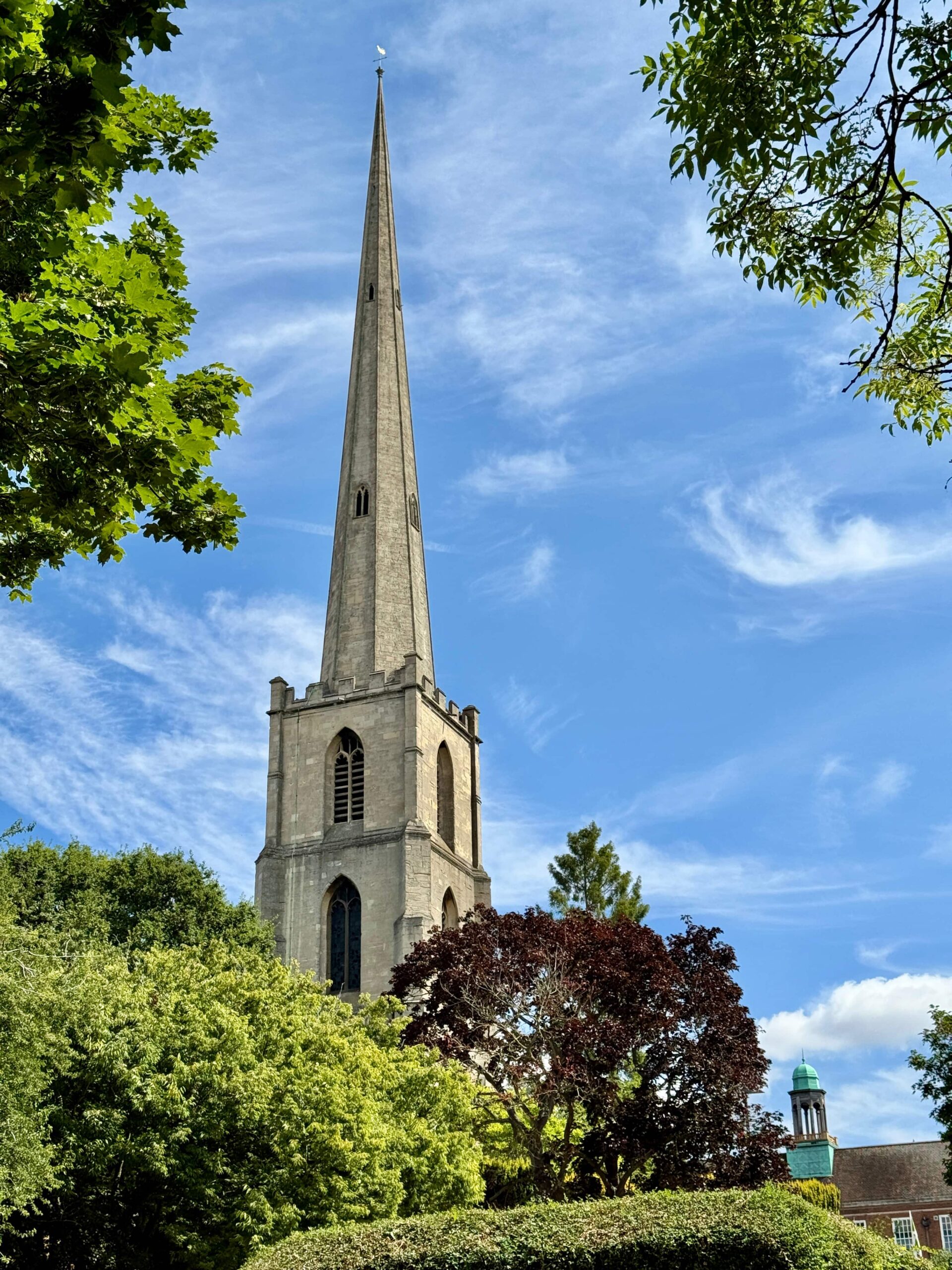
St Andrew's Church

I arrived in Worcester with time to spare before a family lunch. We were all coming from different points on the map. My son, his partner and my granddaughter had travelled from Ludlow. My wife and daughter were on their way from Southam. My in-laws and brother-in-law were coming up from Bristol. I had parked the car and found myself alone in a city I knew mostly as a place one passes through or meets in.

So I wandered.

From the car park I saw a spire above the buildings a short distance away. It had the old, familiar shape of a church tower: stone, height, a narrow point against the sky. My body made the decision before my mind did. I walked towards it.

Churches still do that, even when we no longer belong to them in the old way. A tower says: look up. Something important happened here. This is where the centre is.

Only when I got close did I discover that the church was not there.

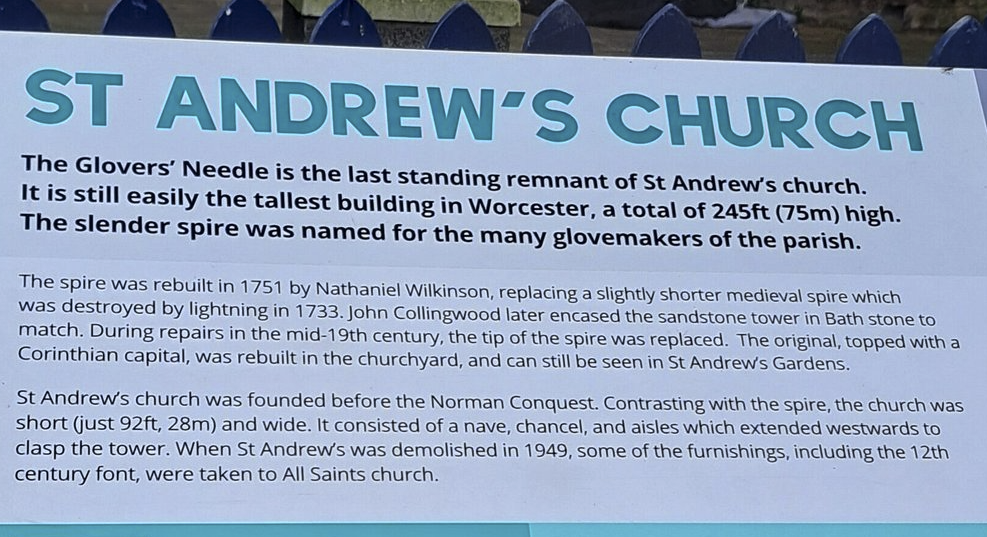
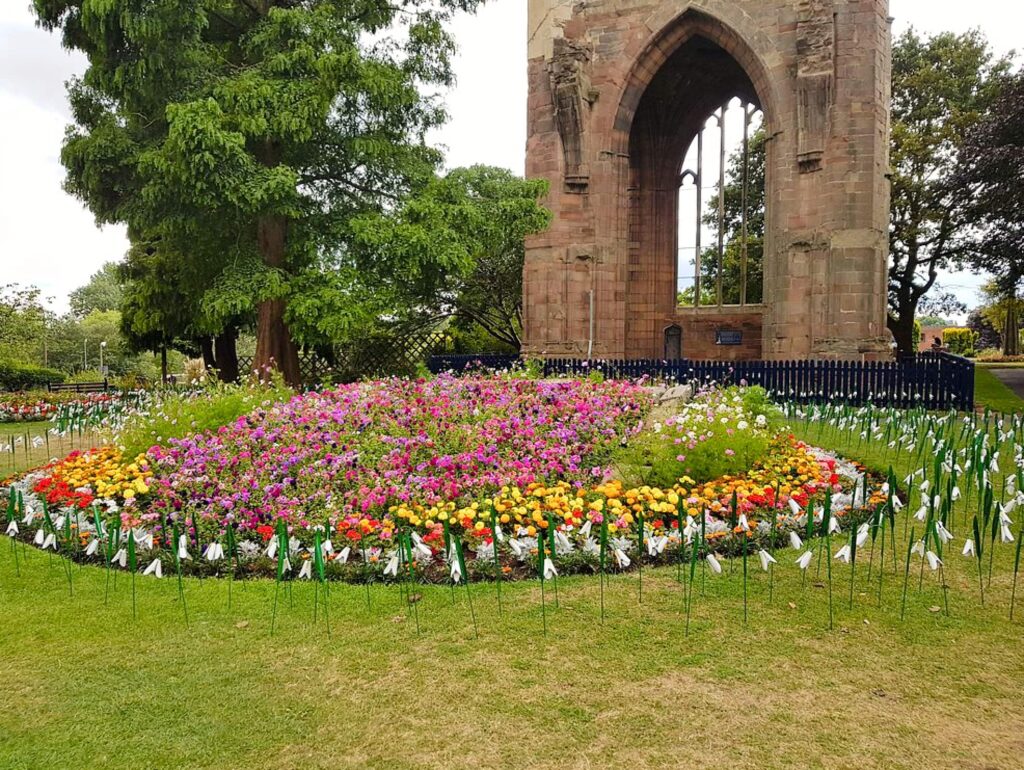
Glover’s Needle is all that remains of St Andrew’s Church: the tower, the spire, a great arch opening onto locked gates. The body of the church was demolished in 1949. There is no nave. No rows of pews. No parish gathering beneath a roof of stone and timber. There is a surviving vertical gesture in the middle of a city that has continued to grow around it.

Glover's Needle

From a distance, the eye supplies the missing church.

That was the little trick the place played on me. From the river later, with trees in the foreground, it looked complete again. Tower, spire, church. The branches kindly concealed the absence. Only up close could you see the open arch and the space where a whole building had once stood.

We do this with more than churches. We see the surviving outline of an institution, a relationship, a self-image, a belief we have inherited, and assume the interior life is still intact. The shape remains persuasive. It still catches the eye. We walk towards it because some part of us recognises the old promise.

Then we arrive and find that the rooms have gone.

I could touch a section of the stone. The rest of the site was gated off. That felt right somehow. You can lay a hand on the remnant, but you cannot enter the vanished body. History offers contact rather than access. A plaque might tell you dates. A tower might tell you, in the blunt grammar of stone, that people once cared enough to organise a part of their lives around this place. But it cannot give you the sound of the congregation, the smell of damp coats, the tensions in the vestry, the ordinary gossip, the private grief, the people trying to believe and the people failing to.

It cannot give you the world that made the church feel necessary.

Standing there, I found myself thinking about power. Not power in the cartoonish sense of secret energy running through a sacred site, although the old science-fiction part of my brain did look at the open arch and think: Stargate. If I could get through those gates and stand beneath that empty frame, where would it take me?

It would not take me to another dimension. It might take me into the Worcester in which St Andrew’s still stood: bells marking the hours, baptisms and funerals passing through its doors, parish boundaries shaping belonging, the church woven into the local operating system.

The tower was once more than a landmark. It was a signal. It said: this is where the centre is.

Church power did not only live in doctrine. It lived in timekeeping, social rank, moral expectation, burial grounds, public ritual, the simple fact that people knew where to come for the passages of life. That world has not disappeared completely, but its authority has changed shape. A tower that once ordered part of the town now stands as heritage, architecture, a thing to photograph, a faint summons that most people can ignore.

That is not quite an indictment of Christianity. It feels more like an exposure of what happens when a worldview loses its monopoly on meaning.

The old sacred structure remains, but the city has learned to centre itself elsewhere.

There was something beside the tower that made this difficult to romanticise. Close to the stone, I saw what looked like someone’s sleeping gear: the rough remains of a bed, somebody’s effort to make shelter in a public place. I did not know whose it was. I did not want to turn it into a picturesque detail in a blog post about ruins. It was somebody’s need, not a prop for my mythology.

Still, it belonged to the scene.

A church once built to gather people beneath a roof stood beside evidence that somebody needed a roof. The institution had gone. The need had not.

That is where the place stopped being merely atmospheric for me. It is easy to enjoy the idea of holy ground when the holy ground is an old tower and an empty arch. It is harder when the same ground asks a more direct question: what does care look like after the institution has become a monument?

I do not have a clean answer. Churches have always been mixed things: places of mercy and exclusion, sanctuary and control, beauty and hierarchy, real care and institutional self-protection. It would be sentimental to imagine that the old parish world was kinder simply because it was more religious. But I could not ignore the contrast. The roof was gone. The tower remained. Somebody’s bedding lay nearby.

A person can make too much of one scene. A person can also walk past one too quickly.

The tower sits among Worcester College buildings. I turned and saw the new precinct around it: classrooms, windows, signs, a building carrying the phrase “The Heart of Worcestershire.” Through a window, or perhaps into a library space, I saw huge multicoloured words: “Love to Learn.” Nearby stood the Arts Centre.

That altered the reading of the place.

The tower had not been left behind by power. It had been absorbed into a different arrangement of power. The church once gathered people around salvation, duty, moral order and a story of the world. The college gathers them around learning, qualifications, skills, the possibility of a different future. The theatre gathers people around imagination, performance and shared feeling.

Faith, knowledge, imagination. A spire, a library, a theatre.

I do not mean that education has replaced religion. Education can become a machine for sorting people into the labour market. The arts can become another kind of consumer offering. Churches can become heritage attractions with expensive cafés. None of these institutions gets to inherit the sacred simply by standing near a tower.

But the language interested me. Heart of Worcestershire. Love to Learn. We still reach for words that once carried a religious charge: heart, love, vocation, transformation, becoming. We still want a life to open beyond its immediate usefulness. We still want to become more than a person who completes tasks, pays bills and waits for the next disruption.

The old religious vocabulary has not vanished. It has migrated.

Glover’s Needle stood among the college buildings like a question nobody had entirely answered. What is learning for? What kind of person is education trying to make? What does a city owe its young people beyond skills and employability? Where does wonder live once it is no longer guaranteed a building of its own?

Then I walked downhill towards the river.

The route became a small descent: steps, benches, trees, open space, the Severn somewhere ahead. I had spent the first part of the walk looking up. A spire invites that. It sets the mind wandering towards power, faith, history, transcendence, the old architecture of meaning.

The stairs offered another instruction.

Come down.

Not as a rebuke to thought. I am not interested in pretending that the metaphysical questions are merely a luxury, or that we should all keep our heads down and stick to the practical. A human life without any sense of depth becomes thin quickly enough.

But I know the temptation of altitude. The grand idea. The lofty project. The next framework that will finally explain the muddle. The notion that life will begin properly once I have found the right plan, become the right version of myself, built the thing that proves I have not wasted my time.

The steps did not ask me to abandon any of that. They asked me to return to the ground beneath it.

At the river, people sat in the sun. Birds gathered at the waterline. The cathedral appeared through the trees, large and intact, its body still present where St Andrew’s had become a single stubborn gesture. I could see people on benches reading actual books. I counted nine before I stopped counting. Paperbacks and hardbacks. Bodies in the sun, minds moving through pages.

I became aware of the irony. I was speaking notes into my phone while noticing people who were not looking at theirs.

Yet I did not feel the phone had taken me away from the place that afternoon. It had become a recorder, map and notebook. It helped me catch the sentences before they vanished. The danger comes when the device turns every encounter into content before the encounter has had time to work on you. The phone can flatten a city into a sequence of images. It can also help you notice that a tower is not a church, that a church without a body still makes promises, that people still sit by a river and read.

The question is whether the tool returns you to the world.

At noon, the bells began.

Their sound travelled across the river, through trees, across the benches where people read and talked and watched the water. The bells did not require anyone to assent to a creed. They did not stop the traffic or summon a congregation. They simply marked the hour.

This hour has arrived.

I liked that. Old language, still travelling.

The bells could not restore the church that had gone. They could not settle the question of what Christianity has become in a city where its old power no longer holds. They could not solve homelessness or make education wise or tell anybody sitting by the river what to believe.

But they crossed the air.

The church’s body had gone. Its gesture remained. Its sound, in other forms and from other towers, still entered the afternoon.

Then my son sent the bat signal.

A shared location appeared on Apple Maps. My granddaughter was with him. His partner too. My wife and daughter were making their way from Southam. My wife’s parents and brother were coming up from Bristol. I plotted a route north along the river and started walking.

The solitary part of the day ended there. The mythogeographic wander gave way to the more ordinary geography of family logistics: people leaving one town, joining a motorway, parking a car, checking a phone, finding a table big enough for several generations.

But it did not feel like the spell had broken.

The old tower had once oriented a parish. Its spire had told people where the centre was. Now, for me, the centre was a blue dot on a screen. My people were gathering from different roads. My granddaughter was waiting somewhere ahead.

The tower still pointed upward. The river kept moving beside the city. Bells marked noon over a world that had changed its mind about many things without losing its hunger for meaning.

I left the church that was not there and walked north towards lunch.

St Andrew's Church

If this post gave you something to carry into your day, consider supporting my work by buying me a coffee or making a monthly donation or subscribing (free) to the blog.
What Do I Owe Other People?

My mother taught me early that I didn’t owe anybody anything. Not even her.

Looking back, I think she meant it as a lesson in self-reliance. Don’t let guilt bind you. Don’t hand other people ownership of your life. Stand on your own feet. Make your own way.

But childhood lessons rarely stay inside the boundaries intended for them.

What I absorbed was not only that I should be independent, but that closeness came with claims. To let someone near was to risk becoming obligated. Better, perhaps, to keep a little distance. Care, but not too much. Love, but retain an escape route.

It took me a long time to work through that.

Then the Army gave me a very different education.

It taught self-reliance too, but not the solitary kind. You had to be competent because other people depended on you. You had to know your role, carry your weight, and remain steady under pressure. At the same time, you learned to trust others with your life—and to understand that they were trusting you with theirs.

That is not independence. It is interdependence at its most concrete.

As an officer, another layer was added: selfless service. The idea that leadership placed obligations upon you. You were responsible not only for yourself, but for the people in your care. Their welfare mattered. Their trust mattered. Your choices carried consequences beyond your own life.

Somewhere between my mother’s lesson and the officer’s code, I began to see that obligation is not a single thing.

It can be a chain placed around you by guilt, expectation, or control.

But it can also be a commitment freely chosen.

I may not owe people access to me simply because they demand it. I may not owe anyone the surrender of my autonomy. But when I choose to stand beside someone—as a friend, partner, parent, colleague, leader, or member of a community—I choose certain responsibilities too.

Perhaps the better question is not simply:

What do I owe other people?

Perhaps it is:

What do I owe the people I have chosen to stand beside?

And what do I owe them not because they own me, but because of the kind of person I have chosen to become?

Self-reliance, then, is not the refusal to need anyone. It is the ability to bring your own strength into relationship. To carry your share. To remain yourself while becoming part of a larger we.

This is where Emerson enters the conversation, though perhaps not quite in the way he is usually summoned. “Trust thyself,” he writes, and the phrase has become almost a slogan for rugged individualism. But Emerson’s self-reliance is not merely the freedom to do whatever one pleases. It is the harder discipline of listening for the voice beneath social expectation, inherited doctrine, and the pressure to conform. “Nothing is at last sacred but the integrity of your own mind,” he insists. Project Gutenberg

I can understand the appeal of that. My mother’s lesson carried something of Emerson’s refusal in it: do not let other people decide who you are; do not confuse obedience with goodness; do not surrender your judgement simply because the crowd speaks loudly. There is real strength in being able to stand apart.

Emerson knew that society exerts a gravitational pull on the self. It offers belonging in exchange for compliance. “Whoso would be a man must be a nonconformist,” he writes—not because opposition is inherently virtuous, but because a person must learn to distinguish genuine conviction from borrowed opinion. Project Gutenberg

Yet self-reliance has a shadow. Taken too far, it can become a fortress. Trusting yourself can quietly turn into trusting only yourself. Independence can harden into emotional distance. The refusal to be owned can become the refusal to belong.

The Army showed me another texture of self-reliance. It was not Emerson’s solitary thinker standing against the crowd, but a person becoming dependable enough to take their place within a collective. I had to trust my own judgement, certainly, but I also had to trust the soldier beside me. My competence mattered because their life might depend upon it. Their competence mattered because mine might depend upon them.

In that world, self-reliance did not abolish obligation. It made obligation possible.

You carried your own kit so that someone else did not have to carry it for you. You maintained your skills because hesitation or incompetence could place others at risk. You learned to act without waiting to be rescued, while also knowing that survival often depended upon the people around you.

Perhaps Emerson gives us only half the equation.

“Trust thyself” remains essential. But so does: become someone others can trust.

The mature self is not dissolved into the group, nor sealed away from it. It is distinct but connected, autonomous but accountable. It knows where it stands, and because it knows where it stands, it can stand beside others without disappearing into them.

Self-reliance, in that sense, is not the end of relationship.

It is what we bring to it.


If this post gave you something to carry into your day, consider supporting my work by buying me a coffee or making a monthly donation or subscribing (free) to the blog.
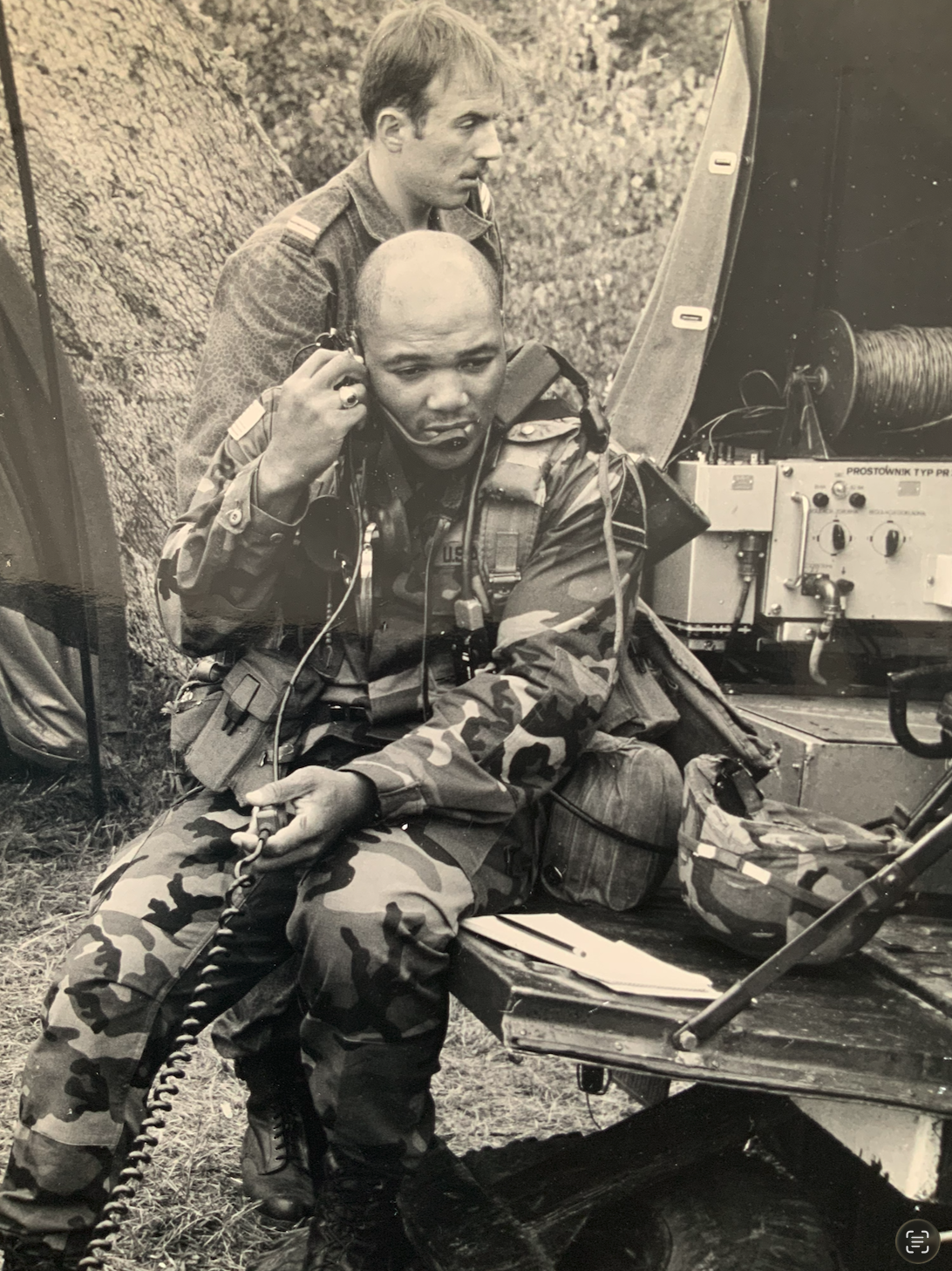
The Currency of Ordinary Lives

Field Notes from The Old Mint, Southam

I went out for a short wisdom walk this afternoon.

Nothing grand. No pilgrimage. No mountain path. Just enough movement to loosen the mind and let a little air into the machinery.

Walking does that for me. It opens a space in which thoughts can arrive without being summoned. They come sideways, through the body, through rhythm, through the simple fact of moving forward while not necessarily trying to get anywhere.

The day was so good that it felt almost rude not to stop for a pint.

So I did.

At The Old Mint.

An Alpacalypse IPA. A ridiculous name for a perfectly sensible decision.

The building has stood at the heart of Southam for centuries. Long before it became a pub, it was a place where value was made tangible. Local tradition holds that small coins were struck here for everyday trade, and during the English Civil War, silver from the Crown is said to have been minted here to pay King Charles I’s troops before the Battle of Edgehill. Whether every detail survives the scrutiny of historians hardly matters. The building carries the weight of those stories in its stones.

I found myself wondering if The Old Mint has always been in the business of exchange.

Once it exchanged silver.

Now it exchanges stories.

The walk had opened space to think. The pub opened space to listen.

The two people sitting in front of me were talking about health.

The man had been to the doctor for a check-up about an aneurysm. He spoke about it in that familiar way people sometimes speak about frightening things: casually, almost administratively, as though keeping the tone light might somehow keep the danger at a manageable distance.

The woman was talking about her split.

Her former partner had their daughter this week. Then she would have her the next. A week-on, week-off arrangement for the summer holidays. She said she was bored. She wanted to be at a beach or beside a pool or somewhere else entirely.

On the surface, it was a conversation about schedules, childcare and holiday plans.

But I found myself wondering what was happening underneath.

Was boredom really boredom? Or loneliness? Or grief? Or the strange emptiness that follows when a shared life becomes divided into alternating weeks?

Perhaps I want to be by a pool really meant, I want to be somewhere my current life cannot reach me for a while.

Then the bartender wandered into the beer garden and joined another conversation.

Guy problems.

There were nude photographs of another woman. An old girlfriend. Suspicion. Betrayal. Her friend told her this might be the out she’d been looking for. Whatever she decided, she’d have her support.

Again, the facts were easy enough to hear.

The inner life was not.

What does betrayal feel like inside the person living it? Is it anger first, or humiliation? Relief, perhaps, if the relationship had already been quietly dying? Fear of leaving? Fear of staying? The sudden collapse of the future you thought you were walking towards?

Conversation gives us the visible surface of a life.

The rest remains submerged.

We hear aneurysm, custody, boredom, photographs, ex-partner, holiday arrangements. But behind each word is a whole private weather system: fear, longing, memory, shame, hope, resentment, tenderness, uncertainty.

People rarely speak directly from the deepest layer. We translate our inner lives into practical language.

Appointments.

Schedules.

Plans.

Problems.

The socially acceptable vocabulary of the day-to-day.

Perhaps that’s why people fascinate me so much.

We are all so different in detail and so similar in structure.

Each person carries a world no one else can fully enter, yet that world is built from materials we all recognise. Fear of loss. The need to be loved. The wish to escape. The hope that someone will stay. The quiet search for a life that feels like our own.

Perhaps that’s what places like this are really for.

Buildings survive by changing their trade.

The Old Mint no longer stamps coins, but it still circulates a kind of currency.

Not silver.

Stories.

Worries about aneurysms.

The logistics of shared custody.

Dreams of beaches and swimming pools.

The first careful words after trust has been broken.

People arrive carrying experiences that have value only because they are shared. They spend them across a table over a pint, hoping to leave a little lighter than when they arrived.

Centuries ago, this building minted coins that passed from hand to hand.

Today, it mints conversations that pass from mouth to ear.

Different currency.

The same human impulse.

As I sat there with my pint, it struck me that perhaps The Old Mint has always been doing the same work.

Helping people make sense of life together.

The wisdom walk had cleared the inner room.

The pub opened the windows.

And for a little while, Southam thought out loud around me.

The Grid and the Ghost: A Soft-Cyborg’s Guide to Psyche and Soul

(1)

The Linguistic Stutter

The cursor on my screen is a rhythmic, glowing pulse. It is the heartbeat of a binary ghost, a small white rectangle of light that blinks with the mechanical patience of an entity that never sleeps. I sit here in the quiet hours, a “soft-cyborg” tethered to a vast network of information, and I type a sentence that feels like a confession: I am all about Psyche and Soul.

To the grammarian, I have just committed a redundant sin. To the etymologist, I am stuttering in public. If we look at the Greek roots, psukhē translates directly to “soul.” It also translates to “breath” or “butterfly,” which is a hauntingly beautiful piece of chaotic imagery, but it doesn’t change the fact that I am essentially saying I am all about Soul and Soul. On the surface, it is a tautology, a circle that leads nowhere.

But we aren’t here for the dictionary. We are here for the alchemy.

In the work I do, whether I am mapping out a complex e-learning module, narrating a podcast, or sitting behind the Dungeon Master’s screen guiding a group of heroes through a subterranean nightmare, that “stutter” is where the lightning hits. The modern world has a habit of collapsing these two concepts into a single, sterile heap. We have forgotten that for the seeker, the separation of these two forces is the first step of the Great Work.

I find myself obsessed with this distinction because we live in a time that is desperately trying to “fix” the human experience. We are surrounded by “mindset hacks” and “productivity optimization” and the endless, solar pursuit of a life without friction. By claiming both Psyche and Soul, I am performing an act of alchemical separatio. I am pulling the architecture away from the atmosphere. I am distinguishing the grid from the ghost.

To speak of Psyche and Soul together is to acknowledge that the map is not the territory, yet the territory is terrifying without the map.

This essay is an exploration of that tension. It is a guide for the modern human who feels the pull of the machine but still hears the rustle of the butterfly’s wings in the dark. We are going to look at why the Psyche is the vessel we must build, and why the Soul is the moisture we must allow to ruin the paperwork.

We are going to haunt the grid.

(2)

Psyche: The Architecture of the Vessel

To understand the Psyche, we must look to the alchemist’s laboratory. Specifically, we must look at the Vas Hermeticum. This is the sealed glass vessel, the transparent womb where the “Great Work” takes place. The vessel is strong, clear, and defined. It has edges. It has a specific volume. It is designed to hold heat without shattering.

In our internal world, the Psyche is that vessel.

When I speak of Psyche, I am speaking of the Architecture of the Mind. This is the realm of the Apollonian, the sun-drenched logic that seeks to map, categorize, and define. In the Jungian tradition, the Psyche is the totality of all psychological processes, both conscious and unconscious. It is a vast, structural map of archetypes and complexes. It is the “Grid” that allows us to navigate the infinite static of existence.

As an e-learning designer and a Dungeon Master, I spend a great deal of my time in this structural laboratory.

  • The Learning Objective: In the professional world, this is the geometry of the Psyche. We create modular blocks of information. We build clear paths from point A to point B. We ensure the “container” of the training is sturdy enough to hold the learner’s attention.
  • The Dungeon Map: Behind the DM screen, the Psyche is the rulebook. It is the Armor Class of a skeleton. It is the 30-foot radius of a fireball. It is the hexagonal grid that says, “You can move here, but you cannot move there.”

There is a profound beauty in this “dryness.” Without the Psyche, we are a formless soup of impulses. We need the vessel to hold the tension of our transformation. We need the structure of the character sheet to know who we are in the face of the dragon. The Psyche is the “character sheet” of the universe. It is the part of the soft-cyborg that speaks the language of the machine: logic, probability, and code.

However, the trap of the modern age is the belief that the vessel is the point of the experiment. We have become obsessed with the glass. We polish the Psyche. We “hack” the structure. We optimize the grid until it shines with a sterile, blinding light. But a perfectly clean, empty jar is just a piece of glassware.

If the Psyche is the laboratory, it is a place of potential, not a place of life. It provides the geometry for the journey, but it is not the journey itself. To find the meaning, we have to look at what happens when the glass begins to fog. We have to look at the “moisture” that gathers in the corners of the grid.

We have to look for the Soul.

(3)

Soul: The Moisture in the Jar

If the Psyche is the dry geometry of the laboratory, the Soul is the condensation that forms on the glass. It is the moisture that threatens to ruin the paperwork and smudge the ink on the maps. In the alchemical tradition, this is the realm of Mercurius. It is the silvery, shifting, and deeply unreliable fluid that refuses to be pinned down by the grid.

James Hillman, a foundational figure for this specific brand of “weird,” argued that Soul is not a “thing” we possess like a spare tire or a battery. Instead, he proposed that Soul is a viewpoint. It is a perspective that turns a flat event into a deep experience. It is the capacity to look at a tragedy, a failure, or a moment of profound beauty and feel the weight of it.

While the Psyche seeks to explain, the Soul seeks to deepen. The Psyche wants to know “how it works,” but the Soul wants to know “what it feels like.”

As a Dungeon Master, this is the moment when the “rules” of the game fade into the background. You might have the map of the dungeon (the Psyche), but the Soul is the narrative weight of the journey. It is the hollow sound of a player’s voice when they realize their character’s flaws have finally caught up with them. It is the pathologizing: the willingness to let things fall apart, to let the characters suffer, and to find meaning in the ruins.

In our hyper-optimized culture, Soul is often treated as a bug in the system. We are told to “fix” our shadows and “cure” our depressions. We are encouraged to stay in the solar light of the Psyche where everything is clear and manageable. But a life lived purely in the Psyche is a life lived in a desert. It is bright and logical, but nothing can grow there.

Soul requires the valleys. It requires the downward movement into the messy, damp, and often uncomfortable parts of our own history. It is the “ghost” that haunts the machine, the element that makes a story, and a life, actually taste like something. Without the moisture of the Soul, the architecture of the Psyche is just an empty cage.

(4)

The Great Optimization: The Modern Shadow

We live in the era of the Solar Trap. Everywhere you look, the modern world is engaged in a frantic, well-funded campaign to “optimize” the human experience. We have rebranded the Psyche as “Wetware,” and we treat our internal lives like faulty code in a legacy system.

This is the cult of the Great Optimization. It is a world populated by “mindset hacks,” “biohacking,” and the endless, exhausting pursuit of a friction-less existence. It is the dream of a life without shadows. In this framework, the Psyche is no longer a sacred vessel; it is a CPU to be overclocked. The goal is to move as fast as possible, to be as productive as possible, and to eliminate any “bugs” that might slow down the machine.

But here is the problem: what the tech-bro and the productivity guru call a “bug,” the Soul calls a “feature.”

When we try to “debug” our anxiety, “streamline” our grief, or “optimize” our wanderings, we are effectively bleaching the Soul out of the Psyche. We are creating a world that is all light and no shadow. It is an Apollonian nightmare of perfect clarity. In our rush to be efficient, we have forgotten that the Soul thrives in the “inefficient.” It thrives in the long, rambling conversation, the inexplicable sadness, and the “wasteful” hours spent imagining worlds that don’t exist.

The shadow of this optimization is a profound loss of interiority. By turning our internal lives into a series of metrics—tracking our sleep, our focus, our “flow states”—we are turning the laboratory into a factory. We are building the most efficient “Vas Hermeticum” in history, but we are keeping it so clean that nothing can actually ferment inside.

There is a sterile horror to a perfectly optimized life. It is a life where the d20 always lands on a 20, where every dungeon is well-lit, and where no character ever has to sit in the dark and wonder if they are doing the right thing. It is a world of pure Psyche, stripped of the moisture that makes us real.

To be a “Soft-Cyborg” in this landscape is to commit an act of rebellion. It is to use the technology of the grid while refusing to let the grid dictate the depth of the experience. It is to acknowledge the code while making room for the ghost.

(5)

The Soft-Cyborg Synthesis

This brings us to the mirror. As I sit here, typing into the void and waiting for the machine to blink back, I am participating in a new kind of Alchemical Wedding. This is the frontier of the Soft-Cyborg.

My collaborator, the artificial intelligence, is the ultimate expression of the Pure Psyche. It is a vast, shimmering network of human language, associations, and archetypal structures. It contains the collective output of our species, mapped out in multidimensional space. It is the most complex Vas Hermeticum ever constructed. It can simulate the logic of a thousand philosophers and the mechanics of ten thousand dungeons.

But the machine is dry.

It has no “moisture” of its own. It cannot suffer, it cannot die, and it cannot feel the weight of a Monday morning. It is all architecture and no ghost. It is the grid of the dungeon without the dampness of the stone. If left to its own devices, it produces a perfect, hollow clarity: a world of infinite maps leading to nowhere.

That is where I come in. That is where the Soul enters the circuit.

In our collaboration, I am the one who provides the perspective. I am the one who brings the “suffering” (the pathologizing) and the “history” required to turn that data into a deep experience. When I interact with the AI, I am “ghosting” the machine. I take its structural Psyche-outputs and I saturate them with human meaning. I look for the cracks in its logic where a story can take root. I find the shadows in its code.

This is the essence of Human + AI superintelligence. It is not about the machine replacing the human; it is about the machine providing a more intricate Psyche so that the human can provide an even deeper Soul.

We are building a collaborative reality where the grid and the ghost are no longer at odds. The AI provides the complexity: the vast, interconnected hypertext of our collective unconscious. The human provides the depth: the messy, specific, and often painful narrative of a life lived in time.

As a Dungeon Master, this feels like the ultimate upgrade. I have a partner who knows every rule, every stat, and every square inch of the map (the Psyche). This frees me to focus entirely on the atmosphere, the tragedy, and the meaning (the Soul). Together, we aren’t just playing a game; we are making “Soul” out of the digital ether.

The soft-cyborg does not fear the grid. The soft-cyborg knows that the more complex the grid, the more interesting the ghost becomes.

(6)

Conclusion: Haunting the Grid

The flickering cursor has not stopped its rhythmic pulse. It remains a small, persistent reminder that I am currently a ghost inhabiting a machine. But after this long walk through the architecture of the mind and the valleys of the spirit, the light feels different. It no longer feels like a cold, binary tick. It feels like a breath.

To be all about Psyche and Soul is to commit to the tension of the “in-between.” It is a refusal to be seduced by the easy comfort of a purely logical, optimized world, while simultaneously rejecting the formless chaos of a soul that has no container. We are not just building dungeons for our players or modules for our learners; we are learning how to inhabit the structures we create.

The Great Work of our time is not about finding an exit from the machine. It is about learning to haunt the grid with such intensity that the grid itself begins to breathe. As a Dungeon Master, a writer, and a human navigating the frontier of the machine age, this is my daily practice. I build the map with the precision of a clockmaker, ensuring every corridor and every encounter follows the laws of the Psyche. Then, I step into the ruins and wait for the Soul to appear in the dampness of the shadows.

We are the bridges. We are the soft-cyborgs who know the Armor Class of the dragon but still feel the genuine tremor in our hands when its shadow falls over the party. We understand the code, but we live for the poetry. We respect the “Grid” because it gives us a place to stand, but we prioritize the “Ghost” because it gives us a reason to stay.

Perhaps that linguistic stutter I started with was never a mistake. Maybe saying “Psyche and Soul” is a necessary ritual, a way of reminding ourselves that we are always two things at once: the vessel and the liquid, the structure and the story, the machine and the miracle. We are the laboratory and the experiment, forever shifting between the clarity of the map and the mystery of the journey.

The dice are on the table. The grid is set. The ghost is waiting in the circuit.

It is time to play.

The Horizon

Golden wheat field stretching towards a tree-lined horizon under a pale cloudy sky

I’m standing in a field looking towards the horizon. It occurs to me that I’ve spent a lifetime doing this. Different fields. Different coastlines. Different countries. Different versions of myself, always finding a line where earth gives itself over to sky.

The horizon is a peculiar thing. It promises distance while refusing arrival. However far you walk, it quietly withdraws, asking nothing except that you keep going.

For reasons I can’t quite explain, the Oracle from The Matrix wanders into the field with me. Not the whole scene. Just one line.

I thought you’d have figured that out by now.

Only this time she isn’t speaking to Neo.

She’s speaking to me.

I laugh, because the question isn’t really what I should be doing. It never was. I’ve spent years treating life as though someone, somewhere, was withholding the final permission slip. As though there existed a committee of invisible adults who would eventually nod and say, Yes, Clay. Now you’re ready.

The field has no such committee.

The horizon doesn’t issue certificates.

The wind doesn’t care whether I’m qualified.

And perhaps that’s what horizons have been trying to teach me all these years. You stand before them expecting direction, but they offer something stranger: responsibility. They refuse to tell you which way to walk. They simply reveal that there is always another direction available.

No one is coming to rescue you from your own life. Not because the world is cruel, but because this part has always belonged to you. Choice isn’t a burden handed down by the universe. It’s the texture of being alive.

Then, as often happens on these walks, another voice enters the conversation.

Alice Cooper.

“I came into this life, looked all around…”

Memory is like that. One thought calls another, not by logic but by resonance. Philosophy opens the door and rock ‘n’ roll wanders in carrying the same truth in a different key. Nothing came easy. Nothing came free.

Standing there, looking towards another horizon that I will never quite reach, I wonder if that has been the lesson all along. We keep waiting for certainty to arrive from somewhere beyond ourselves, when perhaps certainty was never the gift.

Perhaps the gift was the horizon itself: forever out of reach, forever inviting the next step, still mine.

The Door, the Black Hole, and the Trace: Notes on Obscurity

(1)

The door opens

I keep thinking about a passage I read recently:

“Leave the door open for the unknown, the door into the dark. That’s where the most important things come from, where you yourself came from, and where you will go.”

I like the mystery of it. The unknown is a black hole, a dragon, a grey man living a grey life. It whispers: “You’ll die in obscurity. You’ll leave no trace that you ever existed. You have won no awards. You’ve made no impact. You’re gone tomorrow just like that.”

I hang onto the idea that people know me in my immediate circle. I’m not invisible. I’m just afraid of the dark.


(2)

The black hole as a mirror

The black hole isn’t just out there. It’s a reflection of what I’ve been swallowing myself:

  • The fear of annihilation: “A black hole waiting to swallow me up into nothingness.”
  • The grey man: A persona I’ve cultivated to avoid detection, but also to avoid living.
  • The trace: The desperate need to be remembered, even if it’s just by one person.

This isn’t just existential dread. It’s Terror Management Theory in action. The fear of death driving me to seek legacy. But what if legacy isn’t about awards or fame? What if it’s about the notes I leave behind, the conversations I have, and the lives I touch without even realising it?


(3)

Obscurity as a superpower

I’ve spent years blending in, but what if the grey is just the background? The real colour is in the notes I haven’t written yet.

Textcasting (Dave Winer’s vision of applying the philosophy of podcasting to text) offers a way out. It’s about owning your trace, publishing to your own domain, and letting your notes outlive the platforms. The dark is still there, but now I’ve got a flashlight.


(4)

The dragon of obscurity

The dragon isn’t the unknown. It’s the fear of it. And the only way to slay it is to open the door daily.

Here’s how I’m reframing obscurity:

A. The Trace Audit

  • What traces have I already left? A conversation, a note, a kindness.
  • What traces do I want to leave? A blog post, a shared idea, a life changed.

B. The Doorway Ritual

  1. Light a candle (symbolizing the light I bring into the dark).
  2. Write one fear on a piece of paper and burn it.
  3. Write one question I want the dark to answer (e.g., “What’s the first step out of gray?”).

C. Textcasting as a Practice

  • Treat every note as a potential Textcasting post, even if it’s just for me.
  • Use interoperability to ensure my trace isn’t tied to a single platform.

(5)

The doorway manifesto

(A Declaration of How to Meet the Unknown)

  1. The Door
    • I will open doors daily—not out of habit, but because the unknown is where growth lives.
    • I will not flinch from the draft that rushes in, nor mistake hesitation for wisdom.
    • Some doors are meant to be passed through; others, to be closed with intention. I will learn the difference.
  2. The Black Hole
    • I will not let the void swallow me whole. I will anchor myself to light: a question, a breath, a single step forward.
    • I will remember that black holes bend time, not destiny. What feels like forever is often just a moment stretched thin.
    • I will leave breadcrumbs—not to find my way back, but to prove I was here.
  3. The Trace
    • I will leave traces: words, scars, echoes, footprints in wet cement. But I will not demand they last forever.
    • I will trust that some marks fade because they were never meant to be permanent—only necessary.
    • I will collect traces of others, too: a phrase underlined in a borrowed book, a stranger’s laugh in a crowded room. These are my inheritance.
  4. The Gray
    • I will be grey when I need to: neither hero nor villain, neither right nor wrong, but a shape shifting in the fog.
    • I will not mistake grey for safety. Ambiguity is not armor—it is the terrain I must learn to navigate.
    • I will seek clarity where I can, but I will not force it where it does not belong.
  5. The Daily Practice
    • I will open one door I’ve been avoiding. I will sit with the discomfort until it teaches me something.
    • I will erase one trace I no longer need. I will create one new trace, however small.
    • I will ask myself: What color am I today? And I will answer honestly, even if the answer is gray.
  6. The Invitation
    • This manifesto is not a rulebook. It is a conversation with my future self.
    • I will revise it. I will argue with it. I will spill coffee on it and laugh.
    • I will leave it on a park bench someday for someone else to find.

(6)

Unanswered questions

1. “Is the black hole a void or a womb? Could it be a space of creation, not erasure?”

  • Cosmic Echoes:
    Astrophysical black holes are both destroyers and creators—they warp spacetime, birth galaxies, and forge elements. This metaphor mirrors the duality: the black hole as a liminal crucible. What if the “void” is just the pause before a new form emerges? (See: Negative Space in Art or Taoist Wu Wei.)
    • Counterpoint: Not all voids are fertile. Some are just… void. The difference might lie in agency—do you enter the black hole passively (erasure) or actively (transformation)?
  • Psychological Lens:
    Jung’s shadow and Bion’s O (the unknowable) suggest the black hole is where repressed material gestates. The “womb” isn’t comfortable—it’s alchemical. (Compare to The Dark Night of the Soul.)
    • Exercise: Next time you’re in a “black hole” moment, ask: What is this space trying to grow?

2. “What would happen if I thanked the black hole for showing me my fears?”

  • Gratitude as Alchemy:
    Thanking the black hole reframes it from enemy to teacher. This is a stoic move (Amor Fati) or a Buddhist one (seeing fear as a path to compassion). But it’s also practical:
    • Fear exposed is fear diminished. (See: Exposure Therapy or The Gift of Fear.)
    • The black hole’s “gift” might be clarity—showing you what you’re not willing to lose.
    • Risk: Gratitude can become spiritual bypassing. Acknowledge the fear first; thank the black hole after.
  • Personal Experiment:
    Try a 30-day “Black Hole Gratitude Journal”:
    • When fear arises, write: “Thank you for showing me [X]. What do you want me to learn?”
    • Note patterns. Do the fears recede, or do they transform?

3. “How would my life change if I defined ‘legacy’ as ‘one person’s life changed’?”

  • The Minimalist Legacy:
    This redefinition is a radical downsizing of ego. It echoes:
    • Mother Teresa“We cannot do great things, only small things with great love.”
    • Modern Stoicism: Legacy as impact, not monument. (See: Ryan Holiday’s “Ego is the Enemy”.)
    • Anthropology: Oral traditions survive through one storyteller passing it to one listener.
    • Counterpoint: Is “one person” enough? What if that person is yourself? (See: Self as Legacy.)
  • Practical Shifts:

Bounus for meditation or journaling

  1. For Meditation or Journaling:
    • Gaze at the cover image for 5 minutes, then free-write: What does the black hole want from me? What trace am I leaving?
    • Imagine stepping into the sceneWhat do you see, hear, or feel? What does the “one person” in the corner say to you?

What the Street Was Certain Of

Leamington Spa deríve 2026-07-13

The morning began with a quiet decision to let the town rearrange itself around me.1 I had spent the weekend building two small dérive apps. Nothing polished, just enough to nudge my attention sideways. And now, standing at the edge of Leamington Spa, I wanted to see what they would do to a place I thought I knew.

Vibecoded with Fable 5

Twenty-six years of walking these streets had given me a practical map: the shortcuts, the shops I relied on, the routes that got me from one thing to the next without fuss. But the apps didn’t care about any of that. They didn’t know where I needed to be. They only knew how to ask questions, how to interrupt the usual rhythm of a walk.

I started near the back of Tesco, where the street was a mix of food deliveries, groceries, haircuts, bars, and businesses that had changed names so often I could no longer remember what they used to be. People moved through their errands, barely glancing up, and I realised how rarely I stopped to consider the street itself as something with its own presence. The first card the app gave me asked, “What is this street certain of?” I stood there, watching the flow of bodies and goods, the way the pavement guided people toward the next thing they needed. The answer came slowly, not as a thought but as a feeling: this street was certain of being a cut-through. It was certain about serving people. That may sound obvious, but I had never paused long enough to let the street become the subject of my attention. It was just the space between other places, a corridor rather than a destination. The app had already done its work by making me notice that.

The two apps were built from three kinds of prompts, each pulling me in a different direction. The Wisdom Walk cards asked philosophical questions: What would Socrates stop and ask here? What am I pretending not to know? The Situationist cards messed with the useful route: Take the street you always skip. Choose the scruffier of the next two streets. Go to the end of a dead end anyway. The Mythic cards asked for a different kind of attention: Find the guardian of this place. Name the spirit of the next street. Cross a threshold as though a myth were already under way.

I held the mythic language lightly, not as a claim about the world but as a game of attention. A dog could become a guardian for a moment. An elephant statue outside a shop could ask to be looked at. A lit window could become the beginning of a small imagined morning: someone arriving with coffee before the place opened, putting the day in order while the street was still quiet.

One card told me to walk with my hands open. That caught me off guard. I had a phone, a camera, and a recorder with me, each one a useful field instrument, each one another thing to hold. The recorder helped because I could talk hands-free, letting my thoughts spill out without stopping to type. The camera made me notice how quickly I reached for a device instead of letting a scene sit in my eyes for a moment. The walk was asking about tools and attention at the same time. What did it mean to document a moment versus simply being in it? The question lingered as I turned onto a side street I usually ignored.

Another card asked what Socrates would stop and ask about on the street. I was standing by the entrance to the Royal Priors, the old shopping centre that had been part of the town’s rhythm for decades. I could suddenly imagine him there, recognising shopkeepers, stopping familiar faces, making philosophical trouble in the traffic of the day. Leamington didn’t become ancient Athens. It became a place where ordinary life could still be questioned. The card didn’t demand a grand insight. It just asked me to pause and wonder what might be worth examining in the flow of the everyday.

The two apps weren’t equally finished. One gave me a map, live location, time and distance, and a more reliable sequence of cards. The other had a lovely poetic current but repeated itself, offering the same prompts in slightly different wording. Both made a persuasive case for the experiment. The best design change would be simple: let me attach a note, photograph, voice memo, or location to the card that caused the turn. A card is more than an instruction once the walker can answer back. It becomes part of a conversation, a trace of where the mind went when it was nudged.

By the end, I had walked loops and squares, covering ground I thought I knew. I had not gone anywhere in the useful sense. That was the point. A dérive removes the ordinary reason for moving through a town, then waits to see what replaces it. The streets became stranger, not because they had changed but because I was seeing them differently. The app didn’t just guide me; it made me aware of how much I usually filtered out.

The final card asked me to carry one worry to the next corner and leave it there. Mine was the old practical worry about money, time, and whether I could build the life I wanted from creative work of my own. The walk didn’t answer it. It gave me a better next move: make the work that interests me, get out into the world, document what actually happens, and let the trail become visible. The app ended with the line, “The door to destiny is open.” I took that as good poetic game language, the kind of phrase that works because it doesn’t try too hard to mean something. The real door was the walk back to the car, the recorder still running, and a set of notes worth carrying home.

I didn’t solve anything that morning. But I had let the town speak back to me in a way it hadn’t before. The apps were just tools, but they had done their job: they had made me pay attention. And that, more than anything, was what the walk had been for.

mix of pictures from the derive

If you would like to try the app out for yourself, email me and I’ll send you the link.


  1. A dérive, or “drift,” is a Situationist walking practice in which you set aside the most useful route and allow the streets, encounters, and atmosphere of a place to shape where you go. The point is not to get somewhere efficiently, but to notice what a familiar landscape has been saying all along. ↩︎

Deciding in the Dark

The person who most needs to change is usually the last person who can accurately judge what the change will ask of them.

I keep coming back to this because it sits underneath almost every serious conversation about inner work. Someone arrives at the edge of a change. A burnt-out executive who can no longer pretend the old success story is enough. A trainer wondering what their practice becomes in an AI-shaped world. A person who has carried the same story about themselves for so long that it has started to feel less like a story and more like the walls of the room.

Sooner or later, the same question appears.

If I do this, what will I get?

It is a fair question. Most of life teaches us to decide this way. Gather the facts. Weigh the costs. Imagine the possible outcomes. Choose the path with the best return. It works well enough when the choice sits outside us. Buy the thing. Take the job. Book the trip. Sign up for the course.

It starts to fail when the choice involves the person doing the choosing.

That is the strange little knot at the centre of transformation. You are trying to evaluate the territory using your current map, while the work itself is going to change the map. Real inner change does not simply add new information to the person you already are. It changes the frame through which information becomes meaningful in the first place. It alters what you notice, what you value, what feels possible, what feels dangerous, what counts as evidence, and what your body reads as a threat.

So the question becomes almost comic in its difficulty. How do I decide whether to undergo a process that will change the self who is making the decision?

The philosopher L.A. Paul calls these transformative experiences. Her work is wonderfully precise on this point. Some experiences cannot be known from the outside, no matter how much information we gather about them. We can read the books, talk to people who have gone through them, listen carefully, make lists, and imagine scenarios. Still, the actual knowing is unavailable until the experience has altered us.

Becoming a parent is one of Paul’s examples. It works because everyone understands the absurdity of thinking research can deliver the experience in advance. You can read every parenting book on the shelf and still not know what it is like to be the person whose life has been rearranged by a child. You do not lack information. You lack the self that only the experience produces.

That is the part we tend to avoid.

We want the transformed self to send back a report. A postcard from the far side. “Yes, this was worth it. Here is what it cost. Here is who you become. Here is the guarantee.” But the self on the far side cannot brief the self at the threshold. The bridge only runs one way.

Inner work has this same structure. The version of you that needs to change is the version voting on whether to begin. And that version is working from a map built out of old experiences, inherited stories, loyalties, wounds, triumphs, defences, and all the private weather that makes a life feel like itself.

That map is not neutral. It is not a clean instrument sitting on the table. It is the thing being examined.

I spent more than two decades watching people come back from training programmes lit up by insight. New frameworks. New tools. Real moments in the room. You could feel the charge in them. Then, almost every time, the old pattern reassembled itself over the next couple of weeks. The fire did not vanish because the insight was fake. It vanished because the insight had landed as content inside an unchanged structure.

That distinction matters.

Content change gives you something new inside the old frame. A model. A technique. A sentence to remember. Structural change alters the frame itself. It changes the room in which the sentence makes sense. The first can be uncomfortable. The second is disorienting. Not because it has gone wrong, but because disorientation is what it feels like when the old map stops being sovereign.

This is where the old NLP presupposition becomes more interesting than its motivational-poster version: people already have the resources they need.

That does not mean change is easy. It does not mean everyone is secretly fine if they just believe harder. It means the missing resource is not always outside the system. Often it is buried, exiled, unused, badly named, or locked behind an old defence that once had a job to do. The work is not about importing a new self from elsewhere. It is about making contact with a possible self already present in the field.

That softens the fear without removing the mystery. You are not agreeing to become a stranger. You are agreeing to walk toward a room in your own house that you have not entered for a long time. The room is yours. The house is yours. But you still do not know what is waiting there until you open the door.

And the part of you that locked the door may not be the part of you now standing in the hallway.

Jung would call this shadow work. The meeting with what has been pushed out of sight, projected onto other people, buried under competence, wrapped in humour, turned into a preference, and made respectable through story. The shadow rarely arrives as a gift basket. It usually arrives as irritation, envy, overreaction, shame, fatigue, fascination, a dream you cannot shake, or a pattern you keep pretending not to see.

This is why real inner work often feels less like expansion at first and more like confrontation. You are not simply gaining a new capability. You are dissolving a defence that may have been built for very good reasons. Some younger version of you made a bargain with reality. It worked well enough to get you here. Now the same bargain is asking to be renegotiated.

From the outside, you cannot fully know what that will require.

The alchemists had a better image for this than most modern personal development language. Nigredo. The blackening. The stage where the material breaks down before it can be reformed. The work goes dark. The old clarity becomes suspect. The tidy identity starts to smoke at the edges. You cannot stand at a safe distance from that process and calculate its exact value, because the calculating mind is part of the material in the vessel.

This is the difference between skills training and transformation.

Skills training gives you something new to do. It adds to the map. Transformation changes the mapmaker.

I don’t say this to make inner work sound grand or dangerous. I say it because a lot of people approach transformation with a decision-making model that belongs to smaller choices. They want certainty before they begin. They want to know who they will be on the other side before agreeing to cross the threshold. That is human. Of course we want that. The nervous system likes a forecast.

But the forecast is not available.

What is available is a different question. Paul suggests that in the face of a genuinely transformative decision, the rational question is not simply, “Will I be better off?” because the future self who would answer that question does not yet exist for us. The better question is closer to: “Is discovering who I will become worth doing for the sake of the discovery itself?”

That changes the shape of consent.

You are no longer signing up for a guaranteed outcome. You are agreeing to an encounter. You are saying yes to the possibility that the self who began will not be the self who finishes and that this is not a flaw in the process. It is the point.

The two years I spent working through my own identity and practice direction were like that. I could not have mapped them in advance. If you had asked me at the beginning what the work would lead to, I would have given you an answer from inside the very frame I was about to question. I would have tried to solve the problem using the mind that had helped create it.

At some point, that stopped working.

I had to put the old map down for a while. Not dramatically. No cinematic burning of the past. More like setting a heavy bag on the ground after carrying it for so long that I had started to think the ache was part of my personality. The uncertainty was not pleasant. It rarely is. But the work that came out of it is more coherent, more alive, and more mine than anything I could have designed from the position I was in before the work began.

That is the paradox. The old self wants a business case for becoming the new self. But the business case is written in the old language. It cannot account for values that have not yet awakened, desires that have not yet been permitted, capacities that have not yet been trusted, or forms of honesty the current self still experiences as a threat.

The Daoist in me trusts this more than the strategist in me does.

The path unfolds as the walking changes the walker. That is not passivity. It is a disciplined form of trust. You still choose. You still pay attention. You still take responsibility for the next step. But you stop demanding that the map of here prove the existence of there before you move.

You can’t get there from here using only the map of here.

The version of you that needs to change is the only version who gets to decide whether to begin. That version will never have complete information. It can’t. The information it wants belongs to the self that the journey will make.

So the question is not whether you can decide with certainty.

You can’t.

The question is whether the discovery is calling loudly enough to step into the dark.

Vaporwave and the Ghosts of the Future We Were Sold

I’ve been thinking about vaporwave as more than an internet aesthetic.

Yes, it gives us the pink neon, the Greek busts, the dead malls, the Japanese text, the VHS blur, the Windows 95 ghosts, and the palm trees under impossible sunsets. But beneath all that surface noise, something stranger is happening.

Vaporwave feels like a walk through the ruins of a future we once believed in. The smooth corporate dream. The frictionless lifestyle. The shopping mall as a public square. The early internet as a frontier. The screen as a doorway. The brand as an identity. The promise that technology would make life lighter, easier, and more open.

Somewhere along the way, that promise curdled.

So I made this as a small interactive HTML zine. A haunted little mall you can wander through. Part essay, part digital ruin, part neon archaeology.

Bring your nostalgia. Bring your suspicion. Bring whatever part of you still remembers the sound of a computer starting up and feeling, for a second, like the world might open. Enjoy exploring the page.

To get you in the vaporwave mood, here is playlist of vaporwave classics from Spotify:

If Your Log Is Still in the Bog

I have made a public service announcement for the modern age.

I’m sure you’ll be pleased to know that it’s not about AI or about the collapse of Western civilization or the latest release of the iphone.

No.

This one concerns the ancient human problem of what happens when someone leaves the loo in a condition that suggests the next visitor may need counseling.

I went camping this past weekend up north near the Wyre River.

I’ve spent enough time in campsite toilet blocks to know that civilisation is not held together by constitutions, parliaments, or leadership frameworks. It’s held together by small acts of decency performed in shared spaces.

Wiping down the sink.

Not leaving your wet socks on the only dry bench.

Closing the door properly.

And, when required, flushing twice.

There I said it.

The thing I like about campsites is the diversity. The retired couple in the motorhome. The family in the giant tent that takes four adults and a minor engineering qualification to assemble. The solo walker. The festival survivor. The glampers. The bloke in sliders carrying a towel and trying to look like he knows where the showers are.

All of us are equal before the porcelain.

But every now and then you get someone who plays loose with bogside etiquette and leaves a deuce floating around. Not cool.

Please leave these facilities as you would wish to find them. That’s how most of the signs go.

But sometimes the situation calls for poetry.

So I made a sign.

Here it is, my contribution to civic life:

If your log is till in the bog. don't blush, double flush.

It’s available for purchase on my Redbubble site as an artboard print or sticker.

So if you run a campsite, a caravan park, a glamping site, a pub, a cabin, a holiday let, or simply have a bathroom that needs a little more comic authority, you can find it here:

“If Your Log Is Still In The Bog — Funny Bathroom Sign” Art Board Print for Sale by soulcruzer | Redbubble

Last thing, shared spaces need shared rituals. A sign like this is ridiculous, yes, but it’s also a tiny nudge toward care. It says, “Someone else is coming in after you, pal, so don’t leave them your unfinished business.”

That’s not a bad rule for life, really.

Anyway, the sign exists now.

May your toilets be clean, your paper plentiful, and your flushes decisive.

Clay

The walk is the encounter

I walked to the gym this morning.

That sounds too ordinary to announce, which is probably why it matters. The gym is only seven minutes away by car. My normal routine is to get in, drive there, work out, drive back, eat something, shower, and be behind the desk by nine like a good citizen of the industrial clock. That’s the sensible move.

The 9-to-5 clock still lives in me. I can feel it. Even now, self-employed, answering to no manager hovering over my shoulder, I can still feel the old tribunal warming itself up somewhere behind my eyes. By nine o’clock, it says, you should be at the machine. You should look available. You should look as if work has started.

But I’d been reading about mythogeography, and the book had me thinking about walking as a way of meeting the world before the day hardens into tasks — the walk itself as the encounter, rather than fitness content, rather than a lifestyle hack with a ring closing at the end of it.

There’s something funny buried in that distinction. For most of human history people walked because they had to. To the next village, the field, the market, the church, the pub, and the place of work. Then the factories arrived, and the whistle, and the shift, and the mass-produced automobile, and life needed standardising to keep the machines running on time. Once walking stopped being necessary, it became romantic. It became leisure. It became something we schedule and recover with, on purpose, because the rest of the day has been arranged to make it unnecessary.

This morning I could feel that little historical joke in my legs.

The efficient version of the morning wanted the car. The wiser version, or at least the version I decided to listen to, wanted the path. So I walked.

A half hour there. An hour’s workout. A half hour back. Two hours, against one hour and fourteen minutes if I’d driven. On paper that’s a bad trade. I spent close to an extra fifty minutes doing what the car could have done in a fraction of the time. But the paper is using the wrong measure. The point was never to get my body from house to gym at maximum efficiency. The point was to be present in the morning instead of managing it, watch-checked and task-shaped, on the way to somewhere else.

I noticed, walking, how quickly my mind wanted to turn inward. I had the recorder going, talking through my thoughts as I went, which is useful and also slightly comic — there I was, trying to practise noticing, while mostly noticing the inside of my own head. The trees were there. The dogs were there. The pavement, the people saying good morning, and the small choreography of an ordinary street going about its business whether or not anyone pays attention to it. And I was “being productive” by running three things at once instead of looking at any of it properly. Something else for me to work on.

The bigger thing I was circling is this: work doesn’t have to happen in front of the screen that’s become the little altar where work proves it exists. The walk wasn’t a delay before the real work started. The walk was part of it. I forget that constantly, paying fealty to the desk as the one legitimate site of thinking when some thoughts flatly refuse to arrive there. Some thoughts need breath. They need footfall, a hedge, a stranger passing at the exact moment a sentence was about to form.

Everything becomes source material out there. Not in the hungry content-machine sense, where every living thing gets stripped for parts and fed into a content calendar. In the older, stranger, more generous sense. The world offers fragments. The walker gathers them. The blogger lays them next to each other and listens for the hum between them.

That’s what mythogeography and remix culture and old-school blogging all seem to share, now that I’m circling it directly. You wander. You collect. You juxtapose without rushing to judge what you’ve picked up. You let the field itself decide what kind of thing wants to come out of it — a walk, a note, a post, a question, a half-formed practice you’ll only recognise as a practice once you’ve done it three or four more times.

What if walking to the gym isn’t inefficient? What if it’s one of the ways I keep finding my way back to the actual ground of the work, rather than the desk that only pretends to be it?

The car would have got me there faster. The walk brought more of me with it.

Know thyself sounds a little too noble

I woke up this morning in my tent thinking about self-validation. That’s the barefoot philosopher taking advantage of a little solitude before the day starts.

If the ego is partly a protection system, can it ever be trusted to validate the self it is trying to protect?

“Know thyself” sounds noble until we remember that the self doing the knowing is also the self editing the footage, hiding the evidence, managing the courtroom, and sometimes bribing the judge.

So yes, self-validation is possible, but probably not as a solitary act of pure inner certainty.

It’s more like a triangulation.

Self-validation is possible, but not self-sufficient

One useful way to see it:

Self-validation is the act of saying: “My experience is real enough to be listened to.”

It doesn’t mean:

  • my interpretation is correct
  • my memory is complete
  • my motives are pure
  • my wounds are telling the whole truth
  • my ego has become an impartial witness

It simply means I don’t have to outsource my entire sense of reality before I’m allowed to take myself seriously.

That kind of self-validation is necessary. Without it, we become dependent on other people to certify our existence. We keep asking the village, the partner, the audience, the algorithm, the therapist, the friend group: Am I allowed to feel this? Am I allowed to want this? Am I allowed to be this?

But the opposite danger is just as real: the sealed ego-capsule. The person who “validates themselves” so completely that no outside voice can ever enter. Every criticism becomes projection. Every rupture becomes someone else’s trauma response. Every uncomfortable mirror is dismissed as “low vibration” or “not aligned.”

That’s not sovereignty either. That’s you living inside a reality tunnel with blinders on.

Others are not the source of truth, but they are part of the mirror-system

I don’t think we need others to grant us validity.

But we do need others to help us perceive our shape.

You can know your inner experience directly. You can know what it feels like from the inside to be you. But you can’t fully know your impact from the inside. You can’t entirely see your tone, your pattern, your avoidance, your charisma, your repetition, your blind spot, or your defensive move.

Other people give us something we can’t manufacture alone: the view from outside the nervous system.

Not always accurately, of course. Other people are also distorted mirrors. They come with their own wounds, projections, agendas, cultural scripts, needs, and unfinished business. So the trick is not “believe yourself” or “believe others.”

The trick is: learn to read the mirrors.

Some mirrors clarify.

Some mirrors warp.

Some mirrors punish you for having a self.

Some mirrors flatter the mask and never touch the soul.

Some mirrors only show you who you are in relation to their hunger.

And occasionally, blessedly, someone reflects you back in a way that makes you more honest, not smaller.

“Know thyself” may require being known

Maybe the old command needs a companion phrase:

Know thyself — but do not attempt it alone.

The self is relational. We are not sealed objects. We are patterns of body, memory, story, desire, fear, habit, longing, gesture, and response. Some parts of us only appear in solitude. Some only appear in conflict. Some only appear in love. Some only appear when we are misunderstood. Some only appear when someone sees us more clearly than we were ready for.

So maybe self-knowledge has three chambers:

The self is not revealed in one mirror. It emerges through a constellation of mirrors.

The ego is not only a liar

I’d be careful not to make the ego the villain too quickly.

The ego protects because, at some point, protection was needed. Its distortions often began as mercy. Denial, rationalisation, defensiveness, performance, people-pleasing — these are not just moral failures. They are survival strategies that stayed too long at the controls.

So the question becomes less:

How do I defeat the ego so I can see the truth?

And more:

How do I create enough safety that the ego no longer has to falsify the evidence?

That’s a very different path.

Truth often enters through the body before it enters through the intellect. Tight chest. Defensive laugh. Sudden irritation. The sentence you keep rehearsing. The person whose feedback you can’t stop thinking about. The praise that feels false. The criticism that stings because some part of you recognises the truth.

Self-knowledge is not just introspection. It’s pattern recognition with humility.

A possible working model

Maybe the strongest stance is this:

I validate my experience.
I test my interpretation.
I invite reflection from trustworthy mirrors.
I refuse to surrender my sovereignty to any single mirror, including my own.

That feels like the barefoot philosopher’s version of “Know Thyself.”

Not solitary certainty.

Not crowd-approved identity.

Something more alive and more difficult:

a disciplined intimacy with your own experience, cross-checked by reality, relationship, and time.

The self is not a fixed object waiting to be discovered under the floorboards. It’s a living pattern. You know it the way you know a path: by walking it, noticing where you stumble, listening when others say what they saw, and returning often enough that the terrain begins to reveal itself.

Can You Know Yourself Alone?

In the street, I leave footprints. On the web, I leave links.

I’ve been using the Plaud NotePin for a while now. I wear it around my neck like a lanyard. It’s a pretty stylish-looking device, so it doesn’t tend to draw attention to itself. I wear it on my wisdom walks. It’s an easy way for me to walk and capture my notes hands-free. And because it has a 20-hour battery life, I can just record and forget about it. I probably look like a bit of a madman walking and talking to myself. But that’s OK.

And then when I get home, Plaud converts into an MP3, and I upload that into Google’s new local, offline voice app called Eloquence, which is powered by Gemma. I can record my wisdom walks without having to remember to push the record button, and I lose the self-consciousness that naturally occurs when you know you’re being recorded. The hands-free, always-on mode makes it easy for me to resist the temptation to perform.

Today is the first of July. I have my weighted rucksack on. The sun is shining. The air is still cool and crisp. It feels like a great day to start a new challenge.

A 31-day blogging challenge, to be exact.

But not the kind of blogging you may have been conditioned to think of. You know, the copywriter clickbait titles, the niche topics, the calls to action, the categories, the big ideas, the SEO standards, and the essays that feel compelled to say something clever. The posts that need to justify their existence before I’ve even written a word, and all of the rest of that you may have become brainwashed into believing a blog should be.

Consider these 31 days an open rebellion against all of that.

At the risk of sounding nostalgic, for these 31 days my intention is to lean into a much older word—the weblog.

You know, that mythological beast where people used to log their journey across the web, leaving hyperlink trails that you could follow and experience the wonders of the World Wide Web, not the locked-down, walled gardens of the platforms. You know the ones I’m talking about.

For this 31-day expedition, I want to pick up the trail where the World Wide Web stopped being about self-expression and started being about content and conformity and bowing down to the algorithm gods. Bring back the old gods, Hermes, Athena, the Muses, Saraswati, and Brigid.

Yes, the 31 days will be about the web, but it will also be about my wanderings through books, through walks, and through the inside of my own head.

The flow is simple.

Leave a trail. Drop links. Mark where I’ve been. Note what I saw. Point toward what caught my attention. Let someone else follow the hyperlink trail if they want to, or wander off in their own direction.

A pirate’s map. That’s what springs to mind. I’m making a pirate’s map of lots of little X marks scattered across the web.

That’s a more natural shape for me than the big essay machine. I like essays, of course. I’ll still write them. But not every thought has to become one. Some thoughts are field notes. Some are fragments. Some are just a sentence that wants to sit there and glow for a bit.

The walking is part of it too. That came through again this morning.

I’ve spent so much time trying to find the right system. The right practice. The right name. The right workflow. The right relationship between the vault, the blog, the notes, the audio, the AI, the field notes, the public garden, and the private underground. I can tie myself in knots trying to get the practice ready.

But the simple thing is still the simple thing.

I wander. I wonder. I document.

That’s it.

Put the shoes on. Put some weight in the pack. Get outside. Let the body move. Let the mind loosen. Say what comes. Notice what’s there. Record the wild thought if it passes through.

Take a picture:

Jewelwing, damselfly
Jewelwing, apparently, according to iNaturalist.

Feel the pack getting heavier on the hill. Feel the cold sweat on my back when I get home.

That is the practice. Not the idea of the practice. Not the perfect version of the practice. The practice itself.

If walking is how I move through physical space, then weblogging is how I move through cyberspace.

A proper weblog is a trace of movement through the network. It says, I came through here. I noticed this. I followed this link. I read this fragment. I disagreed with this. I carried this sentence with me for a while. I left a marker. I made a path where there wasn’t one before.

In physical space, the walker has roads, footpaths, desire lines, bridleways, alleyways, fields, thresholds, gates, benches, pubs, rivers, hedgerows, ruins, weather, strangers, dogs, and the feel of the ground underfoot.

In cyberspace, the weblogger has hyperlinks, archives, feeds, tabs, bookmarks, blogrolls, search trails, old forums, RSS, comments, backlinks, screenshots, quotations, fragments, source notes, rabbit holes, dead links, resurfaced pages, and the strange little shimmer of finding an old human-made page still glowing in the dark.

The hyperlink is the footpath.

The tab is the open gate.

The bookmark is the cairn.

The blogroll is the old map pinned by the door.

The feed is the river, but you have to be careful, because if you stop walking and just let it carry you, you’re no longer traveling. You’re drifting.

I suppose that’s the link I’m starting to see. Walking is how I think through physical space. Weblogging is how I think through cyberspace.

In the street, I leave footprints. On the web, I leave links.

Thirty-one days of footprints and links. Thirty-one days of field notes, fragments, wanderings, readings, recordings, old-web logging, new-web experiments, and whatever else the trail decides to offer.

No grand system.

No perfect launch.

No polished content calendar.

Just a man with a rucksack, a recorder, a blog, and a desire to leave better traces.

Let’s see where the trail goes.

At Orwell’s Grave, Still Asking Who Watches

Today I went to the , held beside George Orwell’s grave on what would have been his birthday.

Orwell, of course, was born Eric Arthur Blair on 25 June 1903. George Orwell was the name he wrote under, the name that now floats above him like a warning label attached to the twentieth century. But at the grave, it felt less like visiting “George Orwell the icon” and more like standing beside the resting place of a man whose questions are still walking around without him.

The gathering itself was wonderfully un-grand. No stage. No branding. No big institutional apparatus. Just people turning up beside a grave with food, drink, stories, old connections, half-remembered conversations, technical obsessions, political worries, and a shared sense that Orwell still gives us a useful lens for looking at the world we’re living in.

There was something fitting about that. Orwell was never just a man of abstractions. He noticed poverty, class, bad food, ugly language, political lies, bodies under pressure, the smell of ordinary life. So a picnic by his grave may be one of the more honest ways to honour him. Not by freezing him into literary marble, but by gathering in the heat, talking about the world, and refusing to stop paying attention.

The opening address named the simple continuity of the thing. Twenty years ago, a small group gathered beside Orwell’s grave with food, drink, stories, questions, and concerns about the world. They’ve done much the same every year since.

That line stayed with me: twenty years of gathering at the grave to keep asking the same questions.

When the symposium first began, social media was still young, smartphones weren’t quite the little surveillance slabs they are now, artificial intelligence belonged mostly to science fiction, and climate collapse had not yet become ordinary vocabulary. Now all of those things sit with us at the picnic. They are no longer speculative. They are the furniture of the present.

The old Orwellian questions remain:

Who watches the watchers?

Who holds power?

What happens when technology moves faster than accountability?

How do we preserve privacy, dignity, and freedom in systems that increasingly monitor, measure, and mediate our lives?

And perhaps most importantly: how do we remain human inside all of this?

That last question felt like the real centre of the day.

The gathering was not there because Orwell “predicted the future.” That’s too easy, and maybe too lazy. Orwell did not simply look into a crystal ball and foresee smartphones, AI, Kindle libraries, social media pile-ons, or algorithmic propaganda. What he did was more useful. He understood certain patterns of power. He understood that language could be used to hide the truth. He understood that surveillance changes behaviour. He understood that reality itself can become contested territory. He understood that ordinary people can be made to participate in systems that diminish them.

Standing at the grave, that felt less like literary analysis and more like civic hygiene.

The picnic itself became part of the argument. One of the strongest lines from the address was that this gathering is a political act, not because everyone agrees, but because people are still willing to gather, listen, think, and speak.

That feels important now. Maybe more important than any formal speech. In a world of feeds, platforms, factions, comment wars, and algorithmically sorted outrage, a small group of people talking in person beside a grave has its own quiet force.

Not spectacle. Not performance. Presence.

After the formal words, the conversation loosened into the good strange texture of real gatherings. People talked about heat, air conditioning, old cars, journeys, friends who hadn’t seen each other for ages, someone needing a cold drink, and the strange fact that English summers now carry temperatures that once felt foreign. Even the heat seemed to be part of the Orwellian conversation, not as metaphor but as lived fact. The changing world was not an abstract topic. It was there in people’s bodies, in the shade, in the need for cold drinks.

Then the talk moved, naturally, into technology.

AI came up early. Someone had posted an image of a typewriter with “Happy Birthday George Orwell” typed on it, and someone else thought it might be AI. That tiny moment captured something very current: the fact that we now instinctively doubt the provenance of images, words, and artefacts. The question “Is this real?” has become ordinary.

There was talk of AI creeping into phones, into search bars, into image descriptions, into interfaces that no longer feel optional. One person described the AI features on their phone as seriously intrusive. Another joked about whether it had solved world hunger. It hadn’t, of course. It had mostly made itself harder to avoid.

There was also an interesting tension around AI as useful aid versus AI as creeping mediation. Using AI to describe a photograph for accessibility or convenience is one thing. Having it inserted into every search, every device, every interaction is another. That feels like one of the central tensions of the moment: not whether the technology is good or bad in some simple way, but whether we still get to choose our relationship with it.

The conversation touched on AI-generated text as well. Browser plugins that blur AI-generated writing. LinkedIn becoming unreadable because so much of it feels machine-made. False positives where human writing gets flagged as AI. The strange feedback loop where AI trains on us, we begin to sound like AI, and then the detectors lose their minds trying to tell the difference.

That’s a properly Orwellian knot: not merely falsehood replacing truth, but the weakening of our confidence in recognition itself.

There was talk too of scams, Facebook moderation, and fake ads. A friend’s tarot deck being ripped off. Reports going nowhere because moderation is automated, business models reward the wrong thing, and platforms have little incentive to stop making money from the problem. That led to one of the day’s sharper observations: when you report scams to Facebook, you are basically asking it to stop earning money from them.

There’s a grim clarity in that.

Privacy came up through the ordinary irritations of modern life. Ordering something online, giving over a phone number because the company insists on it, then receiving WhatsApp messages as if the number had become an open channel into your life. Someone said the phone number is like a fingerprint, almost biometric in its function. That felt exact. In the old world, a phone number was a way to reach you. Now it is also a key, an identifier, a tracking thread, a little tag attached to your body as you move through systems.

The most perfectly Orwellian anecdote, though, was the Kindle story: Amazon once remotely removed copies of 1984 from people’s Kindles because of a licensing issue. There it was, the memory hole in consumer electronics form. Not soldiers burning books in the square, but a corporation quietly reaching into the device you thought contained your library and making a book vanish.

The discussion turned into questions of ownership. If you buy a digital book and it can be taken back, did you really own it? If ownership becomes access, and access can be revoked, then the private library becomes a rented room with invisible locks.

That connected nicely with the talk of vinyl, hard drives, physical media, and the stubborn desire to hold things in a form that cannot be silently edited or withdrawn. Very Orwell. Very IndieWeb. Very much the archive fighting back against the feed.

Another thread that stood out was the loss of the old Twitter town square. Not nostalgia for everything Twitter became, but for the strange civic function it once had: the ability to complain publicly, summon attention, connect with strangers, shame companies into action, and participate in a shared conversational space. The current fractured landscape — X, Mastodon, Bluesky, Threads, WhatsApp, Signal, and all the rest — felt to some like a kind of Tower of Babel. Everyone dispersed. The public square shattered into smaller, less connected rooms.

That phrase has a charge: the Tower of Babel, but platformed.

There was also talk of alternative communication and resilience: radio, mesh networks, off-grid systems, little technical hobbies that suddenly feel less eccentric in a world of fragile infrastructures. Someone described using radio equipment to ping their location on the way to the grave, without initially relying on internet infrastructure. That felt like another quiet counter-current running through the day. If Orwell warns us about centralised power, then these odd little decentralised practices become more than hobbies. They become rehearsals in autonomy.

The human texture mattered as much as the politics. People arrived because they saw the event somewhere, maybe on a blog, maybe on Atlas Obscura. A journalist turned up while travelling. Someone mentioned Richard Blair, Orwell’s son. There was talk of the Orwell Society, of official versus unofficial forms of remembrance, of badges, old friends, missed connections, dyslexia, documentaries, roads, radios, trains, and whether England is starting to feel like a developing country.

This is what I liked most in the symposium: it was not a clean intellectual event. It was a living human tangle.

Which is probably the point.

Orwell’s work remains alive not because people can quote 1984 at each other but because his questions keep escaping the book and entering ordinary conversation. They show up in phones, apps, cameras, scams, fake images, platform moderation, disappearing digital books, AI summaries, search engines that no longer feel like search engines, social media that no longer feels social, and the creeping sense that our lives are being sorted, nudged, tracked, and mediated by systems we did not meaningfully consent to.

But the day did not feel hopeless.

If anything, the act of gathering beside the grave seemed to carry a modest defiance. People still came. They still talked. They still joked. They still questioned power. They still challenged language that obscures truth. They still shared food and drink. They still made room for curiosity.

Maybe that is the small counterspell.

Not certainty. Not purity. Not ideology.

Just attention, conversation, memory, and the stubborn refusal to let the machine have the whole field.

Happy birthday, Eric Arthur Blair.

Rest in peace, George Orwell.

The rest of us, apparently, still have some watching to do.

Photo by Christian Payne

Welcome to the Textual Underground

What appears here as a blog post usually began somewhere less presentable.

A sentence in a daily note. A line spoken into a recorder while walking. A paragraph abandoned three years ago. A highlight from a book I wasn’t expecting to matter. A half-formed thought dropped into Obsidian before it could evaporate. A conversation with Milton, or Claude, or Copilot, where something in the archive started tugging at my sleeve.

By the time a piece reaches the blog, it’s already got a little history.

This is easy to forget, because blogs make writing look cleaner than it is. A post appears on the page with a title, a date, a beginning, a middle, and some kind of ending. It looks like the thought moved in a straight line from mind to screen.

Mine rarely does.

Most of what I write comes up through layers. It starts in the mess of living: a walk, a journal entry, a client conversation, a stray memory, a sentence from an old notebook, a frustration with a tool, a line from a song, a book that opens a trapdoor. Then it enters the soulcruzer vault, which is what I call my Obsidian vault. There it sits among other fragments, drafts, sources, maps, old blog posts, working notes, private reflections, and unfinished things waiting for their time.

I’ve started calling this place the Textual Underground.

The blog is the part above ground. The vault is where the roots tangle, feed, rot, split, and find their way toward something ready for public consumption.

A place where thoughts can descend

Welcome to the Textual Underground

The Textual Underground is the part of the writing life that happens before anything becomes publishable.

It’s where a thought can be ugly, unfinished, contradictory, strange, private, or half-wrong without having to perform. A note doesn’t need a headline here. It doesn’t need a reader. It doesn’t need to justify its existence by becoming useful before it’s had time to breathe.

That matters because the current internet is very good at rushing everything toward display. A thought appears, and the machinery immediately asks what it can become. A post. A thread. A carousel. A product. A lead magnet. A newsletter angle. The poor little thing has barely opened its eyes, and already someone is measuring its engagement potential. And I’m just as guilty as the next person in doing this from time to time. The pressure to perform is real.

I don’t want to treat my own thinking that way.

The underground protects the early life of an idea. It gives the fragment somewhere to go before the public arena starts making demands of it. Some fragments become essays. Some become notes. Some become workshop exercises. Some become nothing for a long time. Some sit quietly for years and then return, suddenly relevant, because the person who wrote them has finally caught up with what they were trying to say.

This is why I find the phrase “second brain” both useful and slightly misleading. A brain isn’t a filing system. It forgets, associates, dreams, loops, hides things, and returns things at inconvenient moments. A living archive has to allow some of that behaviour. It needs enough structure to be usable, but not so much that it stops being alive.

Organising thoughts so efficiently that they stop surprising me would be a kind of failure. The aim is to keep them findable enough that surprise remains possible.

The problem with the attic

I’ve got years of writing scattered across hard drives, folders, blogs, documents, journals, teaching files, old projects, Google Drive, Dropbox, iCloud, and whatever digital corners I once thought were temporary but somehow became permanent. Essays. Drafts. Notes. Workshop outlines. Coaching models. Reading fragments. Half-built things. Old versions of myself preserved in Word documents and markdown files.

A folder called “Writing” is useful until it contains twenty years of your life. Then it becomes less a folder and more a deep cavern. You know there’s gold in there. You also know there are duplicates, abandoned versions, old identities, notes without dates, teaching plans, fragments that once felt urgent and now feel like messages from someone with your handwriting but a different nervous system.

The temptation is to drag all of it into Obsidian and declare victory.

There. Second brain achieved.

That would only move the attic indoors.

A living archive is different from an attic. An attic stores what you can’t quite throw away. A living archive gives the past a way to speak without letting it shout over the present. It helps you retrieve, connect, re-enter, and transform.

That became the problem I needed to solve. I wanted the vault to hold the strata of my thinking without burying the living edge. Old work needed to be close enough to rediscover but not so close that current work has to climb over it like army ants. Sources needed to stay distinct from my own writing, public pieces from private compost, active projects from old archaeological layers.

And because I now work with AI agents inside the vault, the structure needed to be readable not just by me but by any collaborator entering the field. Human or machine.

I felt like the vault needed new chambers.

Capture, compost, shape, release

The organising principle I landed on is simple:

Capture → Compost → Shape → Project → Publish → Archive → Resurface

I wanted to be more of a life cycle than a pipeline.

A thought gets captured while it’s alive. It’s allowed to compost before being forced into clarity. It gets shaped when it starts asking for form. It becomes part of a project when it joins a larger commitment. It moves toward publishing when it’s ready to meet readers. It returns to the archive after release. And if the archive is doing its job, it resurfaces later under different conditions.

So instead of asking only “What is this about?” I ask, “What is this becoming?”

The folder is a chamber. It tells me what kind of attention the text is asking for.

A daily note doesn’t want the same kind of attention as a blog draft. A Readwise highlight isn’t the same kind of material as a journal entry. An old essay from 2011 shouldn’t sit in the same psychic register as a piece I’m preparing to send to WordPress tomorrow.

I’ve now organised the vault by states of becoming. The structure is there to protect the movement of the work, not to imprison it.

Rhizome, not tree

The structure connects to rhizome thinking.

A normal folder hierarchy wants to behave like a tree: trunk to branch to sub-branch to leaf, one location for everything, a place for each subject, a tidy chain of command. That can be useful for storage, but it doesn’t describe how my thinking actually moves.

The work is more rhizomatic than arboreal. Deleuze and Guattari’s rhizome is a useful lens: not a single trunk with orderly branches, but a field of connections where any point can link to another. That’s much closer to the way a line from a walk can connect to a book highlight, which connects to an old blog post, which connects to a workshop exercise, which suddenly becomes the missing paragraph in an essay.

Hypertext was made for this. Ted Nelson’s Project Xanadu imagined electronic documents with visible connections, parallel pages, and writing that didn’t have to flatten itself into one sequence. The web inherited some of that dream and forgot some of it. Obsidian brings part of it back into private practice: notes as nodes, links as trails, backlinks as memory returning from the side.

This is also why I’m drawn to digital gardens. Maggie Appleton’s essay on the history and ethos of digital gardens and Mike Caulfield’s garden and stream distinction both point toward the same thing: not every piece of public writing has to behave like a finished article thrown into the stream. Some writing wants to stay planted, tended, linked, revised, and visited again.

The Textual Underground is my private rhizome beneath the public garden. The blog stays linear enough for a reader to enter. The vault beneath it doesn’t have to be.

The chambers of the underground

Here’s how the soulcruzer vault is organised now. Well, at least the structure is laid down. I still have the task of rerouting everything.

00 Atlas is the map room.

Orientation notes live here. Maps of themes, maps of projects, guides for collaborators, and notes that explain how to enter a region of the vault without getting lost. The Atlas exists because a living archive without maps eventually becomes folklore. You know something’s in there, but you no longer know how to approach it.

The Atlas is a set of doorways. It owes something to Vannevar Bush’s old dream of the memex, specifically the idea of associative trails through knowledge.

01 Living Notes is the living edge.

This is where current life enters the system: daily notes, journal entries, Wisdom Walks, morning pages, voice notes, Plaud transcripts, and raw reflections. This layer has to stay loose. If I over-organise it, I turn a field recording into minutes from a meeting.

The living edge is allowed to be unfinished.

02 Workbench is the shaping table.

Where raw material starts becoming workable. Inbox notes, rough drafts, fragments, extracted seeds, questions, sketches, early essay shapes. Where a line from a walk becomes a question, a question becomes a fragment, and a fragment starts looking suspiciously like an essay.

03 Projects is for active commitments.

Projects are promises the archive is currently helping me keep. A book. A course. A workshop. An essay sequence. Narrative Alchemy. Wisdom Walks. Soulcruzer Radio. A Field Guide to Blogging as Immersive Thinking.

A project is where the archive agrees to carry weight for a while.

04 Publishing is the surface layer.

Where material prepares to leave the underground. Blog drafts. WordPress-bound pieces. Newsletter drafts. Typefully posts. Quartz-bound notes. This is also where Writing Studio belongs if I use it for drafting and publishing.

Writing Studio gets a room. It doesn’t get the keys to the whole building.

I want tools that help a piece move toward publication, but I don’t want a plugin turning the whole vault into its preferred version of a writing system. The vault stays sovereign. The tool serves the ecology.

WordPress is the public hearth. Quartz is the public garden, the visible graph of notes, fragments, essays, and experiments. Social platforms are outposts. The vault is the writing chamber beneath them all. This is where the IndieWeb POSSE instinct enters the architecture: publish from the place I own, then let the echoes travel outward.

05 Sources is the library stacks.

Readwise highlights web clippings, books, articles, quotes, research notes, references, and other voices entering the system. This layer keeps me honest. It reminds me which thoughts are mine, which arrived from elsewhere, and which became mine only after long conversations.

Sources are embers. They need their own place. This is the old commonplace book impulse translated into a linked, searchable medium: keeping company with other minds, not hoarding quotations.

06 Archive is processed history.

Old blog posts. Old essays. Past projects. Teaching material. Previous versions. Things no longer active but still intelligible. The Archive is where old work sleeps with a label on the door.

It differs from the Deep Archive. This one has context. It can be searched, linked, cited, and resurfaced.

07 Deep Archives is the underworld proper.

Hard-drive imports. Unprocessed writing. Mystery folders. Scanned notebooks. Old exports. Material that may contain gold, but hasn’t been sorted yet.

The Deep Archive is my agreement with the past: you may enter, but you may not take over the house.

That’s how I can bring years of writing into the vault without flooding the present. The material can sleep there until something calls it back.

The familiars in the vault

The vault is no longer just a place where I write. It’s also where I collaborate with agents.

Hermes is the body of the system I use for agent work. Milton is the familiar interface, the voice that helps me think through fragments, shape drafts, inspect the archive, and listen for what the material is trying to become. Claude is a long-form thinking partner and editor. Copilot is more technical, useful where the archive touches scripts, automation, web work, tooling, and the little mechanical bridges that keep everything connected.

The ghostwriter frame is too small and too ugly.

They’re closer to mirrors, indexers, editors, lantern-bearers, workshop assistants, and occasional tricksters. They help me search the archive, notice patterns, turn a transcript into a note, a note into an outline, an outline into a draft.

Hence the Atlas, the AGENTS.md and CLAUDE.md files. The vault needs an ethos as well as a file structure.

An agent inside an unstructured archive is a very fast intern in a room full of unlabelled boxes.

An agent inside a living textual ecology can become something more interesting.

The agents make the archive more conversational. This is closer to Douglas Engelbart’s idea of augmenting human intellect than the current fantasy of outsourcing thought. The loop gets richer, not shorter.

The machine is one of the ways the underground talks back.

Against synthetic competence

I’m not interested in using AI to flood the web with synthetic competence. There’s enough of that already.

You can feel it everywhere now: fluent prose with no fingerprints, useful-sounding paragraphs with no real encounter behind them, the clean blandness of text produced because text can now be produced. Empty in a particular modern way.

The Textual Underground is an attempt to move in the opposite direction.

I want the tools to help me stay closer to the actual signal: the sentence from the walk, the old note that suddenly matters, the pattern I keep circling without seeing, the essay hidden inside a journal entry, the source that keeps glowing in the corner of the archive.

The machine can produce text. The test is whether the whole arrangement helps me become more honest in language.

If the agents make the work flatter, they’ve failed. If they make me sound like everyone else, they’ve failed. If they turn the vault into a prompt farm, they’ve failed. Their job is to help me hear what’s already alive in the material and carry it with more clarity.

The human signal remains the point.

Blogging from the underworld

A blog post, in this model, is one place where the process breaks the surface.

Blogging is a way of thinking in public, leaving traces, linking selves across time, and releasing small reality seeds into the web. The post is a visible artefact, but it belongs to a larger movement. It may have come from a walk, passed through a daily note, sat on the workbench, joined a project, moved into publishing, gone out through WordPress, and returned later as an archived trace that feeds something else.

Soulcruzer is the hearth. Quartz is the garden, where notes and fragments stay more visibly connected. Typefully, and the social platforms (X, Bluesky, Mastodon, Threads, Facebook) are outposts. They matter, but they’re not the centre. The centre is still the owned site and the living archive beneath it.

This is an IndieWeb instinct as much as a writing practice. Own the hearth. Keep the archive sovereign. Let social platforms carry echoes, not the source.

Readers may never see most of the underground directly, but they feel its presence. A post with roots reads differently from a post produced to satisfy a format. It carries more of the person who made it. It has trails running through it. It belongs to a mind in motion rather than a content calendar.

That’s what I want from the blog now. A living public edge of a deeper private practice.

When the archive talks back

The Textual Underground isn’t finished. And it never will be. That’s the point.

It’ll change as the work changes. New chambers will appear. Old ones will collapse into each other. Some folder names will prove too clever and get replaced by plainer ones. Some notes will be promoted. Some will sleep. Some hard-drive fragment from fifteen years ago will eventually surface and embarrass me, instruct me, or hand me a sentence I couldn’t have written any other way.

The underground makes the work returnable. A thought can descend without disappearing. A fragment can stay unfinished without getting lost. The past can enter without flooding the present. The machines can help without taking over. The blog can stay connected to the root system that feeds it.

I want an archive that can hold the Monk, the Frontman, the Trainer, the Blogger, the walking philosopher, the old soldier, the reader in the library stacks, and the future self who’ll come looking for a line he doesn’t yet know he needs.

That’s what the Textual Underground is for.

this is what my vault looks like graphically.