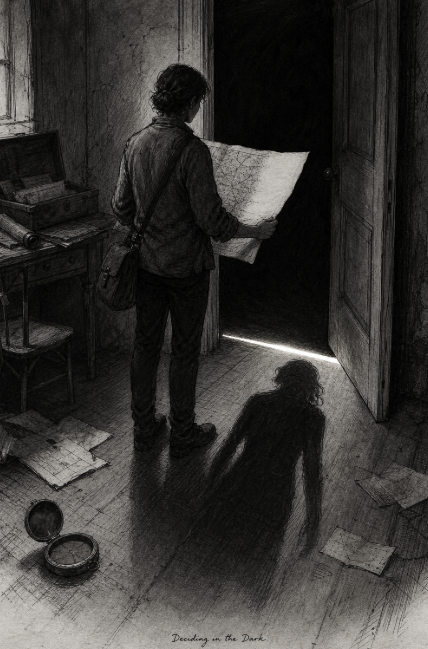
Deciding in the Dark

The person who most needs to change is usually the last person who can accurately judge what the change will ask of them.

I keep coming back to this because it sits underneath almost every serious conversation about inner work. Someone arrives at the edge of a change. A burnt-out executive who can no longer pretend the old success story is enough. A trainer wondering what their practice becomes in an AI-shaped world. A person who has carried the same story about themselves for so long that it has started to feel less like a story and more like the walls of the room.

Sooner or later, the same question appears.

If I do this, what will I get?

It is a fair question. Most of life teaches us to decide this way. Gather the facts. Weigh the costs. Imagine the possible outcomes. Choose the path with the best return. It works well enough when the choice sits outside us. Buy the thing. Take the job. Book the trip. Sign up for the course.

It starts to fail when the choice involves the person doing the choosing.

That is the strange little knot at the centre of transformation. You are trying to evaluate the territory using your current map, while the work itself is going to change the map. Real inner change does not simply add new information to the person you already are. It changes the frame through which information becomes meaningful in the first place. It alters what you notice, what you value, what feels possible, what feels dangerous, what counts as evidence, and what your body reads as a threat.

So the question becomes almost comic in its difficulty. How do I decide whether to undergo a process that will change the self who is making the decision?

The philosopher L.A. Paul calls these transformative experiences. Her work is wonderfully precise on this point. Some experiences cannot be known from the outside, no matter how much information we gather about them. We can read the books, talk to people who have gone through them, listen carefully, make lists, and imagine scenarios. Still, the actual knowing is unavailable until the experience has altered us.

Becoming a parent is one of Paul’s examples. It works because everyone understands the absurdity of thinking research can deliver the experience in advance. You can read every parenting book on the shelf and still not know what it is like to be the person whose life has been rearranged by a child. You do not lack information. You lack the self that only the experience produces.

That is the part we tend to avoid.

We want the transformed self to send back a report. A postcard from the far side. “Yes, this was worth it. Here is what it cost. Here is who you become. Here is the guarantee.” But the self on the far side cannot brief the self at the threshold. The bridge only runs one way.

Inner work has this same structure. The version of you that needs to change is the version voting on whether to begin. And that version is working from a map built out of old experiences, inherited stories, loyalties, wounds, triumphs, defences, and all the private weather that makes a life feel like itself.

That map is not neutral. It is not a clean instrument sitting on the table. It is the thing being examined.

I spent more than two decades watching people come back from training programmes lit up by insight. New frameworks. New tools. Real moments in the room. You could feel the charge in them. Then, almost every time, the old pattern reassembled itself over the next couple of weeks. The fire did not vanish because the insight was fake. It vanished because the insight had landed as content inside an unchanged structure.

That distinction matters.

Content change gives you something new inside the old frame. A model. A technique. A sentence to remember. Structural change alters the frame itself. It changes the room in which the sentence makes sense. The first can be uncomfortable. The second is disorienting. Not because it has gone wrong, but because disorientation is what it feels like when the old map stops being sovereign.

This is where the old NLP presupposition becomes more interesting than its motivational-poster version: people already have the resources they need.

That does not mean change is easy. It does not mean everyone is secretly fine if they just believe harder. It means the missing resource is not always outside the system. Often it is buried, exiled, unused, badly named, or locked behind an old defence that once had a job to do. The work is not about importing a new self from elsewhere. It is about making contact with a possible self already present in the field.

That softens the fear without removing the mystery. You are not agreeing to become a stranger. You are agreeing to walk toward a room in your own house that you have not entered for a long time. The room is yours. The house is yours. But you still do not know what is waiting there until you open the door.

And the part of you that locked the door may not be the part of you now standing in the hallway.

Jung would call this shadow work. The meeting with what has been pushed out of sight, projected onto other people, buried under competence, wrapped in humour, turned into a preference, and made respectable through story. The shadow rarely arrives as a gift basket. It usually arrives as irritation, envy, overreaction, shame, fatigue, fascination, a dream you cannot shake, or a pattern you keep pretending not to see.

This is why real inner work often feels less like expansion at first and more like confrontation. You are not simply gaining a new capability. You are dissolving a defence that may have been built for very good reasons. Some younger version of you made a bargain with reality. It worked well enough to get you here. Now the same bargain is asking to be renegotiated.

From the outside, you cannot fully know what that will require.

The alchemists had a better image for this than most modern personal development language. Nigredo. The blackening. The stage where the material breaks down before it can be reformed. The work goes dark. The old clarity becomes suspect. The tidy identity starts to smoke at the edges. You cannot stand at a safe distance from that process and calculate its exact value, because the calculating mind is part of the material in the vessel.

This is the difference between skills training and transformation.

Skills training gives you something new to do. It adds to the map. Transformation changes the mapmaker.

I don’t say this to make inner work sound grand or dangerous. I say it because a lot of people approach transformation with a decision-making model that belongs to smaller choices. They want certainty before they begin. They want to know who they will be on the other side before agreeing to cross the threshold. That is human. Of course we want that. The nervous system likes a forecast.

But the forecast is not available.

What is available is a different question. Paul suggests that in the face of a genuinely transformative decision, the rational question is not simply, “Will I be better off?” because the future self who would answer that question does not yet exist for us. The better question is closer to: “Is discovering who I will become worth doing for the sake of the discovery itself?”

That changes the shape of consent.

You are no longer signing up for a guaranteed outcome. You are agreeing to an encounter. You are saying yes to the possibility that the self who began will not be the self who finishes and that this is not a flaw in the process. It is the point.

The two years I spent working through my own identity and practice direction were like that. I could not have mapped them in advance. If you had asked me at the beginning what the work would lead to, I would have given you an answer from inside the very frame I was about to question. I would have tried to solve the problem using the mind that had helped create it.

At some point, that stopped working.

I had to put the old map down for a while. Not dramatically. No cinematic burning of the past. More like setting a heavy bag on the ground after carrying it for so long that I had started to think the ache was part of my personality. The uncertainty was not pleasant. It rarely is. But the work that came out of it is more coherent, more alive, and more mine than anything I could have designed from the position I was in before the work began.

That is the paradox. The old self wants a business case for becoming the new self. But the business case is written in the old language. It cannot account for values that have not yet awakened, desires that have not yet been permitted, capacities that have not yet been trusted, or forms of honesty the current self still experiences as a threat.

The Daoist in me trusts this more than the strategist in me does.

The path unfolds as the walking changes the walker. That is not passivity. It is a disciplined form of trust. You still choose. You still pay attention. You still take responsibility for the next step. But you stop demanding that the map of here prove the existence of there before you move.

You can’t get there from here using only the map of here.

The version of you that needs to change is the only version who gets to decide whether to begin. That version will never have complete information. It can’t. The information it wants belongs to the self that the journey will make.

So the question is not whether you can decide with certainty.

You can’t.

The question is whether the discovery is calling loudly enough to step into the dark.

The Editor, Not the Camera

The voice in your head is not neutral.

This sounds obvious. Say it out loud, and most people nod. But knowing it and actually experiencing the implications of it are two entirely different things, separated by a gap that most people spend their entire lives not crossing.

Psychological research has long known that we carry an inner narrator: the voice that runs a continuous commentary on our experience, stitches our memories into a coherent sequence, and gives us the sense of being a continuous self moving through time. It is the voice that reads these words to itself. The voice that decides whether what just happened was good or bad, threatening or promising, evidence that you are capable or evidence that you are not. The voice that was there last night when you could not sleep, replaying the conversation from the afternoon and editing it, adding the things you should have said and glossing over the things you actually did.

Research into inner speech suggests this voice is so woven into our experience that many of us can’t imagine what it would be like without it. Children develop it through a fascinating process: what Lev Vygotsky observed as private speech, the out-loud self-talk that children between two and eight do constantly, gradually goes underground and becomes internal. What started as socialised, external language becomes internalised, compressed, and rapid. By adulthood it runs so fast, so automatically, that we rarely catch it in the act.

What we almost never think to question is whether the narrator is telling us the truth.

The Editor, Not the Camera

Not lying, exactly. The narrator is not malicious. But it is not neutral either. It is an editor, not a camera. It decides which footage makes the final cut and which gets left on the floor. It decides the genre: whether this story is a comedy or a tragedy, a bildungsroman or a cautionary tale. And it makes those decisions using scripts it inherited from experience, from early wounding, from the accumulated weight of everything that happened to you before you were sophisticated enough to question the framing.

I see this play out a lot in my coaching practice. Someone has an insight. A real one, the kind where you can see in their face that something has shifted. They leave energised. But before long, the narrator manages to reassert itself. Not because the insight was false, but because the narrator is faster, more practised, and operates below the threshold of conscious attention. It doesn’t argue with the insight. It simply continues running its programme, and the insight slowly loses purchase.

This is not a failure of willpower or intelligence. It is a structural problem. You can’t opt out of a narrator you have never actually separated yourself from.

Within the NLP framework, internal dialogue is one of the primary representational systems, the auditory digital channel. And it is workable. You can change the qualities of the inner voice: its pace, its volume, its tone, who it sounds like. Slow the critical voice down to a drawl, and give it a silly accent, and it loses authority. Speed up an encouraging voice and make it louder. These are not tricks. They are interventions into the properties of the narrator, and they work because the narrator is not fixed. It has qualities that can be altered.

But that is the technique. The deeper understanding runs elsewhere.

Jung described the ego as the narrator of the story we call ‘I’. The persona, the professional face we wear, and the accumulated roles and identities we have adopted and eventually mistaken for our actual nature are built from the narratives the narrator has been running. We don’t have stories about ourselves. We are, in some functional sense, the story. The narrator is the mechanism by which that story is maintained and defended.

Which is why inner transformation is difficult in a very specific way. It is not that people cannot see their limiting stories when you point them out. In my experience, most people can. The difficulty is that the narrator, which is the thing doing the limiting, is also the thing through which they are trying to see it. You are using the editor to audit the edit. The instrument of perception is the thing being examined.

Most people have had brief, unpredictable flashes of this. Moments when the inner monologue suddenly seems like something happening in the room rather than something happening as you. Meditation traditions have been mapping this territory for millennia. The psychotherapy literature has its own vocabulary for it: mentalisation, metacognition, the observing ego. NLP calls it stepping into third position.

What all of these point toward is the same structural shift: from being the narrator to having a narrator.

That shift is not a destination. It is a practice. And it doesn’t require that the narrator become silent, only that it loses the status of absolute authority. The inner voice can speak without its verdict being final. The commentary can run without you treating it as a direct transmission from reality.

Hans Vaihinger, in his Philosophy of As If, argued that human beings live by fictions we gradually mistake for truths. We construct provisional frameworks—about ourselves, about the world, about what things mean—and then, through repetition and necessity, begin to inhabit them as if they were reality itself. For Vaihinger, the important question was not whether such fictions were literally true in some absolute sense, but whether they were useful: whether they helped us move, orient, endure, and act.

The narrator does not know Vaihinger exists. It does not approach its own stories as provisional devices or useful simplifications. It runs them as absolutes. It presents them as settled fact, as reality in its final form. What began as an interpretation hardens into identity. What began as a protective explanation becomes an invisible law. And because the narrator speaks in the first person, with the intimacy of our own inner voice, its fictions rarely appear as fictions at all. They appear as the way things are.

The work, then, is to create a little distance between the story and the one carrying it. Not to abolish story—because we cannot live without narrative—but to loosen its grip enough that it can be seen as narrative rather than destiny. Enough space to notice that what feels inevitable may only be familiar. Enough space to ask, with some seriousness and without self-deception: Is this story serving me, or have I been serving it? And if I have been serving it, what kind of life has that service been asking me to live?

The question is not as abstract as it sounds. It has an answer. And the answer tends to be visceral rather than intellectual, because the narrator does not surrender its authority at the level of argument. It surrenders it at the level of experience. When you catch it running, really catch it in the act rather than theorising about it, something loosens. Not forever. Not irreversibly. But enough.

What gives it away is not a grand revelation but a subtle shift in texture. A sentence begins in your mind and, for a fraction of a second, you hear it as a sentence rather than as reality. There is a small gap where there used to be none. The commentary is still there, still fluent, still persuasive, but it is no longer identical with what is happening. It is about what is happening. That distinction, once felt, cannot be entirely unfelt.

In that moment, the authority of the narrator flickers. Not because it has been defeated, but because it has been seen. And being seen changes its status. What was previously invisible and therefore unquestionable becomes visible and therefore workable. The voice does not disappear. It continues to offer its interpretations, its edits, its familiar conclusions. But something in you is no longer compelled to accept them without question.

This is why the shift cannot be forced through reasoning alone. You cannot argue the narrator into silence any more than you can think your way out of thinking. The movement is experiential. It happens in real time, in the middle of a thought, in the middle of a reaction, when you recognise—directly, not conceptually—that what feels like reality is in fact a construction unfolding at speed.

And in that recognition, even if it lasts only a few seconds, there is space. Space to not follow the next thought automatically. Space to let a reaction pass without enacting it. Space to choose, however slightly, a different way of responding.

And in that loosening is where the real work begins. Because once there is space, even a small one, the question is no longer whether the narrator is accurate. The question becomes what you do with the fact that it is optional. Whether you continue to live inside its most well-worn scripts, or whether you begin, slowly and deliberately, to edit the editor itself.

I have been thinking about the vocabulary we …

I have been thinking about the vocabulary we use for the inner life. How much of it actually belongs to us.

Most of the words we reach for when we try to describe what is happening inside, sadness, anxiety, frustration, and fear, were handed to us. By language. By family. By the culture we were born into. We use them because we have them. Not because they are precise.

There is a practice gaining attention in psychology circles: inventing your own terms for emotional states that standard language doesn’t quite reach. Coining something private, personal, exact.

I think this practice is more significant than it sounds. Because the words you use for your inner states are not just descriptive. They are partly constitutive. The word shapes the internal representation. It makes certain moves available and closes off others. An approximate word gives you an approximate relationship with what is actually happening.

NLP calls this making a distinction. When you can name something specifically, you have cut it out from the blur around it. You can see its edges. Anything you can see the edges of, you can begin to choose something about.

The map is not the territory. But more importantly, someone else’s map of your territory is especially not the territory.