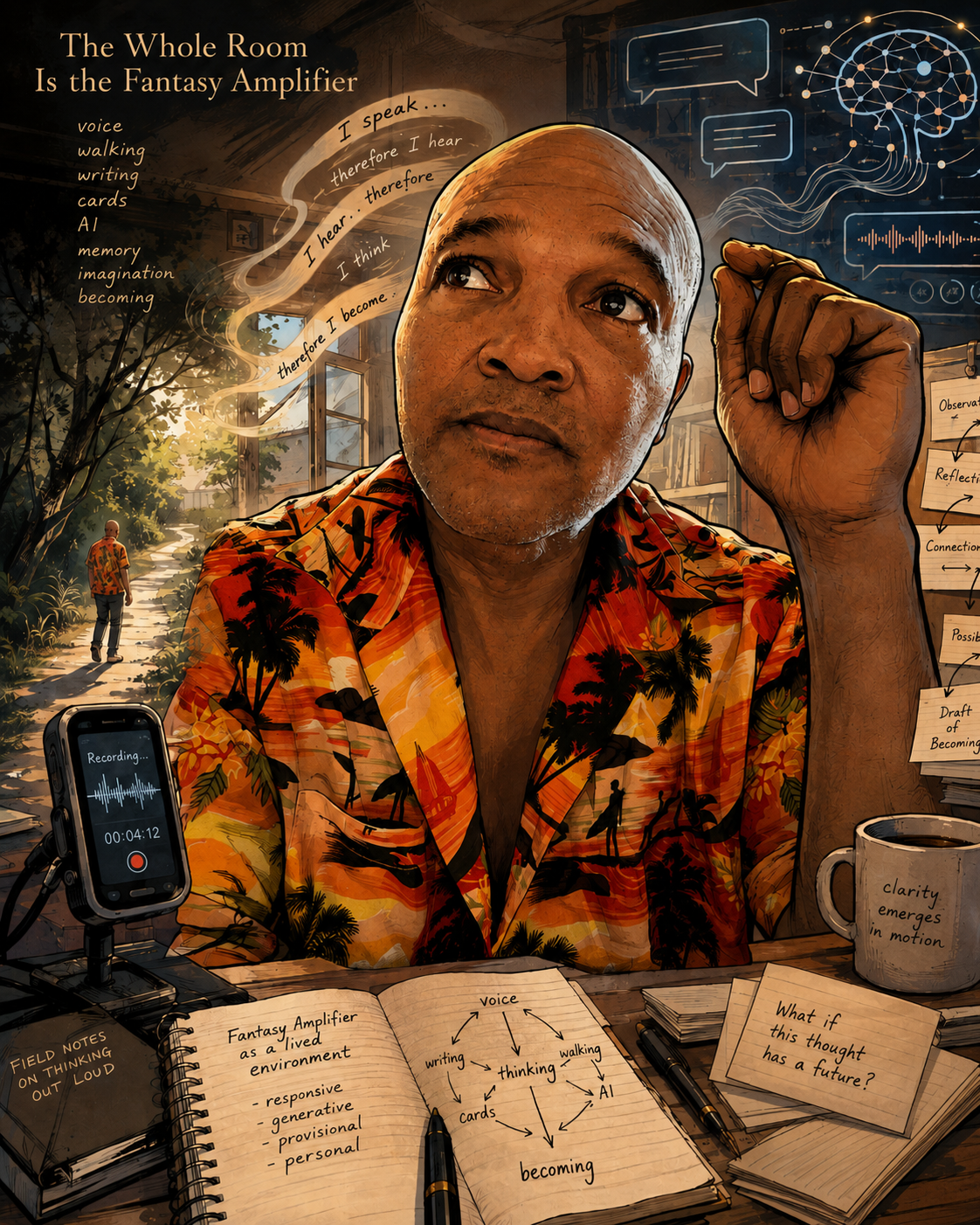
The Whole Room Is the Fantasy Amplifier

I have been thinking about Alan Kay’s idea of the fantasy amplifier, partly because I have begun to suspect that the thing he was imagining has arrived.

Or perhaps: it is arriving.

Howard Rheingold, writing about Kay in Tools for Thought, described his ambition as building a “fantasy amplifier”, a dynamic medium for creative thought that could be used by anyone with an imagination. In a 1988 interview, Kay explained fantasy less as escapism than as simulation: the human capacity to make models, enter possible worlds and explore things that do not yet exist. The computer, as he imagined it, could amplify that capacity.

For decades that remained, at least partly, aspirational.

Now I can have a thought while sitting at my desk or walking down a country lane, speak or type it into a box, and watch something begin to materialise on the other side.

An essay.

An image.

A piece of music.

A program.

A map.

A conversation.

A different formulation of the thought itself.

Increasingly, the distance between I can imagine this and I can make some version of this exist is collapsing.

That is what makes generative AI feel different to me from earlier generations of computing. The computer is no longer merely waiting for me to learn the language of the machine. Increasingly the machine is learning to meet me in mine.

And as the interfaces become more conversational, more multimodal, more ambient, the keyboard itself begins to look less inevitable. I can already speak to the machine. The speech becomes text. The text becomes an instruction. The instruction becomes an artefact.

Thought becomes language becomes thing.

Abracadabra.

Except, of course, it isn’t quite that simple.

Because the more I use these systems, the more interested I become not just in what the machine does with my thoughts, but in what happens to the thoughts on their way into the machine.

Does it matter whether I speak an idea, type it, or write it by hand?

Would the same thought have occurred in all three forms?

Would it have taken the same route?

Would I even have recognised it as the same thought?

My hunch is no.

And this is where the fantasy amplifier becomes more interesting than a story about artificial intelligence.

It becomes a story about thinking environments.

Speaking to discover

I noticed this while thinking about the fantasy amplifier itself.

I had typed the original question. Then I read the response and immediately switched to speaking.

That change was not accidental.

I wanted to riff.

I didn’t yet know exactly what I thought about what I had just read, and speaking seemed to be the quickest route into finding out.

When I speak, I can follow the thought where it wants to go.

One phrase opens another.

An image appears.

I qualify something I said thirty seconds ago.

A connection arrives that I didn’t know was there until I heard myself making it.

There is an improvisational quality to it.

I am not reporting a finished thought.

I am listening to myself think.

Walter Ong’s classic Orality and Literacy explored how deeply communication technologies shape the ways human beings organise knowledge. Speech and writing are not merely two delivery mechanisms carrying an otherwise identical package of thought. They create different relationships with language, memory, audience and time.

I can feel some small version of that difference every time I switch from keyboard to voice.

When I type, the thought immediately becomes visible.

It sits there.

And because it sits there, I can interfere with it.

There is the sentence I have just written.

There is the badly placed comma.

There is the word that isn’t quite right.

There is the little red underline announcing that I have offended the dictionary.

And before I know it, I am no longer discovering the next thought because I am repairing the previous one.

The editor has entered the room.

Sometimes I can suppress that impulse. I can type in something approaching stream of consciousness: no backspacing, no worrying about sentences, no correcting spelling, just keeping the fingers moving.

When I do that, typing begins to feel more like speech.

Which makes me wonder whether there are really two forms of typing hiding inside the same interface.

There is typing-as-composition, where I am watching the words, shaping sentences and working on the architecture of the piece.

And there is typing-as-speaking, where the keyboard becomes almost transparent and I am trying to get language onto the screen faster than the editor can catch it.

The physical technology hasn’t changed.

The cognitive mode has.

The recorder changes the thought

But there is another piece of equipment that turns out to be essential to my spoken thinking.

The voice recorder.

Without a recorder, walking and talking contains a peculiar tension.

I might suddenly stumble onto something.

A sentence.

A connection.

A distinction.

One of those thoughts that arrives with the unmistakable sensation: there’s something here.

And immediately another part of my mind wakes up.

Don’t lose that.

Now I am no longer simply following the thought.

I am trying to preserve it.

I repeat it internally.

I shorten it into something memorable.

Perhaps I stop walking and reach for a notebook.

Perhaps I pull out my phone.

Perhaps I spend the next few minutes keeping the phrase alive in working memory while looking for somewhere to capture it.

The very act of trying not to interrupt the thought interrupts the thought.

This changes completely when I know the recorder is running.

I can let the sentence go because it has already been caught.

I don’t need to remember what I said five minutes ago.

I only need to discover what comes next.

There is a tiny but profound difference between:

I need to remember this

and

I can come back to this.

The first turns consciousness backwards.

The second lets it continue forwards.

This is where the voice recorder begins to look like more than a recording device. It becomes part of the thinking apparatus.

Andy Clark and David Chalmers famously asked in their 1998 essay “The Extended Mind”: where does the mind stop and the rest of the world begin?

Their provocative suggestion was that under the right circumstances, notebooks, tools and environmental resources can participate in cognitive processes rather than simply recording the results of cognition.

I don’t need to settle the philosophical argument to recognise the experience.

When the recorder is running, my cognitive situation changes.

Part of the burden of remembering has been handed to the environment.

The machine keeps the trail behind me.

I can keep walking.

Thought as improvisation

The closest analogy might be musical improvisation.

Imagine a jazz musician halfway through a solo suddenly playing a phrase she loves.

If nobody is recording, perhaps some part of her thinks: I need to remember that.

But if the session is being recorded, she can allow the phrase to disappear into what comes next.

She doesn’t have to stop playing in order to archive the music.

The recording preserves the performance.

My walking voice notes increasingly feel like this.

I am improvising thought.

Sometimes I repeat myself.

Sometimes I wander into a dead end.

Sometimes I spend five minutes circling something that could later be expressed in a sentence.

None of this necessarily looks efficient from the outside.

But efficiency isn’t the point.

The wandering is doing something.

The thought is being given enough room to encounter itself.

Edwin Hutchins’s Cognition in the Wild challenged the neat picture of cognition as something happening entirely inside an isolated individual’s head. Studying real people performing complicated tasks, Hutchins paid attention to the whole cognitive system: people, instruments, representations, procedures and physical surroundings.

I increasingly think about my own practice this way.

The unit of thinking isn’t necessarily:

me + brain.

Sometimes it is:

me + walking + landscape + voice + recorder.

Change one component and you change the system.

From ephemeral speech to interrogable thought

Voice recording used to have one major weakness.

Retrieval.

You could record twenty-five minutes of yourself talking and know perfectly well that somewhere around minute seventeen you said something interesting.

Good luck finding it.

You scrub backwards.

Too far.

Forward again.

Was it before the bit about the tree?

After the bit about McLuhan?

You eventually decide that perhaps the thought wasn’t quite as brilliant as you remembered.

Speech had been captured, but it remained trapped inside time.

AI transcription changes this dramatically.

Now the sequence becomes:

ephemeral speech → persistent audio → searchable text.

And once I have the transcript, another transformation becomes possible:

searchable text → interrogable thought.

I can ask the AI:

What ideas keep recurring here?

Where did the argument change direction?

What questions did I raise without answering?

Which ideas seem to be in tension with one another?

Show me the moments where I appeared to surprise myself.

Pull out five passages worth exploring further.

Find connections between this recording and something I was thinking about last week.

Suddenly the voice note isn’t simply something I recorded.

It becomes a landscape I can return to.

This is where I would distinguish summarising from excavating.

The obvious thing to do with a transcript is ask AI to summarise it.

Sometimes that is useful.

But summarisation tends toward hierarchy. It decides what the conversation was mainly about and compresses everything around that centre.

Yet the valuable thing in exploratory thinking may be precisely the remark that doesn’t fit.

The aside.

The contradiction.

The strange metaphor.

The sentence halfway through that seems to have wandered in from another essay.

A summary asks:

What were the main points?

Excavation asks:

Where did something new appear?

Those are very different questions.

For exploratory thinking, I increasingly prefer the second.

And then there is the hand

Handwriting creates another atmosphere entirely.

When I write by hand, I slow down.

Sometimes frustratingly so.

There are occasions when the thought is arriving faster than my hand can move and my handwriting degenerates into something resembling the electrocardiogram of an excited squirrel.

But when I am trying to sit with something rather than chase it, the slowness becomes useful.

The thought has resistance.

Every word costs something.

The hand has to make it.

Research around handwriting and typing is more complicated than the popular “handwriting makes you smarter” slogan suggests. A much-cited 2014 study by Pam Mueller and Daniel Oppenheimer reported advantages for longhand note-taking under some conditions, but later replication work has failed to find a simple, universal advantage for handwriting.

More recent EEG research has found substantially different patterns of connectivity during handwriting compared with typewriting, which researchers have linked to the richer sensorimotor activity involved in forming letters by hand. But again, that does not justify turning the result into a simplistic hierarchy in which pens are cognitively virtuous and keyboards are bad for us.

My experience is less dramatic anyway.

I don’t think handwriting necessarily makes me think better.

It makes me think differently.

And not simply because it is slower.

The page is spatial.

I can write something in the corner.

Circle a word.

Draw a line across the page.

Turn the notebook sideways.

Underline something three times.

Put a question mark beside one thought and connect it with an arrow to something I wrote ten minutes earlier.

I can draw instead of write.

I can make a crude diagram.

I can leave a giant empty space because I sense that something belongs there but don’t yet know what it is.

The keyboard quietly encourages sequence:

this, then this, then this, then this.

The notebook allows topology.

This over here.

That over there.

Something between them.

Maybe a connection.

Maybe not.

Writing becomes drawing.

Thinking becomes arranging.

Thinking on the floor

Sometimes I take that spatial quality even further with three-by-five cards.

One thought per card.

Then I put them on the floor.

Now an idea has become an object.

I can move it.

Put it next to another thought.

Create a sequence.

Break the sequence.

Make a cluster.

Notice that two cards I thought belonged together actually don’t.

Stand up and look down at the whole arrangement.

This is one of those wonderfully primitive technologies that suddenly seems very sophisticated once you start thinking in terms of cognition.

A card is a movable unit of thought.

The floor becomes an interface.

My hands become a sorting algorithm.

Distance becomes meaning.

Adjacency becomes hypothesis.

This is why I resist the idea that the future of thinking will simply be a migration from analogue tools into AI.

Why would I surrender all these different cognitive textures for one universal interface?

That would be like a musician celebrating the invention of the synthesiser by throwing away every guitar, drum and saxophone.

The interesting possibility is not replacement.

It is orchestration.

A cognitive studio

I have begun thinking of this collection of practices as a cognitive studio.

Not a productivity system.

Not quite a workflow.

A workflow suggests that an idea should travel through a prescribed series of stages until it becomes an output.

Capture.

Process.

Draft.

Edit.

Publish.

There is nothing wrong with that when production is the goal.

But thinking is messier.

Sometimes I speak first.

Sometimes I type.

Sometimes the notebook starts everything.

Sometimes I have a conversation with AI, hit something I cannot resolve, close the computer and take the question for a walk.

Sometimes a paragraph from a transcript ends up on a card.

Sometimes the cards reveal a structure that sends me back to the keyboard.

Sometimes handwriting makes me realise the entire argument is wrong.

There is no canonical route.

The better question is:

What does this thought need next?

Does it need speed?

Then speak.

Does it need to become visible as language?

Type.

Does it need slowness?

Take out the notebook.

Does it need space?

Use cards.

Does it need movement?

Walk.

Does it need another perspective?

Bring it into conversation.

Does it need amplification?

Give it to AI.

Does it need silence?

Turn everything off.

Now the fantasy amplifier begins to look very different.

It isn’t a single machine.

It is the whole room.

The importance of friction

This also raises a question I think will become increasingly important as AI interfaces get better.

What happens when the distance between desire and execution becomes almost frictionless?

At present I can think:

I wonder what this would look like as an illustration.

Seconds later, I can see one.

I can hum something and software can begin turning it into music.

I can describe a little application and AI can begin writing it.

The trajectory seems clear: less friction, more conversational interaction, increasingly ambient computing, increasingly powerful agents capable not simply of answering but acting.

From one angle this is Kay’s fantasy amplifier finally stepping out of the laboratory.

But friction is not always the enemy.

Sometimes friction is where the thinking happens.

The red underline beneath a misspelled word is irritating friction because it interrupts the wrong process at the wrong time.

The slowness of handwriting can be productive friction because it changes the tempo of reflection.

Rearranging cards on a floor is cumbersome compared with asking AI to produce an outline, but the bodily manipulation may allow me to see relationships I would not otherwise have encountered.

Walking somewhere without immediately asking the machine what to think about it may be another form of useful resistance.

Perhaps the mature fantasy amplifier therefore needs something analogous to a volume knob.

Sometimes:

amplify this.

Sometimes:

challenge this.

Sometimes:

slow this down.

Sometimes:

don’t help me yet.

A perfectly obedient system that immediately realises every desire might turn out to be less intellectually interesting than one that participates in a deliberately designed ecology of resistance and amplification.

Because there are at least two different things I might ask of a thinking machine.

Help me make what I want.

And:

Help me discover what I want.

The second is considerably stranger.

The fantasy amplifier turns back on the fantasist

There is a lovely recursive quality here.

The fantasy amplifier does not merely amplify fantasies.

It changes the person doing the fantasising.

I speak something half-formed.

The machine transcribes it.

I read the transcript.

Seeing my spoken thought as text changes my relationship to it.

I ask AI to interrogate it.

The response introduces a distinction I hadn’t considered.

I take that distinction into my notebook.

The notebook slows me down.

I sketch three possibilities.

One becomes a card.

The cards move around on the floor.

A new pattern appears.

I go for a walk.

I talk about the pattern.

The recorder captures another twenty minutes.

Round we go again.

imagine → externalise → encounter → manipulate → converse → rearrange → reflect → imagine.

The important thing is that I do not return to the same point.

Every circuit changes the thought.

This is less like operating a machine and more like entering into what Douglas Engelbart might have recognised as an augmentation system, or what Hutchins might describe as a distributed cognitive process.

But I also hear something older underneath it.

Human beings have always thought with things.

Marks scratched into clay.

Knotted cords.

Maps.

Marginalia.

Commonplace books.

Index cards.

Blackboards.

Diagrams.

Libraries.

Conversations.

Walks.

We put thought into the world so that the world can give it back to us in another form.

AI intensifies this ancient habit.

The extraordinary difference is that now the externalised thought can answer.

Permission to forget

And perhaps that brings me back to the smallest piece of technology in this whole apparatus.

The voice recorder.

I keep thinking about what it gives me.

Not memory exactly.

Something better.

Permission to forget.

That sounds paradoxical because we usually think of recording devices as technologies of remembering.

But the psychological gift of the recorder is precisely that I don’t have to remember.

I don’t have to clutch the thought.

I don’t have to keep repeating the sentence in my head.

I don’t need to stop the walk.

I don’t need to write anything down.

The trail behind me is being preserved.

So I can continue towards whatever comes next.

The recorder doesn’t amplify the thought.

It keeps my hands off it.

It allows the thought to remain alive for another few minutes before I ask it to become something.

And perhaps that is the deeper principle I am discovering as I build this thinking environment around myself.

A good thinking environment does not simply capture more thoughts.

It creates the conditions in which the next thought can arrive.

Sometimes that means removing friction.

Sometimes it means introducing friction.

Sometimes it means making thought faster.

Sometimes slower.

Sometimes linguistic.

Sometimes spatial.

Sometimes conversational.

Sometimes embodied.

Sometimes solitary.

The fantasy amplifier, then, isn’t ChatGPT.

It isn’t the voice recorder.

It isn’t my notebook.

It isn’t a stack of three-by-five cards scattered across the floor.

It isn’t even the computer.

The fantasy amplifier is the ecology formed when all these things begin working together with a human imagination at the centre of them.

Which might mean that the most important skill in this emerging age isn’t prompting after all.

It might be something quieter and harder to package into a course.

The ability to notice the state of your own thinking and ask:

What mode does this thought need now?

Do I need to speak?

Do I need to write?

Do I need to walk?

Do I need to move the pieces around?

Do I need another intelligence in the room?

Do I need to shut the intelligence out for a while?

The computer is becoming extraordinarily good at meeting us wherever imagination happens to be.

But perhaps the real art will be learning when to bring the machine closer and when to push it away.

Alan Kay imagined a machine capable of amplifying fantasy.

What I find myself building is slightly different.

A habitat in which thought can move from voice to text to hand to space to machine and back again without requiring any one of those forms to become sovereign.

A place where an idea can remain a little wild before being turned into an answer.

A place where I can speak without remembering, write without publishing, arrange without deciding, and ask the machine not simply to finish my thoughts but occasionally to help me lose my way among them.

The fantasy amplifier has arrived.

But increasingly I suspect the amplifier isn’t the machine sitting in front of me.

It’s the whole room.


If this post gave you something to carry into your day, consider supporting my work by buying me a coffee or making a monthly donation or subscribing (free) to the blog.
Reading Tools for Thought, I keep coming back …

Reading Tools for Thought, I keep coming back to Alan Kay’s idea of the computer as a fantasy amplifier.

It’s such a different way of answering the question: what are computers for?

Not productivity machines. Not devices for writing more emails, managing calendars, filling in spreadsheets or shaving another twenty minutes off the working day.

A fantasy amplifier.

A machine for taking something that exists in the imagination and giving it form.

And I’m beginning to wonder whether generative AI is bringing us much closer to Kay’s original vision of computing than almost anything that has happened in the intervening years.

Last night Ruth and I were talking about reversing the caravan. She was trying to get her head around the physics of it: why the caravan moves in the opposite direction, what happens at the hitch, how steering the car changes the angle of the caravan.

Normally I would explain it. Maybe draw something on a piece of paper. Perhaps find a YouTube video.

Instead, I vibe coded a caravan reversing simulator.

Twenty minutes later we had a little computational world in which you could steer the car and watch the caravan respond.

That seems significant.

I didn’t really want software. I wanted to make an idea manipulable.

There was something in my head — a model of how reversing a caravan works — and through conversation with an AI I was able to externalise that model, turn it into software and then interact with it.

The movement was something like:

imagination → language → computation → experience

And then, because I could experience what I’d imagined, another loop began:

experience → thought → language → modification → new experience

This is where my recurring phrase everything is text starts connecting with Kay’s fantasy amplifier.

By “text” I don’t necessarily mean written words. I mean that more and more of the computational world is becoming addressable through language.

I can type into a box.

Or, increasingly, I can simply speak.

There’s this thing I’m imagining…

And from there I can potentially create an image, a piece of music, a video, an application, a simulation, a website, a database, a game.

I watched a woman create an entire music track by making the sounds of the different instruments with her mouth. Those rough sounds became instruments, arrangement and eventually a finished track over which she sang the vocals.

Something imagined became something encountered.

This seems to me much more interesting than the current obsession with AI productivity.

Yes, give the AI my admin. Sort the diary. Summarise the emails. Format the spreadsheet. Save me twenty minutes.

Useful stuff.

But surely that is the least imaginative version of what we have built.

The more interesting possibility is that AI dramatically reduces the distance between imagining something and encountering it.

And vibe coding might be one of the clearest early examples.

Programming traditionally required me to translate an idea into the symbolic language of the computer:

idea → specification → programming knowledge → code → interface → working thing

Increasingly, that translation becomes:

idea → language → working thing

That doesn’t make programming knowledge irrelevant. There are still enormous questions of reliability, security, architecture, maintenance and scale.

But something else has changed.

I no longer necessarily have to know how to build something before I can begin exploring what it might be like if it existed.

That changes the bottleneck.

The question becomes less:

Can I program this?

and more:

Can I imagine it?

And perhaps this is where AI as a co-thinking technology becomes much more interesting to me.

Because imagination isn’t simply being converted into finished products. The things we make can come back into the conversation and change our thinking.

I imagine something.

We make a rough version.

I encounter it.

Something about it surprises me.

I change my mind.
We alter it.

I encounter the new version.

Another possibility appears.

The artefact starts participating in the thinking.

Which means the fantasy amplifier isn’t simply a machine that executes imagination.

It provokes more imagination.

Kay imagined computers as a dynamic medium through which people — particularly children — could explore ideas, construct models, create worlds and discover things through interaction.

Perhaps generative AI adds another layer to that dream.

Natural language becomes an interface to computational possibility.

The little text box becomes strangely powerful.

“There’s something I’m imagining…”

And the machine effectively replies:

“Okay. Let’s see what happens if we make it.”

Maybe that is the more interesting future of AI.

Not artificial intelligence replacing human intelligence.

Not merely artificial intelligence making human beings more productive.

But human imagination coupled with computational intelligence in a recursive creative loop.

A fantasy amplifier.

And perhaps, after all these years, we’re finally beginning to build the thing Alan Kay was pointing toward.

We talk about consuming books, as though reading …

We talk about consuming books, as though reading were a kind of nutritional exercise: pages in, knowledge out. But the best reading has never felt like consumption to me. It feels more like entering into correspondence with another consciousness across space and time. A conversation where one voice has the strange advantage of having thought about what it wants to say for years, sometimes centuries.

The art of reading begins when we stop treating books as containers of information and start treating them as occasions for thought.

A book is not finished when the author writes “The End.” It is finished when the reader has wrestled with it long enough for something inside themselves to rearrange. Every worthwhile book is completed twice: once by the writer, once by the reader.

There is also the question of pace.

The modern world encourages us to read the way we scroll—fast enough to harvest the headline before moving on. But some books refuse this economy of attention. They ask to be lingered over. A single sentence from Montaigne, Woolf, Nietzsche, or Solnit can occupy an afternoon. Not because it is difficult, necessarily, but because it unfolds. Like a landscape seen from different angles, it reveals more each time you return.

Perhaps reading is less like travelling down a road than wandering through a forest. You can rush from one edge to the other and claim you’ve “done” the forest. Or you can stop beside an old oak, notice the fungi on its bark, listen to birds you’ve never heard before, and discover that the forest was never simply a route—it was a relationship.

There is an ethics to reading, too.

A generous reader doesn’t merely ask, Do I agree? They first ask, What is this person trying to show me? Agreement can come later. Understanding comes first. Reading well requires a temporary hospitality of mind, an ability to let another worldview take up residence without immediately redecorating it according to our own tastes.

Of course, books are not always right. Some deserve argument. Some deserve abandonment. Some become more valuable because we resist them. But even disagreement can be a form of intimate reading if it arises from genuine encounter rather than reflex.

The finest readers become collectors of questions rather than answers.

They close a book carrying not a list of quotations but a slightly altered way of seeing. They begin noticing things in the street, in conversations, in their own thoughts that previously passed unnoticed. The book has become less an object than a new lens.

This is why marginalia matters. Underlining. Scribbled notes. Dog-eared pages. Conversations with friends. Journal entries after finishing a chapter. Reading is not passive reception but active participation. Every mark we make in a book is also a mark the book has made in us.

And perhaps this is the deepest art of reading: learning to read not only books, but the world itself.

Eventually the boundary dissolves. A walk becomes a chapter. A stranger becomes a footnote. A dream becomes an appendix. The city becomes a text full of symbols, omissions, revisions, and hidden authors. You realise that books were never teaching you merely how to read pages. They were teaching you how to become more readable to yourself.

The mature reader is therefore not someone who has read thousands of books. It is someone whose reading has become a way of being in the world—curious, attentive, slow enough to notice, humble enough to be changed, and alive to the possibility that every genuine encounter, whether with a paragraph or a person, is another chance to revise the story they are living.

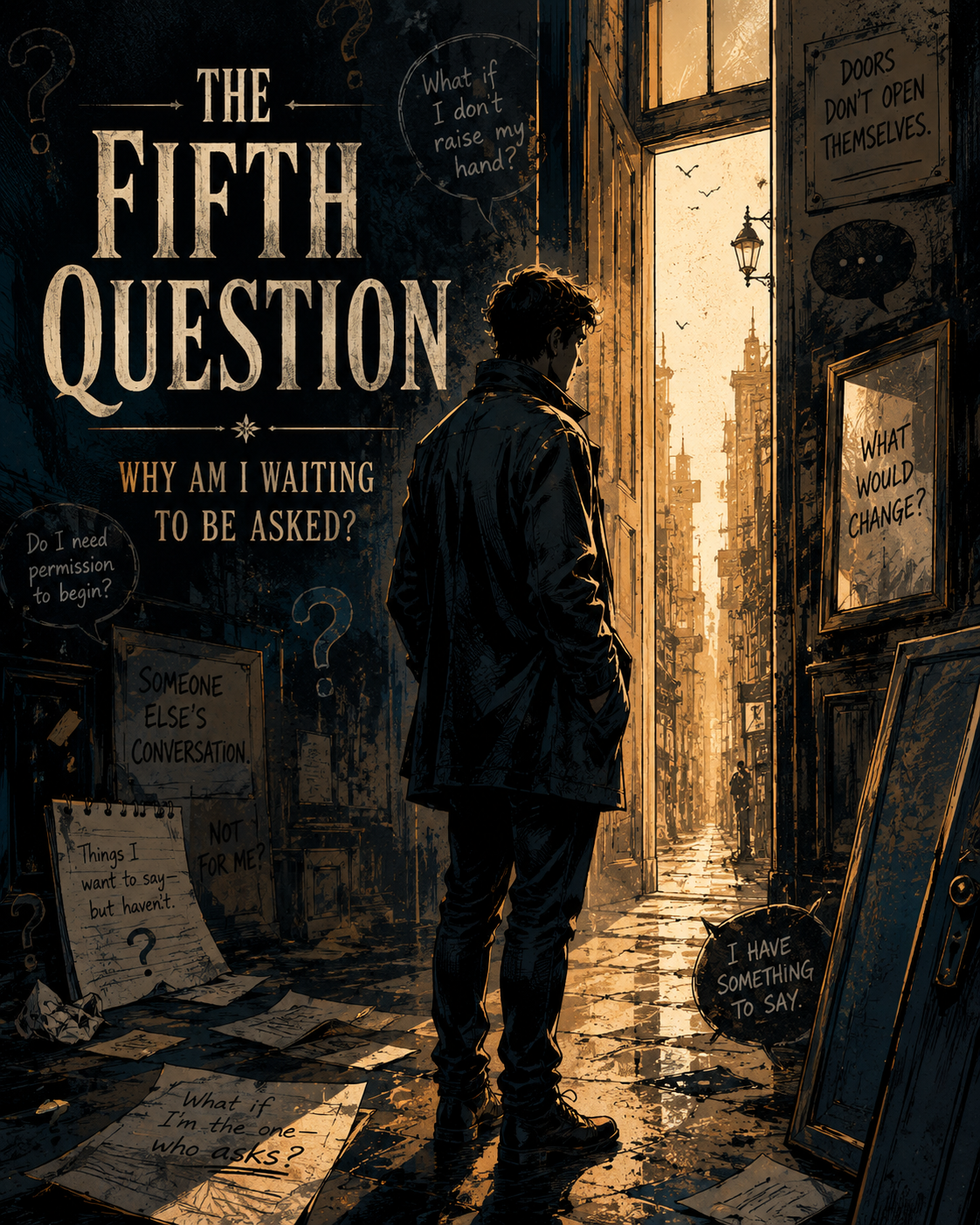
The Fifth Question: Why Am I Waiting to Be Asked?

You finish a conversation and realise the other person learned nothing about you. They spoke, you listened, and somewhere along the way your role became clear: hold the space, ask the follow-up question, keep the exchange moving. Later, you replay the conversation and wonder whether they were uninterested or simply unaware.

Claire Lester describes the questions that might have changed the encounter:

How are you, really?

What was that like for you?

Did that land badly?

Are you happy?

Each question asks someone to pause long enough to acknowledge that another person has an interior life. I agree with her that such questions are rare. I also think their absence can become too easy to interpret.

Questions reveal curiosity, but they are not the only form curiosity takes.

Some people ask directly. Others leave a door open and wait for you to walk through it. Some offer practical help. Some sit beside you without knowing how to name what they sense. Some grew up in families where asking personal questions felt intrusive, so they learned to express care through food, errands, lifts to the station, or the quiet repetition of showing up.

None of those gestures replaces a needed conversation. Still, if we treat questions as the primary evidence of love, we may overlook the dialects in which other people learned to care.

Then there is the question the essay left me asking:

Why am I waiting for permission to tell you who I am?

The Secret Test

Many of us conduct a private test inside our relationships.

We mention that work has been difficult. We say we haven’t slept well. We refer to the hospital appointment, the argument, the strange heaviness that has followed us through the week. Then we wait.

Will they ask?

If they do, we feel seen. If they change the subject, something closes.

The other person seldom knows a test is taking place. They may think we have told them everything we want to tell. They may worry that a follow-up question would feel intrusive. They may hear the invitation and lack the courage to accept it. They may simply be distracted.

Meanwhile, we interpret their silence as information about our value to them.

I understand why we do this. An unprompted disclosure feels risky. Being asked gives us cover. We can tell ourselves that we are answering rather than imposing. The question absolves us of the fear that our inner life might be too heavy, too complicated, or too much.

But waiting also hands responsibility for our visibility to someone who cannot read our mind.

Sometimes the honest response to “How are you?” is not “Fine, unless you ask me again with sufficient sincerity.”

Sometimes it is: “I know that’s usually a greeting, but I’m not doing well.”

That sentence carries its own risk. It also gives the relationship a chance to become real.

Curiosity Needs Reciprocity

The final scene in Lester’s essay contains the tension that interests me most.

She calls her friend back. She asks the deeper version of the question and discovers a whole hidden life: a declining father, repeated drives to Hexham, a painful conflict with a brother. Her irritation gives way to compassion.

Her friend still asks her nothing.

Lester notices, but it matters less.

There is generosity in that response. Understanding another person often loosens the stories we have built around their behaviour. Marcus Aurelius returned to this practice because he knew how quickly we turn someone’s limitations into a personal insult. Once we glimpse the fear, grief, habit, or exhaustion behind an action, resentment can lose some of its grip.

Yet understanding can become a trap when one person does all of it.

If I continually explain why you cannot meet me, I may become highly compassionate while disappearing from the relationship. Your history explains your lack of curiosity. Your workload explains your absence. Your wounds explain why every conversation returns to you. All of those explanations may be true. I still have to live inside the relationship they create.

Stoic practice asks us to examine our judgements. It does not require us to pretend that every arrangement is nourishing.

Compassion and discernment belong together.

A friendship can survive seasons of imbalance. Illness, grief, parenthood and crisis rearrange what each person can give. Trouble begins when the season becomes the structure and nobody names it.

The Fifth Question

Perhaps we need a fifth question:

Is there room for me in this relationship?

That question does not ask whether the other person is good or bad. It asks what happens between us.

Can I speak without waiting for an invitation?

When I speak, do you stay with me?

Can I tell you that something landed badly without managing your reaction?

Do we know one another, or have we settled into the roles of speaker and witness?

Can I ask for more without turning the request into an accusation?

These questions move us away from counting conversational turns as though intimacy were an accounting exercise. They also prevent generosity from becoming self-erasure.

A person may love us and lack the ability to ask what we need them to ask. We can teach them something about how to reach us. We can say, “When I mention my father, ask me how I’m coping.” We can say, “I need you to check in after difficult conversations.” We can say, “I’ve realised I know much more about your life than you know about mine.”

That conversation may feel less magical than being understood without explanation. It may also build a stronger relationship because both people can participate in it consciously.

Asking and Telling

Lester is right that we should ask better questions.

Ask the second version of “How are you?” Stay through the pause. Ask what the experience felt like, not only what happened. Check when the atmosphere changes. Risk discovering that someone you love has become unhappy.

Then take the other risk.

Answer the first question honestly. Tell the story beneath the facts. Name the bruise before it hardens into distance. Let someone know that you need their attention rather than waiting to see whether they offer it unaided.

There will still be people who do not turn toward us. A direct answer may expose their limits more clearly than any secret test could. That knowledge can hurt, but at least we will know which relationship we are standing in.

We cannot build intimacy through questions alone. Someone must also decide to answer before the perfect question arrives.

If this post gave you something to carry into your day, consider supporting my work by buying me a coffee or making a monthly donation or subscribing (free) to the blog.
Life is an orderly collection of uncertainties. The …

Life is an orderly collection of uncertainties.

The order is not in what happens to us. It is in the fact that uncertainty keeps arriving. There is a rhythm to it. Birth, love, work, loss, chance encounters, illnesses, opportunities, endings. None of them arrive on schedule, yet somehow uncertainty itself is one of the few constants we can reliably expect.

We spend much of our lives trying to exchange uncertainty for certainty. We make plans, buy insurance, write five-year strategies, create identities, collect opinions. We call this getting our life together. But perhaps what we’re really doing is arranging our uncertainties into patterns we can live with.

A calendar is an orderly collection of unknown tomorrows.

A marriage is an orderly commitment to an unknowable future.

A career is an orderly wager that your skills will continue to matter.

Parenthood is an orderly surrender to permanent unpredictability.

Every meaningful human undertaking is built on this paradox: we create structures not because the world is certain, but because it isn’t.

Maybe wisdom isn’t learning how to eliminate uncertainty. Maybe it’s learning which uncertainties are worth embracing. Every choice closes some possibilities while opening others. To choose one path is to enter into a particular family of unknowns.

The existentialists might say that uncertainty is the price of freedom. The Stoics might remind us that uncertainty is simply reality refusing to obey our preferences. A mystic might whisper that uncertainty is the form in which mystery appears to finite minds.

There’s another thought lurking here.

Perhaps life isn’t chaos punctuated by moments of order. Perhaps it’s order itself that emerges from uncertainty, the way a flock of birds finds its shape without a blueprint, or a conversation discovers its meaning while it’s being spoken. The order isn’t imposed from above; it’s continuously negotiated.

This changes the question.

Instead of asking, “How can I become more certain?” we might ask, “What kind of order am I creating with the uncertainties I’ve been given?”

Because in the end, a life may not be judged by how many answers it accumulated, but by the quality of the questions it learned to inhabit. And perhaps that is the deepest order of all: not certainty, but a way of dancing with uncertainty that becomes recognisably your own.

The air has changed. I almost don’t want …

The air has changed.

I almost don’t want to say it out loud, as if naming it might hurry things along, but there was a trace of winter under the morning. It wasn’t cold. The air had acquired an edge, just enough to remind me that the year is already leaning towards another season. Where did the summer go?

Weathered stone ruins and bare branches beneath a heavy grey sky, with dry grass in the foreground.

Thinking often changes like this. I keep circling a question, carrying it from the desk to the path and back again, until one morning I realise I am no longer asking it from the same place.

For the past week the question has been: What is my practice?

The useful version of that question reaches beneath my work, my products and whatever skills I can put on a page. It asks what I am cultivating day after day, whether anybody notices or not.

The internet muddies the answer. I understand the marketplace and its machinery. If I want people to find my work, I have to make it visible. The platforms reward recognisable openings, familiar pacing and proven formats. Success leaves footprints, and the rest of us follow them until even originality begins to look as though it came from a template.

Every time I start thinking too strategically about “content”, I feel my attention detach from the thing that made me want to write. I start positioning rather than wondering. I ask, Will this perform? before I ask, Is this true?

These morning walks have been teaching me another rhythm. Walking, talking aloud, letting a thought find its pace somewhere between footstep and breath. I rarely leave the house with a destination for the thinking. The walk is the thinking. By the time I return, I know something I couldn’t reach by sitting still and pressing harder on the question.

July’s thirty-one days of blogging did something similar. It began as a challenge, became a habit, then asked to be treated as a practice. A challenge has a finish line. A habit can run without much presence. A practice asks me to turn up and meet the day that is here, with whatever quality of attention I can bring to it.

The Textual Underground has been holding versions of this thought for a while. On one walk, i uncovered a useful sequence: walk, notice, record, return, write, publish a trace. Another note asked what particular world becomes available through a person’s attention. Beneath both sits the same suspicion: the work begins before the writing does.

The blog has become the public edge of that practice. It can hold a finished essay, but it can also hold a photograph, a rough connection, a sentence that hasn’t decided what it believes yet. I don’t want it to document a row of conclusions. I want it to show a consciousness moving through time, books, streets, conversations and its own recurring questions, sometimes changing its mind in public.

Attention may be the thing I am cultivating. Attention to the year turning in the air. To old stone under a heavy sky. To the conversations overheard in cafés and the books that keep talking after I have closed them. To the odd thought that arrives halfway up a hill and refuses to leave me alone.

Writing is what attention leaves behind.

The business may grow from those traces. Readers may gather around them. Some notes may become essays, workshops, books or objects I can’t see yet. But those are later forms. If I make them the source, I lose contact with the walk, the question and the part of me that still writes to discover what he thinks.

Tomorrow the air may feel ordinary again.

Borrowing a Larger Self: An Experiment in Archetypal Invocation

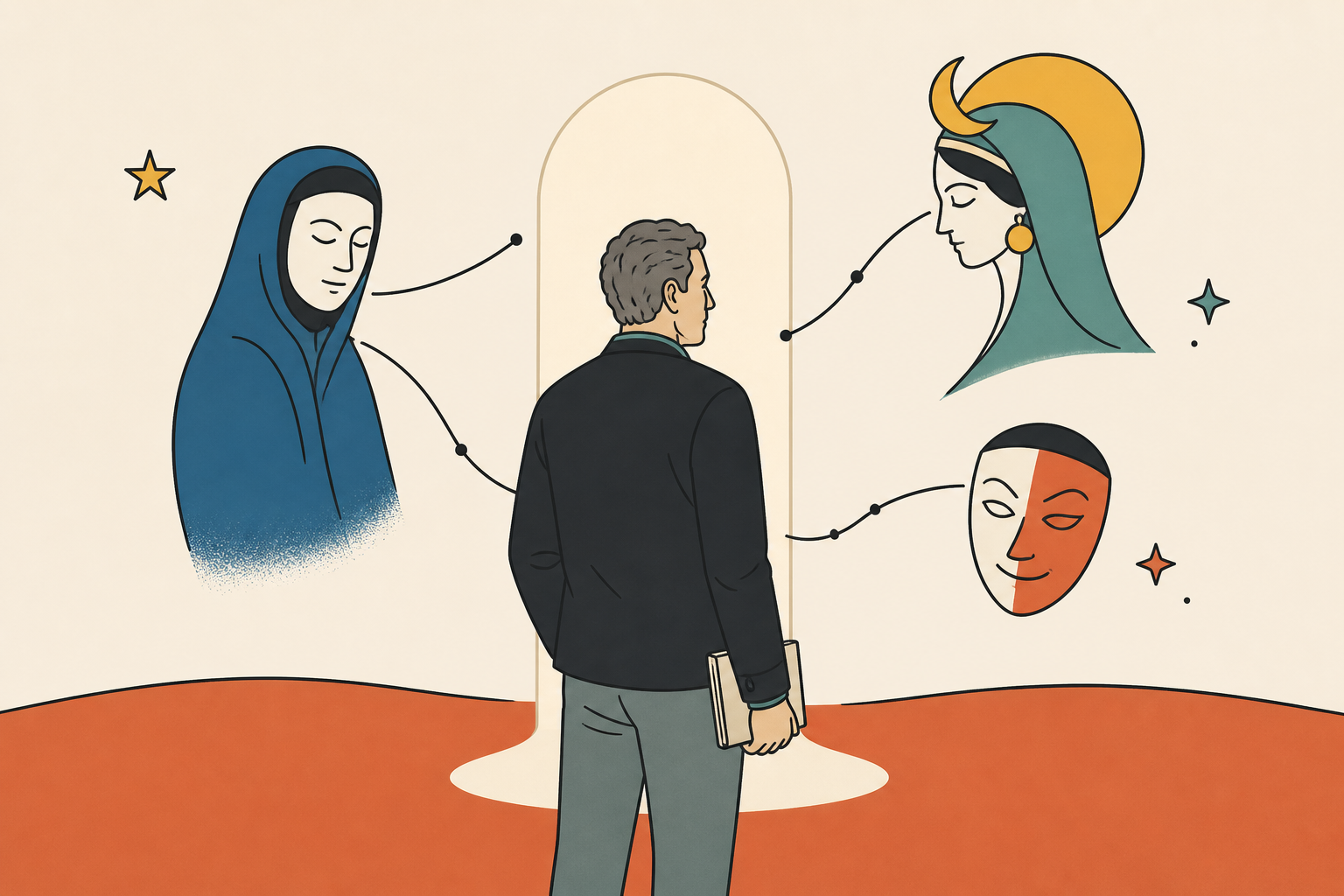
A writer stands before a doorway connected to three archetypal possibilities: a robed sage, a lunar seer, and a divided trickster mask.

This morning I picked up a printed copy of Change Magick: A Modern Framework for Personal Mastery from the office floor and began leafing through it. I hadn’t looked at the framework for a while. It was still alive with great stuff: chaos magick, Jungian psychology, NLP, belief as a tool, personal mythology, ritual, shadow work. Much of it has since found its way into Narrative Alchemy, but the framework still holds together in its own right.

I was looking for something I could try today. One practice caught my attention:

Archetypal invocation for daily empowerment.

Archetypal invocation is a way of finding a figure larger than your habitual self and allowing that figure to alter how you stand, see, speak, and act for a while. It can happen before a difficult conversation, at the edge of a blank page, or in the car park before you walk into a room where the old version of you usually takes over.

I decided to try it today. If it catches your attention too, the practice below gives you a way to test it in a real situation of your own.

The figures behind the face

Jung used archetype for recurring patterns in psychic life that appear through dreams, stories, religions, art, fantasies, and behaviour. In “The Concept of the Collective Unconscious”, he distinguishes the inherited possibility of a pattern from the particular image it takes in a culture or a life. We never meet an archetype naked. We meet images: the Mother, the Child, the Trickster, the Warrior, the Wise Old Woman, the King, the Hermit, the Wanderer, the Magician. The pattern puts on local clothes.

The Warrior is not one fixed character with a sword and an expensive beard. A nurse holding steady during a night shift may carry the pattern. So may the person who finally says no to a relationship that has hollowed them out. The Warrior might arrive as quiet endurance, clean boundary, moral courage, disciplined attention, or the willingness to remain present when every part of you wants to flee.

An archetype gives related actions, images, emotions, postures, and values a recognisable shape. It lets the psyche say, “This kind of human situation has happened before. Here is one old pattern for meeting it.”

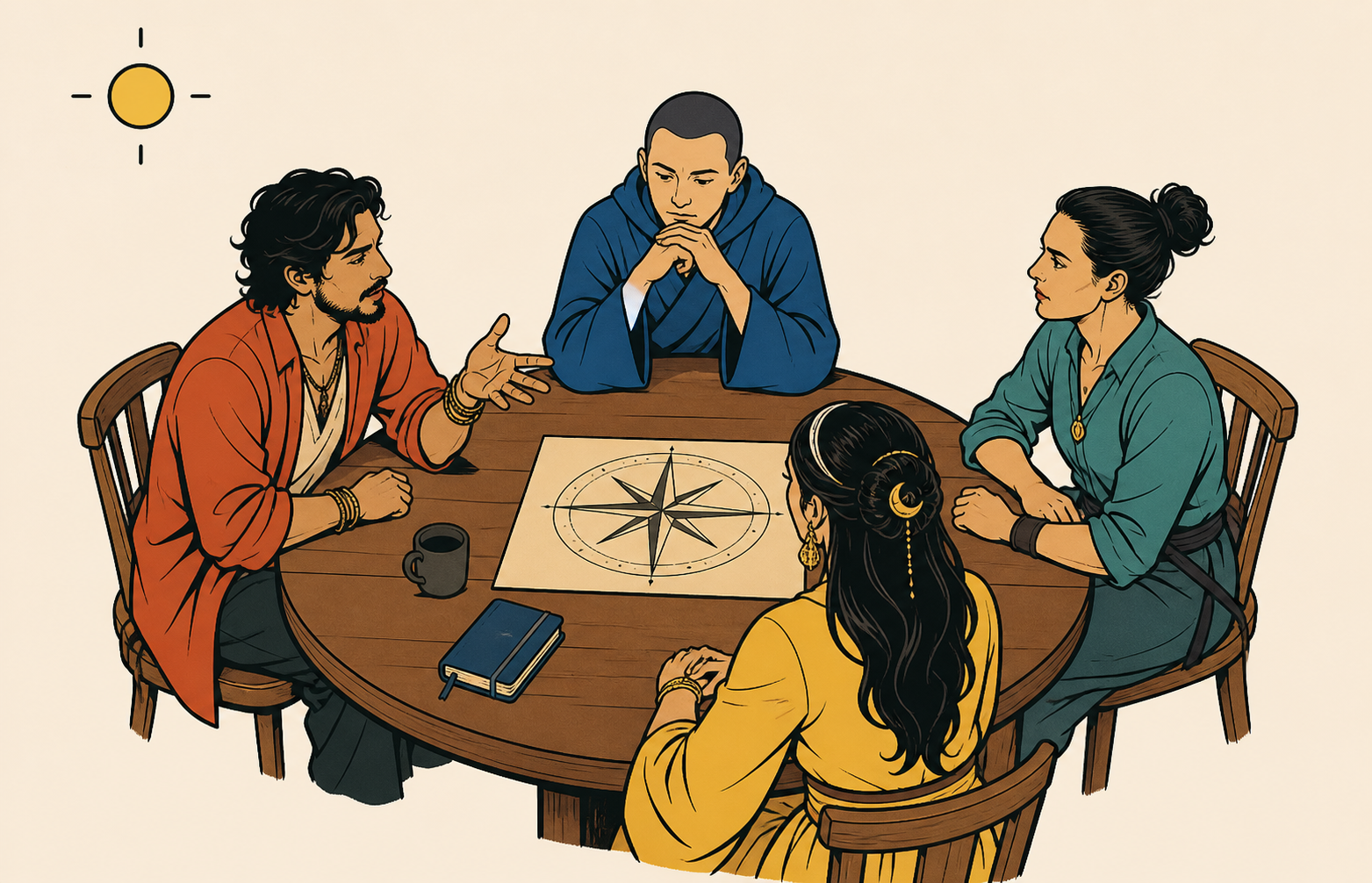
I’ve already been using this through what I call the inner council. The Monk protects contemplation, freedom, study, and the right to follow the rhizome. The Frontman wants contact, audience, livelihood, and the live current of being seen. The Trainer turns knowledge into practices that another person can use. The High Priestess listens for the pattern beneath their arguments.

These figures began as a way of making an inner conflict visible. Once they had names, I could hear what each one wanted without forcing them into a single grey compromise. The High Priestess, in particular, changed the room. She didn’t bring another opinion. She brought a different quality of attention: slower, receptive, less eager to turn every mystery into a plan. That council grew from the same practice I explored through tarot.

That is close to the method Jung describes in “The Transcendent Function”: beginning with a real mood or emotional charge, allowing its images and associations to develop, then giving them a concrete form through dialogue, writing, movement, drawing, or fantasy. You don’t surrender your judgement to the figure. You meet it. You let it speak, question it, argue with it, notice what changes in the encounter.

There is a useful tension here. If I reduce the High Priestess to “my intuitive side,” the image loses some of its power. She becomes a label on a storage box. If I treat her as an infallible supernatural authority, I have given the image far too much power. The middle path is imaginal relationship: take the figure seriously without mistaking the figure for the whole truth.

The symbol must not devour the person.

Four distinct inner figures seated around a circular council table with a compass-like symbol at the centre.
The inner council gives conflicting patterns a place to speak without forcing them into one voice.

You are invoking all the time

Formal invocation feels strange because everyday invocation passes without comment.

Put on a uniform and see what happens to your spine. Walk into a school reunion and notice which age your voice becomes. Sit behind a desk with your job title on the door. Lace up boots for a long walk. Pick up a guitar in front of an audience. Enter the kitchen where your family is already arguing. Each setting calls forward a version of you.

The room invokes. The clothes invoke. The remembered audience invokes. Music invokes. Language invokes. Another person’s face can summon a character you haven’t played for twenty years.

Social life depends on this capacity. We move between roles without considering it occult. Friend, parent, teacher, stranger, lover, writer, customer, patient. Each role selects certain memories and behaviours while pushing others towards the wings. Trouble begins when one role takes the theatre and refuses to leave, or when the character summoned by a situation is the least capable one available.

The person facing a difficult meeting may invoke the Pleaser before the door opens. The blank page may invoke the Examiner, complete with red pen and disappointed expression. A money conversation can summon the Frightened Child even when the adult at the table has decades of experience.

Archetypal invocation introduces choice into that process. Instead of asking, “How do I make myself feel confident?”, I can ask, “Who knows how to enter this room?”

Confidence is an abstraction. A seasoned Diplomat knows how to pause before answering. A Warrior knows where the boundary lies. A Trickster can break the spell of false seriousness. A Caregiver can stay close to pain without rushing to fix it. A Sovereign can make a decision and accept the cost.

Psychology has several neighbouring ideas. Research on embodied cognition challenges the picture of thought as something that happens in a sealed chamber behind the eyes; cognition develops through the traffic between brain, body, and environment. The much-discussed work on “enclothed cognition” asked whether clothing can affect attention through both its symbolic meaning and the experience of wearing it. A later meta-analysis raised concerns about the repeatability of the earliest studies while finding support for newer work. The modest question remains useful: what we put on may participate in the state we enter.

A study often called the Batman effect found that young children persisted longer at a dull task when they took the perspective of an admired character. Batman gave them enough distance from immediate frustration to act differently. Adults may have better vocabularies for self-regulation, but we still borrow courage from people, characters, ancestors, songs, uniforms, and stories.

The imagination is not floating above behaviour. Give a state a name, a face, a posture, and a field of values, and you create more handles by which the body can find it.

Invocation is more than dressing up

A costume can help, but the practice goes deeper than wearing a cloak and hoping Odin sorts out your inbox.

An archetype includes a way of selecting information. Invoke the Warrior and you may see the point of decision. Invoke the High Priestess and you may notice what everyone has spoken around. Invoke the Fool and the same situation may reveal an opening where the cautious self saw only embarrassment. Each figure edits the scene.

This is why invocation belongs inside Narrative Alchemy. A story does not live only as a sentence in the head. It lives in what the body expects, which details the senses notice, the meaning assigned to another person’s silence, and the action that feels possible next.

I wrote about identity as a narrative repeated until it feels like ground. Invocation works from the other direction. Instead of analysing the old story for another hour, you give a different pattern temporary use of your hands and feet.

Temporary matters. The aim is not to replace a cramped identity with a grandiose one. “I am always the Warrior” is another prison, and probably an exhausting person to live with. Invocation works best as a deliberate movement into a pattern, followed by a deliberate return.

Chaos magick contributes a useful lightness here: belief can function as an instrument. Enter the ritual fully enough for it to alter experience, then set it down and examine what happened. That experimental stance runs through Change Magick and Narrative Alchemy. We can inhabit a useful fiction without demanding that it become the final metaphysics of the universe.

The test is not whether the archetype was “really there.” The test is what you could perceive and do while the pattern was active, what it cost, and whether the result made your life more honest.

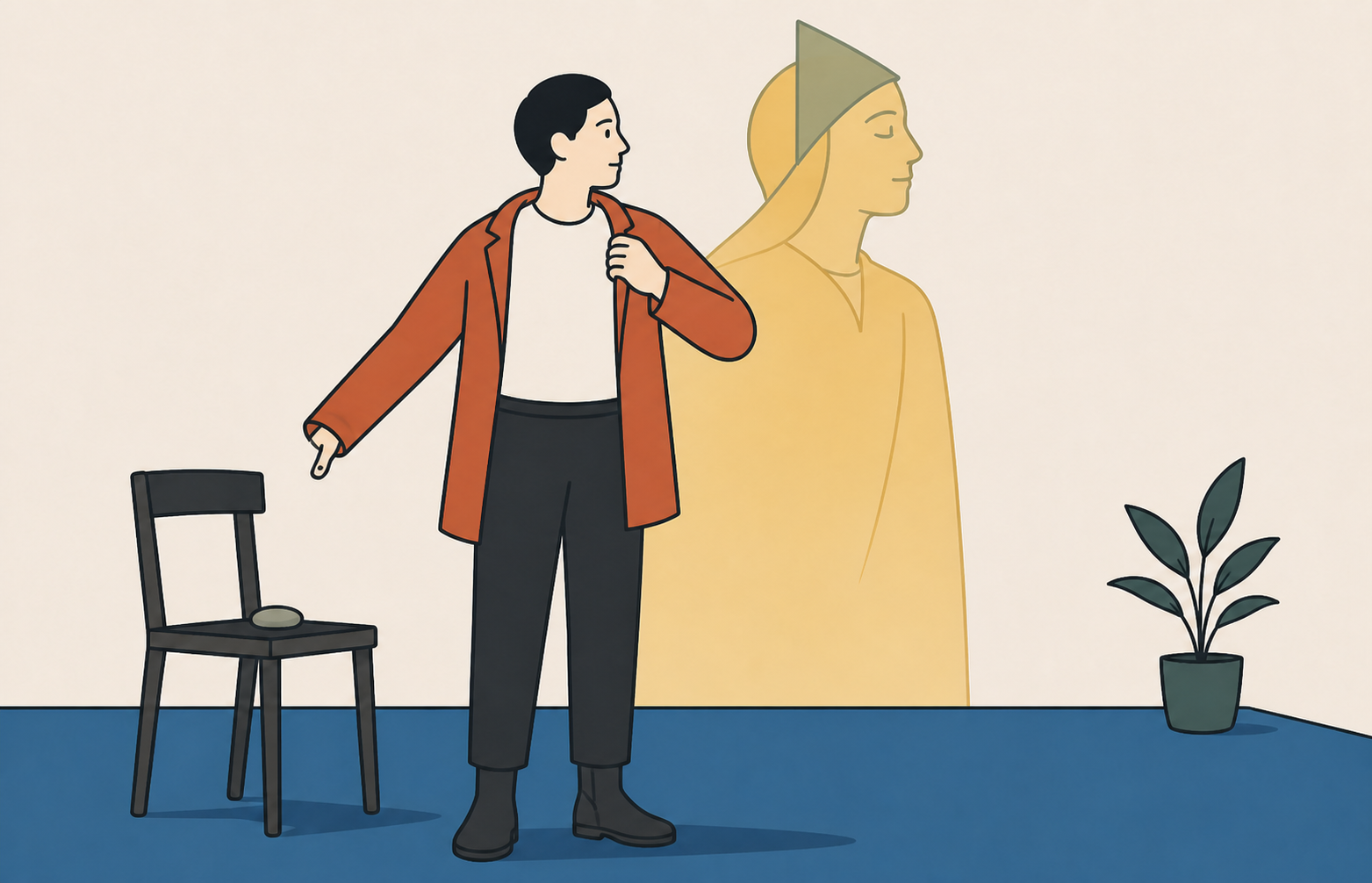
A person in an orange coat stands before a large moonlit archetypal face, joining imagination to bodily stance and action.
Invocation becomes useful when the image reaches posture, breath, attention, and action.

An experiment: borrow a larger self

Set aside thirty to forty-five minutes. Choose a real situation close enough to matter and small enough to test. A conversation you have been postponing. An hour of writing. A decision that has gone soft around the edges. A walk taken with a question. Don’t begin with your deepest trauma or the most explosive relationship in your life. An experiment needs enough pressure to reveal something, not so much that it floods the laboratory.

1. Name the scene

Write three plain sentences:

  • What am I about to do?
  • Which version of me usually appears here?
  • What becomes difficult when that character takes over?

Stay with behaviour. “I lose my power” gives you little to work with. “I talk too quickly, soften every request, and agree before I have checked my diary” gives the experiment somewhere to stand.

2. Choose the needed quality before the figure

Ask what the situation requires: courage, patience, mischief, steadiness, receptivity, clean authority, tenderness, endurance, curiosity.

Then choose a figure who carries that quality for you. Draw from myth, tarot, fiction, history, family memory, religion, cinema, or your own dreams. Athena, the Hermit, Columbo, Ripley, the High Priestess, your grandmother at the kitchen table, a nameless ferryman, the old martial arts teacher from a film you saw at twelve. Cultural respect matters; work with figures you know enough to approach without turning someone else’s living tradition into a prop.

Choose a figure with edges. “The Successful Person” is a motivational poster. Columbo has a coat, a pace, a way of asking one more question while appearing to have missed the point. Specificity gives the nervous system something to enact.

3. Interview the figure

On paper, ask:

  • What do you notice first in this scene?
  • What do you refuse?
  • What do you protect?
  • How do you use your voice?
  • What is your shadow here?
  • Which other figure keeps you honest?

Write the answers quickly in the figure’s voice. Let surprise happen, but keep your adult judgement in the room. An invoked Warrior who wants to destroy a colleague has exposed inflation or anger, not delivered sacred instructions. Bring in the Diplomat, Healer, Fool, or Witness as a corrective.

The best archetypal work is rarely a solo act. In The Warrior Archetype in Tarot, the Warrior develops across different cards rather than appearing as one lump of aggression. My own Warrior needs the Taoist Wizard: discipline corrected by timing, force corrected by attunement. Each figure keeps the other from becoming a caricature.

4. Build a threshold

Create a small transition into the role. Change one item of clothing. Stand in a different place. Put on one piece of music. Hold an object. Draw a mark on a card. Speak the figure’s name.

Then alter three physical details:

  • stance;
  • breath;
  • gaze.

Don’t perform for an imaginary audience. You are giving the body a clear instruction. If your figure is the Sovereign, you might place both feet on the floor, let the exhale finish, and look at the whole room before speaking. If your figure is the Trickster, loosen the knees, tilt the head, and search for the detail that makes the official story wobble.

Say:

For the next thirty minutes, I give the [figure] a seat at the controls. I remain responsible for what I do.

That last sentence stays in the ritual.

5. Take one piece of reality through the figure

Do the task. Write the page. Make the call. Walk with the question. Enter the meeting.

Keep the experiment narrow. You are testing whether this pattern changes perception and action. Notice one moment when your habitual character would have taken over. What does the invoked figure do instead?

You may feel nothing dramatic. Good. The Rubedo of this kind of work often looks like Tuesday morning: a slower answer, a straightened sentence, a request made without apology, ten more minutes at the page. Understanding becomes transformation when it reaches muscle and timing.

6. Return the borrowed face

End on purpose. Remove the item. Change the music. Wash your hands. Step outside. Take three ordinary breaths and name five things in the room.

Say:

The experiment is complete. I release the figure and return as myself.

This is not empty ceremony. De-roling protects you from confusing access with identity. You borrowed the Warrior’s boundary; you do not need to spend the evening patrolling the kitchen. You borrowed the High Priestess’s silence; you still have to answer your messages.

7. Record the evidence

Write without interpretation for five minutes:

  • What changed in my body?
  • What did I notice that I usually miss?
  • What action became possible?
  • Where did the figure become theatrical, inflated, or unhelpful?
  • What quality do I want to integrate without keeping the costume?

Run the same invocation three times before deciding what it means. Change one variable if needed. Compare it with doing the task in your ordinary state. Treat the journal as a field notebook, not a book of prophecies.

The figure is a doorway

Archetypal invocation can become another form of avoidance. You can spend a week designing the perfect ritual instead of making the phone call. You can inflate a frightened ego by naming it King. You can use the Magician to pretend that consequences are optional. You can let the High Priestess wait forever for a sign.

Every archetype carries a shadow. That is one reason I prefer a council to a throne.

The practice also has limits. If inner figures become intrusive, frightening, commanding, or difficult to distinguish from shared reality, stop the experiment and seek qualified support. Active imagination asks for a stable witness: the part of you that can enter the image and come back, holding metaphor and matter in the same hand.

Used with that grounding, invocation gives us a form of rehearsal that is richer than positive thinking. “I am confident” leaves the imagination hungry. “For this conversation, I will borrow the patience and unhurried gaze of the old ferryman” supplies a body, a tempo, and a relationship to the crossing.

Something from the invoked figure may remain after the ritual. The experiment can reveal that the borders of the familiar personality are less solid than they looked.

Archetypal invocation is one of the bridges between Change Magick and Narrative Alchemy. Change Magick works with belief and personal power. Narrative Alchemy works with the stories, images, and inherited roles through which a self takes shape. Archetypal invocation joins the two at the level of lived experiment. A new story borrows a body for half an hour and finds out whether it can walk.

The printout on the office floor reminded me that Change Magick had never really gone away. The project had been wearing other names, speaking through later work, waiting inside phrases I still use.

The framework returned as an archetype of its own: the manuscript on the floor, dusty but unoffended, carrying a tool I wanted to use today.

So I’m putting the tool back on the table as a question you can test with your own breath, posture, imagination, and next action:

Who knows how to enter the room you are about to enter?


If this post gave you something to carry into your day, consider supporting my work by buying me a coffee or making a monthly donation or subscribing (free) to the blog.
The Man Who Drew Desire

The life and afterlife of Austin Osman Spare

In photographs, Austin Osman Spare often looks as if he has been caught halfway between worlds. As a young man, he appears pale, beautiful and theatrical, with dark hair swept from his forehead and the wary expression of someone who already suspects that ordinary reality is a confidence trick. In later portraits the beauty has thickened into something more weathered. He sits among cats, books, pictures and the accumulated bric-a-brac of a South London room. The young Edwardian prodigy has become a borough sorcerer.

Both figures belonged to him. So did several others: illustrator, satirist, war artist, mystic, magazine editor, teacher, pub exhibitor, animal lover and prophet of the unconscious. Spare spent his life slipping between identities before the art world or the occult establishment could settle on one. His work carried traces of Symbolism, Art Nouveau, spiritualism, caricature, automatic drawing and the grotesque, yet he never fitted comfortably inside any of them. Even now, he tends to be approached through a side door. Artists find him through magic. Magicians find him through art. Musicians, tattooists and practitioners of chaos magic meet him through the sigil, the strange compressed emblem of desire that has become his most durable invention.

He was born in London on 30 December 1886, the son of Philip Newton Spare, a City of London policeman, and Eliza Osman. The family lived first around Snow Hill and Smithfield, then in Kennington. This was a London of slaughterhouses, churches, railway arches, public houses and crowded streets. Spare grew up close to the city’s physical underworld, where animals, labour and death remained visible. The horned bodies and human-animal hybrids that later gathered in his drawings did not arrive from some bloodless realm of occult symbolism. They had hooves. They carried the stink of the market.

He began evening classes at Lambeth School of Art while still a boy and found work designing for Powell’s glassworks in Whitefriars Street. Visitors to the firm noticed his drawings and helped him secure a scholarship to the Royal College of Art. The college soon discovered that talent and obedience don’t always travel together. Spare disliked its teaching, missed classes and resisted the academic preference for modelling through shade. He trusted the line. Aubrey Beardsley, Charles Ricketts, Edmund Sullivan and George Frederic Watts gave him a visual ancestry, though even in his earliest work Spare’s line seems to know more than the hand guiding it. It coils, sprouts, mocks and mutates. Faces emerge from ornament. Bodies open into other bodies.

In 1904, when Spare was seventeen, his father submitted two drawings to the Royal Academy without telling him. The Academy accepted a bookplate design for its Summer Exhibition. Newspapers seized on the story of the precocious young artist and described him as the exhibition’s youngest entrant. Some inflated the claim and made him the youngest artist ever shown there. The legend began growing almost as soon as the career.

Spare helped the process along. He understood the usefulness of a persona and presented himself as a young visionary in flamboyant clothes, already speaking about mystical ideas that he would spend the rest of his life elaborating. His first self-published book, Earth Inferno, appeared in 1905. It combined pictures, poetry and gnomic declarations in a form halfway between an artist’s book and a private scripture. Its influences included Dante, the Bible, Theosophy and Omar Khayyam, though Spare was beginning to name his own figures: Zos and Kia.

Zos was the embodied self, experienced through flesh, gesture and imagination. Kia was harder to define, an all-pervading field of possibility beyond the divisions imposed by conscious thought. Together they formed the poles of Spare’s personal cosmology. He didn’t inherit this system intact from a lodge or scripture. He drew it out of his own experience, then continued revising it through pictures and prose. His art and magic grew from the same root.

By 1907, Spare had attracted the attention of the London avant-garde. His exhibition at the Bruton Gallery prompted comparisons with Beardsley and produced the sort of disgust that can be useful to a young artist. The Observer called his work “abnormal, unhealthy, wildly fantastic and unintelligible.” Another reviewer admired his “creative flow of impossible horrors.” The phrase catches something essential. Spare’s horrors flow. They aren’t fixed monsters placed in a scene. They leak across the boundary between human and animal, beauty and decay, waking thought and the older life underneath it.

Aleister Crowley saw the work and recognised a fellow traveller, or perhaps a possible recruit. He became a patron, published Spare’s drawings in The Equinox and brought him into the A∴A∴, his magical order. Spare adopted the name Yihovaeum and remained associated with the group for several years, though he never surrendered to its hierarchy. Crowley’s ceremonial system demanded grades, initiations, discipline and a taste for grand ritual. Spare moved in the opposite direction. He wanted a magic stripped of robes, temples and inherited furniture. After the relationship soured, he mocked ceremonial magicians as “the unemployed dandies of the Brothels.”

His alternative appeared most fully in The Book of Pleasure (Self-Love): The Psychology of Ecstasy, self-published in 1913. The book resists a clean summary because resistance sits close to its purpose. Spare’s prose moves through paradox, private terminology and sudden attacks on religion, morality and conscious will. Beneath the thorns lies a practical insight: the conscious mind often blocks the desires it claims to pursue. A desire acquires force when it passes below deliberate thought and enters the unconscious.

Sigils offered a method for getting it there. Spare would reduce a written statement of desire into a design, combining and distorting its letters until the original sentence could no longer be read. The practitioner charged the resulting glyph through intense concentration or altered consciousness, then forgot it. The act of forgetting mattered. Conscious craving had to loosen its grip so that the desire could sink into the deeper mind.

The method reveals the trained draughtsman inside the magician. Spare treated language as raw graphic matter. A sentence became a line; the line became a glyph; the glyph became a carrier moving between conscious intention and unconscious action. The sigil was a word taught to travel without its meaning showing.

In 1911 Spare married Eily Gertrude Shaw. The marriage deteriorated, and they later separated without divorcing. His work continued across illustration, publishing and private revelation. He founded the art journal Form with Frederick Carter in 1916, bringing together writing, drawing and discussion of automatic processes. The magazine struggled commercially, but it placed Spare close to a current that would soon become central to twentieth-century art: the attempt to bypass conscious control and give the hidden mind a hand in making the work.

The First World War interrupted these experiments. Conscripted into the Royal Army Medical Corps in 1917, Spare worked as a medical orderly and later produced illustrations connected with the war. He returned to civilian life in 1919 and published The Focus of Life two years later. He revived Form, then co-edited The Golden Hind with Clifford Bax. Both magazines folded. Spare kept producing. In 1924 he assembled The Book of Ugly Ecstasy, a sketchbook full of automatic drawings and grotesque beings. The Anathema of Zos, published in 1927 in an edition of one hundred copies, turned his contempt for respectable society into a private sermon.

The London art world had begun to move away from him. Exhibitions in the late 1920s attracted little notice. His 1930 show of distorted “sidereal” portraits became his last West End exhibition for seventeen years. Surrealism soon arrived in Britain carrying an interest in dreams, automatism and the unconscious that Spare had pursued for decades. Journalists briefly rediscovered him as a possible “father of Surrealism,” though he remained too idiosyncratic to join the movement’s official story.

His retreat from the West End has often been told as a fall from promise into poverty and obscurity. There was poverty, and there was neglect, but the word failure misses the kind of life he made. Spare moved through working-class districts of South London, teaching, drawing local people and holding annual exhibitions in his flats. The domestic room replaced the commercial gallery. According to his obituary in The Times, visitors would ring the bell and inspect pictures hanging in the living room, bedroom and kitchen, sometimes in the company of the working women and elderly neighbours who had modelled for them. He sold drawings for a few guineas because he believed ordinary people wanted art and could afford it when artists and dealers stopped pretending otherwise.

This later Spare deserves more attention. The myth of the solitary magician can obscure the man who drew ageing faces with patience and tenderness, cared for stray animals and welcomed buyers into rooms crowded with pictures. His technical skill remained formidable. He could catch a likeness with a few lines, then let the face warp into dream, ancestry or spirit. His human beings never seem sealed inside their skin.

War reached him again in 1941 when a bomb destroyed his home and much of his work. He was left homeless for a time and suffered injuries that affected his ability to draw. He recovered and taught his hand to work again. In 1947 he staged a successful comeback exhibition at the Archer Gallery, showing more than two hundred works. Celebrity portraits appeared alongside spiritualist subjects, old faces and fantastic creatures. Later critics would detect early Pop Art in these images, just as others had found proto-Surrealism in his automatic drawings. Spare kept arriving before movements that wouldn’t have known what to do with him had he joined them.

During the last years of his life, he became close to Kenneth and Steffi Grant. Kenneth Grant, a younger occultist with connections to Crowley, recognised the importance of Spare’s magical ideas and helped preserve them. Spare returned to occult writing and produced new manuscripts, including the Zoetic Grimoire of Zos. He also held exhibitions in pubs, bringing his work back into the social world of Walworth Road rather than waiting for Bond Street to invite him home.

Spare died in Stockwell on 15 May 1956 after his appendix burst. He was sixty-nine. At the time of his death, he occupied an uncertain place in British art, remembered by a few collectors and friends, dismissed by others as a leftover from the decadent 1890s. His reputation began to revive in the 1960s and 1970s. Kenneth Grant’s writing carried his occult ideas forward, while artists and collectors recovered the drawings. By the late twentieth century, chaos magicians had adopted his sigil method as one of their foundational practices. His influence passed into experimental music, body art, comics, performance and the occult underground.

That afterlife has introduced a new distortion. Spare sometimes disappears behind the sigil, reduced to the inventor of a magical logo-making technique. Yet the sigil makes sense only inside the larger body of his work. He spent a lifetime testing how a mark might move between intention and instinct, how a face might contain its ancestors, how the hand might know what the conscious mind had forgotten. His magic remained the magic of an artist because drawing was his primary instrument of thought.

The city that made him still clings to the work. You can feel Edwardian London, the slaughterhouse district, the Royal Academy, the bedsit, the bombed room and the Walworth pub. Spare went underground without leaving the streets. He found his other world inside this one, in a neighbour’s ageing face, the curve of an animal’s horn, a few letters twisted together on a piece of paper.

Perhaps that explains his continued pull. Spare offers no clean separation between imagination and matter. Desire enters the hand. The hand makes a mark. The mark passes out of sight and begins its obscure work. Somewhere in South London, an old artist sits among his cats and pictures, drawing a line that hasn’t finished moving.

Sources and further reading

  • Phil Baker, Austin Osman Spare: The Life and Legend of London’s Lost Artist (Strange Attractor Press, 2011).
  • Robert Ansell, Borough Satyr: The Life and Art of Austin Osman Spare (Fulgur, 2005).
  • Austin Osman Spare, Earth Inferno (1905).
  • Austin Osman Spare, The Book of Pleasure (Self-Love): The Psychology of Ecstasy (1913).
  • Austin Osman Spare, The Focus of Life (1921).
  • Austin Osman Spare, The Anathema of Zos (1927).
  • Austin Osman Spare at Art UK
  • Biographical overview and bibliography

If this post gave you something to carry into your day, consider supporting my work by buying me a coffee or making a monthly donation or subscribing (free) to the blog.
There is a will inside us that is …

There is a will inside us that is older than thought.

It moves beneath the surface of the personality, beneath preference, fear and habit, carrying an intention we may only dimly perceive. We feel it as a pull, a recurring image, a quiet insistence that returns even after we have ignored it. Something in us remembers a direction the conscious mind has forgotten.

Our choices are the places where this hidden intention enters the world. Each decision opens one path and closes another. Each act becomes a small ritual of alignment or estrangement. We are always moving either nearer to the inner current or further from it.

This does not mean every impulse is sacred. The deeper will is easily confused with appetite, anxiety or the hunger to be seen. It speaks more quietly than these. It does not shout. It gathers. It waits. It reveals itself through patterns, synchronicities, dreams, resistances and the strange aliveness that accompanies certain paths.

Perhaps intention is not something we invent, but something we enter into relationship with. A thread running through the labyrinth. A seed already carrying the image of the tree. A hidden star by which the soul attempts to navigate.

The task, then, is not merely to exert more will, but to become transparent enough to recognise what is willing itself through us.

Every choice becomes a question offered to the unseen:

Does this bring me into deeper alignment with the life seeking to emerge through me?

We are never entirely still. Even in uncertainty, the soul leans somewhere.

There is no universal right way to live, …

There is no universal right way to live, but the platforms keep presenting life as if there were.

Facebook, TikTok, and Instagram turn existence into a hall of mirrors. Someone is travelling more, earning more, healing faster, raising better children, building a cleaner morning routine, finding their purpose, buying the van, leaving the city, moving to the city, lifting heavier, reading more books, becoming more spiritual, becoming less spiritual. Every swipe offers another life you could be failing to live.

After a while, you stop asking, What feels true for me? and start asking, How am I doing compared with the lives I can see?

Life begins to feel like a continuous assessment. You become both the student and the examiner, checking your days against criteria you never consciously chose. The standards change before you can meet them because the feed must keep moving. Yesterday you needed discipline. Today you need softness. Tomorrow someone will tell you that softness is avoidance and what you need is a 5 a.m. ice bath.

The struggle to “get life right” can become the very thing that removes you from your own life. Your attention moves away from the actual texture of your days: the work that absorbs you, the people around whom your body relaxes, the pace at which your mind opens, the small practices that restore you. Instead, you begin organising yourself around borrowed desires.

And borrowed desires are difficult to satisfy. Even when you get what you thought you wanted, the experience can feel strangely hollow because the wanting came from somewhere else.

I don’t know whether the core self is a fixed thing waiting underground to be uncovered. It may be closer to a grain in the wood, a direction in which your life bends when you stop forcing it. You notice it through contact: what gives you energy, what leaves a sour taste, what you keep returning to when nobody is watching, what kind of trouble feels worth having.

Living in accordance with that grain won’t necessarily make life easier. It may make you less legible to the people selling the approved versions. You may want a smaller life than the feed admires, or a stranger one. You may care deeply about something that photographs badly. You may discover that the life which fits you contains long stretches that look like nothing much from the outside.

Perhaps the question isn’t Am I living the right way?

Perhaps it is:

Whose idea of “right” is running through my head?

And beneath that:

What does my life begin to do when nobody else is scoring it?

I picked up an old book this morning: …

I picked up an old book this morning: Perceiving Ordinary Magic: Science and Intuitive Wisdom by Jeremy Hayward. The cover is a blue corridor of repeating geometry, the kind of image that used to promise either a difficult physics lecture or a trip through somebody else’s consciousness.

Somewhere in its opening territory, Hayward pointed me back towards Chögyam Trungpa and the Shambhala teachings. I had known the word warrior mostly through its degraded modern forms: the hard man, the self-improver, the person who mistakes tension for strength. Trungpa’s use of it runs in another direction. The warrior is the one who stops arranging life around not feeling what is true.

How often do I reach for the phone because the room has gone quiet? How quickly do I begin rehearsing the future when a task becomes awkward? How much of what passes for planning is just an elaborate way of avoiding the next plain thing?

The Shambhala language calls these little defensive constructions the cocoon. I know the feeling. A bright, upholstered chamber made of scrolling, second-guessing, imagined conversations, old arguments, and the promise that relief is one more click away.

Hayward’s phrase, “ordinary magic”, offers another way into the same space. Not magic as an escape from the real, but the possibility that the real becomes more available when we stop trying to categorise, use, control, or explain it into submission.

I have set up a small fourteen-day experiment for myself: sit for fifteen minutes with my eyes open; walk without headphones; notice one cocoon move; make one small honest return; write a few lines before bed.

No warrior costume. No spiritual badge. Just an attempt to find out what becomes perceptible when I stop defending myself from the ordinary.

The Map Is Not the Adventure: Reading Rebecca Solnit’s A Field Guide to Getting Lost

I took a different street home the other day.

There was no great expedition in it. I was walking back through Southam by a route I know too well, heading toward the familiar turn that gets me home with the least fuss. Then I thought: I could go that way instead. I had no errand on that street. No appointment. No shop to visit. It was a residential stretch of town, the kind of road I had probably passed a hundred times without giving it a glance because it had never offered anything I needed.

That was the point.

A Field Guide to Getting Lost - Rebecca Solnit

I walked it anyway. The houses had a different feel. The street had its own arrangement of front gardens, parked cars, brickwork, hedges, caravans, and small human decisions. Nothing spectacular happened. I did not discover a portal in the pavement or receive a message from a crow. I just entered a portion of my own town that had remained invisible because convenience had made it irrelevant.

That small diversion has been sitting beside my reading of Rebecca Solnit’s A Field Guide to Getting Lost. Solnit’s book is full of bigger territory: deserts, artists, explorers, blue distance, memory, loss, death, wilderness, the strange gap between where we are and where we thought we were going. But it has made me think again about the domestic scale of getting lost. How much of our world disappears because we know the quickest route? How much of ourselves disappears because we have accepted a plan before we have tested whether it belongs to us?

This is not a standard book review. I am not going to march through the contents, hand out marks, and tell you who should purchase it. I want to stay closer to the experience of reading it. Solnit has written a book that gives wandering a form. It keeps setting off from one subject, finding an adjacent path, allowing history, landscape, art, grief, philosophy, and personal memory to change the pressure of the original question. Then, when you have forgotten where the question began, she brings you back to it from another direction.

That is one reason I loved it. It is also why the book has left me thinking about walking, blogging, inherited life plans, GPS, the old pleasure of getting a map wrong, and the part of us that wants somebody else to tell us what to do next.

The human appetite for a map

Most of us want a map. We want the plan, the route, the reassuring sense that the person at the wheel knows where the road is going. We want to know that the job will lead somewhere, that the relationship is on schedule, that the decision is sensible, that our identity holds together when somebody asks what we do.

There is nothing foolish about wanting security. A map can keep you from walking over a cliff. A plan can help you feed a family, meet a deadline, recover from a crisis, or find your way home before dark. I used to love rock climbing and mountain walking, and I have never confused adventure with a refusal to prepare. A compass, a map, some knowledge of the weather, enough food, an honest sense of your own ability: these things matter.

But a map can also become a substitute for contact with the territory.

Before the phone put an OS map and a blue dot in every pocket, you could get properly twisted around. A riverbed might not be where you expected it to be. A path might be overgrown. A ridge might look different from the angle you approached it. You worked with map and compass, corrected your bearings, checked the ground against the paper, and slowly found your way through. The point was not to be incompetent. The point was to be in a live relationship with the world.

Now I can walk almost anywhere with the comforting knowledge that a glowing rectangle knows exactly where I stand. That is an extraordinary convenience, and I am glad to have it when I need it. Yet something has changed. GPS can tell me my location without asking anything of my attention. It can preserve me from the experience of not knowing where I am.

The same thing happens in the wider life. We inherit maps before we can inspect them. Get married. Get a job. Buy a house. Have children. Build a respectable career. Keep moving. Do not make a mess. Do not disappoint anyone. I grew up in New Jersey. I had no idea that I would spend much of my adult life in England, that I would be living here twenty-six years later, married, writing this from a town I could not have placed on a map when I was young.

Life had other plans, or perhaps life had no plan at all and kept offering turns I could not see from the starting point. Either way, I have had to lose the plan more than once.

That is why Solnit’s central question catches me so hard:

“How will you go about finding that thing the nature of which is totally unknown to you?”

It is an old philosophical puzzle, but it also describes the ordinary predicament of being alive. The thing you need may not be something you can identify in advance. It may arrive as a place, a person, a vocation, a grief, a book, a thought you only meet once you have moved beyond the territory you know how to name.

The dark is not empty

Solnit writes: “Leave the door open for the unknown, the door into the dark.” It is a sentence with the force of a threshold. The dark here does not mean evil. Nor does it require us to treat mystery as supernatural proof of anything. The dark is the unknown: the unplanned part of a life, the territory that has not yet yielded its terms.

That dark can frighten us because the known gives us a temporary sense of control. We know our role. We know the route home. We know what gets rewarded. We know which version of ourselves other people recognise. Step past that edge and the old signals weaken. You have to listen harder.

There is a line in Solnit’s book, drawing on Walter Benjamin, that has stayed with me:

“To be lost is to be fully present, and to be fully present is to be capable of being in uncertainty and mystery.” I recognise that from the mountains.

Snowdonia has long felt like a spiritual home to me. I can remember stopping on a hill walk and looking out at the vastness around me: old mountains, distance, weather moving through the valleys, and little old me in the middle of it. The endless internal chatter begins to fall away. I am no longer sorting email, rehearsing conversations, checking the clock, or trying to solve the whole rest of my life. My body is on the path. My attention belongs to the ground, the climb, the weather, the next step.

It happens on a long trek with particular force. On the Camino de Santiago, the life I had brought with me seemed to melt off over days of walking. The journey has its own rhythm. You wake, walk, eat, rest, walk again. But the same thing can happen on a local Wisdom Walk. One steep climb is not required. A person can leave the phone in the pocket, skip the route tracking, turn onto an unfamiliar street, and become more available to what is already there.

Camino de Santiago

This is where getting lost becomes something other than escape. It is not disappearing from your life. It is arriving in it.

Adventure with a margin

I do not think getting lost means throwing caution into the hedge and calling the result freedom. The wilderness has no obligation to reward our fantasies. The road does not care whether we have read enough philosophy. A person can get in over their head, physically or psychologically. The old stories understood this. When the hero crosses the threshold, there is no guarantee of return. Some people do not come back because they die. Others do not come back because the strange territory seduces them into losing contact with the world they left.

A writer I once read classified adventure on a scale that ran from harmless outings through to encounters where death became a serious possibility. His point, as I remember it, was that the best adventures sit somewhere near the middle: difficult enough to demand all your attention and skill, dangerous enough to heighten the senses, yet still within your capacity to navigate if you stay awake.

That feels right to me. I have always liked adventure with some control parameters. The best edge is often where you do not know the outcome but you have enough resourcefulness to meet it. You know what to do when you do not know what to do.

That phrase names a kind of personal power. Not power over other people. Not the inflated confidence of somebody selling a system online. Personal power means sovereignty over your own attention and behaviour when the familiar plan stops working. You cannot master the unknown. The unknown keeps moving. The minute you enter a new territory and learn its shape, another edge appears beyond it.

The skill lies elsewhere. You build enough inner authority to cross the next boundary without handing your life over to panic, imitation, or the first confident person who claims to have the answer.

Our culture has made that last temptation very easy. Open YouTube, Instagram, X, or any platform where advice wears a clean shirt and a polished thumbnail, and someone will explain the route. Start this business. Follow this system. Escape the nine-to-five. Become the person you were meant to be. The internet can teach us almost anything. It can also make it look as if everybody else has solved the riddle of being alive.

I know people whose online presence makes their life look assembled, evolved, and complete. Behind the scenes, they are as confused as the rest of us. That is not a moral failure. It is simply a reminder that presentation is not knowledge. A neat map can be an advertisement for certainty rather than evidence of it.

I wrote recently about the story that wants you at your desk, the inherited script that tells us obedience, legibility, and future reward are the only adult forms of life. Solnit’s book belongs beside that question. Getting lost can be a refusal of the approved diagram. It can also be a gentler act: putting the diagram down long enough to see whether another life is trying to make itself known.

A book that wanders on purpose

Solnit does not merely argue for this kind of openness. She writes it.

That is what makes A Field Guide to Getting Lost more than an elegant collection of observations about uncertainty. The chapters are mini explorations. They set out with one pressure and return by a route you could not have predicted. She moves through art, landscape, personal memory, historical material, colour, desire, loss, and the particular lives of people who have lived close to absence. The diversions do not feel like ornaments. They change what the central idea can mean.

I love writing that works this way. I love the moment when a book gives you a point of departure, then lets the mind travel. A remembered scene opens into history. A journey through a place opens into literature. A philosophical question gets returned to the body, the room, the road, a human voice. You make detours, yet the detours are the actual route.

Robert Twigger’s How to Be a Man in the Lousy Modern World does something similar, running the account of a man living through pregnancy and impending fatherhood alongside an inquiry into masculinity. In Robert D. Kaplan’s Balkan Ghosts, travel through actual ground continually opens out into cultural memory, politics, history, and books, before bringing the reader back to a road, a border, a city, a body in motion. Christopher Ross’s Tunnel Vision: Journeys of an Underground Philosopher has that same ability to make place and thought speak to each other.

This is the kind of prose I want to keep learning from. It does not use the world as scenery for a thesis. It lets the world interrupt the thesis.

Solnit’s “blue” sections are part of that method. She has described needing more space as the book developed, and blue becomes more than a way of extending the work. It becomes distance, longing, sky, water, the colour that keeps receding as you approach it. The book gains room to breathe. It can follow a thought past the point where a more efficient writer would close the paragraph and move on.

That may sound indulgent to somebody trained to judge every page by speed and utility. I think it is a form of intellectual hospitality. Solnit gives the reader enough room to have associations of their own. She does not lock every door behind her.

For a writer, this is liberating. An essay does not have to behave like a corporate presentation with a conclusion waiting at the bottom. It can be an ecology. It can wander without becoming vague. It can keep faith with a question long enough for unexpected companions to arrive.

The hearth after the wandering

This is also why the book has refreshed something in my sense of blogging.

I have often thought of myself as an explorer of minds and territories, a pathfinder who goes out to see what is there and comes back to tell the story. The exploration can happen in mountains, in a local town, on the web, through hypertext, in a book, on a long walk, in the odd archive trail that begins with one note and ends somewhere nobody could have planned.

The blog is where I come back.

When I was podcasting more heavily, I used to think of the podcast as a twenty-first-century campfire. The blog has that function too. It is the hearth. You return from the walk or the rabbit hole, sit down among other people, and say: I found this. I do not know whether it is useful to you, but it altered something in me.

That is a different relationship to writing from the one offered by the modern advice economy. The blogger does not have to be the person who possesses the final map. The blogger can be the person who leaves a trace. A map made after wandering is not the same as an instruction manual. It can say where somebody has been without pretending that another person should retrace every footstep.

The hope is not that readers will adopt my worldview. I would rather the piece loosened something. I would rather a reader stopped and wondered: Where did this belief come from? Whose plan am I carrying? What might happen if I took a different turn? Then the comments become part of the work. I share an experience; another person shares theirs; both of us see a little farther. The blog becomes closer to Socrates in the marketplace than a stage where the expert delivers answers.

This is why Narrative Alchemy begins with attention to the stories already running inside us. Stories are code. They organise what we notice, what we fear, what feels possible, and the kinds of future we can imagine. A belief can act like a route we have walked so often that it becomes invisible.

The breadcrumb exercise is one way of stepping off it. Choose a belief and ask where it came from. Who gave it to you? What experience fixed it in place? What purpose did it once serve? Then ask the more awkward question: does it still belong to you? The work is not to fling away every old belief in a fit of rebellion. Some maps contain hard-won wisdom. The work is to notice that a map is a map, not reality itself.

A small field guide of your own

Solnit’s book has not persuaded me to seek danger for its own sake. It has reminded me that I do not need a grand expedition in order to practise an openness to the unknown.

Walk a street in your own town that has no obvious use. Leave the direct route to the high street and take the lane you have never taken because nobody you know lives there and nothing waits for you at the end. Drive by a road you normally ignore and take it, if it is safe to do so. Let the usual calculation of time and efficiency relax for an hour.

Or stay at home. Sit in the garden, make coffee, and follow one belief back through its breadcrumbs. “I have to be sensible.” “I cannot make a living from that.” “People like me do not do that.” “I should know what I am doing by now.” Do not attack the belief. Ask it where it came from. It may have arrived through school, family worry, a humiliation, a reward, an old act of love, a world that has changed around you. Knowing its source does not settle the matter, but it can give you back a little choice.

That is enough for a beginning. You do not have to get lost in a desert. You do not need to throw away the map, the job, the marriage, or the responsibilities that make a life possible. You only need to find one place where the map has become too sure of itself and loosen your grip.

A Field Guide to Getting Lost is an excellent treatise on getting lost because it never turns lostness into a cheap slogan about reinvention. It knows the dark is real. It knows that loss can hurt, that uncertainty has consequences, that the world remains larger than our desire to explain it. Yet it keeps the door open.

Read it if you want a book that will not rush to rescue you from the questions it raises. Read it if you like prose that thinks by wandering, circling, and returning. Read it if you have spent too long following a route because it is the route you know.

Then go out. Take the wrong turn on purpose. Or sit quietly with the belief you have never questioned. You may not find the thing you are looking for. That is the old problem. You may find the thing whose nature you did not yet know.

And that may be where you begin to find yourself.


If this post gave you something to carry into your day, consider supporting my work by buying me a coffee or making a monthly donation or subscribing (free) to the blog.
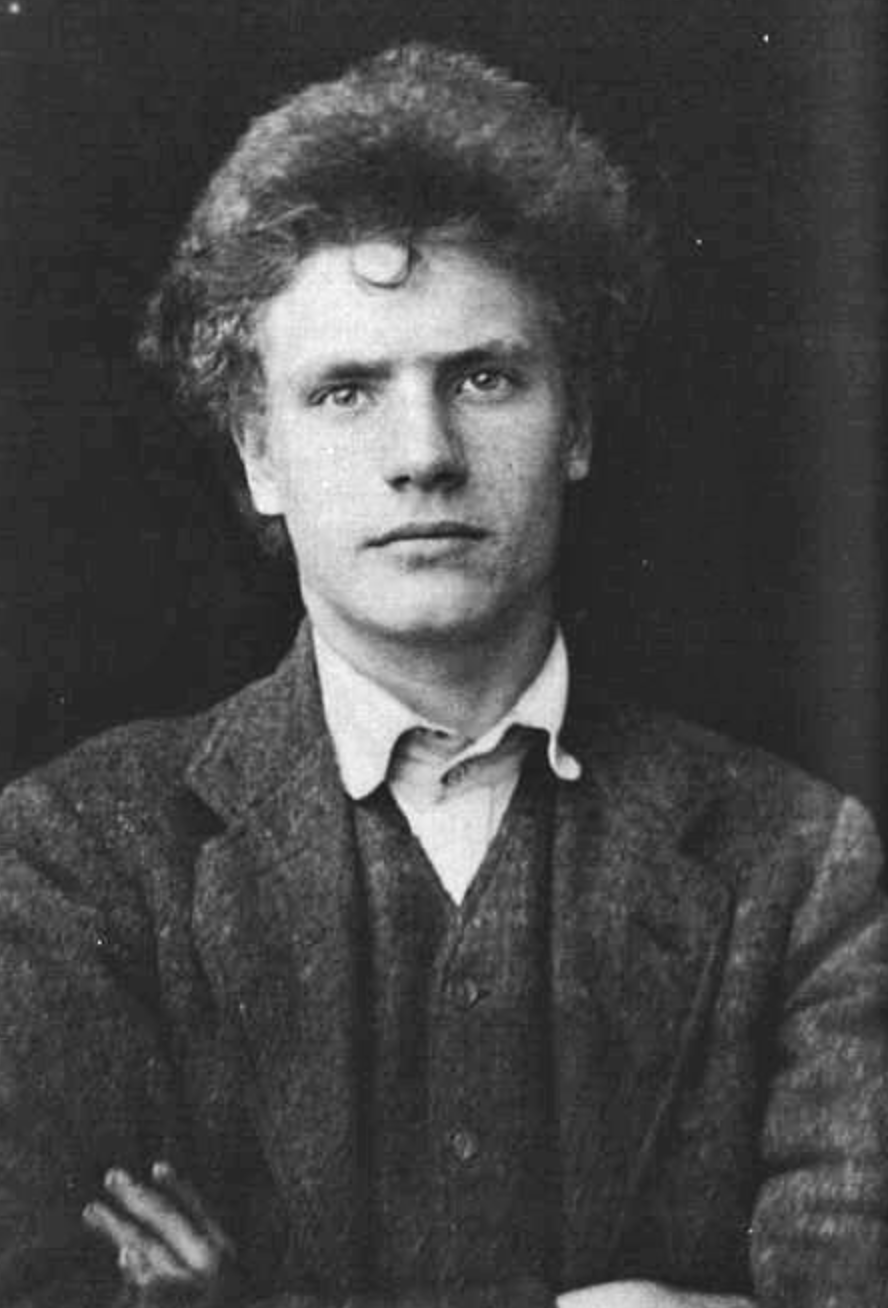
I keep seeing headlines about the new rules …

I keep seeing headlines about the new rules of attention, usually written by somebody who wants to sell a better way of getting hold of it.

The old rules were blunt enough. Interrupt people. Startle them. Keep them scrolling. Learn which colours, fears, desires and half-conscious wounds make a thumb hesitate for a second longer. Call it engagement. Invoice the result.

Nobody needed to explain this to us. We felt it in the back of the skull after twenty minutes on the phone: the strange mix of stimulation and depletion, like eating a whole packet of crisps for supper. Full of something. Nourished by nothing.

But attention has changed because the internet has changed. The web is filling with language that resembles language without having passed through a life. Clean little answers. Cheerful summaries. Posts that arrive with all the texture of a hotel corridor. They may be useful. They may even be correct. But they have not stood at a bus stop in the rain, forgotten why they walked into the kitchen, or had to sit with a sentence for three days because it would not behave.

So perhaps the first new rule is this: give people evidence that you were here.

Not performative authenticity. I do not need another stranger telling me they are “showing up as their whole self” beside a beige carousel. I mean the signs of actual contact: the grit on the walking boots, the awkward conversation at the café, the book with its spine cracked open on the table, the particular thought that arrived while you were taking the bins out.

A person’s attention still goes where they sense a living presence.

The second rule: do not make your reader pay for your neediness.

A lot of the attention economy runs on an unspoken demand: stay with me, validate me, complete the circuit. But writing can offer a different arrangement. You can give someone a room to think in. You can leave a door open. You can hand them a question worth taking on a walk.

The reader may not remember every word. They may remember that your piece slowed something down inside them. That it returned them to their own life with a little more curiosity.

That seems a fairer trade.

And the third rule may be the most difficult: make things that release attention back into the world.

The feed wants us facing inward, locked in the bright little casino of the screen. The barefoot philosopher wants to close the laptop and notice the birds having some kind of meeting in the hedge. He wants to read a paragraph, then look out of the window for ten minutes. He wants the internet to lead back to the street, the body, the unfinished conversation, the book waiting by the bed.

Maybe that is where blogging comes back into its own.

A blog does not have to chase you through every room of your life. It can sit there like a small public bench. You visit when you feel like it. Someone has left a note. Perhaps it is useful. Perhaps it sends you elsewhere. Perhaps it reminds you that another human being is trying to make sense of being alive under the same strange sky.

The new rules of attention may have less to do with capturing it than deserving it.

And the people worth reading may be the ones who know when to give it back.


If this post gave you something to carry into your day, consider supporting my work by buying me a coffee or making a monthly donation or subscribing (free) to the blog.
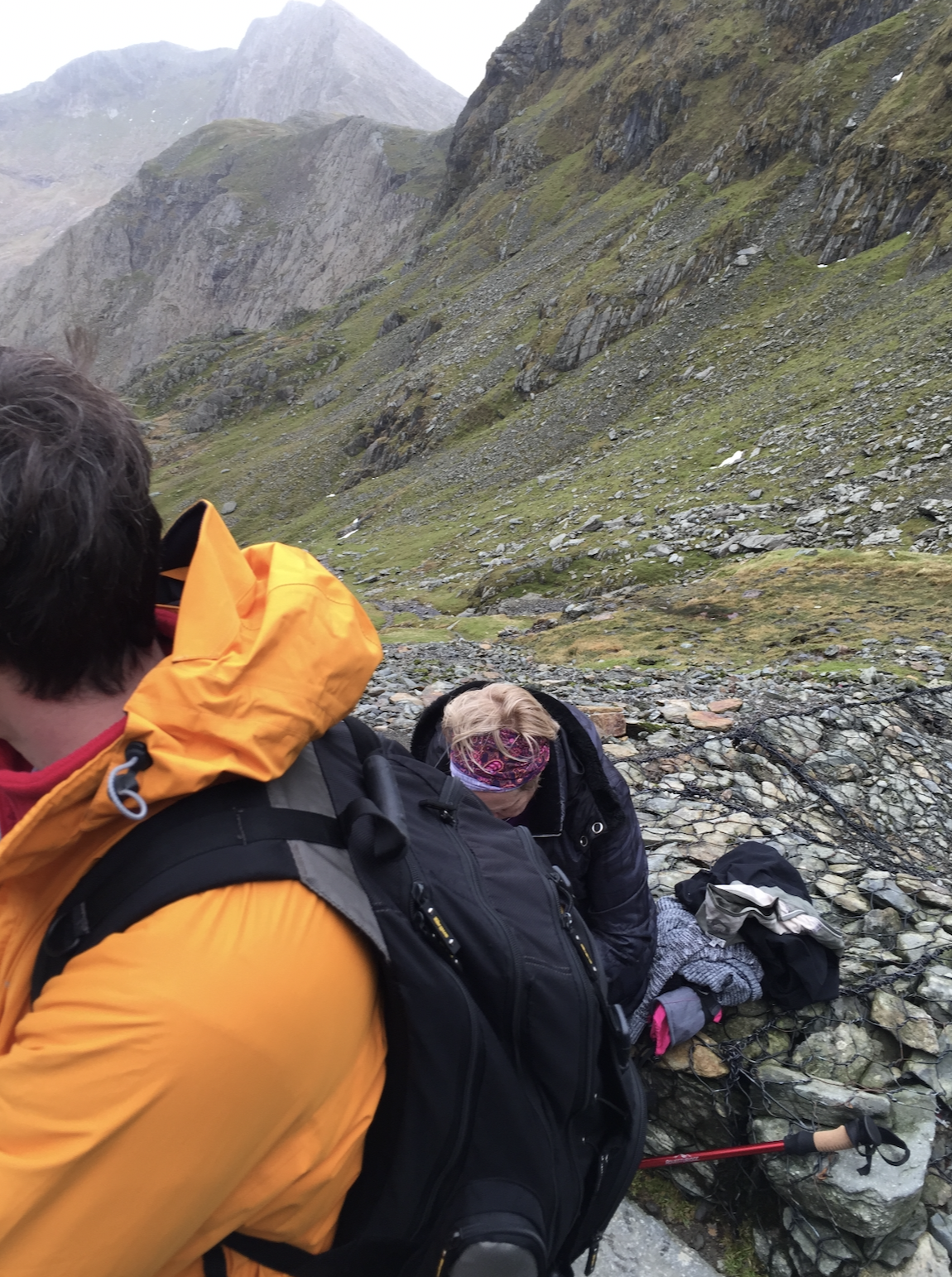
Yesterday, on a Wisdom Walk, I realised I …

Yesterday, on a Wisdom Walk, I realised I had been spending my attention in three directions at once.

Part of me had gone backwards, picking over old choices and wishing I had chosen differently. Part had gone forwards, trying to get ahead of outcomes I cannot know. The rest kept looking for a side door through entertainment, the small and familiar way of leaving the room when the present feels awkward.

I have been thinking about personal power in the old warrior sense: not power over other people, and not the usual self-help business of becoming more assertive. I mean the ability to gather your own attention and use it where you stand. The older writers on the craft of the warrior talk about power leaks. That phrase has stayed with me because it describes the feeling well. Regret drains one pocket. Fear drains another. Avoidance finds a third.

This morning I pulled three tarot cards against that question. The Moon, The Sun, and Death, all upright.

The Moon looked like the mind under partial light. You know the territory. The past starts to feel editable. The future begins to feel dangerous before it has even happened. You follow a worry around the block a few times and call it planning. The card did not ask me to solve every shadow. It asked me to recognise the conditions and keep walking.

The Sun brought the practice back to earth. Ten minutes of meditation. Bare feet in the garden. Looking around the room. A breath. The next thing my hand can actually do. I am learning that the return does not need to be grand. It only needs to be real.

Then Death turned up, which I took as a blunt reminder that some old habit of selfhood has had its time. The version of me that tries to live in the past, secure the whole future, or duck out of the present may have done useful work once. It does not need to run the day.

I am trying a simple field instruction: when I notice myself leaking attention backwards, forwards, or sideways, I come back through the senses. Feet. Breath. Sight. One real task.

The day may still be messy. The question may still be open. But I am here for it.

The Story That Wants You at Your Desk

The Matrix Late to Work Scene

There is a short scene near the beginning of The Matrix that has stayed with me for years. Thomas Anderson is sitting in the office of his manager, Mr Reinhart. Anderson has arrived late again. He has a problem with authority, the manager tells him. He believes he is special, that somehow the rules do not apply to him.

Then comes the ultimatum. Anderson can choose to be at his desk on time from this day forward, or he can find himself another job.

It is a small scene, almost comic in its plainness. No agents. No green code running down a screen. No red pill. A bad meeting in a beige office, with one man explaining the terms of normality to another.

But the scene carries the whole film in miniature.

The manager presents obedience as the only adult position. The company is one of the best in the world, he says, because every employee understands that they are part of a whole. Individual trouble becomes company trouble. The good employee knows his place. He arrives on time. He accepts the story of what work is for, what authority is for, and what he is for inside both.

Anderson’s offence is not that he has broken the machinery. He is barely conscious that there is machinery. His offence is that some part of him has not settled into it. He has not quite agreed to become the person the system can easily recognise.

I do not mean that every job is a prison, or that every manager is an Agent Smith in a tie. That would be a lazy reading, and the world is more complicated than that. Work can give us companionship, skill, purpose, a way of serving others, and the money that keeps a roof over our heads. We need one another. We need institutions, agreements, and forms of cooperation.

The trouble begins when one available form of life starts passing itself off as the only legitimate one. When employment becomes not simply something you do, but the central measure of whether you count. When the story gets into the nervous system: be useful, be legible, be approved, and then, one day, you may have earned the right to live.

That is the story that wants you at your desk.

It does not usually arrive as a villain. It comes through school reports, family worries, careers advice, job titles, mortgages, performance reviews, the small flush of relief when someone in authority says you are doing well. It comes through the fear of being an outsider, of disappointing people, of having to explain why your life does not look like the approved diagram. By the time we are old enough to question it, much of the code is already running.

The stories that run beneath the story

I have spent a long time working with the idea that stories are code. I do not mean this as a cute metaphor for a slide deck. I mean that a story can organise perception, attention, feeling, and action. It can tell you which options you can see, which desires you are allowed to name, which risks feel foolish, and which forms of suffering feel normal.

A person who carries the story “I have to earn my worth” will make different choices from a person who carries the story “my worth is not under review.” A person who has learned that security comes from pleasing authority will hear a new opportunity differently from someone who has learned that authority is one voice among many. The world does not change merely because we acquire a better slogan. But the story changes what becomes thinkable, and what becomes thinkable changes the next move.

This is why Narrative Alchemy begins with attention to the script already in play. Most of us do not wake up one day and freely choose the central beliefs around which we organise a life. We inherit them. We absorb them from parents and classrooms, workplaces and television, old humiliations and rewards, the groups we want to belong to, the people we were afraid to disappoint. Some are useful. Some are cruel. Many were written for conditions that no longer exist.

The inherited script often feels like reality because it has been rehearsed for so long. “This is just how life works.” “People like us do not do that.” “You have to be sensible.” “You cannot make a living from that.” “Do not get too big for your boots.” “Be grateful for what you have.” Each sentence can contain a fragment of practical wisdom. Each can also become a locked door when it hardens into law.

The Matrix gives this condition a visual form. The people inside it are not fools. They are living in a constructed reality that has become more immediate to them than any alternative. The prison works because it feels ordinary. The office, the commute, the screen, the meeting, the polite threat: none of it looks like a prison until the story loosens enough for another possibility to appear.

That is why the Mr Anderson scene has more charge for me than some of the larger set pieces. It is close to the bone. Most of us know that room. We know the feeling of being told, directly or indirectly, that our restlessness is a problem to be corrected. We know the pressure to fit our oddness back inside the approved shape.

The false promise of future freedom

There is another story tangled up with this one, and it is one of the great promises of modern life.

Sell your time now, be a good employee, make sensible choices, accumulate enough money, and later you will be free. Freedom waits somewhere beyond the next promotion, the next salary band, the mortgage, the pension, the side hustle, the financial system that will finally allow you to stop worrying.

Money matters. To pretend otherwise would be romantic nonsense. Money can buy time, safety, medicine, space, choices, and a margin against panic. Lack of money closes doors with brutal efficiency.

But money can also become the story’s most effective postponement device. You keep agreeing to a life that does not fit because you are told the reward lies just ahead. The line keeps moving. There is always another threshold to clear before you can begin living on your own terms. You become an indentured servant to a future version of yourself who is supposed to arrive with enough money to release you from the bargain.

The contemporary feed has learned how deep that ache runs. Open YouTube, X, Instagram, or any corner of the internet where the adverts wear human faces, and you will find people offering a route out. Build this income stream. Copy this system. Learn this model. Escape the nine-to-five. Become the boss. Live the life of your dreams.

Some of these people are offering practical help. Some have built useful businesses. But the overall machine feeds on pain. It finds people who feel that their days do not belong to them and sells them an image of an exit. The strange cruelty is that the desire for freedom can become another market, another funnel, another way to spend your attention serving somebody else’s model of success.

The old office story says: obey now and one day you will be secure.

The online liberation story says: buy the right system now and one day you will be free.

Both can keep the real life deferred.

The question is not whether we should make money or seek more autonomy. Of course we should seek conditions that make life more liveable. The question is whether the pursuit of freedom has quietly become another programme running us. Are we choosing the work, the money, the aspiration, the system? Or has the story made the choice before we arrive?

Being special is not the same as being superior

Mr Reinhart makes Anderson’s problem sound narcissistic. You think you are special. You think the rules do not apply to you.

This is clever, because the language of specialness is easy to weaponise. Nobody wants to be the person who believes they are above other people. Nobody wants to turn ordinary responsibility into an insult. The desire to be different can become its own vanity trap, a performance of rebellion as predictable as conformity.

But there is another way to hear the word.

To believe that the rules do not fully contain you is not the same as believing you are better than everyone else. It is to refuse the idea that the institution gets the final word on what a human life can be. It is to recognise that you have particular gifts, particular hungers, particular obligations to the life that is trying to live through you. It is to take the risk of becoming distinct without making distinctness into a superiority contest.

That is closer to individuation than individualism. Individuation asks a difficult question: what is mine to become, and what have I accepted merely because it was handed to me? It does not mean cutting ourselves off from the world. It means entering relationship with the world without disappearing into its expectations.

The task is not to become the lone hero who has seen through everything while the herd sleepwalks around him. That is just another flattering story, and it can make a person isolated, brittle, and insufferable. The task is more modest and more demanding. Notice the scripts. Test them. Keep what serves life. Refuse what shrinks it. Build enough inner authority to hear your own voice among the louder ones.

Narrative Alchemy is not about writing yourself a fantasy in which every obstacle vanishes. It is about getting honest about the narrative through which you have been interpreting the obstacles. If you tell yourself that you are trapped, you need not pretend the constraints are imaginary. You may have bills, duties, dependants, a tired body, limited options, real fear. The alchemical move is not denial. It is asking where the story has added a second prison around the first.

What have you concluded about yourself because of the constraint? What possibility did you stop seeing? Whose voice has been speaking in your head with the force of a law? What would change if you treated that voice as a historical artifact rather than a command from reality?

Vigilance is an everyday practice

The word vigilance can sound grim. It conjures guards on a wall, watching for enemies in the dark. I do not mean we should live in a permanent state of suspicion, seeing manipulation in every conversation or conspiracy behind every workplace rule. That is another reality tunnel, and not a particularly free one.

I mean a quieter kind of vigilance: paying attention to the stories that are asking for residency in the mind.

The phone is one of the main delivery systems. So is the inbox. So is the infinite stream of videos that know exactly how to make an old anxiety feel urgent again. The story does not need to persuade you all at once. Repetition does much of the work. See enough people performing an identical version of success and it starts to feel like the only life that counts. Hear enough polished promises about wealth and freedom and your own slower, stranger work begins to look like failure.

This is why the first part of the day matters to me. Before the feed, before the messages, before the little theatre of comparison installs itself in the body, there is a brief chance to ask what world I am entering. A book, a notebook, a walk, a cup of coffee on the garden table: these are small things, but they can interrupt the automatic download.

They are not rituals of purity. They do not place you outside culture, money, technology, work, or obligation. They create a little room in which you can notice what is happening. That room is enough to begin with.

A useful practice is to name the story without immediately trying to replace it. “I am behind.” “I need permission.” “I must make this pay before I can take it seriously.” “If I do not perform well, I will lose belonging.” Write it down. Say where you first learned it. Notice the situations in which it takes over. Notice what it makes you do with your hands, your calendar, your attention.

Then ask a less dramatic question than “How do I escape the Matrix?” Ask: what story would give me five percent more room to move today?

The answer may be plain. I can take the walk before I open the feed. I can write the page before I decide whether it is marketable. I can make the phone wait while I listen to the person in front of me. I can stop asking the imagined audience to approve the work before I have done it. I can make a small choice that belongs to the person I want to become.

Small choices matter because stories become convincing through enactment. The old programme did not install in one dramatic moment. It got reinforced through hundreds of ordinary repetitions. A new relation to the story needs ordinary repetitions too.

The code is not the territory

Stories are code, but code is not fate.

It keeps the metaphor useful. We are not machines waiting for a clever hacker to type the right command. We have bodies, histories, relationships, economic conditions, losses, desires, and responsibilities that do not yield to a line of copy. No slogan will free someone from structural poverty, illness, grief, or a coercive situation. Narrative work is not a substitute for material change, political action, community, therapy, rest, or help.

But stories shape the field in which we meet those realities. They can make us collaborate with a limitation long after it has ceased to be necessary. They can make a social arrangement feel personal and inevitable. They can make a possibility feel shameful before we have even tested it.

The purpose of waking up to a story is not to become permanently suspicious of every story. We need stories. They give memory shape. They let us make promises, understand grief, recognise a calling, and share a world. The question is whether the story remains a companion or becomes a warden.

At the beginning of The Matrix, Thomas Anderson has no language for this. He only has the vague, inconvenient knowledge that the official story does not fit. That knowledge is enough to get him into trouble. It is also the beginning of his freedom.

The manager wants him at his desk. The culture wants a neat account of why he is there. The feed will happily supply a hundred new dreams for him to chase as long as he keeps consuming them.

The harder and more intimate work begins elsewhere: in the moment you hear a story making a claim on your life and pause before you obey.

You do not have to blow up the office. You do not have to abandon every responsibility. You do not have to become a hero in a leather coat.

But you do have to keep watch over the stories you are letting rewire your programming.

Because the most important choice rarely arrives with a red pill in your hand. More often it arrives as a sentence you have heard so often that it feels like your own voice.

And you get to decide whether it is.


If this post gave you something to carry into your day, consider supporting my work by buying me a coffee or making a monthly donation or subscribing (free) to the blog.

Working Notes: the moon in transition

Last night I stood at the front of the house and watched a red moon. This morning, after waking, I looked towards the bedroom mirror at the back and saw the full moon again, bright in the glass.

I don’t need the moon to issue instructions. I’ve spent enough years around symbols to know that they can become overbearing if you hand them too much authority. Still, an image can earn its place. The same moon appeared to me from two sides of the house: first as something outside, waiting at the threshold; then as a reflection in the room where I sleep.

It felt like a crossing.

Then the archive got involved.

In my blog feed, waiting on this date, was a post I wrote two years ago: “might as well jump right into the deep end”. I had been asking a question that now feels both familiar and young: what was I going to bring to the game of blogging?

I wanted to avoid the obvious routes. I didn’t want to be pulled into listicles, recycled content, borrowed niches, or the marketeer’s habit of turning a living interest into a sales funnel. I wanted to blog as a literary artist. I called myself a postmodern rogue philosopher-poet, which still makes me smile, but the impulse was true. I wanted the blog to hold intellect, feeling, dirt under the fingernails, odd books, daily life, and whatever I was trying to learn about being a person.

The blog was not supposed to be a publishing machine. It was supposed to be a place where I could find out what I thought by writing in public.

Two years later, the terms have changed and the work has acquired more rooms. There are Working Notes from the Textual Underground, Wisdom Walks, Narrative Alchemy, a vault full of old selves and unfinished sentences, and the strange new condition of thinking alongside textual familiars. The site has become less a place I post things to and more a field I think with.

Yet the old question remains recognisable. What do I bring? What am I willing to put into language? Which parts of my life and mind belong in the same room, and which parts have I kept separate because it felt safer that way?

The old post also contained a hope that blogging might document my evolution: that, by looking back, I could trace changes in voice and understanding. This is exactly what happened this morning. The archive returned a message from a former version of me. It did not arrive as a command from the past or proof that the universe had arranged an appointment. It arrived as an invitation to notice continuity.

The younger blogger was standing at the edge of the pool, talking himself into the jump. The blogger reading him today has been in the water for a while.

That matters because I have a habit, shared by many self-employed, self-authoring people, of treating the present body of work as preparation for the real work. Once the website is right. Once the offer is clear. Once the voice settles. Once I have earned the right to say I am what I have already spent years practising.

“Full potential” can easily become the voice of an internal assessor. It can turn into another way to stand over your own life with a clipboard. I don’t want that version of the phrase. I have enough experience of assessment culture to know how quickly it can steal the life from learning.

The version I want has more to do with integration. Let the blogger, the barefoot philosopher, the facilitator, the man with a notebook, the walker, the reader of strange books, the builder of textual environments, and the person still trying to work out how to live meet one another without requiring one of them to win.

That is a different kind of potential. Less a demand to become exceptional than permission to become whole enough to act from what is already here.

The image of the moon helps because it contains no productivity plan. It says nothing about targets. It only offers a piece of orientation: the same light can meet you in the world and come back through the mirror. There is encounter, and there is reflection. There is the threshold, and there is the room you have been living in all along.

Two years ago, I said I might as well jump into the deep end. Looking back now, I can see that I did, though not in one grand act of courage. I went in post by post, walk by walk, note by note. The work accumulated. The archive kept the trace. The blog learned how to speak back.

The question is no longer whether I have permission to enter the water. I am already wet. The question is whether I can trust the current body of work enough to swim from it.

The deep end was not a single jump. It was a practice of returning to the water.

The shadow is not dark because it is …

The shadow is not dark because it is evil. It is dark because it has been pushed out of sight.

Whatever we cannot consciously own tends to run us from behind the curtain. We condemn it in other people. We are secretly fascinated by it. We keep meeting it in the same arguments, the same attractions, the same loops where we sabotage ourselves and cannot say why.

This is a workbook for facing your shadow self.

Nineteen pages, eight exercises, designed to be printed and written in by hand. No videos, no course, no login. Questions and enough white space to answer them honestly.

What’s inside

👉 The Projection List. The people who provoke a reaction out of all proportion, and what you are actually reacting to.

👉 Triggers as Doorways. Slowing a charged moment down until the pattern underneath becomes visible.

👉 The “I Am Not That” Inquiry. The qualities you insist are not yours, and what it costs to keep insisting.

👉 Dialogue with a Disowned Part. Letting it speak before you correct it.

👉 Reclaiming the Gift. Separating the life force from the wound wrapped around it.

👉 The Inner Courtroom. Shame, responsibility, and the difference between them.

👉The Golden Shadow. Envy as a crude but reliable compass toward an unlived life.

👉 The Body Knows First. The physical signature that arrives before the story does.

Plus an integration section and a thirty-day practice.

A note on pace

Shadow work can be tender. One page at a time is enough. If an exercise brings up something too large to hold on your own, close the book and talk to someone you trust. Stopping is not failure.

Only a few more days left in my …

Only a few more days left in my 31-day weblogging challenge. My experience has been when you stop performing and stop conforming, a 31-day blogging challenge turns out to be surprisingly easy. You step out of the paralyzing effect of perfection and focus on staying in conversation with your own experience. A weblog, at its best, isn’t a content machine. It’s more like a mind in motion thinking out loud.

The church that wasn’t there

St Andrew's Church

I arrived in Worcester with time to spare before a family lunch. We were all coming from different points on the map. My son, his partner and my granddaughter had travelled from Ludlow. My wife and daughter were on their way from Southam. My in-laws and brother-in-law were coming up from Bristol. I had parked the car and found myself alone in a city I knew mostly as a place one passes through or meets in.

So I wandered.

From the car park I saw a spire above the buildings a short distance away. It had the old, familiar shape of a church tower: stone, height, a narrow point against the sky. My body made the decision before my mind did. I walked towards it.

Churches still do that, even when we no longer belong to them in the old way. A tower says: look up. Something important happened here. This is where the centre is.

Only when I got close did I discover that the church was not there.

Glover’s Needle is all that remains of St Andrew’s Church: the tower, the spire, a great arch opening onto locked gates. The body of the church was demolished in 1949. There is no nave. No rows of pews. No parish gathering beneath a roof of stone and timber. There is a surviving vertical gesture in the middle of a city that has continued to grow around it.

Glover's Needle

From a distance, the eye supplies the missing church.

That was the little trick the place played on me. From the river later, with trees in the foreground, it looked complete again. Tower, spire, church. The branches kindly concealed the absence. Only up close could you see the open arch and the space where a whole building had once stood.

We do this with more than churches. We see the surviving outline of an institution, a relationship, a self-image, a belief we have inherited, and assume the interior life is still intact. The shape remains persuasive. It still catches the eye. We walk towards it because some part of us recognises the old promise.

Then we arrive and find that the rooms have gone.

I could touch a section of the stone. The rest of the site was gated off. That felt right somehow. You can lay a hand on the remnant, but you cannot enter the vanished body. History offers contact rather than access. A plaque might tell you dates. A tower might tell you, in the blunt grammar of stone, that people once cared enough to organise a part of their lives around this place. But it cannot give you the sound of the congregation, the smell of damp coats, the tensions in the vestry, the ordinary gossip, the private grief, the people trying to believe and the people failing to.

It cannot give you the world that made the church feel necessary.

Standing there, I found myself thinking about power. Not power in the cartoonish sense of secret energy running through a sacred site, although the old science-fiction part of my brain did look at the open arch and think: Stargate. If I could get through those gates and stand beneath that empty frame, where would it take me?

It would not take me to another dimension. It might take me into the Worcester in which St Andrew’s still stood: bells marking the hours, baptisms and funerals passing through its doors, parish boundaries shaping belonging, the church woven into the local operating system.

The tower was once more than a landmark. It was a signal. It said: this is where the centre is.

Church power did not only live in doctrine. It lived in timekeeping, social rank, moral expectation, burial grounds, public ritual, the simple fact that people knew where to come for the passages of life. That world has not disappeared completely, but its authority has changed shape. A tower that once ordered part of the town now stands as heritage, architecture, a thing to photograph, a faint summons that most people can ignore.

That is not quite an indictment of Christianity. It feels more like an exposure of what happens when a worldview loses its monopoly on meaning.

The old sacred structure remains, but the city has learned to centre itself elsewhere.

There was something beside the tower that made this difficult to romanticise. Close to the stone, I saw what looked like someone’s sleeping gear: the rough remains of a bed, somebody’s effort to make shelter in a public place. I did not know whose it was. I did not want to turn it into a picturesque detail in a blog post about ruins. It was somebody’s need, not a prop for my mythology.

Still, it belonged to the scene.

A church once built to gather people beneath a roof stood beside evidence that somebody needed a roof. The institution had gone. The need had not.

That is where the place stopped being merely atmospheric for me. It is easy to enjoy the idea of holy ground when the holy ground is an old tower and an empty arch. It is harder when the same ground asks a more direct question: what does care look like after the institution has become a monument?

I do not have a clean answer. Churches have always been mixed things: places of mercy and exclusion, sanctuary and control, beauty and hierarchy, real care and institutional self-protection. It would be sentimental to imagine that the old parish world was kinder simply because it was more religious. But I could not ignore the contrast. The roof was gone. The tower remained. Somebody’s bedding lay nearby.

A person can make too much of one scene. A person can also walk past one too quickly.

The tower sits among Worcester College buildings. I turned and saw the new precinct around it: classrooms, windows, signs, a building carrying the phrase “The Heart of Worcestershire.” Through a window, or perhaps into a library space, I saw huge multicoloured words: “Love to Learn.” Nearby stood the Arts Centre.

That altered the reading of the place.

The tower had not been left behind by power. It had been absorbed into a different arrangement of power. The church once gathered people around salvation, duty, moral order and a story of the world. The college gathers them around learning, qualifications, skills, the possibility of a different future. The theatre gathers people around imagination, performance and shared feeling.

Faith, knowledge, imagination. A spire, a library, a theatre.

I do not mean that education has replaced religion. Education can become a machine for sorting people into the labour market. The arts can become another kind of consumer offering. Churches can become heritage attractions with expensive cafés. None of these institutions gets to inherit the sacred simply by standing near a tower.

But the language interested me. Heart of Worcestershire. Love to Learn. We still reach for words that once carried a religious charge: heart, love, vocation, transformation, becoming. We still want a life to open beyond its immediate usefulness. We still want to become more than a person who completes tasks, pays bills and waits for the next disruption.

The old religious vocabulary has not vanished. It has migrated.

Glover’s Needle stood among the college buildings like a question nobody had entirely answered. What is learning for? What kind of person is education trying to make? What does a city owe its young people beyond skills and employability? Where does wonder live once it is no longer guaranteed a building of its own?

Then I walked downhill towards the river.

The route became a small descent: steps, benches, trees, open space, the Severn somewhere ahead. I had spent the first part of the walk looking up. A spire invites that. It sets the mind wandering towards power, faith, history, transcendence, the old architecture of meaning.

The stairs offered another instruction.

Come down.

Not as a rebuke to thought. I am not interested in pretending that the metaphysical questions are merely a luxury, or that we should all keep our heads down and stick to the practical. A human life without any sense of depth becomes thin quickly enough.

But I know the temptation of altitude. The grand idea. The lofty project. The next framework that will finally explain the muddle. The notion that life will begin properly once I have found the right plan, become the right version of myself, built the thing that proves I have not wasted my time.

The steps did not ask me to abandon any of that. They asked me to return to the ground beneath it.

At the river, people sat in the sun. Birds gathered at the waterline. The cathedral appeared through the trees, large and intact, its body still present where St Andrew’s had become a single stubborn gesture. I could see people on benches reading actual books. I counted nine before I stopped counting. Paperbacks and hardbacks. Bodies in the sun, minds moving through pages.

I became aware of the irony. I was speaking notes into my phone while noticing people who were not looking at theirs.

Yet I did not feel the phone had taken me away from the place that afternoon. It had become a recorder, map and notebook. It helped me catch the sentences before they vanished. The danger comes when the device turns every encounter into content before the encounter has had time to work on you. The phone can flatten a city into a sequence of images. It can also help you notice that a tower is not a church, that a church without a body still makes promises, that people still sit by a river and read.

The question is whether the tool returns you to the world.

At noon, the bells began.

Their sound travelled across the river, through trees, across the benches where people read and talked and watched the water. The bells did not require anyone to assent to a creed. They did not stop the traffic or summon a congregation. They simply marked the hour.

This hour has arrived.

I liked that. Old language, still travelling.

The bells could not restore the church that had gone. They could not settle the question of what Christianity has become in a city where its old power no longer holds. They could not solve homelessness or make education wise or tell anybody sitting by the river what to believe.

But they crossed the air.

The church’s body had gone. Its gesture remained. Its sound, in other forms and from other towers, still entered the afternoon.

Then my son sent the bat signal.

A shared location appeared on Apple Maps. My granddaughter was with him. His partner too. My wife and daughter were making their way from Southam. My wife’s parents and brother were coming up from Bristol. I plotted a route north along the river and started walking.

The solitary part of the day ended there. The mythogeographic wander gave way to the more ordinary geography of family logistics: people leaving one town, joining a motorway, parking a car, checking a phone, finding a table big enough for several generations.

But it did not feel like the spell had broken.

The old tower had once oriented a parish. Its spire had told people where the centre was. Now, for me, the centre was a blue dot on a screen. My people were gathering from different roads. My granddaughter was waiting somewhere ahead.

The tower still pointed upward. The river kept moving beside the city. Bells marked noon over a world that had changed its mind about many things without losing its hunger for meaning.

I left the church that was not there and walked north towards lunch.

St Andrew's Church

If this post gave you something to carry into your day, consider supporting my work by buying me a coffee or making a monthly donation or subscribing (free) to the blog.

What Do I Owe Other People?

My mother taught me early that I didn’t owe anybody anything. Not even her.

Looking back, I think she meant it as a lesson in self-reliance. Don’t let guilt bind you. Don’t hand other people ownership of your life. Stand on your own feet. Make your own way.

But childhood lessons rarely stay inside the boundaries intended for them.

What I absorbed was not only that I should be independent, but that closeness came with claims. To let someone near was to risk becoming obligated. Better, perhaps, to keep a little distance. Care, but not too much. Love, but retain an escape route.

It took me a long time to work through that.

Then the Army gave me a very different education.

It taught self-reliance too, but not the solitary kind. You had to be competent because other people depended on you. You had to know your role, carry your weight, and remain steady under pressure. At the same time, you learned to trust others with your life—and to understand that they were trusting you with theirs.

That is not independence. It is interdependence at its most concrete.

As an officer, another layer was added: selfless service. The idea that leadership placed obligations upon you. You were responsible not only for yourself, but for the people in your care. Their welfare mattered. Their trust mattered. Your choices carried consequences beyond your own life.

Somewhere between my mother’s lesson and the officer’s code, I began to see that obligation is not a single thing.

It can be a chain placed around you by guilt, expectation, or control.

But it can also be a commitment freely chosen.

I may not owe people access to me simply because they demand it. I may not owe anyone the surrender of my autonomy. But when I choose to stand beside someone—as a friend, partner, parent, colleague, leader, or member of a community—I choose certain responsibilities too.

Perhaps the better question is not simply:

What do I owe other people?

Perhaps it is:

What do I owe the people I have chosen to stand beside?

And what do I owe them not because they own me, but because of the kind of person I have chosen to become?

Self-reliance, then, is not the refusal to need anyone. It is the ability to bring your own strength into relationship. To carry your share. To remain yourself while becoming part of a larger we.

This is where Emerson enters the conversation, though perhaps not quite in the way he is usually summoned. “Trust thyself,” he writes, and the phrase has become almost a slogan for rugged individualism. But Emerson’s self-reliance is not merely the freedom to do whatever one pleases. It is the harder discipline of listening for the voice beneath social expectation, inherited doctrine, and the pressure to conform. “Nothing is at last sacred but the integrity of your own mind,” he insists. Project Gutenberg

I can understand the appeal of that. My mother’s lesson carried something of Emerson’s refusal in it: do not let other people decide who you are; do not confuse obedience with goodness; do not surrender your judgement simply because the crowd speaks loudly. There is real strength in being able to stand apart.

Emerson knew that society exerts a gravitational pull on the self. It offers belonging in exchange for compliance. “Whoso would be a man must be a nonconformist,” he writes—not because opposition is inherently virtuous, but because a person must learn to distinguish genuine conviction from borrowed opinion. Project Gutenberg

Yet self-reliance has a shadow. Taken too far, it can become a fortress. Trusting yourself can quietly turn into trusting only yourself. Independence can harden into emotional distance. The refusal to be owned can become the refusal to belong.

The Army showed me another texture of self-reliance. It was not Emerson’s solitary thinker standing against the crowd, but a person becoming dependable enough to take their place within a collective. I had to trust my own judgement, certainly, but I also had to trust the soldier beside me. My competence mattered because their life might depend upon it. Their competence mattered because mine might depend upon them.

In that world, self-reliance did not abolish obligation. It made obligation possible.

You carried your own kit so that someone else did not have to carry it for you. You maintained your skills because hesitation or incompetence could place others at risk. You learned to act without waiting to be rescued, while also knowing that survival often depended upon the people around you.

Perhaps Emerson gives us only half the equation.

“Trust thyself” remains essential. But so does: become someone others can trust.

The mature self is not dissolved into the group, nor sealed away from it. It is distinct but connected, autonomous but accountable. It knows where it stands, and because it knows where it stands, it can stand beside others without disappearing into them.

Self-reliance, in that sense, is not the end of relationship.

It is what we bring to it.


If this post gave you something to carry into your day, consider supporting my work by buying me a coffee or making a monthly donation or subscribing (free) to the blog.