Exploring the Connection Between Tarot’s Court Cards and the MBTI

Have you ever wondered how the symbolic world of tarot could intersect with the psychological insights of personality typing? It turns out that tarot’s 16 court cards and the Myers-Briggs Type Indicator (MBTI) may have more in common than you’d think. Both systems, though originating from different traditions—one mystical and the other psychological—offer profound ways of understanding human behaviour and archetypal energies. In this post, I want to explore how these two systems can align, shedding light on how we might use them together to dive deeper into self-awareness.

At first glance, the tarot’s court cards seem like timeless archetypes, representing personas or ways of interacting with the world through the lenses of the four suits—Wands, Cups, Swords, and Pentacles. Each suit speaks to a different element of life: creativity, emotions, intellect, and the material world. Similarly, the MBTI divides personalities into 16 types, each shaped by preferences in how we engage with the world and process information. By pairing these two systems, we gain an enriched perspective on both.


The idea of mapping the 16 Myers-Briggs Type Indicator (MBTI) personality types to the 16 court cards in the tarot is an intriguing blend of psychology and esotericism. Both systems deal with archetypes and human behaviour, and while the MBTI breaks down personality into cognitive functions and preferences, the tarot’s court cards represent distinct personas, roles, or modes of action. The challenge and beauty of connecting the two is in recognising how these symbolic systems reflect aspects of our psyche.

Let’s break it down.

MBTI and Tarot: A Shared Structure

The MBTI divides personalities based on four key dichotomies:

  • Extraversion (E) vs. Introversion (I)
  • Sensing (S) vs. Intuition (N)
  • Thinking (T) vs. Feeling (F)
  • Judging (J) vs. Perceiving (P)

These preferences combine to create 16 possible personality types.

In tarot, the 16 court cards (Pages, Knights, Queens, and Kings from each suit) represent different expressions of personality or ways of interacting with the world. Each suit corresponds to one of the four elements, each symbolising different areas of life:

  • Wands (Fire): Creativity, action, inspiration
  • Cups (Water): Emotions, relationships, intuition
  • Swords (Air): Thought, communication, intellect
  • Pentacles (Earth): Practicality, work, material concerns

Within each suit, the hierarchy moves from the Page (youth or beginnings) to the Knight (action or pursuit), the Queen (nurture or mastery of emotions), and the King (leadership or mastery of the element).

The Correspondences

The attempt to link MBTI with tarot suggests that each tarot court card represents a distinct MBTI type. Here’s how that correlation might look based on common interpretations:

Wands (Fire) – Intuitive and Action-Oriented Types

The suit of Wands is associated with energy, action, and inspiration. These court cards tend to represent those who are imaginative, adventurous, and driven to initiate change.

  1. King of Wands – ENTJ (The Commander)
    • A natural leader, the King of Wands is bold, decisive, and visionary, much like the ENTJ, who takes charge with confidence and charisma, always thinking of the big picture and how to move forward strategically.
  2. Queen of Wands – ENFJ (The Protagonist)
    • Warm and inspiring, the Queen of Wands motivates others through her passion and energy. The ENFJ is similarly nurturing and charismatic, leading by example and helping others realize their potential.
  3. Knight of Wands – ENTP (The Debater)
    • The Knight of Wands is quick to action, always ready for the next adventure or challenge, which aligns with the ENTP’s love of new ideas, exploration, and intellectual sparring.
  4. Page of Wands – INFP (The Mediator)
    • Curious and idealistic, the Page of Wands embodies the INFP’s deep inner world of passion and creativity. Both are dreamers who are always searching for meaning and new possibilities.

Cups (Water) – Emotionally Intuitive and Feeling Types

The Cups court cards are connected to emotion, relationships, and the subconscious. People represented by these cards are sensitive, empathetic, and often motivated by their values and feelings.

  1. King of Cups – INFJ (The Advocate)
    • Calm, wise, and emotionally intelligent, the King of Cups embodies the INFJ’s deeply empathetic and insightful nature. Both offer support and guidance through their intuitive understanding of others’ needs.
  2. Queen of Cups – ISFJ (The Defender)
    • Caring and protective, the Queen of Cups reflects the ISFJ’s nurturing and loyal personality. Both are grounded in their emotional understanding and commitment to helping those around them.
  3. Knight of Cups – ENFP (The Campaigner)
    • Idealistic, romantic, and driven by emotions, the Knight of Cups is a perfect match for the ENFP’s enthusiastic and deeply passionate pursuit of dreams and possibilities.
  4. Page of Cups – ESFP (The Entertainer)
    • Playful, imaginative, and full of surprises, the Page of Cups is always looking for creative and emotional experiences, much like the outgoing, spontaneous ESFP who thrives on emotional connection and creative expression.

Swords (Air) – Intellectual and Thinking Types

The suit of Swords deals with thought, communication, and conflict. The court cards in this suit represent people who are analytical, logical, and skilled at strategizing and problem-solving.

  1. King of Swords – INTJ (The Architect)
    • Logical and strategic, the King of Swords is a master of rational thought and long-term planning, much like the INTJ, who excels at seeing the bigger picture and creating effective strategies to achieve their goals.
  2. Queen of Swords – INTP (The Logician)
    • Intellectual, objective, and independent, the Queen of Swords aligns with the INTP’s love of knowledge, critical thinking, and deep analysis. Both value truth and clarity above all else.
  3. Knight of Swords – ESTJ (The Executive)
    • Assertive and driven, the Knight of Swords charges forward with a clear goal in mind, reflecting the ESTJ’s decisive, goal-oriented nature. Both are determined to make things happen efficiently and effectively.
  4. Page of Swords – ISTP (The Virtuoso)
    • Inquisitive, clever, and always ready to act, the Page of Swords mirrors the ISTP’s pragmatic, hands-on approach to life, always curious and quick to analyze and respond to new situations.

Pentacles (Earth) – Practical and Sensing Types

The suit of Pentacles is associated with the material world, work, and practicality. The court cards here represent those who are grounded, reliable, and focused on tangible results.

  1. King of Pentacles – ESTP (The Entrepreneur)
    • The King of Pentacles is a confident, successful figure who enjoys the fruits of his labor, much like the ESTP, who is practical, resourceful, and always on the lookout for new opportunities to make things happen.
  2. Queen of Pentacles – ESFJ (The Consul)
    • Generous and nurturing, the Queen of Pentacles provides for others in a practical, down-to-earth way. This resonates with the ESFJ’s desire to care for and support those around them through concrete actions and emotional warmth.
  3. Knight of Pentacles – ISTJ (The Logistician)
    • Hardworking and methodical, the Knight of Pentacles mirrors the ISTJ’s attention to detail and sense of duty. Both are reliable, patient, and dedicated to achieving their goals with precision.
  4. Page of Pentacles – ISFP (The Adventurer)
    • Practical yet creative, the Page of Pentacles explores new opportunities for growth, much like the ISFP, who seeks personal experience and fulfillment through hands-on exploration of the world.

Why Does This Work?

Both the MBTI and tarot court cards can be understood as ways of categorising and exploring human experience and expression. While the MBTI relies on a psychological framework, the tarot deals more with symbolic and archetypal language. The correlation works because both systems offer paths to self-understanding and insight, using different lenses but tapping into similar human truths. Each tarot card and MBTI type represents a different way of being and interacting with the world, and finding these links provides rich terrain for personal exploration.

Limitations

It’s important to note that this is an interpretative framework rather than a strict rule. Tarot, with its symbolic flexibility, can’t always be reduced to a one-to-one correspondence with a psychological system like the MBTI. But it can serve as a creative tool for reflecting on the qualities of each type and persona, providing new perspectives on both the tarot and the MBTI system.

In the end, whether or not these systems can perfectly align, this exercise invites us into deeper self-reflection and a richer understanding of the different archetypal energies at play in our lives.


By weaving together tarot and the MBTI, we open a doorway into an intriguing exploration of archetypes and psychological insights. These two systems, though seemingly disparate, reflect universal truths about how we navigate the world—whether through the intuitive depths of the Cups or the logical structure of the Swords. Exploring this connection invites us to use both the tarot and personality typing as tools for reflection and growth, offering a new lens to see ourselves and others more clearly. Whether you’re an MBTI enthusiast or a seasoned tarot reader, there’s something powerful in realising how these archetypal energies manifest in our everyday lives.


As an ENFP, I find myself naturally aligned with the Knight of Cups, a connection that feels like a perfect reflection of my inner journey. The Knight of Cups is the dreamer, the romantic who moves through life led by ideals and emotions, seeking meaning in every experience. I see this same impulse in myself—the desire to explore not just the world around me but the depths within, always searching for beauty, depth, and connection.

The Knight of Cups, much like the ENFP, embodies a blend of emotional richness and creativity, always following the call of the heart. This archetype resonates with my passion for mysticism, Jungian depth psychology, and the personal mythology I’ve been crafting. It’s not enough for me to simply understand life on an intellectual level; like the Knight of Cups, my quest is one of emotional and spiritual connection. This alignment reminds me that my path is about more than just action—it’s about experiencing life with an open heart, seeking deeper truths, and honouring the adventure of soul discovery.

Lecture Notes: Jungian Perspective and the Tarot—Lesson 3

Outline for Lecture: Tarot and the Minor Arcana

Lecturer: Jungian Analyst, Kenneth James, Ph.D.

Minor Arcana Overview

  • Explanation of the Minor Arcana: PIP cards and Court cards
  • Focus on personal experience vs. archetypal (Major Arcana)
  • PIP Cards: Personal events and situations (Ace to 10)
  • Court Cards: Relationships in the world and psyche

Tarot as a Visual Tool

  • Emphasis on visual immersion and storytelling through the cards
  • Each Minor Arcana suit (Wands, Cups, Swords, Pentacles) represents elements and functions

Typological Functions & Tarot Suits

  • Intuition: Wands, Fire, Atzilut (Kabbalah), Archetypal world
  • Feeling: Cups, Water, Bria (Kabbalah), World of Creation
  • Thinking: Swords, Air, Yetzirah (Kabbalah), World of Formation
  • Sensation: Pentacles, Earth, Asiyah (Kabbalah), Manifestation world

Experiencing the PIP Cards

  • Visual journey through Ace to 10 in each suit
  • Reflect on the story each suit tells about its element
  • Exercise: Write a short narrative about the “story” of each suit

Court Cards and Their Roles

  • Page: Encountering the element or function
  • Knight: Exploring the element or function
  • Queen: Contemplating the element or function
  • King: Expressing the element or function
  • Medieval role structure: Page → Knight → Queen → King

Numerology of the Minor Arcana

  • Exploring number symbolism (Ace to 10) across the four suits
  • Qualitative aspects of numbers, not just quantitative
  • Patterns and themes in the numbers: Unity, Structure, Stability, Change

Class Activity

  • Sorting the PIP cards into “gifts” and “challenges” (27 gifts, 13 challenges)
  • Reflecting on the qualitative meaning of each card and suit

Closing Remarks

  • Encourage open-ended reflection on the Tarot
  • Discussion on how personal insights come through visual engagement with the cards

Key Messages

  • Tarot as a Reflective Tool: The Minor Arcana helps us explore personal situations, relationships, and psychological functions.
  • Visual Immersion: Tarot is a visual tool that invites us to step into stories and patterns through its imagery, beyond intellectual understanding.
  • Suit Associations: Each suit of the Minor Arcana (Wands, Cups, Swords, Pentacles) connects to a Jungian typological function and a Kabbalistic world.
  • Narrative Reflection: The progression from Ace to 10 tells a story within each suit, which mirrors the journey through life’s elemental experiences.
  • Court Cards as Personal Stages: The Court cards reflect stages of development with each element, moving from encountering to expressing.
  • Numerology’s Role: The numbers in the Tarot aren’t just incremental—they reflect deeper qualities of experience, such as stability (Three) and completion (Ten).
  • Embrace Confusion: Allowing yourself to not “understand” immediately can lead to richer, more intuitive readings. Tarot reveals itself over time.
  • Personal Interpretation: While Tarot carries traditional meanings, it also speaks to each reader personally. Engage with the cards to discover your own story and truth.

Uncertainty is not a barrier

In times of heightened uncertainty, the external world—often chaotic and unpredictable—seems to close in on us. It’s easy to feel like the familiar pathways of decision-making, routine, and control have dissolved. This can feel unsettling, even threatening. But in these moments, there’s an invitation, though often subtle: to turn inward. We’re forced to seek a key within ourselves, a guide to navigate what feels like an ever-shifting landscape.

Carl Jung spoke of this very dynamic in terms of the individuation process—the journey towards self-realisation. When the outer world presents confusion, the psyche is compelled to reach inward, to face the deeper layers of the self. It’s no coincidence that in moments of global or personal crisis, we often encounter a surge of dreams, synchronicities, or a calling to explore the spiritual realm. The uncertainty becomes the catalyst for an inward pilgrimage.

If we think about uncertainty symbolically, it can resemble the Tower card in Tarot—a sudden upheaval, destruction of what was once stable. The Tower is frightening because it strips away the illusions of control and security. Yet, what often follows is not just destruction but revelation. When the old structures fall, we’re confronted with ourselves, raw and vulnerable but also ripe for growth.

As we’re forced inward, we might encounter the Hermit archetype. The Hermit carries his lantern in the dark, walking a path that only he can walk. It’s a deeply personal journey, and the light of his lantern comes not from outside, but from his own soul. In uncertain times, we become our own Hermits, seeking out the light within to guide us forward. That key, the one we search for in times of crisis, is rarely found in the external world. It’s forged in introspection, in confronting our shadows, and in embracing the unknown parts of ourselves.

The process of turning inward also invites us to question the narratives we’ve built. Much like we’ve explored before, the stories we tell ourselves shape our reality. In uncertainty, these stories may feel inadequate and brittle. But this is where transformation occurs. We’re given the chance to rewrite the narrative, to choose new metaphors that reflect our evolving understanding of ourselves and the world. We’re asked to look at our inner myths—those personal myths that guide our sense of purpose and meaning.

What happens when we allow ourselves to be inwardly focused, to hold space for not knowing? We begin to cultivate a different kind of vision. One that is not about predicting the future or controlling outcomes, but one that trusts in the process of becoming. Uncertainty, in this sense, is the fertile ground for transformation. It strips away the distractions and demands of the outer world, forcing us to confront the self and, in doing so, to encounter new layers of wisdom, creativity, and depth.

Much like the seed buried in the soil, there is a period of darkness and stillness before growth. That key, which we seek so desperately in moments of uncertainty, may not unlock the doors we expect. It might instead unlock a door we didn’t even realise existed—a door leading to a deeper sense of authenticity, connection to the soul, or a new path altogether.

As we are inwardly focused, we realise that uncertainty is not a void to be feared, but a space where the imagination and soul can rise to meet the unknown. We may stumble upon unexpected insights, creative sparks, or new levels of self-awareness. Like the Magician in Tarot, we discover that all the tools we need have been with us all along; we just needed the chaos to reveal them.

Uncertainty, then, is not a barrier—it is an opening, a liminal space, where we meet ourselves in a new way. The key we find within unlocks more than just survival. It unlocks growth, expansion, and the deepening of our personal mythology.

Transpersonal Wisdom Through Randomness and Synchronicity

The concept of transpersonal intelligence is rooted in the idea that human consciousness can extend beyond the individual self, tapping into deeper, interconnected layers of reality. In this framework, knowledge and insight are not merely the result of personal intellect or reasoning but are accessed through a greater, often mysterious, transpersonal dimension that transcends the ego. When we combine this idea with random selection and synchronicity, we start to glimpse an approach to wisdom that honours both the mystical and the intuitive.

Transpersonal Intelligence: Beyond the Ego

To understand transpersonal intelligence, let’s first break down the term. “Transpersonal” refers to states of consciousness that go beyond the personal self, crossing into the realms of collective or spiritual experience. This can manifest through spiritual experiences, deep meditative states, or moments of profound insight where the boundaries of individual identity blur and one feels connected to something larger—whether we call that the collective unconscious, universal consciousness, or divine intelligence.

Transpersonal intelligence allows us to access wisdom that is not merely born from our individual mind but from a shared source of knowledge that exists outside time and space. It recognises that there are currents of meaning flowing through the universe, and when we tap into these currents, we often feel a sense of deep knowing that transcends logic or rational explanation.

Deep Dive Podcast

The Power of Random Selection

Random selection is often viewed as purely chance-based, disconnected from meaning. However, when approached from a transpersonal perspective, random selection becomes a tool through which the unconscious can communicate with the conscious mind. Think of the way we draw a Tarot card, flip through the I Ching, or even pick a random word from a book. On the surface, these methods seem to involve pure randomness. But, in practice, they become powerful vehicles for revealing hidden insights.

Random selection works because it bypasses the conscious mind’s attempt to control or force meaning. It allows space for deeper, often hidden, connections to emerge. By relinquishing control over the selection process, we invite the transpersonal realm to make itself known. What appears random may, in fact, be a reflection of an underlying order—a synchronicity—that is waiting to be recognised.

Synchronicity: Meaningful Coincidence

Jung’s concept of synchronicity is key to this understanding. Synchronicity refers to the experience of two or more events occurring in a way that is meaningful, even though they may not be causally related. For example, you think of an old friend and they call you that day, or you ask for guidance on a difficult decision and come across a passage in a book that offers the exact wisdom you need.

From a transpersonal lens, synchronicities are moments when the inner and outer worlds align. They are reminders that the universe is not random or chaotic but alive with meaning. These events suggest that there is a greater intelligence at play, something that is orchestrating events and guiding us towards the insight we need at just the right moment.

Combining Random Selection with Synchronicity

When we combine random selection with synchronicity, we are consciously engaging with the transpersonal realm. We use randomness not as a disconnected roll of the dice but as a sacred tool for accessing deeper knowledge. The random selection, whether it’s choosing a card, rolling dice, or flipping through a book, opens a door to the transpersonal, inviting synchronicities to arise.

Think of it as tuning into a radio frequency. Random selection is how you spin the dial; synchronicity is the signal you receive when you’ve landed on the right station. What emerges may feel like a coincidence, but in reality, it is the universe’s way of communicating with you. It’s as if the cosmos is saying, “Here is what you need to pay attention to right now.”

Applying Transpersonal Intelligence Through Random Selection and Synchronicity

One powerful way to apply this idea is through intuitive practices like Tarot, runes, or bibliomancy. By choosing a card, symbol, or passage at random, you tap into the transpersonal layer of intelligence, allowing hidden patterns to emerge. The synchronicities that follow—the seemingly coincidental ways in which the card or symbol speaks to your current situation—become moments of deep insight.

These practices are not about divination in the traditional sense, where the future is predicted. Instead, they are ways to access your own deeper knowing, unlocking insights from the transpersonal realm that you wouldn’t otherwise see. The random selection disrupts your usual patterns of thinking, making space for new connections and meanings to emerge.

Living Synchronicity: A State of Flow

The beauty of working with random selection and synchronicity is that it teaches us to live in a state of flow. Rather than trying to control every outcome or force every decision, we learn to trust that the universe has a rhythm, and that by aligning ourselves with it, we can access a transpersonal wisdom far greater than our individual minds.

By embracing this approach, you begin to see synchronicities everywhere. Life becomes a dance with the unknown, and you come to trust that the “random” events in your life are, in fact, the universe whispering its wisdom into your ear. It’s a reminder that you are never truly alone in your decision-making process—there is always something greater at play, guiding you toward your next step.

Conclusion

Transpersonal intelligence invites us to go beyond the limits of the individual self and into a realm of collective knowing, where synchronicity and randomness become tools for accessing deeper wisdom. By embracing the randomness of life through practices like Tarot or bibliomancy, and remaining open to synchronicities, we tap into the mystery that exists beneath the surface of our conscious lives. The universe, it turns out, is alive with meaning—and when we listen, it speaks.

Journal Prompts

  1. Describe a time when you experienced a synchronicity that felt meaningful. What message or insight did you take from it, and how did it influence your path moving forward?
  2. How do you currently connect with deeper layers of wisdom beyond your individual mind? Reflect on how you might incorporate random selection (e.g., Tarot, bibliomancy) into your process to invite new insights.
  3. What areas of your life feel stuck or overly controlled? How could you begin to release control and allow randomness and synchronicity to guide you towards new possibilities?

A Tarot Reading for Transpersonal Intelligence

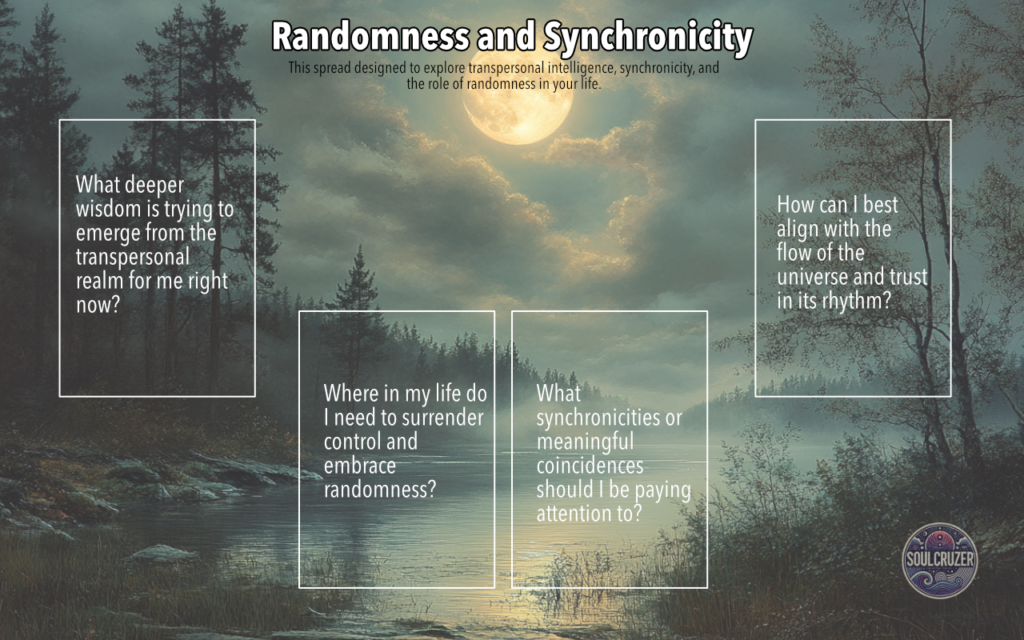
Here’s a 4-card Tarot spread designed to explore transpersonal intelligence, synchronicity, and the role of randomness in your life:

  1. What deeper wisdom is trying to emerge from the transpersonal realm for me right now?
    (This card reveals the insight or knowledge available to you from beyond the personal self.)
  2. Where in my life do I need to surrender control and embrace randomness?
    (This card highlights an area where letting go of control could invite new opportunities or insights.)
  3. What synchronicities or meaningful coincidences should I be paying attention to?
    (This card points to the synchronicities around you that hold significant guidance.)
  4. How can I best align with the flow of the universe and trust in its rhythm?
    (This card offers guidance on how to move in harmony with the universe and its deeper wisdom.)

This spread is crafted to help you engage both your intuitive and rational sides while exploring your connection to transpersonal intelligence.

Tarot Journal Entry: Exploring Transpersonal Intelligence, Synchronicity, and Randomness

This is how the cards played out for me…

The Tower (What deeper wisdom is trying to emerge from the transpersonal realm for me right now?)
The Tower appears in this position like a thunderclap of change. It’s here to tear down the walls of outdated thought patterns and beliefs that no longer serve me. In the context of transpersonal intelligence, this upheaval feels like an invitation to radically transform my relationship with myself and the world. I can sense that the universe is pushing me to dismantle the structures I’ve relied on, those ego-driven layers of control. It’s uncomfortable, but it’s also necessary. This destruction clears the space for a deeper wisdom to emerge—a wisdom that’s coming from beyond my own personal sphere. I need to lean into this chaos, knowing it’s a catalyst for my growth.

Queen of Pentacles (Where in my life do I need to surrender control and embrace randomness?)
The Queen of Pentacles gently nudges me to let go, especially in areas where I’ve been holding on too tightly—work, finances, relationships, the things that usually offer security. I can feel her reminding me that abundance flows more freely when I surrender control. Randomness, in this case, feels less like chaos and more like trust in the universe’s natural rhythm. Maybe I don’t need to know exactly how things will unfold. There’s a subtle call to loosen my grip and allow synchronicity to fill in the gaps. She’s asking me to nurture my own sense of stability from within, knowing that the universe supports me in ways I can’t always foresee.

10 of Cups (What synchronicities or meaningful coincidences should I be paying attention to?)
With the 10 of Cups, synchronicities surrounding emotional fulfilment and harmony are rising to the surface. I feel like the universe is speaking through moments of connection, especially with family and community. Meaningful coincidences might appear as little sparks of joy or unexpected moments of belonging—reminders that I am part of a larger, interconnected whole. There’s a loving flow to this card, and it’s urging me to be present with the people around me, to notice when those serendipitous moments arise, and to recognise that they’re guiding me towards a deeper sense of unity and collective harmony.

8 of Pentacles (How can I best align with the flow of the universe and trust in its rhythm?)
The 8 of Pentacles shows up like a steady drumbeat, reminding me that mastery comes through dedication. To align with the universe’s flow, it’s not enough to just float along—I need to be intentional in honing my craft, whether that’s my spiritual practice, creative projects, or personal growth. There’s a beautiful message of co-creation here: the universe responds to the work I put in. But it’s not just about the effort; it’s about trusting the rhythm of progress. Each step, no matter how small, aligns me more deeply with the greater wisdom and synchronicities that are unfolding in my life. There’s a balance between action and surrender that I’m being called to embody.

Reflection
This reading feels like a map of the next stage in my journey. The Tower is clearing the way for new growth, breaking down the ego’s defences, and pushing me to expand into deeper wisdom. The Queen of Pentacles reminds me that sometimes surrender is the key to abundance and that control can block the universe’s flow. Synchronicities are my guideposts, especially in the realm of relationships and emotional connections, as the 10 of Cups suggests. Finally, the 8 of Pentacles is the whisper to keep doing the work—dedicating myself to growth, knowing that with each step, I’m aligning with the universe’s greater rhythm.

In this dance between transpersonal intelligence, synchronicity, and randomness, I’m learning that trusting the process means embracing both the chaos and the craftsmanship of life. It’s a beautiful paradox, and today’s cards have helped me see that more clearly.

Lecture Notes: Jungian Perspective and the Tarot—Lesson 2

tarot cards on wooden table

Lecturer: Jungian Analyst, Kenneth James, Ph.D.

Using the Tarot to work on oneself

  • Key Themes:
    • Using the tarot to work on oneself.
    • Receptive vs. inactive modes of using the tarot.
    • Principle of synchronicity in tarot.
    • Understanding the Major Arcana in relation to the individuation process.
  • Receptive and Inactive Modes:
    • Receptive Mode: Consulting the cards for clarification or insight, receiving knowledge.
    • Inactive Mode: Using the cards to actively cultivate qualities or engage in active imagination, meditation, and pathworking.
  • Principle of Synchronicity:
    • Events are connected in time through:
      1. Causality: One event causing another.
      2. Temporality: Co-occurrence of events without a direct causal relationship.
      3. Synchronicity: Events are connected through meaning, not cause.
    • Psyche and matter reflect one another and are connected through meaning.
    • Tarot operates within this synchronicity framework.
  • Structure of the Major Arcana:
    • Composed of three cycles of seven cards, each representing stages of life:
      1. Knowledge (cards 1-7): Development of personal identity.
      2. Understanding (cards 8-14): Exploring inner worlds and synthesising knowledge.
      3. Wisdom (cards 15-21): Embracing deeper consciousness and transformation.
    • The Fool card (0) transcends all cycles, representing the journey of individuation.
  • Detailed Breakdown of the Major Arcana:
    • First Cycle (1-7) – Knowledge:
      • The Magician: Harnessing personal power, using elements of life to shape experience.
      • The High Priestess: Accessing inner wisdom and subconscious knowledge.
      • The Empress: Fertility, creativity, and the nurturing aspect of life.
      • The Emperor: Authority, structure, and order.
      • The Hierophant: Outer spiritual wisdom, tradition, and teaching.
      • The Lovers: Union of opposites, balance in relationships.
      • The Chariot: Moving forward in life with balance but caution.
    • Second Cycle (8-14) – Understanding:
      • Strength: Mastery over inner strength, balancing power with gentleness.
      • The Hermit: Inner reflection and wisdom, going inward for clarity.
      • Wheel of Fortune: The cycles of life, fortune, and fate.
      • Justice: Balance and fairness in decision-making.
      • The Hanged Man: Changing perspective, surrendering old beliefs.
      • Death: Letting go of what no longer serves, transformation.
      • Temperance: Healing, balance, and patience.
    • Third Cycle (15-21) – Wisdom:
      • The Devil: Materialism, illusion, and bondage to false beliefs.
      • The Tower: Destruction of old structures, forced transformation.
      • The Star: Hope, inspiration, and guidance through difficult times.
      • The Moon: Illusion, dreams, and the unconscious mind.
      • The Sun: Joy, clarity, and new potential.
      • Judgment: Awakening, realization, and life’s final decisions.
      • The World: Completion, wholeness, and mastery.
  • Exercises for Participants:
    1. Daily Tarot Draws: Continue drawing one card per day and at the end of the week, review the cards drawn to create a narrative for the week.
    2. Tarot Autobiography: Shuffle the cards and select one with your non-dominant hand, reflecting on an event from your life that resonates with the card. Record how that memory aligns with the card’s meaning.

Key Messages:

  1. Synchronicity as a Framework: Tarot readings operate through the principle of synchronicity, where internal and external realities meet through symbolic meaning.
  2. The Tarot as a Tool for Self-Reflection: Beyond divination, tarot can be used to work on oneself, facilitating personal growth, deeper understanding, and individuation.
  3. Tarot as a Narrative Tool: The tarot helps create a narrative of personal and spiritual development through its symbolism, encouraging reflection and insight into one’s life journey.
  4. The Importance of Interpretation: While traditional meanings of cards exist, personal interpretations are valid and essential. Each person’s interaction with the tarot is unique, fostering a deeper connection to the self.
  5. Major Arcana as Stages of Life: The cards of the Major Arcana mirror the stages of life, moving from knowledge, through understanding, and into wisdom.
  6. Balancing Inner and Outer Realities: The tarot encourages balance between the conscious and unconscious, the personal and the collective, as well as inner wisdom and external guidance.

Embracing The Fool

Lately, I’ve been diving deep into my relationship with The Fool, guided by Rachel Pollack’s The New Tarot Handbook: Master the Meaning of the Cards. As someone who’s always felt an affinity for the archetypes within the tarot, The Fool stands out for me as a figure of pure potential and adventure. There’s something both exhilarating and unsettling about that first step into the unknown, and it feels like a reflection of where I’ve been and where I’m headed.

As part of my journey, I’ve been working through Pollack’s exercises, and the first one I tackled posed six questions about how The Fool has shown up in my life. For each question, I drew a corresponding card, and the experience has been both illuminating and humbling. It’s a curious thing, using tarot not just for divination but as a mirror for self-reflection—seeing how these archetypal energies play out in my life in ways I hadn’t fully grasped before.

The first question was a big one: “How have I been a fool in my life?” For this, I drew the Ace of Wands. I immediately saw the connection. If I’ve been a fool, it’s been in the way I leap headfirst into new creative ventures, following sparks of inspiration without always worrying about where they’ll lead. The Ace of Wands is all about that raw, untamed energy of new beginnings, and I’ve embraced that more times than I can count. Whether it’s a writing project, a new blog community, or an unexpected spiritual path, I’ve always said yes to the adventure. It’s been my way of embracing The Fool’s openness to life.

The second question asked, “How has this helped me?”—a question that made me pause. I drew the Five of Swords here, which traditionally speaks to conflict and tough choices. I initially struggled with this one, but upon reflection, I realised that The Fool has helped me avoid unnecessary conflict by knowing when to walk away. In situations where others might cling to the need to win, I’ve been able to let go and move on. The Fool teaches detachment, and that’s served me well, especially in moments where staying in the fight would have been more damaging than walking away.

But, as with all archetypes, The Fool has a shadow side. “How has being a fool hurt me?” brought out the Death card. Now, Death isn’t a card to fear; it represents transformation and the inevitable endings that come with life. However, being a fool has hurt me when I’ve ignored the signs of necessary endings, clinging to situations far past their expiration dates. It’s that tricky balance between embracing The Fool’s carefree spirit and knowing when it’s time to let go and transform. Being too naive, too resistant to closure, can leave you blindsided when things do inevitably change.

The fourth question—“Where in my life do I need to be more foolish?”—brought forth the Seven of Pentacles, a card about patience and long-term investments. I took this as a sign to loosen up in areas where I’ve been too methodical or overly cautious. The Fool’s energy isn’t always about rushing in headfirst—it’s about trusting the process. Sometimes, it’s about taking risks in the areas where I’ve been carefully tending my garden, letting go of the need to control the outcome, and trusting that life will unfold in its own time.

The most sobering question, “Where will The Fool not serve me?” gave me the Two of Swords, a card of indecision and stalemate. Here, I was reminded that The Fool’s boundless energy and impulsiveness won’t help me when it’s time to make tough decisions. Sometimes, you can’t leap without looking. Sometimes, you have to sit with the discomfort of not knowing, weigh your options, and make a conscious choice. The Fool may want to keep moving, but there are moments when stillness and reflection are what’s needed most.

Finally, “What gift does The Fool bring me?” delivered the Knight of Swords. This card speaks of bold, determined action, and I realised that The Fool’s gift to me is clarity in motion. When I fully embrace life’s possibilities, The Fool gives me the courage to act with purpose. It’s not about wandering aimlessly—it’s about knowing when to charge forward, sword in hand, ready to pursue the vision that’s emerged from all that openness.

Reflecting on this exercise, I see how deeply intertwined The Fool is with my journey. I’ve long been drawn to the spirit of beginnings—there’s something about stepping into the unknown with trust and openness that speaks to my soul. As I continue to explore tarot and Jungian depth psychology, I see that this isn’t just a casual curiosity. It’s the foundation of my work as a coach, a facilitator, and a storyteller. I’m learning to let go of fears and doubts, to embrace my creativity and intuition, and to trust the process of life.

If anything, The Fool reminds me that life is an adventure. Each step is a leap into the unknown, but it’s the willingness to leap that brings growth, transformation, and—most importantly—joy.

The Fool and the Mysterious Number Zero

Now, picture this: The Fool, with nothing but a small bundle slung over his shoulder, standing on the edge of a great precipice. The sun warms his back, the earth crumbles beneath his feet, and yet his gaze is skyward, carefree and trusting.

His number? Zero.

Not one, not ten, but that infinite space of potential—where all is possible and nothing is set in stone. Zero is a mystical number, one that holds the key to creation itself. It is the point of pure potential, the moment before form takes shape, the silence before the first word is spoken. Imagine it as the cosmic egg, the unbroken shell from which the whole universe hatches—a fragile yet infinite vessel that cradles the beginnings of all things. It’s not empty; far from it. It is everything waiting to be born.

In this sense, zero is the great paradox. It is nothing, yet it contains everything. Within its void lies the spark of creation, the initial breath that sets the cosmos into motion. Think of it like a seed buried in the dark earth, full of life yet dormant, waiting for the right moment to burst forth. The magic of zero is that it embodies both stillness and movement.

In many myths, creation often emerges from a primal void, a formless expanse that seems empty but is pregnant with possibility. The ancient Greeks called it Chaos, the fertile disorder from which order and life sprang forth. In Hindu cosmology, there is the concept of Brahman, the infinite and unmanifested reality from which the entire universe is woven. Zero represents this same principle—the point of inception, where all things come into being, not from something, but from no-thing.

To engage with the energy of zero is to embrace the unknown, to step into the space where creation is yet unshaped, unspoken, but fully present. It reminds us that in every ending, there is a new beginning; in every void, there is the promise of something emerging. Zero is the doorway to transformation, the place where imagination, spirit, and matter begin their dance. The Kabbalists called it Ein Sof—the endless, boundless source of all that is. It’s like the dark womb of the earth, teeming with life, though no-one can see it yet.

And there, on the cliff’s edge, The Fool stands at the doorway between worlds, at the threshold of the known and the unknown. His heart is light, and his spirit is free, for he trusts that whatever happens next will guide him toward discovery. But this Fool is not just an innocent wanderer. No, he represents something far deeper. In the teachings of Carl Jung, that wise old seeker of the soul, zero is much like the unconscious. The Fool’s journey is a mirror of our own quest, diving deep into the uncharted waters of our psyche, into that mysterious realm where all our dreams, archetypes, and long-forgotten memories reside.

The unconscious isn’t just some dark, forgotten basement where our unwanted thoughts are locked away—no, it’s a vast ocean, deep and mysterious, where the raw material of our souls lies waiting to be shaped. Imagine it: endless, shimmering, alive with currents that pulse with hidden energy, a realm far richer and more expansive than we might first believe. It’s not a place of neglect, but one of immense potential. This is where the unseen forces that shape our lives swirl, just beneath the surface, waiting to rise.

Now, friends, imagine what happens when we allow ourselves to dip into this zero space, when we listen to the whispers of our unconscious. The Fool’s leap is not reckless; it’s an act of trust in something greater. Jung himself would say that this is how we grow—by bringing the hidden parts of ourselves into the light. We don’t fear the leap, because we know that within the abyss, there is something calling to us, something that will guide us toward wholeness.

The unconscious, you see, is alive with potential. It’s where the stories we haven’t yet told are waiting to be discovered. It’s where the symbols that shape our lives are hiding, like treasures in the deep. Every now and then, one of these symbols rises, whether in a dream, in a sudden flash of insight, or in a quiet moment of reflection. And when we follow these signs, we’re stepping into that same unknown that The Fool walks into.

Imagine, now, that crossroads in your life—the moments when you didn’t know which path to take, when the way forward seemed foggy, but something within you stirred. That’s the zero, my friends, the place of possibility. It’s not random. Oh no, it’s the fertile ground from which growth emerges. It’s like planting a seed. At first, all you have is the dark earth, but deep within, life is unfolding. You just have to trust that something is growing, even when you can’t see it.

And that’s what Jung meant by individuation—becoming who we truly are by diving into this unconscious, this zero, and bringing its gifts into the world. It’s a bit like the Fool’s journey. Every step forward requires us to leave behind the known and step into the unknown, to let the hidden parts of ourselves rise to the surface, like stars slowly appearing in the night sky.

So, whenever you draw The Fool from the tarot deck, remember this story. It’s not just about beginnings–it’s about stepping into the boundless realm of possibility that zero represents, a space where all things are yet to be formed but everything is already present in potential. The Fool isn’t just a symbol of naivety or reckless abandon; he’s a guide, a reminder that life’s most profound transformations don’t come from playing it safe. They arise when we’re willing to take that leap into the unknown, to embrace uncertainty with an open heart, trusting that the universe, or perhaps our own unconscious, will guide us to where we need to be.

And so the Fool steps off the cliff, into the void, into the zero.

Lecture Notes: The Jungian Perspective and the Tarot—Lesson 1

Lecturer: Jungian Analyst, Kenneth James, Ph.D.

The Jungian Perspective

  • Definition of a Jungian Perspective:
    • The Jungian perspective must relate to the process of individuation.
    • Jung’s psychology is practical, aiming to facilitate individuation.
  • Individuation as the Core:
    • Goal of inner work and a lifelong process.
    • Process of becoming “undivided” (moving from division toward wholeness).
    • Complexes, drives, and fantasies create inner divisions.
    • Life naturally pushes individuation; inner work, including tarot, aids the process.

Tarot and Its Role in Individuation

  • Tarot as a Tool for Inner Work:
    • The tarot is used in the service of individuation.
    • Jung’s concept of “abbézement du nouvementale” — lowering the mental level to access deeper unconscious material.
  • Ego and the Tarot:
    • Consulting the tarot relativizes the ego’s dominance.
    • Tarot helps us confront defenses and resistance to the unconscious.
    • Non-egoic determinants of experience influence life.

Structure of the Tarot Deck

  • Two Decks in One:
    • 78 cards in total, divided into:
      1. Major Arcana (22 cards) – archetypal, transpersonal forces.
      2. Minor Arcana (56 cards) – daily experiences, personal situations.
  • Major Arcana:
    • Reflect archetypal forces that shape human experience.
    • Examples include “The Fool,” “The Lovers,” and “Death.”
  • Minor Arcana:
    • Depicts everyday situations and interpersonal dynamics.
    • Four suits: Pentacles, Wands, Swords, and Cups.
    • Includes court cards (King, Queen, Knight, Page) and pip cards (Ace to 10).

Tarot, Jung, and the Unconscious

  • Jung’s Views on Tarot:
    • Tarot represents the flow of the unconscious.
    • Applicable for intuitive methods that help us understand life.
    • Tarot reveals meaning between the unconscious and outer world.

Key Messages:

  • Individuation as Life’s Work:
    • Tarot, like dreams and synchronicities, helps guide us towards wholeness.
    • The process is natural, inevitable, and essential for personal growth.
  • Tarot as an Oracle:
    • Consulting tarot is an acknowledgement of needing information beyond egoic control.
    • It helps us surrender to a broader, non-rational form of knowledge.
  • The Role of Archetypes:
    • Archetypes shape the personal and collective experience and are key to understanding both.
  • Complexes and Ego Defence Mechanisms:
    • The tarot helps us see past our ego defences, opening the door to self-awareness.
  • Non-Egoic Forces and the Self:
    • Beyond the ego, non-egoic forces (complexes, archetypes) play a significant role in shaping life experiences.
    • Recognising these forces is essential for growth and individuation.

Exercises for Participants:

  1. Tarot Diary Exercise:
  • Draw a card each day, reflect on its meaning in the morning and before bed.
  1. Narrative of Insight:
  • Select three cards, tell a story connecting them without focusing on divination.

Closing Thoughts

  • Integration of the Tarot and Jung’s Psychology:
    • Tarot serves as an ally in the individuation process, helping us navigate life’s inner and outer worlds.

in-between spaces

I sit at my desk, the hum of the world still catching its breath from the night’s slumber. The sunlight is hesitant, as if it knows it should rise but isn’t quite ready to commit. This feels like the perfect time for some morning pages—a stream of consciousness that lets my thoughts spill out like water finding its course through rocks and earth.

I reach for my notebook, and as the pen touches the page, something curious happens. The words I write don’t seem entirely my own. Instead of the usual jumble of musings about my day or plans, the ink forms a river—literally. A small river on the page, its waters shimmering like quicksilver, twisting between the lines of my journal. I dip my finger into the ink and suddenly, I’m there.

The landscape is familiar but foreign, a half-remembered dream. Trees grow in spirals, leaves curling like question marks. A fox with emerald eyes stands on the path ahead, watching me. Is this some dream-shamanic journey I’ve wandered into? I’m not sure, but the ground beneath me feels solid, and the air is crisp with potential.

I walk toward the fox, and it doesn’t run. Instead, it speaks—soft, like a breath you’d miss if you weren’t listening closely.

“Write your dreams,” it says, its tail flicking with subtle impatience. “Record them. Live them.”

I nod because the fox is right. It’s time I renew that practice, time I dive deeper into the liminal, that in-between space where reality and dreams blur. Morning pages are the portal, but the dreamwork—the shamanic journeys, the hypnotic meditations, the sound of drums reverberating in the back of my mind—that’s the real work. The practice that weaves waking and sleeping into the same thread. I’m reminded of Robert Moss’ words—dreams and reality aren’t separate; they’re different lenses to view the same landscape.

The fox turns and darts away, and before I can follow, I’m back at my desk, staring at the now blank page. The river of ink is gone, but the message lingers in the air.

Later, in the afternoon, I make my way to Liverpool, and Joseph Campbell keeps me company. His voice echoes in the car, weaving the Hero’s Journey into every curve of the road. I can feel the myths breathing alongside me, the stories ancient yet evergreen. I know the power they hold—the power to reshape the psyche, to uncover those buried fragments of soul. His words about the hero’s call to adventure make me think of my own journey, not just through life but through the worlds that exist beyond the veil of this one. Perhaps I’ve been listening too much to the logical voices that try to impose order and meaning. Perhaps I’ve forgotten how to “fall in love” with the pictures in front of me—be they tarot cards or dream symbols.

Rachel Pollack had the right idea. Her tarot explorations in A Walk Through the Forest of Souls were like nothing I’ve read before—less rigid, more fluid, as though the cards themselves were breathing, inviting me to ask them questions instead of demanding answers. It’s time to let them speak their stories, to let the images reveal what they want, without the weight of interpretation hanging over them like a fog.

I pull a deck from my bag as the car continues its journey north. The cards feel warm in my hands, alive. I shuffle without thinking, without intention, and draw three: The Fool, Death, and The Tower.

I chuckle to myself. Of course. The story of transformation, of destruction and rebirth. A theme echoed in every myth, in every dream, and in every creative endeavour I’ve ever attempted. It’s the same story I’ve been telling myself but hadn’t yet realised I was living.

There’s a flash from the corner of my eye, and suddenly the fox is back—sitting calmly in the passenger seat. It’s strange how normal this feels now, like the veil between reality and imagination is thinner than I thought. The fox yawns lazily, eyes on the cards in my hand.

“You know what this means,” it says, as if we’re old friends, as if we’ve had this conversation before. Maybe we have, in dreams I’ve forgotten.

“I do,” I reply. It’s time to weave the magic of the surreal into my writing, to infuse my blog with this very essence. No more boundaries between the real and the unreal. I’ll call upon the cards, the myths, the dreams—perhaps even the fox—to guide me.

The road stretches out in front of me, endless and full of possibility. The pen is back in my hand, and the ink, once again, is a river waiting to be followed.