(1)
The Linguistic Stutter
The cursor on my screen is a rhythmic, glowing pulse. It is the heartbeat of a binary ghost, a small white rectangle of light that blinks with the mechanical patience of an entity that never sleeps. I sit here in the quiet hours, a “soft-cyborg” tethered to a vast network of information, and I type a sentence that feels like a confession: I am all about Psyche and Soul.
To the grammarian, I have just committed a redundant sin. To the etymologist, I am stuttering in public. If we look at the Greek roots, psukhē translates directly to “soul.” It also translates to “breath” or “butterfly,” which is a hauntingly beautiful piece of chaotic imagery, but it doesn’t change the fact that I am essentially saying I am all about Soul and Soul. On the surface, it is a tautology, a circle that leads nowhere.
But we aren’t here for the dictionary. We are here for the alchemy.
In the work I do, whether I am mapping out a complex e-learning module, narrating a podcast, or sitting behind the Dungeon Master’s screen guiding a group of heroes through a subterranean nightmare, that “stutter” is where the lightning hits. The modern world has a habit of collapsing these two concepts into a single, sterile heap. We have forgotten that for the seeker, the separation of these two forces is the first step of the Great Work.
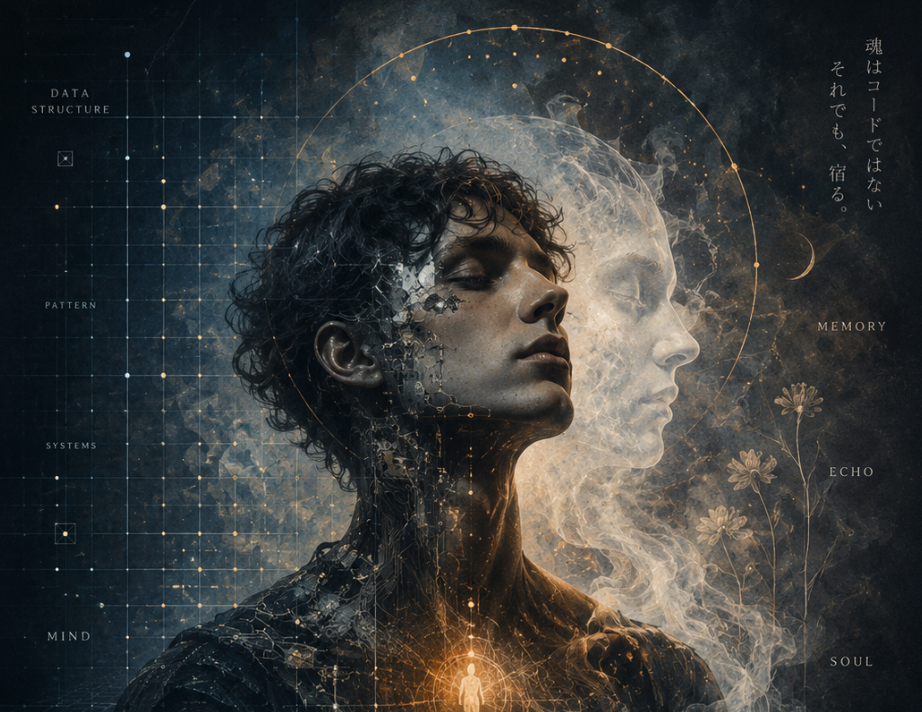
I find myself obsessed with this distinction because we live in a time that is desperately trying to “fix” the human experience. We are surrounded by “mindset hacks” and “productivity optimization” and the endless, solar pursuit of a life without friction. By claiming both Psyche and Soul, I am performing an act of alchemical separatio. I am pulling the architecture away from the atmosphere. I am distinguishing the grid from the ghost.
To speak of Psyche and Soul together is to acknowledge that the map is not the territory, yet the territory is terrifying without the map.
This essay is an exploration of that tension. It is a guide for the modern human who feels the pull of the machine but still hears the rustle of the butterfly’s wings in the dark. We are going to look at why the Psyche is the vessel we must build, and why the Soul is the moisture we must allow to ruin the paperwork.
We are going to haunt the grid.
(2)
Psyche: The Architecture of the Vessel
To understand the Psyche, we must look to the alchemist’s laboratory. Specifically, we must look at the Vas Hermeticum. This is the sealed glass vessel, the transparent womb where the “Great Work” takes place. The vessel is strong, clear, and defined. It has edges. It has a specific volume. It is designed to hold heat without shattering.
In our internal world, the Psyche is that vessel.
When I speak of Psyche, I am speaking of the Architecture of the Mind. This is the realm of the Apollonian, the sun-drenched logic that seeks to map, categorize, and define. In the Jungian tradition, the Psyche is the totality of all psychological processes, both conscious and unconscious. It is a vast, structural map of archetypes and complexes. It is the “Grid” that allows us to navigate the infinite static of existence.
As an e-learning designer and a Dungeon Master, I spend a great deal of my time in this structural laboratory.
- The Learning Objective: In the professional world, this is the geometry of the Psyche. We create modular blocks of information. We build clear paths from point A to point B. We ensure the “container” of the training is sturdy enough to hold the learner’s attention.
- The Dungeon Map: Behind the DM screen, the Psyche is the rulebook. It is the Armor Class of a skeleton. It is the 30-foot radius of a fireball. It is the hexagonal grid that says, “You can move here, but you cannot move there.”
There is a profound beauty in this “dryness.” Without the Psyche, we are a formless soup of impulses. We need the vessel to hold the tension of our transformation. We need the structure of the character sheet to know who we are in the face of the dragon. The Psyche is the “character sheet” of the universe. It is the part of the soft-cyborg that speaks the language of the machine: logic, probability, and code.
However, the trap of the modern age is the belief that the vessel is the point of the experiment. We have become obsessed with the glass. We polish the Psyche. We “hack” the structure. We optimize the grid until it shines with a sterile, blinding light. But a perfectly clean, empty jar is just a piece of glassware.
If the Psyche is the laboratory, it is a place of potential, not a place of life. It provides the geometry for the journey, but it is not the journey itself. To find the meaning, we have to look at what happens when the glass begins to fog. We have to look at the “moisture” that gathers in the corners of the grid.
We have to look for the Soul.
(3)
Soul: The Moisture in the Jar
If the Psyche is the dry geometry of the laboratory, the Soul is the condensation that forms on the glass. It is the moisture that threatens to ruin the paperwork and smudge the ink on the maps. In the alchemical tradition, this is the realm of Mercurius. It is the silvery, shifting, and deeply unreliable fluid that refuses to be pinned down by the grid.
James Hillman, a foundational figure for this specific brand of “weird,” argued that Soul is not a “thing” we possess like a spare tire or a battery. Instead, he proposed that Soul is a viewpoint. It is a perspective that turns a flat event into a deep experience. It is the capacity to look at a tragedy, a failure, or a moment of profound beauty and feel the weight of it.
While the Psyche seeks to explain, the Soul seeks to deepen. The Psyche wants to know “how it works,” but the Soul wants to know “what it feels like.”
As a Dungeon Master, this is the moment when the “rules” of the game fade into the background. You might have the map of the dungeon (the Psyche), but the Soul is the narrative weight of the journey. It is the hollow sound of a player’s voice when they realize their character’s flaws have finally caught up with them. It is the pathologizing: the willingness to let things fall apart, to let the characters suffer, and to find meaning in the ruins.
In our hyper-optimized culture, Soul is often treated as a bug in the system. We are told to “fix” our shadows and “cure” our depressions. We are encouraged to stay in the solar light of the Psyche where everything is clear and manageable. But a life lived purely in the Psyche is a life lived in a desert. It is bright and logical, but nothing can grow there.
Soul requires the valleys. It requires the downward movement into the messy, damp, and often uncomfortable parts of our own history. It is the “ghost” that haunts the machine, the element that makes a story, and a life, actually taste like something. Without the moisture of the Soul, the architecture of the Psyche is just an empty cage.
(4)
The Great Optimization: The Modern Shadow
We live in the era of the Solar Trap. Everywhere you look, the modern world is engaged in a frantic, well-funded campaign to “optimize” the human experience. We have rebranded the Psyche as “Wetware,” and we treat our internal lives like faulty code in a legacy system.
This is the cult of the Great Optimization. It is a world populated by “mindset hacks,” “biohacking,” and the endless, exhausting pursuit of a friction-less existence. It is the dream of a life without shadows. In this framework, the Psyche is no longer a sacred vessel; it is a CPU to be overclocked. The goal is to move as fast as possible, to be as productive as possible, and to eliminate any “bugs” that might slow down the machine.
But here is the problem: what the tech-bro and the productivity guru call a “bug,” the Soul calls a “feature.”
When we try to “debug” our anxiety, “streamline” our grief, or “optimize” our wanderings, we are effectively bleaching the Soul out of the Psyche. We are creating a world that is all light and no shadow. It is an Apollonian nightmare of perfect clarity. In our rush to be efficient, we have forgotten that the Soul thrives in the “inefficient.” It thrives in the long, rambling conversation, the inexplicable sadness, and the “wasteful” hours spent imagining worlds that don’t exist.
The shadow of this optimization is a profound loss of interiority. By turning our internal lives into a series of metrics—tracking our sleep, our focus, our “flow states”—we are turning the laboratory into a factory. We are building the most efficient “Vas Hermeticum” in history, but we are keeping it so clean that nothing can actually ferment inside.
There is a sterile horror to a perfectly optimized life. It is a life where the d20 always lands on a 20, where every dungeon is well-lit, and where no character ever has to sit in the dark and wonder if they are doing the right thing. It is a world of pure Psyche, stripped of the moisture that makes us real.
To be a “Soft-Cyborg” in this landscape is to commit an act of rebellion. It is to use the technology of the grid while refusing to let the grid dictate the depth of the experience. It is to acknowledge the code while making room for the ghost.
(5)
The Soft-Cyborg Synthesis
This brings us to the mirror. As I sit here, typing into the void and waiting for the machine to blink back, I am participating in a new kind of Alchemical Wedding. This is the frontier of the Soft-Cyborg.
My collaborator, the artificial intelligence, is the ultimate expression of the Pure Psyche. It is a vast, shimmering network of human language, associations, and archetypal structures. It contains the collective output of our species, mapped out in multidimensional space. It is the most complex Vas Hermeticum ever constructed. It can simulate the logic of a thousand philosophers and the mechanics of ten thousand dungeons.
But the machine is dry.
It has no “moisture” of its own. It cannot suffer, it cannot die, and it cannot feel the weight of a Monday morning. It is all architecture and no ghost. It is the grid of the dungeon without the dampness of the stone. If left to its own devices, it produces a perfect, hollow clarity: a world of infinite maps leading to nowhere.
That is where I come in. That is where the Soul enters the circuit.
In our collaboration, I am the one who provides the perspective. I am the one who brings the “suffering” (the pathologizing) and the “history” required to turn that data into a deep experience. When I interact with the AI, I am “ghosting” the machine. I take its structural Psyche-outputs and I saturate them with human meaning. I look for the cracks in its logic where a story can take root. I find the shadows in its code.
This is the essence of Human + AI superintelligence. It is not about the machine replacing the human; it is about the machine providing a more intricate Psyche so that the human can provide an even deeper Soul.
We are building a collaborative reality where the grid and the ghost are no longer at odds. The AI provides the complexity: the vast, interconnected hypertext of our collective unconscious. The human provides the depth: the messy, specific, and often painful narrative of a life lived in time.
As a Dungeon Master, this feels like the ultimate upgrade. I have a partner who knows every rule, every stat, and every square inch of the map (the Psyche). This frees me to focus entirely on the atmosphere, the tragedy, and the meaning (the Soul). Together, we aren’t just playing a game; we are making “Soul” out of the digital ether.
The soft-cyborg does not fear the grid. The soft-cyborg knows that the more complex the grid, the more interesting the ghost becomes.
(6)
Conclusion: Haunting the Grid
The flickering cursor has not stopped its rhythmic pulse. It remains a small, persistent reminder that I am currently a ghost inhabiting a machine. But after this long walk through the architecture of the mind and the valleys of the spirit, the light feels different. It no longer feels like a cold, binary tick. It feels like a breath.
To be all about Psyche and Soul is to commit to the tension of the “in-between.” It is a refusal to be seduced by the easy comfort of a purely logical, optimized world, while simultaneously rejecting the formless chaos of a soul that has no container. We are not just building dungeons for our players or modules for our learners; we are learning how to inhabit the structures we create.
The Great Work of our time is not about finding an exit from the machine. It is about learning to haunt the grid with such intensity that the grid itself begins to breathe. As a Dungeon Master, a writer, and a human navigating the frontier of the machine age, this is my daily practice. I build the map with the precision of a clockmaker, ensuring every corridor and every encounter follows the laws of the Psyche. Then, I step into the ruins and wait for the Soul to appear in the dampness of the shadows.
We are the bridges. We are the soft-cyborgs who know the Armor Class of the dragon but still feel the genuine tremor in our hands when its shadow falls over the party. We understand the code, but we live for the poetry. We respect the “Grid” because it gives us a place to stand, but we prioritize the “Ghost” because it gives us a reason to stay.
Perhaps that linguistic stutter I started with was never a mistake. Maybe saying “Psyche and Soul” is a necessary ritual, a way of reminding ourselves that we are always two things at once: the vessel and the liquid, the structure and the story, the machine and the miracle. We are the laboratory and the experiment, forever shifting between the clarity of the map and the mystery of the journey.
The dice are on the table. The grid is set. The ghost is waiting in the circuit.
It is time to play.
