
I woke up this morning in my tent thinking about self-validation. That’s the barefoot philosopher taking advantage of a little solitude before the day starts.
If the ego is partly a protection system, can it ever be trusted to validate the self it is trying to protect?
“Know thyself” sounds noble until we remember that the self doing the knowing is also the self editing the footage, hiding the evidence, managing the courtroom, and sometimes bribing the judge.
So yes, self-validation is possible, but probably not as a solitary act of pure inner certainty.
It’s more like a triangulation.
Self-validation is possible, but not self-sufficient
One useful way to see it:
Self-validation is the act of saying: “My experience is real enough to be listened to.”
It doesn’t mean:
- my interpretation is correct
- my memory is complete
- my motives are pure
- my wounds are telling the whole truth
- my ego has become an impartial witness
It simply means I don’t have to outsource my entire sense of reality before I’m allowed to take myself seriously.
That kind of self-validation is necessary. Without it, we become dependent on other people to certify our existence. We keep asking the village, the partner, the audience, the algorithm, the therapist, the friend group: Am I allowed to feel this? Am I allowed to want this? Am I allowed to be this?
But the opposite danger is just as real: the sealed ego-capsule. The person who “validates themselves” so completely that no outside voice can ever enter. Every criticism becomes projection. Every rupture becomes someone else’s trauma response. Every uncomfortable mirror is dismissed as “low vibration” or “not aligned.”
That’s not sovereignty either. That’s you living inside a reality tunnel with blinders on.
Others are not the source of truth, but they are part of the mirror-system
I don’t think we need others to grant us validity.
But we do need others to help us perceive our shape.
You can know your inner experience directly. You can know what it feels like from the inside to be you. But you can’t fully know your impact from the inside. You can’t entirely see your tone, your pattern, your avoidance, your charisma, your repetition, your blind spot, or your defensive move.
Other people give us something we can’t manufacture alone: the view from outside the nervous system.
Not always accurately, of course. Other people are also distorted mirrors. They come with their own wounds, projections, agendas, cultural scripts, needs, and unfinished business. So the trick is not “believe yourself” or “believe others.”
The trick is: learn to read the mirrors.
Some mirrors clarify.
Some mirrors warp.
Some mirrors punish you for having a self.
Some mirrors flatter the mask and never touch the soul.
Some mirrors only show you who you are in relation to their hunger.
And occasionally, blessedly, someone reflects you back in a way that makes you more honest, not smaller.
“Know thyself” may require being known
Maybe the old command needs a companion phrase:
Know thyself — but do not attempt it alone.
The self is relational. We are not sealed objects. We are patterns of body, memory, story, desire, fear, habit, longing, gesture, and response. Some parts of us only appear in solitude. Some only appear in conflict. Some only appear in love. Some only appear when we are misunderstood. Some only appear when someone sees us more clearly than we were ready for.
So maybe self-knowledge has three chambers:
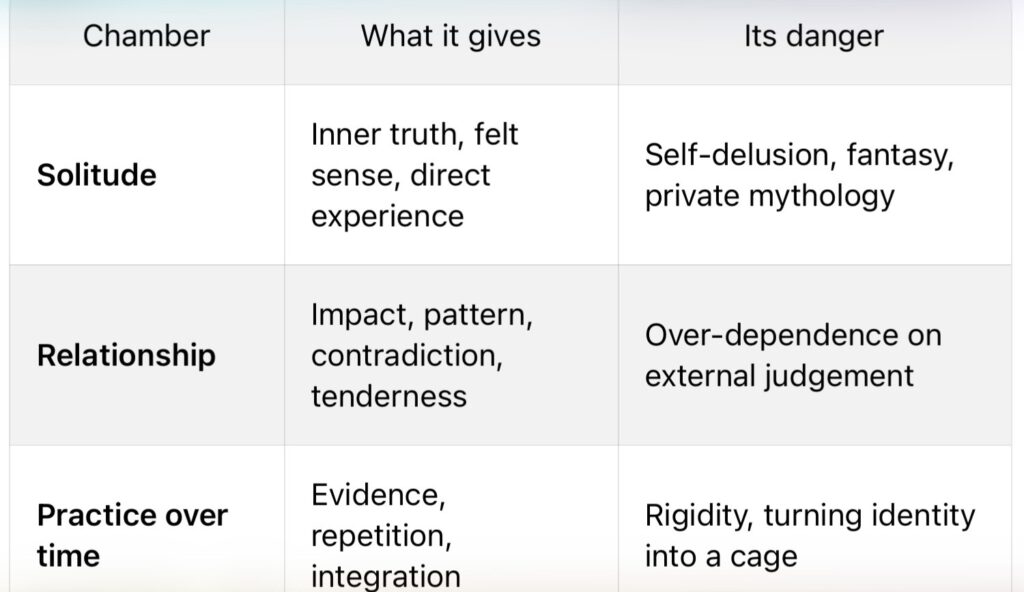
The self is not revealed in one mirror. It emerges through a constellation of mirrors.
The ego is not only a liar
I’d be careful not to make the ego the villain too quickly.
The ego protects because, at some point, protection was needed. Its distortions often began as mercy. Denial, rationalisation, defensiveness, performance, people-pleasing — these are not just moral failures. They are survival strategies that stayed too long at the controls.
So the question becomes less:
How do I defeat the ego so I can see the truth?
And more:
How do I create enough safety that the ego no longer has to falsify the evidence?
That’s a very different path.
Truth often enters through the body before it enters through the intellect. Tight chest. Defensive laugh. Sudden irritation. The sentence you keep rehearsing. The person whose feedback you can’t stop thinking about. The praise that feels false. The criticism that stings because some part of you recognises the truth.
Self-knowledge is not just introspection. It’s pattern recognition with humility.
A possible working model
Maybe the strongest stance is this:
I validate my experience.
I test my interpretation.
I invite reflection from trustworthy mirrors.
I refuse to surrender my sovereignty to any single mirror, including my own.
That feels like the barefoot philosopher’s version of “Know Thyself.”
Not solitary certainty.
Not crowd-approved identity.
Something more alive and more difficult:
a disciplined intimacy with your own experience, cross-checked by reality, relationship, and time.
The self is not a fixed object waiting to be discovered under the floorboards. It’s a living pattern. You know it the way you know a path: by walking it, noticing where you stumble, listening when others say what they saw, and returning often enough that the terrain begins to reveal itself.
Can You Know Yourself Alone?