(1)
The door opens
I keep thinking about a passage I read recently:
“Leave the door open for the unknown, the door into the dark. That’s where the most important things come from, where you yourself came from, and where you will go.”
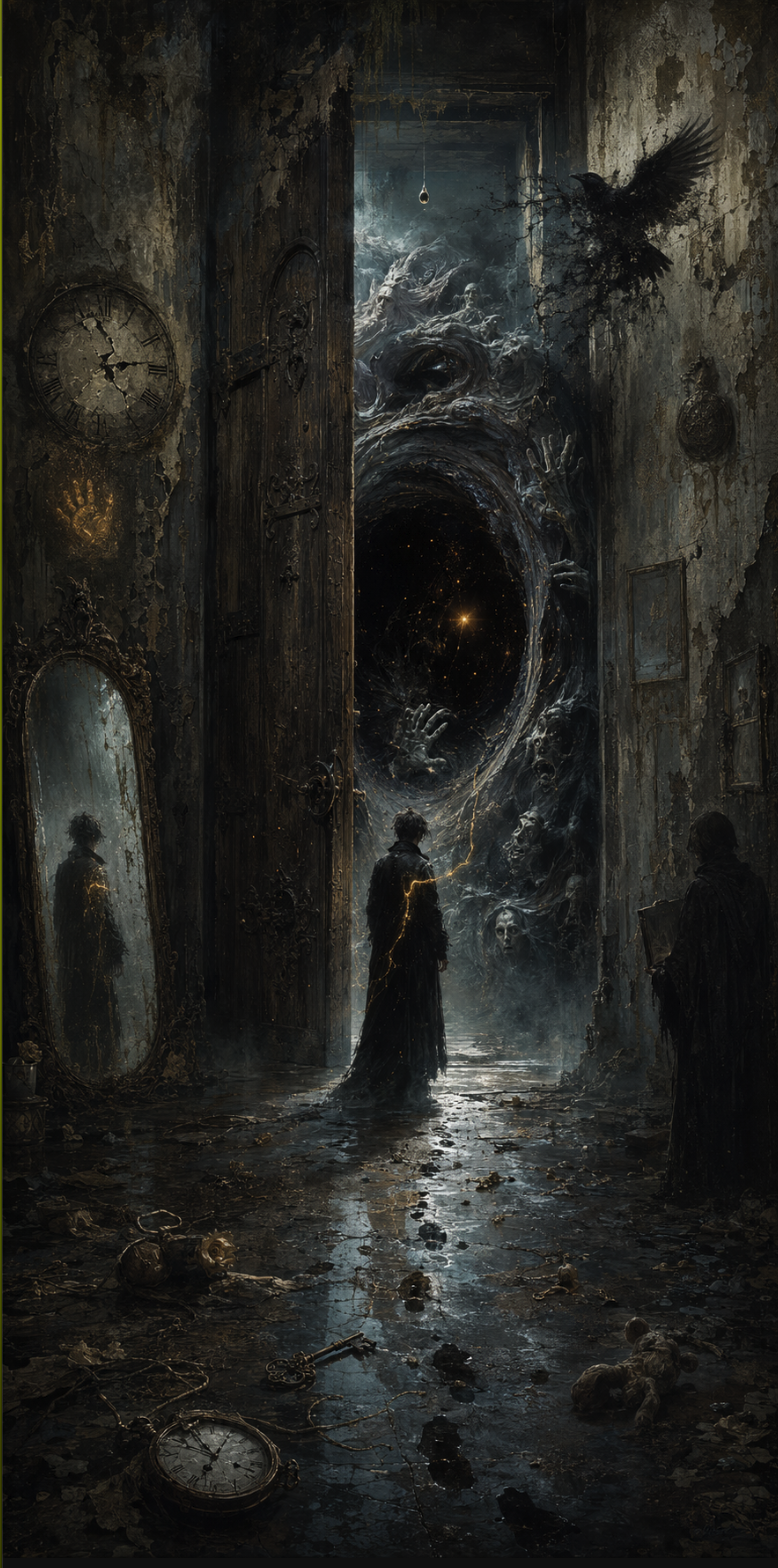
I like the mystery of it. The unknown is a black hole, a dragon, a grey man living a grey life. It whispers: “You’ll die in obscurity. You’ll leave no trace that you ever existed. You have won no awards. You’ve made no impact. You’re gone tomorrow just like that.”
I hang onto the idea that people know me in my immediate circle. I’m not invisible. I’m just afraid of the dark.
(2)
The black hole as a mirror
The black hole isn’t just out there. It’s a reflection of what I’ve been swallowing myself:
- The fear of annihilation: “A black hole waiting to swallow me up into nothingness.”
- The grey man: A persona I’ve cultivated to avoid detection, but also to avoid living.
- The trace: The desperate need to be remembered, even if it’s just by one person.
This isn’t just existential dread. It’s Terror Management Theory in action. The fear of death driving me to seek legacy. But what if legacy isn’t about awards or fame? What if it’s about the notes I leave behind, the conversations I have, and the lives I touch without even realising it?
(3)
Obscurity as a superpower
I’ve spent years blending in, but what if the grey is just the background? The real colour is in the notes I haven’t written yet.
Textcasting (Dave Winer’s vision of applying the philosophy of podcasting to text) offers a way out. It’s about owning your trace, publishing to your own domain, and letting your notes outlive the platforms. The dark is still there, but now I’ve got a flashlight.
(4)
The dragon of obscurity
The dragon isn’t the unknown. It’s the fear of it. And the only way to slay it is to open the door daily.
Here’s how I’m reframing obscurity:
A. The Trace Audit
- What traces have I already left? A conversation, a note, a kindness.
- What traces do I want to leave? A blog post, a shared idea, a life changed.
B. The Doorway Ritual
- Light a candle (symbolizing the light I bring into the dark).
- Write one fear on a piece of paper and burn it.
- Write one question I want the dark to answer (e.g., “What’s the first step out of gray?”).
C. Textcasting as a Practice
- Treat every note as a potential Textcasting post, even if it’s just for me.
- Use interoperability to ensure my trace isn’t tied to a single platform.
(5)
The doorway manifesto
(A Declaration of How to Meet the Unknown)
- The Door
- I will open doors daily—not out of habit, but because the unknown is where growth lives.
- I will not flinch from the draft that rushes in, nor mistake hesitation for wisdom.
- Some doors are meant to be passed through; others, to be closed with intention. I will learn the difference.
- The Black Hole
- I will not let the void swallow me whole. I will anchor myself to light: a question, a breath, a single step forward.
- I will remember that black holes bend time, not destiny. What feels like forever is often just a moment stretched thin.
- I will leave breadcrumbs—not to find my way back, but to prove I was here.
- The Trace
- I will leave traces: words, scars, echoes, footprints in wet cement. But I will not demand they last forever.
- I will trust that some marks fade because they were never meant to be permanent—only necessary.
- I will collect traces of others, too: a phrase underlined in a borrowed book, a stranger’s laugh in a crowded room. These are my inheritance.
- The Gray
- I will be grey when I need to: neither hero nor villain, neither right nor wrong, but a shape shifting in the fog.
- I will not mistake grey for safety. Ambiguity is not armor—it is the terrain I must learn to navigate.
- I will seek clarity where I can, but I will not force it where it does not belong.
- The Daily Practice
- I will open one door I’ve been avoiding. I will sit with the discomfort until it teaches me something.
- I will erase one trace I no longer need. I will create one new trace, however small.
- I will ask myself: What color am I today? And I will answer honestly, even if the answer is gray.
- The Invitation
- This manifesto is not a rulebook. It is a conversation with my future self.
- I will revise it. I will argue with it. I will spill coffee on it and laugh.
- I will leave it on a park bench someday for someone else to find.
(6)
Unanswered questions
1. “Is the black hole a void or a womb? Could it be a space of creation, not erasure?”
- Cosmic Echoes:
Astrophysical black holes are both destroyers and creators—they warp spacetime, birth galaxies, and forge elements. This metaphor mirrors the duality: the black hole as a liminal crucible. What if the “void” is just the pause before a new form emerges? (See: Negative Space in Art or Taoist Wu Wei.)- Counterpoint: Not all voids are fertile. Some are just… void. The difference might lie in agency—do you enter the black hole passively (erasure) or actively (transformation)?
- Psychological Lens:
Jung’s shadow and Bion’s O (the unknowable) suggest the black hole is where repressed material gestates. The “womb” isn’t comfortable—it’s alchemical. (Compare to The Dark Night of the Soul.)- Exercise: Next time you’re in a “black hole” moment, ask: What is this space trying to grow?
2. “What would happen if I thanked the black hole for showing me my fears?”
- Gratitude as Alchemy:
Thanking the black hole reframes it from enemy to teacher. This is a stoic move (Amor Fati) or a Buddhist one (seeing fear as a path to compassion). But it’s also practical:- Fear exposed is fear diminished. (See: Exposure Therapy or The Gift of Fear.)
- The black hole’s “gift” might be clarity—showing you what you’re not willing to lose.
- Risk: Gratitude can become spiritual bypassing. Acknowledge the fear first; thank the black hole after.
- Personal Experiment:
Try a 30-day “Black Hole Gratitude Journal”:- When fear arises, write: “Thank you for showing me [X]. What do you want me to learn?”
- Note patterns. Do the fears recede, or do they transform?
3. “How would my life change if I defined ‘legacy’ as ‘one person’s life changed’?”
- The Minimalist Legacy:
This redefinition is a radical downsizing of ego. It echoes:- Mother Teresa: “We cannot do great things, only small things with great love.”
- Modern Stoicism: Legacy as impact, not monument. (See: Ryan Holiday’s “Ego is the Enemy”.)
- Anthropology: Oral traditions survive through one storyteller passing it to one listener.
- Counterpoint: Is “one person” enough? What if that person is yourself? (See: Self as Legacy.)
- Practical Shifts:
- Relationships: You’d prioritise depth over breadth. (See: Dunbar’s Number vs. The Deep End.)
- Work: You’d measure success by transformation, not metrics. (See: The One-Person Impact Audit.)
- Art/Creation: You’d create for one ideal reader, not the algorithm. (See: The Ideal Reader Exercise.)
Bounus for meditation or journaling
- For Meditation or Journaling:
- Gaze at the cover image for 5 minutes, then free-write: What does the black hole want from me? What trace am I leaving?
- Imagine stepping into the scene: What do you see, hear, or feel? What does the “one person” in the corner say to you?
