I picked up an old book this morning: …

I picked up an old book this morning: Perceiving Ordinary Magic: Science and Intuitive Wisdom by Jeremy Hayward. The cover is a blue corridor of repeating geometry, the kind of image that used to promise either a difficult physics lecture or a trip through somebody else’s consciousness.

Somewhere in its opening territory, Hayward pointed me back towards Chögyam Trungpa and the Shambhala teachings. I had known the word warrior mostly through its degraded modern forms: the hard man, the self-improver, the person who mistakes tension for strength. Trungpa’s use of it runs in another direction. The warrior is the one who stops arranging life around not feeling what is true.

How often do I reach for the phone because the room has gone quiet? How quickly do I begin rehearsing the future when a task becomes awkward? How much of what passes for planning is just an elaborate way of avoiding the next plain thing?

The Shambhala language calls these little defensive constructions the cocoon. I know the feeling. A bright, upholstered chamber made of scrolling, second-guessing, imagined conversations, old arguments, and the promise that relief is one more click away.

Hayward’s phrase, “ordinary magic”, offers another way into the same space. Not magic as an escape from the real, but the possibility that the real becomes more available when we stop trying to categorise, use, control, or explain it into submission.

I have set up a small fourteen-day experiment for myself: sit for fifteen minutes with my eyes open; walk without headphones; notice one cocoon move; make one small honest return; write a few lines before bed.

No warrior costume. No spiritual badge. Just an attempt to find out what becomes perceptible when I stop defending myself from the ordinary.

I keep seeing headlines about the new rules …

I keep seeing headlines about the new rules of attention, usually written by somebody who wants to sell a better way of getting hold of it.

The old rules were blunt enough. Interrupt people. Startle them. Keep them scrolling. Learn which colours, fears, desires and half-conscious wounds make a thumb hesitate for a second longer. Call it engagement. Invoice the result.

Nobody needed to explain this to us. We felt it in the back of the skull after twenty minutes on the phone: the strange mix of stimulation and depletion, like eating a whole packet of crisps for supper. Full of something. Nourished by nothing.

But attention has changed because the internet has changed. The web is filling with language that resembles language without having passed through a life. Clean little answers. Cheerful summaries. Posts that arrive with all the texture of a hotel corridor. They may be useful. They may even be correct. But they have not stood at a bus stop in the rain, forgotten why they walked into the kitchen, or had to sit with a sentence for three days because it would not behave.

So perhaps the first new rule is this: give people evidence that you were here.

Not performative authenticity. I do not need another stranger telling me they are “showing up as their whole self” beside a beige carousel. I mean the signs of actual contact: the grit on the walking boots, the awkward conversation at the café, the book with its spine cracked open on the table, the particular thought that arrived while you were taking the bins out.

A person’s attention still goes where they sense a living presence.

The second rule: do not make your reader pay for your neediness.

A lot of the attention economy runs on an unspoken demand: stay with me, validate me, complete the circuit. But writing can offer a different arrangement. You can give someone a room to think in. You can leave a door open. You can hand them a question worth taking on a walk.

The reader may not remember every word. They may remember that your piece slowed something down inside them. That it returned them to their own life with a little more curiosity.

That seems a fairer trade.

And the third rule may be the most difficult: make things that release attention back into the world.

The feed wants us facing inward, locked in the bright little casino of the screen. The barefoot philosopher wants to close the laptop and notice the birds having some kind of meeting in the hedge. He wants to read a paragraph, then look out of the window for ten minutes. He wants the internet to lead back to the street, the body, the unfinished conversation, the book waiting by the bed.

Maybe that is where blogging comes back into its own.

A blog does not have to chase you through every room of your life. It can sit there like a small public bench. You visit when you feel like it. Someone has left a note. Perhaps it is useful. Perhaps it sends you elsewhere. Perhaps it reminds you that another human being is trying to make sense of being alive under the same strange sky.

The new rules of attention may have less to do with capturing it than deserving it.

And the people worth reading may be the ones who know when to give it back.


If this post gave you something to carry into your day, consider supporting my work by buying me a coffee or making a monthly donation or subscribing (free) to the blog.

Yesterday, on a Wisdom Walk, I realised I …

Yesterday, on a Wisdom Walk, I realised I had been spending my attention in three directions at once.

Part of me had gone backwards, picking over old choices and wishing I had chosen differently. Part had gone forwards, trying to get ahead of outcomes I cannot know. The rest kept looking for a side door through entertainment, the small and familiar way of leaving the room when the present feels awkward.

I have been thinking about personal power in the old warrior sense: not power over other people, and not the usual self-help business of becoming more assertive. I mean the ability to gather your own attention and use it where you stand. The older writers on the craft of the warrior talk about power leaks. That phrase has stayed with me because it describes the feeling well. Regret drains one pocket. Fear drains another. Avoidance finds a third.

This morning I pulled three tarot cards against that question. The Moon, The Sun, and Death, all upright.

The Moon looked like the mind under partial light. You know the territory. The past starts to feel editable. The future begins to feel dangerous before it has even happened. You follow a worry around the block a few times and call it planning. The card did not ask me to solve every shadow. It asked me to recognise the conditions and keep walking.

The Sun brought the practice back to earth. Ten minutes of meditation. Bare feet in the garden. Looking around the room. A breath. The next thing my hand can actually do. I am learning that the return does not need to be grand. It only needs to be real.

Then Death turned up, which I took as a blunt reminder that some old habit of selfhood has had its time. The version of me that tries to live in the past, secure the whole future, or duck out of the present may have done useful work once. It does not need to run the day.

I am trying a simple field instruction: when I notice myself leaking attention backwards, forwards, or sideways, I come back through the senses. Feet. Breath. Sight. One real task.

The day may still be messy. The question may still be open. But I am here for it.

The Horizon

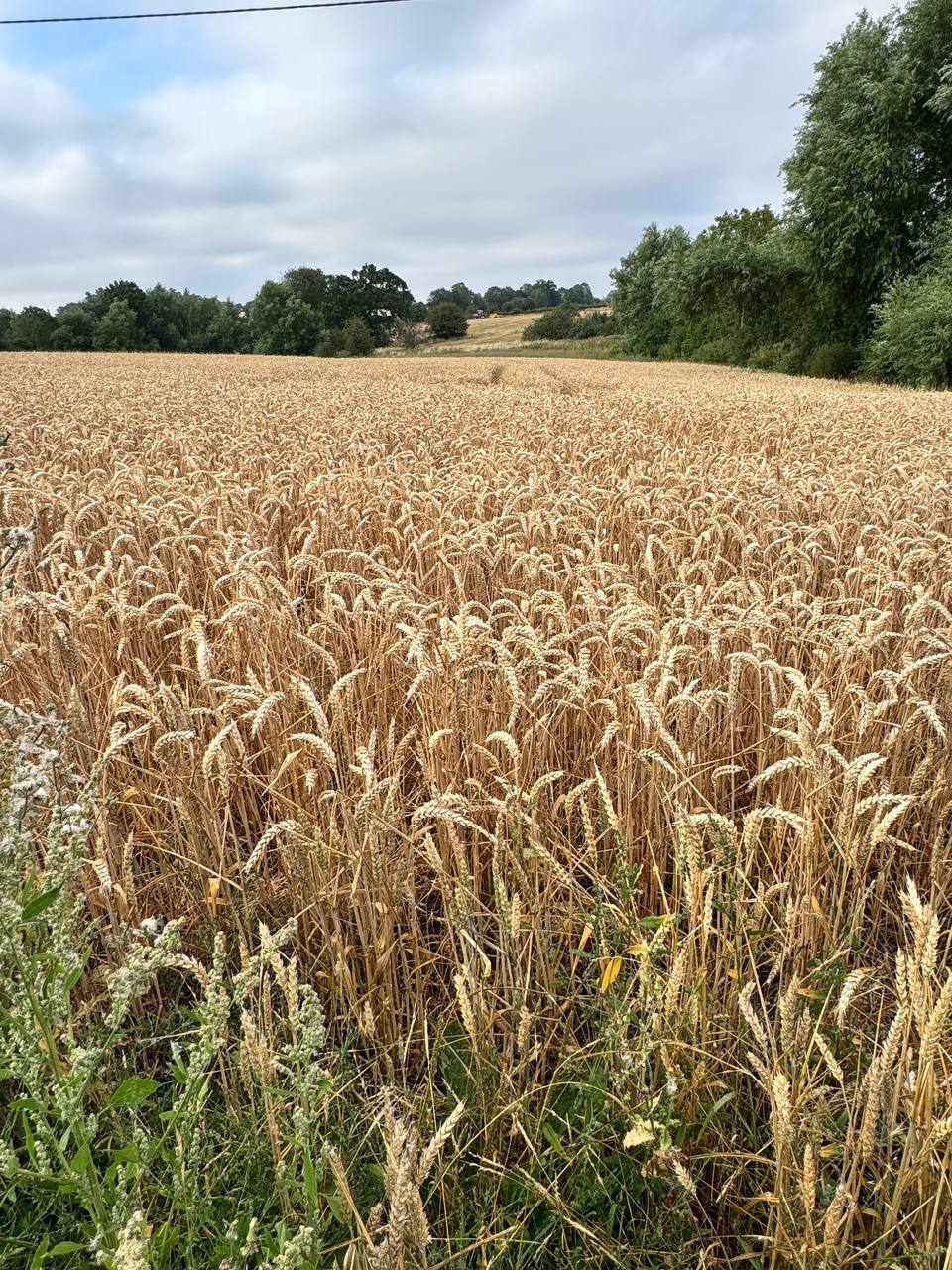
Golden wheat field stretching towards a tree-lined horizon under a pale cloudy sky

I’m standing in a field looking towards the horizon. It occurs to me that I’ve spent a lifetime doing this. Different fields. Different coastlines. Different countries. Different versions of myself, always finding a line where earth gives itself over to sky.

The horizon is a peculiar thing. It promises distance while refusing arrival. However far you walk, it quietly withdraws, asking nothing except that you keep going.

For reasons I can’t quite explain, the Oracle from The Matrix wanders into the field with me. Not the whole scene. Just one line.

I thought you’d have figured that out by now.

Only this time she isn’t speaking to Neo.

She’s speaking to me.

I laugh, because the question isn’t really what I should be doing. It never was. I’ve spent years treating life as though someone, somewhere, was withholding the final permission slip. As though there existed a committee of invisible adults who would eventually nod and say, Yes, Clay. Now you’re ready.

The field has no such committee.

The horizon doesn’t issue certificates.

The wind doesn’t care whether I’m qualified.

And perhaps that’s what horizons have been trying to teach me all these years. You stand before them expecting direction, but they offer something stranger: responsibility. They refuse to tell you which way to walk. They simply reveal that there is always another direction available.

No one is coming to rescue you from your own life. Not because the world is cruel, but because this part has always belonged to you. Choice isn’t a burden handed down by the universe. It’s the texture of being alive.

Then, as often happens on these walks, another voice enters the conversation.

Alice Cooper.

“I came into this life, looked all around…”

Memory is like that. One thought calls another, not by logic but by resonance. Philosophy opens the door and rock ‘n’ roll wanders in carrying the same truth in a different key. Nothing came easy. Nothing came free.

Standing there, looking towards another horizon that I will never quite reach, I wonder if that has been the lesson all along. We keep waiting for certainty to arrive from somewhere beyond ourselves, when perhaps certainty was never the gift.

Perhaps the gift was the horizon itself: forever out of reach, forever inviting the next step, still mine.
This morning I had one of those spells …

This morning I had one of those spells where there were so many possible things to do that I couldn’t bring myself to choose any of them. Nothing dramatic. Just the little wheel-spin of a mind faced with too many open tabs and too many worthy directions.

Then I decided to walk into town for sausages and hot dog buns.

That gave the day a shape.

There’s fresh sunshine in Southam to enjoy. I’ll light the barbecue this afternoon, cook a few sausages, and sit outside for a while in the shade and drink a few IPAs my daughter dropped off this morning and that are now chilling in the fridge. I think that’s a good enough recovery plan. No grand strategy. Just food, a walk, some sun, and lounging in the back garden.

I forget this sometimes. The answer to a head full of choices isn’t always another choice. Sometimes it’s a pack on my back, a familiar route into town, and something simple to prepare when you get back.

The work can wait until my mind clears. For now, the sausages will do.

I’m sunning myself like a shameless lizard on …

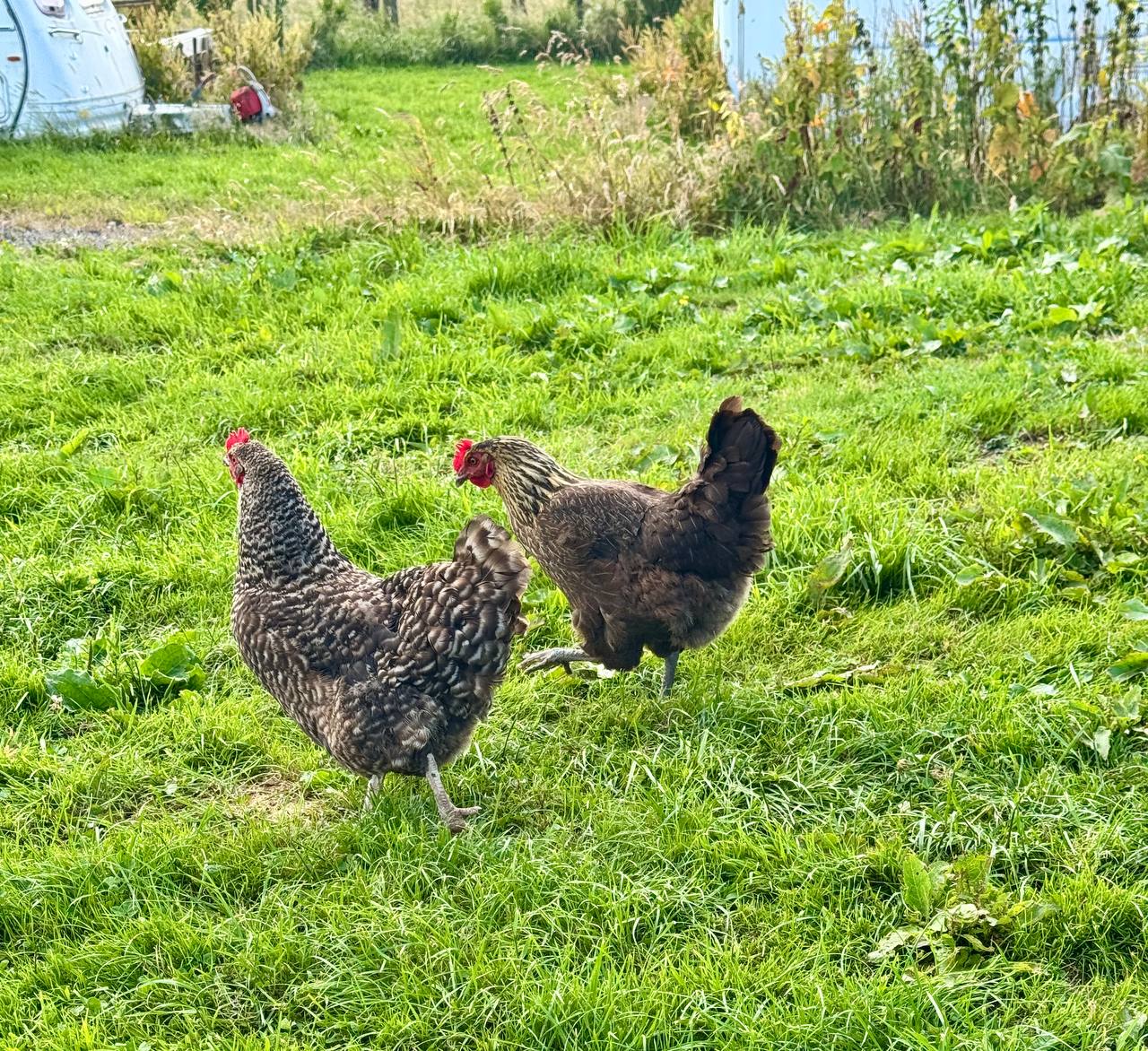
Two inquisitive chickens in the grass at camp

I’m sunning myself like a shameless lizard on a warm rock. Our camp is set up. I’ve cracked open the first Punk IPA of our extended weekend. Aerosmith’s Amazing is playing in the background, blending in with the goats. A couple of chickens came by earlier to greet us. My first chicken welcoming committee. They seemed eager to tell us all about their farm. I have no plans this evening beyond the plans I’m executing right now, which is nothing.

And nothing is good. In fact, nothing remarkable has happened today. And yet it feels quietly significant. Perhaps that’s one of camping’s hidden gifts. It lowers the threshold for what counts as enough. A patch of grass. A cold beer. A favourite song. And a couple of inquisitive chickens.

Went to look at a caravan this evening. …

Went to look at a caravan this evening. It was older than it looked in the photos.

The couple selling it lived on a farm. They said they had never actually camped in it. They had been using it as a spare room for their son while they renovated his bedroom.

If I were more of a handyman, I might have taken it on as a fixer-upper. But they had removed the whole front seating area, and they hadn’t tested the water or the gas, so it was a no from me.

We’re looking for something around 2004, four-berth, with a fixed bed.

Once upon a time, I was a news …

Once upon a time, I was a news junkie. Devouring multiple newspapers and magazines. I wanted to know what was happening in the world. Partly because of my job — I was an infantry officer — and partly because I just liked knowing what was going on in the world. Then something changed.

The business model incentives shifted toward engagement instead of accuracy. Headlines became optimised for reaction, not information. The work of explaining the world gave way to keeping us agitated enough to keep on clicking.

Journalism’s Logical Fallacy

I like this Kurt Vonnegut quote: “We are …

I like this Kurt Vonnegut quote: “We are what we pretend to be, so we must be careful about what we pretend to be.”

Who are you pretending to be? That’s an honest question. Approach the answer with brutal honesty and you’ll be surprised by what you discover. And let me tell you, it’s a hard question to answer. Your defensive system will kick in almost immediately with, “I’m not pretending to be anyone; I’m just me. Straight up!”

Push a little harder.

Oh, why do I ask myself such brutal questions on a Saturday?

When the Mask Slips

When the mask slips, let it.

We spend much of our lives arranging faces for the world. A mask for work, another for friends, and still another for family gatherings. These are not always deceptions. Masks can be protective, ceremonial, even sacred. They help us navigate the stage of daily life without having to walk bare-skinned into every storm.

But masks are fragile things. They crack when laughter bursts too loud, when grief presses through the seams, when love or anger rushes up unplanned. The slip can feel like a mistake. Like you’re being caught unprepared. This isn’t failure. It’s more of a revelation.

The face beneath isn’t less real; it’s more real. That glimpse reminds us that the soul has its own expression, unpractised and unpolished. To let it show is to remember you are a living presence, not a role or a performance. It’s the difference between living inside a costume and living inside a body.

In the language of narrative alchemy, this is where the old story collides with the raw material of truth. The mask speaks one version of who you are; the slip reveals another. That tension is a threshold, a crack in the shell where light can enter. Step through it, and you find yourself in the workshop of transformation.

Carry this question with you today: will you cling to the script carved onto the mask, or will you give breath to the story that emerges when it falls?

The slipped mask is not an ending. It’s the beginning of a more honest story of who you are.

Field Notes 01.10.2025