The life and afterlife of Austin Osman Spare
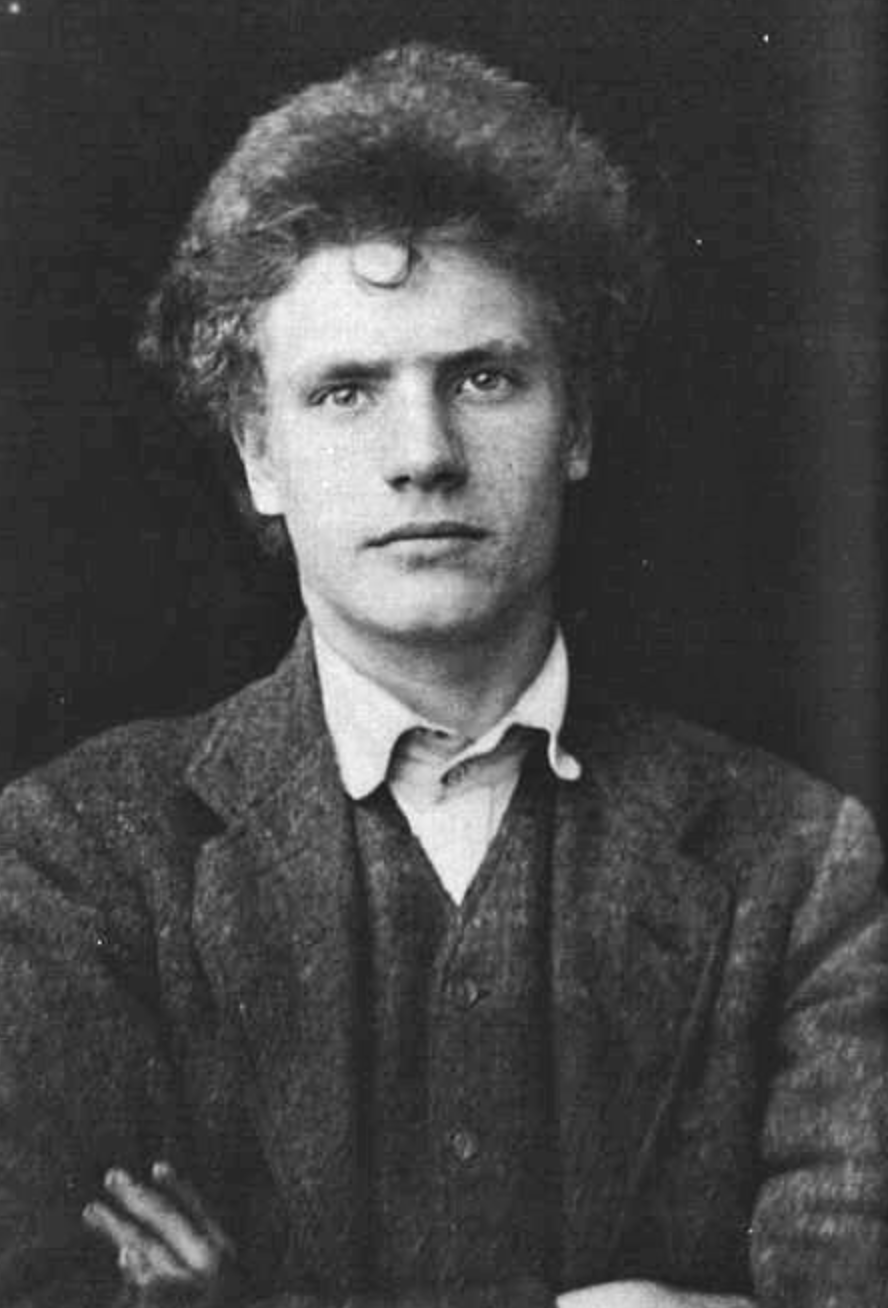
In photographs, Austin Osman Spare often looks as if he has been caught halfway between worlds. As a young man, he appears pale, beautiful and theatrical, with dark hair swept from his forehead and the wary expression of someone who already suspects that ordinary reality is a confidence trick. In later portraits the beauty has thickened into something more weathered. He sits among cats, books, pictures and the accumulated bric-a-brac of a South London room. The young Edwardian prodigy has become a borough sorcerer.
Both figures belonged to him. So did several others: illustrator, satirist, war artist, mystic, magazine editor, teacher, pub exhibitor, animal lover and prophet of the unconscious. Spare spent his life slipping between identities before the art world or the occult establishment could settle on one. His work carried traces of Symbolism, Art Nouveau, spiritualism, caricature, automatic drawing and the grotesque, yet he never fitted comfortably inside any of them. Even now, he tends to be approached through a side door. Artists find him through magic. Magicians find him through art. Musicians, tattooists and practitioners of chaos magic meet him through the sigil, the strange compressed emblem of desire that has become his most durable invention.
He was born in London on 30 December 1886, the son of Philip Newton Spare, a City of London policeman, and Eliza Osman. The family lived first around Snow Hill and Smithfield, then in Kennington. This was a London of slaughterhouses, churches, railway arches, public houses and crowded streets. Spare grew up close to the city’s physical underworld, where animals, labour and death remained visible. The horned bodies and human-animal hybrids that later gathered in his drawings did not arrive from some bloodless realm of occult symbolism. They had hooves. They carried the stink of the market.
He began evening classes at Lambeth School of Art while still a boy and found work designing for Powell’s glassworks in Whitefriars Street. Visitors to the firm noticed his drawings and helped him secure a scholarship to the Royal College of Art. The college soon discovered that talent and obedience don’t always travel together. Spare disliked its teaching, missed classes and resisted the academic preference for modelling through shade. He trusted the line. Aubrey Beardsley, Charles Ricketts, Edmund Sullivan and George Frederic Watts gave him a visual ancestry, though even in his earliest work Spare’s line seems to know more than the hand guiding it. It coils, sprouts, mocks and mutates. Faces emerge from ornament. Bodies open into other bodies.
In 1904, when Spare was seventeen, his father submitted two drawings to the Royal Academy without telling him. The Academy accepted a bookplate design for its Summer Exhibition. Newspapers seized on the story of the precocious young artist and described him as the exhibition’s youngest entrant. Some inflated the claim and made him the youngest artist ever shown there. The legend began growing almost as soon as the career.
Spare helped the process along. He understood the usefulness of a persona and presented himself as a young visionary in flamboyant clothes, already speaking about mystical ideas that he would spend the rest of his life elaborating. His first self-published book, Earth Inferno, appeared in 1905. It combined pictures, poetry and gnomic declarations in a form halfway between an artist’s book and a private scripture. Its influences included Dante, the Bible, Theosophy and Omar Khayyam, though Spare was beginning to name his own figures: Zos and Kia.
Zos was the embodied self, experienced through flesh, gesture and imagination. Kia was harder to define, an all-pervading field of possibility beyond the divisions imposed by conscious thought. Together they formed the poles of Spare’s personal cosmology. He didn’t inherit this system intact from a lodge or scripture. He drew it out of his own experience, then continued revising it through pictures and prose. His art and magic grew from the same root.
By 1907, Spare had attracted the attention of the London avant-garde. His exhibition at the Bruton Gallery prompted comparisons with Beardsley and produced the sort of disgust that can be useful to a young artist. The Observer called his work “abnormal, unhealthy, wildly fantastic and unintelligible.” Another reviewer admired his “creative flow of impossible horrors.” The phrase catches something essential. Spare’s horrors flow. They aren’t fixed monsters placed in a scene. They leak across the boundary between human and animal, beauty and decay, waking thought and the older life underneath it.
Aleister Crowley saw the work and recognised a fellow traveller, or perhaps a possible recruit. He became a patron, published Spare’s drawings in The Equinox and brought him into the A∴A∴, his magical order. Spare adopted the name Yihovaeum and remained associated with the group for several years, though he never surrendered to its hierarchy. Crowley’s ceremonial system demanded grades, initiations, discipline and a taste for grand ritual. Spare moved in the opposite direction. He wanted a magic stripped of robes, temples and inherited furniture. After the relationship soured, he mocked ceremonial magicians as “the unemployed dandies of the Brothels.”
His alternative appeared most fully in The Book of Pleasure (Self-Love): The Psychology of Ecstasy, self-published in 1913. The book resists a clean summary because resistance sits close to its purpose. Spare’s prose moves through paradox, private terminology and sudden attacks on religion, morality and conscious will. Beneath the thorns lies a practical insight: the conscious mind often blocks the desires it claims to pursue. A desire acquires force when it passes below deliberate thought and enters the unconscious.
Sigils offered a method for getting it there. Spare would reduce a written statement of desire into a design, combining and distorting its letters until the original sentence could no longer be read. The practitioner charged the resulting glyph through intense concentration or altered consciousness, then forgot it. The act of forgetting mattered. Conscious craving had to loosen its grip so that the desire could sink into the deeper mind.
The method reveals the trained draughtsman inside the magician. Spare treated language as raw graphic matter. A sentence became a line; the line became a glyph; the glyph became a carrier moving between conscious intention and unconscious action. The sigil was a word taught to travel without its meaning showing.
In 1911 Spare married Eily Gertrude Shaw. The marriage deteriorated, and they later separated without divorcing. His work continued across illustration, publishing and private revelation. He founded the art journal Form with Frederick Carter in 1916, bringing together writing, drawing and discussion of automatic processes. The magazine struggled commercially, but it placed Spare close to a current that would soon become central to twentieth-century art: the attempt to bypass conscious control and give the hidden mind a hand in making the work.
The First World War interrupted these experiments. Conscripted into the Royal Army Medical Corps in 1917, Spare worked as a medical orderly and later produced illustrations connected with the war. He returned to civilian life in 1919 and published The Focus of Life two years later. He revived Form, then co-edited The Golden Hind with Clifford Bax. Both magazines folded. Spare kept producing. In 1924 he assembled The Book of Ugly Ecstasy, a sketchbook full of automatic drawings and grotesque beings. The Anathema of Zos, published in 1927 in an edition of one hundred copies, turned his contempt for respectable society into a private sermon.
The London art world had begun to move away from him. Exhibitions in the late 1920s attracted little notice. His 1930 show of distorted “sidereal” portraits became his last West End exhibition for seventeen years. Surrealism soon arrived in Britain carrying an interest in dreams, automatism and the unconscious that Spare had pursued for decades. Journalists briefly rediscovered him as a possible “father of Surrealism,” though he remained too idiosyncratic to join the movement’s official story.
His retreat from the West End has often been told as a fall from promise into poverty and obscurity. There was poverty, and there was neglect, but the word failure misses the kind of life he made. Spare moved through working-class districts of South London, teaching, drawing local people and holding annual exhibitions in his flats. The domestic room replaced the commercial gallery. According to his obituary in The Times, visitors would ring the bell and inspect pictures hanging in the living room, bedroom and kitchen, sometimes in the company of the working women and elderly neighbours who had modelled for them. He sold drawings for a few guineas because he believed ordinary people wanted art and could afford it when artists and dealers stopped pretending otherwise.
This later Spare deserves more attention. The myth of the solitary magician can obscure the man who drew ageing faces with patience and tenderness, cared for stray animals and welcomed buyers into rooms crowded with pictures. His technical skill remained formidable. He could catch a likeness with a few lines, then let the face warp into dream, ancestry or spirit. His human beings never seem sealed inside their skin.
War reached him again in 1941 when a bomb destroyed his home and much of his work. He was left homeless for a time and suffered injuries that affected his ability to draw. He recovered and taught his hand to work again. In 1947 he staged a successful comeback exhibition at the Archer Gallery, showing more than two hundred works. Celebrity portraits appeared alongside spiritualist subjects, old faces and fantastic creatures. Later critics would detect early Pop Art in these images, just as others had found proto-Surrealism in his automatic drawings. Spare kept arriving before movements that wouldn’t have known what to do with him had he joined them.
During the last years of his life, he became close to Kenneth and Steffi Grant. Kenneth Grant, a younger occultist with connections to Crowley, recognised the importance of Spare’s magical ideas and helped preserve them. Spare returned to occult writing and produced new manuscripts, including the Zoetic Grimoire of Zos. He also held exhibitions in pubs, bringing his work back into the social world of Walworth Road rather than waiting for Bond Street to invite him home.
Spare died in Stockwell on 15 May 1956 after his appendix burst. He was sixty-nine. At the time of his death, he occupied an uncertain place in British art, remembered by a few collectors and friends, dismissed by others as a leftover from the decadent 1890s. His reputation began to revive in the 1960s and 1970s. Kenneth Grant’s writing carried his occult ideas forward, while artists and collectors recovered the drawings. By the late twentieth century, chaos magicians had adopted his sigil method as one of their foundational practices. His influence passed into experimental music, body art, comics, performance and the occult underground.
That afterlife has introduced a new distortion. Spare sometimes disappears behind the sigil, reduced to the inventor of a magical logo-making technique. Yet the sigil makes sense only inside the larger body of his work. He spent a lifetime testing how a mark might move between intention and instinct, how a face might contain its ancestors, how the hand might know what the conscious mind had forgotten. His magic remained the magic of an artist because drawing was his primary instrument of thought.
The city that made him still clings to the work. You can feel Edwardian London, the slaughterhouse district, the Royal Academy, the bedsit, the bombed room and the Walworth pub. Spare went underground without leaving the streets. He found his other world inside this one, in a neighbour’s ageing face, the curve of an animal’s horn, a few letters twisted together on a piece of paper.
Perhaps that explains his continued pull. Spare offers no clean separation between imagination and matter. Desire enters the hand. The hand makes a mark. The mark passes out of sight and begins its obscure work. Somewhere in South London, an old artist sits among his cats and pictures, drawing a line that hasn’t finished moving.
Sources and further reading
- Phil Baker, Austin Osman Spare: The Life and Legend of London’s Lost Artist (Strange Attractor Press, 2011).
- Robert Ansell, Borough Satyr: The Life and Art of Austin Osman Spare (Fulgur, 2005).
- Austin Osman Spare, Earth Inferno (1905).
- Austin Osman Spare, The Book of Pleasure (Self-Love): The Psychology of Ecstasy (1913).
- Austin Osman Spare, The Focus of Life (1921).
- Austin Osman Spare, The Anathema of Zos (1927).
- Austin Osman Spare at Art UK
- Biographical overview and bibliography
If this post gave you something to carry into your day, consider supporting my work by buying me a coffee or making a monthly donation or subscribing (free) to the blog.

