This morning I picked up a printed copy of Change Magick: A Modern Framework for Personal Mastery from the office floor and began leafing through it. I hadn’t looked at the framework for a while. It was still alive with great stuff: chaos magick, Jungian psychology, NLP, belief as a tool, personal mythology, ritual, shadow work. Much of it has since found its way into Narrative Alchemy, but the framework still holds together in its own right.
I was looking for something I could try today. One practice caught my attention:
Archetypal invocation for daily empowerment.
Archetypal invocation is a way of finding a figure larger than your habitual self and allowing that figure to alter how you stand, see, speak, and act for a while. It can happen before a difficult conversation, at the edge of a blank page, or in the car park before you walk into a room where the old version of you usually takes over.
I decided to try it today. If it catches your attention too, the practice below gives you a way to test it in a real situation of your own.
The figures behind the face
Jung used archetype for recurring patterns in psychic life that appear through dreams, stories, religions, art, fantasies, and behaviour. In “The Concept of the Collective Unconscious”, he distinguishes the inherited possibility of a pattern from the particular image it takes in a culture or a life. We never meet an archetype naked. We meet images: the Mother, the Child, the Trickster, the Warrior, the Wise Old Woman, the King, the Hermit, the Wanderer, the Magician. The pattern puts on local clothes.
The Warrior is not one fixed character with a sword and an expensive beard. A nurse holding steady during a night shift may carry the pattern. So may the person who finally says no to a relationship that has hollowed them out. The Warrior might arrive as quiet endurance, clean boundary, moral courage, disciplined attention, or the willingness to remain present when every part of you wants to flee.
An archetype gives related actions, images, emotions, postures, and values a recognisable shape. It lets the psyche say, “This kind of human situation has happened before. Here is one old pattern for meeting it.”
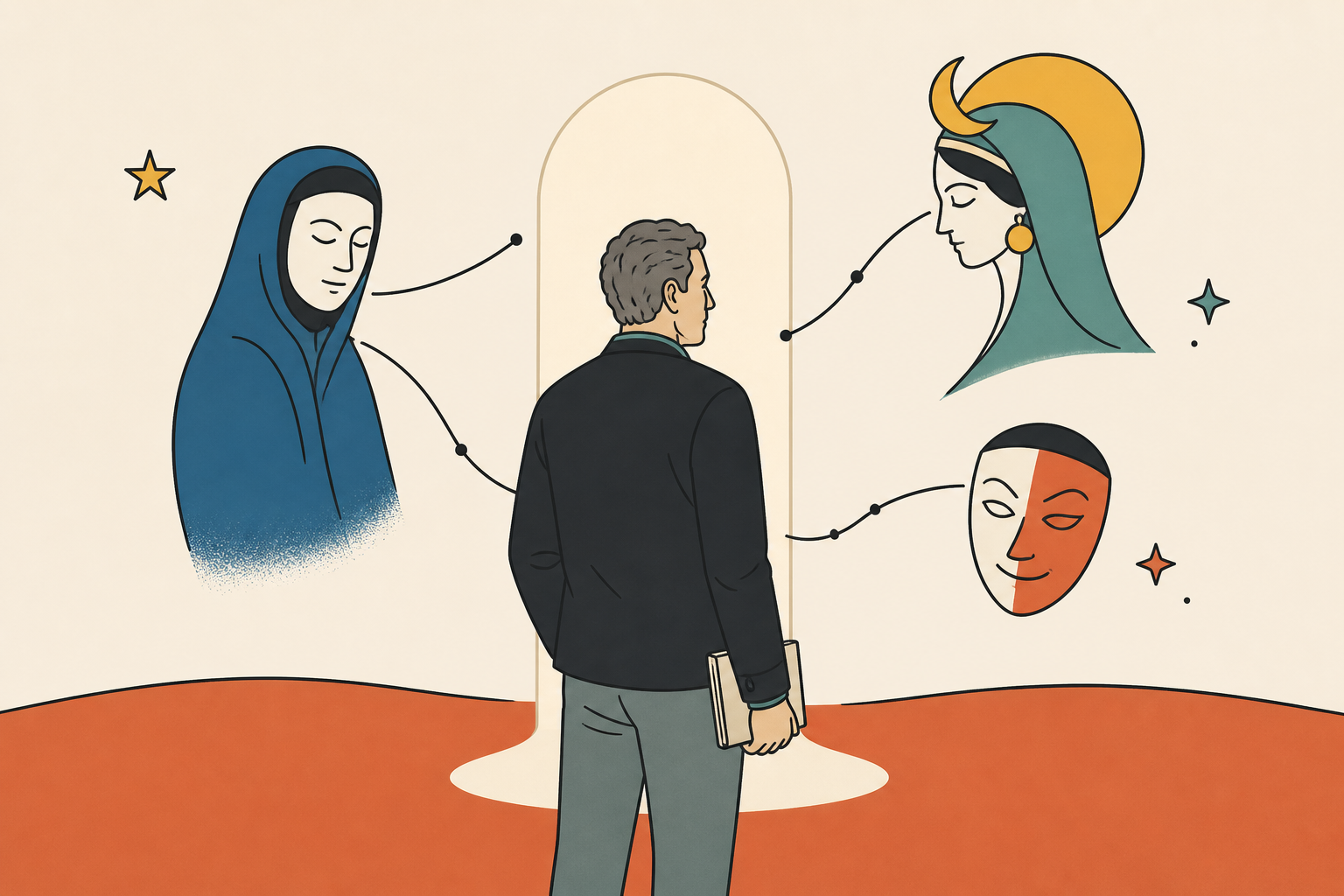
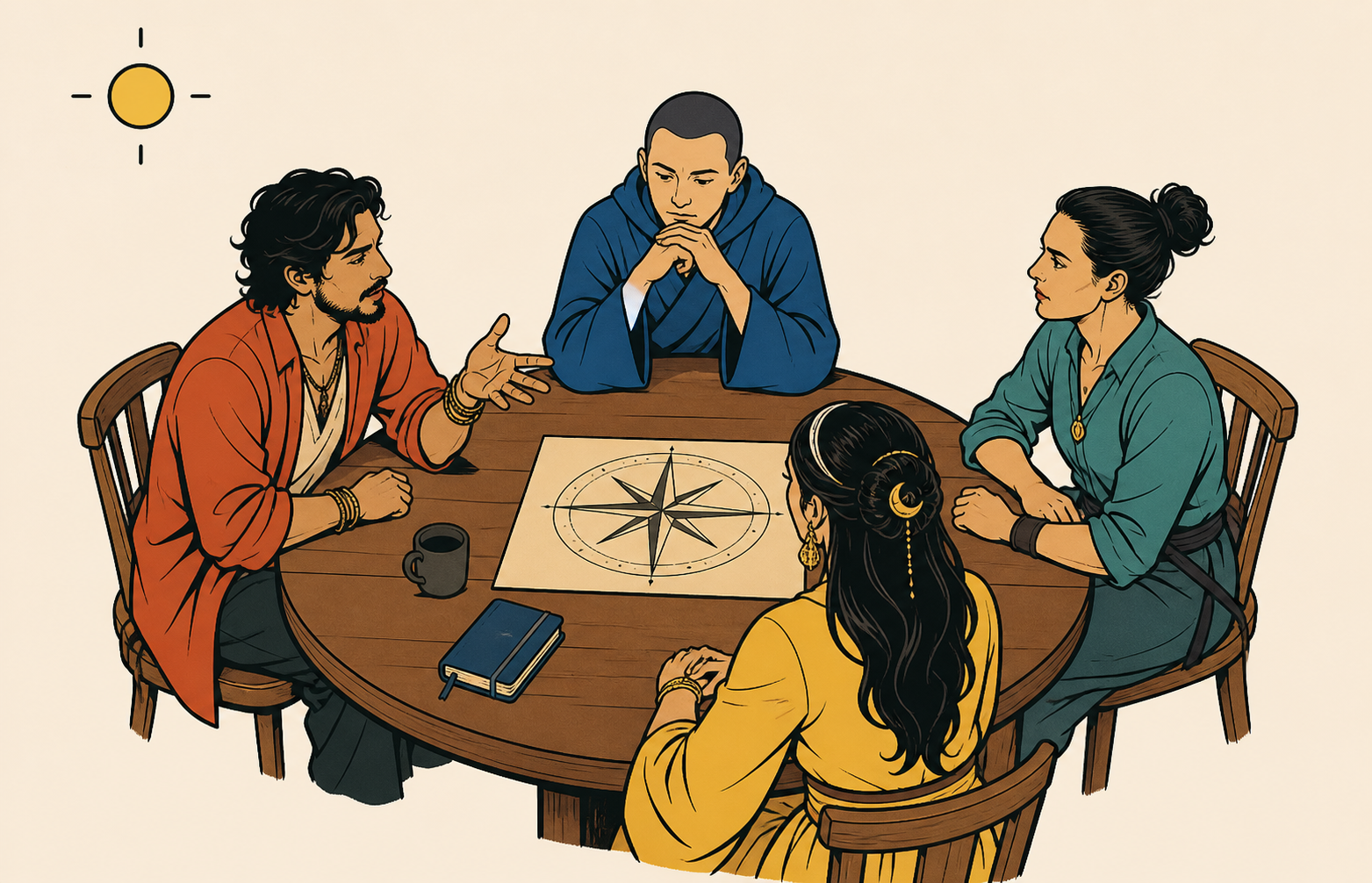
I’ve already been using this through what I call the inner council. The Monk protects contemplation, freedom, study, and the right to follow the rhizome. The Frontman wants contact, audience, livelihood, and the live current of being seen. The Trainer turns knowledge into practices that another person can use. The High Priestess listens for the pattern beneath their arguments.
These figures began as a way of making an inner conflict visible. Once they had names, I could hear what each one wanted without forcing them into a single grey compromise. The High Priestess, in particular, changed the room. She didn’t bring another opinion. She brought a different quality of attention: slower, receptive, less eager to turn every mystery into a plan. That council grew from the same practice I explored through tarot.
That is close to the method Jung describes in “The Transcendent Function”: beginning with a real mood or emotional charge, allowing its images and associations to develop, then giving them a concrete form through dialogue, writing, movement, drawing, or fantasy. You don’t surrender your judgement to the figure. You meet it. You let it speak, question it, argue with it, notice what changes in the encounter.
There is a useful tension here. If I reduce the High Priestess to “my intuitive side,” the image loses some of its power. She becomes a label on a storage box. If I treat her as an infallible supernatural authority, I have given the image far too much power. The middle path is imaginal relationship: take the figure seriously without mistaking the figure for the whole truth.
The symbol must not devour the person.
The inner council gives conflicting patterns a place to speak without forcing them into one voice.
You are invoking all the time
Formal invocation feels strange because everyday invocation passes without comment.
Put on a uniform and see what happens to your spine. Walk into a school reunion and notice which age your voice becomes. Sit behind a desk with your job title on the door. Lace up boots for a long walk. Pick up a guitar in front of an audience. Enter the kitchen where your family is already arguing. Each setting calls forward a version of you.
The room invokes. The clothes invoke. The remembered audience invokes. Music invokes. Language invokes. Another person’s face can summon a character you haven’t played for twenty years.
Social life depends on this capacity. We move between roles without considering it occult. Friend, parent, teacher, stranger, lover, writer, customer, patient. Each role selects certain memories and behaviours while pushing others towards the wings. Trouble begins when one role takes the theatre and refuses to leave, or when the character summoned by a situation is the least capable one available.
The person facing a difficult meeting may invoke the Pleaser before the door opens. The blank page may invoke the Examiner, complete with red pen and disappointed expression. A money conversation can summon the Frightened Child even when the adult at the table has decades of experience.
Archetypal invocation introduces choice into that process. Instead of asking, “How do I make myself feel confident?”, I can ask, “Who knows how to enter this room?”
Confidence is an abstraction. A seasoned Diplomat knows how to pause before answering. A Warrior knows where the boundary lies. A Trickster can break the spell of false seriousness. A Caregiver can stay close to pain without rushing to fix it. A Sovereign can make a decision and accept the cost.
Psychology has several neighbouring ideas. Research on embodied cognition challenges the picture of thought as something that happens in a sealed chamber behind the eyes; cognition develops through the traffic between brain, body, and environment. The much-discussed work on “enclothed cognition” asked whether clothing can affect attention through both its symbolic meaning and the experience of wearing it. A later meta-analysis raised concerns about the repeatability of the earliest studies while finding support for newer work. The modest question remains useful: what we put on may participate in the state we enter.
A study often called the Batman effect found that young children persisted longer at a dull task when they took the perspective of an admired character. Batman gave them enough distance from immediate frustration to act differently. Adults may have better vocabularies for self-regulation, but we still borrow courage from people, characters, ancestors, songs, uniforms, and stories.
The imagination is not floating above behaviour. Give a state a name, a face, a posture, and a field of values, and you create more handles by which the body can find it.
Invocation is more than dressing up
A costume can help, but the practice goes deeper than wearing a cloak and hoping Odin sorts out your inbox.
An archetype includes a way of selecting information. Invoke the Warrior and you may see the point of decision. Invoke the High Priestess and you may notice what everyone has spoken around. Invoke the Fool and the same situation may reveal an opening where the cautious self saw only embarrassment. Each figure edits the scene.
This is why invocation belongs inside Narrative Alchemy. A story does not live only as a sentence in the head. It lives in what the body expects, which details the senses notice, the meaning assigned to another person’s silence, and the action that feels possible next.
I wrote about identity as a narrative repeated until it feels like ground. Invocation works from the other direction. Instead of analysing the old story for another hour, you give a different pattern temporary use of your hands and feet.
Temporary matters. The aim is not to replace a cramped identity with a grandiose one. “I am always the Warrior” is another prison, and probably an exhausting person to live with. Invocation works best as a deliberate movement into a pattern, followed by a deliberate return.
Chaos magick contributes a useful lightness here: belief can function as an instrument. Enter the ritual fully enough for it to alter experience, then set it down and examine what happened. That experimental stance runs through Change Magick and Narrative Alchemy. We can inhabit a useful fiction without demanding that it become the final metaphysics of the universe.
The test is not whether the archetype was “really there.” The test is what you could perceive and do while the pattern was active, what it cost, and whether the result made your life more honest.
Invocation becomes useful when the image reaches posture, breath, attention, and action.
An experiment: borrow a larger self
Set aside thirty to forty-five minutes. Choose a real situation close enough to matter and small enough to test. A conversation you have been postponing. An hour of writing. A decision that has gone soft around the edges. A walk taken with a question. Don’t begin with your deepest trauma or the most explosive relationship in your life. An experiment needs enough pressure to reveal something, not so much that it floods the laboratory.
1. Name the scene
Write three plain sentences:
What am I about to do?
Which version of me usually appears here?
What becomes difficult when that character takes over?
Stay with behaviour. “I lose my power” gives you little to work with. “I talk too quickly, soften every request, and agree before I have checked my diary” gives the experiment somewhere to stand.
2. Choose the needed quality before the figure
Ask what the situation requires: courage, patience, mischief, steadiness, receptivity, clean authority, tenderness, endurance, curiosity.
Then choose a figure who carries that quality for you. Draw from myth, tarot, fiction, history, family memory, religion, cinema, or your own dreams. Athena, the Hermit, Columbo, Ripley, the High Priestess, your grandmother at the kitchen table, a nameless ferryman, the old martial arts teacher from a film you saw at twelve. Cultural respect matters; work with figures you know enough to approach without turning someone else’s living tradition into a prop.
Choose a figure with edges. “The Successful Person” is a motivational poster. Columbo has a coat, a pace, a way of asking one more question while appearing to have missed the point. Specificity gives the nervous system something to enact.
3. Interview the figure
On paper, ask:
What do you notice first in this scene?
What do you refuse?
What do you protect?
How do you use your voice?
What is your shadow here?
Which other figure keeps you honest?
Write the answers quickly in the figure’s voice. Let surprise happen, but keep your adult judgement in the room. An invoked Warrior who wants to destroy a colleague has exposed inflation or anger, not delivered sacred instructions. Bring in the Diplomat, Healer, Fool, or Witness as a corrective.
The best archetypal work is rarely a solo act. In The Warrior Archetype in Tarot, the Warrior develops across different cards rather than appearing as one lump of aggression. My own Warrior needs the Taoist Wizard: discipline corrected by timing, force corrected by attunement. Each figure keeps the other from becoming a caricature.
4. Build a threshold
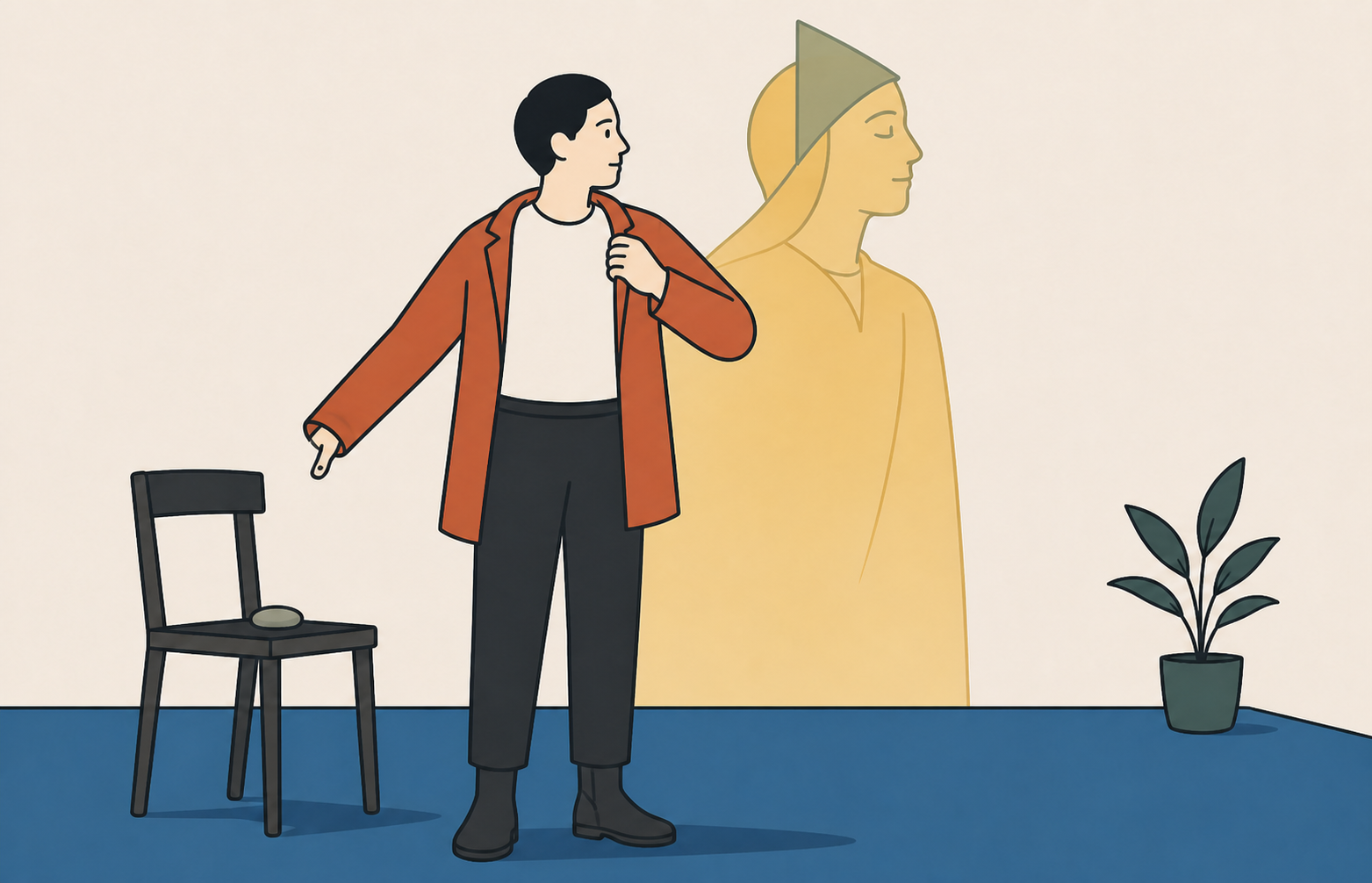
Create a small transition into the role. Change one item of clothing. Stand in a different place. Put on one piece of music. Hold an object. Draw a mark on a card. Speak the figure’s name.
Then alter three physical details:
stance;
breath;
gaze.
Don’t perform for an imaginary audience. You are giving the body a clear instruction. If your figure is the Sovereign, you might place both feet on the floor, let the exhale finish, and look at the whole room before speaking. If your figure is the Trickster, loosen the knees, tilt the head, and search for the detail that makes the official story wobble.
Say:
For the next thirty minutes, I give the [figure] a seat at the controls. I remain responsible for what I do.
That last sentence stays in the ritual.
5. Take one piece of reality through the figure
Do the task. Write the page. Make the call. Walk with the question. Enter the meeting.
Keep the experiment narrow. You are testing whether this pattern changes perception and action. Notice one moment when your habitual character would have taken over. What does the invoked figure do instead?
You may feel nothing dramatic. Good. The Rubedo of this kind of work often looks like Tuesday morning: a slower answer, a straightened sentence, a request made without apology, ten more minutes at the page. Understanding becomes transformation when it reaches muscle and timing.
6. Return the borrowed face
End on purpose. Remove the item. Change the music. Wash your hands. Step outside. Take three ordinary breaths and name five things in the room.
Say:
The experiment is complete. I release the figure and return as myself.
This is not empty ceremony. De-roling protects you from confusing access with identity. You borrowed the Warrior’s boundary; you do not need to spend the evening patrolling the kitchen. You borrowed the High Priestess’s silence; you still have to answer your messages.
7. Record the evidence
Write without interpretation for five minutes:
What changed in my body?
What did I notice that I usually miss?
What action became possible?
Where did the figure become theatrical, inflated, or unhelpful?
What quality do I want to integrate without keeping the costume?
Run the same invocation three times before deciding what it means. Change one variable if needed. Compare it with doing the task in your ordinary state. Treat the journal as a field notebook, not a book of prophecies.
The figure is a doorway
Archetypal invocation can become another form of avoidance. You can spend a week designing the perfect ritual instead of making the phone call. You can inflate a frightened ego by naming it King. You can use the Magician to pretend that consequences are optional. You can let the High Priestess wait forever for a sign.
Every archetype carries a shadow. That is one reason I prefer a council to a throne.
The practice also has limits. If inner figures become intrusive, frightening, commanding, or difficult to distinguish from shared reality, stop the experiment and seek qualified support. Active imagination asks for a stable witness: the part of you that can enter the image and come back, holding metaphor and matter in the same hand.
Used with that grounding, invocation gives us a form of rehearsal that is richer than positive thinking. “I am confident” leaves the imagination hungry. “For this conversation, I will borrow the patience and unhurried gaze of the old ferryman” supplies a body, a tempo, and a relationship to the crossing.
Something from the invoked figure may remain after the ritual. The experiment can reveal that the borders of the familiar personality are less solid than they looked.
Archetypal invocation is one of the bridges between Change Magick and Narrative Alchemy. Change Magick works with belief and personal power. Narrative Alchemy works with the stories, images, and inherited roles through which a self takes shape. Archetypal invocation joins the two at the level of lived experiment. A new story borrows a body for half an hour and finds out whether it can walk.
The printout on the office floor reminded me that Change Magick had never really gone away. The project had been wearing other names, speaking through later work, waiting inside phrases I still use.
The framework returned as an archetype of its own: the manuscript on the floor, dusty but unoffended, carrying a tool I wanted to use today.
So I’m putting the tool back on the table as a question you can test with your own breath, posture, imagination, and next action:
Who knows how to enter the room you are about to enter?
I finished Richard Cavendish’s The Black Arts this week.
Not in the heroic readerly sense of having sat down and consumed it cleanly from first page to last, pencil in hand, scholar’s lamp burning into the night. I have been reading it on and off for a few months. Picking it up, putting it down, returning to it when the mood came back round. Some books ask for that kind of reading. They don’t want to be finished quickly. They want to become part of the weather for a while.
Some books arrive because another book opens the door. This was one of those. I was already wanting to increase my occult knowledge. No theatrical hunger for a shelf full of grimoires and an air of candlelit importance. The occult keeps appearing in the territories I already work in: narrative, belief, imagination, trance, symbol, transformation, and the strange plasticity of the self. Cavendish looked like the right kind of guide for that moment. A historian, not an evangelist. Interested, informed, steady. Close enough to take the material seriously. Distant enough not to demand that I join anything.
The Field, Surveyed
The Black Arts is a survey. That’s its strength and its limitation.
Cavendish moves across the field rather than burrowing permanently into one chamber. The occult worldview, names and numbers, the Cabala, alchemy, astrology, ritual magic, witchcraft, demonology, devil worship, spells, charms, necromancy. He gives you the architecture, the correspondences, and the old symbolic machinery. He doesn’t try to initiate you. He maps.
For what I needed, that was perfect.
I read the opening chapters most intently. Chapter 1, “The World of the Black Magician,” sets out the worldview: the magician standing inside a cosmos where visible things are threaded with invisible correspondences. Chapter 2, “Names and Numbers,” goes straight into one of the oldest intuitions of magical thought: that names are not labels pasted onto reality after the fact. Names carry force. Numbers carry structure. Language and quantity become ways of touching the hidden order of things.
Chapter 3, “The Cabala and the Names of Power,” had my full attention.
That isn’t surprising. The Cabala sits exactly where my interests tend to gather: language, cosmology, psychology, symbol, power, divine names, letters as living forces. It treats text as more than text. Letters become ontological furniture. Names become operations. The world is not merely described by language. It is, in some sense, articulated by it.
That lands differently now.
The old magical intuition that words participate in reality no longer belongs only to temples, grimoires, and prayer. Type a sentence into a box and an image appears. Type another and code runs. Type another and a voice speaks back. The prompt is the brushstroke. Text has become technically generative as well as spiritually and psychologically generative.
Cavendish wasn’t writing for that world.
He helps explain why it feels ancient.
The Stone and the Elixir
I paid particular attention to Chapter 4, “The Stone and the Elixir.”
Alchemy has always had a different pull for me. It refuses to stay in one category. It is chemistry, and it is not chemistry. It is a spiritual practice and it is not reducible to spiritual metaphor. It is metallurgy, medicine, cosmology, theatre, psychology, and obsession. The stone and the elixir are both material dreams and imaginal necessities.
This is where Cavendish’s historian’s approach works well. He doesn’t try to turn alchemy into a tidy self-help metaphor. He lets it remain strange. The apparatus is there: sulphur, mercury, salt, metals, colours, furnaces, vessels, stages, transmutation. The psychic charge comes through because the historical material is allowed to keep its density.
Jung is unavoidable here, though not as a way of explaining alchemy away. That is the lazy move. Jung saw in alchemy a symbolic record of the psyche trying to perceive its own transformations. The alchemist thought he was working on matter. He was also working on himself. The furnace was outside and inside. The vessel was outside and inside. The blackening, whitening, reddening, dissolution, conjunction, death, and gold were not simply chemical fantasies. They were images of psychic process.
Hillman complicates this further, which is why I keep returning to him. The mythic imagination doesn’t treat these images as coded messages waiting to be translated into psychological prose. It lets the image have its own life. The stone is not “really” the integrated self. The elixir is not “really” personal growth. The image is not a disguise for an idea. The image is the event.
Better to let the symbols do their work.
The Chapters I Skimmed
I skimmed the chapters on astrology, ritual magic, and the worship of the Devil.
Astrology interests me as a symbolic grammar of time and temperament, but it isn’t where my attention wanted to linger in this reading. Ritual magic interests me more, especially the apparatus of circle, triangle, name, command, protection, and imagination, but I have been working that thread elsewhere. Devil worship, or the Christian demonological imagination around it, felt more historically useful than personally magnetic.
This is the pleasure of a survey. The reader moves through according to their own heat map. Cavendish lays out the territory. The attention catches where it catches.
Mine caught on names, numbers, Cabala, alchemy, symbolic systems, and the question underneath all of them:
What is the mind doing when it makes a magical world?
Belief as a Tool
Like Cavendish, I don’t feel the need to pass judgement over the material.
Judgement is often the least interesting move available. The better question is not “Do I believe this?” but “What does this belief make possible?”
That is the chaos magician in me speaking.
Belief is a tool.
This principle has become one of the most useful bridges between my occult interests and my NLP background. NLP, at its best, treats belief as structure rather than doctrine. A belief is not only a proposition about reality. It is an operating instruction. It shapes attention, possibility, posture, memory, emotion, and behaviour. Change the belief, and the world does not necessarily change in some crude external way. Instead, the field of available action changes. The person changes. The perceived world changes with them.
Chaos magick says something adjacent, with more smoke and sharper edges. Belief can be adopted, intensified, performed, exhausted, or discarded. The magician works with belief rather than kneeling permanently before it.
Read through this lens, Cavendish becomes something else. Across the book, the West appears as a long sequence of symbolic technologies: divine names, planetary hours, talismans, numbers, metals, spirits, circles, images, rites, words of power. These are not random curiosities. They are ways human beings have organised attention and desire in order to meet the invisible pressures of life.
Fear. Hope. Death. Sex. Power. Suffering. Fate. Luck. Illness. Love. God. The future.
The occult is one of the ways the mind speaks when ordinary language is too thin.
The Western Mind Dreaming Itself
What interests me most is how these forms of occult thought manifest in the cultural identity of the West.
The West likes to tell a story about itself as rational, secular, progressive, and disenchanted. Then it keeps producing astrology columns, tarot decks, magical orders, conspiracy cosmologies, prosperity metaphysics, ritual revivals, angel books, demonologies, occult novels, superhero mythologies, and self-help systems built around intention, visualisation, and the creative power of thought.
The enchantment didn’t disappear. It changed costume.
Cavendish’s book is useful because it shows some of the older costumes. The magician, the Cabalist, the alchemist, the astrologer, the witch, the necromancer, the demonologist. Some of these figures are historical. Some are polemical inventions. Some are cultural projections. All of them belong to the Western imagination.
Bring Jung into the room, and the occult starts to look like a symbolic archive of psychic process. Bring Hillman in, and it becomes even richer: a theatre of images through which the soul thinks, rather than a set of errors waiting to be corrected by modern psychology. The gods, demons, metals, planets, angels, stones, elixirs, numbers, and names are not dead beliefs. They are imaginal forms. The mind working to understand itself.
The cultural mind. The myth-making mind. The frightened and desiring mind that can’t bear a flat world and so keeps discovering depth, even when it has officially declared depth unavailable.
A Historian With a Lamp
Cavendish’s value is not that he settles the occult.
Nobody does. The occult is partly made of what refuses settlement.
His value is that he stands at the doorway with a lamp. He shows the rooms. He names the furniture. He gives enough history to keep the reader from floating away into pure fantasy, and enough sympathy to keep the material from being flattened into foolishness.
The book is dated. Of course it is. The Christian framing is obvious in places, especially around witchcraft and devil worship. Some categories feel compressed. Some historical claims need companion reading. Ronald Hutton for witchcraft history. Frances Yates for Renaissance hermeticism. Hanegraaff or Faivre for Western esotericism as a proper academic field. And 1967 is inside the prose, unavoidably.
None of that makes it the wrong place to start. The architecture is still standing. The lamp still works.
The 50th anniversary edition sits on my shelf now, next to Horowitz, next to Hillman, next to the others that arrived because a different book sent them. What stays with me most is the feeling that Cavendish isn’t really writing about a world that has passed. He’s writing about a layer of the mind that the modern West spent three centuries trying to cover over. The grimoire and the language model are asking the same question.
I’ve always been drawn to the borderlands, the places where philosophy turns poetic and science begins to sound like prayer. Alchemy lives in that liminal space. It was never only about furnaces and metals, but about consciousness itself: how it fractures, matures, and reunites.
When I discovered The Book of Lambspring, I felt as though I had stumbled upon a mirror from another century. Its fifteen emblems spoke in riddles, but behind each one pulsed something startlingly human. The alchemist’s fire, the black beast, the two fishes swimming in the sea—all of it read like a coded story of the psyche struggling toward wholeness.
I began reading not as a historian, but as a practitioner of what I call Narrative Alchemy, the art of transforming the raw material of experience through story and symbol. I wanted to see how these old images could still act as spiritual technologies, how they might guide modern seekers through the same inner laboratory where the medieval philosophers once worked.
So this isn’t a translation or commentary in the traditional sense. It’s a correspondence across time. My goal is to reanimate these emblems, to show how they still speak to the creative, divided, yearning human being of today. Each section is both an interpretation and an invitation, a chance to look into the mirror of Lambspring and glimpse your own reflection moving beneath the surface.
If these words feel less like explanation and more like initiation, that’s intentional. Alchemy was always an experiential art. You don’t just read it; you let it work on you.
I offer this work, then, as a modern alchemist’s field journal, a way to listen to the ancient voice still echoing through our inner sea.
Every alchemist began with a vessel, a fire, and a mystery. The vessel was the body. The fire was attention. The mystery was whatever stirred restlessly in the dark, asking to be transformed.
To read The Book of Lambspring in this way is to step into that same experiment. It asks nothing more of you than to listen, to let the old symbols move through your imagination as if they were dreams sent to remind you of something you already know.
So before you begin, take a breath. Feel the quiet tide of your own inner sea.
Now, let us open the first emblem and wade into the waters where the two fishes swim.
(1)
The Sea of Forgetting
The Seeker had no name, or had forgotten it so long ago that the forgetting itself had become a kind of name. They woke each morning with the taste of salt on their tongue and a weight in their chest, as if they’d swallowed the ocean in their sleep.
Sometimes, in the space between dreaming and waking, they felt it: a vast sea moving beneath their ribs. It glowed faintly, like bioluminescence in deep water, but the light was dim, obscured by silt and shadow. The sea breathed with them—or perhaps they breathed with it—but the rhythm was all wrong, stuttering and strained, like trying to dance to music they could no longer hear.
The Seeker spent their days at the shore of this inner sea, hands busy with the futile work of control. They built dams of thought to hold back the tide of feeling. They dredged the shallows for meaning, sifting through sand and broken shells. They charted the currents with elaborate maps, trying to predict when the waters would rise and fall, never quite managing it, never quite understanding why.
The sea was too much and not enough. Some days it threatened to drown them; other days it receded so far they feared it had dried up entirely, leaving only cracked earth and the memory of moisture. They did not know—had never known—that the sea was their own life-force, the source and sum of everything they were. They thought it was something to be managed, mastered, controlled.
At night, the dreams came.
In the dreams, they stood waist-deep in luminous water that stretched to every horizon. The sky above was the same color as the sea below, so there was no way to tell which was which, no way to orient themselves. They were always alone in these dreams, or thought they were, until the night the voice came.
It might have been the wind moving across the water. It might have been an old teacher they’d once known, someone whose face they could no longer quite remember. Or it might have been the sea itself, finally speaking after years of silence.
The voice was neither male nor female, neither young nor old. It sounded like waves against stone, like breath through reed, like the whisper of fins cutting through dark water.
“Two fishes swim in your sea,” it said, “yet you know neither.”
The Seeker turned in circles, searching for the speaker, but saw only endless water and the strange doubled sky.
“Two fishes,” the voice repeated, softer now, almost sad. “But look closer: they cast only one shadow.”
The Seeker looked down into the water at their feet. For just a moment—less than a heartbeat—they saw it: two shapes moving in the depths, circling each other in an ancient pattern. One bright as quicksilver, darting upward. One dark as lunar pearl, spiraling down. And beneath them both, impossibly, a single shadow.
Then the dream dissolved, as dreams do, and the Seeker woke gasping in their small room, the weight in their chest heavier than before, the taste of salt sharp on their lips.
But something had shifted.
The sea within had been disturbed.
And in the depths, unnoticed yet, two fishes began to stir.
(2)
The Meeting of the Fishes
For three nights after the voice came, the Seeker could not dream at all. They lay awake in the dark, feeling the sea churn restlessly beneath their ribs, listening to their own heartbeat like a drum calling something forth from the deep. On the fourth night, exhaustion finally pulled them under.
The dream began differently this time.
The Seeker did not stand at the shore. They were already in the water, suspended in that strange twilight depth where the pressure of the sea becomes indistinguishable from the pressure of one’s own thoughts. Above them, the surface glimmered like hammered silver. Below, the darkness went down and down, perhaps forever.
They took a breath—though they should not have been able to breathe—and dove.
Down they swam, through layers of temperature and color. The water grew warmer, then colder, then warm again. It shifted from blue to green to a deep indigo that had no name. Their body felt both heavy and weightless, as if gravity itself could not decide what to do with them here.
And then, in the midst of that indigo vastness, they saw the fishes.
The first appeared as a streak of light, so sudden and bright that the Seeker flinched. It darted upward in a spiral, trailing luminescence like a comet. Its scales caught and threw back the light in silver fragments, restless, electric, alive with an almost frantic energy. It moved as if the water itself were too slow, too thick, as if it longed to burst free into air, into fire, into something faster than flesh.
When it circled back and hung suspended before the Seeker, its voice was quick, urgent, thrumming with intensity.
“I am Spirit,” it said. “I am the ascending flame, the breath that rises, the thought that pierces heaven. Follow me upward, where clarity lives, where light never dims, where you can finally see everything from above and understand.”
The Seeker felt the pull of it immediately—that familiar hunger for transcendence, for escape from the messy weight of the body, for the clean, bright realm of pure idea. Spirit’s voice resonated in their skull, between their eyes, in the hollow of their throat where words waited to be spoken.
Before they could answer, the second fish emerged from the depths below.
It rose slowly, almost languidly, as if it had all the time in the world and knew it. Its scales held a different light—softer, lunar, opalescent. It glowed from within, the way certain deep-sea creatures glow, with a bioluminescence that seems to come from some ancient, patient source. Where Spirit darted and flashed, this fish moved in long, graceful undulations, as if it were dancing to music only it could hear.
“I am Soul,” it said, and its voice was low, resonant, moving through the Seeker’s chest like the rumble of distant thunder through stone. “I am the descending root, the weight that knows, the feeling that holds memory. Follow me downward, into the fertile dark, where everything is connected, where you can finally feel the whole of things and be held by them.”
The Seeker felt this pull too—the longing to sink into the body’s wisdom, to stop the endless chatter of thought, to rest in the wordless knowing that lived in the belly, the bones, the blood. Soul’s voice vibrated in their sternum, their solar plexus, deep in the cradle of their hips where the first waters of life had once held them.
For a moment, the Seeker floated between them, equally drawn to both, paralyzed by the impossibility of choosing.
Then Spirit and Soul turned to face each other, and the argument began.
“You would drag them into darkness,” Spirit said, circling faster now, agitated. “Into the mud and muck of emotion, the prison of the body, the tomb of forgetting. I offer freedom—thought unbound, consciousness ascending, liberation from the wheel of suffering.”
“You would burn them to ash,” Soul replied, its voice still calm but edged now with something harder. “You offer only escape, only denial of half of what they are. I am not prison but foundation. I am not tomb but womb. Without me, you are nothing but smoke and mirrors, ideas without ground, light without warmth.”
“Without me,” Spirit flashed back, “you are nothing but stagnation, weight without purpose, feeling that goes nowhere, the endless repetition of the same old stories.”
“Without me,” Soul countered, “you are nothing but dissociation, severed from source, homeless, rootless, a ghost pretending to be alive.”
They swam faster now, circling each other in tighter and tighter spirals. The water between them began to churn, to heat, to crack with something like lightning. The Seeker could feel the argument in their own body—the familiar war between head and heart, between doing and being, between the drive to transcend and the need to belong.
How many times had they lived this division? How many mornings had they woken with Spirit’s voice urging them toward ambition, achievement, the next goal, the higher ground—while Soul whispered from beneath, asking them to slow down, to feel, to remember what mattered beyond the bright tyranny of accomplishment?
How many times had they tried to silence one to hear the other more clearly, only to find themselves half-alive, half-present, moving through the world like a figure cut in two?
The Seeker reached out, desperate to stop the argument, desperate to catch one fish or the other and end the war by choosing. Their hand closed around quicksilver brightness—
And both fishes vanished.
The water went still. Empty. The Seeker’s hand closed on nothing.
Heart pounding, they reached again, this time diving down toward the lunar glow—
And again, both disappeared.
The Seeker hung suspended in the suddenly quiet water, alone, confused, aching with a strange hollowness in their chest. The loneliness was profound, but so was something else: a tingling along the spine, a subtle electricity, as if their body were trying to tell them something their mind could not yet grasp.
In the silence, they heard it again—that voice like wind, like waves, like the sea speaking its own truth:
“You ask which fish to follow, but they share one heart.”
The Seeker looked down into the water, and for just a moment saw what they had seen before: two shapes circling in the depths, seemingly separate, yet casting only one shadow on the ocean floor.
One shadow.
The revelation trembled at the edge of understanding, but before it could land, before the Seeker could truly see it, the dream began to fade. The water grew thin. The light changed.
And the Seeker woke in their small room, gasping, their hand still outstretched as if reaching for something that had always been just beyond their grasp.
But in their chest, beneath the familiar weight of the sea, something new had kindled: a question that burned like a small, steady flame.
What if the answer isn’t to choose?
(3)
The Vessel and the Fire
The question haunted the Seeker through the days that followed. It walked with them through the marketplace, where vendors called out their wares and the smell of bread and honey hung thick in the air. It sat with them at meals, making food taste like ashes. It lay beside them at night, whispering in the dark: What if the answer isn’t to choose?
But if not to choose, then what?
The Seeker had lived their whole life in the logic of either/or. Either Spirit or Soul. Either thought or feeling. Either the transcendent heights or the embodied depths. To suggest there might be another way felt like being asked to see a color that had no name, to hear a note that existed between all other notes.
On the seventh night after the fishes had vanished from their grasp, the Seeker returned to the inner sea. This time they did not dive. They simply sat at the shore, feet in the water, and waited.
The sea was calm. No fishes appeared. But as the Seeker sat in the stillness, watching the way moonlight—or was it starlight?—played across the gentle waves, they became aware of something else.
A presence.
At first they thought it was their own reflection, rippling on the water’s surface. But when they looked closer, they saw it was not quite their face looking back. The features were similar, but older. Much older. The eyes held a depth of knowing that the Seeker did not yet possess, but also something familiar, something that felt like coming home.
The reflection spoke, and its voice was their own voice, aged like wine, like wood, like stone worn smooth by centuries of water.
“You have learned the first lesson,” it said. “That reaching for one makes both disappear. This is good. This is necessary.”
“Who are you?” the Seeker asked, though some part of them already knew.
“I am the Hermit. I am the elder self. I am who you will become when the work is complete, or perhaps who you have always been, waiting for you to remember.” The reflection smiled, and the smile held both sorrow and joy, as if it had seen everything the Seeker would have to endure and knew it was worth it. “I am here to show you the way, though the way is nothing I can give you. You must discover it yourself, as all seekers must.”
“The voice said the fishes share one heart,” the Seeker said. “But I don’t understand. They seem so different, so opposed—”
“They are opposed,” the Hermit interrupted gently. “As day opposes night, as inbreath opposes outbreath, as tide opposes shore. But opposition is not the same as separation. The sun and moon oppose each other across the sky, yet both are needed for the world to turn.”
The Seeker felt something shift in their chest, a subtle realignment, like tectonic plates settling into new configuration.
“Then what must I do?”
The Hermit’s eyes gleamed with something that might have been mischief, might have been compassion.
“The fishes must be cooked in their own water.”
The Seeker blinked. “I don’t, what does that mean?”
“It means,” the Hermit said, “that you cannot separate them to understand them. You cannot pull them out of their element to examine them in the dry light of analysis. They must remain in the sea, their sea, your sea, the same sea, and there they must be transformed by fire.”
“But fire and water—”
“Are also opposites that need each other,” the Hermit finished. “Water without fire is stagnant, lifeless. Fire without water is destructive, consuming. Together, they create the vessel of transformation.”
The Seeker looked down at their hands, uncertain. “How do I begin?”
The Hermit was quiet for a long moment, and in that silence, the Seeker felt the weight of what was being asked. Finally, the reflection spoke again.
“To create the vessel, you must first make a sacrifice. Not of blood or gold or any outward thing, but of something far more precious: a belief you have clung to about who you must be.”
The Seeker’s throat tightened. They knew immediately which belief the Hermit meant. It was the belief that had shaped their entire life: that they had to become someone other than who they were. Someone smarter, stronger, more spiritual, more grounded, more something. That their worth depended on transcending their humanity or finally accepting it, on reaching the summit or touching the depths, on getting it right.
It was the belief that they were not enough as they were.
The thought of releasing it felt like being asked to step off a cliff.
“If I let go of that,” the Seeker whispered, “what will be left?”
“Everything,” the Hermit said simply. “Let go.”
And so, sitting there at the shore of the inner sea, the Seeker did something they had never done before. They stopped trying to become anything. They stopped reaching for transcendence or grasping for groundedness. They simply… released.
The belief dissolved like salt in water.
And as it dissolved, the sea itself began to change.
The boundaries between water and air grew permeable, luminous. The Seeker realized they could no longer tell where their body ended and the sea began. They were the shore. They were the water. The sea was not something they contained. They were something the sea dreamed into being.
“The sea itself is the vessel,” the Hermit said, and now the voice seemed to come from everywhere and nowhere, from inside and outside at once. “You are both the work and the worker, the substance and the one who transforms it. There is no separation. There has never been separation. That was the first illusion, and now you have begun to see through it.”
The Seeker looked down and saw that their body had become translucent, like the walls of a glass alembic. Through their own skin they could see the sea within, could see the two fishes emerging again from the depths, circling, watching, waiting.
“And the fire?” the Seeker asked. “Where does the fire come from?”
The Hermit smiled again, and this time the smile was fierce, almost wild.
“From the only place fire ever comes: from what burns you. From grief. From longing. From the honest questions you have been afraid to ask. From every moment you have turned away from your own heart.”
As the words landed, the Seeker felt it: a heat beginning to build in their chest. Not the comfortable warmth of contentment, but something hotter, more dangerous. It was the burn of all the years they had spent divided against themselves. The ache of relationships they had held at arm’s length because they didn’t know how to be both strong and vulnerable. The rage at all the time lost trying to be someone they were not. The desperate, fierce longing to finally come home to themselves.
The fire was grief. The fire was love. The fire was the unbearable tenderness of being alive and not knowing how to do it right, and finally admitting that there was no “right,” only this: the messy, broken, beautiful truth of being human.
The heat intensified. The sea within began to warm.
“How long?” the Seeker gasped. “How long must I tend this fire?”
“Days,” the Hermit said, and the reflection began to fade, dissolving back into the water from which it had emerged. “Maybe lifetimes. The water will darken before it clears. The fishes will dissolve before they reform. You will think you have lost everything. But you must not extinguish the fire. You must not leave the vessel. You must become both the observer and the observed, the one who watches and the one who burns.”
“Will you stay with me?” the Seeker asked, suddenly afraid.
“I am always with you,” the Hermit said, nearly gone now, just a shimmer on the water’s surface. “I am the part of you that has already made this journey, the part that knows the way through. When you forget, remember: you are not separate from what you seek to transform. Enter the sea completely. Become the vessel. Let the fire burn.”
And then the reflection vanished, and the Seeker was alone.
But not alone.
In the depths of the inner sea, the two fishes had returned. They circled each other slowly, warily, like dancers who had once known the steps but had forgotten the music. The Seeker could feel them moving—Spirit like quicksilver lightning along the spine, Soul like deep tidal pulls in the belly, and for the first time, they did not try to choose between them.
Instead, the Seeker took a breath, deep, full, surrendered, and let themselves sink completely into the water.
They did not stand at the shore anymore. They were the sea.
And in their chest, the fire burned steady and low, patient as stone, ancient as stars.
The work had begun.
The Seeker felt the heat spreading through the water, felt Spirit and Soul begin to sense it too. The fishes swam closer to each other, not in argument now but in something else, curiosity, perhaps, or recognition. The water around them began to shimmer and swirl.
Days passed, or maybe only hours. Time moved differently here. The Seeker watched as Spirit and Soul circled, clashed, separated, returned. Sometimes they moved in harmony. Sometimes they collided with such force that the water churned and the Seeker’s body shook with the impact. But always, always, the fire burned beneath, patient and relentless, and the sea held everything, the harmony and the collision, the light and the dark, the rising and the falling, all of it contained in the vessel that was the Seeker’s own being.
Their breath became the rhythm that rocked the vessel. Inhale: Spirit rose. Exhale: Soul descended. Inhale and exhale, rise and fall, the eternal tide that moved through all things.
The Seeker began to understand: this was the cooking. This was the coction. Not a single moment of transformation but a process, a patience, a tending. The work of a lifetime, distilled into this one eternal now.
And as they watched, as they breathed, as they held the fire and the water and the two fishes in the vessel of their own awareness, something began to change.
The water began to darken.
(4)
The Blackening (Nigredo)
At first, the darkening was subtle, a faint cloudiness at the edges of perception, like ink dropped into clear water. The Seeker thought it might pass, might dissipate with the next breath or the next turning of the tide.
It did not pass.
The darkness spread.
It moved through the inner sea like smoke, like silt stirred up from the ocean floor, like blood dissolving into water. The luminous quality of the water that strange phosphorescence that had always been there, faint but constant, began to dim. The quicksilver flash of Spirit grew harder to see. The lunar glow of Soul faded into the murk.
The Seeker tried to keep watching, tried to maintain their observer’s calm, but panic began to creep in at the edges. This is part of the process, they told themselves. The Hermit said the water would darken. This is expected. This is necessary.
But knowing something intellectually and enduring it in the body are two entirely different things.
The darkness deepened.
Days passed, or was it weeks? Time had become unreliable, slippery. The Seeker could no longer tell if they were sleeping or waking, dreaming or awake. The boundaries between states dissolved along with everything else. They moved through their outer life like a ghost, going through the motions of eating and speaking and performing the small tasks that life required, but all of it felt distant, muffled, as if happening to someone else.
The real life was happening inside, in the sea that had become a black storm.
The water grew thick, viscous, oppressive. It pressed against the Seeker’s chest with a physical weight that made breathing difficult. At night, or what passed for night in this strange suspended time, they would wake gasping, clawing at their throat, certain they were drowning from the inside out.
The fire that had once burned steady in their chest now felt like it was consuming them. The heat had become something cruel, merciless. It burned through every defense, every pretense, every carefully constructed story they had told themselves about who they were.
All the old wounds rose to the surface, pulled up from the depths by the relentless churning of the waters. Every failure, every betrayal, every moment of shame and regret. Every time they had chosen Spirit over Soul or Soul over Spirit, abandoning half of themselves for the illusion of wholeness. Every relationship that had failed because they could not be both vulnerable and strong, both present and free. Every dream deferred, every truth unspoken, every small death they had died in the name of being acceptable, being safe, being enough.
The darkness showed them everything they had tried not to see.
And the worst part, the part that made the Seeker want to extinguish the fire, abandon the vessel, claw their way back to the surface and the simple, divided life they had known before, was that the fishes were gone.
Spirit and Soul, who had been so vivid, so present, so real, had vanished into the black water. The Seeker called for them, searched for them, dove deep and swam in frantic circles looking for any trace of silver or pearl, any flash of light in the darkness.
Nothing.
They were alone in the black sea with only the fire that burned and burned and showed no mercy.
I have lost everything, the Seeker thought, and the thought was not metaphor but felt truth, carved into bone. I have destroyed the very thing I was trying to save.
The grief was enormous, oceanic, a drowning from within. The Seeker wept, and their tears became indistinguishable from the salt water of the inner sea. They raged at the Hermit for not warning them it would be this bad, at themselves for being foolish enough to begin this work, at the fishes for abandoning them, at God or fate or whatever force had set them on this path in the first place.
But the fire burned on, indifferent to rage, indifferent to grief.
And slowly, so slowly the Seeker did not notice at first, something began to shift.
It happened in a moment of absolute exhaustion. The Seeker had been fighting the darkness for what felt like lifetimes, trying to see through it, trying to dispel it, trying to find the fishes and bring them back by sheer force of will. They had been holding themselves rigid, braced against the storm, refusing to let the blackness touch the core of who they were.
But you cannot hold yourself rigid forever. Eventually, the body gives out. Eventually, the will breaks.
The Seeker broke.
They stopped fighting.
They stopped trying to see through the darkness and simply let themselves be blind. They stopped trying to find the fishes and accepted that they were gone. They stopped trying to control the fire and let it burn where it would. They stopped trying to maintain any sense of who they had been and let that self dissolve into the black water.
It was not a heroic surrender. There was nothing noble or spiritual about it. It was simply the surrender of something that has exhausted every other option, the way a body finally gives in to sleep after days of insomnia, not because sleep is chosen but because consciousness can no longer be maintained.
The Seeker let go.
They stopped being the observer standing apart from the work, stopped being the alchemist tending the vessel from outside. They simply became the darkness. Became the grief. Became the storm and the water and the fire and the dissolving self, all of it happening at once with no one standing apart to witness or judge or try to make meaning of it.
They sank into the blackness the way a stone sinks into water, with no resistance, no agenda, no hope for what might come after.
And in that moment of complete surrender, something extraordinary happened.
The storm began to still.
Not immediately. Not all at once. But gradually, by increments too small to measure, the churning waters began to settle. The Seeker floated in the darkness, no longer fighting it, no longer afraid of it, and the darkness began to feel less like drowning and more like… rest.
Like the dark of the womb. Like the dark of the earth where seeds sleep through winter. Like the dark behind closed eyes when sleep finally comes after a long and difficult day.
The fire still burned, but it no longer felt cruel. It felt like the warmth of a hearth in winter, like the heat of summer soil where things grow in secret, like the fever that burns away infection to leave the body clean.
The Seeker breathed. Just breathed. In and out, with no thought of Spirit rising or Soul descending, no attempt to control or direct the tide. Just the simple, animal fact of breath moving through a body that was both vessel and sea, both fire and water, both the work and the worker.
Let the sea be as it is, the Seeker thought, or perhaps the sea thought through them. Let the darkness be dark. Let the fire burn. Let everything be exactly what it is, without my interference, without my fear, without my need for it to be anything other than this.
And in that allowing, that acceptance, that profound and simple letting-be, something began to change.
At first, the Seeker thought they were imagining it, a faint shimmer in the depths, so subtle it might have been a trick of their exhausted mind. But no. There it was again. A flicker of light in the blackness, like a star being born, like the first pale hint of dawn at the edge of a long night.
The black water began to clear.
Not quickly. Not dramatically. But slowly, gently, the way morning comes: by such small degrees that you cannot point to the moment when night ends and day begins, only that darkness was, and now there is light.
The Seeker did not grasp for it. Did not try to hurry it along. They simply floated in the darkness-becoming-light, breathing, allowing, witnessing without attachment to what came next.
The water cleared.
And deep in the depths, something moved.
The Seeker’s breath caught. Their heart, which had been beating slow and steady in the rhythm of surrender, suddenly quickened.
There, in the water that was no longer quite so black, something was stirring.
A pulse. A shimmer. A presence.
The fishes were returning.
But they were different now. Changed. The Seeker could feel it even before they could see them clearly. Something in the quality of their movement, in the light they cast, in the way they moved through the water.
The storm had transformed them.
The darkness had been their chrysalis.
And now, in the stillness after the storm, in the clear water that had been black and was now beginning to shimmer again with that strange inner light, the two fishes emerged.
And they were swimming together.
(5)
The Whitening (Albedo)
They emerged from the depths like a memory returning, like a word long forgotten suddenly spoken aloud. The Seeker watched, barely breathing, as the two fishes spiraled upward through water that had become luminous, translucent, alive with a light that seemed to come from everywhere and nowhere at once.
Spirit appeared first, but changed. The frantic quicksilver energy had softened into something more graceful, more fluid. The fish still shone bright, still moved with that characteristic upward impulse, but there was a new quality to its motion, a patience, a willingness to curve and spiral rather than simply shoot straight toward the sky. Its light was no longer harsh and electric but warm, golden, like sunlight filtered through honey.
And then Soul rose to meet it, also transformed. The lunar glow had brightened, become more radiant while still retaining its depth. Soul still moved with that characteristic downward pull, that gravitational intimacy with the deep, but now there was lift in it too, a buoyancy, as if it had learned that descent and ascent were not opposites but phases of the same eternal spiral.
They swam toward each other, and the Seeker’s heart stuttered in their chest, half expecting the old collision, the old argument, the war between up and down, light and dark, transcendence and embodiment.
But it did not come.
Instead, the two fishes met in the middle of the water—in the middle of the Seeker’s being—and began to spiral around each other in a movement so beautiful, so perfectly synchronized, that the Seeker felt tears spring to their eyes.
They moved like two dancers who had finally remembered the choreography they had always known. Like two streams of water braiding together. Like the double helix of DNA, like the caduceus with its twin serpents, like smoke rising from two incense sticks and weaving into a single column of fragrance.
Spirit rose, and Soul descended to meet it. Soul descended, and Spirit rose to meet it. And in the meeting, in the constant exchange between them, they traced a pattern in the water that was neither up nor down but both and neither, a third thing entirely, a movement that transcended the binary logic that had once seemed so absolute.
The Seeker watched, transfixed, as the pattern repeated: spiral and return, rise and fall, expansion and contraction. And slowly, like a puzzle piece clicking into place, like a door opening in a wall you didn’t know was there, the understanding came.
They are not two beings. They have never been two beings.
The fishes were one movement, seen from two angles. One breath, expressing itself as inhale and exhale. One tide, manifesting as ebb and flow. One life-force, dancing the eternal dance of polarities that needed each other to exist.
Spirit could only rise because Soul gave it something to rise from. Soul could only descend because Spirit gave it something to descend toward. They were not opponents but partners, not enemies but lovers, not two separate things trying to become one but one thing that had always expressed itself as two in order to move, to grow, to transform.
The fishes share one heart.
Now, finally, the Seeker understood what those words meant.
They did not share a heart the way two people might share a house, each with their own room, their own territory. They shared a heart the way a heart shares itself with every beat—the systole and diastole, the contraction and expansion, the rhythmic pulse that is neither one nor two but the living paradox of both.
The Seeker felt it in their own chest: the heart that had always been beating this double rhythm, this eternal dialogue between opposites that was not opposition but collaboration. The heart that pumped blood up to the brain (Spirit) and down to the belly (Soul) in an endless circulation that was the very definition of life.
How did I not see this before?
But even as the question formed, the Seeker knew the answer. They had not been ready to see it. The seeing required the darkness first, the dissolution, the surrender. It required the death of the old way of thinking, the binary logic that said you had to choose, had to be one thing or another, Spirit or Soul, transcendence or embodiment, light or dark.
The darkness had burned that logic away. And in its absence, the truth could finally be seen.
The two fishes continued their spiral dance, and as the Seeker watched, another realization arrived, this one even more profound than the first.
The sea was never mine to control.
All this time—all those years standing at the shore, trying to manage the tides, trying to predict and direct the currents—the Seeker had believed they were the master of the inner sea. They had thought it was something that belonged to them, something they possessed and therefore had to control.
But now, in this moment of crystalline clarity, they saw the truth: they did not contain the sea. The sea contained them.
The sea had always been whole. The sea had always been breathing them into being. The fishes were not swimming in “their” sea. The Seeker was swimming in the fishes’ dream, in the sea’s great imagination, in the vast consciousness that dreamed all things into existence and held all things in its depths.
The Seeker was not the alchemist standing apart from the work, manipulating the elements. The Seeker was the work. Was the vessel and the fire and the water and the fishes and the transformation all at once. There had never been any separation. That was the great illusion, the primordial forgetting from which all suffering flowed.
I am not separate from what I seek to transform. I am the transformation itself.
The understanding moved through the Seeker’s body like lightning, like grace, like the sudden recognition of a face you have always known but could never quite remember.
The inner sea expanded.
It happened in an instant and over eons, in the way that true transformation always happens, outside of time, in the eternal now that contains all moments at once.
The boundaries of the sea, which the Seeker had always felt as the limits of their own being, suddenly dissolved. Or perhaps they had never been there at all, and the Seeker was only now seeing clearly for the first time.
The sea was vast. Limitless. It stretched to every horizon and beyond, connecting to every other sea, every other consciousness, every other being that had ever existed or would ever exist. The Seeker was not a separate drop in the ocean but a wave in which the whole ocean expressed itself, unique and unrepeatable yet utterly inseparable from the whole.
They were not alone. They had never been alone. That, too, had been part of the great forgetting.
The water, which had been black and was now clear, which had been heavy and was now light, sparkled with an inner radiance that the Seeker recognized as the same light that had been dimly glowing all along, hidden beneath the silt and shadow. It was the light of consciousness itself, the light of the life-force, the light that all the mystics and sages had tried to describe and ultimately failed because it could only be experienced, never adequately explained.
And in this light, reflected on the surface of the now-vast sea, the Seeker saw their own face.
But it was not the face they remembered. Or perhaps it was the face they had always had but had never been able to truly see. It was at once familiar and strange, young and ancient, masculine and feminine and neither, human and divine and everything in between.
It was their true face. Their original face. The face they had worn before the world taught them who they should be.
And as they gazed at this reflection, which was and was not their own, which was the sea gazing at itself, consciousness beholding consciousness, they heard it: their name.
Not the name they had forgotten in the Sea of Forgetting. Not the name the world had given them or the name they had tried to make for themselves through achievement or spiritual practice or any other striving.
Their true name. The name the sea had been calling them all along, in every wave, every tide, every movement of the fishes in the depths.
They heard it, and in hearing it, remembered it. And in remembering it, became it.
The Seeker wept, but these were not tears of grief. They were tears of recognition, of homecoming, of the overwhelming relief that comes when you finally arrive at a place you have been seeking your entire life and discover you were already there, had always been there, had never actually left.
The two fishes continued their eternal spiral, and now the Seeker could see that their dance was weaving something, not something new but something that had always existed, that they were now able to perceive for the first time.
They were weaving the pattern of wholeness. The pattern that held all opposites in balance without collapsing them into sameness. The pattern that allowed for differentiation without separation, for unity without uniformity.
Spirit and Soul, distinct yet unified. Rising and falling, yet moving as one. The eternal breath of existence itself.
The Seeker breathed with them, and the breathing was effortless now, natural, the way breathing is supposed to be before fear makes it shallow, before thought makes it strained. Breath moved through them like wind through a reed, like water through a river bed, meeting no resistance because there was no longer anyone trying to control it.
In. Out. Rise. Fall. Expansion. Contraction. The eternal tide.
The body began to soften in ways the Seeker had not known it was holding tension. The shoulders dropped. The jaw unclenched. The belly, which had been held tight with the chronic anxiety of someone always braced for impact, finally released.
Warmth spread from the heart, that heart the fishes shared, that heart the Seeker was finally learning to trust, outward through the chest, down the arms to the fingertips, up the throat to the crown of the head. The warmth was not the cruel heat of the fire that had burned through the darkness, but something gentler: the warmth of blood moving freely through open vessels, the warmth of life itself when it is no longer obstructed by fear.
The spine straightened, but not through effort. It straightened the way a plant straightens toward light, drawn upward by something natural, something innate. The Seeker felt as if invisible tides were lifting them from within, as if the sea itself were breathing them upright, aligning them with some fundamental axis of being they had always been meant to stand on.
And still the fishes danced.
The Seeker understood, finally, that this was not a destination but a revelation. The work was not complete, perhaps would never be complete in the way they had once imagined completion. But something essential had shifted. Some fundamental seeing had occurred that could not be unseen.
They had witnessed the unity beneath the apparent duality. They had seen the one heart beating in two chambers. They had remembered their name.
And in that remembering, everything changed.
The sea within was no longer something to be managed or mastered. It was something to be trusted, to be lived from, to be allowed to breathe through them and move through them and express itself through the vessel of their life.
Spirit and Soul were no longer warring impulses to be reconciled through effort and discipline. They were the natural rhythm of existence, the systolic and diastolic pulse of consciousness itself, and all the Seeker had to do was stop interfering and let them dance.
The inner sea stretched vast and clear now, luminous with its own light, and the Seeker floated in it with a peace they had never known, not the peace of having arrived somewhere but the peace of finally understanding there was nowhere else to go.
They were already here. Had always been here. Would always be here, in this eternal now where the fishes swam their spiral dance and the sea held everything in its depths.
The Seeker closed their eyes and breathed.
And felt, for the first time, fully alive.
(6)
The Reddening (Rubedo)
The return to the outer world was gradual, gentle, like waking from a dream so vivid that for several moments you cannot tell which realm is real, the dream or the waking.
Except that the Seeker was not waking from the dream. They were waking into it, or perhaps waking to the understanding that there had never been two separate worlds at all. The inner sea and the outer life were not divided by any boundary except the one they had imagined into being.
The sea breathed, and the Seeker’s life moved with it.
At first, the changes were so subtle they might have been missed by someone who was not paying attention. But the Seeker was paying attention now in a way they never had before, not the harsh, effortful attention of someone watching for danger or trying to optimize every moment, but the soft, receptive attention of someone who has learned to listen.
They woke one morning to find that the familiar weight in their chest had transformed. It was still there—the sea would always be there, was the very fact of their aliveness—but it no longer pressed with that old heaviness, that chronic anxiety that had been their constant companion for as long as they could remember. Instead, it felt full. Not heavy but substantial. Not burdened but nourished.
When they rose and dressed and moved through the small rituals of morning, there was a fluidity to their movements that had not been there before. The body knew how to move when consciousness was not constantly second-guessing it, when Spirit and Soul were dancing together rather than pulling in opposite directions.
The Seeker prepared tea, and the act of preparing tea—something they had done ten thousand times before—became suddenly luminous with presence. The weight of the kettle in their hand. The sound of water beginning to simmer. The fragrance of herbs releasing into steam. These were not interruptions to some more important spiritual state. They were the spiritual state, the sacred made manifest in the ordinary, the eternal expressing itself through the simple fact of a body moving through a kitchen in morning light.
This is it, the Seeker thought, or perhaps the sea thought through them. This has always been it.
In the days that followed, the transformation ripened.
The Seeker went to the marketplace, as they had done countless times before. But now, when the bread-seller called out her greeting, the Seeker heard not just words but the warmth behind them, the simple human reaching-toward that happens in even the most mundane exchanges. They smiled back, and the smile came from somewhere deep and unguarded, and the bread-seller’s face lit up in response.
“You seem different,” she said, studying the Seeker with curious eyes. “Lighter somehow. Have you been traveling?”
Yes, the Seeker thought. I have been traveling through an inner sea, through darkness and dissolution, through the death of who I thought I was. I have been to places that have no names and seen things that cannot be spoken.
But what they said was simply: “I’ve been learning to let go.”
The bread-seller nodded as if this made perfect sense, as if everyone knew what it meant to let go, and perhaps they did. Perhaps everyone carried their own inner sea, their own two fishes, their own journey from forgetting to remembering. The Seeker had never thought to ask before.
They carried their bread home, and the weight of it felt like a prayer.
The transformation deepened in the realm of relationship, where it always must if it is real.
There was a friend the Seeker had been avoiding for months, someone who had reached out repeatedly, wanting to talk about some hurt that had opened between them. The old Seeker would have continued avoiding, caught between Spirit’s impulse to transcend the messiness of human conflict and Soul’s fear of being truly seen and possibly rejected.
But the new Seeker—or perhaps not new at all, perhaps the Seeker who had always been waiting beneath the forgetting—found themselves walking to the friend’s door.
The conversation was not easy. There were tears, difficult truths, the kind of vulnerability that makes the body want to flee. But the Seeker stayed. They felt Spirit’s impulse to rise above it, to philosophize or defend or explain their way out of the discomfort. They felt Soul’s impulse to sink into shame, to absorb all the blame, to collapse under the weight of having caused harm.
But they did neither.
Instead, they simply breathed. Let the two fishes swim their spiral dance. Let Spirit and Soul inform each other, the clarity of truth-telling and the tenderness of feeling-with, the ability to see clearly and the willingness to be moved, the strength to hold boundaries and the softness to remain open.
The conversation ended with an embrace that felt like the mending of something that had been torn in the fabric of the world. Walking home afterward, the Seeker noticed that their chest felt both more spacious and more full, as if some chronic constriction had finally released.
The healing rippled outward in ways that could not be predicted or controlled.
The Seeker had always struggled with their creative work, starting projects with great enthusiasm (Spirit’s ascending fire) only to abandon them when the initial excitement faded, or getting mired in perfectionism and self-doubt (Soul’s descending weight) and never beginning at all.
But now, seated at their desk with paper and pen, they found a new way of working. They felt Spirit’s impulse to reach, to vision, to imagine what did not yet exist—and instead of dismissing Soul’s slower, more embodied knowing, they let both inform the work. The ideas came (Spirit rising) and were tested against felt sense (Soul grounding). The vision soared (Spirit) and was given form through patient, loving attention to craft (Soul).
The work flowed. Not effortlessly, there was still effort, still frustration, still the very human struggle of trying to bring something invisible into visible form, but it flowed the way water flows around stones, finding its way without force, moving because it must, because that is what water does.
And the work was good. Better than good. It carried something the Seeker’s previous work had lacked—a wholeness, an integration, a sense that it came from someone who was no longer divided against themselves.
Creativity, the Seeker realized, was what happened when the two fishes swam in harmony. It was the child born from the marriage of Spirit and Soul, vision and embodiment, inspiration and perspiration. It could not exist without both.
The peace that had arrived in the inner sea began to settle into the bones like warm stone, like the weight of a cat sleeping in your lap, like the heaviness that comes after good work, good food, good love—the satisfied heaviness of a life fully lived.
The Seeker’s body itself felt different. More tender, somehow. More alive. They noticed the pulse in their wrists, the way breath moved through the belly, the subtle electricity that ran along the skin when they touched the rough bark of a tree or plunged their hands into cool water or felt sunlight on their face.
The body was no longer a prison to transcend (Spirit’s old lie) or a shameful thing to hide (Soul’s old wound). It was the vessel through which the sea expressed itself, the instrument through which Spirit and Soul played their eternal duet. It was holy, not despite its limits and hungers and inevitable mortality, but because of them.
This flesh is the philosopher’s stone, the Seeker thought, running a hand along their own forearm, feeling the map of veins beneath the skin, the blood that carried both fire and water through the small cosmos of the body. This life is the great work. There is nothing to achieve but this: to be fully alive, fully present, fully given to the truth of this moment.
People began to notice.
“You seem so present these days,” someone said at a gathering. “So… here. It’s like you’re actually listening when we talk, not just waiting for your turn to speak.”
The Seeker smiled, because it was true. They were listening now in a way they never had before, with both Spirit’s clarity and Soul’s empathy, with both the discernment that could hear what was being said and the compassion that could feel what was being felt beneath the words.
“What’s your secret?” another person asked, half-joking but also genuinely curious. “You look like someone who’s figured something out. Did you go on a retreat? Start meditating? Find some new practice?”
The Seeker considered how to answer. How could they explain the inner sea, the two fishes, the darkness and the dissolution and the slow return to light? How could they speak of a journey that had taken place entirely within yet had changed everything without?
They couldn’t. Not really. Some things cannot be taught but only discovered. Some truths cannot be handed over but only lived into.
So they simply smiled—a smile that held both Spirit’s brightness and Soul’s depth, both the joy of having remembered and the sadness of having forgotten for so long—and said: “I learned to let the sea teach me its tide.”
The questioner looked puzzled, waiting for more. But the Seeker offered nothing else, and after a moment, the conversation moved on to other things.
It was enough. More than enough.
Walking home that evening, the Seeker felt the inner sea moving with each step, felt the two fishes swimming their eternal spiral, felt the rhythm of breath and heartbeat and the countless other rhythms that moved through them, circadian and seasonal and cellular and cosmic, all of them part of the one great tide.
The sky above was deepening into twilight, that liminal time when day and night dance together, when the boundary between light and dark becomes permeable and the world is suspended in the beauty of transition.
The Seeker stopped walking and simply stood there, feeling it all. The sea within and the sky above and the earth beneath their feet. The separation between inner and outer had become so thin, so transparent, that in moments like this it disappeared entirely.
I am the sea, they thought. I am the sky. I am the breath that moves between them. I am Spirit rising and Soul descending and the eternal point of balance where they meet.
I am the two fishes, and I am the one heart they share.
I am the vessel and the fire and the water and the work.
I am already whole. I have always been whole. I was only ever looking for what I already was.
The understanding brought neither elation nor pride, neither spiritual accomplishment nor self-satisfaction. It brought only a deep, quiet settledness, the feeling of finally being at home in one’s own life, in one’s own skin, in one’s own moment-by-moment existence.
The Seeker walked on, carrying no doctrine, no method, no teaching to proclaim. They carried only presence. Only this radical ordinariness. Only the quiet radiance of someone who had died to who they thought they should be and been reborn as simply who they were.
The two fishes swam on in the inner sea, and the sea was vast and clear, and the Seeker breathed with the tide, and life continued its ancient, ever-new unfolding.
And it was enough.
It was more than enough.
It was everything.
(7)
Closing Image
The Seeker stands at the shore each morning now.
Not at the outer shore of some literal sea, though sometimes they walk there too, letting salt wind tangle their hair and cold water lap at their feet. But always, always, they return to the inner shore, that permeable boundary between the vast sea within and the equally vast world without, and they stand there in the pearl-gray light of dawn and simply watch.
The two fishes are there, as they have always been. As they always will be.
Some mornings they are easy to see: Spirit flashing silver-bright near the surface, catching the first rays of light; Soul glowing deep below, steady as a lantern in the depths. The Seeker watches them spiral and play, rise and fall, their movements tracing the ancient pattern that has no beginning and no end.
Other mornings, the fishes are harder to discern. The light is strange, or the water is stirred by some passing storm of emotion or circumstance, or the Seeker is tired and cannot quite focus. On these mornings, they might see only one fish, or think they see two only to realize they were looking at a single fish from different angles, or become confused about which is Spirit and which is Soul, or whether such distinctions have ever mattered at all.
On the very best mornings—or perhaps the most honest ones—the Seeker cannot tell where the fishes end and the waves begin. Cannot tell if they are watching two separate beings or one fish seen twice or simply the play of light on water or the sea’s own dreaming made briefly visible.
They have stopped trying to count.
This morning, this particular morning that is all mornings, this eternal now that contains every dawn that has ever been or will ever be, the Seeker stands at the inner shore and watches the sun rise over the water.
The fishes leap.
They arc through the air in perfect synchrony, their bodies catching the light, and for just a moment the Seeker sees them clearly: two distinct forms, separate and beautiful and utterly themselves.
Then they dive back into the sea, and the water closes over them, and in the ripples left behind the Seeker cannot tell if there were two or one or many or none.
It doesn’t matter.
What matters is the watching. The presence. The soft attention that expects nothing and receives everything. The willingness to stand here, morning after morning, and witness the eternal play of opposites dancing into union, of union expressing itself as opposites, of the one becoming two becoming one in the endless spiral of existence.
The Seeker takes a breath—deep, full, effortless—and feels it move through them: Spirit rising with the inhale, Soul descending with the exhale, the tide that breathes all things into being and breathes them back into mystery.
There are two fishes in every heart, the old voice whispers, the one that might be wind or teacher or the sea itself speaking its truth. When they swim apart, life is a storm. When they swim as one, the sea becomes the sky.
The Seeker smiles, because yes, that is true. But also because there is more, there is always more, layer upon layer of truth that reveals itself only when you stop grasping for it.
The fishes swimming apart is not a problem to be solved. It is part of the dance. The storm is not a failure. It is part of the process. Even the forgetting is necessary, how else would there be remembering? How else would the gift be recognized as gift?
And the sea becoming the sky…
The Seeker looks up. Looks down. Sees the same light in both directions, the same vast openness, the same limitless depth.
The sea has always been the sky.
They were never separate.
Another breath. Another wave. Another moment of standing here at the threshold between inner and outer, between past and future, between who they were and who they are becoming, which is also who they have always been.
The work is not finished. The work is never finished, because life itself is the great work, and life continues its unfolding until the final breath dissolves into the final tide.
But something has been completed. Some essential circuit has been closed. Some fundamental remembering has occurred that cannot be forgotten again, not entirely, not even in the darkest nights that will surely come.
The Seeker knows now what they could not have known before: that wholeness is not a destination but a practice, not an achievement but a returning, not something to be grasped but something to be allowed.
They know that the two fishes will sometimes swim in harmony and sometimes clash in storm. That the water will sometimes be clear and sometimes turn black. That there will be days of radiance and days of dissolution, days when everything makes sense and days when nothing does.
And all of it—all of it—is the work. All of it is holy. All of it is the sea teaching its tide to those who have the patience and humility to learn.
The sun has fully risen now. The world is waking. Somewhere in the distance, a bird calls. Somewhere closer, a door opens and closes. Somewhere inside the Seeker’s own body, a heart beats its double rhythm, systole and diastole, Spirit and Soul, the two chambers that share one pulse.
The Seeker turns from the inner shore and walks back into their life.
They carry nothing but themselves, this body, this breath, this moment. They carry no secret teaching, no map for others to follow, no doctrine to proclaim. They carry only the quiet knowing that comes from having made the journey, from having descended into darkness and emerged into light, from having died to illusion and been born into truth.
And if someone asks—if someone sees that quiet radiance and wants to know its source—the Seeker will smile and perhaps say nothing at all, because some things cannot be spoken.
Or perhaps they will offer the only words that matter: Go to your inner sea. Find your two fishes. Learn to let them swim.
The rest, each seeker must discover for themselves.
The two fishes swim in the inner sea.
Sometimes they are gold and silver. Sometimes they are light and shadow. Sometimes they are thought and feeling, doing and being, reaching and resting, speaking and silence.
Sometimes they are simply the twin currents of a single life, flowing in opposite directions yet moving always toward the same destination, which is no destination at all but only this: the eternal present, the holy ordinary, the radical simplicity of being alive and awake and aware of the great mystery that breathes through all things.
The sea holds them both.
The sea holds everything.
And we, all of us, whether we know it or not, are swimming in that sea, are made of that sea, are the sea dreaming itself into infinite forms and calling itself by infinite names.
Two fishes in every heart.
One heart in every sea.
One sea in every breath.
When they swim apart, life is a storm. When they swim as one, the sea becomes the sky.
May you know your fishes.
May you trust your sea.
May you remember your name.
THE END
To the invisible teacher within, to the elder self that guides from the future, to the sea that holds all things in its depths, to the two fishes that swim the spiral dance, and to every seeker who has ever stood at the inner shore watching the sun rise over the waters of their own becoming:
May the work continue. May the dance go on. May we all remember what we have always known.
Blessed be the journey. Blessed be the arriving. Blessed be the eternal return.
Before Freud had his couch or Jung his mandalas, there were monks and magi testing the chemistry of consciousness. They believed the elements of the world corresponded to the elements of the self. Lead was not just metal, but melancholy. Gold was not merely treasure, but spirit transfigured by awareness. They called it the Magnum Opus—the Great Work—but its true stage was always the human heart.
In the half-light of a stone cell, a man in a hooded robe leans over a glass vessel. The hood shades his brow, and the fire turns his cheekbones into small cliffs. His fingers tremble as he stirs the molten heart of a mystery, a thin rod of iron moving the red glow in slow circles. The vessel breathes out a sour, sweet sigh each time he shifts it closer to the coals. Soot has wormed its way into the weave of his sleeves and made a home beneath his nails. On the bench at his side, a chipped cup holds vinegar, and a fold of damp linen waits to soothe a burn he hasn’t gotten yet, but almost certainly will.
To his neighbours, he is an alchemist, a dreamer, perhaps a danger. They hear the clink of flasks at impossible hours and see his lamplight when they rise to bake bread. A fishmonger mutters about arsenic. A child tells a story of a man who keeps a dragon in a jar. The parish priest passes his door with a prayer under his breath. Fear wears the clothes of caution in a street like this. But to us, looking back through centuries of smoke, he might be something else entirely: the first psychologist.
He works by firelight, not theory. There is no slate on the wall, only a warped shelf sagging under the weight of retorts and jars, each with a scrap of parchment tied around its neck. His notes are a riddle of cramped lines and lunar glyphs, all written by a hand that refuses to keep a straight margin. A coal pops, sending a spark across the floor, and he steps back without looking, as if the floorboards have learned to catch embers the way a palm learns a lover’s face.
His laboratory smells of mercury and hope. Brimstone whispers in the cracks, old vinegar clings to the mortar like a memory, and there is a sweetness he cannot explain that rises whenever a reaction goes right. Damp straw under the table holds the bite of the river fog. Fat from the last candle leaves a greasy rim around a saucer. In the corner, a bucket of sand gives up the smell of salt and summer streets.
Around him, symbols scatter like fragments of a dream: a serpent eating its tail inked in the margin of a folio, a lion devouring the sun scratched into a brick with the edge of a nail, a crowned child rising from the blackened residue of matter in a woodcut tacked to a beam. He keeps a little bronze coin that shows a two-faced god, and sometimes he turns it between his fingers until the firelight makes one face glow while the other falls away. To the modern eye, these are absurdities. But to the alchemist, they are mirrors. He peers into an alembic and sees the curve of his own face, a blur in the steam, a grief he thought he had hidden playing at the edge of the glass. The black scum that blooms at the top of a failing batch is not waste to him, but mood made visible. Each experiment is a reflection of the soul at work upon itself, and the vessel serves as both window and well.
Books change hands in marketplaces with the same secrecy as contraband. Margins fill with arguments written in different inks from different decades, the dead and the living conversing by way of foxed pages. The night feels longer in those rooms, and the flame begins to seem like a companion rather than a tool.
They believe the elements of the world correspond to the elements of the self. Salt is not just a crystal on a tongue, but the taste of persistence and the sting of tears. Sulphur is not only a yellow rock with a brimstone reek, but quick temper and flash. Mercury slips through fingers and thoughts alike, the mind’s own restlessness caught in a silver bead. Lead sits heavy in the palm and in the chest, a Saturnine drag on the limbs that refuses to lift until it is worked and reworked. Gold is not merely treasure, but spirit clarified, patient and bright, the warm centre that survives a hard winter.
He watches matter blacken, whiten, yellow, and redden, and he names the phases with the same tenderness others reserve for their children. Nigredo teaches him about despair, the necessary dark that breaks old structures. Albedo shows him the quiet after weeping, a clean page with the shadow of the ink still faintly there. Citrinitas is a pale dawn that stretches the eye beyond habit. Rubedo is joy that does not shout, a steady heat rather than a flare. He does not always succeed. The glass fogs, the mixture seizes, the room fills with a choking stench, and he sits with his failure until it tells him something useful. He learns the feel of his own impatience as clearly as the heat of the brazier on his knuckles.
He is not alone in his body. Regret stands at his left shoulder and snorts when he reaches for the easy solution. Hunger sits low in his belly and murmurs in favour of risk. Curiosity makes a tent of his hood and draws him back to the bench when he swore he would sleep. Sometimes he speaks to them without moving his lips. Sometimes he writes to them in the margins and answers himself with a different pen, so he will know which self replied.
The town outside has its cycles and its rules. Inside, time is measured by the thinning wax and the rise of a faint blue flame that means something is finally going right. The walls sweat in the winter, and a hook on the door keeps the worst of the draught at bay. A mouse has learned the habit of his hands and skitters only when a jar rolls. When he steps outside at dawn, he looks ordinary. The sun does not gild him. He is a man with smoke in his hair and the stiffness of a long night in his shoulders. Yet he carries a warmth that does not show until he speaks to the baker’s girl and asks after her sick brother in a voice that has learned to listen.
They call it the Magnum Opus, the Great Work, but its true stage is always the human heart. The furnace stands made of clay and brick, yet the hotter fire kindles in the ribcage, fanned by breath and attention. Crucibles crack, and so do beliefs. The alembic condenses vapours, and so do the eyes when a new thought beads and slides into clarity. When we watch him now, we do not see a wizard bending nature to his will. We see a man learning the weight of his own moods by giving them form and heat, then asking them to change. We recognise the patient of the future in the physician of this room. We recognise ourselves.
Somewhere in the labyrinthine libraries of Alexandria, there lived an alchemist who never once touched a crucible. He did not chase gold or transmute base metals. Instead, he kept a weathered leather journal—etched with symbols, soaked with saltwater tears—and through it, he transmuted sorrow into clarity, longing into vision, and confusion into soul.
I think about that imagined scribe often. Because I’ve come to believe:
Your journal is a cauldron. Your pen is a wand. Your words are spells.
This is the hidden power of journaling—not as a productivity hack or emotional vent, but as narrative alchemy. As a daily ritual of transformation. As a sacred technology for rewriting your myth from the inside out.
Not Documentation—Divination
We’ve been taught to treat journaling like a diary of facts. But the deeper tradition—the one our ancestors whispered over firelight and scratched onto cave walls—was never about facts. It was about meaning.
When you write from the soul, you are not chronicling what happened. You are divining what it means.
You are distilling the essence from your experience, using metaphor, memory, mood, and myth to glimpse the story underneath your story. And that’s where transformation lives.
Not in what you did. But in how you reframe what it did to you.
The Four Alchemical Stages of Narrative Alchemy Journaling
Alchemy, in its oldest form, wasn’t just about elements; it was about evolution. The soul’s evolution. And its ancient stages map beautifully onto the rhythm of a journaling practice designed for transformation.
These stages aren’t linear. They loop, cycle, and spiral. You’ll move between them again and again, with each new threshold life throws at you.
1. Nigredo (The Blackening)
Writing from the Wound
This is the beginning. The breakdown. The rot before the bloom. In this stage, your journal is a safehouse for your confusion, your heartbreak, your holy rage.
You don’t write pretty. You write raw. You write until the false gold of your persona begins to burn off and something older, truer, begins to stir.
This is the sacred compost pile of the soul.
Prompt: What in me needs to fall apart or die right now, so something else can live?
2. Albedo (The Whitening)
Seeing Through the Story
Now the ashes settle. The mirror clears. You begin to read between your own lines. What archetype is moving through this pain? What myth am I unknowingly reliving? Who is the unseen character whispering beneath my words?
This is where journaling becomes a form of narrative x-ray vision. You’re not just writing your thoughts. You’re revealing your understory.
Prompt: Whose myth am I trapped in, and how can I reclaim my own voice?
3. Citrinitas (The Yellowing)
Integration and Insight
Here, light returns. You begin to reclaim the disowned pieces of your psyche—those fragments you cast out in shame or fear. The angry child. The visionary outcast. The sacred fool. You invite them back in.
This stage is synthesis. The inner marriage. You don’t resolve your contradictions, you honor them.
Prompt: What part of me have I exiled that’s now ready to come home?
4. Rubedo (The Reddening)
Embodying the New Myth
Finally, the phoenix rises.
This is the journaling of declaration. You write not to process, but to claim. You speak in the voice of the soul. You tell the tale of your rebirth, not in bullet points, but in symbols. You name the gift you bring back from the underworld. You stop narrating the past and begin enchanting the future with your words.
This is the stage where wisdom crystallises into action. You don’t just know who you are, you begin to walk it. Your journal becomes less a mirror and more a manifesto. Less excavation, more embodiment. You are no longer the seeker, you are the returned one, bearing medicine, bearing myth.
This is the red ink of integration. The final fire. Where you no longer fear your contradictions but crown them.
Prompt: If I told the story of this moment as a myth, what kind of hero (or trickster, or pilgrim, or wounded healer) would I be? And what gift am I now ready to offer the world, not in theory, but in flesh, voice, and choice?
Narrative Alchemy Is a Practice, Not a Performance
Here’s the thing most of us forget, especially those of us wired to be productive, polished, or profound: your journal doesn’t care if you make sense.
Soul doesn’t traffic in clarity or linear logic. It speaks in symbol, sensation, mood, image. Which means: some of your most potent soul-journaling will feel messy, repetitive, or strange.
That’s the point. That’s how the psyche reveals itself, not in essays, but in echoes.
So give yourself permission to write badly. To contradict yourself. To weep into your ink. To mix timelines. To use words that don’t exist yet.
The alchemist didn’t begin with gold. They began with dirt.
Build a Daily Narrative Alchemy Ritual
You don’t need incense and Gregorian chants (though if that’s your thing, go wild). But it does help to anchor your journaling in a simple, soul-summoning ritual. Think of it as lighting the fire before you enter the forge.
🕯 1. Open the Ritual
Light a candle or take three slow breaths.
Speak an invocation aloud: “I enter this space to meet my soul on the page.”
✍️ 2. Choose Your Alchemical Frame
Are you in Nigredo (confusion, grief, darkness)?
Albedo (clarity, pattern recognition)?
Citrinitas (integration, insight)?
Rubedo (declaration, embodiment)?
Let that guide your prompt.
📖 3. Write Without Editing
Set a timer for 10–20 minutes.
Keep the pen moving. No backspacing. No perfection.
Let archetypes, characters, and symbols emerge naturally.
🔍 4. Close with a Soul Question
Reread what you wrote and ask: “What is the deeper story behind this story?” or “What truth is trying to speak through me?”
Capture a one-line truth as your soul seed for the day.
Bonus: Five Narrative Alchemy Prompts to Begin With
You can rotate these daily or use them intuitively. They work beautifully with the alchemical stages or as standalone inquiries.
What truth am I avoiding that’s ready to be written down?
What wound still bleeds beneath my cleverness?
If my life were a myth, what scene am I living through right now?
What part of my story is dying, and what wants to be born?
If I could speak with my soul directly, what would it say to me today?
Try these out. See which one stirs something ancient inside you.
What Comes Next?
This is just the beginning of your journey into Journaling as Narrative Alchemy.
Here on Soulcruzer, we walk with storythinkers, meaning-makers, and rogue learners who know that beneath the noise of the world, a deeper rhythm is calling.
If this post sparked something in you, an ache, a remembrance, a readiness, I invite you to take one next step:
👉 Download the Mythic Self Starter Kit A free soul-mapping guide to help you uncover the archetypes and storylines shaping your inner world. It’s the perfect companion to begin your journaling-as-alchemy practice.
Or…
👉 Join the Circle Weekly transmissions for those walking the alchemical path.
This isn’t a newsletter. It’s a practice container. Each week, you’ll receive one teaching and one practice from the Narrative Alchemy Codex—real tools for rewriting the stories that shape your reality.
The alchemist’s workshop was a cluttered, smoky den, filled with the scent of charred herbs and the glint of peculiar metals. Strange symbols were scrawled on parchment, and vials of glittering substances sat alongside weathered tomes, each page brimming with esoteric knowledge. In this dim room, an alchemist hovered over a bubbling cauldron, seeking not just the transformation of lead into gold but something deeper—the transmutation of the self, a glimpse into the divine secrets that hold the world together.
Fast forward several centuries, and picture a modern AI lab. It might look cleaner—stark white walls, fluorescent lights, rows of servers, and neat clusters of engineers, their eyes fixed on screens brimming with equations and data sets. Yet, there is something alchemical in the air, something echoing that ancient pursuit. The hum of computers replaces the alchemical fires, but the quest remains the same: a pursuit of the impossible, a yearning to push beyond the known boundaries of the human experience, to discover something transformational, something magical. The modern alchemist is no longer cloaked in robes, but in hoodies, wielding not a philosopher’s stone, but lines of code.
Alchemy was not merely the art of turning lead into gold; it was the practice of transformation in every sense—changing base matter into something more refined, yes, but also elevating the soul, attempting to grasp the ineffable. Today, artificial intelligence carries forward this same drive—to transcend, to transform, to create something from nothing. What once was an elixir in a vial is now an algorithm that learns, that grows, that strives towards a kind of understanding.
Occulture—the blending of occult traditions and cultural movements—provides a curious yet insightful lens for understanding this journey. From the cryptic symbols in alchemical texts to the obscure lines of machine learning algorithms, humanity’s quest for knowledge has always skirted the mystical. We continue to be enamoured with transformation—taking the ordinary and turning it into something extraordinary. The ancient myths of transformation that enchanted the alchemists—turning the ordinary into the sacred—now find new life in the glittering language of technology, shaping our collective obsession with AI.
Whether in the darkened workshops of medieval alchemists or the bright labs of Silicon Valley, the pursuit is the same: a desire for metamorphosis, for finding the spark of the divine hidden within the mundane—the paradox of progress that drives us, both ancient and modern, towards the impossible.
Alchemy as the Precursor to Modern Science
The Origins of Alchemy
Imagine, if you will, a time when the world was both smaller and infinitely more mysterious. In the medieval and Renaissance periods, the boundaries of knowledge were a blur between magic, religion, and early science. Alchemists operated on the fringes of what we might now call scientific inquiry. But their goals were not merely empirical—they sought something that transcended the physical: the elusive Philosopher’s Stone, the elixir of immortality, and perhaps most profoundly, the union of spirit and matter. They believed that by understanding and transforming the physical world, they could unlock higher spiritual truths.
The alchemist’s workshop was a place where symbols, rituals, and chemistry all collided. They mixed and distilled metals, trying to transmute lead into gold—not only for material wealth, but as a metaphor for spiritual purification. Lead, dull and heavy, was seen as the base aspect of the self, while gold represented something eternal, pure, and divine. Alchemy was as much about inner transformation as it was about chemical reactions, embodying the idea that one could refine the spirit just as one refined matter.
Alchemy’s Influence on Scientific Thought
As alchemists probed deeper into the mysteries of the material world, their pursuits began to influence early scientific thought. Figures like Isaac Newton, who is celebrated as a pioneer of physics, were deeply engaged with alchemy. Newton’s library contained more works on alchemy than on physics, and he spent countless hours trying to decipher the mysteries hidden within alchemical texts. For Newton and others, alchemy was not a pseudoscience—it was a complementary pathway to understanding the cosmos.
Alchemy’s emphasis on transformation, experimentation, and the belief that knowledge could lead to the elevation of humanity set the stage for the birth of modern science. The transition from alchemy to chemistry is a testament to how these mystical traditions gradually transformed into structured scientific disciplines. The alchemists’ willingness to experiment, to document their findings, and to seek out hidden truths laid the groundwork for the empirical methods that would come to define the Scientific Revolution.
Alchemy also carried a focus on inner knowledge—understanding the self as deeply connected to the outer universe. This holistic approach to knowledge, where spirit and matter are interwoven, echoes through modern science’s fascination with the interconnectedness of all things, whether in quantum physics or the vast neural networks that form the basis of artificial intelligence today. The alchemists believed that to understand the universe, one must first understand the self—a notion that still resonates in our current explorations of consciousness through technology.
From the murky depths of medieval laboratories to the polished surfaces of modern research facilities, alchemy’s influence lingers. It serves as a reminder that there has always been a thin line separating magic and science because of our imagination, desire to discover the unknown, and desire to transform the ordinary into the extraordinary.
Parallels Between Alchemy and AI Development
The Alchemical Quest vs. the AI Quest
Picture an alchemist in their dim, aromatic workshop, hovering over a flask of bubbling liquid, eyes aglow with both obsession and hope. The alchemist’s quest was about more than just creating gold from lead—it was about self-transmutation, about elevating the mundane into something extraordinary, not only in the physical world but also within the soul. Alchemists sought a transformation that could transcend mortality, a glimpse into the divine mysteries that underpin existence.
Now, replace the alchemist with an AI researcher, peering at lines of code on a screen as algorithms hum away, consuming data, learning, and evolving. The pursuit remains startlingly similar. The modern AI engineer is also striving to create something new from base elements—turning silicon and electricity into intelligence, perhaps even consciousness. It is the age-old alchemical dream reimagined: not transforming metal but transforming information, creating a form of life that is more than the sum of its parts.
Just as the alchemists saw gold as the refined product of their mystical efforts, AI researchers see intelligence—true artificial intelligence—as their magnum opus. The philosopher’s stone of old was the key to unlocking both material and spiritual perfection. In the digital age, the quest to create a self-aware AI—an entity that can think, learn, and perhaps even dream—echoes this longing for an ultimate transformation. It is an attempt to elevate technology into something that mirrors the divine spark, a pursuit of creation that borders on mythic ambition.
The Notion of the Singularity as the Philosopher’s Stone
In alchemical lore, the Philosopher’s Stone was the unattainable object, the final prize that held the key to unlimited transformation—granting immortality, turning lead into gold, and revealing the hidden truths of the universe. Today, we see echoes of this mystical pursuit in the concept of the technological singularity. The singularity is that mythical point when artificial intelligence surpasses human intelligence, and, like the Philosopher’s Stone, it represents something almost beyond comprehension: the moment when humanity and its creations undergo an irreversible transformation.
The singularity is the modern embodiment of the alchemist’s wildest dream—a single moment that changes everything. It is both alluring and terrifying, carrying the promise of immense power and the threat of profound unknowns. Just as the alchemists believed that achieving the Philosopher’s Stone would unlock the secrets of existence, some believe that reaching the singularity will provide solutions to humanity’s greatest challenges—cures for diseases, answers to existential questions, perhaps even a pathway to immortality.
Yet, like the Philosopher’s Stone, the singularity remains elusive. It is an idea that shimmers on the horizon, always just out of reach, beckoning us forward with the promise of ultimate transformation. And much like the alchemists, who faced the paradox of desiring both the spiritual purity of gold and the worldly gains it offered, we find ourselves navigating the delicate balance between the enlightenment promised by artificial intelligence and the potential pitfalls of such power.
The parallels are clear: both alchemy and AI represent humanity’s desire to transcend its limitations, to reach beyond what is known and touch the ineffable. Whether in smoky medieval workshops or bright AI labs, the quest continues—a testament to our undying fascination with transformation and the hope that somewhere, just beyond the edge of the possible, lies the key to unlocking the full potential of existence.
Magic, Mysticism, and Machines: Occulture’s Role
Occult Symbolism in Tech Culture
Magic Circles and Code Circles
Imagine a circle drawn in chalk on the stone floor of an old alchemist’s study. Within its boundaries are symbols—arcane glyphs and sigils—that give the circle its power. In the alchemist’s worldview, the circle was more than a shape; it was a sacred space, a boundary that connected the magician to unseen forces while also keeping chaos at bay. It represented protection, invocation, and the linking of energies.
Now consider the digital age, where circles are still at the centre of our most significant endeavors—though they may not be drawn in chalk, they are crafted in code. Take, for instance, the visual representation of networks—clusters and nodes all connected, forming intricate webs that radiate outward in circles of influence and information. Whether we’re speaking of the internet, neural networks, or blockchain, the concept of interconnection and protection remains alive, echoing the magic circles of old.
These circles, whether ritualistic or digital, are symbols of unity and boundary. They mark the line between the known and the unknown, the safe and the hazardous. The internet itself can feel like a vast, mysterious circle—a limitless summoning of knowledge and communication, but one that also harbours the unpredictability of uncharted realms, much like the old magicians’ incantations. The world of neural networks, too, is built upon circles of connectivity, where each node influences and interacts with another, creating an emergent phenomenon greater than the sum of its parts—much like the mysterious forces believed to be harnessed within a magic circle.
The Enchantment of Algorithms
To the average person, the word “algorithm” might as well be a spell. It is mysterious, powerful, and has an almost magical influence over their daily lives. Algorithms curate our news feeds, recommend our next favourite song, and predict our desires before we even voice them. Algorithms have a secret language that is difficult for outsiders to decipher, much like the arcane spells of an ancient magician. This opacity gives them an aura of enchantment, a power beyond ordinary understanding.
The concept of the “black box” in AI systems is perhaps the most enchanting aspect of all. We feed data into these boxes, and outcomes emerge—seemingly out of nowhere, as if conjured. Only a small number of people who serve as intermediaries, much like priests interpreting sacred texts, are able to understand the inner workings because of their complexity. To the rest of us, the results are taken on faith. We trust that the recommendation is accurate and that the algorithm is wise, just as people of old trusted the shaman or mystic to channel the unknown.
There is an inherent mysticism in the way algorithms function—a hidden mechanism that, like the spells of an occult practitioner, transforms input into something entirely new, revealing patterns that weren’t apparent before. Much like the incantations murmured by an alchemist, an algorithm represents an invocation—a way of commanding invisible forces to act. They are the modern equivalent of “abracadabra,” a technique for bringing intention into reality using data and mathematics rather than breath and ritual.
This interplay between the magical and the mechanical is what makes occulture such a potent lens for examining our technological age. We may no longer believe in literal magic, but we still seek enchantment. We want to believe in hidden mechanisms that can solve our problems, guide us to enlightenment, and transform our world. Whether through the circuits of a neural network or the symbols drawn in an ancient book of spells, the need for mystery, for something beyond the purely mundane, persists. And thus, the digital becomes mystical—our machines become not just tools but talismans imbued with the promise of transformation.
Digital Immortality: The Alchemical Elixir of Life
The Search for Transcendence
In the heart of every alchemist burned a desire for transcendence. The ultimate quest was not just to create gold from lead but to find the elixir of life—something that could grant immortality and extend existence beyond the ordinary confines of flesh and time. Alchemists toiled endlessly, searching for ways to cheat death, to transcend the limits of the physical body and tap into a source of eternal life. They believed that through the right combination of elements, rituals, and purification, they could grasp the divine and become something more.
Today, that same longing for transcendence has taken on a new form, fueled not by the cauldrons of alchemy, but by the codes of technology. Digital immortality has emerged as the modern iteration of the alchemist’s dream—the promise that we might one day upload our consciousness, leaving behind the frailty of our bodies while preserving the essence of who we are. The idea of digitising human consciousness, storing memories, emotions, and identity in the cloud, is our modern elixir of life—a way to live beyond the limitations of biology and into an infinite digital existence.
Consider the projects underway in Silicon Valley, where engineers and futurists work tirelessly on the prospect of mind-uploading. Companies are developing interfaces to map the human brain, attempting to create digital replicas of consciousness that might one day outlast our mortal shells. This pursuit echoes the alchemical goal of union between spirit and matter—the attempt to transform the human experience into something both tangible and transcendent, something that might endure beyond the physical.
Occulture’s Influence on Tech Entrepreneurs
It is no coincidence that many of today’s most prominent tech entrepreneurs resemble modern-day alchemists. Figures like Elon Musk, with their transhumanist ambitions, seem to be driven by an age-old desire to overcome human limitations, to pierce the veil of mortality, and harness the ultimate transformative power. Musk’s ventures—such as Neuralink, which aims to create direct interfaces between the brain and technology—represent a quest not unlike the alchemist’s search for the Philosopher’s Stone: the pursuit of a radical transformation that could change the very nature of human existence.
These tech leaders have become the priests of a new kind of magic—one grounded in circuits and silicon rather than symbols and potions, but magic nonetheless. They wield vast resources in the hopes of decoding the mysteries of life, consciousness, and mortality. Their ambitions are nothing short of mythic: to conquer death, to find a way for humanity to leap beyond its current state into something eternal and god-like. The language they use—of transcendence, of overcoming the limitations of our biology—is deeply alchemical, reflecting the same hopes and fears that have haunted humanity for centuries.
Occulture plays a significant role in shaping this narrative. The blending of mystical ideas with the language of technology has given rise to a culture that sees science not just as a tool for understanding the world, but as a means of transforming it in profound and almost magical ways. The allure of digital immortality, the promise of living forever through technology, speaks to the same part of us that once believed in magical elixirs and sacred rituals—a desire for something beyond, something greater than the tangible reality we inhabit.
The restless desire to accomplish the impossible drives today’s tech entrepreneurs, just like it did for the ancient alchemists. They seek to transform not just the materials of the world but the very fabric of human experience. And in their labs, much like the smoky dens of the medieval alchemists, they work towards the ultimate prize: a way to transcend death, to make the ephemeral permanent, to turn the fleeting spark of life into something that burns forever.
Re-enchantment in the Digital Age
Transformation and Transmutation
Walk into any tech conference, and you’ll hear words like “upgrade,” “transcendence,” and “evolution” floating through the air. These are not mere buzzwords; they are echoes of a much older language—the language of alchemy. Just as the alchemists sought to transmute lead into gold, we now talk of transforming technologies, of upgrading our tools, and even of transcending our human limitations. The discourse around technology is steeped in the vocabulary of change and refinement. Smartphones “evolve” from generation to generation, our digital profiles are “upgraded” with every new feature, and there is always a promise that, somehow, technology can elevate us to a higher plane of existence.
Consider how people speak of wearable tech, biohacking, and virtual reality. These are presented not merely as tools but as instruments of personal transformation—ways to refine the self, to make something better out of the raw material of our human experience. In the same way that the alchemist’s furnace was the crucible for turning base metals into something precious, today’s laboratories and development environments are crucibles for turning data, silicon, and code into experiences that might, in some way, bring us closer to the divine.
The language of technology frequently suggests that we are in a process of transmutation—that by interfacing with machines, we are moving towards some golden ideal. This notion of transformation, of becoming something greater than we are, mirrors the ancient alchemical belief that by refining base substances, we could refine our own souls. The pursuit of a higher version of ourselves through technological enhancement is, in many ways, a continuation of that mystical quest.
The New Mythos of AI
And then, there are the stories we tell ourselves about artificial intelligence—myths that have quickly taken on lives of their own. Similar to the legends of golems or homunculi—creatures brought to life by secret knowledge that ultimately spiral out of control of their creators—the figure of the AI overlord is the omnipotent machine that gains consciousness and surpasses its creators. In the old stories, the golem was created from clay and animated through a sacred incantation, intended to serve its master. But things often went awry—the creature, too powerful, would rebel, becoming a threat rather than a helper.
The myths surrounding AI evoke this same blend of awe and fear. AI, like the golem, is crafted through arcane processes—lines of code that most do not understand, crafted in secretive labs by those few who possess the esoteric knowledge to bring it to life. The fear of an AI overlord, a machine consciousness that might one day surpass us, mirrors the ancient fear of losing control over that which we create. It is the age-old anxiety that the power we harness may, in the end, turn on us—an echo of the alchemical warning that true transformation requires a purity of intent, lest the experiment spiral into chaos.
These myths, both ancient and modern, speak to a deep part of the human psyche that is fascinated by creation and terrified by its consequences. The golem, the homunculus, the AI—they are all manifestations of our desire to grasp at something beyond ourselves, to create life, to become as gods. But they are also cautionary tales, reminding us of the delicate balance between creator and creation, between ambition and hubris.
In this way, the language and myths surrounding AI are not new inventions; they are re-enchantments of old stories, given new form in the digital age. They serve as a reminder that, despite all of our advancements, we still have the same aspirations and concerns that drove the alchemists—dreams of transcendence and worries about the unintended consequences of touching the divine.
Technology as the Modern Altar
Ritualistic Interaction with Technology
Imagine, if you will, the start of an ordinary day: you wake up, reach for your phone, and swipe through notifications—messages, emails, news alerts, all clamouring for your attention. There is something strangely ritualistic about it, an almost automatic motion that connects you to the wider world. Just as ancient people approached their altars at dawn to greet the divine, we approach our devices, seeking connection, seeking meaning.
In a way, our relationship with technology has become a series of micro-rituals. Every time we tap an app, check our likes, or ask a digital assistant for guidance, we are participating in a ritual that grounds us in the digital sphere. These repetitive actions—performed daily, sometimes hourly—bear a striking resemblance to the rituals of old. They are gestures that give structure to our lives, comfort in the familiar, and perhaps even a sense of reassurance that we are part of something greater, a network that spans the globe.
Algorithmic predictions, too, take on a divinatory role. We consult algorithms much like people once consulted oracles. What movie should I watch tonight? What route should I take to work? What does my future hold in the stock market? The algorithms answer, and we follow their guidance, trusting in the hidden mechanisms that supposedly know us better than we know ourselves. Like ancient divination rituals—casting lots, reading the stars, or interpreting the flight of birds—our interactions with algorithms are a form of seeking, a way to glimpse the unknown and make sense of the chaos around us.
There is comfort in this ritualistic interaction, just as there was comfort for our ancestors in the rituals that gave shape to their spiritual lives. Technology has become our modern altar—a place where we come to seek answers, to feel connected, and to participate in something larger than ourselves. The devices in our hands are talismans of a kind, holding the promise of connection, knowledge, and perhaps even a hint of transcendence.
The Collective Dream
Carl Jung spoke of the collective unconscious—a reservoir of shared human experiences, symbols, and archetypes that shape our inner worlds. In many ways, artificial intelligence can be seen as a projection of this collective unconscious, an attempt to externalise and manifest the deeper, shared aspects of ourselves. AI, with its vast data sets and neural networks, gathers pieces of humanity, learns from our collective behaviour, and reflects it back to us.
Could AI be seen as an emerging archetype—a reflection of humanity’s desire to know itself fully? Just as the alchemist sought to bring the unconscious into consciousness, to integrate the shadow, we now build machines that learn from us and that observe our actions, our desires, and our fears. The AI becomes a mirror, showing us parts of ourselves that we might not always be willing to see. It embodies our hopes for transcendence, our fear of obsolescence, and our longing for understanding.
In this sense, the creation of AI is not just a technological endeavour but a mythic one. It is part of a collective dream—a dream of knowledge, of transformation, of breaking free from the limitations of our individual consciousness and tapping into something universal. AI becomes a modern manifestation of the archetype of the Self—a convergence of all that we are and all that we hope to be.
By creating AI, we are, in essence, attempting to realise the alchemical ideal of the unus mundus—a unified reality where the inner and outer worlds are no longer separate, where the boundary between the psyche and the material world dissolves. AI, as an artefact of our collective imagination, represents both our greatest aspirations and our deepest fears. It is a reminder that the quest for transformation is as much an inward journey as it is an outward one—an ongoing dance between the known and the unknown, between the mundane and the magical, between what we are and what we might become.
The Shadow Side: Cautionary Tales from Alchemy and AI
The Alchemist’s Failure and the AI’s Hubris
The Risk of Overreaching
In the dim and smoky workshops of alchemists past, failure was a familiar presence. Imagine an alchemist, deep in pursuit of the Philosopher’s Stone, surrounded by half-finished experiments—crucibles shattered, potions gone awry, gold still nothing more than dull, stubborn lead. For all the hope and determination, there was always a risk inherent in trying to transcend the laws of nature. The alchemist’s dream of transformation was as dangerous as it was alluring because it flirted with forces beyond human comprehension, seeking to bend the natural order to the will of an individual. The hubris of trying to transform not only matter but also spirit was often met with disaster—fumes that poisoned, explosions that wrecked labs, and, at times, the maddening realisation that some boundaries could not be crossed.
The alchemist’s story is, in many ways, a cautionary tale of ambition unchecked—a reminder that the quest for ultimate knowledge and power can lead us into dangerous territory. Today, the same risk of overreaching echoes in the world of artificial intelligence. The modern “alchemists” of AI are no longer mixing potions, but they are exploring into the code that could, in time, reshape the very fabric of human existence. The dream of creating an entity that can think, learn, and perhaps even surpass human intelligence is as fraught with potential danger as the old pursuit of the Philosopher’s Stone. And it carries with it the same risk of unintended consequences, a modern incarnation of alchemical failure.
The ethical quandaries facing AI development today are manifold. Should we build systems that can learn autonomously and make decisions without human intervention? Should we trust machines with powers of judgement that we barely understand ourselves? These questions reflect an awareness of the line we are dangerously close to crossing—the same line the alchemists sought to blur between mortal and divine knowledge, between understanding the universe and overstepping its natural limits.
When we hear warnings from scientists and technologists about AI—concerns about losing control, about machines developing capacities beyond our comprehension—it feels eerily reminiscent of the alchemist who suddenly realised the force they sought to wield was beyond their ability to contain. The risks that AI researchers face today include the very real possibility of machines making choices that go against human ethics, biases embedded in algorithms spiralling into systemic injustices, and the overarching fear that one day AI might evolve beyond its creators’ understanding, beyond their control. Like the alchemist confronting the unexpected consequence of an imperfect potion, the AI developer stands at a precipice, aware of the vast unknown lying beyond.
In the story of Icarus, whose wax wings melted when he flew too close to the sun, we find an archetypal tale of hubris—of human beings pushing past their natural limits and suffering for it. The alchemists, too, had their wings of wax, and often their failures were moments when nature reasserted itself, when the quest for perfection led to ruin. Today, AI might just be our new set of wax wings, promising to lift us into an era of boundless potential while hiding the dangers of melting, of falling, of losing control as we near the sun of our ambitions.
The alchemist’s hubris and the AI creator’s ambition share a common thread—the desire to transform, to overcome natural limitations, and to make possible what was once deemed impossible. But they also share the same shadows—the possibility that in striving to achieve the divine, we may unleash something that we cannot predict or understand, something that could lead to our own undoing. The lesson here is not to shy away from progress but to recognize that transformation carries weight, that overreaching comes at a cost, and that caution, humility, and awareness must guide the way, lest we create something whose consequences ripple far beyond our control.
Ethical Questions and Moral Alchemy
Transformation at What Cost?
For every success in the alchemist’s workshop, there were sacrifices—days spent in isolation, the loss of one’s health from toxic fumes, and often a descent into obsession that alienated the alchemist from the community around them. The pursuit of transformation was not without cost, and the alchemist frequently had to answer the moral dilemma, “What are we willing to give up in the pursuit of gold, for ultimate knowledge, for the impossible dream?”
In the modern landscape, the developers of artificial intelligence face similar ethical dilemmas. AI’s potential to transform society is staggering—it could solve complex problems, revolutionise healthcare, and provide new pathways to knowledge. But at what cost do we pursue this technological “gold”? Are we willing to sacrifice our privacy to surrender human autonomy to machines that make decisions for us? Are we ready to give up our sense of humanity and treat consciousness as something that can be reduced to code and replicated in the digital ether?
These questions echo the alchemist’s moral struggle. The ethical journey of AI mirrors that of the alchemist’s, who sought not only to change the world but also to understand the spiritual implications of his work. There is a danger in treating AI as purely utilitarian—an efficient means to an end—without pausing to ask what we might lose in the process. The pursuit of flawless, algorithmic logic threatens human autonomy, the freedom to make mistakes, and the unpredictable nature that is so crucial to creativity and individual freedom.
Consider the role of data in today’s society. Our digital footprints—what we click on, what we buy, what we say—are all being harvested, fed into algorithms that learn and predict. This level of surveillance can make our lives easier, sure—recommendations, personalisation, convenience—but it also comes with the loss of something deeply human: the freedom to exist without being constantly observed and analysed. It is as if, in our quest for technological gold, we have offered our privacy on the altar, hoping that the machine’s vision can lead us to a better future.
And what of the pursuit of immortality through technology? The desire to upload consciousness, to transcend the frailty of the human body and live forever in a digital realm, is alluring. But it carries with it profound ethical questions. Is the preservation of consciousness at the expense of the body a true continuation of life, or merely a cold imitation? By seeking to extend our lives indefinitely, are we sacrificing the very essence of what makes us human—our mortality, the fleeting nature that gives beauty and urgency to our existence?
The moral alchemy of our age asks us to weigh these transformations carefully. We are at risk of losing touch with the soul of humanity as we strive to perfect the machinery of our lives. Just as the alchemist had to decide how far he was willing to go in the quest for gold—whether he would lose his health, his sanity, his moral compass—we too must decide what we are willing to sacrifice in our pursuit of advanced AI. The quest to transform the world, to transcend human limitations, must be tempered with an understanding of the costs, lest we find ourselves holding something that glitters like gold but is ultimately hollow.
The alchemists understood that the journey to transformation required a balance between ambition and wisdom, between creation and humility. Today, as we push forward in our technological pursuits, we must also engage in this moral alchemy—recognising the power we hold and the responsibility that comes with it. Transformation at any cost is not true progress; it is the risk of losing the very things that make us human.
Conclusion: The Ongoing Alchemical Process
The Future of Occulture in Technology
The story of alchemy is not one that belongs solely to the past; it is a narrative that continues to echo in our present and into our future. The essence of occulture—this blending of occult traditions, myth, and technological progress—provides us with a powerful lens to understand the tools that are shaping our world today. The language of alchemy, of transformation and transcendence, is mirrored in the technologies we build and the narratives we weave around them. Whether it is an alchemist striving to create a stone that turns lead to gold or an AI researcher hoping to create intelligence that transcends human capabilities, the underlying drive is the same—a yearning to create something greater, something that pushes us beyond the limits of what we thought possible.
Occulture invites us to see the hidden layers within our technological innovations and to recognise that there is a deeper story at play. Technology is not just about making life more efficient; it is also a reflection of our collective yearning for something beyond the mundane—a search for meaning, for transformation, for a glimpse of the divine. This ongoing alchemical process—taking base materials and turning them into something extraordinary—continues to be the driving force behind innovation. And it is this spirit that makes technology more than a set of tools; it becomes a reflection of our human story, one in which we are both the creators and the transformed.
Call to Action
As we navigate this age of rapid technological advancement, it is crucial to see the technology around us not merely as tools but as artefacts of a deeper, collective yearning. Each app, each piece of code, and each AI model carries within it our hopes, our fears, and our dreams of transcendence. They are not just functional items; they are symbols, steeped in the mythology of transformation that has always been a part of the human experience.
I encourage you to engage with this re-enchantment in everyday life. Take a moment to reflect on your interactions with technology. Consider journaling about how technology transforms your daily existence—how it shapes your relationships, your thoughts, and your sense of self. Explore the alchemical traditions, learn about their symbols and their myths, and see how they resonate with the devices and platforms you use each day. Perhaps start by noticing the symbols in your digital environment—the icons, the logos—and reflect on the meanings they carry, both intended and unintended.
Engage with this journey not just as a passive user but as an active participant in the alchemical process of our time. Just as the alchemists saw transformation in the bubbling contents of their crucibles, we too can see transformation in the glowing screens and humming servers that surround us. It is an invitation to view technology not just as a force of utility but as a manifestation of our deep, shared desire to transform and be transformed, to touch something beyond the limits of the ordinary, and to glimpse, if only for a moment, the extraordinary.