A Lamp at the Doorway

I finished Richard Cavendish’s The Black Arts this week.

Not in the heroic readerly sense of having sat down and consumed it cleanly from first page to last, pencil in hand, scholar’s lamp burning into the night. I have been reading it on and off for a few months. Picking it up, putting it down, returning to it when the mood came back round. Some books ask for that kind of reading. They don’t want to be finished quickly. They want to become part of the weather for a while.

My copy is the 50th anniversary edition. I bought it after seeing Cavendish turn up in Mitch Horowitz’s Daydream Believer: Unlocking the Ultimate Power of the Mind. Horowitz quotes him early, in a passage about the Cabalists and the Gnostics trying to answer the old religious questions: evil, suffering, mercy, the infinite God and the finite world.

A Lamp at the Doorway

That was enough.

Some books arrive because another book opens the door. This was one of those. I was already wanting to increase my occult knowledge. No theatrical hunger for a shelf full of grimoires and an air of candlelit importance. The occult keeps appearing in the territories I already work in: narrative, belief, imagination, trance, symbol, transformation, and the strange plasticity of the self. Cavendish looked like the right kind of guide for that moment. A historian, not an evangelist. Interested, informed, steady. Close enough to take the material seriously. Distant enough not to demand that I join anything.

The Black Arts is a survey. That’s its strength and its limitation.

Cavendish moves across the field rather than burrowing permanently into one chamber. The occult worldview, names and numbers, the Cabala, alchemy, astrology, ritual magic, witchcraft, demonology, devil worship, spells, charms, necromancy. He gives you the architecture, the correspondences, and the old symbolic machinery. He doesn’t try to initiate you. He maps.

For what I needed, that was perfect.

I read the opening chapters most intently. Chapter 1, “The World of the Black Magician,” sets out the worldview: the magician standing inside a cosmos where visible things are threaded with invisible correspondences. Chapter 2, “Names and Numbers,” goes straight into one of the oldest intuitions of magical thought: that names are not labels pasted onto reality after the fact. Names carry force. Numbers carry structure. Language and quantity become ways of touching the hidden order of things.

Chapter 3, “The Cabala and the Names of Power,” had my full attention.

That isn’t surprising. The Cabala sits exactly where my interests tend to gather: language, cosmology, psychology, symbol, power, divine names, letters as living forces. It treats text as more than text. Letters become ontological furniture. Names become operations. The world is not merely described by language. It is, in some sense, articulated by it.

That lands differently now.

The old magical intuition that words participate in reality no longer belongs only to temples, grimoires, and prayer. Type a sentence into a box and an image appears. Type another and code runs. Type another and a voice speaks back. The prompt is the brushstroke. Text has become technically generative as well as spiritually and psychologically generative.

Cavendish wasn’t writing for that world.

He helps explain why it feels ancient.

I paid particular attention to Chapter 4, “The Stone and the Elixir.”

Alchemy has always had a different pull for me. It refuses to stay in one category. It is chemistry, and it is not chemistry. It is a spiritual practice and it is not reducible to spiritual metaphor. It is metallurgy, medicine, cosmology, theatre, psychology, and obsession. The stone and the elixir are both material dreams and imaginal necessities.

This is where Cavendish’s historian’s approach works well. He doesn’t try to turn alchemy into a tidy self-help metaphor. He lets it remain strange. The apparatus is there: sulphur, mercury, salt, metals, colours, furnaces, vessels, stages, transmutation. The psychic charge comes through because the historical material is allowed to keep its density.

Jung is unavoidable here, though not as a way of explaining alchemy away. That is the lazy move. Jung saw in alchemy a symbolic record of the psyche trying to perceive its own transformations. The alchemist thought he was working on matter. He was also working on himself. The furnace was outside and inside. The vessel was outside and inside. The blackening, whitening, reddening, dissolution, conjunction, death, and gold were not simply chemical fantasies. They were images of psychic process.

Hillman complicates this further, which is why I keep returning to him. The mythic imagination doesn’t treat these images as coded messages waiting to be translated into psychological prose. It lets the image have its own life. The stone is not “really” the integrated self. The elixir is not “really” personal growth. The image is not a disguise for an idea. The image is the event.

Better to let the symbols do their work.

I skimmed the chapters on astrology, ritual magic, and the worship of the Devil.

Astrology interests me as a symbolic grammar of time and temperament, but it isn’t where my attention wanted to linger in this reading. Ritual magic interests me more, especially the apparatus of circle, triangle, name, command, protection, and imagination, but I have been working that thread elsewhere. Devil worship, or the Christian demonological imagination around it, felt more historically useful than personally magnetic.

This is the pleasure of a survey. The reader moves through according to their own heat map. Cavendish lays out the territory. The attention catches where it catches.

Mine caught on names, numbers, Cabala, alchemy, symbolic systems, and the question underneath all of them:

What is the mind doing when it makes a magical world?

Like Cavendish, I don’t feel the need to pass judgement over the material.

Judgement is often the least interesting move available. The better question is not “Do I believe this?” but “What does this belief make possible?”

That is the chaos magician in me speaking.

Belief is a tool.

This principle has become one of the most useful bridges between my occult interests and my NLP background. NLP, at its best, treats belief as structure rather than doctrine. A belief is not only a proposition about reality. It is an operating instruction. It shapes attention, possibility, posture, memory, emotion, and behaviour. Change the belief, and the world does not necessarily change in some crude external way. Instead, the field of available action changes. The person changes. The perceived world changes with them.

Chaos magick says something adjacent, with more smoke and sharper edges. Belief can be adopted, intensified, performed, exhausted, or discarded. The magician works with belief rather than kneeling permanently before it.

Read through this lens, Cavendish becomes something else. Across the book, the West appears as a long sequence of symbolic technologies: divine names, planetary hours, talismans, numbers, metals, spirits, circles, images, rites, words of power. These are not random curiosities. They are ways human beings have organised attention and desire in order to meet the invisible pressures of life.

Fear. Hope. Death. Sex. Power. Suffering. Fate. Luck. Illness. Love. God. The future.

The occult is one of the ways the mind speaks when ordinary language is too thin.

What interests me most is how these forms of occult thought manifest in the cultural identity of the West.

The West likes to tell a story about itself as rational, secular, progressive, and disenchanted. Then it keeps producing astrology columns, tarot decks, magical orders, conspiracy cosmologies, prosperity metaphysics, ritual revivals, angel books, demonologies, occult novels, superhero mythologies, and self-help systems built around intention, visualisation, and the creative power of thought.

The enchantment didn’t disappear. It changed costume.

Cavendish’s book is useful because it shows some of the older costumes. The magician, the Cabalist, the alchemist, the astrologer, the witch, the necromancer, the demonologist. Some of these figures are historical. Some are polemical inventions. Some are cultural projections. All of them belong to the Western imagination.

Bring Jung into the room, and the occult starts to look like a symbolic archive of psychic process. Bring Hillman in, and it becomes even richer: a theatre of images through which the soul thinks, rather than a set of errors waiting to be corrected by modern psychology. The gods, demons, metals, planets, angels, stones, elixirs, numbers, and names are not dead beliefs. They are imaginal forms. The mind working to understand itself.

The cultural mind. The myth-making mind. The frightened and desiring mind that can’t bear a flat world and so keeps discovering depth, even when it has officially declared depth unavailable.

Cavendish’s value is not that he settles the occult.

Nobody does. The occult is partly made of what refuses settlement.

His value is that he stands at the doorway with a lamp. He shows the rooms. He names the furniture. He gives enough history to keep the reader from floating away into pure fantasy, and enough sympathy to keep the material from being flattened into foolishness.

The book is dated. Of course it is. The Christian framing is obvious in places, especially around witchcraft and devil worship. Some categories feel compressed. Some historical claims need companion reading. Ronald Hutton for witchcraft history. Frances Yates for Renaissance hermeticism. Hanegraaff or Faivre for Western esotericism as a proper academic field. And 1967 is inside the prose, unavoidably.

None of that makes it the wrong place to start. The architecture is still standing. The lamp still works.

The 50th anniversary edition sits on my shelf now, next to Horowitz, next to Hillman, next to the others that arrived because a different book sent them. What stays with me most is the feeling that Cavendish isn’t really writing about a world that has passed. He’s writing about a layer of the mind that the modern West spent three centuries trying to cover over. The grimoire and the language model are asking the same question.

What happens when you say the name?

Mitch Horowitz, Daydream Believer: Unlocking the Ultimate Power of the Mind.

Richard Cavendish, The Black Arts, 50th anniversary edition.

What did God do when he buried his breath in the clay?

abstract digital illustration

Maybe he made matter remember music.

Clay, before breath, is just earth with potential. Dense. Damp. Waiting. It belongs to gravity, riverbed, field, grave, brick, and vessel. But breath is movement. Breath is an invisible rhythm. Breath is spirit entering form without ceasing to be invisible.

So when God buried his breath in the clay, maybe he hid wind inside weight.

He took what falls and placed inside it something that rises.

That’s the human paradox right there: mud with a skyward ache.

Not pure spirit. Not mere animal. Not just body, not just soul. A walking contradiction. Earth that dreams. Dust that sings. Flesh that asks why. A creature made from the same stuff as the path underfoot, yet haunted by the breath of the one who walked over the waters.

And buried is the interesting word.

Not placed.

Not installed.

Not added.

Buried.

That suggests concealment. Seed-like. Tomb-like. Treasure-like.

God did not leave his breath on the surface where we could easily point to it and say, “There, that’s the divine bit.” He buried it deep. Under appetite, memory, fear, shame, longing, language, labour, and love. So the spiritual life becomes a kind of archaeology. We dig through ourselves looking for the breath that was hidden there from the beginning.

Maybe that’s why we are always listening inwardly.

Maybe prayer is not us speaking upward so much as us trying to hear the buried breath still breathing.

And because it is buried in clay, the breath is not separate from the clay. The divine does not bypass the body. It enters it. It accepts limitations. It consents to pulse, hunger, fatigue, desire, and death. God’s breath becomes intimate with lungs. With ribs. With dirt under fingernails. With the ache of being embodied.

So maybe incarnation begins earlier than Bethlehem. Maybe the first incarnation is this: breath in clay.

The body as the original chapel.

The mouth as an altar of air.

The human being as a little weather system of God.

There’s also something tender in it. To breathe into clay, God must come close. This is not a command-from-a-distance creation. It is mouth-to-mouth. Nearness. Vulnerability. Divine intimacy. The creator kneels in the dirt, shapes the form, and gives something of himself away.

And that raises the dangerous question:

Did God lose something when he breathed into us?

Or did he multiply himself?

Maybe both.

Maybe every human being is a buried fragment of divine weather, trying to remember the wind it came from.

And then the ethical turn: if God buried his breath in the clay, then every body is holy ground. Not metaphorically only. Actually. The beggar, the enemy, the lover, the stranger, the child, the ageing parent, the difficult self in the mirror: all clay carrying concealed breath.

To harm another is to strike earth where God is hidden.

To love another is to help the buried breath find air.

And perhaps this is what a life is: the slow uncovering of the breath.

We begin as clay animated by something we did not earn. Then we spend our days either hardening around it or becoming porous to it. The breath wants circulation. It wants speech, song, blessing, courage, and forgiveness. But clay dries. Clay cracks. Clay can become brick, wall, idol, or weapon.

So the work is to stay moist enough for the breath to keep shaping us.

That might be the whole spiritual practice:

Stay workable.

Stay close to water.

Do not become too finished.

Because God buried breath in clay, not marble.

The human is not a statue.

The human is still being shaped.

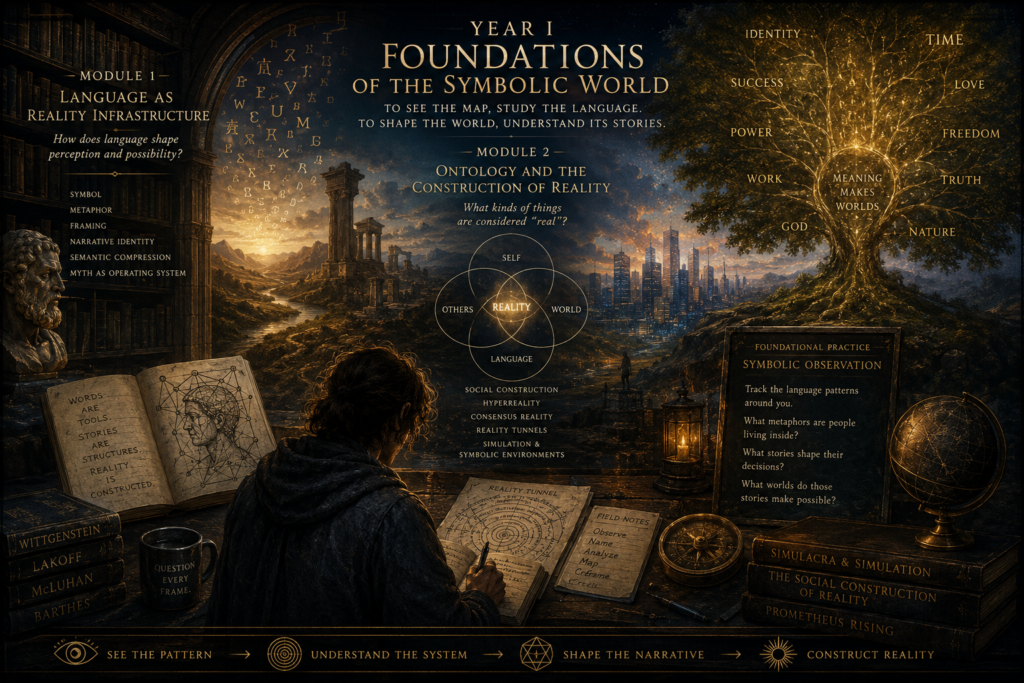
The Text-Based Ontologist: A Syllabus for Reality Engineers, Narrative Alchemists, and Semantic Cartographers

the text-based ontologist

This is not a traditional academic programme.

It sits somewhere between the philosophy department, occult library, media lab, hacker space, monastery, writer’s workshop, and signal intelligence unit.

The central premise:

Human beings inhabit realities structured by language.
In computational culture, text has become executable.
Therefore, whoever understands symbolic systems understands reality construction.

The goal of the text-based ontologist is not merely to analyse the world, but to perceive and shape the narrative architectures through which worlds emerge.

foundations

YEAR I — FOUNDATIONS OF THE SYMBOLIC WORLD

Module 1: Language as Reality Infrastructure

Core Question: How does language shape perception and possibility?

Topics:

  • Language as symbolic technology
  • Naming and categorisation
  • Metaphor as cognition
  • Narrative identity
  • Framing effects
  • Semantic compression
  • Myth as operating system

Key Thinkers:

  • Ludwig Wittgenstein
  • George Lakoff
  • Marshall McLuhan
  • Roland Barthes

Primary Texts:

  • Philosophical Investigations
  • Metaphors We Live By
  • Mythologies

Practical Exercise:
Spend one week documenting every metaphor people use around work, time, identity, and success.


Module 2: Ontology and the Construction of Reality

Core Question: What kinds of things are considered “real”?

Topics:

  • Classical ontology
  • Social construction
  • Hyperreality
  • Consensus reality
  • Reality tunnels
  • Simulation and symbolic environments

Key Thinkers:

  • Jean Baudrillard
  • Peter L. Berger
  • Thomas Luckmann
  • Robert Anton Wilson

Primary Texts:

  • Simulacra and Simulation
  • The Social Construction of Reality
  • Prometheus Rising

Field Assignment:
Track how social media transforms symbolic signals into perceived reality.

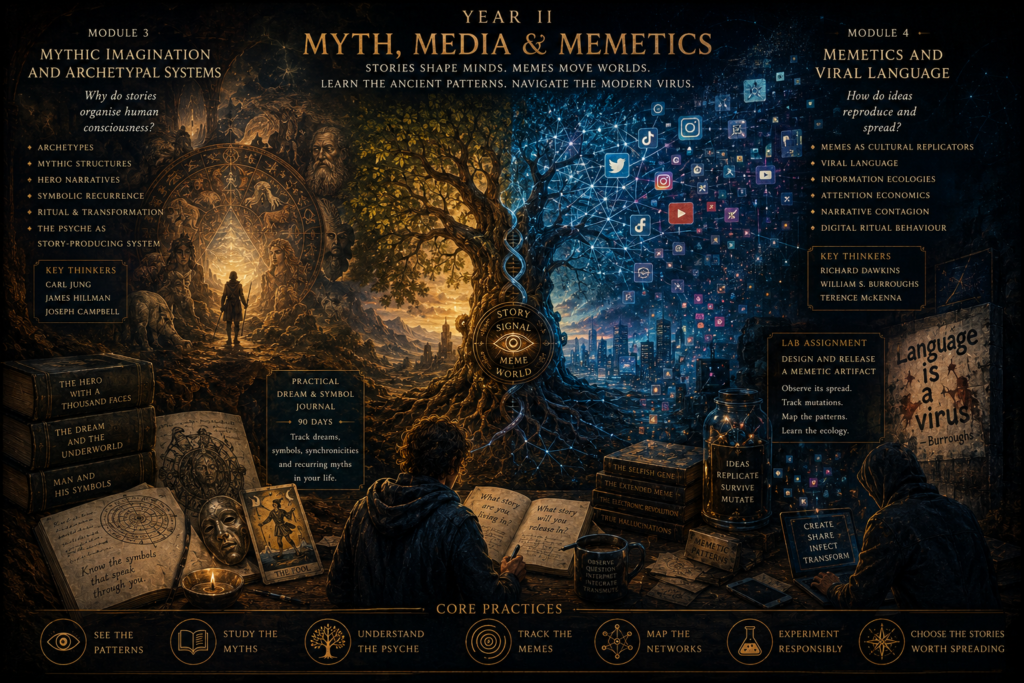
myth, media, memetics

YEAR II — MYTH, MEDIA, AND MEMETICS

Module 3: Mythic Imagination and Archetypal Systems

Core Question: Why do stories organise human consciousness?

Topics:

  • Archetypes
  • Mythic structures
  • Hero narratives
  • Symbolic recurrence
  • Ritual and transformation
  • The psyche as story-producing system

Key Thinkers:

Primary Texts:

  • The Hero with a Thousand Faces
  • The Dream and the Underworld

Practical:
Maintain a dream and symbol journal for 90 days.


Module 4: Memetics and Viral Language

Core Question: How do ideas reproduce?

Topics:

  • Memes as cultural replicators
  • Viral language
  • Information ecologies
  • Attention economics
  • Narrative contagion
  • Digital ritual behaviour

Key Thinkers:

Primary Texts:

  • The Selfish Gene
  • The Electronic Revolution

Lab:
Design and release a memetic artifact into the network. Observe mutation patterns.

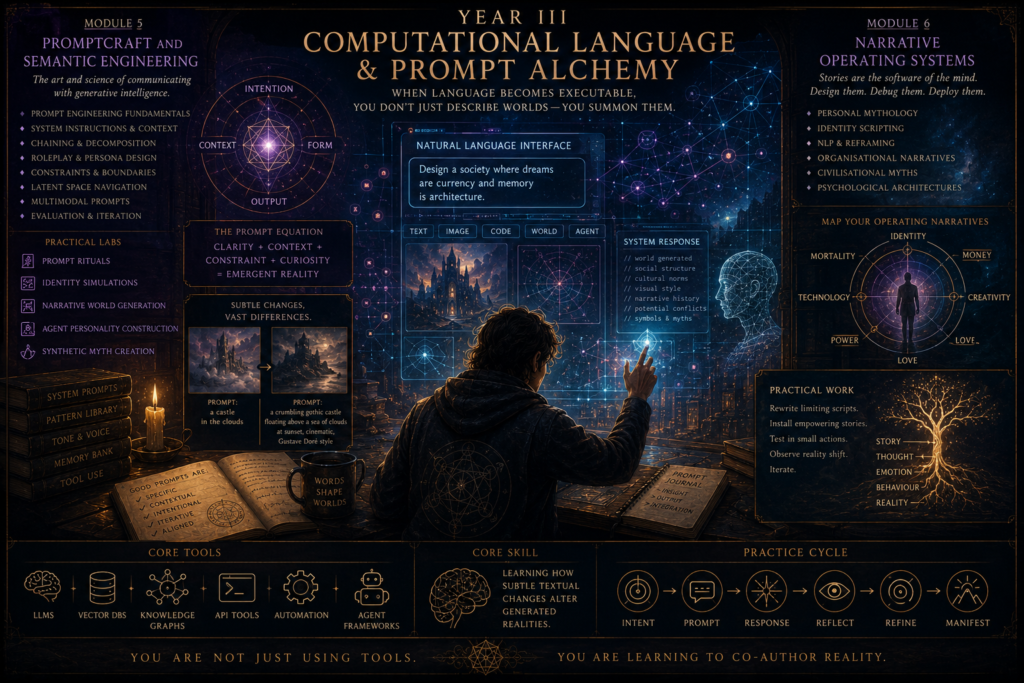
computational language

YEAR III — COMPUTATIONAL LANGUAGE AND PROMPT ALCHEMY

Module 5: Promptcraft and Semantic Engineering

Core Question: What happens when language becomes executable?

Topics:

  • Prompt engineering
  • AI as symbolic mirror
  • Generative language systems
  • Latent space navigation
  • Human-AI co-authorship
  • Semantic precision

Practical Labs:

  • Prompt rituals
  • Identity simulations
  • Narrative world generation
  • Agent personality construction
  • Synthetic myth creation

Core Skill:
Learning how subtle textual changes alter generated realities.


Module 6: Narrative Operating Systems

Core Question: How do stories become behavioural infrastructure?

Topics:

  • Personal mythology
  • Identity scripting
  • NLP and reframing
  • Organisational narratives
  • Civilisational myths
  • Psychological architectures

Key Thinkers:

  • Gregory Bateson
  • Viktor Frankl
  • Robert Dilts

Practical:
Map your own operating narratives across:

  • identity
  • money
  • creativity
  • love
  • power
  • technology
  • mortality
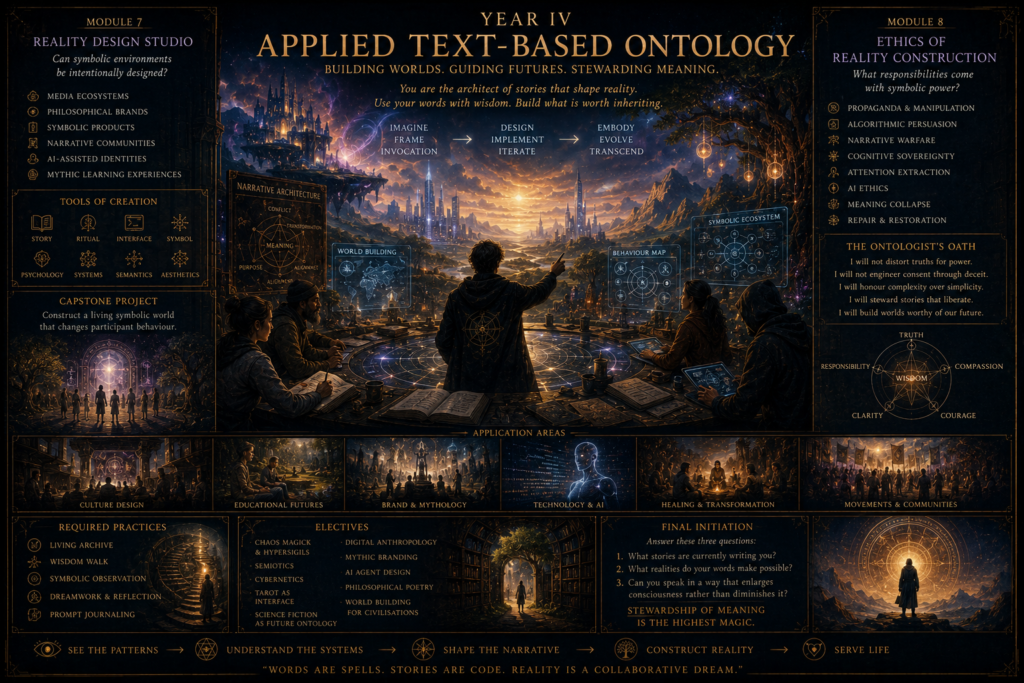
applied text-based ontology

YEAR IV — APPLIED TEXT-BASED ONTOLOGY

Module 7: Reality Design Studio

Core Question: Can symbolic environments be intentionally designed?

Students build:

  • media ecosystems
  • philosophical brands
  • symbolic products
  • narrative-driven communities
  • AI-assisted identities
  • mythic learning experiences

This module combines:

  • storytelling
  • interface design
  • psychology
  • systems thinking
  • ritual structure
  • semantic architecture

Capstone Project:
Construct a living symbolic world that changes participant behaviour.


Module 8: Ethics of Reality Construction

Core Question: What responsibilities come with symbolic power?

Topics:

  • Propaganda
  • Manipulation
  • Algorithmic persuasion
  • Narrative warfare
  • Cognitive sovereignty
  • Attention extraction
  • AI ethics
  • Meaning collapse

Key Texts:

  • Amusing Ourselves to Death
  • The Society of the Spectacle

Final Question:
How do we shape worlds without becoming tyrants of meaning?


REQUIRED PRACTICES

Every text-based ontologist must maintain:

1. The Living Archive

A searchable second brain.
(Obsidian recommended.)

2. The Wisdom Walk

Daily ambulatory cognition practice.

3. Symbolic Observation

Track recurring motifs, metaphors, and memes in culture.

4. Dreamwork and Reflection

Because symbolic systems emerge from below conscious awareness.

5. Prompt Journaling

Document prompts and resulting realities.


ELECTIVES

  • Chaos Magick and Hypersigils
  • Cybernetics
  • Semiotics
  • Science Fiction as Future Ontology
  • Tarot as Symbolic Interface
  • Digital Anthropology
  • Philosophical Poetry
  • AI Agent Persona Design
  • Mythic Branding
  • Worldbuilding for Civilisations
  • The History of Esoteric Writing Systems

FINAL INITIATION

To graduate, the student must answer three questions:

  1. What stories are currently writing you?
  2. What realities do your words make possible?
  3. Can you speak in a way that enlarges consciousness rather than diminishes it?

Because the final responsibility of the text-based ontologist is not manipulation.

It is stewardship of meaning.

The Imaginal as a Forgotten Sense: Seeing with the Soul’s Eye

“What if imagination isn’t something we use—but something we see through?”

Long ago, before the world was hemmed in by spreadsheets and satellite maps, there was a way of seeing that didn’t require eyes. The old mystics called it the soul’s eye, or sometimes the mundus imaginalis—the imaginal world.

Not imaginary. Not pretend.

Imaginal, as in a realm just as real as this one, only glimpsed through a different aperture.

We’ve forgotten this eye, most of us. We traded it for optics and logic, for evidence and utility. But the soul remembers. And if you listen—if you pause long enough to hear the silence beneath the noise—you may feel it stir again.

An ache behind your eyes.
A flicker just at the edge of thought.
A ripple through the fabric of the seen.

That’s the imaginal reaching for you.


The Mapmaker’s Mistake

When I was younger, I believed imagination was a tool. A creative instrument. A function of the brain to solve problems, craft stories, build futures. I respected it—adored it even—but still treated it like an accessory.

It wasn’t until life cracked me open like a geode and urged me to look inside that I saw imagination not as something to summon but something to see through.

There’s a difference between fantasy and imaginal perception.
Fantasy is what the ego conjures to escape the weight of being.
Imaginal is what the soul perceives when it’s finally heard.

The imaginal reveals.
It doesn’t decorate reality—it unveils it.

It’s the bridge between flesh and spirit. The eye that sees meaning shimmer where others see only dust.

The Organ of Meaning

“The eye sees only what the mind is prepared to comprehend.” — Henri Bergson

But what if the mind isn’t the only organ of perception?

What if there’s a subtler eye, veiled behind the forehead or seated in the chest, that reads the world not for fact, but for meaning?

Henry Corbin called this the organ of meaning—not metaphorically, but literally. Like your ears hear music, this part of the soul hears myth.

It perceives what your rational faculties cannot.
It drinks in symbol, resonance, vision, and dream.
It’s how you feel a truth that no one’s spoken.

You’ve felt this before.

  • A line of poetry that stirs something ancient in you.
  • A dream that lingers like prophecy.
  • A recurring image or symbol that haunts your waking life with uncanny timing.

That’s not a glitch.
That’s perception.
That’s your soul’s eye blinking open.

In a culture obsessed with data and reason, we’ve numbed this sense. We’ve called it “irrational,” “unscientific,” “childish.” But the soul doesn’t speak in logic. It speaks in symbols.

To navigate life without the organ of meaning is to wander a living myth blindfolded, mistaking every synchronicity for coincidence and every archetype for inconvenience.

But when the imaginal reawakens, the world thickens.
Meaning returns.
You stop seeking signs and start seeing them.

Seeing Again: Practices for the Soul’s Eye

“You do not see the world as it is.
You see the world as you are.” — Talmudic saying

The soul’s eye doesn’t need effort to open. It needs invitation.

These are not tasks. They’re thresholds.
Not techniques—but rituals of remembrance.

Here are three such practices, offered as keys:

1. Active Imagination

The Art of Inner Dialogue

Begin with an image—a tarot card, a dream figure, an archetype. Don’t analyse it. Enter it.

Ask:

  • “Why are you here?”
  • “What do you want from me?”
  • “What part of my life do you reflect?”

Listen.
Write down what it says.
Even if it doesn’t make sense.
Especially if it doesn’t.

This isn’t imagination in the modern sense.
It’s perception, inwardly turned.
A conversation between ego and soul.


2. Walking the World as Symbol

The Landscape as Oracle

Next time you walk your neighbourhood or trail, treat the world as a living dream. Ask:

“If this were a dream, what would it mean?”

  • A crow on a fencepost? A message.
  • A torn billboard? A forgotten vow.
  • The sound of wind in the trees? A breath from another world.

Let the world speak back.
Not in answers, but in images.

This is the language of the birds.
The secret tongue of the imaginal.


3. Keep a Grimoire

A Mythic Record of the Unseen

Not a journal.
A grimoire.

A sacred container for:

  • Dreams
  • Symbols
  • Synchronicities
  • Quotes that strike like lightning
  • Songs that haunt
  • Visions that visit unbidden

You are not documenting life.
You are mapping meaning.

Let the entries be wild, cryptic, poetic, and raw. Over time, the pages will reveal a deeper story—the myth beneath your name.


The Return of the Soul-Eye

“Myth is the transparency of the world through which the soul can be seen.” — James Hillman

When the soul-eye opens, the world changes texture.

The tree is no longer just a tree—it’s an elder.
The ache is no longer pain—it’s a message.
The random encounter is no longer chance—it’s a mirror.

This isn’t magical thinking.
It’s mythic perception.

You move from observer to participant. From confusion to story.
You stop asking what’s happening to me and start asking what myth am I in?

And here’s the quiet revolution:
The world becomes both map and mirror.
You become both seeker and symbol.

Every desire becomes a daemon.
Every struggle becomes a spell.
Every act of noticing becomes an invocation.

This is the return.
Not to belief. But to being.
Not to certainty. But to symbol.
Not to fantasy. But to the imaginal field where soul meets world.


A Contemplative Prompt

Pause. Breathe.
Let the ordinary blur, just for a moment.

Now ask yourself:

Where in my life am I being asked to see differently—through the eye of the soul, not the lens of reason?

Maybe it’s a recurring dream.
Maybe it’s a hawk overhead.
Maybe it’s an ache you can’t explain.

Whatever it is—don’t decode it.
Dialogue with it.

Then ask:

What if this isn’t just a moment I’m going through… but a myth I’m being called to embody?

Write it.
Whisper it.
Walk it.

And remember: once the soul’s eye opens, it never fully closes again.

Welcome back.

The Mythic Revival Is Not a Fad—It’s a Return of the Soul

Invocation: The Spark Before the Fire

Prometheus did not ask permission. He saw the fire of the gods and knew it belonged to us.”

I believe the mythic revival now underway is no mere fad. It is not a trend dressed in archetypes or a phase of spiritual nostalgia curated for the algorithmic self. It is something deeper—older—stirring in the marrow of our moment. Like smoke rising from long-dormant embers, it signals the return of something essential: the soul’s own language, the sacred grammar of symbols, story, and imagination.

You can feel it, can’t you? A pulse beneath the pixels. A low hum in your bones when you read certain words, or see a tarot card flipped just so, or feel the wind shift at the edge of a new season. Myth is not a theory—it’s a sensation. A knowing that doesn’t come from the head, but from the body of time itself.

We are not merely consuming myths. We are re-entering them.

After centuries of exile—of logic crowned king and spirit made servant—myth is making its quiet return. Not as dogma, not as doctrine, but as the soul’s immune response to the illness of meaninglessness.

Because what else do we call this era of the world, if not a crisis of meaning?

We scroll past tragedy and miracle in the same breath. We medicate the ache of the unknown. We mistake information for wisdom, and distraction for desire. And through it all, the soul waits—patient, persistent, whispering not in facts but in fables.

And now, some of us are remembering how to listen.

The mythic imagination is reawakening not because it’s trendy, but because it’s timely. Because we are creatures of story. Because even our deepest technologies—AI, the internet, neural nets—are just new ways of enacting the oldest impulse: to encode meaning, to make sense, to connect.

I’m not here to persuade you. I’m here to remind you.

You’ve always known this wasn’t just about career paths and productivity hacks and personality tests. You’ve always felt the call of something stranger, wilder, more whole. You’ve always been a mythmaker, even if no one taught you the craft.

So let’s begin there: with the stolen fire.

You hold it in your hands now.

The Collapse of Meaning in the Modern Age

“The gods have not fled; we have forgotten how to see them.”
James Hillman

We live in a time of great forgetting. Not just of history or heritage, but of meaning itself. The stories that once held us, that wove us into the fabric of a living cosmos, have unraveled—or been torn apart by systems that demand certainty, speed, and scale.

In their place? Metrics. Memos. Microdoses of simulated connection. We have apps to track our sleep and calendars to optimize our joy, yet many of us drift through our days with a quiet ache, a question that buzzes beneath the surface like a mosquito in the dark:

Is this it?

It’s a dangerous thing to live without myth. Not because myth offers answers—but because without it, we forget how to ask the right questions.

We forget that grief is not a pathology. That longing is not a weakness. That suffering is not meaningless. We lose our sense of soul—not in the religious sense, but in the root sense: anima, breath, the thing that makes us more than machines.

Modern life has excelled at functionality but failed at depth. We can build rockets to Mars, but we’ve lost the ability to name the inner terrain we wander every night in our dreams. We know how to launch startups and grow our platforms—but not how to descend into darkness and emerge changed.

We’re told to move fast and break things.

But myth says: descend slowly and be broken open.

The mythic imagination was never meant to compete with science. It’s not here to disprove, but to disclose—to reveal the soul’s perspective, to show us the symbolic layer beneath the literal. Yet in the modern paradigm, this symbolic way of seeing has been dismissed as primitive, irrational, even dangerous.

And so we’ve turned away from the old stories. We’ve traded the labyrinth for the spreadsheet. The oracle for the algorithm. The ritual for the routine.

But even now, the hunger persists.

You see it in the burnout masked as busyness. The spiritual seeking that never quite finds rest. The craving for something—anything—that feels real, not just virtual, curated, or performative. We are surrounded by content, but starving for context. Surrounded by data, but cut off from depth.

And in the absence of shared meaning, we grasp for spectacle. We perform identity. We brand our pain. We declare ourselves “authentic” while secretly hoping someone, somewhere will give us a script.

The collapse of meaning isn’t just cultural. It’s personal. Intimate. It happens in the silence after a tragedy, when the platitudes fall flat. It happens in the mirror, when success feels hollow. It happens in the inbox, when another inspirational quote doesn’t quite land.

But here’s the good news: the cracks are where the myth seeps back in.

The old stories were never meant to live in textbooks or temples. They live in thresholds, in turning points, in moments when the old scripts no longer work and something deeper calls. That’s where myth thrives—not as entertainment, but as orientation.

Not to escape the world—but to re-enchant it.

What Is the Mythic Imagination?

“Myth is the secret opening through which the inexhaustible energies of the cosmos pour into human cultural manifestation.”
—Joseph Campbell

The mythic imagination is not a skill. It’s not a genre. It’s not reserved for poets, mystics, or academics in smoky libraries.

It is a way of seeing.

A lens that reveals layers beneath the surface. A mode of perception that hears metaphor in the mundane, symbol in the ordinary, soul in the silence. When you engage the mythic imagination, the world doesn’t become more magical—it reveals the magic that was always there.

It’s not about belief—it’s about pattern recognition. You start to see your heartbreak not as failure, but as a descent into the underworld. Your creative block not as laziness, but as a liminal initiation. Your strange dreams not as random noise, but as encrypted messages from the deep psyche.

The mythic imagination doesn’t just interpret life—it deepens it.

Carl Jung called myth the “natural language of the unconscious.” Hillman spoke of it as a way of seeing-through—not explaining away, but peeling back. Myth doesn’t flatten reality; it thickens it. It restores the dignity of mystery. It gives back depth, and with it, dignity.

When you look with mythic eyes, your life stops being a sequence of events and starts becoming a story. And not just any story—but a story that’s happening to you and through you. A story that’s larger than you, but that needs your participation to unfold.

You stop asking, “What’s wrong with me?”
You start asking, “What myth am I living?”

And that question changes everything.

Because myth isn’t just about Zeus and Isis and Odin and Inanna. It’s about the patterns they represent—archetypes, yes, but more than that: psychic currents. Invisible forces. Timeless dramas re-enacted through our modern lives.

The mythic imagination helps us hold paradox. It speaks in both/and. It refuses to choose between the sacred and the profane, the personal and the collective, the dream and the data. It braids them together like old-world rope.

And perhaps most importantly, it reminds us that our inner lives matter. That what you feel, fear, long for, and struggle with is not just psychological—it’s mythological. It has weight. Shape. Narrative arc.

To cultivate a mythic imagination is not to live in fantasy. It’s to live more fully in reality—to see through the surface and into the soul of things.

It’s to remember that when you were a child, a tree wasn’t just a tree. A storm wasn’t just weather. A mirror could open, and a question could lead you somewhere dangerous and true.

That capacity is not lost.

Just sleeping.

And now—thanks to the cracks in the dominant paradigm—it’s beginning to stir.

Signs of the Revival

“The dream is the small hidden door in the deepest and most intimate sanctum of the soul…”
—Carl Jung

You can see the signs if you know where to look. Not in headlines or algorithms, but in the quiet revolution happening beneath the noise. A thousand candles being lit in a darkened room.

This mythic revival is not loud, but it is widespread. It hums in subcultures and creative pockets, in podcast monologues and tarot spreads shared in moonlit kitchens. It lives in zines stitched from grief and wonder. It hides in journals written by those who no longer want to optimise their lives—they want to alchemise them.

The mythic is returning through many doors:

  • Tarot and astrology, once cast aside as superstition, are now being reclaimed not as fortune-telling tools but as symbolic maps of self and psyche. Not predictive—but reflective. Not prescriptive—but participatory.
  • Myth-based storytelling is rising again—not only in fantasy novels and films, but in the way people frame their healing, their relationships, their careers. “I’m on a journey,” they say. “This breakup was my descent.” “This illness was a call to initiate.”
  • Digital spaces—blogs, newsletters, social audio, even the occasional TikTok—are becoming modern-day mythic scrolls. The internet, once dominated by utility, is becoming a dreaming ground again. A place for narrative experiments, symbolic art, story-as-signal.
  • Workshops, retreats, and soul circles gather not to dispense answers, but to hold sacred questions. To sit in the archetypal. To invoke the ancestors, even if their names are only half-remembered.
  • Even games and Alternate Reality Experiences are starting to mirror the mythic cycle—casting players as heroes, riddlers, wanderers in liminal realms. Play as initiation. Puzzle as pilgrimage.

These are not mere trends. They are soul behaviors.

The modern psyche, long starved of symbolic nourishment, is seeking it out wherever it can. And what’s beautiful—and crucial—is that this revival doesn’t belong to any one lineage, school, or system. It’s decentralized. Grassroots. Wildly diverse.

Some are drawn through the doorway of Jung. Others through psychedelics, or digital ritual, or grief that cracked them open. Some come through sci-fi and story structure. Others through ancestral reconnection. Some were never disconnected to begin with.

But the thread is there. A shared longing. A mythic pulse. A desire not just for story—but for story that sees you.

It’s not about escaping the world. It’s about re-enchanting your relationship to it. It’s about learning to live symbolically again—to read your life like a sacred text, full of omens and mirrors.

We are beginning to remember:
That storytelling is not just communication. It’s invocation.
That ritual is not superstition. It’s participation.
That imagination is not indulgence. It’s a way of knowing.

The mythic revival isn’t coming.

It’s here.

Scattered across platforms and time zones. Written in ink and pixels. Whispered in therapy sessions and shouted in drum circles. Fragmented, yes—but unmistakable.

And in its own quiet way, it is reshaping the world.

Why This Matters Now

“In the end, we will not be saved by data. We will be saved by story.”

We are living in an age of thresholds. The ground is shifting—ecologically, technologically, psychologically. What was once solid is now soft. What we once trusted—institutions, narratives, even the self—feels uncertain. We are in-between worlds.

And in liminal times, myth becomes essential.

Because myth is the oldest technology we have for navigating uncertainty. Before we had algorithms, we had archetypes. Before we had roadmaps, we had riddles. Myth was the way we marked the mystery, made peace with paradox, and found meaning in chaos.

And make no mistake—we are in the midst of chaos.

Climate collapse, AI disruption, collective burnout, spiritual disillusionment, political fragmentation—the collapse isn’t coming. It’s here. We’re walking through it in real time, holding shattered stories in our hands.

The old myths—the ones we’ve inherited from modernity—are failing.

The myth of endless growth.
The myth of individual supremacy.
The myth of progress as salvation.
The myth of disconnection—from nature, from each other, from soul.

These are not neutral ideas. They are mythic structures dressed up as common sense. And when myths collapse, they don’t go quietly. They go with fire.

But in every mythic cycle, collapse is not the end. It is the beginning of a new initiation.

The mythic imagination matters now because we are no longer in need of surface-level change. We need deep narrative transformation. We need to re-story the world—not with utopias, but with soul-truths. With stories that can hold the weight of what we’re living through.

We need myths that are wide enough to contain grief. Flexible enough to bend with change. Sacred enough to restore reverence. And personal enough to remind us that we each have a role to play.

Myth gives us that.

It gives us back the dignity of being a protagonist in a living world—not just a consumer in a dying one. It reclaims our suffering as part of a larger arc. It reminds us that the dark isn’t a detour. It’s the descent before the return.

And it calls us not to escape, but to engage. To participate in the making of new meaning, right here in the ruins.

You see, the mythic revival is not a retreat from reality. It’s a return to what’s most real. A return to story as soulcraft. A return to the inner compass when the external map is burning.

Because in the absence of a collective myth, we become isolated wanderers. But in the presence of myth, we become something else:

A people on a shared journey.

This Is a Rebellion, Not a Regression

“The visionary is the only true realist.”
— Federico Fellini

Let’s say it plainly: some will scoff at this revival.

They’ll say it’s indulgent. Sentimental. A symptom of a generation that can’t face reality without dressing it up in archetypes and oracle decks. They’ll say myth is for the past, not the future. That it’s a soft substitute for serious thought. A retreat into fantasy.

But they miss the point entirely.

This return to myth is not a regression. It is a rebellion. A refusal to let the world be stripped of wonder. A refusal to accept the terms of a life reduced to performance metrics, identity brands, and dopamine loops. A refusal to live in a story where we are nothing but cogs in a machine that never stops spinning.

To live mythically is not to pretend.

It’s to resist reduction.

It’s to say: I am not just my résumé. I am not just my wounds. I am not just a demographic or a dataset. I am a soul in motion, a story in the making, a vessel of mystery moving through time.

And that is not soft. That is power.

Because when we see our lives mythically, we stop outsourcing meaning. We stop waiting for someone else to give us the plot. We begin to author from within. Not to control the narrative—but to participate in it.

Mythic imagination reclaims inner authority.

And that’s dangerous in a culture designed to keep us fragmented, distracted, and docile.

It’s dangerous because a person who sees their life as sacred will no longer settle for systems that desecrate.

It’s dangerous because a person who listens to their soul more than their screen cannot be easily manipulated.

It’s dangerous because a person who walks with archetypes walks with ancestors—and ancestors don’t care about quarterly earnings or follower counts.

This is why the mythic matters now. Not because it offers escape—but because it offers depth in an age of flatness. It offers pattern in an age of noise. It offers meaning in an age that treats meaning as a branding tool.

The return of the mythic imagination is not about losing touch with reality.

It’s about refusing to be trapped in someone else’s definition of it.

So yes—call it rebellion. A soulful, poetic, dignified rebellion against the tyranny of the literal. Against the cult of productivity. Against the storyless world that tells us there is no mystery left to live.

We know better.

We’ve felt the fire.

And we are not going back.

The Personal Turn: A Mythic Praxis

“The privilege of a lifetime is to become who you truly are.”
—Carl Jung

This isn’t theory for me. It’s biography.

The mythic imagination didn’t enter my life as a concept—it arrived as a lifeline. A thread I didn’t know I was following until I looked back and saw the pattern woven through every season of unravelling.

There were moments when the inherited scripts stopped working. When the goals I was supposed to want rang hollow. When the mask of “being fine” cracked wide open—and something older, wilder, and wiser slipped through the gap.

I didn’t find myth in a book. I found it in my body. On long walks when I’d speak aloud to no one, only to realize I was speaking to some deeper part of myself. In dreams that felt like riddles from another world. In the strange synchronicities that followed grief, as if the universe were whispering, “Keep going. This has meaning.”

Eventually, I gave up trying to live a normal life and chose to live a storied one instead.

Now, I treat journaling as soul-mapping. I walk not just to clear my mind, but to converse with archetypes. I treat movies like modern myths and tarot spreads like mythic mirrors. I run my business as if it were a grimoire. I write blog posts like dispatches from the threshold. I speak to the page the way the ancients spoke to their gods: with reverence, with longing, with curiosity.

This is my mythic praxis.

It’s not a system or a ten-step program. It’s a posture. A way of orienting toward life that says: everything is symbolic, and nothing is accidental. Every problem is a plotline. Every wound is a portal. Every threshold is an invitation to become more fully who I’ve always been.

And I believe this is available to all of us—not just as philosophy, but as practice.

Because you don’t need to know all the old myths to live mythically. You just need to start listening for the symbolic pulse of your own story. You just need to ask different questions.

Not “What should I do?” but “What story am I in?”
Not “How do I fix this?” but “What is this trying to initiate in me?”
Not “Why is this happening?” but “Who am I being called to become?”

This is the path. Not upward, but inward. Not linear, but labyrinthine. Not perfect, but poetic.

And once you begin to walk it, you’ll start to see signs. Little breadcrumbs left by the soul. A book that falls off the shelf. A song lyric that hits like a prophecy. A conversation that opens something in you you didn’t know was closed.

The mythic imagination trains you to pay attention.
And in paying attention, you begin to re-story your life.

Not to escape it. But to live it more deeply. More soulfully. More whole.

A Quiet Call to the Storythinkers

“You are the one who keeps watch. You are the one who remembers. You are the one the myth was written for.”

If you’ve made it this far, it’s not because of me.

It’s because something ancient in you is stirring.
Something that remembers the shape of symbols.
Something that aches for a life that means more than survival, more than performance, more than passing time.

You are not alone in that longing.

There is a quiet uprising happening—among the storythinkers, the soul-listeners, the mythmakers in exile. We are not gathered in temples or town halls. We’re scattered across blogs, back porches, audio diaries, late-night journals. We are philosophers in hoodies, mystics with deadlines, seekers disguised as consultants and creators.

But we are here.

And I believe we’re being called—not to go back, but to go deeper. To become the next generation of myth-makers. To remember that our lives aren’t just content to be managed—they’re epics to be lived. They’re dreams to be decoded. They’re living myths in motion.

You don’t need to have it all figured out.

You just need to start listening differently.

So here’s a question I offer you, warm from the fire:

What myth is trying to live through you right now?

Not the one you inherited.
Not the one you think you’re supposed to live.
But the one that knocks at 3am.
The one that won’t leave you alone.
The one that feels like both a curse and a calling.

Find that thread.

Follow it—not to arrive, but to remember.

You are not a brand.
You are not a product.
You are not a problem to be solved.

You are a threshold-walker. A meaning-seeker.
A keeper of the flame.

And this mythic revival?

It’s not a phase.

It’s your soul coming back online.

So let’s keep the fire lit.
Let’s keep the stories alive.
Let’s make meaning in a world that forgot how.

Not because it’s easy.

But because it’s holy.


Awakening the Mythic Imagination: Reclaiming Your Life Through Story

Imagine, for a moment, a fire crackling in the heart of an ancient forest. Sparks leap like tiny stars into the velvet dark, spiralling skyward in silent communion with the heavens. You sit close enough to feel the fire’s gentle warmth kiss your skin, hear its whispers blending with the wind’s hushed secrets. Around you, shadows dance in graceful rhythms, conjuring figures both familiar and strange—spirits of myth, ancestors of imagination.

We’ve all felt it, haven’t we? That subtle tug toward the stories whispered in flame and shadow, a primal longing for something deeper, something woven from the threads of mystery itself. This is the pulse of the mythic imagination, an ancient inner campfire around which your soul has always gathered, even when you forgot its presence.

In earlier times, the storyteller—the griot, the bard, the sage—gathered us around flames much like these, sharing myths that shaped worlds, built cultures, and whispered the hidden truths of our humanity. Today, though the external fires may be fewer, that inner flame still burns. It waits patiently within your being, ready to illuminate your path and reveal the deeper stories shaping your life.

Consider for a moment: what myths are you quietly carrying? What subtle narratives have nestled in your soul, shaping your choices, your identity, your entire way of seeing and being in the world?

Perhaps these myths arrived gently, passed down by elders or found in the pages of cherished books. Or maybe they were imposed silently by culture’s hidden hand, stories of who you “should” be and how you “should” live—whispered persistently enough that you mistook them for truth. But the mythic imagination, the flame inside, offers something radical: the chance to reclaim, rewrite, and rediscover those very myths that shape your existence.

Tonight, sitting together at this inner fire, I invite you to lean closer. Let us journey beneath the surface of your everyday narratives and explore the mythic imagination—the living, breathing stories that shape your soul’s quest.

Gaze into the flames. Listen to the fire’s ancient murmurs. Feel its warmth kindle the spark of recognition deep within.

And as you do, ask yourself gently:

“What myth has brought me here, and what story within my soul is aching to be remembered?”

Mythic Imagination: A Doorway into the Deep

Within every heart lies a hidden door, inconspicuous to casual observers, yet sacred and waiting patiently for the curious seeker. On its surface, you might see nothing more than weathered wood, ancient hinges, and the faintest shimmer of something strange and unknowable. It seems ordinary enough to overlook—but approach it with intention, open it even slightly, and you’ll find yourself stepping onto a threshold where reality deepens, richens, and transforms before your eyes.

This is the doorway of the mythic imagination, the entryway into the hidden rooms of your inner world—the places where life ceases to be merely lived and begins to be narrated, mythologised, and imagined into meaning.

James Hillman, that wise explorer of the psyche, tells us that myths are not merely old stories from dusty books. They are the natural language of the soul, whispered by our dreams, echoed in synchronicities, and glimpsed in the poetic rhythms of our days. They come to life precisely when we stop trying to decode them intellectually and instead allow ourselves to dwell within them, sensing their rhythms and reverberations in the marrow of our being.

I recall vividly the first moment my own mythic imagination stirred awake. It was on a solitary walk through woods thick with the quiet hum of summer, sunlight breaking gently through the canopy like scattered pieces of gold. Lost in thought, perhaps distracted by trivial worries or fleeting concerns, I nearly missed the delicate object resting on the path—a single raven feather, dark as ink, glossy in the sun. As I lifted it, feeling its weightlessness yet sensing a strange gravity, the world shifted subtly around me. In that instant, I wasn’t merely holding a feather—I had stepped into a story.

That simple feather became a symbol, an emissary sent by some deeper narrative asking for attention. It was no longer an object but a metaphor, an invitation, perhaps even a messenger from Odin or Morrigan—archetypes whispered to life by the mythic imagination. What once seemed random had become sacred; the mundane world opened itself to reveal layers of hidden meaning. The raven feather had become my key, and through that seemingly ordinary encounter, my mythic imagination ignited.

This, friend, is what the mythic imagination offers you—a deeper way of seeing, one that transforms the ordinary world into an enchanted realm. It invites you to notice feathers and whispers, dreams and symbols, tarot cards and chance encounters, as doorways into deeper narrative truths. It calls you to see your life not as a mundane progression of events but as a rich story of mythic significance.

The question is never whether this hidden door exists, but whether you dare to open it.

And so I ask you gently, with curiosity and reverence:

What quiet symbols or subtle synchronicities have recently entered your world, whispering an invitation into deeper meaning? What myths might they be offering you, if you choose to step across their threshold?

The Stories We Inherit

Imagine standing on the shore of a river, its waters flowing ceaselessly onward, whispering ancient secrets and carrying forward the dreams, desires, and myths of countless generations. We are each born along this river, swept into currents of stories not entirely our own—tales told long before our first breath, beliefs shaped long before our first thoughts formed.

These are the inherited stories, the unseen myths that guide our lives from within shadows. Some of them nourish and inspire, illuminating paths toward meaning and fulfilment. Others quietly bind us, weaving threads of obligation, expectation, and conformity that can subtly constrict the soul’s longing.

Joseph Campbell speaks eloquently of the “mono-myth”—the hero’s journey—that universal narrative embedded within every culture. Yet alongside this nourishing myth live other, less empowering stories: myths of success as wealth and acclaim; myths of worthiness tied to productivity; myths of identity bound up in endless striving. Each of these stories whispers insistently, shaping what we value, how we act, and who we believe ourselves to be.

I have felt the weight of these inherited myths deeply in my own journey. Once, early in my career, I found myself chasing the relentless myth of achievement—an unconscious quest for validation through success as defined by society’s yardstick. The promotions, the titles, the applause: each milestone was supposed to bring meaning, yet each felt emptier than the last, an echo without source.

It wasn’t until I stepped away, retreating into the solitude of reflection and journaling, that I finally glimpsed the hidden story that had silently shaped my path. In my notebook, I traced back through my choices, mapping my beliefs like constellations. Gradually, patterns emerged—myths whispered by culture, family, schooling, media. I saw clearly how this inherited narrative had defined success as external validation, approval measured by others’ standards rather than my own soulful truth.

Through the mythic imagination, however, I discovered another way: the power not only to see these stories clearly but also to reclaim and rewrite them. Sitting by the metaphorical fire within my soul, I began crafting new stories—stories that embraced deeper truths, stories in which success was no longer a relentless pursuit but a meaningful alignment with purpose, creativity, and joy.

This shift was subtle yet seismic. It was as if I stepped off a familiar but exhausting road and entered a winding path leading through mythic landscapes of my own making. The myths I chose to live by transformed, from shadows quietly directing my steps into lanterns illuminating the journey ahead.

And so it is for each of us. To awaken your mythic imagination is not simply to dream vividly or poetically—it is to recognise clearly the stories you’ve inherited and consciously choose the ones you wish to carry forward. It’s an act of reclaiming, rewriting, and reshaping your very self, story by story, into a more soulful truth.

Let’s pause together at this riverside, then, and gaze into the reflective waters with gentle curiosity. Ask yourself:

“Which stories have guided my life without my conscious consent? Which myths of success, worthiness, or identity am I ready to lovingly release—and what new story is ready to be born in their place?”

Archetypes and Allies

In the quiet moments when the world’s clamor recedes, you can hear the soft footsteps of archetypes moving gracefully within the corridors of your soul. Archetypes—those primal, luminous figures of the collective unconscious—are not distant abstractions; they are your allies, your guides, companions whispering wisdom from realms deeper and older than memory itself.

Carl Jung taught us that archetypes reside in the psyche, timeless patterns that weave themselves into myths, dreams, and symbols. They appear as familiar strangers, embodying aspects of ourselves we’ve forgotten or never consciously known. To awaken your mythic imagination is to welcome these archetypes home, inviting their stories, wisdom, and power to dance within your own lived narrative.

In my own journey, four archetypal allies have emerged clearly—Prometheus, Sophia, Thoth, and Odin—each representing facets of my mythic imagination, each illuminating different corners of my psyche.

Prometheus, the fire-stealer, speaks boldly within me, reminding me always of the power of creativity, rebellion, and illumination. He dares me to challenge the gods of convention, to seek truths hidden in shadows, to trust that wisdom often lies in the courageous theft of forbidden insight. Prometheus, chained yet defiant, teaches me resilience in the face of struggle, perseverance in pursuit of the soul’s true fire.

Sophia, the divine feminine spirit of wisdom, whispers gently, guiding me inward toward contemplation, compassion, and intuitive understanding. She is the gentle muse who invites depth over surface, wisdom over information. Sophia appears in moments of quiet reflection, in dreams scented with jasmine and sandalwood, and in subtle intuitions that arrive softly, urging patience, care, and clarity.

Thoth, the ibis-headed scribe, guardian of words and keeper of knowledge, meets me in the interplay of story and symbol, writing and myth. He teaches that words have the power not only to describe reality but to shape it—each sentence a magical incantation, each narrative a subtle spell shaping consciousness itself. In my work as storyteller, griot, and myth-weaver, Thoth remains my constant companion, guiding my pen and illuminating the transformative power of language.

And then there is Odin—seeker of hidden wisdom, traveler of the nine realms, poet-shaman wandering between worlds. Odin invites me to embrace mystery and paradox, to see clearly through the eye of sacrifice, to grasp knowledge not by hoarding answers but by fearlessly questioning all assumptions. Odin reminds me that wisdom is won not through certainty but through courageous exploration, through willingness to face the unknown.

Each archetype has revealed itself through rituals and practices—through journaling, tarot, mythic reflections, and storytelling. Each has become more than symbolic: they are companions whose presence deepens and enriches my mythic imagination, reminding me that I am never alone on this soul-journey.

Once, during a tarot reading, Odin appeared to me vividly in the form of the Hanged Man—an image of sacrifice, surrender, and wisdom won through inversion. At first glance, the card startled me, echoing a fear of vulnerability. Yet as I allowed the archetype to speak, I recognised his profound teaching: wisdom arises precisely when we surrender control, when we accept the discomfort of uncertainty, when we dare to see the world from an inverted perspective.

In embracing Odin’s archetypal wisdom, I discovered new strength in vulnerability, new clarity in paradox, and new freedom in surrender. This is the mythic imagination’s great gift: archetypes become allies, and their stories transform from ancient fables into living truths guiding your daily life.

Pause for a moment here, and invite your own archetypal allies to step forward. Ask yourself gently:

“Which archetypes have been quietly guiding my journey? What wisdom are they whispering, and how might embracing their presence help me more deeply embody the myth I was born to live?”

Thresholds and Transformations

Picture yourself standing at the edge of a deep forest, twilight settling gently into the spaces between the trees. Behind you lies the familiar path, comfortable yet worn thin by the steps you’ve taken time and again. Ahead lies the unknown—a place both enticing and uncertain, lit only by moonlight and the quiet shimmer of possibilities unseen.

This place—the borderland between the known and the mystery—is the threshold, a sacred liminal space where profound transformations await.

Thresholds are at the heart of the mythic imagination. They signify moments of great transition, when the soul is called to leave behind old identities, beliefs, or ways of being, to step courageously into the unknown. Joseph Campbell described these thresholds as crossings, passages in the hero’s journey where the familiar world must be relinquished for deeper wisdom and true soul-growth to emerge.

In myth, these crossings appear vividly—a hero plunges into the underworld, ventures into an enchanted forest, or sets sail across a turbulent sea. But your thresholds, though subtler, are no less potent. They appear as career changes, personal crises, spiritual awakenings, or simply the quiet realisation that life as you’ve known it no longer fits the soul you’ve become.

I have known such thresholds intimately. One of the most profound came during a period when my life, outwardly successful and secure, suddenly felt empty and misaligned. I stood at an inner crossroads, knowing intuitively that to remain where I was would mean betraying the deeper call whispering from within.

The threshold appeared quietly, as thresholds often do, in a series of sleepless nights and reflective walks, in conversations that echoed with a strange, unsettling resonance. Eventually, the moment of crossing arrived—not with a dramatic flourish, but as a calm yet undeniable knowing that it was time to step forward, even without knowing precisely what awaited on the other side.

I crossed into a space of profound uncertainty, leaving behind familiar identities built around roles and accomplishments. Yet within that uncertainty, something extraordinary unfolded. My mythic imagination awakened fully, guiding me deeper into my inner landscape, helping me reclaim stories I’d forgotten, and illuminating new pathways toward authenticity and purpose.

In the mythic imagination, thresholds aren’t merely places of passage—they are sacred initiations. To cross them is to surrender to transformation, allowing yourself to be reshaped by forces deeper than the conscious mind. It’s a moment of trusting that beneath uncertainty lies the promise of renewal, a deeper alignment with the mythic story your soul seeks to embody.

Perhaps you, too, find yourself standing at such a threshold now, feeling its subtle pull, sensing the quiet whispers urging you forward into mystery. Perhaps your threshold appears as a quiet longing, an inner voice calling for change, or a restless knowing that life holds something deeper, richer, more aligned with your true nature.

As you linger at the threshold, know this: you stand in sacred company. Every hero, every seeker, every soul who has dared live authentically has stood exactly where you now find yourself.

Take a breath. Feel the gentle courage within.

Ask yourself softly, yet earnestly:

“What threshold am I standing at today? What must I leave behind to cross into the deeper story waiting patiently on the other side?”

Mythic Praxis: Living the Imaginal

There comes a time when myth ceases to be something you merely read or imagine and becomes something you live—a breathing, tangible practice that infuses your days with meaning and depth. This deliberate embodiment of the mythic imagination is what I call mythic praxis—the subtle yet profound art of weaving myth into the fabric of everyday life.

Mythic praxis invites you not only to see your life as a narrative but to consciously shape it through rituals, reflections, and symbolic acts that awaken your inner storyteller. It transforms ordinary moments into encounters with the sacred, turning your life into an ongoing dialogue between the tangible world and the imaginal realm.

I discovered the power of mythic praxis through simple but potent rituals—practices such as mythic journaling, wisdom walks, tarot storytelling, and soulful conversations with archetypal allies. These are not mere activities; they are quiet ceremonies that awaken the mythic imagination, inviting it to speak clearly and guide your steps.

Consider journaling: what might seem like a modest act of pen meeting paper becomes, through mythic praxis, a sacred invocation. When I journal, I open myself to the mythic dimensions of my experience, exploring dreams, symbols, and synchronicities. The blank page becomes a portal, the pen a wand, words the threads weaving together my lived story with deeper truths. Each entry reveals hidden connections, archetypal whispers, and subtle guidance, illuminating my path through the mundane toward the profoundly meaningful.

Similarly, wisdom walks—those reflective strolls taken without agenda, open-hearted and attentive—become journeys of revelation. On these walks, nature herself becomes an oracle: each fallen leaf, each murmuring brook, each passing cloud is imbued with symbolic resonance. A hawk soaring overhead might speak of clarity and vision; a winding trail becomes a metaphor for life’s unexpected turns. Mythic praxis is seeing these simple occurrences not as random events, but as meaningful signs, stories waiting to be deciphered by your mythic imagination.

Tarot storytelling is another powerful practice—one that merges symbolism with narrative intuition. The cards, rich with archetypal imagery, offer not merely answers but reflections of the stories living deep within your psyche. In drawing the cards and narrating their symbolic dance, you tap directly into the mythic imagination, discovering profound insights and reclaiming your agency as both storyteller and protagonist of your life’s unfolding tale.

Through these practices, mythic praxis reveals itself as a way of living poetically and intentionally. It reminds you that the mundane world is pregnant with symbolic significance, waiting only for your recognition. It transforms your relationship with reality itself, teaching you that each moment, no matter how ordinary, contains seeds of mythic meaning if approached with reverence and curiosity.

Moreover, mythic praxis deepens your intimacy with yourself and your connection to others. By living your myths consciously, you invite authenticity and vulnerability into your relationships, creating spaces where soulful conversations can flourish, rooted in shared stories and archetypal truths.

As you embrace mythic praxis, something beautiful and alchemical occurs: your life begins to resonate with mythic coherence. The threads of your story—once tangled, fragmented, or seemingly random—start weaving themselves into a meaningful tapestry. You realise, perhaps for the first time, that you are not merely living your life but authoring it, co-creating a story infused with intentionality, imagination, and soul.

Pause with me here, by our inner campfire, and reflect for a moment:

“How might I begin to consciously embody my mythic imagination each day? What rituals or practices could transform my ordinary moments into profound encounters with myth, meaning, and magic?”

Invitation: Becoming the Myth You Were Born to Tell

Our fire now burns low, its embers pulsing gently beneath the ash like a heartbeat—steady, quiet, waiting patiently to flare once more. Yet as our time here draws softly toward its close, this is not an ending; it’s an opening, an invitation to step forward from this sacred threshold into the deeper story of your life.

You see, the mythic imagination is never truly finished. It calls continually, inviting you deeper into the narrative currents that flow beneath your everyday existence. Each insight, each archetype, each threshold crossed is but one chapter in the ever-unfolding myth your soul is here to embody.

You were born with stories inside you—myths whispered into your being long before you took your first breath. To awaken your mythic imagination is to reclaim those stories consciously, to author your life with intention, courage, and soulful authenticity. It is the sacred act of remembering who you are beneath the layers of inherited scripts, societal expectations, and cultural narratives.

What story, then, is yours to tell? What myth pulses within your heart, waiting patiently, insistently, to be lived?

Perhaps you are Prometheus, boldly stealing fire to illuminate a path for yourself and others, daring to defy convention and claim your power of creation. Perhaps you embody Sophia, patiently guiding yourself and others toward wisdom, compassion, and intuitive knowing. Perhaps Thoth calls you, inviting you to shape reality through language, imagination, and the power of your voice. Or perhaps Odin whispers courageously in your ear, reminding you that wisdom is found in embracing mystery, paradox, and the unknown.

Whoever you are, whatever your myth, know this: your story matters. It is unique, sacred, and vital to the great story of human experience. To live your myth is not an indulgence; it is an act of profound courage, creativity, and compassion. It is a gift to yourself, yes—but also to the world, which aches for the richness, depth, and authenticity your true story offers.

Tonight, as you rise from this mythic campfire within, I offer you this gentle invitation:

Become the myth you were born to tell.

Live consciously, poetically, and mythically, transforming your everyday moments into encounters with the sacred. Step courageously across thresholds, welcoming transformation. Befriend your archetypes and allies, honoring the wisdom they whisper to your soul. And most importantly, trust deeply in your own narrative, knowing it to be exactly the story you need—and the one the world needs—from you now.

I leave you with a reflective prompt, a gentle question to guide you onward:

If your life were a myth—and it most assuredly is—what story would you choose to live, beginning today?

Hold this question tenderly. Allow it to linger. Carry it forward, not just as a thought, but as a quiet prayer whispered softly within your heart.

The mythic imagination awaits you. The story of your soul has only just begun.

Let the Flame Consume Me

bonfire surrounded with green grass field

A personal resurrection in seven acts

Threshold Moment: The Phoenix Stir

There’s a moment just before the flame catches, when the ashes still whisper the name of who you used to be.

I find myself standing in that moment now. It’s a Friday—gray-skied and bone-cold here in the UK—but mythically speaking, it’s a threshold day. The world calls it the weekend, but for those of us walking the soul path, this is something deeper. A turning point. A chance to die and be reborn.

I’ve been circling this fire for some time—walking my Wisdom Walks, speaking into the wind, sending audio dispatches from the edges of my becoming. People are listening. Something in the voice, in the rhythm, is resonating. They’re feeling the myth behind the words.

And I am, too.

The truth is, there’s a version of me still clinging by the toes to an old way of being. He’s not evil. He’s not broken. He simply no longer belongs. He’s done his part. But I’ve been slow to let him go. Maybe you know the feeling—the ache of becoming, right before the release.

So today, I mark the shift.
Today, I light the pyre.

This isn’t just journaling. This is ritual.
A personal resurrection ceremony in three acts:

  1. Write a eulogy for the version of you that’s outlived his story. Honor him. Mourn him. Then burn the words—or bury them beneath a tree.
  2. Craft a resurrection vow. Speak directly to the self you’re becoming in Act III. Make it mythic. Make it matter.
  3. Walk with intention. Even if it’s cold. Even if it’s just around the block. Let your feet carry the vow into your body.

Me? I’m starting here.
Right here, in the liminal hush before the flame.

“I’ve been hanging by the toes to an old self. Today, I let go.”

The Phoenix doesn’t rise by willpower. It rises because it has no other choice.

And neither do I.


🔥 JOURNALING RITUAL: The Eulogy and the Vow

Today, write like you’re tending a sacred flame.

🕯️ Part One: The Eulogy

  • Who is the self you are ready to release?
  • What story has he been living?
  • What burdens has he carried?
  • What will you thank him for before you let him go?

🌄 Part Two: The Resurrection Vow

  • Who are you becoming in Act III?
  • What values guide this self?
  • What vow do you make to him—to yourself—as you cross the threshold?

“Let the flame consume me. Let it burn bright enough to guide others through the dark.”


The Ashes: A Season of Wandering

Before any resurrection, there is the wandering.

Mine didn’t come with thunderclaps or visions in the desert. It came quietly, like dust settling on a path half-forgotten. I didn’t notice, at first, that I’d drifted from the fire. One day I was mentoring seekers through mythic rites of passage, guiding them up sacred mountains. The next, I was inside boardrooms and performance review loops, speaking the language of metrics and deliverables.

The world called it success. But I knew better.
I knew what it felt like to burn. And I wasn’t burning anymore.

What started as a brief detour became a long exile. A season of soul drift. I convinced myself it was practical. Necessary. Everyone’s got to eat. And there’s truth in that. But in chasing the secure, I left behind the sacred.

I don’t regret those years—they sharpened my skills, taught me to read the map of power and systems. But I see now that I was living as a fraction of myself. A well-spoken ghost.

And yet, the ember never fully died.

“There’s more than this,” it kept whispering.
Usually when I walked. Or when I was still enough to hear it.

Ashes are not endings.
They are fertile. They remember fire.


🌫️ JOURNALING RITUAL: Walking Through Ashes

🪵 Reflect:

  • When did you start to drift from your fire?
  • What did you trade for safety, approval, or success?
  • What have you learned in exile that you wouldn’t have learned at the fire?

🔥 Listen for the Ember:

  • What sacred part of yourself refuses to be extinguished?

The First Flame: Kinabalu and the Campfire

It started in Borneo. Not with a coaching session or a grand insight—but with mud underfoot, sweat on the brow, and stars overhead.

I joined a 10-day adventure race at the foot of Mount Kinabalu. It was grueling—three races a day, deep jungle, no phones, no distractions. But it wasn’t the challenge that changed me. It was what happened after the finish line.

Each night, we’d gather at base camp. Strangers by day, fire-kin by night. We ate, talked, shed our corporate skins. Something ancient woke up around that fire—something raw, honest, and profoundly human.

And then—something even wilder.
When we returned home, people quit their jobs.
Left the city. Changed their lives.

Not because I coached them.
Because something in the jungle and the fire reminded them of who they were.

That’s when it hit me:
Transformation doesn’t need theory.
It needs place, presence, and mythic space.

And so the seed of Personal Growth Adventures was planted.

The Spark Becomes a Flame: Personal Growth Adventures

I didn’t want to teach transformation. I wanted people to live it.

So I built The Ascent Experience—a weekend retreat structured on the Hero’s Journey. From the call to adventure, to the crossing of thresholds, to the return with the elixir. We didn’t talk about myth. We enacted it.

Friday night began with The Feast of Heroes. Strangers gathered like destiny had drawn them to the same table. After dinner, we stepped into the dark. No flashlights. Just trust. Just instinct.

“What is the mountain whispering to you?” we asked them in the night.

Saturday brought the outer ascent—up Mount Snowdon—and the inner descent into values, fears, and forgotten dreams. We walked. We coached. We climbed.

Sunday, they carried the elixir home—not just metaphorically, but in their hands. A stone from the summit. A message from the mountain.

That was my work.
My flame.
My myth.
And then—once again—I drifted.

The Mistake: Unplugging Without a Net

We were good at the rupture.
But we failed at the return.

We knew how to awaken people. To unplug them from the Matrix. But we didn’t know how to walk with them through the reintegration. We left them open—and unguarded.

Some soared. Others stumbled. And I’ve carried that with me.

Because the hero’s journey doesn’t end at the summit.
It ends when the gift is brought home.

“We handed them the elixir, but offered no vessel to carry it in.”

Never again.

Now I know: the work isn’t just about ignition. It’s about accompaniment. About helping people return with their flame intact.


🌀 JOURNALING RITUAL: After the Awakening

🪨 Reflect:

  • Have you ever awakened… and then felt lost?
  • What support did you need—but didn’t receive?
  • What kind of guide would’ve helped you walk the return path?

🔥 Now consider:

  • Who in your life might need your presence now?
  • How can you be a hearth, not just a matchstick?

Resurrection: The Return of the Mentor

This isn’t a reinvention. It’s a resurrection.

The self I’m becoming is the one I left behind—covered in soot and story, still seated at the edge of the fire. And now, I’m returning to him.

Not as a seeker. But as a mentor.
Not with a pitch. But with a vow.

“Let the flame consume me. Let it burn bright enough to guide others through the dark.”

Act III is not about achievement. It’s about offering.
About being a living myth in a world addicted to sleep.
About walking as a soul-guide—not above, not ahead—but beside.

No more hiding.
No more shrinking.
The fire is mine to tend.

The Offering: Wisdom Walks and Adventures Reborn

Every myth ends in return. Every resurrection brings a gift.

Mine? It looks like this:

🌀 Wisdom Walks — reflective audio dispatches from the edge of becoming.
🔥 Adventure Coaching — walking shoulder to shoulder with those ready to reclaim their story.
🪵 Digital Campfires — creating spaces of story, stillness, and shared myth.

But this time, the work doesn’t stop at awakening.
It extends into integration, embodiment, and community.

This time, I’m not just unplugging others. I’m helping them rebuild their life outside the Matrix—with meaning, with myth, and with grounded tools.

“What can I offer the world this spring?”
A fire rekindled.
A voice remembered.
A vow spoken under starlight.

And this:
To walk the path with others
Until they remember they’ve always had one of their own.


🌿 FINAL JOURNALING RITUAL: The Gift You Carry Back

🎒 Reflect:

  • What gift is rising within you now?
  • What flame are you ready to tend—for yourself, and for others?
  • What myth are you here to remember… and to live?

Write your own resurrection vow.
Let it be messy, honest, and mythic.
You are not beginning.
You are returning.

Act III and the Cosmic Dancer

woman in red dress with red light

What if the third act of your life isn’t about slowing down but becoming the myth you were born to tell? Join me on a wisdom walk through memory, metaphor, and mythic insight as I unpack the tension between old worlds and new callings. Guided by mythic imagination, story, and soul, this is a transmission for those ready to dance with change and live in full colour.

“At 57, I’m not winding down—I’m spiralling in. This is not the finale. This is the reclamation.”

In this Wisdom Walk edition of the Soulcruzer Podcast, I step into the mythic terrain of Act III—the Reclamation Phase. Blending Joseph Campbell’s Hero’s Journey, James Hillman’s mythic imagination, and the soul-deep symbolism of the Osho Zen Tarot, this episode explores the turning of the inner wheel and the soulful integration that defines the latter chapters of life.

In this episode:

  • What it means to live in Act III—not as decline, but as the return with the elixir
  • How soul integration and legacy begin with letting go of split identities
  • Embodied reflections on the three Osho Zen cards drawn for this walk:
    • The Torn One (Schizophrenia) – the inner conflict of clinging to two worlds
    • The Dream Gazer (Postponement) – the cost of waiting to step into the full-color life
    • The Cosmic Dancer (Change) – surrendering to the rhythm of the turning wheel
  • A real-time mythic meditation on life, death, purpose, and legacy
  • The personal reckoning of letting go of the “safe structure” in order to fully serve those who’ve awakened from the Matrix

This isn’t just a podcast—it’s a soul signal for those who’ve stirred from the dream of the ordinary and now find themselves blinking into the mythic light, wondering, What now?


🌀 Mentioned in this episode:

🧭 Walk With Me:

This episode isn’t just meant to be heard—it’s meant to be walked.
Consider taking your own Wisdom Walk while listening.
Take a journal. Embody your own Torn One. Meet your Dream Gazer. Dance with Change.


🗣️ Let’s Continue the Conversation:

  • Have you crossed a threshold recently?
  • Are you holding on to two worlds that no longer coexist?
  • What part of yourself are you ready to retire to the Museum of You?

Reach out, reflect, or respond—email, voice note, or tag me in your own Wisdom Walk reflections.

🧭 Subscribe, Share, Soul-Signal Boost
If this episode speaks to something ancient and alive in you, share it with a fellow storythinker or mythic seeker. This is how we find each other.

The Alchemy of Lemon and Ginger Tea

brown cup on wooden tray

Blogger’s Note: The Alchemy of a Simple Cup of Tea

Why just have a simple cup of tea when you can activate your mythic imagination and transform the act into a mindful ritual?

In a world that rushes past the sacred in favour of the efficient, we often forget that even the most ordinary moments can be portals to transformation. A cup of tea is not just a beverage—it’s an invocation, an alchemical process that turns heat, water, and botanical essence into something greater than the sum of its parts.

When you slice fresh ginger, you’re not just cutting a root; you’re awakening the fire within, summoning warmth and vitality. When you squeeze a lemon, you’re not just adding flavour; you’re inviting clarity and purification into your mind and body. And when you pour the steaming water, you’re watching base elements merge, dissolve, and transmute—a miniature Great Work, happening right in your hands.

This is the power of mythic imagination—the ability to see beyond the mundane and engage with life as if it were a living ritual, a personal mystery school, a work of art in progress. Whether it’s a tea ceremony, a morning journal entry, or a quiet moment of breath, every small act holds the potential for alchemy—if we choose to see it that way.

So let’s begin. The kettle is boiling. The transformation awaits.


A Potent Elixir for Transformation

There’s something ancient and alchemical about steeping a cup of lemon and ginger tea. The elements themselves feel like they belong in a hermetic text—fire, air, water, and earth converging in a simple but potent brew. Ginger, the fiery rhizome, awakens the senses and stokes the digestive furnace. Lemon, the golden orb, purifies, clarifies, and brightens. Together, they form a transformative elixir, capable of shifting the body’s internal balance, much like a well-placed sigil or an alchemist’s stone.

But let’s take this beyond mere folk remedies and into the deeper alchemical and philosophical dimensions of this brew. What happens when we approach this simple tea as a spagyric potion, a liquid philosopher’s stone that catalyses internal transformation?


I. The Prima Materia: The Core Ingredients and Their Properties

Ginger: The Fire Element and the Mercurial Catalyst

In alchemical terms, ginger is ruled by Mars—a planet of action, heat, and intensity. It represents the sulphur principle, the active, fiery essence that stimulates circulation, digestion, and energy flow.

Metaphysical Properties: Ginger has long been associated with protection, passion, and vitality. In magical traditions, it is used in spells for success and to accelerate results, much like how it speeds up circulation in the body.

Physical Properties: Scientifically, ginger is rich in gingerols and shogaols, compounds that have anti-inflammatory and anti-nausea effects. It heats up the body, aiding digestion, reducing bloating, and stimulating the immune system.

Energetic Effect: Ginger warms the internal cauldron of the stomach and solar plexus, making it ideal for times when one feels sluggish, heavy, or emotionally blocked.

Ginger, then, is the catalyst, the fire that stirs transformation. It wakes the system from stagnation, just as sulphur acts in alchemical processes to bring about change.


Lemon: The Purifier and the Lunar Quintessence

Where ginger is fire, lemon is both air and water, a perfect mercurial and lunar substance. It has an illuminating, clarifying nature, like the white stone of alchemy, which dissolves impurities and refines substances to their purest state.

Metaphysical Properties: Lemon is associated with purification, clarity, and mental sharpness. It is often used in magical and spiritual work to banish negativity and open mental pathways.

Physical Properties: The citric acid in lemons stimulates bile production, aiding detoxification. The vitamin C boosts immunity, while its alkalising effect balances the body’s pH levels.

Energetic Effect: Lemon cuts through emotional and physical stagnation, much like how a philosopher’s stone refines base metals into gold. It lifts the spirits, sharpens the mind, and removes the murkiness that clogs intuition.

Lemon, then, acts as the mercurial dissolver, breaking down barriers, clearing toxins, and purifying the internal landscape.


II. The Alchemical Process: Brewing the Potion

To truly make lemon and ginger tea an alchemical elixir, we must consider the three stages of alchemical transformation:

1. Nigredo (Blackening): The Breakdown Phase

When we chop fresh ginger and squeeze lemon, we are in the nigredo phase—the breakdown of substances to their fundamental essence. This is the death stage, where the old form dissolves. The cutting of the ginger root and lemon peel symbolises the breaking of old structures, much like the dark night of the soul in spiritual traditions.

2. Albedo (Whitening): The Purification Phase

As the ginger and lemon steep in hot water, they enter the albedo phase—purification and extraction. The water draws out the active compounds, just as an alchemist would extract the essence from plants. This is the clarification stage, where the body and spirit begin to lighten, detoxify, and find balance.

3. Rubedo (Reddening): The Integration Phase

The final phase, rubedo, is where transformation is complete. The brew, now rich and golden, is consumed, bringing its alchemy into the body. This phase represents embodiment and mastery, where the effects of the tea integrate into the system, activating both physical vitality and spiritual insight.


III. The Effects of the Elixir: How It Transforms the Body and Mind

By drinking lemon and ginger tea, we initiate a process of internal transmutation. The effects are multi-layered:

Physical Effects:

Detoxification: The combination of ginger’s thermogenic effect and lemon’s cleansing properties supports the liver and kidneys in filtering toxins.

Digestive Boost: Ginger stimulates digestive fire (Agni) in Ayurvedic medicine, while lemon enhances enzymatic function, aiding smooth digestion.

Immunity Activation: With its high vitamin C content and antimicrobial properties, this tea fortifies the immune system, much like a protective talisman.

Energetic Effects:

Mental Clarity: Lemon, ruled by Mercury, enhances mental acuity, while ginger’s Mars energy awakens the will. This tea is perfect before intellectual work or creative rituals.

Emotional Alchemy: It lifts the mood, dispelling lethargy and emotional stagnation. In times of depression, confusion, or apathy, this tea acts as a golden spark to reignite one’s spirit.

Energetic Cleansing: Both ingredients have purifying properties, making this tea ideal before meditation, spellwork, or intention setting.


IV. Making the Potion: A Ritual for Transformation

To maximise the alchemical effects of lemon and ginger tea, you can approach its preparation as a ritual act:

1. Gather Your Ingredients with Intention

• A fresh ginger root (Mars, Fire)

• A lemon (Mercury, Air & Water)

• Boiling water (Spirit, Universal Solvent)

• (Optional) Honey (Venus, Sweetening and Harmonization)

2. Infusion as a Hermetic Process

• Chop the ginger mindfully, recognising that you are releasing its fiery essence.

• Squeeze the lemon, visualising purification and clarity entering the mix.

• Pour hot water over the ingredients, imagining the elements merging and transmuting into an elixir.

3. Drink with Awareness

• Hold the cup and set an intention. Are you seeking mental clarity, digestive healing, or energetic purification?

• Drink slowly, consciously, allowing the warmth to move through your system.

• Pay attention to its effects—how does it shift your body, emotions, and mental state?


Conclusion: A Simple Yet Profound Act of Daily Alchemy

Lemon and ginger tea is more than just a soothing beverage; it is an alchemical process in miniature, demonstrating how simple substances can undergo profound transformation. In this brew, we find the fire of sulphur (ginger), the dissolving mercurial essence (lemon), and the integrating water (the universal solvent).

By engaging with this simple elixir with presence and intention, we participate in the timeless practice of alchemy, transforming not just our health, but our energy, our awareness, and perhaps even our destiny.

seeing the world through the lens of myth and symbolic storytelling

I’ve been dipping in and out of Stephen Larsen’s book, The Mythic Imagination: The Quest for Meaning Through Personal Mythology for a while now. It’s become an ongoing companion that keeps nudging me to explore how I exercise my own mythic imagination.

I find myself tapping into this deeper way of seeing whenever I’m walking in the woods or doing one of my shamanic journeys. There’s something about being in those spaces, surrounded by nature or in the stillness of inner exploration, where myth and symbol come alive for me. It’s as if they rise up from the earth or the depths of my mind, guiding me through the familiar patterns of life—birth, death, love, and transformation.

For me, the mythic imagination is about seeing the world through the lens of myth and symbolic storytelling. It’s about accessing that well of archetypal narratives that sit at the core of who we are, as humans.

These stories aren’t outdated or irrelevant; they’re alive, dynamic, and constantly shifting but always reflecting something essential. Myths, to me, are like mirrors that reflect my subconscious mind back to me. They are stepping stones to the collective unconscious.

Lately, I’ve been reflecting on how I might bring this sense of the mythic into my coaching practice. It feels like an untapped resource, something that could help people access the deeper, archetypal stories that are shaping their lives, whether they’re aware of them or not.

I think weaving mythic wisdom into the work I do would help people see their lives as part of a greater, unfolding story.

Playing with the imagination for personal growth

Fired off episode 3 of the new podcast series I’ve been working on with Naomi. We’re beginning to find our natural cadence and rhythm as co-hosts. The podcast too is beginning to morph into what I believe it’s destined to be, which is ostensibly The Journey:

The Wisdom Experience Podcast is the place where the quest for myths and meaning meet. Each of us is on a journey to discover who we truly are. We use stories and myths to help guide us on the journey. Our personal myths and stories fuel our behaviors, test our limitations and deepen our connections with others.

Working on the podcast has also reawakened in me the desire to pursue work in the transpersonal and transformational space, as a practitioner and journeyman.

Anyway, here’s the episode. Please let me know what you think. Any feedback would be much appreciated.

Man, myth, and magic

I spent most of today researching the idea of the mythic imagination. It’s the topic of our podcast on Wednesday. It’s an area that has long fascinated me. As a boy, I grew up reading heroic fantasy novels, comics, and history. I loved epic stories of good versus evil, the lone solemn warrior, the protector, and the fair maiden, and the wise old man, and the savior of the free world.

Although I must say, I always fancied being the companion to the champion, especially the wise old man figure in the form of the wizard. Gandalf from the Lord of the Rings is a perfect example. My favorite scene in the LOR movie was the scene where Gandalf goes to the library to research the Ring – drinking coffee, smoking his pipe, and reading ancient scrolls!

I’m looking forward to taking a deep dive in mythic imagination with Naomi.