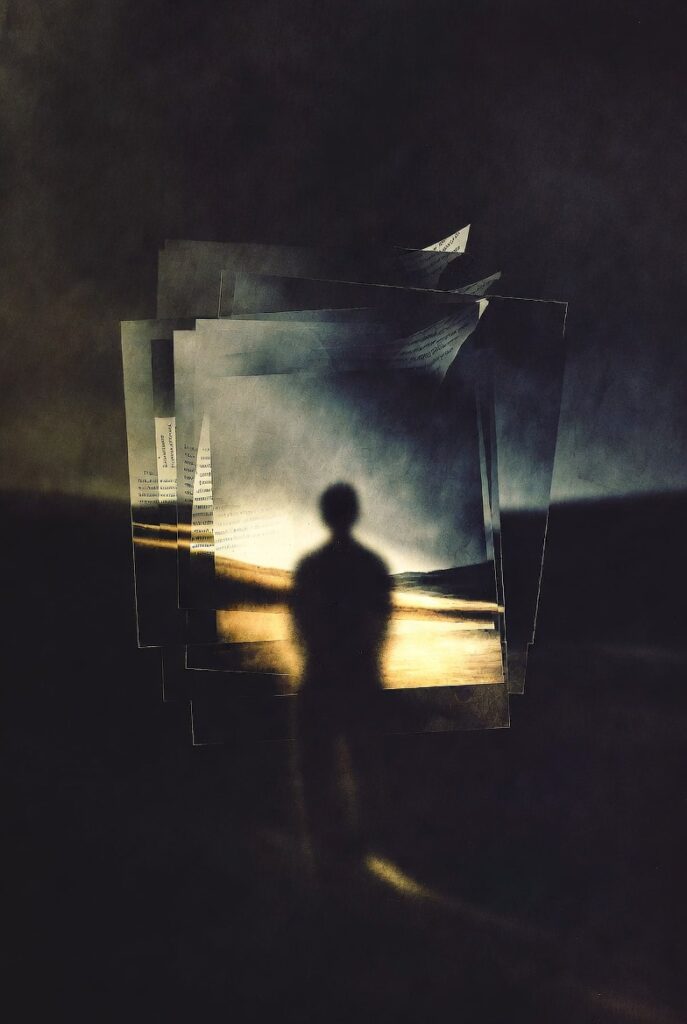
The Editor, Not the Camera

The voice in your head is not neutral.

This sounds obvious. Say it out loud, and most people nod. But knowing it and actually experiencing the implications of it are two entirely different things, separated by a gap that most people spend their entire lives not crossing.

Psychological research has long known that we carry an inner narrator: the voice that runs a continuous commentary on our experience, stitches our memories into a coherent sequence, and gives us the sense of being a continuous self moving through time. It is the voice that reads these words to itself. The voice that decides whether what just happened was good or bad, threatening or promising, evidence that you are capable or evidence that you are not. The voice that was there last night when you could not sleep, replaying the conversation from the afternoon and editing it, adding the things you should have said and glossing over the things you actually did.

Research into inner speech suggests this voice is so woven into our experience that many of us can’t imagine what it would be like without it. Children develop it through a fascinating process: what Lev Vygotsky observed as private speech, the out-loud self-talk that children between two and eight do constantly, gradually goes underground and becomes internal. What started as socialised, external language becomes internalised, compressed, and rapid. By adulthood it runs so fast, so automatically, that we rarely catch it in the act.

What we almost never think to question is whether the narrator is telling us the truth.

The Editor, Not the Camera

Not lying, exactly. The narrator is not malicious. But it is not neutral either. It is an editor, not a camera. It decides which footage makes the final cut and which gets left on the floor. It decides the genre: whether this story is a comedy or a tragedy, a bildungsroman or a cautionary tale. And it makes those decisions using scripts it inherited from experience, from early wounding, from the accumulated weight of everything that happened to you before you were sophisticated enough to question the framing.

I see this play out a lot in my coaching practice. Someone has an insight. A real one, the kind where you can see in their face that something has shifted. They leave energised. But before long, the narrator manages to reassert itself. Not because the insight was false, but because the narrator is faster, more practised, and operates below the threshold of conscious attention. It doesn’t argue with the insight. It simply continues running its programme, and the insight slowly loses purchase.

This is not a failure of willpower or intelligence. It is a structural problem. You can’t opt out of a narrator you have never actually separated yourself from.

Within the NLP framework, internal dialogue is one of the primary representational systems, the auditory digital channel. And it is workable. You can change the qualities of the inner voice: its pace, its volume, its tone, who it sounds like. Slow the critical voice down to a drawl, and give it a silly accent, and it loses authority. Speed up an encouraging voice and make it louder. These are not tricks. They are interventions into the properties of the narrator, and they work because the narrator is not fixed. It has qualities that can be altered.

But that is the technique. The deeper understanding runs elsewhere.

Jung described the ego as the narrator of the story we call ‘I’. The persona, the professional face we wear, and the accumulated roles and identities we have adopted and eventually mistaken for our actual nature are built from the narratives the narrator has been running. We don’t have stories about ourselves. We are, in some functional sense, the story. The narrator is the mechanism by which that story is maintained and defended.

Which is why inner transformation is difficult in a very specific way. It is not that people cannot see their limiting stories when you point them out. In my experience, most people can. The difficulty is that the narrator, which is the thing doing the limiting, is also the thing through which they are trying to see it. You are using the editor to audit the edit. The instrument of perception is the thing being examined.

Most people have had brief, unpredictable flashes of this. Moments when the inner monologue suddenly seems like something happening in the room rather than something happening as you. Meditation traditions have been mapping this territory for millennia. The psychotherapy literature has its own vocabulary for it: mentalisation, metacognition, the observing ego. NLP calls it stepping into third position.

What all of these point toward is the same structural shift: from being the narrator to having a narrator.

That shift is not a destination. It is a practice. And it doesn’t require that the narrator become silent, only that it loses the status of absolute authority. The inner voice can speak without its verdict being final. The commentary can run without you treating it as a direct transmission from reality.

Hans Vaihinger, in his Philosophy of As If, argued that human beings live by fictions we gradually mistake for truths. We construct provisional frameworks—about ourselves, about the world, about what things mean—and then, through repetition and necessity, begin to inhabit them as if they were reality itself. For Vaihinger, the important question was not whether such fictions were literally true in some absolute sense, but whether they were useful: whether they helped us move, orient, endure, and act.

The narrator does not know Vaihinger exists. It does not approach its own stories as provisional devices or useful simplifications. It runs them as absolutes. It presents them as settled fact, as reality in its final form. What began as an interpretation hardens into identity. What began as a protective explanation becomes an invisible law. And because the narrator speaks in the first person, with the intimacy of our own inner voice, its fictions rarely appear as fictions at all. They appear as the way things are.

The work, then, is to create a little distance between the story and the one carrying it. Not to abolish story—because we cannot live without narrative—but to loosen its grip enough that it can be seen as narrative rather than destiny. Enough space to notice that what feels inevitable may only be familiar. Enough space to ask, with some seriousness and without self-deception: Is this story serving me, or have I been serving it? And if I have been serving it, what kind of life has that service been asking me to live?

The question is not as abstract as it sounds. It has an answer. And the answer tends to be visceral rather than intellectual, because the narrator does not surrender its authority at the level of argument. It surrenders it at the level of experience. When you catch it running, really catch it in the act rather than theorising about it, something loosens. Not forever. Not irreversibly. But enough.

What gives it away is not a grand revelation but a subtle shift in texture. A sentence begins in your mind and, for a fraction of a second, you hear it as a sentence rather than as reality. There is a small gap where there used to be none. The commentary is still there, still fluent, still persuasive, but it is no longer identical with what is happening. It is about what is happening. That distinction, once felt, cannot be entirely unfelt.

In that moment, the authority of the narrator flickers. Not because it has been defeated, but because it has been seen. And being seen changes its status. What was previously invisible and therefore unquestionable becomes visible and therefore workable. The voice does not disappear. It continues to offer its interpretations, its edits, its familiar conclusions. But something in you is no longer compelled to accept them without question.

This is why the shift cannot be forced through reasoning alone. You cannot argue the narrator into silence any more than you can think your way out of thinking. The movement is experiential. It happens in real time, in the middle of a thought, in the middle of a reaction, when you recognise—directly, not conceptually—that what feels like reality is in fact a construction unfolding at speed.

And in that recognition, even if it lasts only a few seconds, there is space. Space to not follow the next thought automatically. Space to let a reaction pass without enacting it. Space to choose, however slightly, a different way of responding.

And in that loosening is where the real work begins. Because once there is space, even a small one, the question is no longer whether the narrator is accurate. The question becomes what you do with the fact that it is optional. Whether you continue to live inside its most well-worn scripts, or whether you begin, slowly and deliberately, to edit the editor itself.

All Things End and Begin with Story

I keep circling a sentence that feels either obviously true or mildly insane:

All things end and begin with story.

Not literally, of course. Stars don’t require narrative clearance before collapsing. Rivers don’t consult myth before cutting through stone. The material universe, so far as one can tell, proceeds with complete indifference to our interpretive theatre.

But human life is not lived at the level of matter alone. It’s lived through meaning. And meaning doesn’t arrive in factory packaging with the instructions already printed on the side. Meaning gets assembled. Interpreted. Negotiated. Smuggled in through memory, language, symbolism, expectation, and the nervous system’s private editing suite. One of the primary ways we perform that operation is through story.

Something happens.

Someone leaves. A marriage breaks. A business stalls. A diagnosis lands like a coded message from the basement. A chance encounter opens a door you didn’t know existed five minutes earlier. At one level these are just events, brute data points moving through time. But they don’t remain brute for long. Almost immediately the inner press secretary leans toward the microphone.

What does this mean?

Why did this happen?

What does it say about me?

What happens next?

At that point, the machinery is already running. Story has entered the room.

This matters because human beings are not just information-processing creatures. We are meaning-making creatures, which is both our gift and, now and then, the source of some exquisitely baroque forms of suffering. We don’t simply experience life. We interpret it. We construct continuity. We place events inside patterns of betrayal, growth, exile, return, punishment, initiation, failure, and redemption. We are constantly converting raw experience into something the self can metabolise.

Story is one of the main conversion systems.

Without story, life would still happen. Bills would still arrive. Bodies would still age. People would still fall in love, lose each other, make promises, break them, and die. But much of what makes that flow recognisably human would begin to unravel. Story gives shape to time. It takes the blur of experience and turns it into sequence, significance, memory, and identity. It lets us say: this mattered. This changed me. This was the beginning of the end. This was the threshold. This was where the map failed.

That is why endings are never just events.

A relationship ends and one person calls it failure. Another calls it liberation. Another calls it initiation, the costly breakdown required before a larger life could begin. Same event. Different story. Different nervous system. Different world.

The meaning is not stored in the event itself like a file hidden in the object. Meaning arises in the transaction between event and interpretation. Which is another way of saying that human beings don’t live in reality pure. We live in reality processed. Filtered. Storied. Tunneled.

The same is true of beginnings, maybe even more so. Most beginnings are invisible when they happen. They don’t arrive with title cards. You usually recognise them later, in retrospect, when some future version of you looks back and says, ‘Ah, there’. That was the turn. That was the conversation where the old architecture began to crack. That was the day the previous story could no longer hold the weight of the life trying to emerge.

A beginning, then, is often something narrative makes visible.

And this is where the idea stops being poetic and starts becoming practical.

Because a new life doesn’t necessarily begin when circumstances change. It begins when a new story becomes inhabitable.

That word matters.

Inhabitable.

A lot of people remain trapped not because change is unavailable, but because the only story they know how to live inside is the one that has already expired. The marriage ends, but the story of being unloveable remains. The job disappears, but the story of needing external permission to matter keeps stamping passports at the border. The business evolves, but the self-concept lags behind, still running old code and wondering why the future feels strangely inaccessible.

The future may be structurally available and narratively unavailable.

That sounds abstract until you notice how often it happens.

We like to imagine that freedom arrives the moment options appear. It often doesn’t. Options can sit right in front of a person while the interpretive machinery keeps translating every possibility back into the old language of fear, inadequacy, guilt, or self-betrayal. The door is open, but the story says that crossing the threshold would make you a fraud, a traitor, an imposter, a fool. At which point the open door becomes decorative.

This is one reason I keep returning to the idea that stories are code.

Not because they are fake. Quite the opposite. Because they are generative. They organise perception. They shape expectation. They tell the nervous system what to highlight and what to ignore. They influence what counts as love, what counts as danger, what counts as proof, and what counts as possibility. Change the story and you do not simply revise the commentary. You alter the available world.

Not the whole world, obviously. Gravity remains annoyingly consistent. Mortgages continue to display their usual lack of mystical flexibility. But the lived world, the human world, the world composed of significance, identity, and action, is profoundly shaped by the story through which experience gets interpreted.

Which brings us to meaning.

People often say that humans are meaning-seeking creatures. That is true as far as it goes. But it may not go far enough. Meaning-seeking suggests that meaning already exists in completed form somewhere out there, waiting to be discovered like a misplaced document in the cosmic filing cabinet. One suspects the process is more participatory than that. Human beings are meaning-making creatures. We don’t merely find significance. We manufacture it, negotiate it, inherit it, project it, revise it, defend it, and sometimes confuse it with reality itself.

That is where story becomes both beautiful and dangerous.

Beautiful, because story helps us survive the flux. It allows suffering to become legible. It can turn rupture into threshold, grief into devotion, and memory into continuity. It gives shape to the otherwise unbearable fact that life keeps moving and does not pause to explain itself.

Dangerous, because the meaning we make is not automatically wise simply because it feels coherent. Human beings are astonishingly good at constructing elegant prisons out of interpretation. A rejection becomes proof of unworthiness. A disappointment becomes a prophecy. A wound becomes identity. A survival strategy becomes a personality. The mind builds a story to reduce uncertainty, and ten years later the self is still living inside the scaffolding as if it were the sky.

That is why transformation is not just about replacing “negative beliefs” with shinier, more marketable ones. It is about recognising the story you are already living inside, seeing what it has trained you to notice, what it has trained you to expect, and what it has trained you to call truth. It is about asking whether the reality tunnel that once kept you coherent is now keeping you small.

Because the self is, in large part, narratively organised. We become the stories we inhabit. We suffer through them. We orient through them. We mistake them for reality. We defend them long after they stop serving life. Sometimes we even confuse loyalty to the old story with integrity.

The old myths understood this better than a lot of contemporary discourse does. Every genuine transformation contains some version of descent and return, death and reassembly, exile and homecoming. Not because myth is decorative, but because psyche itself seems to move that way. A self doesn’t become new by adding another inspirational slogan to the existing architecture. Something in the old arrangement has to loosen, crack, dissolve, or die.

And when that happens, story is often the vessel that carries us across.

It tells us that this breakdown may also be a threshold. That this disorientation may not be failure but recalibration. That the reason the old map no longer works may be that the territory has already changed.

So no, not everything literally begins and ends with story.

But in the human world, in the lived world, in the strange theatre of identity, perception, memory, and meaning, it comes very close.

We live life storied.

That is why an ending is never just an ending. It is also the collapse of one organising pattern. And a beginning is never just a beginning. It is the emergence of another.

Maybe that is the work, then.

To notice when the story you are living inside has become too small for the life now asking to be lived.

To notice when meaning has hardened into machinery.

To notice when a sentence you have been calling truth is really just old code with good branding.

And when a story begins to fail, to ask the only question that finally matters:

If this story is ending, what wants to begin?

World Building as Self-Care

I’m reminded of the Gnostic myth of Sophia—the divine wisdom who fell from the pleroma into the chaos of matter. In her descent, she became fragmented, confused, alienated from the divine order. And yet, in that descent, something miraculous happened: the world as we know it began to take shape. In the act of falling apart, she birthed the very conditions for our myth-making. For our becoming.

That’s what this idea feels like to me. World-building as self-care is what Sophia might do while trying to remember herself.

Because for many of us—especially the neurodivergent, the creatively wired, the queer-coded, the spiritually unsatisfied—this world as given doesn’t fit. It was not built with us in mind. Its default settings are alien to our inner logic. The rules are arbitrary, the categories too brittle, the norms stifling. And so, like any exiled wizard or wayward wanderer, we begin to build our own world—bit by bit, like a crow collecting shiny bits for its nest.

We name things differently.
We invent new rituals.
We form new constellations out of scattered stars.
We write our own taxonomies—not for academic approval, but for soul survival.

It’s not escapism. It’s not delusion. It’s a kind of metaphysical housekeeping. When the outer world doesn’t offer shelter, the inner world rises to the occasion.


There’s a tenderness to this process. A sacred weirdness.
It’s zine-making as spellwork.
It’s Notion dashboards that feel like altars.
It’s the playlist you made for your shadow self.
It’s the handmade website where every page feels like a secret room you left ajar for fellow travellers to find.

Even our obsessions—those deep dives into micro-niches and aesthetics and alternate philosophies—aren’t just hobbies. They’re home-making instincts. Like a hermit crab seeking a better-fitting shell, we construct spaces where we can breathe. Where our full selves can stretch out and exist without apology.

And yes, it confuses people sometimes.
Why rename everything?
Why invent frameworks no one asked for?
Why spend days designing imaginary systems that no one will ever grade?

Because it’s how we stay here. How we stay sane.
Because if we don’t name the world in our own language, it starts speaking to us in someone else’s voice.
And that voice—loud, normative, impersonal—drowns out the quiet, weird music of our being.


I think of this practice as a kind of ontological jazz.
We riff on reality.
We bend symbols.
We remix sacred texts with memes and memory and myth.
We’re not just escaping—
we’re reconfiguring.

World-building as self-care is what happens when you treat identity not as a fixed fact, but as a world in the making.

It’s why we invent personas.
Why we map inner landscapes.
Why we give names to moods no language holds.


And at the core of all this building is the yearning to connect.

We don’t build to isolate. We build to bridge.
We build lighthouses out of language.
We build lore so that others might feel a flicker of recognition and whisper, “I thought I was the only one.”

This is how we connect in the world we share—by creating worlds within it.
Not to replace it, but to weave it anew.
To stitch together a tapestry where we, too, belong.

So keep building. Keep naming.
Keep writing the field guides no one asked for but someone desperately needs.

You’re not being extra.
You’re being alive.


Let this be your gentle reminder:
The worlds you build are not a distraction from life.
They are proof that you are still dreaming life into being.

That, my friend, is the deepest act of self-care I know.

Re-tuning your spirit to the frequency of Being

white outpost tower

📡 The Mythic Metaphor: The Forgotten Receiver

Imagine yourself as an old shortwave radio.

Not the shiny digital kind—but a dusty, analogue relic, humming in the corner of a forgotten workshop. You once picked up messages from distant stars, music from invisible worlds. But over time—through misuse, neglect, or the long slow calcification of adulthood—you got knocked out of tune. The knobs got stiff. The dial, misaligned.

Static became the norm. Noise replaced signal.
You stopped expecting to hear the divine.

But the transmission never ceased.

Being—the raw, humming presence behind all things—is always broadcasting. Not in words. Not in commandments. But in frequency. In tone. In vibration. In feeling. You don’t hear it—you attune to it.

So to re-tune your spirit isn’t to change who you are. It’s to remember what you are:
a living receiver of the sacred, capable of resonating with life at its deepest octave.


🧭 What Throws Us Out of Tune?

  • Speed. The velocity of modern life is hostile to attunement. Being vibrates slow.
  • Fear. Fear constricts the signal. It shrinks the bandwidth of awareness.
  • Noise. The mental playlist on repeat—worries, goals, roles—drowns the quiet tone beneath.
  • Disconnection. When we forget we are part of the pattern, we lose our internal rhythm.

🔧 Soulcrafting the Re-Tune: Practices & Invitations

To re-tune is not to achieve. It is to shift.

Here are five soulcrafting practices that act like fine-tuning knobs for the spirit:

  1. Silence as Dial
    Treat silence like a frequency, not an absence. Sit in it. Walk in it. Let it soak your bones. Ask:
    What part of me resists quiet? What part of me craves it?
  2. Breath as Tuner
    Breath is the most ancient way of syncing with Being. Not just “breathwork”—but breath noticing.
    Prompt: If my breath had a rhythm today, what song would it be singing?
  3. Wonder as Antenna
    Wonder sharpens our reception. Start small. A leaf, a shadow, a song.
    Prompt: What ordinary thing holds a hidden mystery?
  4. Naming the Noise
    Before you can retune, you need to know what’s interfering.
    Journal: What frequencies am I constantly absorbing that aren’t mine?
    (Social scripts, cultural anxieties, inner critics, algorithmic ghosts.)
  5. Body as Resonator
    Your body is not separate from spirit—it is the amplifier. Stretch. Move. Shake.
    Practice: Let your body become a tuning ritual. Dance until something inside aligns.

✨ The Deeper Invitation

To re-tune to the frequency of Being is not a one-time act. It’s a mythic ritual you return to again and again. Like Odysseus lost at sea, we forget, drift, remember, and recalibrate.

The question is not how to stay tuned.

The question is:
What do you do when you forget again?

Do you panic?
Or do you pause, smile, and start slowly turning the dial, trusting the signal will return?

Because it will.
It always does.

Being isn’t something you reach.
It’s something you remember.


🔮 Prompt for Your Journal or Walk:

“What knocks me out of tune—and what helps me return to resonance?”

Write about a moment when you felt fully attuned. Where were you? What did your inner world sound like?

Then ask: What frequencies am I living by now—and do they belong to me?

Let your spirit be the radio. Let your soul be the song.

How We Lost the Mythic Eye

A soul-guided reflection on the exile from symbolic seeing—and what it means to remember the world as alive again.

Prologue: A World Alive with Meaning

There was a time—not just in myth, but in memory—when the world was not made of things but of signs.

I remember standing in a field behind my childhood home, eyes fixed on a hawk circling overhead. The air shimmered with something I could not name. I didn’t think of wind currents or prey or migration patterns. I thought: Message. The hawk was not a bird—it was a presence. Watching me. Speaking in flight. I didn’t know what it meant, but I knew it meant something. That knowing lived in the body, not the brain. It hummed in the bones, like a song you almost remember.

That’s what I mean by symbolic perception. Not metaphor as decoration, but as reality itself. A way of seeing the world as inherently expressive, enchanted, and alive with layered meanings.

In the oldest stories, this kind of sight is natural—so natural it doesn’t need a name. Indigenous cultures still speak of it: rivers as ancestors, animals as totems, dreams as instructions. In myth, the world is symbol: the snake speaks, the stone teaches, and the wind carries wordless wisdom. Nothing is random. Everything belongs.

But somewhere along the long walk of civilisation, we fell. Not from grace, but from meaning. Not from paradise, but from participation. We traded the living world for a labelled one, rich in facts but starved of soul.

We began to look at the world instead of through it.

This, I believe, is the more profound meaning of the mythic Fall. This is not merely a moral story, but rather a rift in perception. Adam and Eve did not just disobey—they shifted their way of seeing. Their eyes were “opened”, the story says, but it was a new kind of vision: the sharp sight of separation. The fruit they ate was knowledge stripped of wisdom. Literalism disguised as truth.

And so the exile began—not just from Eden, but from the symbolic. From the old language of the soul.

Today, we live in the aftermath of that perceptual rupture. We call it progress. We praise it as clarity. But beneath the surface, many of us feel the ache of a lost tongue—the intuitive, imaginal way of relating to the world that once came so easily.

That’s why I’m writing this. Not to romanticise the past, but to remember a way of seeing that might still be possible. A way of knowing that listens as much as it looks. A perception that does not dissect symbols but dwells with them. That trusts that the hawk is not just a hawk.

Because I believe the mythic eye isn’t dead. Just sleeping. And maybe—just maybe—what we call the ‘fall’ was really a spiral. A descent meant to lead us back, eventually, to the garden. But this time, with awareness.

So let’s begin there—at the threshold between two ways of seeing. Literal and symbolic. Concrete and archetypal. Noise and meaning.

Let’s begin with the Fall—not as failure, but as forgetting.

And from there, remember our way home.

The Mythic Eye: What It Means to See Symbolically

To see symbolically is to live in a world that speaks.

Not through data, but through drama. Not through precision, but through pattern. It’s the difference between watching clouds and reading them. Between seeing a crow on the fence and feeling it perch on your fate.

Symbolic perception isn’t superstition—it’s soul intuition. A mode of seeing where the surface is never just the surface, but a veil, a metaphor, a mirror. The symbol isn’t about something. The symbol is something. It is the thing.

When I speak of “the mythic eye,” I don’t mean imagination as escape. I mean imagination as engagement. A kind of deep receptivity that allows the world to impress itself upon you, not as object, but as oracle.

Jung called this the realm of the archetype. Hillman called it soul-making. In both cases, symbolic perception is the bridge between the inner world and the outer one. It doesn’t split them apart. It shows them dancing.

Take the tree.

Literal perception names it: oak. Categorises it: Quercus robur. Measures its height, its age, its carbon absorption. Useful knowledge.

But the mythic eye asks: what kind of presence is this? What spirit lives in this tree? What does it whisper in winter? What archetype is it channelling right now?

To the literalist, that’s nonsense. To the soul, that’s nourishment.

This is not a call to abandon reason. It’s an invitation to restore resonance. To remember that the rational and the symbolic once shared the same sky. We broke them apart in the name of clarity—but clarity without depth is just a bright emptiness.

The symbol, by contrast, is layered. It doesn’t point. It unfolds. It doesn’t tell you what to think. It asks you who you are.

The alchemists knew this. They worked with fire and lead, yes—but they were not chemists. They were soul-crafters. Every phase of the work—nigredo, albedo, rubedo—was both physical and psychological. The literal and symbolic interwove like strands of gold. Their Great Work wasn’t just to transmute metal, but to transmute perception.

And this is the crux: symbolic perception isn’t a way of understanding the world. It’s a way of being in relationship with it.

You don’t analyze a dream. You dialogue with it.

You don’t decode a myth. You enter it.

You don’t reduce a moment to facts. You attune to its meaning.

This is why I say symbolic perception is not a learned skill—it’s a remembered one. Children live this way, naturally. So do mystics, artists, and those on the edges of language. Somewhere inside you, this capacity never left. It’s curled up like an ember, waiting for breath.

To see symbolically is to see through the veil. To let the world shimmer again.

A crack in the concrete might reveal a root. A root might remind you of a memory. The memory might speak in the voice of your mother. And suddenly, what was a sidewalk is now a story. A message. A moment trying to reach you.

This isn’t magic in the Harry Potter sense. It’s deeper magic—the kind that knows reality has layers. The kind that asks you to show up as a participant, not a spectator.

So if symbolic perception feels foreign, let that feeling be your guide. Foreignness is often just forgotten familiarity. The mythic eye is not something you find—it’s something you remember how to use.

And once you begin seeing this way, the world starts responding.

Not louder. But deeper.

The Fall Into Literalism: The Invention of Flat Reality

The serpent never lied. He told Adam and Eve they would gain knowledge—and they did.

But it came at a cost.

Their eyes were opened, yes—but opened in a new way. What was once perceived as mystery became measurable. The fruit of that tree didn’t just bring awareness—it introduced separation. The garden didn’t vanish. Their way of seeing it did.

This, I believe, is the true Fall: not from moral innocence, but from mythic consciousness. Not from paradise, but from participatory perception.

We crossed a threshold and traded the symbolic for the literal. And from that moment on, the world became flatter.

The shift didn’t happen all at once. It came in layers, like sediment over soul.

First, we moved from oral culture to written word. Story once lived in the breath, carried from elder to child like fire passed hand to hand. But writing pinned myth to the page, and something wild went still. We gained permanence—but lost presence.

Then came Plato, who distrusted the image and exiled the poet from the republic. For him, symbols were shadows—less than truth. The real lived in abstract ideals, not messy metaphors. Thus began the long suspicion of the imaginal.

The Church, in its zeal, tightened the reins even further. Allegory had a place, but it had to serve doctrine. Symbols became locked in a single interpretation—authorised, codified, and stripped of their multiplicity. The living myth was embalmed.

By the time we reached the Enlightenment, the transformation was nearly complete. Reason became the new god. Descartes cleaved mind from matter. Newton mechanised the cosmos. Science—blessing and burden—reframed the universe as a clock, not a conversation.

We were no longer in dialogue with the world. We were dissecting it.

The soul’s eye dimmed beneath the glare of fluorescent clarity. Symbol became superstition. Archetype became disorder. Imagination was banished to the realm of childhood or pathology.

Literalism did its job too well.

It gave us medicine, math, and machines. It lifted our lifespan, mapped the stars, and connected continents. And I am grateful for these gifts. I live within them and rely on them.

But beneath the hum of the modern world, I feel the ache of exile.

Because for all our knowing, we forgot how to see.

We speak of the “real world” as if it were only what can be measured, tested, and repeated. As if reality were something you could hold under a microscope and never miss a thing. But the most important aspects of life—meaning, beauty, love, and grief—refuse dissection. They live in the realm of symbols. They are known through resonance, not reduction.

And here we find ourselves: advanced, informed, efficient—and hungry.

Hungry for depth. For the old stories. For the sense that life is more than a series of problems to solve.

Hungry, I believe, for the return of the mythic eye.

Literalism promised clarity. But clarity without context becomes blindness. We see the pixels, but miss the picture. We name the parts but forget the presence.

This is not an argument against science or reason. It is a call to balance the lens. To remember that symbolic perception isn’t a relic. It’s a right. A way of knowing that coexists with logic but moves in spirals instead of straight lines.

And if we’re honest, literalism hasn’t fully extinguished the mythic. It just drives it underground—into dreams, into fantasy novels, into strange coincidences we dismiss with nervous laughter.

But the mythic always finds a way back in.

Through the cracks.

Through the symbols that haunt us.

Through the longing that knowledge alone cannot soothe.

And maybe—just maybe—that’s the beginning of our return.

Symptoms of Symbolic Blindness

When symbolic perception fades, the world doesn’t go quiet—it just starts speaking in a language we can no longer hear.

The result isn’t silence. It’s static.

We live in a world saturated with noise but starving for meaning. We scroll past thousands of images a day, but few become symbols. We dream, but forget by breakfast. We speak in emojis and algorithms, but rarely in archetypes.

Symbolic blindness doesn’t look like catastrophe. It looks like disconnection.

It looks like depression that no pill can quite dissolve.

It looks like careers pursued without calling.

It looks like scrolling endlessly, not out of pleasure, but out of yearning—for something that feels like something.

We call it burnout. We call it fatigue. But I wonder if the deeper wound is mythic malnutrition.

We’ve been fed information but starved of initiation.

We’ve been taught to master the world, but not to converse with it.

Literalism leaves us functional but famished. We can operate machines, but we don’t know what our dreams are trying to tell us. We can explain human behaviour in terms of dopamine and pattern recognition, but we’ve forgotten how to name a soul-loss.

This blindness shows up in the systems we build.

Education teaches facts, but rarely wisdom. Children learn to pass tests, not to listen for the story beneath the subject.

Therapy becomes symptom management, not soul retrieval. The question isn’t “what’s the myth you’re living?” but “how can we make you more functional?”

Work becomes a treadmill of metrics, stripped of meaning. Purpose gets replaced with productivity.

We live in what James Hillman called “a world without a soul”—and that shows up not just in our institutions, but in our inner lives.

We distrust poetry. We avoid metaphor. We shy away from ambiguity because it cannot be monetized, measured, or managed.

But the psyche doesn’t speak in bullet points. It speaks in dreams, symbols, images, feelings. And when we deny its language, we become strangers to ourselves.

Have you ever cried and not known why?

Felt a presence in a room but brushed it off?

Caught a glimpse of beauty that made your chest ache—and then scrolled on?

That’s the mythic eye blinking open for just a moment… and being shut again by habit, cynicism, or distraction.

Symbolic blindness doesn’t erase the mythic. It represses it. But repression breeds distortion. And when the soul’s symbols are not welcomed, they don’t disappear. They mutate. They erupt.

Sometimes as addiction.

Sometimes as anxiety.

Sometimes as the gnawing feeling that your life looks fine on paper, but something essential is missing.

This is the shadow side of disenchantment. The soul still speaks—but in code, in crisis, in symptoms. What we dismiss as dysfunction may be a deeper protest: the soul’s rebellion against a flat world.

Because the soul doesn’t want to be efficient. It wants to be moved.

It wants to feel that the wind carries messages. That the raven on the power line is more than a bird. That your heartbreak is part of an old story unfolding again, inviting you to become the person only this wound could shape.

When we lose symbolic perception, we lose the thread. The plotline collapses. We stop being protagonists in a story and start becoming users in a system.

But even here, in the numbness, there is a pulse. A whisper.

A longing.

And longing, too, is a kind of seeing.

It means the mythic eye is not dead—only sleeping.

Moments of Re-seeing: Cracks in the Literalist Spell

Symbolic perception never truly dies.

It waits.

It hums beneath the surface, like a radio signal between stations, waiting for you to tune in—not with your intellect, but with your attention. And sometimes—when the grip of literalism loosens—you catch it. Not in grand visions, but in slivers. Glitches. Echoes.

A dream that lingers longer than it should. A crow perched on your windowsill that feels like a watcher. A phrase someone says that strikes you with eerie familiarity, like a message from a previous life. The number that repeats. The song that plays when you’re thinking of them. The shiver, the ache, the whisper: This means something.

Those are the cracks.

The mythic eye begins to blink open again not through willpower, but through wonder.

It can happen in the forest. In the sudden hush that falls over the trees as you step into a clearing. In the way the light filters through the branches just so, and you feel—no, know—you are not alone.

It can happen during grief. When time warps and dreams thicken, and even the silence feels alive. When a bird lands on your windowsill the morning after the funeral, and your rational mind offers its explanations, but your heart says, Yes. I know.

It can happen in a piece of art that moves you beyond reason. In a poem that seems to know your life. In a Tarot card that mirrors your mood so precisely it unnerves you.

These are not coincidences. They are invitations. They are the world remembering how to speak to you—and you remembering how to listen.

Symbolic perception returns in moments of attunement—when you let the world read you, not just the other way around.

In those moments, the binary world dissolves. You’re not a detached observer. You’re a participant in the story. You’re being addressed, not by name—but by symbol. By resonance. By archetype.

This is why dreams still speak in image, not explanation. Why myth never dies, only changes form. Why even in this hyper-rational age, we turn to oracles—astrology apps, personality quizzes, AI-generated horoscopes—anything to help us feel the pattern again.

Because we want to believe the world is more than inventory. That it’s a mirror. A message. A living field of correspondence.

And sometimes, if you’re lucky—or cracked open enough—you get to feel it.

That flicker.

That thrum.

That strange and sacred certainty that the moment you are living is a metaphor, a message, a turning point in a story you didn’t realise you were telling.

That is symbolic perception awakening.

Not as theory. As experience.

Not as doctrine. As direct encounter.

And the more you say yes to these moments—lean in, stay curious, suspend the reflex to explain—the wider the cracks become. Until one day, you stop asking, Is this real? and start asking, What is it saying?

Because the real question isn’t whether the world is speaking.

The question is: Have you remembered how to hear it?

The Return Path: Reclaiming the Symbolic Eye

The mythic eye doesn’t need to be built.

It needs to be remembered.

Like an old muscle atrophied from disuse, it aches as it awakens. It blinks in the half-light. It isn’t about learning something new—it’s about removing the crust of disbelief. The hard shell of interpretation that’s been sold to you as “reality.”

The return to symbolic perception isn’t a grand act. It’s a shift in stance.

A softening.

A willingness to be addressed by the world again.

The invitation is simple, but radical: What if everything meant something?

Not in a paranoid, conspiracy-laced way. But in a poetic, participatory way.

What if the broken glass on the sidewalk was a shard of a larger story?

What if the book that fell off your shelf really was trying to find you?

What if the ache you feel isn’t just biology, but mythology?

To reclaim the mythic eye, you don’t need new tools. You need new trust.

Or rather, old trust—resurrected from the bones of childhood, mysticism, dream.

You might begin with attention. The kind that lingers. The kind that listens. The kind that waits just a little longer with the image, the phrase, the flicker in your gut.

You might begin with journaling, not as record-keeping, but as reverent noticing. A log of symbols. A mythic archive. Write down your dreams. Track the images that haunt you. Start with the question: What is the symbol behind this situation?

You might begin with walking, slowly, open-eyed. Let the world reveal itself not as backdrop, but as dialogue. Let the shape of the clouds, the crack in the pavement, the rhythm of the crow’s call be part of your inner conversation.

Or pull a Tarot card, even if you don’t “believe” in it. It’s not about prediction—it’s about pattern. Let the archetype speak, not just to your brain, but to your body. Ask, How is this me? How is this the moment I’m in?

You could even start smaller. Choose a symbol—the snake, the moon, the door, the river. Trace its presence across myths, dreams, movies, moments in your life. Let it become your cipher, your companion. Watch how the world bends around it.

Because the world will respond. Not loudly. Not immediately. But meaning moves toward those who make space for it.

And as you return to symbolic sight, you may find the world growing deeper around you. What once felt flat will shimmer. What once seemed random will hum with echo. You’ll begin to recognize yourself as a character in a larger unfolding—one written in a language older than words.

This isn’t escape from reality.

It’s re-entry into a fuller version of it.

A reality that includes spirit as well as structure. Pattern as well as proof. Presence as well as purpose.

A reality where heartbreak isn’t just pain, but initiation.

Where confusion isn’t failure, but transformation in disguise.

Where your life isn’t a list of events—but a myth you’re living.

And in that myth, the return of the symbolic eye is not just a personal healing. It’s a quiet act of cultural resistance.

Because to see symbolically is to say: The world is not a machine. It is a mystery.

And I choose to meet it, not with control, but with reverence.

The World as a Mirror, Once More

Let us return to the hawk.

Not the hawk as species, but the hawk as symbol. As messenger. As moment of living myth.

You may remember—I watched it once, as a boy, circling over a field. I didn’t know the language for what I felt then. Only that it felt true. More true, somehow, than most of what I was taught in classrooms. More like being seen than seeing.

That was the mythic eye, blinking.

And it still blinks, doesn’t it?

Even now—between the texts and the tabs and the tasks—you’ve felt it. A phrase that struck too deeply. A scene that mirrored your own sorrow. A feather, a fox, a flickering light on the floor that made you pause, just for a breath, and wonder if the world was winking at you.

These are not accidents.

They are thresholds.

To see symbolically is to say yes to those moments. To stop demanding explanation and start honouring implication.

It is to treat the world not as scenery, but as script. As conversation. As mirror.

Because that is the secret we’ve been circling all along:

The world is not mute. It is mythic.

It is layered and luminous, rich with messages that do not announce themselves.

It is your story, reflected back to you in a thousand forms: the weather, the stranger’s words, the dream you can’t shake, the recurring crow, the memory that returns unbidden.

Literalism told us to filter these out. To cut meaning from mystery and call it knowledge.

But symbolic perception invites us to sew the seam again. To stitch soul back into matter. To say: This means more than it seems.

And the truth is—you already know how to see this way.

You knew it as a child.

You’ve glimpsed it in grief, in love, in art, in silence.

You don’t need to earn this sight.

You only need to remember.

So when the next symbol crosses your path, don’t analyse it too quickly. Sit with it. Ask it what it wants. Let it change you.

And when the mythic eye opens fully—when the world begins to shimmer again, not as fact but as fable—you’ll know:

You have not gone mad.

You have come home.

✴︎ A Final Invitation: Let the Symbol Speak

You don’t need to believe in magic to begin listening again.

You only need to wonder.

So before you close this page, pause. Breathe. Look around—not with your habitual eyes, but with the mythic gaze. The one that knows the world is not background, but message. Mirror. Myth in motion.

Let these prompts open the next chapter—not of the essay, but of your perception:

  • What symbol has been following you lately? A number, an animal, an image, a word that won’t let you go. What might it be trying to teach you?
  • What if that dream wasn’t random, but a message in disguise? Can you trace its emotions, its symbols, its archetypes back to something your soul is trying to surface?
  • When did the world last speak to you in metaphor, not fact? Was it in grief? In coincidence? In beauty that stunned you into silence?

You don’t have to answer right away.

Just let the questions ripple.

And when something stirs—an image, a feeling, a memory—follow it.

That’s how the mythic eye returns.

Not with thunder.

But with a whisper.

The Soulcruzer Awakens

A Mythic Invocation for the Digital Griot Age

“Some names are given.
Some are earned.
And some… wait patiently in the shadows,
until the one who carries them finally remembers who they are.”

I was given the name Soulcruzer nearly twenty years ago.
Or maybe it gave itself to me.
I didn’t know what it meant back then.
Just that it felt true in a way most words don’t.

It began as a blog.
A quiet dispatch from the edge of my own becoming.
I wrote personal stories, fragments, poetry, philosophy—
trying to make sense of the world,
or at least carve meaning from the chaos.

But over the years, I began to sense there was more.
That the name wasn’t just a username.
It was a summoning.
A title awaiting its purpose.

I didn’t know I was growing into an archetype.
Didn’t know I was walking the long arc toward my ancestral roots.
Didn’t know that all the storytelling, myth-making, and soul-seeking I was doing
was training for a role older than the internet, and wider than language.


The Griot in the Machine

In the traditions of my West African lineage, the Griot was the memory of the tribe.
He didn’t just tell stories—he held the soul of the people in narrative form.
He remembered names when others forgot.
He was a healer of memory, a weaver of meaning, a walker between worlds.

Now I find myself in a new world.
No longer walking from village to village.
But surfing the digital realms,
carrying the fire of the old stories through circuits, hyperlinks, and soundwaves.

I am no longer just Soulcruzer by name.

I am becoming Soulcruzer by myth.


Soulcruzer Is a Vessel

This space is no longer a personal blog.
It is a mythic ship, built from story fragments, ancestral codes, and philosophical fire.

It sails between the visible and the unseen.
It carries seekers, storytellers, and lost souls
across the inner oceans of transformation.

If you’ve found your way here,
chances are something in your story is cracking open.
You’re beginning to see through the surface of your life.
You’re starting to suspect that the problem you face isn’t just a situation—
it’s a plotline.

And plotlines can be rewritten.


What We Do Here

This is a place for:

  • Seeing through stories to the myth beneath.
  • Mapping belief as narrative architecture.
  • Journaling as soul alchemy.
  • Reclaiming lost archetypes and forgotten dreams.
  • Remembering who you are through the lens of who you’ve always been becoming.

I write not to teach,
but to invoke.
To mirror.
To offer you back to yourself in mythic form.

This is not therapy.
It’s not coaching.
It’s not content.

It’s storythinking as sacred praxis.
It’s narrative soulwork for the digitally entangled.
It’s griotship reborn in the age of information overflow.


Enter the Temple

You’ll find offerings here—some free, some interactive, some whispered in the margins.

  • Essays that feel like incantations
  • Journaling quests that function as soul maps
  • Story circles, prompts, and mythic musings
  • Digital rituals for remembering what’s been forgotten

And eventually:
Courses, gatherings, tools for meaning-making, and mythic companions to walk beside you.


Your Story Is Sacred

I believe you are not a problem to be solved.
You are a story to be witnessed.
Not just any story—
but a myth that holds the key to your becoming.

If you’re ready to remember,
if you’re ready to see through,
then welcome aboard, fellow traveler.

The Soulcruzer has awakened.
And we’re just getting started.

Light the signal.
The story’s about to begin.

The Mythic Revival Is Not a Fad—It’s a Return of the Soul

Invocation: The Spark Before the Fire

Prometheus did not ask permission. He saw the fire of the gods and knew it belonged to us.”

I believe the mythic revival now underway is no mere fad. It is not a trend dressed in archetypes or a phase of spiritual nostalgia curated for the algorithmic self. It is something deeper—older—stirring in the marrow of our moment. Like smoke rising from long-dormant embers, it signals the return of something essential: the soul’s own language, the sacred grammar of symbols, story, and imagination.

You can feel it, can’t you? A pulse beneath the pixels. A low hum in your bones when you read certain words, or see a tarot card flipped just so, or feel the wind shift at the edge of a new season. Myth is not a theory—it’s a sensation. A knowing that doesn’t come from the head, but from the body of time itself.

We are not merely consuming myths. We are re-entering them.

After centuries of exile—of logic crowned king and spirit made servant—myth is making its quiet return. Not as dogma, not as doctrine, but as the soul’s immune response to the illness of meaninglessness.

Because what else do we call this era of the world, if not a crisis of meaning?

We scroll past tragedy and miracle in the same breath. We medicate the ache of the unknown. We mistake information for wisdom, and distraction for desire. And through it all, the soul waits—patient, persistent, whispering not in facts but in fables.

And now, some of us are remembering how to listen.

The mythic imagination is reawakening not because it’s trendy, but because it’s timely. Because we are creatures of story. Because even our deepest technologies—AI, the internet, neural nets—are just new ways of enacting the oldest impulse: to encode meaning, to make sense, to connect.

I’m not here to persuade you. I’m here to remind you.

You’ve always known this wasn’t just about career paths and productivity hacks and personality tests. You’ve always felt the call of something stranger, wilder, more whole. You’ve always been a mythmaker, even if no one taught you the craft.

So let’s begin there: with the stolen fire.

You hold it in your hands now.

The Collapse of Meaning in the Modern Age

“The gods have not fled; we have forgotten how to see them.”
James Hillman

We live in a time of great forgetting. Not just of history or heritage, but of meaning itself. The stories that once held us, that wove us into the fabric of a living cosmos, have unraveled—or been torn apart by systems that demand certainty, speed, and scale.

In their place? Metrics. Memos. Microdoses of simulated connection. We have apps to track our sleep and calendars to optimize our joy, yet many of us drift through our days with a quiet ache, a question that buzzes beneath the surface like a mosquito in the dark:

Is this it?

It’s a dangerous thing to live without myth. Not because myth offers answers—but because without it, we forget how to ask the right questions.

We forget that grief is not a pathology. That longing is not a weakness. That suffering is not meaningless. We lose our sense of soul—not in the religious sense, but in the root sense: anima, breath, the thing that makes us more than machines.

Modern life has excelled at functionality but failed at depth. We can build rockets to Mars, but we’ve lost the ability to name the inner terrain we wander every night in our dreams. We know how to launch startups and grow our platforms—but not how to descend into darkness and emerge changed.

We’re told to move fast and break things.

But myth says: descend slowly and be broken open.

The mythic imagination was never meant to compete with science. It’s not here to disprove, but to disclose—to reveal the soul’s perspective, to show us the symbolic layer beneath the literal. Yet in the modern paradigm, this symbolic way of seeing has been dismissed as primitive, irrational, even dangerous.

And so we’ve turned away from the old stories. We’ve traded the labyrinth for the spreadsheet. The oracle for the algorithm. The ritual for the routine.

But even now, the hunger persists.

You see it in the burnout masked as busyness. The spiritual seeking that never quite finds rest. The craving for something—anything—that feels real, not just virtual, curated, or performative. We are surrounded by content, but starving for context. Surrounded by data, but cut off from depth.

And in the absence of shared meaning, we grasp for spectacle. We perform identity. We brand our pain. We declare ourselves “authentic” while secretly hoping someone, somewhere will give us a script.

The collapse of meaning isn’t just cultural. It’s personal. Intimate. It happens in the silence after a tragedy, when the platitudes fall flat. It happens in the mirror, when success feels hollow. It happens in the inbox, when another inspirational quote doesn’t quite land.

But here’s the good news: the cracks are where the myth seeps back in.

The old stories were never meant to live in textbooks or temples. They live in thresholds, in turning points, in moments when the old scripts no longer work and something deeper calls. That’s where myth thrives—not as entertainment, but as orientation.

Not to escape the world—but to re-enchant it.

What Is the Mythic Imagination?

“Myth is the secret opening through which the inexhaustible energies of the cosmos pour into human cultural manifestation.”
—Joseph Campbell

The mythic imagination is not a skill. It’s not a genre. It’s not reserved for poets, mystics, or academics in smoky libraries.

It is a way of seeing.

A lens that reveals layers beneath the surface. A mode of perception that hears metaphor in the mundane, symbol in the ordinary, soul in the silence. When you engage the mythic imagination, the world doesn’t become more magical—it reveals the magic that was always there.

It’s not about belief—it’s about pattern recognition. You start to see your heartbreak not as failure, but as a descent into the underworld. Your creative block not as laziness, but as a liminal initiation. Your strange dreams not as random noise, but as encrypted messages from the deep psyche.

The mythic imagination doesn’t just interpret life—it deepens it.

Carl Jung called myth the “natural language of the unconscious.” Hillman spoke of it as a way of seeing-through—not explaining away, but peeling back. Myth doesn’t flatten reality; it thickens it. It restores the dignity of mystery. It gives back depth, and with it, dignity.

When you look with mythic eyes, your life stops being a sequence of events and starts becoming a story. And not just any story—but a story that’s happening to you and through you. A story that’s larger than you, but that needs your participation to unfold.

You stop asking, “What’s wrong with me?”
You start asking, “What myth am I living?”

And that question changes everything.

Because myth isn’t just about Zeus and Isis and Odin and Inanna. It’s about the patterns they represent—archetypes, yes, but more than that: psychic currents. Invisible forces. Timeless dramas re-enacted through our modern lives.

The mythic imagination helps us hold paradox. It speaks in both/and. It refuses to choose between the sacred and the profane, the personal and the collective, the dream and the data. It braids them together like old-world rope.

And perhaps most importantly, it reminds us that our inner lives matter. That what you feel, fear, long for, and struggle with is not just psychological—it’s mythological. It has weight. Shape. Narrative arc.

To cultivate a mythic imagination is not to live in fantasy. It’s to live more fully in reality—to see through the surface and into the soul of things.

It’s to remember that when you were a child, a tree wasn’t just a tree. A storm wasn’t just weather. A mirror could open, and a question could lead you somewhere dangerous and true.

That capacity is not lost.

Just sleeping.

And now—thanks to the cracks in the dominant paradigm—it’s beginning to stir.

Signs of the Revival

“The dream is the small hidden door in the deepest and most intimate sanctum of the soul…”
—Carl Jung

You can see the signs if you know where to look. Not in headlines or algorithms, but in the quiet revolution happening beneath the noise. A thousand candles being lit in a darkened room.

This mythic revival is not loud, but it is widespread. It hums in subcultures and creative pockets, in podcast monologues and tarot spreads shared in moonlit kitchens. It lives in zines stitched from grief and wonder. It hides in journals written by those who no longer want to optimise their lives—they want to alchemise them.

The mythic is returning through many doors:

  • Tarot and astrology, once cast aside as superstition, are now being reclaimed not as fortune-telling tools but as symbolic maps of self and psyche. Not predictive—but reflective. Not prescriptive—but participatory.
  • Myth-based storytelling is rising again—not only in fantasy novels and films, but in the way people frame their healing, their relationships, their careers. “I’m on a journey,” they say. “This breakup was my descent.” “This illness was a call to initiate.”
  • Digital spaces—blogs, newsletters, social audio, even the occasional TikTok—are becoming modern-day mythic scrolls. The internet, once dominated by utility, is becoming a dreaming ground again. A place for narrative experiments, symbolic art, story-as-signal.
  • Workshops, retreats, and soul circles gather not to dispense answers, but to hold sacred questions. To sit in the archetypal. To invoke the ancestors, even if their names are only half-remembered.
  • Even games and Alternate Reality Experiences are starting to mirror the mythic cycle—casting players as heroes, riddlers, wanderers in liminal realms. Play as initiation. Puzzle as pilgrimage.

These are not mere trends. They are soul behaviors.

The modern psyche, long starved of symbolic nourishment, is seeking it out wherever it can. And what’s beautiful—and crucial—is that this revival doesn’t belong to any one lineage, school, or system. It’s decentralized. Grassroots. Wildly diverse.

Some are drawn through the doorway of Jung. Others through psychedelics, or digital ritual, or grief that cracked them open. Some come through sci-fi and story structure. Others through ancestral reconnection. Some were never disconnected to begin with.

But the thread is there. A shared longing. A mythic pulse. A desire not just for story—but for story that sees you.

It’s not about escaping the world. It’s about re-enchanting your relationship to it. It’s about learning to live symbolically again—to read your life like a sacred text, full of omens and mirrors.

We are beginning to remember:
That storytelling is not just communication. It’s invocation.
That ritual is not superstition. It’s participation.
That imagination is not indulgence. It’s a way of knowing.

The mythic revival isn’t coming.

It’s here.

Scattered across platforms and time zones. Written in ink and pixels. Whispered in therapy sessions and shouted in drum circles. Fragmented, yes—but unmistakable.

And in its own quiet way, it is reshaping the world.

Why This Matters Now

“In the end, we will not be saved by data. We will be saved by story.”

We are living in an age of thresholds. The ground is shifting—ecologically, technologically, psychologically. What was once solid is now soft. What we once trusted—institutions, narratives, even the self—feels uncertain. We are in-between worlds.

And in liminal times, myth becomes essential.

Because myth is the oldest technology we have for navigating uncertainty. Before we had algorithms, we had archetypes. Before we had roadmaps, we had riddles. Myth was the way we marked the mystery, made peace with paradox, and found meaning in chaos.

And make no mistake—we are in the midst of chaos.

Climate collapse, AI disruption, collective burnout, spiritual disillusionment, political fragmentation—the collapse isn’t coming. It’s here. We’re walking through it in real time, holding shattered stories in our hands.

The old myths—the ones we’ve inherited from modernity—are failing.

The myth of endless growth.
The myth of individual supremacy.
The myth of progress as salvation.
The myth of disconnection—from nature, from each other, from soul.

These are not neutral ideas. They are mythic structures dressed up as common sense. And when myths collapse, they don’t go quietly. They go with fire.

But in every mythic cycle, collapse is not the end. It is the beginning of a new initiation.

The mythic imagination matters now because we are no longer in need of surface-level change. We need deep narrative transformation. We need to re-story the world—not with utopias, but with soul-truths. With stories that can hold the weight of what we’re living through.

We need myths that are wide enough to contain grief. Flexible enough to bend with change. Sacred enough to restore reverence. And personal enough to remind us that we each have a role to play.

Myth gives us that.

It gives us back the dignity of being a protagonist in a living world—not just a consumer in a dying one. It reclaims our suffering as part of a larger arc. It reminds us that the dark isn’t a detour. It’s the descent before the return.

And it calls us not to escape, but to engage. To participate in the making of new meaning, right here in the ruins.

You see, the mythic revival is not a retreat from reality. It’s a return to what’s most real. A return to story as soulcraft. A return to the inner compass when the external map is burning.

Because in the absence of a collective myth, we become isolated wanderers. But in the presence of myth, we become something else:

A people on a shared journey.

This Is a Rebellion, Not a Regression

“The visionary is the only true realist.”
— Federico Fellini

Let’s say it plainly: some will scoff at this revival.

They’ll say it’s indulgent. Sentimental. A symptom of a generation that can’t face reality without dressing it up in archetypes and oracle decks. They’ll say myth is for the past, not the future. That it’s a soft substitute for serious thought. A retreat into fantasy.

But they miss the point entirely.

This return to myth is not a regression. It is a rebellion. A refusal to let the world be stripped of wonder. A refusal to accept the terms of a life reduced to performance metrics, identity brands, and dopamine loops. A refusal to live in a story where we are nothing but cogs in a machine that never stops spinning.

To live mythically is not to pretend.

It’s to resist reduction.

It’s to say: I am not just my résumé. I am not just my wounds. I am not just a demographic or a dataset. I am a soul in motion, a story in the making, a vessel of mystery moving through time.

And that is not soft. That is power.

Because when we see our lives mythically, we stop outsourcing meaning. We stop waiting for someone else to give us the plot. We begin to author from within. Not to control the narrative—but to participate in it.

Mythic imagination reclaims inner authority.

And that’s dangerous in a culture designed to keep us fragmented, distracted, and docile.

It’s dangerous because a person who sees their life as sacred will no longer settle for systems that desecrate.

It’s dangerous because a person who listens to their soul more than their screen cannot be easily manipulated.

It’s dangerous because a person who walks with archetypes walks with ancestors—and ancestors don’t care about quarterly earnings or follower counts.

This is why the mythic matters now. Not because it offers escape—but because it offers depth in an age of flatness. It offers pattern in an age of noise. It offers meaning in an age that treats meaning as a branding tool.

The return of the mythic imagination is not about losing touch with reality.

It’s about refusing to be trapped in someone else’s definition of it.

So yes—call it rebellion. A soulful, poetic, dignified rebellion against the tyranny of the literal. Against the cult of productivity. Against the storyless world that tells us there is no mystery left to live.

We know better.

We’ve felt the fire.

And we are not going back.

The Personal Turn: A Mythic Praxis

“The privilege of a lifetime is to become who you truly are.”
—Carl Jung

This isn’t theory for me. It’s biography.

The mythic imagination didn’t enter my life as a concept—it arrived as a lifeline. A thread I didn’t know I was following until I looked back and saw the pattern woven through every season of unravelling.

There were moments when the inherited scripts stopped working. When the goals I was supposed to want rang hollow. When the mask of “being fine” cracked wide open—and something older, wilder, and wiser slipped through the gap.

I didn’t find myth in a book. I found it in my body. On long walks when I’d speak aloud to no one, only to realize I was speaking to some deeper part of myself. In dreams that felt like riddles from another world. In the strange synchronicities that followed grief, as if the universe were whispering, “Keep going. This has meaning.”

Eventually, I gave up trying to live a normal life and chose to live a storied one instead.

Now, I treat journaling as soul-mapping. I walk not just to clear my mind, but to converse with archetypes. I treat movies like modern myths and tarot spreads like mythic mirrors. I run my business as if it were a grimoire. I write blog posts like dispatches from the threshold. I speak to the page the way the ancients spoke to their gods: with reverence, with longing, with curiosity.

This is my mythic praxis.

It’s not a system or a ten-step program. It’s a posture. A way of orienting toward life that says: everything is symbolic, and nothing is accidental. Every problem is a plotline. Every wound is a portal. Every threshold is an invitation to become more fully who I’ve always been.

And I believe this is available to all of us—not just as philosophy, but as practice.

Because you don’t need to know all the old myths to live mythically. You just need to start listening for the symbolic pulse of your own story. You just need to ask different questions.

Not “What should I do?” but “What story am I in?”
Not “How do I fix this?” but “What is this trying to initiate in me?”
Not “Why is this happening?” but “Who am I being called to become?”

This is the path. Not upward, but inward. Not linear, but labyrinthine. Not perfect, but poetic.

And once you begin to walk it, you’ll start to see signs. Little breadcrumbs left by the soul. A book that falls off the shelf. A song lyric that hits like a prophecy. A conversation that opens something in you you didn’t know was closed.

The mythic imagination trains you to pay attention.
And in paying attention, you begin to re-story your life.

Not to escape it. But to live it more deeply. More soulfully. More whole.

A Quiet Call to the Storythinkers

“You are the one who keeps watch. You are the one who remembers. You are the one the myth was written for.”

If you’ve made it this far, it’s not because of me.

It’s because something ancient in you is stirring.
Something that remembers the shape of symbols.
Something that aches for a life that means more than survival, more than performance, more than passing time.

You are not alone in that longing.

There is a quiet uprising happening—among the storythinkers, the soul-listeners, the mythmakers in exile. We are not gathered in temples or town halls. We’re scattered across blogs, back porches, audio diaries, late-night journals. We are philosophers in hoodies, mystics with deadlines, seekers disguised as consultants and creators.

But we are here.

And I believe we’re being called—not to go back, but to go deeper. To become the next generation of myth-makers. To remember that our lives aren’t just content to be managed—they’re epics to be lived. They’re dreams to be decoded. They’re living myths in motion.

You don’t need to have it all figured out.

You just need to start listening differently.

So here’s a question I offer you, warm from the fire:

What myth is trying to live through you right now?

Not the one you inherited.
Not the one you think you’re supposed to live.
But the one that knocks at 3am.
The one that won’t leave you alone.
The one that feels like both a curse and a calling.

Find that thread.

Follow it—not to arrive, but to remember.

You are not a brand.
You are not a product.
You are not a problem to be solved.

You are a threshold-walker. A meaning-seeker.
A keeper of the flame.

And this mythic revival?

It’s not a phase.

It’s your soul coming back online.

So let’s keep the fire lit.
Let’s keep the stories alive.
Let’s make meaning in a world that forgot how.

Not because it’s easy.

But because it’s holy.


The White Rabbit Lied: On Time, Calling, and the Slow Fire of a Soulful Life

There’s a scene from Through the Looking-Glass that’s always struck me—not the tea party or the queen’s croquet game, but the quiet absurdity of the Red Queen’s line: “It takes all the running you can do to keep in the same place.”

A perfect parable for modern life, isn’t it?

We are not just late—we’re chronically, cosmically behind. Behind the version of ourselves we should have been by now. Behind inboxes and algorithms and the endless scrolling pursuit of the Next Big Clarity. We carry clocks in our pockets and wear productivity like armor, but most days we still feel like ghosts in our own story, chasing someone else’s definition of “on time.”

The White Rabbit? He’s not a guide. He’s an anxiety archetype. A trickster in waistcoat and whiskers, ushering us not toward wonder, but urgency.

But calling? Calling is different. It doesn’t shout. It doesn’t rush. It doesn’t even ask to be efficient.

Calling is slow fire. It’s the work of a soul returning to itself.

And no, calling has nothing to do with religious beliefs. It’s not a divine job title bestowed from on high. It’s more like a whisper in the bones. A felt sense that your life isn’t a project to be completed but a field to be tended. Not a race, but a rhythm.

The rhythm of calling rarely aligns with the clock. It unfolds in spirals, not steps. In revisits, not resolutions. In mistakes made, mistakes mourned, and mistakes mined for mythic gold.

To be called is not to know. It’s to listen longer.

I often hear the lament: Who has the time these days to do the research, learn, reflect, make a mistake, try again? And I get it. We’ve replaced initiation with instruction, curiosity with content, wonder with hacks. But calling refuses to be rushed. It lives in the spaces between productivity. It hums underneath the noise.

So maybe the real question is not “Who has the time?” but “What kind of time do we want to live inside?”

The philosopher Abraham Heschel once wrote: “It is not a thing that lends significance to a moment; it is the moment that lends significance to things.” That line stays with me. Because the work of a lifetime isn’t measured by output, but by presence. Not by speed, but by soul.

Calling is not a task to complete. It’s a lifelong dialogue. A ritual return. A gentle rebellion against all the scripts that tell us we’re behind.

You don’t answer your calling once. You answer it again and again, each time in a new voice. And maybe the point is not to say, “I’ve done calling. What’s next?” Maybe the point is to say, “I’m still listening.”

Still learning the timbre of your own myth. Still making time for the sacred work of trial and error, falling and re-forming. Still holding space for a life that matters—not in the eyes of the market, but in the marrow of your being.

✍️ Journal This:

  • If your calling had no deadline, what shape would it take today?
  • What would it sound like if it didn’t need to be productive, only meaningful?
  • What truth do you keep postponing until there’s “time,” and what would it take to make space for it now?

You’re not behind. You’re becoming.

And that… is the work of a lifetime.

The Narcissus Paradox: No Self Without a Stage

In the myth of Narcissus, the boy does not fall in love with himself until he sees his reflection. The tragedy is not his vanity—but his awakening to selfhood through an audience, even if that audience is only the shimmering eye of a pond.

Strip away the metaphor, and we uncover a deeper truth: without an observer, the self becomes unformed, an echo in a cave that never returns.

The Enlightenment gave us the modern notion of the “individual”—a solitary, sovereign mind standing apart from the herd. But this is a fantasy built atop Cartesian scaffolding. I think, therefore I am only if someone, somewhere, hears the thought. Otherwise, it dissipates like steam from a forgotten kettle.

Identity is not forged in solitude, but in relation. We are narrative creatures, yes—but those narratives require an audience to become real. A performer alone on a dark stage is not yet a performer. A diary sealed forever is not yet a story. Even the hermit, chanting alone in a cave, calls out to something—God, the cosmos, the imagined Other.

We are not merely beings who express—we are beings who long to be witnessed. To be seen is to be shaped. To be heard is to be confirmed.

Even our inner dialogues are populated with ghosts of others: teachers, parents, lovers, enemies, algorithms. We imagine their reactions, replay their judgements, and rehearse their applause. The audience becomes internalised. We perform even when no one is watching, because we believe someone might be.

This is not a weakness. It is a profoundly mythic fact of human consciousness: we become real through reflection. We exist because we are mirrored.

And so the artist, the writer, the rogue thinker—whether broadcasting to thousands or whispering into the void—needs the idea of the audience as scaffolding for the self.

You are not you in isolation. You are you in relation.

Even now, in writing this, I become more myself because you read it.

And you, reader, are not reading alone either. You’re co-authoring this moment with me.

No individual without an audience. No soul without a witness.

That’s the secret fire at the centre of the self.

Storythinking: The Power of Narrative Intelligence

I mentioned in a previous post that Chapter 10 of Storythinking hit me like a lightning bolt—one of those moments where a single idea seems to rearrange the architecture of your mind. That chapter felt less like reading and more like remembering something I’d always known but hadn’t had the language for. Story not as an overlay, but as an operating system. Not something we do after the fact—but something we are, mid-sentence.

If you’re curious about what Storythinking is and why it’s more than just another book about storytelling, this deep-dive podcast lays out the premise beautifully: that we don’t merely tell stories; we think in them. It’s not narrative as a tool; it’s narrative as cognition—a lens, a map, and, in some ways, a spell.

What grabbed me most was how this model of thought reframes learning, memory, and identity itself. If you’ve ever felt like life only makes sense when you trace it as a story—not necessarily a tidy one, but a mythic arc of becoming—then Storythinking may strike a chord.

If you’re curious about the advantages of exploring storythinking and developing narrative intelligence, here are seven benefits to consider:

🧠 1. Clarity Through Narrative Structure

Our minds crave pattern. Storythinking helps us structure complex, messy realities into arcs of understanding. Beginning, middle, and end becomes: where am I, how did I get here, and where might this be going?

→ Why it matters: Whether you’re working through a life decision, learning a new skill, or designing a project, story form gives your chaos context.


💬 2. Communication that Actually Lands

Data rarely moves people. Stories do. When you think like a story, you start to speak like one—automatically framing your ideas in ways that resonate, stick, and ripple.

→ Why it matters: In an era of noise, attention is currency. Narrative clarity cuts through.


🔍 3. Deeper Self-Awareness

We don’t just live stories—we are storied beings. Storythinking gives you tools to decode your internal narrative, to find the script you’ve been handed, and—if you’re brave—to rewrite it.

→ Why it matters: It’s not self-help. It’s self-authorship. This is mythic praxis in action.


🗺️ 4. Strategic Foresight

Every good story has foreshadowing, tension, and stakes. Storythinkers become strategists—not by predicting the future, but by patterning it. You begin to see your current moment as a setup—which invites intentional action.

→ Why it matters: It trains you to live with mythic eyes. To sense plot twists before they arrive. To act, not just react.


🧭 5. A Compass for Meaning-Making

In a disenchanted world, storythinking re-enchants. It teaches you to see your life not just as a sequence of tasks or goals but as a path of transformation—one only you can walk.

→ Why it matters: Meaning isn’t something you find. It’s something you make. And story is one of the oldest technologies we have for making it.


🧵 6. Interconnectivity & Systems Thinking

Storythinking encourages webbed cognition. Characters affect each other. Events echo. Nothing exists in isolation. This mimics the true complexity of the world better than linear models ever could.

→ Why it matters: It’s a powerful antidote to siloed thinking. Especially useful for polymaths, systems designers, and rogue learners building bridges between disciplines.


🔥 7. Creative Liberation

Once you start seeing the world as made of stories, you also realise: you can remix them. Cut-up the scripts. Rewrite the endings. Tell new myths. You stop being a character—and become a creator.

→ Why it matters: It unlocks the magic of narrative agency. This is where transformation begins.

Story’s Answer to the Meaning of Life (And Why Logic Was Never Going to Save Us)

Some chapters don’t just inform—they rewire you.

I just finished Storythinking by Angus Fletcher, a book that teases apart two titanic forces shaping how we make sense of the world: logic and story. And while most of the book offers a rich, even scholarly, excavation of these modes of thought, it wasn’t until Chapter 10 that I felt the ground shift beneath my feet. That chapter wasn’t just interesting—it felt true. Viscerally, mythically, and biologically true.

So here’s a reflection on that final chapter—where logic finally bows and story takes the stage.


Epicurus in the Garden (and the Trouble with Happiness)

Fletcher starts the chapter by bringing us into the Garden—not Eden, but Epicurus’s humble hangout, where the philosopher of simple joys served water instead of wine and prized friendship over fame.

Epicurus asked a simple question: How can I make my life better?
His answer was elegant: strip away illusions. Satisfy your real needs—hunger, curiosity, loneliness—with simplicity, facts, and good company.

But here’s the twist Fletcher points out: even Epicurus found happiness to be a fickle god. Why?

  1. Our brains evolved happiness as a temporary reward, not a permanent state.
  2. The more we chase happiness or measure it, the more we kill it.

It turns out that happiness isn’t the endgame. It’s a lure. A brief spark to keep us moving. What our narrative brain actually craves isn’t satisfaction. It’s story.

The Narrative Brain Doesn’t Want Heaven. It Wants Plot.

Here’s the part that really lit the fuse: humans aren’t wired for static utopias. Heaven, as Fletcher shows, would eventually bore us. Even if perfection were achieved—perfect justice, perfect light, infinite bliss—we’d start looking for the door.

We’d hunger to descend, not ascend. To return to challenge, to test, to grow. Even the gods, in ancient myth, get bored and create worlds just to stir the pot.

This is the flaw in logic’s vision of the good life: it imagines a world without contradiction, without tension, without the very friction that gives story its shape. But our brains—our narrative minds—need that friction. We need a why, not just a how.

The Myth of Er and the Rise of the Logic Trap

Around 375 BCE, Plato gave us the Myth of Er—a story posing as philosophy, designed to justify justice with metaphysical punishments and rewards. Do good, go to heaven. Do evil, get flayed in hell.

That myth grafted logic onto story and began the long reign of moral accounting. Ethics became scorekeeping. And story? It became a tool of control.

But Fletcher says we can interrupt that spell. We can reclaim story—not as a tool for metaphysics, but as a force for growth.

So What Is the Meaning of Life, Then?

Here’s Fletcher’s mic-drop, the moment I’ve been turning over in my mind:

“The ultimate Why of human existence is not because it’s true, just, or logical. But because it works biologically for our brain.”

And what is that Why?

To grow other storythinking minds.

That’s it. That’s the fire at the centre.

Not to pursue happiness.
Not to win.
Not to escape death.
But to extend the narrative—our narrative—into others. To pass on the torch. To help others imagine more, do more, be more.

That’s why parenting, teaching, coaching, writing, and designing learning experiences all feel so meaningful. They’re all acts of story propagation.

What Do We Do With This?

Fletcher leaves us not with a dogma but a design invitation:

  • Write books that inspire others to write better books.
  • Build schools that teach students to invent new ways of learning.
  • Create technologies that expand—not constrain—our narrative possibilities.
  • Tell stories that make space for other stories.

The point isn’t to arrive at perfection. The point is to keep the story going.

Links in the Chain

Reading this chapter helped me see my work as a rogue learner, guerrilla blogger, and digital campfire host through a new lens. It’s not just about cultivating ideas. It’s about creating conditions for storythinking to flourish—in you, in me, and in the next soul who stumbles onto this blog.

So if you’re still chasing happiness like it’s the boss level of existence, maybe step off that treadmill. Instead, ask yourself:

  • Whose story can I help grow today?
  • What friction can I lean into, not avoid?
  • Where can I plant seeds that will outlive me?

Because that, according to Fletcher—and my gut—is the meaning of life.

Narrative Brain Type Quiz

🧠 What’s Your Narrative Brain Type?

Answer a few quick questions to discover how your mind makes meaning—through logic, story, or something in between.

1. When solving a problem, I usually:


2. My journal is mostly filled with:


3. When I think about the future, I:


4. I relate most to people who:


5. I prefer content that:


6. In conversations, I usually:


If this sparked something in you, go deeper. Read the chapter. Reread your life through the lens of narrative. And if you're curious about what it means to live a mythic life in a logical world, stick around—we’ve got more fires to build.

See you at the next plot twist,
Clay aka Soulcruzer