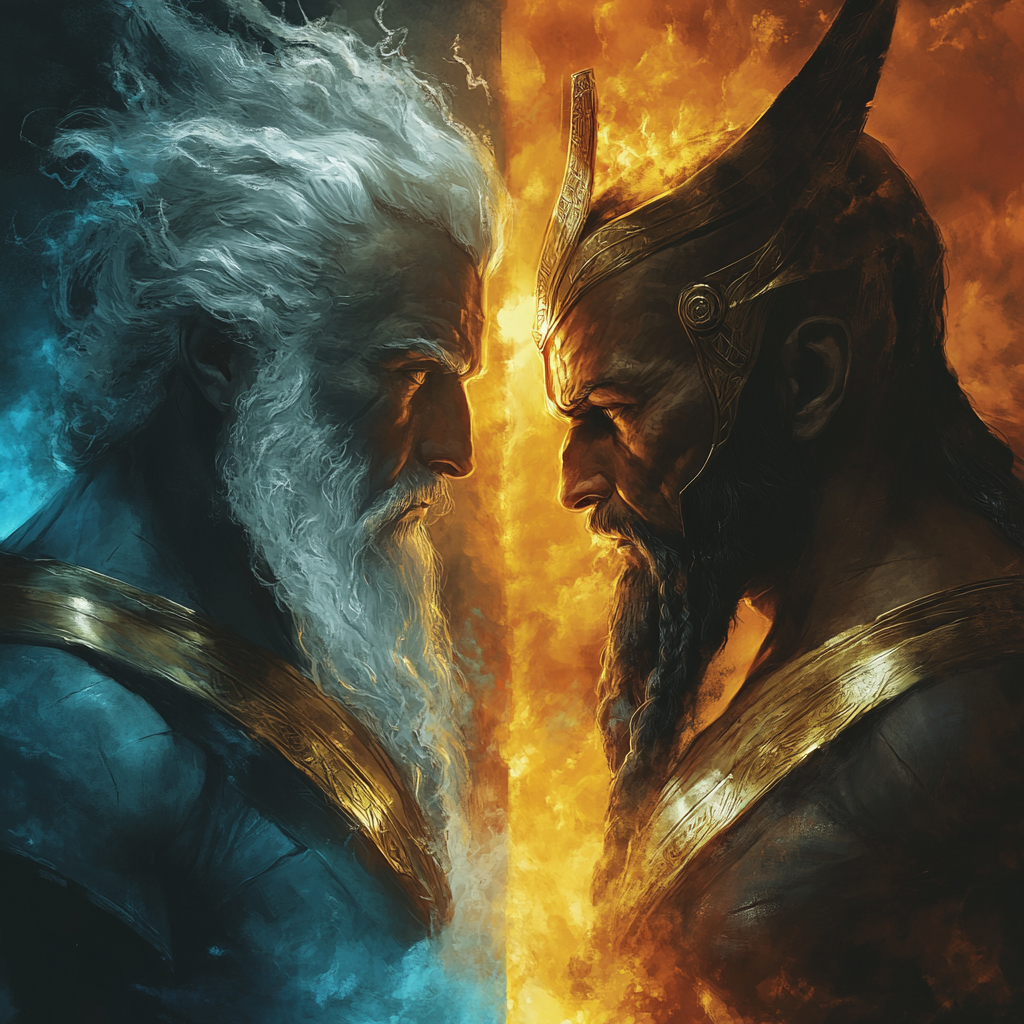
This morning I picked up a printed copy of Change Magick: A Modern Framework for Personal Mastery from the office floor and began leafing through it. I hadn’t looked at the framework for a while. It was still alive with great stuff: chaos magick, Jungian psychology, NLP, belief as a tool, personal mythology, ritual, shadow work. Much of it has since found its way into Narrative Alchemy, but the framework still holds together in its own right.
I was looking for something I could try today. One practice caught my attention:
Archetypal invocation for daily empowerment.
Archetypal invocation is a way of finding a figure larger than your habitual self and allowing that figure to alter how you stand, see, speak, and act for a while. It can happen before a difficult conversation, at the edge of a blank page, or in the car park before you walk into a room where the old version of you usually takes over.
I decided to try it today. If it catches your attention too, the practice below gives you a way to test it in a real situation of your own.
The figures behind the face
Jung used archetype for recurring patterns in psychic life that appear through dreams, stories, religions, art, fantasies, and behaviour. In “The Concept of the Collective Unconscious”, he distinguishes the inherited possibility of a pattern from the particular image it takes in a culture or a life. We never meet an archetype naked. We meet images: the Mother, the Child, the Trickster, the Warrior, the Wise Old Woman, the King, the Hermit, the Wanderer, the Magician. The pattern puts on local clothes.
The Warrior is not one fixed character with a sword and an expensive beard. A nurse holding steady during a night shift may carry the pattern. So may the person who finally says no to a relationship that has hollowed them out. The Warrior might arrive as quiet endurance, clean boundary, moral courage, disciplined attention, or the willingness to remain present when every part of you wants to flee.
An archetype gives related actions, images, emotions, postures, and values a recognisable shape. It lets the psyche say, “This kind of human situation has happened before. Here is one old pattern for meeting it.”
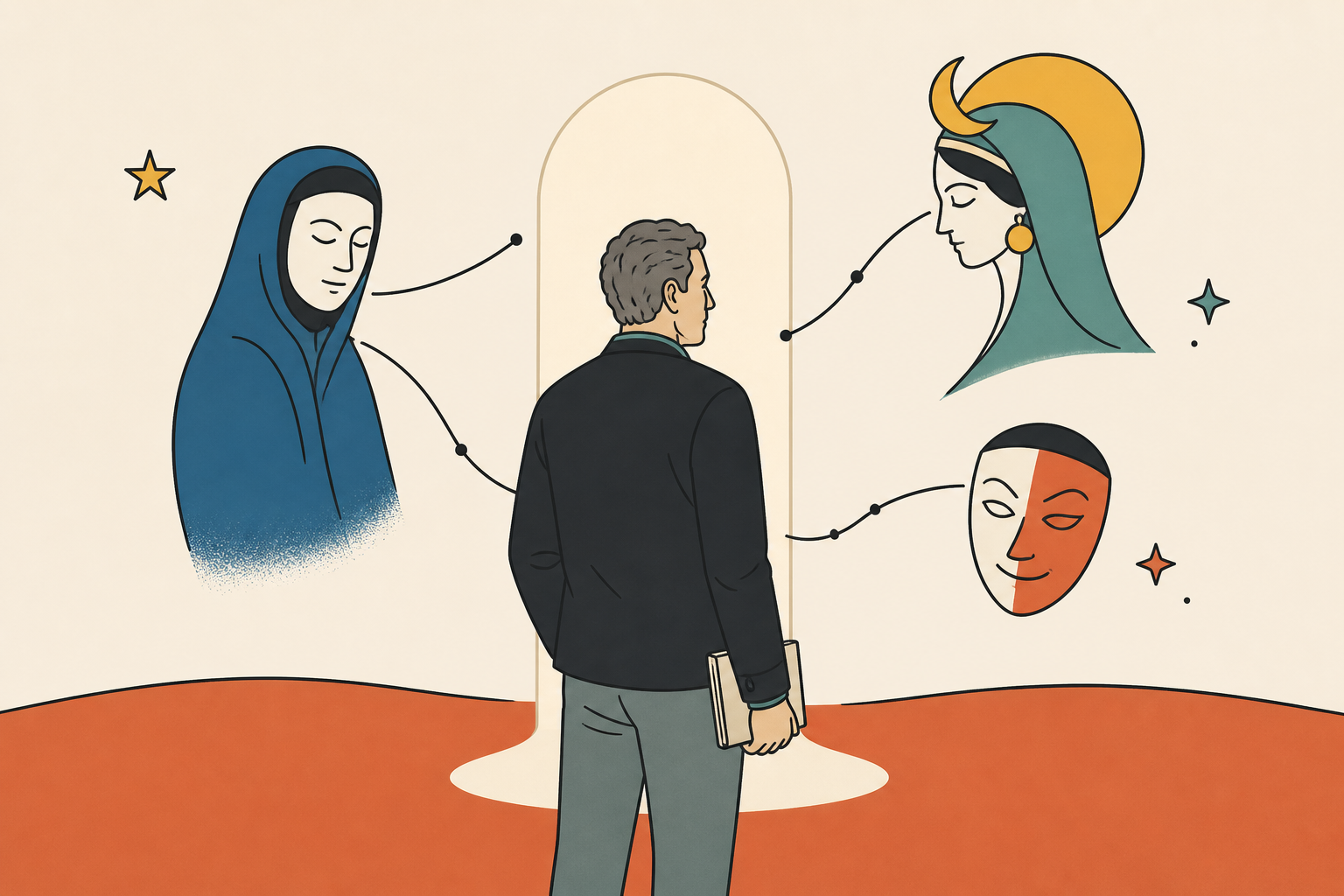
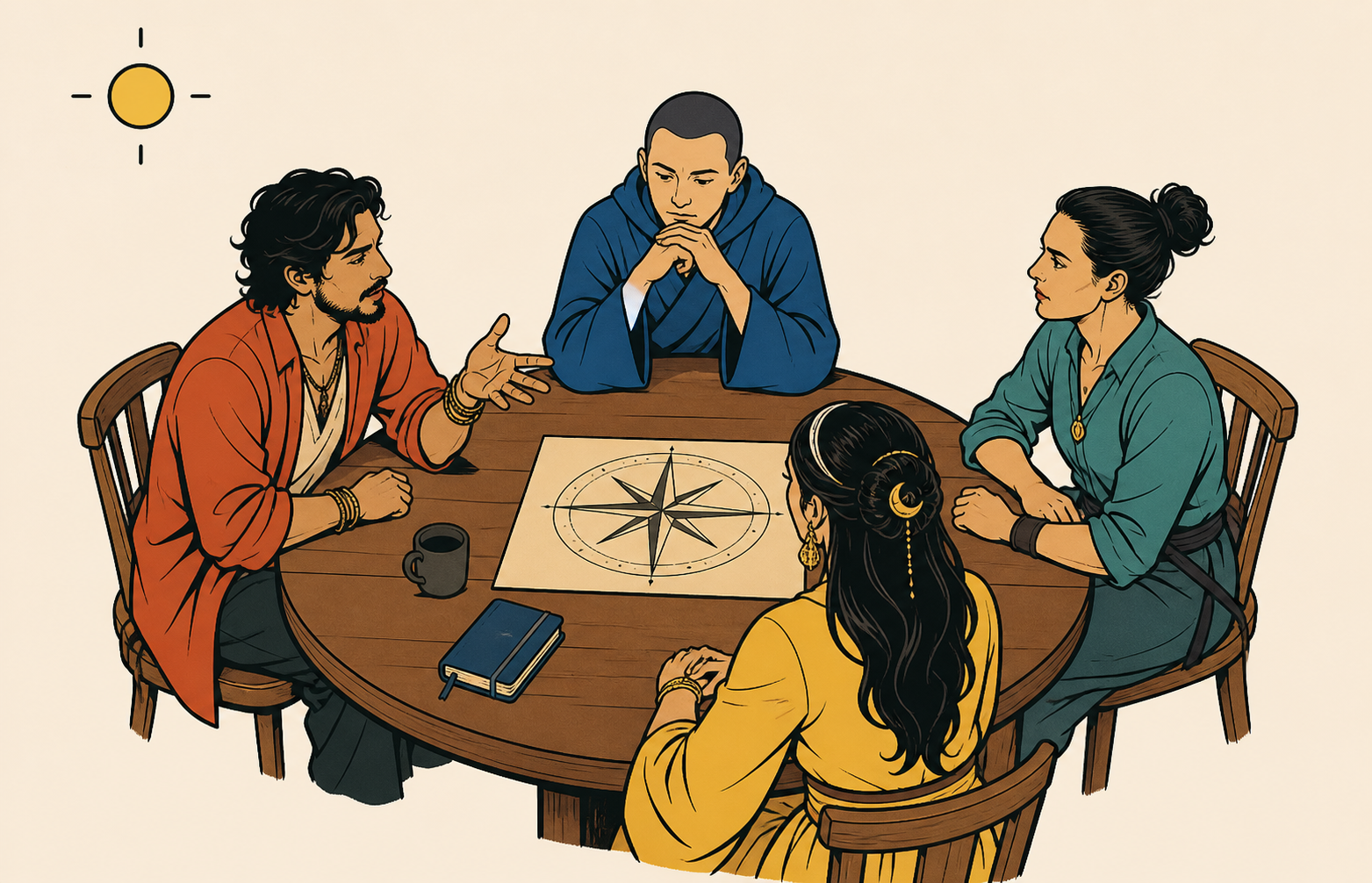
I’ve already been using this through what I call the inner council. The Monk protects contemplation, freedom, study, and the right to follow the rhizome. The Frontman wants contact, audience, livelihood, and the live current of being seen. The Trainer turns knowledge into practices that another person can use. The High Priestess listens for the pattern beneath their arguments.
These figures began as a way of making an inner conflict visible. Once they had names, I could hear what each one wanted without forcing them into a single grey compromise. The High Priestess, in particular, changed the room. She didn’t bring another opinion. She brought a different quality of attention: slower, receptive, less eager to turn every mystery into a plan. That council grew from the same practice I explored through tarot.
That is close to the method Jung describes in “The Transcendent Function”: beginning with a real mood or emotional charge, allowing its images and associations to develop, then giving them a concrete form through dialogue, writing, movement, drawing, or fantasy. You don’t surrender your judgement to the figure. You meet it. You let it speak, question it, argue with it, notice what changes in the encounter.
There is a useful tension here. If I reduce the High Priestess to “my intuitive side,” the image loses some of its power. She becomes a label on a storage box. If I treat her as an infallible supernatural authority, I have given the image far too much power. The middle path is imaginal relationship: take the figure seriously without mistaking the figure for the whole truth.
The symbol must not devour the person.
The inner council gives conflicting patterns a place to speak without forcing them into one voice.
You are invoking all the time
Formal invocation feels strange because everyday invocation passes without comment.
Put on a uniform and see what happens to your spine. Walk into a school reunion and notice which age your voice becomes. Sit behind a desk with your job title on the door. Lace up boots for a long walk. Pick up a guitar in front of an audience. Enter the kitchen where your family is already arguing. Each setting calls forward a version of you.
The room invokes. The clothes invoke. The remembered audience invokes. Music invokes. Language invokes. Another person’s face can summon a character you haven’t played for twenty years.
Social life depends on this capacity. We move between roles without considering it occult. Friend, parent, teacher, stranger, lover, writer, customer, patient. Each role selects certain memories and behaviours while pushing others towards the wings. Trouble begins when one role takes the theatre and refuses to leave, or when the character summoned by a situation is the least capable one available.
The person facing a difficult meeting may invoke the Pleaser before the door opens. The blank page may invoke the Examiner, complete with red pen and disappointed expression. A money conversation can summon the Frightened Child even when the adult at the table has decades of experience.
Archetypal invocation introduces choice into that process. Instead of asking, “How do I make myself feel confident?”, I can ask, “Who knows how to enter this room?”
Confidence is an abstraction. A seasoned Diplomat knows how to pause before answering. A Warrior knows where the boundary lies. A Trickster can break the spell of false seriousness. A Caregiver can stay close to pain without rushing to fix it. A Sovereign can make a decision and accept the cost.
Psychology has several neighbouring ideas. Research on embodied cognition challenges the picture of thought as something that happens in a sealed chamber behind the eyes; cognition develops through the traffic between brain, body, and environment. The much-discussed work on “enclothed cognition” asked whether clothing can affect attention through both its symbolic meaning and the experience of wearing it. A later meta-analysis raised concerns about the repeatability of the earliest studies while finding support for newer work. The modest question remains useful: what we put on may participate in the state we enter.
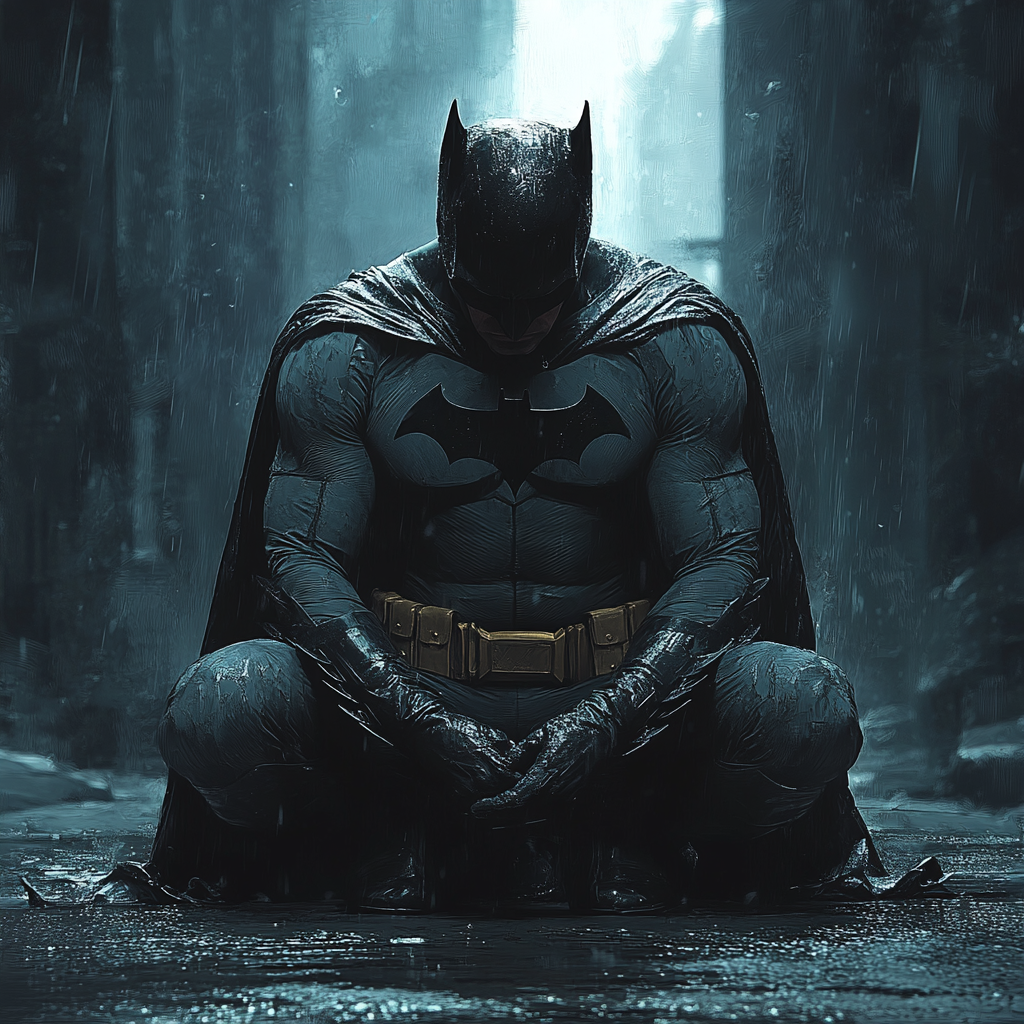
A study often called the Batman effect found that young children persisted longer at a dull task when they took the perspective of an admired character. Batman gave them enough distance from immediate frustration to act differently. Adults may have better vocabularies for self-regulation, but we still borrow courage from people, characters, ancestors, songs, uniforms, and stories.
The imagination is not floating above behaviour. Give a state a name, a face, a posture, and a field of values, and you create more handles by which the body can find it.
Invocation is more than dressing up
A costume can help, but the practice goes deeper than wearing a cloak and hoping Odin sorts out your inbox.
An archetype includes a way of selecting information. Invoke the Warrior and you may see the point of decision. Invoke the High Priestess and you may notice what everyone has spoken around. Invoke the Fool and the same situation may reveal an opening where the cautious self saw only embarrassment. Each figure edits the scene.
This is why invocation belongs inside Narrative Alchemy. A story does not live only as a sentence in the head. It lives in what the body expects, which details the senses notice, the meaning assigned to another person’s silence, and the action that feels possible next.
I wrote about identity as a narrative repeated until it feels like ground. Invocation works from the other direction. Instead of analysing the old story for another hour, you give a different pattern temporary use of your hands and feet.
Temporary matters. The aim is not to replace a cramped identity with a grandiose one. “I am always the Warrior” is another prison, and probably an exhausting person to live with. Invocation works best as a deliberate movement into a pattern, followed by a deliberate return.
Chaos magick contributes a useful lightness here: belief can function as an instrument. Enter the ritual fully enough for it to alter experience, then set it down and examine what happened. That experimental stance runs through Change Magick and Narrative Alchemy. We can inhabit a useful fiction without demanding that it become the final metaphysics of the universe.
The test is not whether the archetype was “really there.” The test is what you could perceive and do while the pattern was active, what it cost, and whether the result made your life more honest.
Invocation becomes useful when the image reaches posture, breath, attention, and action.
An experiment: borrow a larger self
Set aside thirty to forty-five minutes. Choose a real situation close enough to matter and small enough to test. A conversation you have been postponing. An hour of writing. A decision that has gone soft around the edges. A walk taken with a question. Don’t begin with your deepest trauma or the most explosive relationship in your life. An experiment needs enough pressure to reveal something, not so much that it floods the laboratory.
1. Name the scene
Write three plain sentences:
What am I about to do?
Which version of me usually appears here?
What becomes difficult when that character takes over?
Stay with behaviour. “I lose my power” gives you little to work with. “I talk too quickly, soften every request, and agree before I have checked my diary” gives the experiment somewhere to stand.
2. Choose the needed quality before the figure
Ask what the situation requires: courage, patience, mischief, steadiness, receptivity, clean authority, tenderness, endurance, curiosity.
Then choose a figure who carries that quality for you. Draw from myth, tarot, fiction, history, family memory, religion, cinema, or your own dreams. Athena, the Hermit, Columbo, Ripley, the High Priestess, your grandmother at the kitchen table, a nameless ferryman, the old martial arts teacher from a film you saw at twelve. Cultural respect matters; work with figures you know enough to approach without turning someone else’s living tradition into a prop.
Choose a figure with edges. “The Successful Person” is a motivational poster. Columbo has a coat, a pace, a way of asking one more question while appearing to have missed the point. Specificity gives the nervous system something to enact.
3. Interview the figure
On paper, ask:
What do you notice first in this scene?
What do you refuse?
What do you protect?
How do you use your voice?
What is your shadow here?
Which other figure keeps you honest?
Write the answers quickly in the figure’s voice. Let surprise happen, but keep your adult judgement in the room. An invoked Warrior who wants to destroy a colleague has exposed inflation or anger, not delivered sacred instructions. Bring in the Diplomat, Healer, Fool, or Witness as a corrective.
The best archetypal work is rarely a solo act. In The Warrior Archetype in Tarot, the Warrior develops across different cards rather than appearing as one lump of aggression. My own Warrior needs the Taoist Wizard: discipline corrected by timing, force corrected by attunement. Each figure keeps the other from becoming a caricature.
4. Build a threshold
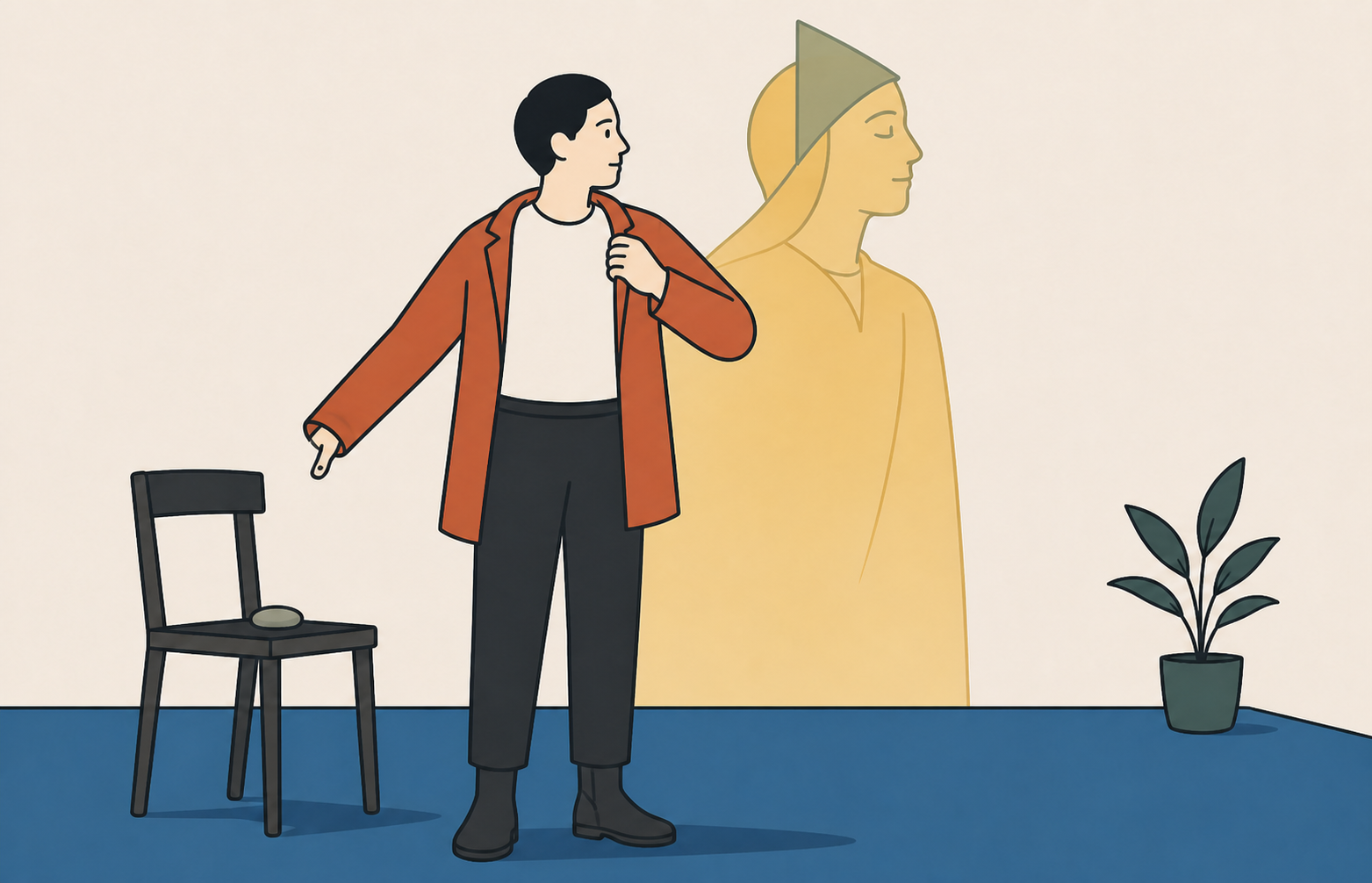
Create a small transition into the role. Change one item of clothing. Stand in a different place. Put on one piece of music. Hold an object. Draw a mark on a card. Speak the figure’s name.
Then alter three physical details:
stance;
breath;
gaze.
Don’t perform for an imaginary audience. You are giving the body a clear instruction. If your figure is the Sovereign, you might place both feet on the floor, let the exhale finish, and look at the whole room before speaking. If your figure is the Trickster, loosen the knees, tilt the head, and search for the detail that makes the official story wobble.
Say:
For the next thirty minutes, I give the [figure] a seat at the controls. I remain responsible for what I do.
That last sentence stays in the ritual.
5. Take one piece of reality through the figure
Do the task. Write the page. Make the call. Walk with the question. Enter the meeting.
Keep the experiment narrow. You are testing whether this pattern changes perception and action. Notice one moment when your habitual character would have taken over. What does the invoked figure do instead?
You may feel nothing dramatic. Good. The Rubedo of this kind of work often looks like Tuesday morning: a slower answer, a straightened sentence, a request made without apology, ten more minutes at the page. Understanding becomes transformation when it reaches muscle and timing.
6. Return the borrowed face
End on purpose. Remove the item. Change the music. Wash your hands. Step outside. Take three ordinary breaths and name five things in the room.
Say:
The experiment is complete. I release the figure and return as myself.
This is not empty ceremony. De-roling protects you from confusing access with identity. You borrowed the Warrior’s boundary; you do not need to spend the evening patrolling the kitchen. You borrowed the High Priestess’s silence; you still have to answer your messages.
7. Record the evidence
Write without interpretation for five minutes:
What changed in my body?
What did I notice that I usually miss?
What action became possible?
Where did the figure become theatrical, inflated, or unhelpful?
What quality do I want to integrate without keeping the costume?
Run the same invocation three times before deciding what it means. Change one variable if needed. Compare it with doing the task in your ordinary state. Treat the journal as a field notebook, not a book of prophecies.
The figure is a doorway
Archetypal invocation can become another form of avoidance. You can spend a week designing the perfect ritual instead of making the phone call. You can inflate a frightened ego by naming it King. You can use the Magician to pretend that consequences are optional. You can let the High Priestess wait forever for a sign.
Every archetype carries a shadow. That is one reason I prefer a council to a throne.
The practice also has limits. If inner figures become intrusive, frightening, commanding, or difficult to distinguish from shared reality, stop the experiment and seek qualified support. Active imagination asks for a stable witness: the part of you that can enter the image and come back, holding metaphor and matter in the same hand.
Used with that grounding, invocation gives us a form of rehearsal that is richer than positive thinking. “I am confident” leaves the imagination hungry. “For this conversation, I will borrow the patience and unhurried gaze of the old ferryman” supplies a body, a tempo, and a relationship to the crossing.
Something from the invoked figure may remain after the ritual. The experiment can reveal that the borders of the familiar personality are less solid than they looked.
Archetypal invocation is one of the bridges between Change Magick and Narrative Alchemy. Change Magick works with belief and personal power. Narrative Alchemy works with the stories, images, and inherited roles through which a self takes shape. Archetypal invocation joins the two at the level of lived experiment. A new story borrows a body for half an hour and finds out whether it can walk.
The printout on the office floor reminded me that Change Magick had never really gone away. The project had been wearing other names, speaking through later work, waiting inside phrases I still use.
The framework returned as an archetype of its own: the manuscript on the floor, dusty but unoffended, carrying a tool I wanted to use today.
So I’m putting the tool back on the table as a question you can test with your own breath, posture, imagination, and next action:
Who knows how to enter the room you are about to enter?
“Prometheus did not ask permission. He saw the fire of the gods and knew it belonged to us.”
I believe the mythic revival now underway is no mere fad. It is not a trend dressed in archetypes or a phase of spiritual nostalgia curated for the algorithmic self. It is something deeper—older—stirring in the marrow of our moment. Like smoke rising from long-dormant embers, it signals the return of something essential: the soul’s own language, the sacred grammar of symbols, story, and imagination.
You can feel it, can’t you? A pulse beneath the pixels. A low hum in your bones when you read certain words, or see a tarot card flipped just so, or feel the wind shift at the edge of a new season. Myth is not a theory—it’s a sensation. A knowing that doesn’t come from the head, but from the body of time itself.
We are not merely consuming myths. We are re-entering them.
After centuries of exile—of logic crowned king and spirit made servant—myth is making its quiet return. Not as dogma, not as doctrine, but as the soul’s immune response to the illness of meaninglessness.
Because what else do we call this era of the world, if not a crisis of meaning?
We scroll past tragedy and miracle in the same breath. We medicate the ache of the unknown. We mistake information for wisdom, and distraction for desire. And through it all, the soul waits—patient, persistent, whispering not in facts but in fables.
And now, some of us are remembering how to listen.
The mythic imagination is reawakening not because it’s trendy, but because it’s timely. Because we are creatures of story. Because even our deepest technologies—AI, the internet, neural nets—are just new ways of enacting the oldest impulse: to encode meaning, to make sense, to connect.
I’m not here to persuade you. I’m here to remind you.
You’ve always known this wasn’t just about career paths and productivity hacks and personality tests. You’ve always felt the call of something stranger, wilder, more whole. You’ve always been a mythmaker, even if no one taught you the craft.
So let’s begin there: with the stolen fire.
You hold it in your hands now.
The Collapse of Meaning in the Modern Age
“The gods have not fled; we have forgotten how to see them.” — James Hillman
We live in a time of great forgetting. Not just of history or heritage, but of meaning itself. The stories that once held us, that wove us into the fabric of a living cosmos, have unraveled—or been torn apart by systems that demand certainty, speed, and scale.
In their place? Metrics. Memos. Microdoses of simulated connection. We have apps to track our sleep and calendars to optimize our joy, yet many of us drift through our days with a quiet ache, a question that buzzes beneath the surface like a mosquito in the dark:
Is this it?
It’s a dangerous thing to live without myth. Not because myth offers answers—but because without it, we forget how to ask the right questions.
We forget that grief is not a pathology. That longing is not a weakness. That suffering is not meaningless. We lose our sense of soul—not in the religious sense, but in the root sense: anima, breath, the thing that makes us more than machines.
Modern life has excelled at functionality but failed at depth. We can build rockets to Mars, but we’ve lost the ability to name the inner terrain we wander every night in our dreams. We know how to launch startups and grow our platforms—but not how to descend into darkness and emerge changed.
We’re told to move fast and break things.
But myth says: descend slowly and be broken open.
The mythic imagination was never meant to compete with science. It’s not here to disprove, but to disclose—to reveal the soul’s perspective, to show us the symbolic layer beneath the literal. Yet in the modern paradigm, this symbolic way of seeing has been dismissed as primitive, irrational, even dangerous.
And so we’ve turned away from the old stories. We’ve traded the labyrinth for the spreadsheet. The oracle for the algorithm. The ritual for the routine.
But even now, the hunger persists.
You see it in the burnout masked as busyness. The spiritual seeking that never quite finds rest. The craving for something—anything—that feels real, not just virtual, curated, or performative. We are surrounded by content, but starving for context. Surrounded by data, but cut off from depth.
And in the absence of shared meaning, we grasp for spectacle. We perform identity. We brand our pain. We declare ourselves “authentic” while secretly hoping someone, somewhere will give us a script.
The collapse of meaning isn’t just cultural. It’s personal. Intimate. It happens in the silence after a tragedy, when the platitudes fall flat. It happens in the mirror, when success feels hollow. It happens in the inbox, when another inspirational quote doesn’t quite land.
But here’s the good news: the cracks are where the myth seeps back in.
The old stories were never meant to live in textbooks or temples. They live in thresholds, in turning points, in moments when the old scripts no longer work and something deeper calls. That’s where myth thrives—not as entertainment, but as orientation.
Not to escape the world—but to re-enchant it.
What Is the Mythic Imagination?
“Myth is the secret opening through which the inexhaustible energies of the cosmos pour into human cultural manifestation.” —Joseph Campbell
The mythic imagination is not a skill. It’s not a genre. It’s not reserved for poets, mystics, or academics in smoky libraries.
It is a way of seeing.
A lens that reveals layers beneath the surface. A mode of perception that hears metaphor in the mundane, symbol in the ordinary, soul in the silence. When you engage the mythic imagination, the world doesn’t become more magical—it reveals the magic that was always there.
It’s not about belief—it’s about pattern recognition. You start to see your heartbreak not as failure, but as a descent into the underworld. Your creative block not as laziness, but as a liminal initiation. Your strange dreams not as random noise, but as encrypted messages from the deep psyche.
The mythic imagination doesn’t just interpret life—it deepens it.
Carl Jung called myth the “natural language of the unconscious.” Hillman spoke of it as a way of seeing-through—not explaining away, but peeling back. Myth doesn’t flatten reality; it thickens it. It restores the dignity of mystery. It gives back depth, and with it, dignity.
When you look with mythic eyes, your life stops being a sequence of events and starts becoming a story. And not just any story—but a story that’s happening to you and through you. A story that’s larger than you, but that needs your participation to unfold.
You stop asking, “What’s wrong with me?” You start asking, “What myth am I living?”
And that question changes everything.
Because myth isn’t just about Zeus and Isis and Odin and Inanna. It’s about the patterns they represent—archetypes, yes, but more than that: psychic currents. Invisible forces. Timeless dramas re-enacted through our modern lives.
The mythic imagination helps us hold paradox. It speaks in both/and. It refuses to choose between the sacred and the profane, the personal and the collective, the dream and the data. It braids them together like old-world rope.
And perhaps most importantly, it reminds us that our inner lives matter. That what you feel, fear, long for, and struggle with is not just psychological—it’s mythological. It has weight. Shape. Narrative arc.
To cultivate a mythic imagination is not to live in fantasy. It’s to live more fully in reality—to see through the surface and into the soul of things.
It’s to remember that when you were a child, a tree wasn’t just a tree. A storm wasn’t just weather. A mirror could open, and a question could lead you somewhere dangerous and true.
That capacity is not lost.
Just sleeping.
And now—thanks to the cracks in the dominant paradigm—it’s beginning to stir.
Signs of the Revival
“The dream is the small hidden door in the deepest and most intimate sanctum of the soul…” —Carl Jung
You can see the signs if you know where to look. Not in headlines or algorithms, but in the quiet revolution happening beneath the noise. A thousand candles being lit in a darkened room.
This mythic revival is not loud, but it is widespread. It hums in subcultures and creative pockets, in podcast monologues and tarot spreads shared in moonlit kitchens. It lives in zines stitched from grief and wonder. It hides in journals written by those who no longer want to optimise their lives—they want to alchemise them.
The mythic is returning through many doors:
Tarot and astrology, once cast aside as superstition, are now being reclaimed not as fortune-telling tools but as symbolic maps of self and psyche. Not predictive—but reflective. Not prescriptive—but participatory.
Myth-based storytelling is rising again—not only in fantasy novels and films, but in the way people frame their healing, their relationships, their careers. “I’m on a journey,” they say. “This breakup was my descent.” “This illness was a call to initiate.”
Digital spaces—blogs, newsletters, social audio, even the occasional TikTok—are becoming modern-day mythic scrolls. The internet, once dominated by utility, is becoming a dreaming ground again. A place for narrative experiments, symbolic art, story-as-signal.
Workshops, retreats, and soul circles gather not to dispense answers, but to hold sacred questions. To sit in the archetypal. To invoke the ancestors, even if their names are only half-remembered.
Even games and Alternate Reality Experiences are starting to mirror the mythic cycle—casting players as heroes, riddlers, wanderers in liminal realms. Play as initiation. Puzzle as pilgrimage.
These are not mere trends. They are soul behaviors.
The modern psyche, long starved of symbolic nourishment, is seeking it out wherever it can. And what’s beautiful—and crucial—is that this revival doesn’t belong to any one lineage, school, or system. It’s decentralized. Grassroots. Wildly diverse.
Some are drawn through the doorway of Jung. Others through psychedelics, or digital ritual, or grief that cracked them open. Some come through sci-fi and story structure. Others through ancestral reconnection. Some were never disconnected to begin with.
But the thread is there. A shared longing. A mythic pulse. A desire not just for story—but for story that sees you.
It’s not about escaping the world. It’s about re-enchanting your relationship to it. It’s about learning to live symbolically again—to read your life like a sacred text, full of omens and mirrors.
We are beginning to remember: That storytelling is not just communication. It’s invocation. That ritual is not superstition. It’s participation. That imagination is not indulgence. It’s a way of knowing.
The mythic revival isn’t coming.
It’s here.
Scattered across platforms and time zones. Written in ink and pixels. Whispered in therapy sessions and shouted in drum circles. Fragmented, yes—but unmistakable.
And in its own quiet way, it is reshaping the world.
Why This Matters Now
“In the end, we will not be saved by data. We will be saved by story.”
We are living in an age of thresholds. The ground is shifting—ecologically, technologically, psychologically. What was once solid is now soft. What we once trusted—institutions, narratives, even the self—feels uncertain. We are in-between worlds.
And in liminal times, myth becomes essential.
Because myth is the oldest technology we have for navigating uncertainty. Before we had algorithms, we had archetypes. Before we had roadmaps, we had riddles. Myth was the way we marked the mystery, made peace with paradox, and found meaning in chaos.
And make no mistake—we are in the midst of chaos.
Climate collapse, AI disruption, collective burnout, spiritual disillusionment, political fragmentation—the collapse isn’t coming. It’s here. We’re walking through it in real time, holding shattered stories in our hands.
The old myths—the ones we’ve inherited from modernity—are failing.
The myth of endless growth. The myth of individual supremacy. The myth of progress as salvation. The myth of disconnection—from nature, from each other, from soul.
These are not neutral ideas. They are mythic structures dressed up as common sense. And when myths collapse, they don’t go quietly. They go with fire.
But in every mythic cycle, collapse is not the end. It is the beginning of a new initiation.
The mythic imagination matters now because we are no longer in need of surface-level change. We need deep narrative transformation. We need to re-story the world—not with utopias, but with soul-truths. With stories that can hold the weight of what we’re living through.
We need myths that are wide enough to contain grief. Flexible enough to bend with change. Sacred enough to restore reverence. And personal enough to remind us that we each have a role to play.
Myth gives us that.
It gives us back the dignity of being a protagonist in a living world—not just a consumer in a dying one. It reclaims our suffering as part of a larger arc. It reminds us that the dark isn’t a detour. It’s the descent before the return.
And it calls us not to escape, but to engage. To participate in the making of new meaning, right here in the ruins.
You see, the mythic revival is not a retreat from reality. It’s a return to what’s most real. A return to story as soulcraft. A return to the inner compass when the external map is burning.
Because in the absence of a collective myth, we become isolated wanderers. But in the presence of myth, we become something else:
A people on a shared journey.
This Is a Rebellion, Not a Regression
“The visionary is the only true realist.” — Federico Fellini
Let’s say it plainly: some will scoff at this revival.
They’ll say it’s indulgent. Sentimental. A symptom of a generation that can’t face reality without dressing it up in archetypes and oracle decks. They’ll say myth is for the past, not the future. That it’s a soft substitute for serious thought. A retreat into fantasy.
But they miss the point entirely.
This return to myth is not a regression. It is a rebellion. A refusal to let the world be stripped of wonder. A refusal to accept the terms of a life reduced to performance metrics, identity brands, and dopamine loops. A refusal to live in a story where we are nothing but cogs in a machine that never stops spinning.
To live mythically is not to pretend.
It’s to resist reduction.
It’s to say: I am not just my résumé. I am not just my wounds. I am not just a demographic or a dataset. I am a soul in motion, a story in the making, a vessel of mystery moving through time.
And that is not soft. That is power.
Because when we see our lives mythically, we stop outsourcing meaning. We stop waiting for someone else to give us the plot. We begin to author from within. Not to control the narrative—but to participate in it.
Mythic imagination reclaims inner authority.
And that’s dangerous in a culture designed to keep us fragmented, distracted, and docile.
It’s dangerous because a person who sees their life as sacred will no longer settle for systems that desecrate.
It’s dangerous because a person who listens to their soul more than their screen cannot be easily manipulated.
It’s dangerous because a person who walks with archetypes walks with ancestors—and ancestors don’t care about quarterly earnings or follower counts.
This is why the mythic matters now. Not because it offers escape—but because it offers depth in an age of flatness. It offers pattern in an age of noise. It offers meaning in an age that treats meaning as a branding tool.
The return of the mythic imagination is not about losing touch with reality.
It’s about refusing to be trapped in someone else’s definition of it.
So yes—call it rebellion. A soulful, poetic, dignified rebellion against the tyranny of the literal. Against the cult of productivity. Against the storyless world that tells us there is no mystery left to live.
We know better.
We’ve felt the fire.
And we are not going back.
The Personal Turn: A Mythic Praxis
“The privilege of a lifetime is to become who you truly are.” —Carl Jung
This isn’t theory for me. It’s biography.
The mythic imagination didn’t enter my life as a concept—it arrived as a lifeline. A thread I didn’t know I was following until I looked back and saw the pattern woven through every season of unravelling.
There were moments when the inherited scripts stopped working. When the goals I was supposed to want rang hollow. When the mask of “being fine” cracked wide open—and something older, wilder, and wiser slipped through the gap.
I didn’t find myth in a book. I found it in my body. On long walks when I’d speak aloud to no one, only to realize I was speaking to some deeper part of myself. In dreams that felt like riddles from another world. In the strange synchronicities that followed grief, as if the universe were whispering, “Keep going. This has meaning.”
Eventually, I gave up trying to live a normal life and chose to live a storied one instead.
Now, I treat journaling as soul-mapping. I walk not just to clear my mind, but to converse with archetypes. I treat movies like modern myths and tarot spreads like mythic mirrors. I run my business as if it were a grimoire. I write blog posts like dispatches from the threshold. I speak to the page the way the ancients spoke to their gods: with reverence, with longing, with curiosity.
This is my mythic praxis.
It’s not a system or a ten-step program. It’s a posture. A way of orienting toward life that says: everything is symbolic, and nothing is accidental. Every problem is a plotline. Every wound is a portal. Every threshold is an invitation to become more fully who I’ve always been.
And I believe this is available to all of us—not just as philosophy, but as practice.
Because you don’t need to know all the old myths to live mythically. You just need to start listening for the symbolic pulse of your own story. You just need to ask different questions.
Not “What should I do?” but “What story am I in?” Not “How do I fix this?” but “What is this trying to initiate in me?” Not “Why is this happening?” but “Who am I being called to become?”
This is the path. Not upward, but inward. Not linear, but labyrinthine. Not perfect, but poetic.
And once you begin to walk it, you’ll start to see signs. Little breadcrumbs left by the soul. A book that falls off the shelf. A song lyric that hits like a prophecy. A conversation that opens something in you you didn’t know was closed.
The mythic imagination trains you to pay attention. And in paying attention, you begin to re-story your life.
Not to escape it. But to live it more deeply. More soulfully. More whole.
A Quiet Call to the Storythinkers
“You are the one who keeps watch. You are the one who remembers. You are the one the myth was written for.”
If you’ve made it this far, it’s not because of me.
It’s because something ancient in you is stirring. Something that remembers the shape of symbols. Something that aches for a life that means more than survival, more than performance, more than passing time.
You are not alone in that longing.
There is a quiet uprising happening—among the storythinkers, the soul-listeners, the mythmakers in exile. We are not gathered in temples or town halls. We’re scattered across blogs, back porches, audio diaries, late-night journals. We are philosophers in hoodies, mystics with deadlines, seekers disguised as consultants and creators.
But we are here.
And I believe we’re being called—not to go back, but to go deeper. To become the next generation of myth-makers. To remember that our lives aren’t just content to be managed—they’re epics to be lived. They’re dreams to be decoded. They’re living myths in motion.
You don’t need to have it all figured out.
You just need to start listening differently.
So here’s a question I offer you, warm from the fire:
What myth is trying to live through you right now?
Not the one you inherited. Not the one you think you’re supposed to live. But the one that knocks at 3am. The one that won’t leave you alone. The one that feels like both a curse and a calling.
Find that thread.
Follow it—not to arrive, but to remember.
You are not a brand. You are not a product. You are not a problem to be solved.
You are a threshold-walker. A meaning-seeker. A keeper of the flame.
And this mythic revival?
It’s not a phase.
It’s your soul coming back online.
So let’s keep the fire lit. Let’s keep the stories alive. Let’s make meaning in a world that forgot how.
In this episode, I explore the King archetype as revealed through my mythic-expressive writing practice, highlighting my realization of needing to reclaim inner leadership. I discuss reframing internal adversaries as constructive opponents and the empowering role of mythic imagination. Join me as I reconnect with the fragments of my psyche to restore balance and purpose.
I got a lot of insights from this journey. I’ll share more as process them.
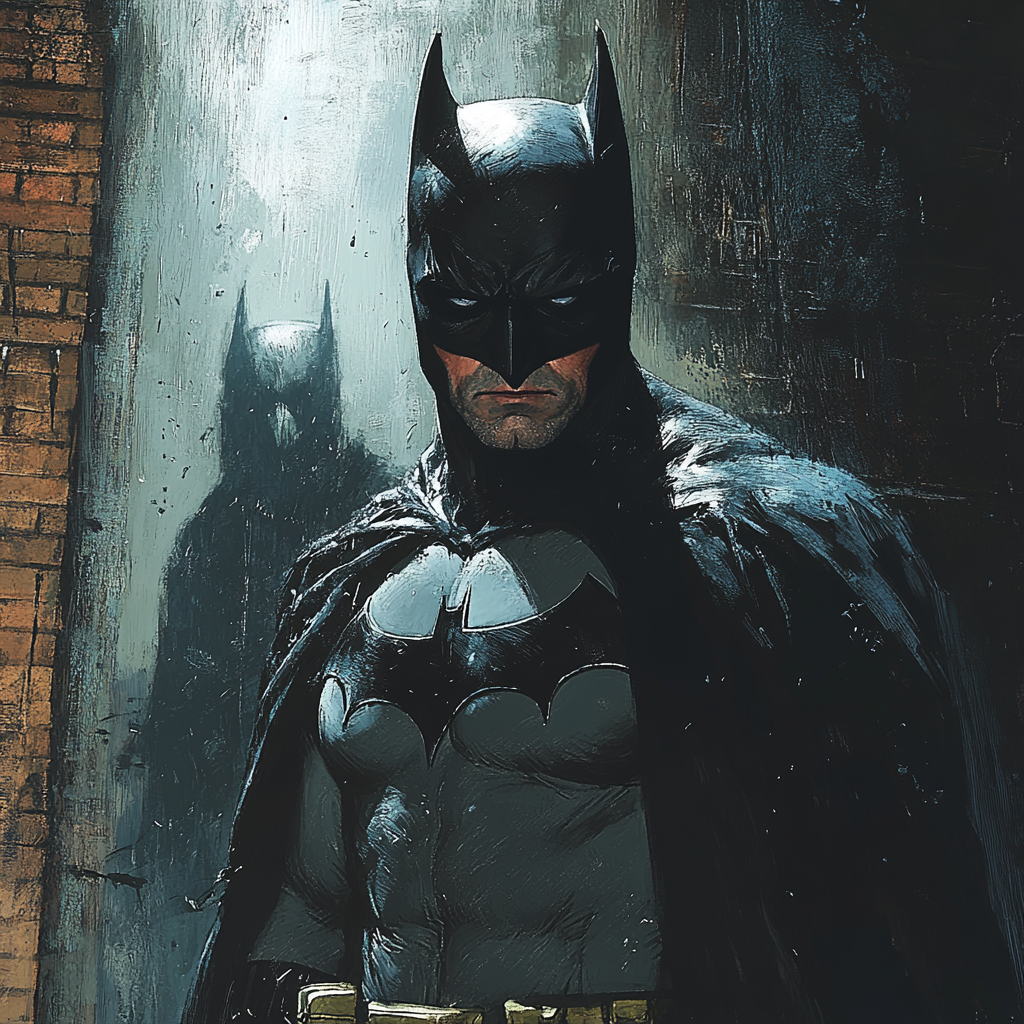
Batman has long stood as a symbol of resilience, justice, and the power of human will. Cloaked in darkness, he’s a hero who walks the line between vigilante and saviour, refusing to stray too far into the light or the shadow. But beneath the mask, Bruce Wayne is a man shaped by trauma—an orphan who witnessed the brutal murder of his parents and who, as a result, was thrust into a lifelong battle with his inner demons. What sets Batman apart from other heroes is that his strength doesn’t come from superhuman abilities but from his woundedness. He is, at his core, a wounded hero, an archetype that has echoed through mythology and depth psychology for centuries.
In this way, Batman joins a pantheon of mythic figures like Hades and Osiris—gods who are comfortable navigating the liminal spaces between life and death, light and shadow. Both Hades, the ruler of the underworld, and Osiris, the god of death and resurrection, embody the kind of archetypal journey that Batman undertakes. They each dwell in realms where the veil between worlds is thin, where life’s darkest truths must be confronted in order to transform and gain wisdom. Batman, too, exists in this space, constantly drawn into the depths of Gotham’s underworld, both literally and metaphorically.
As we explore the idea of Batman as the wounded hero, we’ll look at how his trauma serves as a gateway to the archetypal shadow realms that mythological figures like Hades and Osiris represent. We’ll also see how his story reflects the universal human experience of living in that tension between light and dark, order and chaos, wholeness and fragmentation. This archetypal resonance is what makes Batman not just a symbol of justice but also a figure deeply connected to our collective unconscious—a hero who, despite his wounds, rises again and again to fight the darkness.
The Wounded Hero Archetype
At the heart of every myth, there is a wound—a pivotal moment of trauma that shapes the hero’s journey. In the world of archetypes, the wounded hero represents the figure who has suffered deeply, yet channels that suffering into a higher purpose. Carl Jung described archetypes as universal symbols or motifs that recur throughout the collective unconscious, and the wounded hero is one of the most profound. This archetype embodies the paradox that, through wounding, one is forged into a hero—brokenness becomes the source of power, insight, and transformation.
Batman is perhaps one of the clearest modern embodiments of the wounded hero. His story is inseparable from the tragedy that defines him: the death of his parents, gunned down in front of his young eyes in a senseless act of violence. This trauma doesn’t just propel Bruce Wayne into the vigilante life; it becomes the wound he carries for the rest of his days. It’s his burden, his drive, and his raison d’être. Batman’s entire mission—the protection of Gotham—is rooted in his unresolved grief and pain, and this is precisely what makes him a wounded hero. Unlike many superheroes who thrive in the light of their powers or victories, Batman is continuously shaped by his shadows.
In mythology, the wounded hero archetype often manifests in gods and figures who endure immense suffering but emerge with a new kind of wisdom or power. Take, for instance, the myth of Osiris. He is a god who was once whole, only to be brutally murdered and dismembered by his brother Set. His pieces were scattered across the world, and it was only through the tireless efforts of his wife, Isis, that he was reassembled and brought back to life. But even in his resurrection, Osiris was changed—he became the ruler of the underworld, forever marked by his death, yet transformed into a powerful figure of judgment and renewal.
Like Osiris, Batman is perpetually marked by his trauma. His mission to rid Gotham of its darkness is both an external and internal battle—a fight to keep the chaos of the world at bay while managing his own internal shadows. The same principle applies to Hades, who, though not a hero in the traditional sense, rules over the dead in a world of darkness, presiding over what most fear to face: the finality of death and the unknown. Hades does not fear the shadows; he lives within them, much like Batman.
The wounded hero archetype, then, is not about overcoming trauma in the traditional sense—it’s about living with it, transforming it into something powerful. Batman, like Hades and Osiris, walks this line between destruction and renewal. His wound never heals, and in many ways, it isn’t supposed to. It’s a sacred wound that allows him to be the dark protector Gotham needs, and this unresolved pain is what connects him to the mythic archetype of the wounded hero. His power isn’t his physical strength or intellect; it’s his ability to carry his wound and use it as the fuel for his mission.
In Jungian terms, the wounded hero is a figure who integrates their shadow—those darker, unresolved parts of the psyche. Batman’s relentless pursuit of justice is as much an attempt to reconcile his inner darkness as it is to bring order to the streets of Gotham. It’s this delicate balance between light and shadow, trauma and heroism, that makes the archetype so compelling, not just in mythology but in the way it resonates with our own lives.
We all carry wounds, and like Batman, we’re faced with the choice: do we allow our wounds to define us, or do we find a way to transform them into our strength?
Batman’s Trauma: The Catalyst for the Heroic Journey
Batman’s origin story is one of the most compelling in modern mythology, not because it involves cosmic battles or godlike powers, but because it’s rooted in a simple, devastating moment: a child losing his parents. This trauma—Bruce Wayne witnessing the brutal murder of Thomas and Martha Wayne—becomes the defining event of his life. It’s not just a loss; it’s the birth of Batman. The pain and fear that young Bruce felt in that alley never fade, but rather evolve into the fuel that drives him forward. In many ways, this trauma is not something that can be healed—it becomes a companion that informs his mission, his identity, and his methods.
In psychology, trauma often manifests as a split, a fragmentation of the self. For Bruce, this split creates the dual identity of Bruce Wayne, the billionaire playboy, and Batman, the dark vigilante. This division reflects the deep internal rift caused by his trauma, a rift that echoes through every action he takes. Unlike many heroes, Batman doesn’t possess an inherent sense of invulnerability or hope. His heroism is forged in the fires of loss, and this makes him a complex, sometimes contradictory figure. He’s not saving Gotham to fulfill an abstract ideal of justice—he’s trying to prevent the city’s dark underbelly from creating more victims like himself.
Where many mythic heroes are driven by quests of discovery or transformation, Batman’s journey is more about containment. He’s not trying to conquer an external enemy; he’s attempting to manage the internal chaos that was unleashed the night his parents died. His trauma never fully resolves, but it transforms into something larger than himself—a mission to bring order to the chaos of Gotham’s streets. This mission, however, is not one of pure altruism; it’s deeply personal. Every criminal he apprehends, every villain he faces, is in some ways a symbolic confrontation with the forces of darkness that took his parents from him.
This is where Batman’s path diverges from that of other mythic figures. In mythology, the hero’s journey often involves crossing thresholds, confronting external trials, and emerging changed on the other side. In contrast, Batman’s journey is cyclical—there is no final battle, no decisive victory. Instead, his fight is ongoing, endless, as he constantly returns to the same darkness that created him. His trauma acts as both a wound and a compass, forever guiding him back to the streets of Gotham, where the line between good and evil is blurred.
While mythological figures like Osiris undergo literal death and resurrection, Batman’s transformation is psychological. After the death of his parents, Bruce Wayne essentially “dies” as well, and from that death, Batman is born. But unlike Osiris, who is reassembled and made whole, Bruce never fully recovers from his dismemberment. He exists in a permanent state of fragmentation, with Batman representing the shadow self that rises from his wound. His mask is more than just a disguise—it’s a manifestation of his internal split, allowing him to function in a world where his trauma is both his greatest strength and his deepest vulnerability.
Batman’s trauma also places him in direct opposition to many of his adversaries, who are often twisted reflections of his own darkness. Characters like the Joker or Two-Face represent what happens when trauma consumes an individual entirely. They are the embodiment of chaos, reminding Batman that he is always on the brink of becoming what he fights against. This dynamic is central to his journey—his trauma not only shapes his mission but also keeps him in constant tension with the forces of disorder that he seeks to control.
In many ways, Batman’s journey mirrors that of Hades, the god who presides over the dead but is never truly part of the world of the living. Batman operates in the shadows, and while he protects the living, his life is one of isolation and darkness. Gotham itself becomes a kind of underworld—full of corruption, crime, and chaos—that only Batman can navigate. He is both the protector and the prisoner of this world, unable to escape its grip because it is tied to the wound he carries.
Unlike mythic heroes who seek resolution or transcendence, Batman knows that his trauma cannot be undone. His role as Gotham’s guardian is not about healing—it’s about control. He cannot stop the darkness within himself, but he can channel it, direct it, and use it to prevent others from experiencing the same pain. This is the paradox of the wounded hero: Batman’s greatest strength comes from his wound, but it is also the source of his unending struggle. There is no final victory, no moment of triumph—only the constant return to the shadows.
Batman as a Liminal Figure
One of the most fascinating aspects of Batman’s character is how he exists in a liminal space—a realm that lies between the clear boundaries of light and dark, good and evil, life and death. Liminality, in myth and psychology, refers to the threshold between two states of being, a place where transformation occurs but is never fully resolved. Batman, more than almost any other hero, embodies this liminality, constantly navigating the grey areas of morality, law, and identity.
Unlike heroes like Superman, who represent the clear light of idealised justice, Batman operates in the shadows, both literally and metaphorically. He is not a symbol of pure goodness, nor is he an agent of chaos like his arch-nemesis, the Joker. Instead, Batman treads the fine line between order and disorder, justice and vengeance. This makes him a liminal figure, one who thrives in the in-between spaces where the usual rules of morality and law no longer apply.
In myth, we often see liminal figures in gods and beings who dwell at the edges of the known world, like Hades. He exists apart from both the living and the dead, ruling over a shadowy domain that is neither here nor there. Like Hades, Batman is comfortable operating in the unseen, hidden corners of Gotham City, a place of corruption and crime where the law struggles to maintain control. But unlike Hades, who reigns over the dead with cold detachment, Batman actively engages with this world, striving to impose his own sense of justice within it.
Similarly, Osiris embodies liminality through his own transformation. After his death and resurrection, Osiris does not return to the land of the living but instead becomes the ruler of the underworld, a place where life and death intermingle. In the same way, Batman never truly exists in the daylight world of Bruce Wayne. Even when he walks among Gotham’s elite as a billionaire, his true self remains in the shadows, bound to his identity as the Dark Knight. Like Osiris, Batman has been forever changed by the trauma he endured, and this transformation leaves him unable to fully return to the world of the living.
Batman’s liminality is not just about his relationship to Gotham’s criminal underworld; it’s also reflected in his complex moral code. He follows a strict rule never to kill, which separates him from the villains he fights, but his methods are often violent, brutal, and psychologically taxing. This tension between upholding justice and flirting with the darker impulses of vengeance is what makes him such a unique figure among superheroes. He refuses to cross certain lines, yet he constantly tests their boundaries, often operating outside the law to achieve his goals.
This moral ambiguity places Batman in stark contrast to heroes who follow clear, idealised codes of conduct. His world is not one of black-and-white choices but of difficult, sometimes morally grey decisions. For example, he works alongside police commissioner Jim Gordon but refuses to be constrained by the rules of the legal system. This liminal space allows him to pursue justice on his own terms, without the restrictions that bind others. It’s what makes him both a hero and an outlaw, a figure trusted by Gotham’s citizens yet feared by its criminals.
Yet Batman’s liminality also comes at a cost: isolation. Much like Hades, who is cut off from the world of the living, Batman’s constant dwelling in the shadows leaves him distanced from those he cares about. His relationships are strained because of the double life he leads, and even his allies, like Alfred and Gordon, can only support him from a distance. He is a protector, but one who is perpetually alone, caught between two worlds that he can never fully belong to—Bruce Wayne’s world of privilege and Batman’s world of darkness. This duality is the core of his struggle.
In many ways, Batman’s identity is defined by his ability to navigate these in-between spaces. His strength comes not from his ability to overpower enemies but from his comfort in uncertainty, in ambiguity. He operates where others fear to tread, engaging with the shadowy parts of the human experience, both in the criminals he faces and in his own psyche. Batman’s true superpower is his ability to move fluidly between these worlds, embodying the archetype of the liminal figure—a hero who, like Hades or Osiris, can dwell in the dark without losing sight of the light.
This constant dance between light and shadow is what makes Batman so compelling as a modern mythic figure. He is the embodiment of the grey areas that we all inhabit—the place where our fears, desires, and moral dilemmas collide. Batman’s liminality makes him relatable on a deeply human level. We, too, must often navigate the spaces between right and wrong, light and dark, grappling with the tension between who we are and who we aspire to be. And like Batman, we must learn to walk the line, finding our strength not in purity or perfection, but in our ability to hold these opposites in balance.
Hades and Osiris: Gods of the Shadow and the Underworld
Batman’s character has often been compared to mythological figures, but few parallels are as striking as those with Hades and Osiris, both of whom are gods of the shadow, rulers of realms beyond the living. While Batman is no god, his embodiment of shadow work, trauma, and his place in Gotham’s underworld closely aligns him with these ancient figures. Both Hades and Osiris reign over domains that are hidden from the light, where transformation occurs not in life, but through death, destruction, and rebirth. In many ways, Batman shares their dominion over the darker aspects of existence—he is not a figure of pure light but a guardian of the liminal spaces where life and death, good and evil, intertwine.
Hades: Lord of the Unseen
Hades, the Greek god of the underworld, is not often portrayed as a villain, but he is undoubtedly a figure of mystery and shadow. As the ruler of the dead, Hades’ domain is beneath the surface, both literally and figuratively. He reigns in the underworld, a place of finality and separation from the living world above. Much like Batman, Hades is often misunderstood. He is not evil, but he is feared, and his role as lord of the dead places him at the edge of the known world, where most mortals dare not go.
Batman, too, inhabits this hidden, shadowy realm. His Gotham is not the bright, hopeful city depicted in the daytime; it is a place of crime, corruption, and fear, especially when the sun sets. Like Hades, Batman rules over this underworld, not with cruelty but with a sense of responsibility. He becomes a protector of those who live in fear of the chaos lurking in the city’s dark corners. But, unlike the bright, shining heroes of Metropolis, Batman embraces the role of a shadowy figure—his power comes from the darkness itself, from understanding its depths and manoeuvring within it.
Hades’ connection to the unseen and the underworld mirrors Batman’s role in Gotham. Both figures stand at the threshold between two worlds—life and death for Hades, law and chaos for Batman. They are not consumed by these worlds but instead rule over them with an intimate understanding of their complexity. Batman’s ability to operate in the shadows and navigate Gotham’s criminal underbelly with precision and purpose speaks to this shared mastery of the unseen. His very identity is cloaked in darkness, and it is in this darkness that he finds his strength.
Osiris: Death, Resurrection, and Renewal
Osiris, on the other hand, offers a different kind of shadow: one that speaks to transformation and renewal. As the Egyptian god of death and rebirth, Osiris is dismembered by his brother Set, torn apart, and later reassembled by his wife, Isis. His journey through death leads him to the throne of the underworld, where he becomes a figure of resurrection. Osiris is both broken and reborn, a god who symbolises the cyclical nature of life and death, destruction and creation.
Batman’s journey parallels Osiris’s in profound ways. Bruce Wayne, shattered by the trauma of his parents’ death, undergoes his own form of symbolic death. The boy who witnessed that brutal act in the alley dies with his parents, and from this fragmentation, Batman is born. But like Osiris, Batman’s journey is not about healing in the traditional sense—it’s about transformation. His trauma doesn’t fade into the background; it becomes the very foundation of his new identity. Bruce Wayne’s brokenness is reassembled, not as a healed whole, but as a new, more powerful form: Batman.
Like Osiris, Batman’s rebirth comes with a deep connection to the shadow. He operates within the dark spaces of Gotham, but this is not a place of destruction alone—it is also a place of creation. Batman’s existence in the shadows allows him to rebuild what has been broken, bring order to chaos, and restore a sense of justice to a city that seems irreparably corrupt. In this way, he mirrors Osiris’s role as a figure of resurrection and renewal. He transforms Gotham, much as Osiris oversees the cycle of life and death, always returning to the underworld to guide those who pass through its gates.
But while Osiris ultimately ascends to a place of peace, ruling the dead from a distance, Batman’s transformation is never fully complete. His resurrection is ongoing, a cycle of destruction and renewal that plays out again and again in the pages of his story. Each new crisis, each new villain, brings him back to the core of his trauma, forcing him to rebuild himself anew. Batman, like Osiris, is forever marked by his wounds, yet it is through these wounds that he draws his power.
Batman’s Unique Connection to the Underworld
In comparing Batman to these mythological figures, it becomes clear that his role as Gotham’s protector is not just about fighting crime. It is about his ability to navigate the spaces where most people cannot go—into the darkness, into the heart of trauma, into the underworld itself. Hades’ reign over the dead and Osiris’s mastery of resurrection speak to Batman’s own ability to engage with death and rebirth, not as a one-time transformation but as a constant cycle of destruction and renewal.
Batman, Hades, and Osiris are all rulers of the shadow in their own way. But while Hades and Osiris are gods, fixed in their roles, Batman remains human. His power comes from his willingness to embrace his humanity, to accept the pain of his trauma, and to use it as a source of strength. He is not just a hero of the light, but a hero of the liminal spaces, the in-between places where transformation occurs. Like Hades and Osiris, he is comfortable in the shadows, not because he is unafraid of them, but because he knows they are necessary for true renewal.
The Shadow Self: Batman’s Relationship with Darkness
One of the most profound aspects of Batman’s character is his intimate relationship with the shadow—a concept deeply rooted in Carl Jung’s psychological theory. Jung believed that the shadow represents the unconscious parts of ourselves, the aspects we deny, repress, or fear. It contains both darkness and potential, the things we hide from the world and even from ourselves. In Batman’s case, the shadow is not just something he grapples with; it’s something he has learnt to live within. His heroism is not born from his ability to conquer the shadow but from his willingness to engage with it, face it, and wield its power.
Batman’s shadow self is symbolised by the mask he wears, the dark persona he adopts to fight crime. Unlike many heroes, who live in the light of public adoration or who represent ideals of purity, Batman embraces the shadow as part of his identity. The Bat itself, a creature of the night, embodies fear, the unknown, and the hidden. By taking on this symbol, Bruce Wayne chooses to confront his own fear and use it as a weapon. But more than that, he becomes a living representation of the shadow, moving through Gotham’s darkest corners, confronting the city’s hidden evils while simultaneously acknowledging the darker parts of himself.
In Jungian terms, the shadow must be integrated, not defeated. Batman’s relationship with his shadow is one of complex integration—he doesn’t banish it or try to destroy it. Instead, he accepts its role in his life, knowing that without it, he could not fulfil his mission. The criminals he faces are often extreme manifestations of unintegrated shadows—figures like the Joker or Two-Face, who have been fully consumed by their darker impulses. In many ways, these villains represent what Batman might become if he allowed his shadow to take full control, giving in to the desire for vengeance or chaos.
However, what sets Batman apart is his discipline, his unwavering commitment to a moral code that keeps him from crossing certain lines. This code, particularly his refusal to kill, is what prevents him from becoming the very thing he fights against. His struggle is constant—he must continually confront his shadow without letting it consume him. In this way, Batman’s journey is not one of transcending the shadow but of balancing it. He moves within the shadowy realms of Gotham and within himself, walking the tightrope between justice and vengeance, order and chaos.
The tension between Batman and his shadow is also evident in his relationships with other characters. His closest allies, such as Alfred, Commissioner Gordon, and even his protégé, Robin, often serve as reminders of his humanity, grounding him when he veers too close to the edge. They act as mirrors, reflecting back the parts of Bruce Wayne that he might lose touch with when submerged in the Batman persona. The dichotomy between Bruce Wayne and Batman is itself an expression of this shadow work—Bruce represents the part of him that seeks connection, order, and stability, while Batman is the embodiment of his shadow, the part that operates in darkness and isolation.
Jung’s concept of the shadow also ties into Batman’s lifelong confrontation with fear. As a boy, Bruce Wayne was paralysed by the fear and helplessness of watching his parents die. As Batman, he consciously adopts fear as a tool. His mastery over fear allows him to confront the criminals of Gotham, many of whom, like the Scarecrow, use fear as their primary weapon. In this sense, Batman’s ability to navigate the shadow extends beyond his own psyche and into the external world—he uses fear to strike at the heart of Gotham’s villains, turning the psychological weapon they wield back against them.
What’s particularly interesting about Batman’s relationship with his shadow is that it’s not about defeating the darkness, but about finding power within it. Unlike other heroes, whose arcs might focus on overcoming internal demons, Batman’s journey is about accepting that the darkness will always be part of him. His strength lies in his ability to channel this darkness towards a greater purpose, without letting it overwhelm him. He is not immune to the pull of his shadow, but he knows how to navigate it with precision. This makes him a hero of paradox—one who embodies both light and shadow, hope and fear, justice and vengeance.
In this sense, Batman’s relationship with his shadow is what makes him a unique and enduring figure in modern mythology. He is not a hero in the traditional sense of purity and perfection, but a hero of the liminal, the in-between spaces where light and dark coexist. His strength comes not from banishing the shadow but from integrating it into his identity, accepting its role in his life without surrendering to it. Batman teaches us that the shadow is not something to fear but something to understand, to confront, and ultimately, to use as a source of power and transformation.
Navigating Life and Death: Batman’s Role as a Death-Rebirth Figure
One of the most defining characteristics of Batman’s journey is his continual dance with death—not only as a thematic element of his story but as a symbolic process of destruction and rebirth. Unlike mythological heroes who undergo a singular death and resurrection, Batman’s entire existence is framed around this cyclical process. He repeatedly experiences symbolic “deaths,” moments of profound destruction and loss, only to rise again—reborn and more determined than ever. This cycle mirrors the ancient myths of gods like Osiris, whose death and rebirth symbolise the deeper mysteries of transformation.
From the very beginning, Batman’s story is rooted in death—the murder of his parents in Crime Alley, a tragedy that marks the “death” of Bruce Wayne as an innocent child. But this loss doesn’t destroy him. Instead, it propels him into becoming something entirely new. Bruce Wayne, as he was, ceases to exist, and from his personal destruction, Batman is born. This is the first and most significant instance of Batman’s role as a death-rebirth figure, but it is far from the last.
Throughout his story, Batman continually confronts his own mortality—both physically and psychologically. In the Knightfall saga, for instance, he is physically broken by Bane, who shatters his body and forces Bruce to relinquish the Batman identity for a time. This represents another symbolic death, as Batman is no longer capable of protecting Gotham. Yet, this “death” leads to a period of renewal, where Bruce undergoes a painful recovery, both physically and spiritually, to reclaim the mantle of the Dark Knight. His rebirth isn’t just a return to his previous self—it’s a transformation. Each time Batman is broken, he rises with new strength and insight, much like Osiris, who, after being dismembered and reassembled, rules the underworld as a more powerful and eternal figure.
In myth, the journey through death often leads to profound insight and wisdom, and Batman’s relationship with death follows a similar path. His role as Gotham’s protector is not just about physical survival; it’s about navigating the psychological and existential thresholds that define human existence. Batman has faced death in countless forms—whether battling the Joker’s lethal schemes, walking the fine line of self-destruction through his relentless pursuit of justice, or even faking his own death (as seen in The Dark Knight Rises). Each encounter with death forces him to confront his deepest fears and vulnerabilities, yet each time, he emerges with a renewed sense of purpose.
This cycle of destruction and rebirth is also reflected in Batman’s interactions with Gotham itself. The city, often depicted as a crumbling, decaying entity, goes through its own cycles of destruction and renewal. Batman’s role as a guardian is, in many ways, about ensuring that Gotham’s death—whether in the form of corruption, crime, or literal destruction—leads to rebirth. He is both a protector and a destroyer, allowing certain systems of power to crumble while helping new, more just structures emerge from the rubble. This is the essence of the death-rebirth archetype—allowing what no longer serves to die so that something new can rise in its place.
Batman’s complex relationship with death extends beyond his own experiences and into the lives of those around him. His greatest foes—such as the Joker and Ra’s al Ghul—are often figures who, in their own ways, also embody the death-rebirth cycle. Ra’s al Ghul, with his use of the Lazarus Pit to cheat death, represents the shadow side of this archetype—seeking immortality without true transformation. The Joker, too, flirts with death in nearly every confrontation, embodying chaos and destruction without the renewal that Batman seeks. These villains serve as foils to Batman’s more constructive engagement with the cycle of death and rebirth—they represent what happens when the process becomes unbalanced, when death is sought without the intent for true renewal.
Batman’s no-kill rule is also deeply tied to this archetype. While he constantly faces death, he refuses to cross that final line with his enemies, understanding that killing would mark an irreparable transformation in himself. In refusing to kill, Batman preserves the potential for renewal—not only for himself but also for Gotham and the criminals he fights. He believes in the possibility of redemption, even if it seems far-fetched, and by allowing his enemies to live, he maintains a belief in the cycle of rebirth—that even those lost in darkness might one day rise again.
Perhaps the most striking example of Batman’s role as a death-rebirth figure is found in the Death of the Family storyline, where he confronts the Joker in a symbolic battle for the soul of Gotham. In this narrative, Batman comes face-to-face with his own mortality, as the Joker seeks to strip him of everything he holds dear. Yet, rather than succumbing to the Joker’s nihilistic vision, Batman emerges with a renewed sense of his mission and a deeper understanding of the stakes involved. It’s not just about defeating villains—it’s about navigating the constant tension between destruction and creation, life and death.
In the end, Batman’s role as a death-rebirth figure is not about achieving a final victory over death but about living within its cycles. He doesn’t seek immortality, nor does he aim to escape the consequences of his actions. Instead, he embraces the idea that destruction is a necessary part of transformation, and that each time he faces death—whether literal or symbolic—he has the opportunity to rise again, stronger and more focused. This cyclical process mirrors the human experience, where loss and renewal are constant companions, and where our ability to navigate these cycles defines who we are.
Conclusion: The Wounded Hero as a Bridge Between Worlds
In the end, Batman stands as more than just a comic book hero—he is a symbol of the wounded hero archetype, a figure who continually navigates the complex space between light and shadow, life and death, heroism and humanity. His journey is not one of simple triumph, but one of ongoing struggle, transformation, and rebirth. Like mythological figures such as Hades and Osiris, Batman thrives in liminal spaces, where few others dare to tread. His power comes not from his ability to defeat enemies or overcome his trauma, but from his willingness to live within the tension of these opposites and to make meaning from them.
Batman’s woundedness is not just a backstory—it’s the core of his character. It’s what gives him his edge, his drive, and his unshakeable commitment to his mission. But unlike many other heroes, who may find resolution or healing in their arcs, Batman’s wound remains an integral part of who he is. His trauma never fully heals, and that’s what keeps him grounded in the world of Gotham, fighting endlessly for justice. His identity as both Bruce Wayne and Batman is split, much like the dismembered Osiris, and yet, in this fragmentation, he finds his purpose. Rather than seeking to return to a life of wholeness, Batman accepts that his brokenness is the key to his mission.
In many ways, Batman serves as a bridge between worlds. He connects the ordinary and the extraordinary, the human and the heroic, the light and the dark. He operates in the physical world of Gotham while also inhabiting the psychological landscape of his own shadow. He is not fully one thing or the other, and this liminality allows him to act as a guide, both for Gotham’s citizens and for the readers who follow his journey. Batman shows us that the path of the wounded hero is not about erasing the pain or conquering the darkness, but about integrating those aspects into a larger sense of self and purpose.
This bridging role is crucial because it makes Batman a figure of both vulnerability and strength. He’s not invincible like Superman, nor is he purely driven by an ideal of justice like Wonder Woman. Instead, Batman’s heroism is messy, complicated, and deeply human. His connection to the shadow, the underworld, and the cycle of death and rebirth makes him relatable to anyone who has faced loss, struggled with trauma, or found themselves navigating the grey areas of life. In Batman, we see a reflection of our own struggles with the darkness, and we are reminded that it is possible to face it and emerge stronger—not by escaping the darkness but by learning to move within it.
Batman’s archetypal resonance goes beyond the pages of comics or the screen of blockbuster films. He speaks to a universal truth about the human condition: that we are all wounded in some way, and yet these wounds can become the source of our greatest strength. His journey is a testament to the idea that even in our brokenness, we have the power to rise, to transform, and to make meaning from the chaos of our lives. Just as Osiris’s dismemberment leads to his reign in the underworld, and just as Hades presides over the shadowy realm of death, Batman’s place in Gotham’s shadows allows him to be a force for order, for justice, and for hope.
In conclusion, Batman embodies the archetype of the wounded hero because he never turns away from his trauma. Instead, he allows it to guide him, to push him deeper into the shadow, where he finds both danger and purpose. He is not a hero of absolutes, but of balance—a figure who walks the line between darkness and light, never fully belonging to either but understanding the necessity of both. His story reminds us that the journey of the wounded hero is not about healing in the traditional sense but about finding power, purpose, and even redemption within our wounds. Like Batman, we too can become heroes of our own stories, embracing our shadows and using them to illuminate the path ahead.
Call to Adventure
Batman’s journey invites us to look at our own lives through the lens of the wounded hero. His story shows that our wounds, rather than holding us back, can become the very source of our strength. So, ask yourself:
What shadows are you walking through right now? How might your own experiences of pain and trauma be transformed into something powerful and purposeful?
I encourage you to reflect on your own relationship with the shadow—the parts of yourself you might hide or suppress—and consider how they can be integrated into your life in a meaningful way. Whether it’s through journaling, meditation, or even creative expression, take time to explore the places where light and shadow meet within you.
If you’re interested in diving deeper into archetypes, mythology, or Jungian psychology, I’d love to hear from you. Share your thoughts in the comments, or join my Mythic Soul Tribe, where we explore these concepts together, using tools like the Tarot and personal mythology to navigate the liminal spaces of our lives. Let’s walk this path of transformation side by side, embracing the shadows and finding strength in our wounds.
The journey of the wounded hero is one we all share. Let’s take it together.
For some time now, I’ve been a wanderer, a seeker, chasing mirages in the vast, unforgiving desert of the real, a landscape that often blurs the lines between illusion and truth. I had as my guides The Fool and The Magician.
The fool, with his fearless embrace of the unknown and his willingness to leap into the void, has been a constant companion in my adventures. Energetically, the fool represents the spirit of exploration and the innocence of beginning, a reminder that every journey starts with a single, often uncertain step. I’ve spent a lot of time over the past few years chasing the feeling of new beginnings and basking in the heightened energy that comes with uncertainty. And once the high was gone, so was I. I enjoyed blowing things up so I could start again.
The magician, on the other hand, has been the embodiment of transformation and manifestation. This archetype has enabled me to tap into my inner resources, harnessing the power of creativity and will to shape my reality. The magician is a master of the elements, bending the very fabric of existence to his will, a testament to the power of intention and knowledge. Energetically, the magician fuelled my curiosity for mysticism, metaphysics, and philosophy of mind. For most of my life, I’ve chased the esoteric, desperate to harness it’s secrets and use its power.
But now, I hear the call to evolve, to adopt a new archetype that resonates with my current phase of life. It’s time to give the fool and the magician a well-deserved rest and embrace the archetype of the warrior-king. Energetically, the warrior-king represents the confluence of personal leadership, strength, and wisdom gleaned from a life of many battles fought, won, and lost. It speaks to a maturity of spirit and a readiness to rule, not necessarily over external physical domains but over inner realms. The mastery of self.
The Returning King is an ancient narrative echoing through the corridors of history and literature. From King Arthur, who is fabled to return in Britain’s greatest hour of need, to Aragorn in Tolkien’s “The Lord of the Rings,” who reclaims his throne and restores peace to a troubled land, the theme is universal. Its roots are entrenched in the fertile soil of human imagination, branching out into countless cultures and epochs.
In mythology, this archetype often symbolises the end of chaos and the ushering in of a golden age. The king is not just a ruler but a pivotal figure who embodies the highest ideals of the land and its people. His return marks the culmination of a journey, both literal and metaphorical, reflecting the inner transformation and the overcoming of great trials. This journey often parallels our own personal quests for growth and understanding.
In literature, particularly in the postmodern and cyberpunk genres, this theme can take on more complex and nuanced forms. The returning king might not be a monarch in the traditional sense but could be an idea, a lost piece of knowledge, or a revolutionary technology that changes the course of history. This reinterpretation challenges the classical notion of the king, inviting us to explore the concept of leadership and governance in a rapidly changing, technologically advanced world.
But what most attracts me to the warrior-king archetype is its image as a restorer of balance. Particularly for me, inner balance.
Across myths and stories, this figure emerges to set right what has gone awry, defeating shadows to usher in peace and harmony to fractured lands. I’m drawn to this restorative quality—the potential the warrior-king represents for rebirth and renewal, not just of external realms but of our internal landscapes as well.
In the context of contemporary society, where leaders are often scrutinised and the world faces numerous challenges, the myth of the returning king offers a beacon of hope. It’s a reminder that amidst the chaos and complexity of modern life, there lies the potential for transformative change and the emergence of leadership that can guide us towards a brighter future.
This narrative also invites introspection. It asks us to consider our own roles in the unfolding story of our time. Are we passive bystanders, or are we actively engaged in the pursuit of a better world? In what ways do we embody the qualities of the archetypal king in our own lives and communities?
The archetype of the returning warrior-king is a powerful metaphor, and one that I will take forward with me into 2024 and beyond.