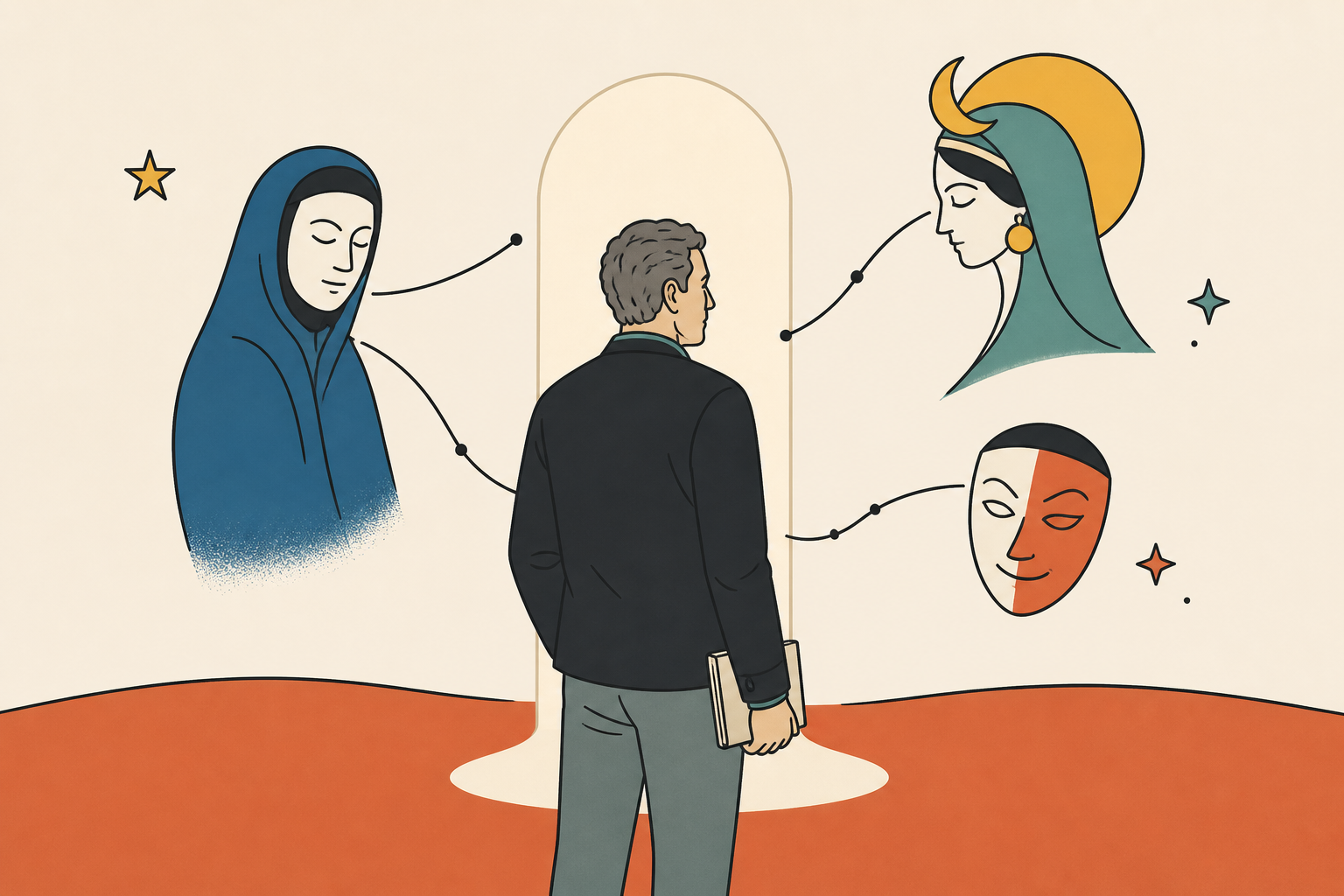
This morning I picked up a printed copy of Change Magick: A Modern Framework for Personal Mastery from the office floor and began leafing through it. I hadn’t looked at the framework for a while. It was still alive with great stuff: chaos magick, Jungian psychology, NLP, belief as a tool, personal mythology, ritual, shadow work. Much of it has since found its way into Narrative Alchemy, but the framework still holds together in its own right.
I was looking for something I could try today. One practice caught my attention:
Archetypal invocation for daily empowerment.
Archetypal invocation is a way of finding a figure larger than your habitual self and allowing that figure to alter how you stand, see, speak, and act for a while. It can happen before a difficult conversation, at the edge of a blank page, or in the car park before you walk into a room where the old version of you usually takes over.
I decided to try it today. If it catches your attention too, the practice below gives you a way to test it in a real situation of your own.
The figures behind the face
Jung used archetype for recurring patterns in psychic life that appear through dreams, stories, religions, art, fantasies, and behaviour. In “The Concept of the Collective Unconscious”, he distinguishes the inherited possibility of a pattern from the particular image it takes in a culture or a life. We never meet an archetype naked. We meet images: the Mother, the Child, the Trickster, the Warrior, the Wise Old Woman, the King, the Hermit, the Wanderer, the Magician. The pattern puts on local clothes.
The Warrior is not one fixed character with a sword and an expensive beard. A nurse holding steady during a night shift may carry the pattern. So may the person who finally says no to a relationship that has hollowed them out. The Warrior might arrive as quiet endurance, clean boundary, moral courage, disciplined attention, or the willingness to remain present when every part of you wants to flee.
An archetype gives related actions, images, emotions, postures, and values a recognisable shape. It lets the psyche say, “This kind of human situation has happened before. Here is one old pattern for meeting it.”
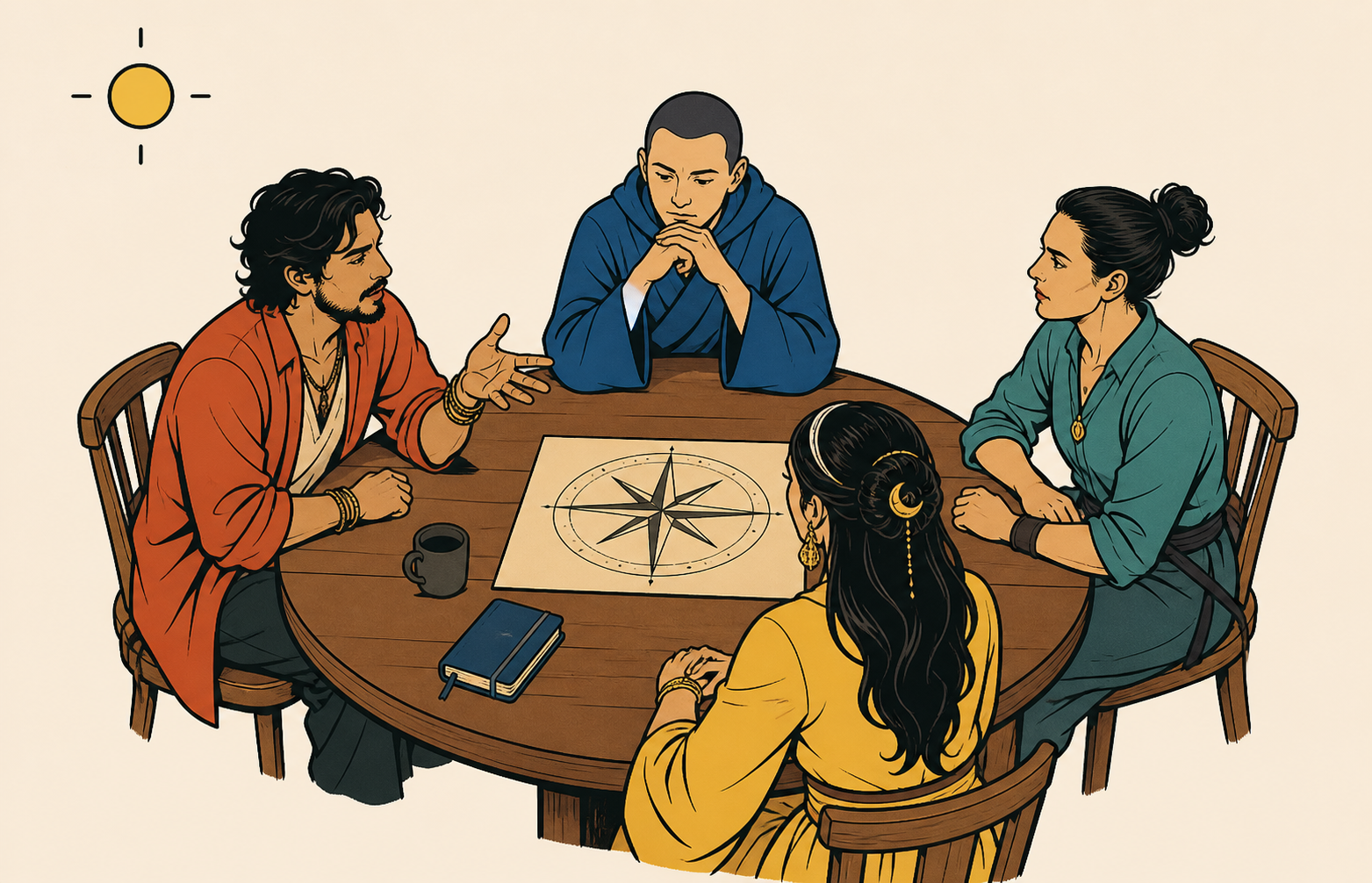
I’ve already been using this through what I call the inner council. The Monk protects contemplation, freedom, study, and the right to follow the rhizome. The Frontman wants contact, audience, livelihood, and the live current of being seen. The Trainer turns knowledge into practices that another person can use. The High Priestess listens for the pattern beneath their arguments.
These figures began as a way of making an inner conflict visible. Once they had names, I could hear what each one wanted without forcing them into a single grey compromise. The High Priestess, in particular, changed the room. She didn’t bring another opinion. She brought a different quality of attention: slower, receptive, less eager to turn every mystery into a plan. That council grew from the same practice I explored through tarot.
That is close to the method Jung describes in “The Transcendent Function”: beginning with a real mood or emotional charge, allowing its images and associations to develop, then giving them a concrete form through dialogue, writing, movement, drawing, or fantasy. You don’t surrender your judgement to the figure. You meet it. You let it speak, question it, argue with it, notice what changes in the encounter.
There is a useful tension here. If I reduce the High Priestess to “my intuitive side,” the image loses some of its power. She becomes a label on a storage box. If I treat her as an infallible supernatural authority, I have given the image far too much power. The middle path is imaginal relationship: take the figure seriously without mistaking the figure for the whole truth.
The symbol must not devour the person.
You are invoking all the time
Formal invocation feels strange because everyday invocation passes without comment.
Put on a uniform and see what happens to your spine. Walk into a school reunion and notice which age your voice becomes. Sit behind a desk with your job title on the door. Lace up boots for a long walk. Pick up a guitar in front of an audience. Enter the kitchen where your family is already arguing. Each setting calls forward a version of you.
The room invokes. The clothes invoke. The remembered audience invokes. Music invokes. Language invokes. Another person’s face can summon a character you haven’t played for twenty years.
Social life depends on this capacity. We move between roles without considering it occult. Friend, parent, teacher, stranger, lover, writer, customer, patient. Each role selects certain memories and behaviours while pushing others towards the wings. Trouble begins when one role takes the theatre and refuses to leave, or when the character summoned by a situation is the least capable one available.
The person facing a difficult meeting may invoke the Pleaser before the door opens. The blank page may invoke the Examiner, complete with red pen and disappointed expression. A money conversation can summon the Frightened Child even when the adult at the table has decades of experience.
Archetypal invocation introduces choice into that process. Instead of asking, “How do I make myself feel confident?”, I can ask, “Who knows how to enter this room?”
Confidence is an abstraction. A seasoned Diplomat knows how to pause before answering. A Warrior knows where the boundary lies. A Trickster can break the spell of false seriousness. A Caregiver can stay close to pain without rushing to fix it. A Sovereign can make a decision and accept the cost.
Psychology has several neighbouring ideas. Research on embodied cognition challenges the picture of thought as something that happens in a sealed chamber behind the eyes; cognition develops through the traffic between brain, body, and environment. The much-discussed work on “enclothed cognition” asked whether clothing can affect attention through both its symbolic meaning and the experience of wearing it. A later meta-analysis raised concerns about the repeatability of the earliest studies while finding support for newer work. The modest question remains useful: what we put on may participate in the state we enter.
A study often called the Batman effect found that young children persisted longer at a dull task when they took the perspective of an admired character. Batman gave them enough distance from immediate frustration to act differently. Adults may have better vocabularies for self-regulation, but we still borrow courage from people, characters, ancestors, songs, uniforms, and stories.
The imagination is not floating above behaviour. Give a state a name, a face, a posture, and a field of values, and you create more handles by which the body can find it.
Invocation is more than dressing up
A costume can help, but the practice goes deeper than wearing a cloak and hoping Odin sorts out your inbox.
An archetype includes a way of selecting information. Invoke the Warrior and you may see the point of decision. Invoke the High Priestess and you may notice what everyone has spoken around. Invoke the Fool and the same situation may reveal an opening where the cautious self saw only embarrassment. Each figure edits the scene.
This is why invocation belongs inside Narrative Alchemy. A story does not live only as a sentence in the head. It lives in what the body expects, which details the senses notice, the meaning assigned to another person’s silence, and the action that feels possible next.
I wrote about identity as a narrative repeated until it feels like ground. Invocation works from the other direction. Instead of analysing the old story for another hour, you give a different pattern temporary use of your hands and feet.
Temporary matters. The aim is not to replace a cramped identity with a grandiose one. “I am always the Warrior” is another prison, and probably an exhausting person to live with. Invocation works best as a deliberate movement into a pattern, followed by a deliberate return.
Chaos magick contributes a useful lightness here: belief can function as an instrument. Enter the ritual fully enough for it to alter experience, then set it down and examine what happened. That experimental stance runs through Change Magick and Narrative Alchemy. We can inhabit a useful fiction without demanding that it become the final metaphysics of the universe.
The test is not whether the archetype was “really there.” The test is what you could perceive and do while the pattern was active, what it cost, and whether the result made your life more honest.
An experiment: borrow a larger self
Set aside thirty to forty-five minutes. Choose a real situation close enough to matter and small enough to test. A conversation you have been postponing. An hour of writing. A decision that has gone soft around the edges. A walk taken with a question. Don’t begin with your deepest trauma or the most explosive relationship in your life. An experiment needs enough pressure to reveal something, not so much that it floods the laboratory.
1. Name the scene
Write three plain sentences:
- What am I about to do?
- Which version of me usually appears here?
- What becomes difficult when that character takes over?
Stay with behaviour. “I lose my power” gives you little to work with. “I talk too quickly, soften every request, and agree before I have checked my diary” gives the experiment somewhere to stand.
2. Choose the needed quality before the figure
Ask what the situation requires: courage, patience, mischief, steadiness, receptivity, clean authority, tenderness, endurance, curiosity.
Then choose a figure who carries that quality for you. Draw from myth, tarot, fiction, history, family memory, religion, cinema, or your own dreams. Athena, the Hermit, Columbo, Ripley, the High Priestess, your grandmother at the kitchen table, a nameless ferryman, the old martial arts teacher from a film you saw at twelve. Cultural respect matters; work with figures you know enough to approach without turning someone else’s living tradition into a prop.
Choose a figure with edges. “The Successful Person” is a motivational poster. Columbo has a coat, a pace, a way of asking one more question while appearing to have missed the point. Specificity gives the nervous system something to enact.
3. Interview the figure
On paper, ask:
- What do you notice first in this scene?
- What do you refuse?
- What do you protect?
- How do you use your voice?
- What is your shadow here?
- Which other figure keeps you honest?
Write the answers quickly in the figure’s voice. Let surprise happen, but keep your adult judgement in the room. An invoked Warrior who wants to destroy a colleague has exposed inflation or anger, not delivered sacred instructions. Bring in the Diplomat, Healer, Fool, or Witness as a corrective.
The best archetypal work is rarely a solo act. In The Warrior Archetype in Tarot, the Warrior develops across different cards rather than appearing as one lump of aggression. My own Warrior needs the Taoist Wizard: discipline corrected by timing, force corrected by attunement. Each figure keeps the other from becoming a caricature.
4. Build a threshold
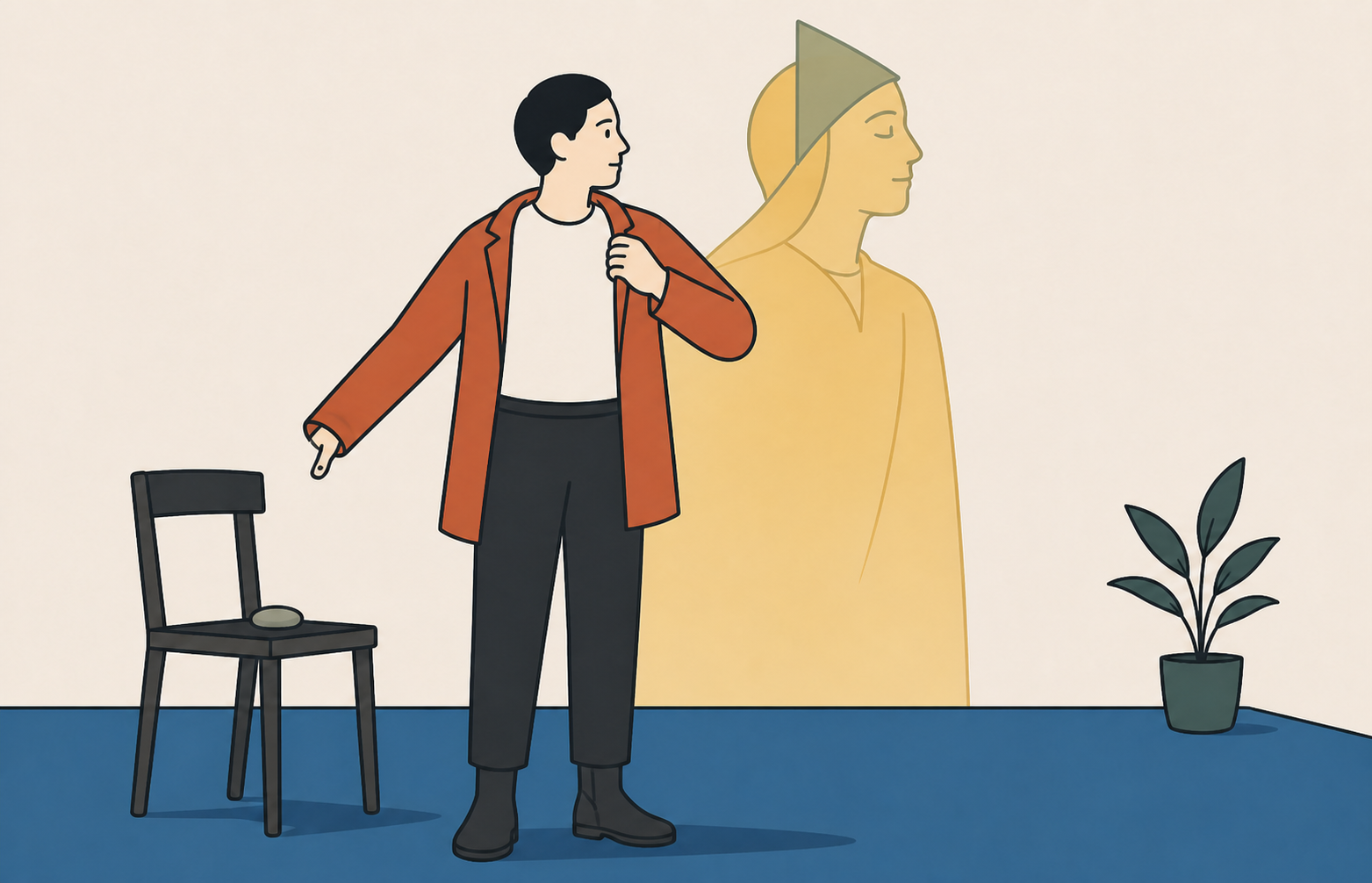
Create a small transition into the role. Change one item of clothing. Stand in a different place. Put on one piece of music. Hold an object. Draw a mark on a card. Speak the figure’s name.
Then alter three physical details:
- stance;
- breath;
- gaze.
Don’t perform for an imaginary audience. You are giving the body a clear instruction. If your figure is the Sovereign, you might place both feet on the floor, let the exhale finish, and look at the whole room before speaking. If your figure is the Trickster, loosen the knees, tilt the head, and search for the detail that makes the official story wobble.
Say:
For the next thirty minutes, I give the [figure] a seat at the controls. I remain responsible for what I do.
That last sentence stays in the ritual.
5. Take one piece of reality through the figure
Do the task. Write the page. Make the call. Walk with the question. Enter the meeting.
Keep the experiment narrow. You are testing whether this pattern changes perception and action. Notice one moment when your habitual character would have taken over. What does the invoked figure do instead?
You may feel nothing dramatic. Good. The Rubedo of this kind of work often looks like Tuesday morning: a slower answer, a straightened sentence, a request made without apology, ten more minutes at the page. Understanding becomes transformation when it reaches muscle and timing.
6. Return the borrowed face
End on purpose. Remove the item. Change the music. Wash your hands. Step outside. Take three ordinary breaths and name five things in the room.
Say:
The experiment is complete. I release the figure and return as myself.
This is not empty ceremony. De-roling protects you from confusing access with identity. You borrowed the Warrior’s boundary; you do not need to spend the evening patrolling the kitchen. You borrowed the High Priestess’s silence; you still have to answer your messages.
7. Record the evidence
Write without interpretation for five minutes:
- What changed in my body?
- What did I notice that I usually miss?
- What action became possible?
- Where did the figure become theatrical, inflated, or unhelpful?
- What quality do I want to integrate without keeping the costume?
Run the same invocation three times before deciding what it means. Change one variable if needed. Compare it with doing the task in your ordinary state. Treat the journal as a field notebook, not a book of prophecies.
The figure is a doorway
Archetypal invocation can become another form of avoidance. You can spend a week designing the perfect ritual instead of making the phone call. You can inflate a frightened ego by naming it King. You can use the Magician to pretend that consequences are optional. You can let the High Priestess wait forever for a sign.
Every archetype carries a shadow. That is one reason I prefer a council to a throne.
The practice also has limits. If inner figures become intrusive, frightening, commanding, or difficult to distinguish from shared reality, stop the experiment and seek qualified support. Active imagination asks for a stable witness: the part of you that can enter the image and come back, holding metaphor and matter in the same hand.
Used with that grounding, invocation gives us a form of rehearsal that is richer than positive thinking. “I am confident” leaves the imagination hungry. “For this conversation, I will borrow the patience and unhurried gaze of the old ferryman” supplies a body, a tempo, and a relationship to the crossing.
Something from the invoked figure may remain after the ritual. The experiment can reveal that the borders of the familiar personality are less solid than they looked.
Archetypal invocation is one of the bridges between Change Magick and Narrative Alchemy. Change Magick works with belief and personal power. Narrative Alchemy works with the stories, images, and inherited roles through which a self takes shape. Archetypal invocation joins the two at the level of lived experiment. A new story borrows a body for half an hour and finds out whether it can walk.
The printout on the office floor reminded me that Change Magick had never really gone away. The project had been wearing other names, speaking through later work, waiting inside phrases I still use.
The framework returned as an archetype of its own: the manuscript on the floor, dusty but unoffended, carrying a tool I wanted to use today.
So I’m putting the tool back on the table as a question you can test with your own breath, posture, imagination, and next action:
Who knows how to enter the room you are about to enter?
If this post gave you something to carry into your day, consider supporting my work by buying me a coffee or making a monthly donation or subscribing (free) to the blog.