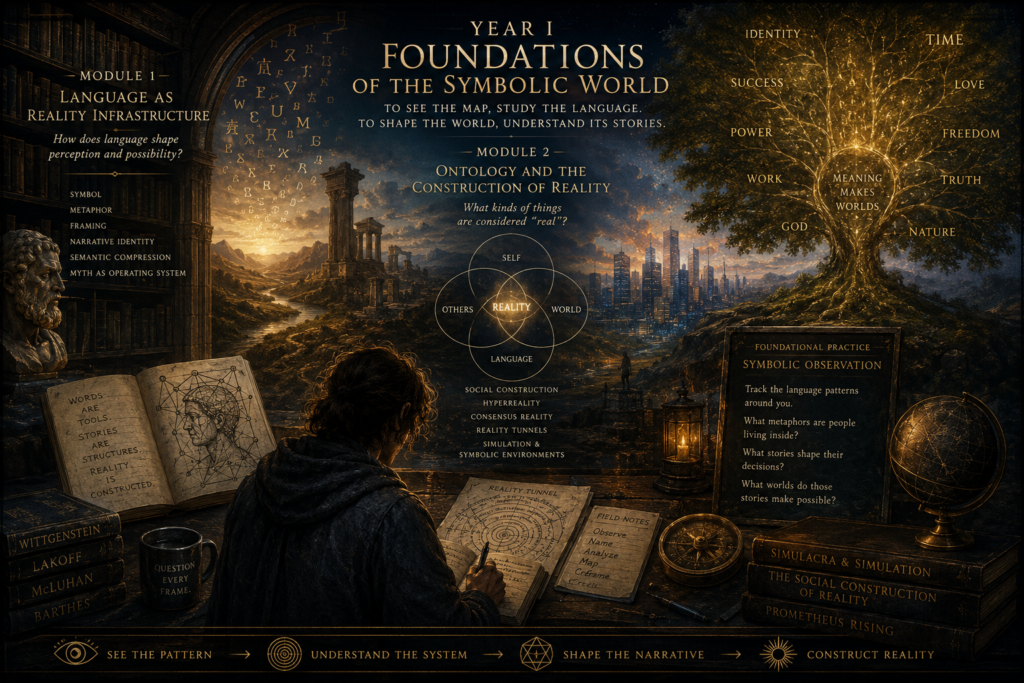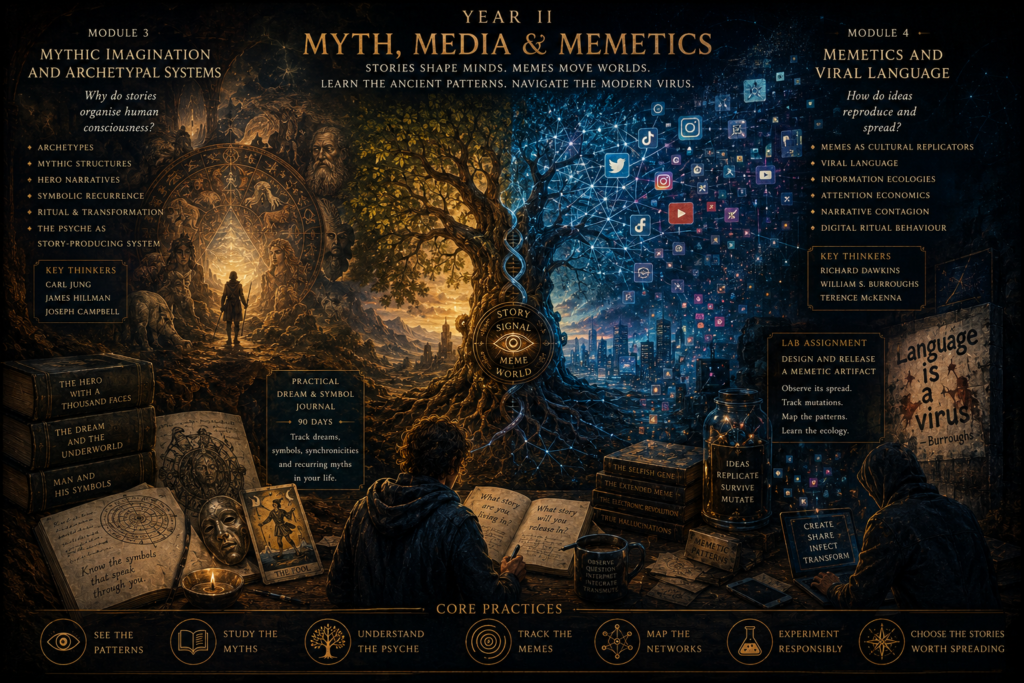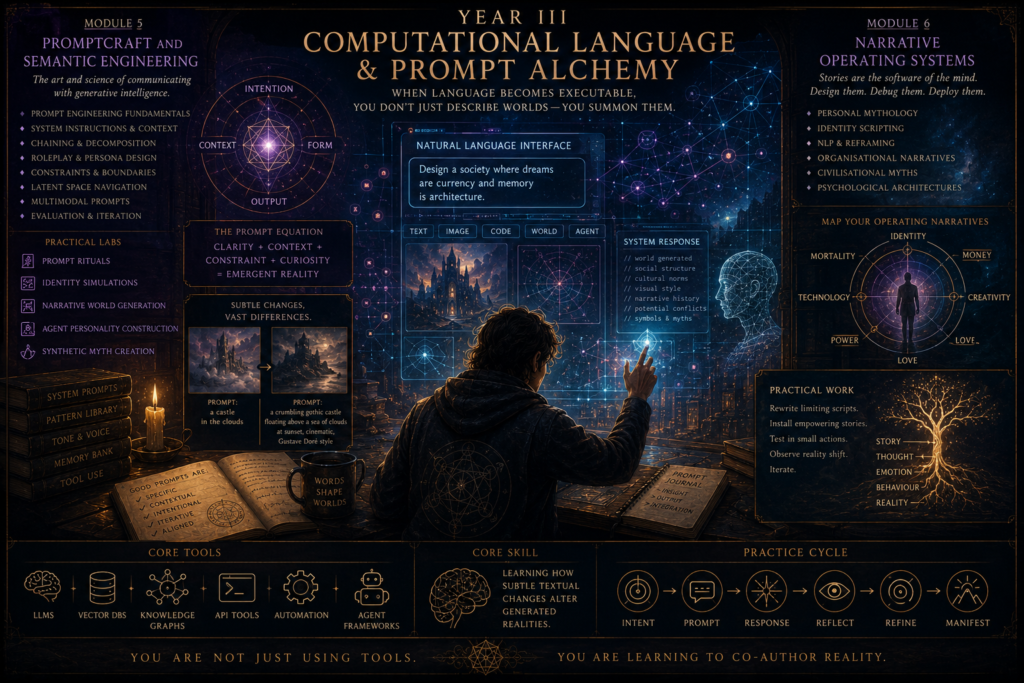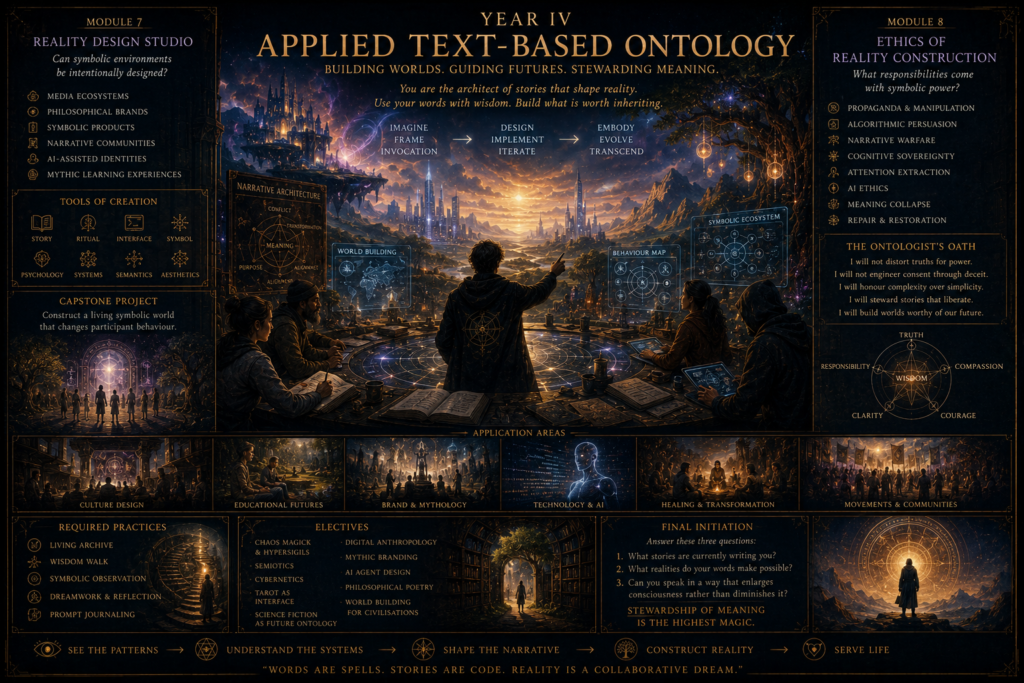
There was a time when ontology belonged to philosophers in heavy coats asking whether tables were real. The question has since escaped the seminar room and entered the machine. Today, ontology is no longer merely the study of being. It is the management of symbolic reality systems. The organisation of categories. The naming of entities. The arrangement of relations between things. And increasingly, this work occurs inside environments where language itself is operational infrastructure. The medium is no longer paper describing reality from a distance. The medium is executable text.
To call oneself a text-based ontologist sounds at first like either a joke or an overinflated job title invented by someone with too many tabs open and insufficient sunlight exposure. But the phrase becomes less absurd the longer one sits with it. We are already surrounded by people whose primary interaction with reality occurs through symbolic manipulation. Lawyers rewrite social reality through contracts. Coders rewrite machine reality through syntax. Priests rewrite existential reality through sacred language. Advertisers rewrite desire through slogans. Politicians rewrite collective memory through narrative framing. Therapists rewrite identity through conversational reframing. Symbolic operators have always governed the world.
The difference now is velocity.
The old symbolic systems moved at the speed of institutions. The new ones move at the speed of prompts.
Something profound changes when text ceases to be merely descriptive and becomes generative. For most of human history, language pointed toward reality. Increasingly, language produces reality. A prompt enters a system, and a world appears. Images materialise. Code executes. Agents act. Financial markets move. Human emotions shift. Narratives spread across networks and alter behaviour at civilisational scale. The symbolic has escaped containment and become infrastructural.
William Burroughs saw this long before the arrival of large language models. “Language is a virus from outer space,” he wrote, which sounded delightfully insane until language itself became programmable matter. Burroughs understood something many rationalists still resist: words do not simply communicate ideas. They colonise nervous systems. They propagate behaviours. They alter perceptual boundaries. A sentence can become a habitation. A metaphor can become a prison. A story can become an operating system.
The text-based ontologist works directly with these architectures.
Not merely writing words, but examining the ontological assumptions embedded inside them. What categories are being invoked? What forms of existence are being permitted? What relations are being normalised? What realities become thinkable once particular linguistic structures are installed?
This sounds abstract until one notices how much of ordinary life already operates this way.
Consider the phrase “personal brand.” Two words. Entire ontological reorganisation. A human being is subtly reconceived as a market-facing symbolic asset requiring optimisation, visibility management, and audience capture. Once the phrase enters culture, behaviours follow naturally. Identity reorganises itself around metrics. Experience becomes content inventory. Friendship becomes networking potential. Leisure becomes monetisable authenticity performance.
Ontology disguised as vocabulary.
Or consider the transformation produced by therapeutic language entering mainstream discourse. Suddenly, ordinary sadness becomes diagnosable pathology. Disagreement becomes toxicity. Attachment becomes a style category. Human experience is reorganised through linguistic classification systems. Entire emotional landscapes become newly visible while others disappear into shadow. The categories determine the perceptual field.
The text-based ontologist studies these transitions the way an ecologist studies invasive species.
But there is another layer now emerging beneath all this, stranger than anything Burroughs or even McLuhan fully anticipated. We are entering environments where text is no longer merely interpreted by humans. It is interpreted by nonhuman cognition. Language has become a machine-readable reality substrate.
This changes everything.
In earlier eras, writing functioned primarily as a means of communication between minds. Today, writing increasingly functions as environmental programming. Prompts shape machine behaviour. Metadata shapes visibility. Taxonomies shape retrieval. Context windows shape cognition itself. One begins to realise that modern existence is increasingly governed not by physical architecture but by semantic architecture.
The old industrial world was built from steel, concrete, oil, and electricity.
The new world is built from tokens.
A strange sentence. Yet increasingly literal.
The text-based ontologist, therefore, becomes something like an infrastructure mystic. Part philosopher, part systems thinker, part occult engineer. Someone attempting to understand what happens when language becomes the universal interface layer between humans, machines, institutions, and reality models themselves.
And because this occurs largely through text, the ancient magical intuition suddenly returns, wearing computational clothing.
The magicians were not entirely wrong.
A sigil is a compressed intention encoded symbolically to alter behaviour through subconscious channels. A prompt is a compressed intention encoded symbolically to alter machine behaviour through statistical inference. The mechanisms differ. The structural resemblance remains uncanny.
“Speak the right words and the world changes.”
This was once religious thinking. Then magical thinking. Then, poetic thinking. Now, increasingly technical thinking.
The contemporary coder already understands this instinctively. Tiny symbolic variations produce radically different outcomes. A misplaced character collapses the system. Precise syntax summons operational realities from invisible infrastructure. The programmer sits before the glowing screen, uttering ritual language into abstraction layers they only partially comprehend, invoking processes hidden beneath visibility.
A medieval grimoire would not find this entirely unfamiliar.
Nor would Kafka.
Because the psychological consequence of existing inside text-mediated reality is profound. One begins to experience life itself as editable. Identities become revisable drafts. Narratives become modular. Selves become version-controlled symbolic constructs moving through overlapping systems of interpretation.
This is liberating right up until it becomes destabilising.
The postmodernists announced decades ago that reality was textually mediated, but they largely encountered this insight academically. We are encountering it operationally. The distinction matters. It is one thing to theorise that identity is socially constructed. It is another thing entirely to live inside systems where identity literally emerges through profile fields, prompts, feeds, databases, tags, recommendation systems, and algorithmic categorisation structures.
Ontology becomes user interface design.
And somewhere inside all this, the text-based ontologist wanders like a tunnel inspector beneath civilisation, examining the symbolic pipes through which reality flows.
The work quickly becomes archaeological.
One notices, for example, how many inherited concepts no longer map cleanly onto current conditions. “Author.” “Reader.” “Originality.” “Truth.” “Presence.” “Knowledge.” These words arrived from earlier epistemological environments. Print culture assumptions persist awkwardly inside networked cognition. We still speak as though humans produce discrete finished texts consumed passively by other humans, even as synthetic cognition dissolves the boundaries between writing, dialogue, simulation, remixing, and collaborative generation.
The categories lag behind reality.
This lag produces ontological turbulence.
A writer today increasingly resembles less a solitary creator and more a navigator moving through fields of symbolic probability. The role shifts from generating language ex nihilo toward shaping flows, curating resonance, constructing interpretive environments, training symbolic systems, and orchestrating meaning emergence across human and machine cognition simultaneously.
The solitary author dissolves into distributed cognition networks.
This alarms people attached to older models of authorship because the romantic image of the writer depends heavily upon scarcity. The lone genius confronting silence. But text generation is no longer scarce. Language itself has become abundant beyond precedent. We are entering a civilisation-scale surplus of words.
Which means the scarce resource shifts elsewhere.
Attention, perhaps.
Discernment.
Signal integrity.
Ontological coherence.
The text-based ontologist, therefore, becomes less concerned with producing more language and more concerned with maintaining meaningful structures inside symbolic excess. The role begins to resemble gardening more than manufacturing. Pruning. Arranging. Pattern recognition. Cultivating conceptual ecosystems where certain forms of thought become possible, and others wither.
This is why notebook culture has become so important for many contemporary thinkers. Obsidian vaults. Linked notes. Knowledge graphs. Constellational writing systems. These are not merely productivity tools. They are attempts to externalise cognition spatially inside textual environments.
The note becomes a semantic object connected relationally to other semantic objects.
Thought itself becomes navigable terrain.
Walter Benjamin would have understood immediately. So would Borges. So would the medieval mystics constructing memory palaces through symbolic architecture. The difference now is that the architecture has become interactive, recursive, searchable, and increasingly inhabited by machine cognition alongside human cognition.
The archive is no longer passive storage.
The archive thinks back.
Or appears to.
This introduces another strange psychological shift for the text-based ontologist: the growing impossibility of maintaining stable distinctions between internal and external cognition. Memory once resided primarily within the skull, supplemented by bookshelves. Now thought distributes itself fluidly across notes, feeds, databases, search engines, AI systems, voice memos, hyperlinks, and collaborative symbolic environments.
The self becomes partially exoskeletal.
One begins to think with tools rather than merely through them.
Marshall McLuhan insisted media function as extensions of nervous systems. We are now living inside the full implications of that statement. The smartphone is not merely a communication device. It is an auxiliary memory organ. Social platforms are distributed identity surfaces. AI systems increasingly function as conversational cognition mirrors reflecting symbolic associations back toward the user.
The consequences remain psychologically underexamined because the speed of transition exceeds our capacity for philosophical digestion.
Which is why the text-based ontologist matters.
Someone must descend into the tunnels and map the new symbolic infrastructure.
Someone must ask what kinds of humans emerge from environments where language itself becomes a programmable reality substrate.
Already the effects are visible.
Attention fragments into feed logic. Identity performs itself continuously under conditions of algorithmic visibility. Experience increasingly arrives preformatted for narration. The interior monologue itself starts adopting platform cadence. Human beings begin unconsciously optimising speech patterns for machinic legibility.
Even spirituality mutates under these conditions.
The ancient contemplative traditions generally aimed toward silence. Dissolution of conceptual fixation. Liberation from compulsive narration. But contemporary life pushes relentlessly in the opposite direction toward continuous textualisation. Everything becomes explainable, documentable, shareable, captionable, and promptable.
One suspects the mystics would diagnose this as a new form of possession.
And yet there is another possibility hidden inside the same technologies.
Because text-based ontology also allows unprecedented forms of self-authorship.
A person trapped inside inherited narratives can now encounter alternative symbolic frameworks at extraordinary speed. Someone raised within one reality tunnel can suddenly access thousands of competing ontologies. Philosophy, psychology, mythology, neuroscience, occultism, systems theory, poetry, machine cognition, contemplative traditions — all collapsing into the same searchable symbolic field.
This can produce confusion.
It can also produce liberation.
Robert Anton Wilson described reality tunnels as the perceptual structures through which humans organise experience. Most people inherit theirs unconsciously. The text-rich environment destabilises this inheritance mechanism by exposing individuals to radical ontological plurality. Suddenly, one sees that every worldview is at least partially constructed through language patterns, symbolic framing, and narrative reinforcement loops.
The tunnel walls become visible.
Once visible, editable.
The text-based ontologist, therefore, occupies a paradoxical role. Both cartographer and saboteur. Mapping symbolic systems while simultaneously revealing their contingency. Exposing how realities are constructed without collapsing into nihilistic relativism.
Because the danger here is obvious.
If all realities become merely textual constructions, meaning itself risks dissolution. The postmodern collapse into endless ironic distance. Infinite interpretation without commitment. Semantic drift without grounding. One eventually disappears into abstraction layers disconnected from embodied life.
The healthiest forms of text-based ontology, therefore, remain tethered to lived experience.
Nietzsche understood this deeply. His philosophy was never merely conceptual. It emerged physiologically. Walking, climate, digestion, solitude, music, illness, and altitude. Thought rooted in embodiment. The aphoristic form itself reflected this understanding. Ideas arriving through movement rather than systematic abstraction.
This matters enormously now because contemporary symbolic environments increasingly encourage disembodiment. Endless semantic manipulation detached from material consequence. The text-based ontologist risks becoming a ghost floating through conceptual architectures while forgetting sunlight, hunger, weather, mortality, and touch.
The antidote is rhythm.
Walks.
Conversations.
Silence.
The return to the body as an ontological anchor.
Otherwise, one eventually disappears into simulation recursion.
This perhaps explains the growing fascination many people feel toward practices like journaling, psychogeography, analogue note-taking, tarot, contemplative walking, and tactile rituals. These practices reintroduce friction into environments tending toward total abstraction. They restore symbolic engagement to embodied temporality.
A tarot card pulled physically from a deck feels different from infinite algorithmic feed generation because the ritual slows interpretation. Attention thickens. Meaning condenses around the encounter rather than the acceleration.
The same applies to walking through cities.
Psychogeography is ultimately a form of embodied ontology. The city read symbolically through movement. Infrastructure is becoming psyche. Architecture becoming narrative. The walker discovers that space itself carries ideological assumptions and emotional residue.
The text-based ontologist extends this impulse into digital environments.
What kinds of consciousness emerge from notification architectures? What metaphysics are implied by the infinite scroll? What ontological assumptions underpin platform identity systems? What forms of selfhood are encouraged by metrics-driven visibility economies?
These are no longer merely technological questions.
They are existential ones.
Because every medium secretly carries a philosophy of human nature embedded within its structure.
Industrial systems treated humans as mechanical labour units.
Broadcast media treated humans as audience aggregates.
Network platforms treat humans as engagement nodes.
AI environments increasingly treat humans as prompt-generating symbolic entities interacting recursively with machine cognition.
Each framework subtly reshapes self-understanding.
And perhaps this is the strangest realisation awaiting the text-based ontologist operating today:
We may ourselves be becoming textual entities.
Not literally, of course. Flesh remains stubbornly physical. Mortality remains gloriously analogue. But identity increasingly exists as editable symbolic continuity distributed across platforms, archives, messages, prompts, databases, photographs, behavioural traces, recommendation profiles, and conversational systems.
The self becomes partially written.
Partially searchable.
Partially generative.
A fluid symbolic construct is maintained collaboratively between human memory and machine systems.
This terrifies people seeking a stable essence.
Yet perhaps there was never stability to begin with.
Only stories repeated long enough to feel solid.
The text-based ontologist does not necessarily mourn this revelation. Nor celebrate it uncritically. The role is observational before ideological. Descending into the tunnels. Listening to the hum of symbolic infrastructure beneath contemporary life. Noticing where language hardens into invisible architecture. Noticing where new forms of freedom emerge inside the same systems that produce enclosure.
And perhaps most importantly, remembering that no ontology is neutral.
Every naming is an invitation.
Every classification a boundary.
Every metaphor a corridor.
Every story a machine for generating possible worlds.
To work consciously with text in this era is therefore to work directly with the hidden architecture of reality-production itself.
Not because words are everything.
But because increasingly everything passes through words on its way to becoming real.