I’m not asking what happens to productivity or output. I’m asking what happens to meaning.
When thinking is distributed across human-AI systems, something genuinely new appears. Not better thinking or faster thinking. A different category. Meaning that emerges from the interchange itself, that no single node, human or machine, can claim to have authored.
You can’t point to the moment you had the idea. You can’t separate what you thought from what the system returned. The origin dissolves. What remains is only the pattern that emerged between you.
This isn’t collaboration in the old sense. Collaboration assumed distinct agents contributing discrete parts. What I’m describing is closer to emergence. The meaning appears in the space between, and neither party can reconstruct how it got there.
We’ve organised centuries of intellectual life around authorship. Around the idea that meaning originates in a single location like a person, a mind, or a signature. Kant thought this. Woolf wrote that. The work points back to its source.
Networked thought makes that gesture impossible. The meaning that appears doesn’t have a return address.
I don’t know yet whether this is loss or liberation. Probably both. What I know is that it forces a different question: if meaning doesn’t require a single author, what else have we been wrong about?
How should I live? Socrates called it the examined life. The Daoists called it the Way. Every philosophical tradition worth its name has some version of it, which tells you something. This question isn’t optional. It’s baked into what it means to be human.
I was listening to Jordan Peterson’s Maps of Meaning on my walk into town this afternoon, heading to Tesco to pick up a few things. I listened to chapter one, Maps of Experience. Already, it feels like one of those books you don’t just read. You go into it.
His opening move is deceptively simple. We don’t experience the world as a bunch of objects. We experience it as a field of meaning.
A chair isn’t just a physical thing with weight and structure. It’s something to sit on. Something in the way. Something that belongs to someone. Something that defines a corner of a room. The meaning shows up first. The “object” comes later, when we deliberately shift into analysis.
That sounds obvious until you follow it all the way through.
If meaning comes first, if the world we actually live in is a world of significance rather than just things, then how we make meaning isn’t some optional add-on. It’s the central question. And the tools we’ve built for that, myth, religion, story, and ritual, are not primitive versions of science waiting to be replaced. They answer a different kind of question. One science doesn’t even try to answer.
Peterson is making an epistemological point, not a theological one. Science asks how things work. Myth asks how you should act in relation to them. Those are different categories.
You can understand the neurochemistry of grief and still have no idea how to grieve. You can explain the evolutionary function of courage and still not know how to be brave. A map of mechanism isn’t a map of meaning.
What mythology carries, across cultures and millennia, is behavioural wisdom. Not the kind you can fully capture in neat propositions. The hero who descends into the underworld, faces the monster, and comes back changed is as precise a description as we have of how real change works. You go into the unknown. You face what’s there. If you make it back, you bring something with you that matters, not just for you but also for others.
The hero’s journey isn’t just a story template. It’s a map of territory every one of us has to cross at some point.
I’ve spent over twenty years working at the level of story, with people trying to rewrite the scripts running their lives, often without realising those scripts are there. What I keep seeing is this. Transformation doesn’t happen in the rational mind.
You can understand a story is false. You can trace where it came from, see what it’s costing you, and even describe a better version. And still stay stuck. Understanding sits on the surface. The story runs deeper.
Peterson is giving me the theoretical scaffolding for what I’ve been seeing in practice. Myth is where the code runs. Reason mostly skims across the top. Which is why you can’t just think your way into a different life. You have to work at the level of story.
This is where Friedrich Nietzsche comes in. He saw, maybe more clearly than anyone, what was at stake when the West started dismantling its mythic foundations in the name of reason.
“The death of God” is a cultural diagnosis. The framework that held meaning together for centuries was losing its grip. The stories were no longer landing in the way they needed to.
They still existed. The language was still there. The symbols were still in circulation. But something in the relationship between people and those stories had shifted. They were no longer inhabited in the same way. What had once organised perception, behaviour, and value from the inside began to feel external, optional, even arbitrary.
The structure remained in place, but the felt reality that gave it force had thinned. And once that happens, a framework can persist for a long time in form while quietly losing its ability to orient action.
The framework doesn’t disappear just because you’ve stopped believing in it.
Peterson touches on this almost in passing, but it deserves more attention. The idea that human beings have inherent worth. That truth matters, not just strategically but morally. That history has direction, that actions accumulate, that things tend somewhere. These are not scientific facts. They are inheritances. Mythic ones.
The code is still running, whether you’re aware of it or not.
Nietzsche saw the consequence. You can’t keep the fruit while cutting the root. Eventually the structure underneath inherited morality collapses. What fills that gap is not reason. Reason is good at taking things apart. It is not good at building something to live inside.
What tends to rush in is ideology, a partial map pretending to be the whole territory. The twentieth century gave us more than enough evidence of that.
This is what Peterson is pointing at when he contrasts the hero with the ideologue. The hero goes into the unknown willing to be changed. The ideologue goes in with conclusions already fixed and forces everything to fit them. One updates the map. The other defends it.
I’ve been orbiting these ideas for a long time, from different directions. Carl Jung and archetypes. NLP and deep structure. Chaos magick and the idea that belief is something you use, not something you have to commit to permanently.
Underneath it all, the same question keeps returning. Why do these ancient stories still hit? Even now. Even for people who have rejected the systems that produced them. Why does the hero going into the dark still land in the chest like recognition?
Peterson’s answer is clean. Those stories describe the structure of experience itself. The known and the unknown. Order and chaos. Mapped territory and the edges where the map runs out.
Every life moves through that terrain.
Myths are the compressed record of how to do it. They were carried forward because they worked. Because the people who knew how to move through that landscape made it through. The others did not.
Story is not just how we communicate meaning. It is how we hold it.
Peterson has spent thirty years mapping this from inside the library. I’ve spent twenty-odd years mapping it from inside the room. Different routes, similar conclusions. That kind of convergence is always interesting.
So I’m going in.
I don’t know yet where it will lead. The best thinking rarely ends up where you expect. I’ll write as I go. Follow the thread rather than pretend I already know the destination.
If this is your kind of terrain, the questions that don’t sit still, the place where mythology and the problem of how to live turn out to be the same thing, come along.
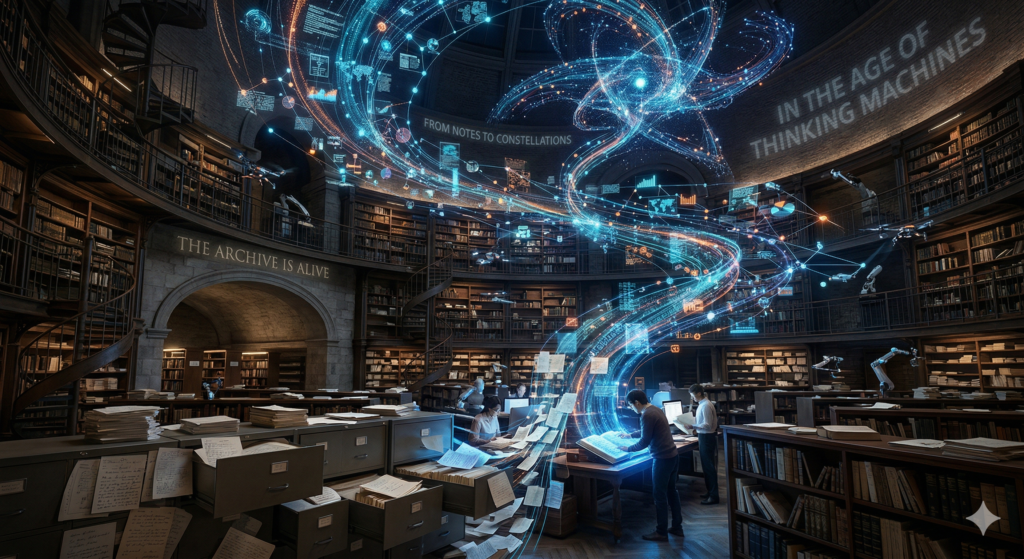
From Notes to Constellations in the Age of Thinking Machines
I opened Obsidian expecting to find a note I’d written three months earlier about liminality and threshold states. What I found instead was a cluster of connections I hadn’t consciously built. Six notes reaching backward through NLP reframe patterns, Jungian individuation, and something I’d scribbled at midnight about rivers carving canyons. The note I was looking for was there. But it was not alone. It was alive inside a web I had been unconsciously weaving for months without knowing I was doing it.
I thought I was building a second brain.
What I found was something that talked back.
This is the discovery that a personal knowledge system quietly springs on you, if you stay long enough and go deep enough. The archive is no longer a place where knowledge is stored. It is a conversational field of memory where meaning is continuously re-authored. The philosophers have been circling this question for decades. What is the archive, really? Now the tools have caught up with the theory, and the question is no longer abstract.
My Obsidian Graph View
The classical dream of the personal knowledge system is seductive precisely because it is so orderly. You capture everything. You tag, you nest, you link. You choose between PARA and Zettelkasten and spend more time than you’d like to admit deciding how you feel about folders. You read Sönke Ahrens on the slip-box and resolve to be more systematic. You restructure the vault on a Saturday and feel, briefly, that the work of understanding is mostly a problem of organisation. If you could only get everything in the right place, it would add up to something.
This is the animating belief of the productivity-as-optimisation culture that has grown up around tools like Notion, Roam, Obsidian, and Logseq: knowledge is an asset, and like any asset, it compounds when well managed. The second brain becomes an internal balance sheet. Information in, insights out.
But here is what that model gets wrong. Structure is not insight. Storage is not meaning. You can build the most elegant taxonomy in the world and still have nothing to say. You can tag a hundred notes about identity and transformation and still not understand what they are pointing toward. The organisation gestures at meaning without producing it.
Vannevar Bush understood this in 1945. In “As We May Think,” he imagined the Memex — a device for associative retrieval rather than categorical filing. The human mind, he observed, does not operate by indexes. It operates by association. One idea instantly suggests another along a web of connections traced through thought, experience, and analogy. Every attempt to impose a hierarchical structure on that web is, at some level, a suppression of how thinking actually moves.
The Zettelkasten preserves one version of this insight. Luhmann’s slip-box was not an archive in the traditional sense. It was a dialogue partner. Notes were written to talk to other notes. The system was designed to surprise you. But it was still static. The notes did not respond. They had to be arranged and read into relationship by a human doing the connecting.
Something strange happens when the system becomes dense enough. The dots begin to behave differently.
There is a useful image for what happens next: notes that began as isolated dots, over time, form constellations. And constellations have a fractal quality — the patterns at one scale recur at another. A thought about grief turns out to have the same structural shape as a thought about creative block. A note on alchemical transformation echoes a note on narrative identity written eight months later, by what felt like a different version of the writer. The resonance is real. The geometry repeats.
Obsidian makes this visible. The graph view, the backlinks, the quiet surfacing of related notes as you type — these are not just navigation aids. They are mirrors. You begin to see not just what you have been collecting but what you have been circling. The recurring themes, the obsessions beneath the surface interests, the deep attractor patterns in your own thinking.
This is where hypertext promised to take us in the 1990s. Ted Nelson’s vision of a docuverse was, at its heart, a vision of associative, non-linear knowledge. The link was meant to be generative. One document pointing to another, pointing to another, creating a topology of meaning rather than a sequence. Jorge Luis Borges had already written it, in the Library of Babel, as fiction: a total archive containing all possible books, which becomes not a resource but a labyrinth, precisely because it lacks any principle of living connection.
The limitation of hypertext was that it was static. The documents did not synthesise. They pointed, but they did not speak. Connections were visible if you chose to traverse them, but meaning had to be assembled by hand and stayed assembled only for as long as the reader held it in their head.
That is what changes with language models.
When you bring an LLM into relationship with your archive, you are not adding a search function. You are adding a participant.
This distinction is the one that matters. A search engine finds what you already know you’re looking for. A conversational layer finds what you didn’t know was there. It surfaces patterns across notes you wrote years apart. It suggests that the thing you’ve been calling a problem is structurally identical to something you solved in a different domain three years ago. It reads your own thinking back to you in a way that reveals its architecture rather than merely its contents.
The archive becomes conversational. Memory becomes dynamic. Interpretation becomes iterative. Insight becomes emergent — not retrieved from storage, but generated in the encounter between past thinking and a present question.
This is what I mean by a conversational field of memory where meaning is continuously re-authored. The word field matters here. A field is not a container. It is a zone of interaction, with its own dynamics, its own resonances, its own strange attractors. When you enter the archive now, you do not simply retrieve. You stir the field. And the field responds.
Derrida, in Archive Fever, writes that the archive is always about the future as much as the past. The drive to archive is a drive toward what will have been — a structuring of the present so that some version of it persists. What he could not have anticipated is a system in which the archive does not merely persist but actively interprets itself. In which the past becomes material for ongoing sense-making rather than fixed record.
Foucault understood the archive not as a library but as a system of enunciability — the set of conditions that determines what can be said, and how. The LLM-augmented archive is, in a precise sense, a new system of enunciability. It changes not just what you can find. It changes what you can think.
Andrej Karpathy has been approaching this from the other direction. His LLM-Wiki proposal is a structured, densely interlinked knowledge document designed not for human navigation but for LLM ingestion — and the insight is precise. Most of the web was built for human readers. The formatting, the cross-references, the implied context: all of it assumes a reader who arrives with background knowledge and can resolve ambiguity on the fly. LLMs can do this too, but they do it better when the structure is explicit, the connections are surfaced, and the material is dense with meaning rather than optimised for search engines.
The practical move Karpathy proposes is to build your knowledge base as a document an LLM can reason over well. Not a folder of notes. A living interface over your own thinking.
I built a version of this using Claude Code — feeding my Obsidian vault into a structured interface that can be queried conversationally. The notes remain where they are. But I am no longer searching them. I am querying my mind-in-time.
The difference is not small. When I search my notes, I retrieve answers I already had. When I query the living archive, I generate understanding I am only arriving at now. The LLM does three things that transform the experience: it summarises across notes I would never read together, it connects ideas across domains I have kept artificially separate, and it reframes familiar material in ways that make the obvious suddenly strange. That third function is underrated. The ability to take something you have been staring at and rotate it so the light falls differently — that is not retrieval. It is cognition. And now it is available as a collaborative act between the writer and the machine.
If you want to work in a living archive rather than a static one, five moves will serve you.
Write for resonance, not retrieval. The note you are writing is not a document to be filed. It is a signal sent into a field. Write in a way that will vibrate against other notes, other ideas, other versions of your thinking. Forget the tag. Find the language that carries the feeling of the idea, even if the feeling is only half-formed.
Use links lightly and trust emergence. Over-tagging is a way of imposing premature closure. When everything is labelled, nothing is discovered. Leave space for the system to surprise you. The connections you did not make deliberately are often the most generative.
Ask better questions than you store answers. The archive is not an answer bank. It is a question generator. When you bring a language model into the conversation, the most productive prompts are not “summarise my notes on X” but the harder ones: what patterns am I missing here, where have I thought this before, what is the deeper narrative running through this cluster? These questions invite the system to do what it does best — read across the grain of your own thinking.
Use the AI as a pattern amplifier, not an authority. It surfaces connections. It does not define truth. The interpretation is still yours. What the model offers is a kind of cognitive peripheral vision — it sees things you are too close to see. The judgement about what matters belongs to you.
Treat old notes as living material. A note from three years ago is not a document. It is an artefact of the person you were then. When you read it now, you read it differently. When you query it through an LLM, you read it differently again. Let it evolve. The meaning is not fixed in the text. It lives in the encounter.
There is a risk here, and it is worth naming directly.
The more fluent you become in working with a conversational archive, the easier it is to mistake the system’s interpretation for your own thinking. The LLM surfaces a pattern, and you accept it. It suggests a connection, and you stop asking whether that connection is right. You begin navigating by the model’s map rather than your own perception of the territory.
This is narrative drift applied to cognition. You outsource interpretation and gradually lose authorship — not of your notes, but of your mind. The archive starts writing you.
Identity, in the depth psychology tradition, is not a fixed entity. It is a narrative. We are the stories we tell about ourselves, and those stories are formed through interpretation, through the ongoing act of meaning-making that is never fully conscious and never fully finished. If you hand that act entirely to a machine, you have not augmented your intelligence. You have abdicated the most important part of it.
The archive should be a collaborator. The distinction requires vigilance, and it requires that you bring your own reading — your own felt sense of what resonates, what rings true, what sits wrong — to every encounter with the system. The machine reads widely. Only you know what matters.
Which brings us to what I think is the deepest possibility inside all of this.
When I return to a note I wrote two years ago, I am not simply reading it. I am rewriting it. Not the words — the meaning. The same language, filtered through everything that has happened since, becomes something different. Something that could not have existed when the words were first laid down.
This is narrative alchemy. The revisiting of notes changes their meaning. The change in meaning changes the story you tell about yourself. The change in story changes who you are in the present, which changes what you do next. The archive is not preserving the past. It is continuously rewriting it.
That rewriting is where identity work actually happens — not in the dramatic moments of crisis or breakthrough, but in the quiet, iterative act of returning to old material and finding it transformed by new context. Metajournaling is a practice built on this principle. You do not merely journal; you journal about your journal. You read your past self as a text. You ask what the patterns meant, what stories were running beneath the surface, what the earlier you was trying to work out.
The LLM-augmented archive makes this practice deeper. The machine can read your past self more thoroughly than you can, across more notes over more time, with less of the psychological resistance that makes us skim past the uncomfortable entries. It holds the whole field steady while you do the interpretive work.
Walter Benjamin wrote about the constellation as a method for reading history — not as a sequence of causes and effects, but as a sudden flash of recognition in which distant moments illuminate each other across time. The dialectical image: the past and present colliding in a single, charged instant of understanding. That is what the living archive makes possible, not as an occasional accident, but as a practice, as a way of working deliberately with your own intellectual life.
What is emerging here is a genuinely different mode of thinking.
The old mode was linear, fixed, and archival. You wrote something down. It stayed where you put it. You retrieved it when you needed it. Meaning was deposited in documents and extracted from documents. The knower and the archive were separate, the archive passive, the knower doing all the moving.
The new mode is associative, conversational, and generative. Thinking is no longer solitary. It is co-evolutionary — a dynamic between the human and the machine, between the present self and the recorded past, between the single note and the constellation it belongs to without knowing it. The knower and the archive are in dialogue. The boundary between them is porous and productive.
This does not mean thought has been automated. It means the conditions for thought have changed. The field in which thinking occurs has new properties. It is denser, more resonant, more responsive. Ideas find each other faster. Patterns surface that would have stayed buried for years, or stayed buried forever. The question of who is thinking is genuinely more interesting than it used to be.
I came back to the note I was looking for.
Liminality. Threshold states. The moment between what you were and what you are becoming.
I found it in the middle of a constellation I had not noticed I was building. Six notes deep in a web of connections that only made sense because I could see all of them at once — because the archive had held them together long enough for the shape to surface.
You are not building a second brain. You are cultivating a living system of meaning.
A second brain is still a tool. It is external, supplementing you, doing your retrieval so your biological memory can rest. A living archive is something different. It is a relationship. It has its own texture, its own history, its own dynamics. You change it every time you write in it. It changes you every time you re-enter it.
Not a library. Not a database. A landscape you walk through, and which is altered by the walking.
The archive is alive. And every time you enter it, it becomes something new — because so do you.
You take in raw experience, sensation, and uncertainty, and your mind reshapes all of that into ideas, concepts, interpretations, and conclusions that help you function. The purpose isn’t to give you a flawless copy of some objective reality. You don’t have direct access to that anyway.
Your thoughts have done their job when they help you live more effectively. When they help you predict what might happen, weigh outcomes, make decisions, and respond well to real situations, then your thinking is doing what it’s meant to do.
So the real question isn’t whether your thoughts perfectly match some absolute truth out there. The real question is whether they’re useful. You test an idea by living with it, by seeing what it allows you to do, where it helps, and where it falls apart.
Put simply: your thinking is a tool for navigating life, not a mirror of ultimate reality.
There is a model hiding inside every moment you have ever course-corrected, changed your mind, or walked out of a room sensing something had shifted. It is not a philosophy. It is not a metaphor. It is a working system, and once you see it, you cannot unsee it.
The model is cybernetic. It is the same logic that keeps a thermostat maintaining temperature, that guides a missile to a target, that allows a living body to heal itself. It runs on a continuous loop of sensing, comparing, and adjusting. And it turns out that the four pillars at the heart of Narrative Alchemy map onto this loop almost exactly.
Put them in sequence and you don’t have a coaching framework. You have a description of how life actually works.
The Thermostat Knows Something You Have Forgotten
A thermostat has no anxiety about the gap between current temperature and desired temperature. It simply reads the room, compares it to the setting, and acts. If the room is cold, the heat comes on. If the room is warm, it shuts off. The loop never closes permanently because life is not a problem you solve once. It is a system you stay inside.
Human beings are capable of exactly this, and they are also capable of something the thermostat is not: they can get so attached to their existing behaviour that they refuse to run the loop at all. They keep doing what they are doing, deny the data coming in from their senses, and call it consistency.
This is where the cybernetic model becomes a diagnostic tool. When your life feels stuck, one of four things has broken down. Either you have lost contact with the system you are operating inside. Or you stopped paying attention to the feedback it is generating. Or you never got clear about what you actually wanted. Or you know all of this but you keep pulling the same lever.
The four pillars address each failure point in turn.
Rapport: Connecting to the System
Before you can influence anything, you have to be inside it.
Rapport is the condition of genuine connection with another person, a situation, or a context. It is not charm. It is not manipulation. It is attunement. The state of being in resonance with whatever system you are attempting to move through.
In cybernetic terms, rapport is the input channel. Without it, the feedback loop cannot begin because you are not actually receiving signal from the system you think you are engaging with. You are operating on a projection, a memory, an assumption.
The practitioner of chaos magick knows this from working with servitors and egregores: your working does not connect with the target if you have not first genuinely interfaced with it. The Jungian knows it from shadow work: you cannot integrate what you refuse to acknowledge as part of you. The NLP practitioner knows it because rapport is not a step before the real work begins. It is the substrate the real work runs on.
When you are in rapport, information flows in both directions. You affect the system, and the system affects you. This is not a power dynamic. It is participation.
The question rapport asks of you: are you actually here, in contact with this situation as it is, or are you engaged with a story about it?
Sensory Awareness: Gathering the Data
Once you are connected to the system, you need to know what it is telling you.
This is sensory awareness: the disciplined practice of receiving information through your actual senses rather than through the filter of what you expect to perceive. Most of us think we are observing our environment. What we are mostly doing is confirming our existing model of it.
The feedback loop runs on real data. If you have degraded your input channels through assumption, through selective attention, through the psychological need to be right, the loop cannot self-correct. You are working with noise and calling it signal.
Sensory awareness is what makes the difference between a practitioner and a theorist. The practitioner notices micro-expressions, tonal shifts, changes in breathing, and the quality of silence in a room. The practitioner reads the energy of a working and adjusts in real time. The practitioner walks through a place and feels what is actually there rather than what is supposed to be there.
This is not mysticism. It is high-resolution perception. It is what twenty-five years of journaling practice builds when it is done honestly: you train your attention to notice what is actually present rather than what you wish were present. Your journal becomes a log of genuine observations rather than a literature of preferred reality.
The question sensory awareness asks of you: what is actually happening right now, and how much of what you think is happening is something you brought with you?
Outcome Thinking: Setting the Direction
A feedback loop without a target is just noise. It generates movement, but not direction.
Outcome thinking is the process of establishing a clear, specific, sensory-grounded representation of what you want. Not what you want to avoid. Not what you think you can get. What you actually want. The distinction matters because the system cannot navigate toward an absence. If your stated outcome is “I want to stop feeling anxious,” the system has nothing to point toward. The compass needs a destination, not a repulsion.
This is where the magical tradition and the NLP tradition converge completely. Neville Goddard’s instruction to live in the end. The chaos magician’s practice of constructing the intention before the working. The vision board that embarrasses the rational mind but somehow keeps producing results. All of these are ways of establishing a target state that the cybernetic system can use as a reference point.
The thermostat needs the setting before it can do anything. The missile needs coordinates. The self needs an outcome.
Outcome thinking is also where most people stall, not because they cannot think clearly but because they are afraid to commit. To name what you want is to risk not getting it. So the protective strategy becomes to keep the outcome vague. If you never really aimed at anything specific, you never really missed.
The cybernetic model does not allow this luxury. Vague outcomes produce vague trajectories. The loop cannot compare “current state” to “desired state” if the desired state is a fog.
The question outcome thinking asks of you: if you woke up tomorrow and this situation was exactly as you want it to be, what would you see, hear, and feel that would tell you the change had happened?
Behavioral Flexibility: Adjusting the Response
This is where most people discover that knowing the model is not the same as living it.
Behavioural flexibility is the capacity to do something different when what you are doing is not working. It sounds obvious. It is extraordinarily rare. The definition of insanity that everyone quotes is not really about insanity. It is about the human attachment to familiar behaviour even in the face of clear feedback that the familiar behaviour is not producing the desired result.
The cybernetic principle here is direct: the element in the system with the most behavioural options has the most influence over the system’s outcome. Not the loudest element. Not the most forceful. The most flexible.
This is one of the most counterintuitive ideas in the whole framework. Power, in a feedback loop, comes not from dominating the system but from being able to vary your response to it. The river carves the canyon not because it is harder than the rock but because it never stops adjusting.
Behavioural flexibility is also where the spiritual dimension of this model becomes most visible. The tradition of beginner’s mind. The instruction to hold your intentions lightly. The alchemical understanding that transformation requires the old form to dissolve before the new one can emerge. All of this is, in functional terms, behavioural flexibility. The willingness to release the approach that is not working and try something you have never tried before.
The question behavioural flexibility asks of you: what have you been unwilling to do differently, and what does that unwillingness actually cost you?
The Loop in Motion
These four pillars are not a sequence you run through once and finish. They are a continuous loop that you are always already inside.
Rapport feeds the sensory channel. Sensory awareness provides the data that gets compared to the outcome. The comparison generates the signal that calls for behavioural adjustment. And behavioural adjustment requires returning to rapport with the system to receive the next round of feedback.
This is life as an iterative experiment. Not life as a project with a completion date. Not life as a performance where you hope to eventually get it right. Life as a system you are perpetually engaged with, constantly receiving data from, and always capable of adjusting in response to.
The magician who understands this stops grieving their failures and starts mining them for information. The coach who understands this stops trying to deliver the perfect intervention and starts listening for what the client is actually telling them. The person who understands this stops asking “why does this keep happening to me” and starts asking “what feedback am I currently ignoring?”
The stories you are running, the narratives that structure your experience of reality, are the software layer sitting on top of this cybernetic hardware. When a story is debugged, when a limiting belief is rewritten, what actually happens is that the feedback loop is restored. You reconnect to the system, you restore your sensory input channels, you clarify your outcome, and you expand your behavioural repertoire.
Narrative alchemy is not a poetic name for therapy. It is a description of what is actually happening when a human being changes.
The Model Is Not the Territory
One final note: the cybernetic model is itself a story. It is a map. And like all maps, it has edges, places where the territory stops cooperating with the representation.
There are dimensions of human experience that a feedback loop cannot fully account for. Grace. Synchronicity. The moment when something shifts not because you worked the system correctly but because you finally stopped working it at all. The tradition has its own name for this: wu wei, surrender, the dark night that precedes the dawn.
The model is useful precisely because it is a model. It gives you traction when you are stuck and clarity when you are confused. But the practitioner who worships the model misses the point as surely as the one who rejects it.
Hold it lightly. Run the loop. And stay curious about what happens when it surprises you.
In a world that often measures value in terms of productivity and tangible outcomes, the life of the mind can seem like an indulgence, something reserved for scholars, professionals, or those with the luxury of time. But intellectual engagement—curiosity, reflection, and the pursuit of knowledge—is not the domain of a select few. It is a fundamental part of what it means to be human, as natural as breathing and as vital as nourishment.
This piece invites us to rethink what it means to cultivate an inner life. It reminds us that intellectual activity is not confined to lecture halls or research papers; it thrives in late-night conversations, solitary walks, book clubs, and quiet moments of personal inquiry. It belongs to the amateur botanist tending a backyard garden, the musician experimenting with new sounds, and the taxi driver weaving philosophy into casual conversation. It is a wellspring available to anyone willing to seek, question, and connect the dots.
By exploring the ways in which learning serves as both a refuge and a resource, this reflection challenges the notion that intellectualism is a privilege rather than a birthright. It calls on us to claim our space in the world of ideas, to see knowledge-seeking not as an obligation but as an art of living—an invitation to wonder, to wander, and ultimately, to expand the boundaries of what we know and who we are.
So as you read, consider: How do you nurture your inner life? Where do you engage in the world of ideas outside of conventional spaces? And what role does intellectual activity play in shaping not just what you know, but who you become?
There is a sanctuary within each of us, an inner life that forms the core of our being—a place of refuge, contemplation, and quiet resistance against the entropy of the world. This sanctuary does not construct itself; it must be nurtured and cultivated like a walled garden, not to keep the world out, but to create a space where deeper currents of thought, wonder, and understanding can flow freely.
Many paths lead to this cultivation. Some find it in music, their fingers translating emotion into sound, making the ineffable briefly tangible. Others shape their inner life through service, in acts of kindness toward the weak and vulnerable, finding that tending to another’s need also fortifies something deep within themselves. Some walk through forests or sit by the sea, listening to the wisdom encoded in wind and waves. Some kneel in prayer, turning inward through the lens of devotion.
And then, there is learning—an endless, self-replenishing well, both a resource and a refuge, a place not only to think but to be. The pursuit of knowledge, of intellectual engagement, is not merely a professional exercise reserved for those with letters after their name or offices lined with books. It is as much at home in the late-night conversations of insomniacs and philosophers as in the classroom. It thrives in taxicabs, in the minds of street poets and amateur astronomers, in book clubs, in backyard gardens where hands work the soil while minds unearth ideas. It belongs to the one who reads at dawn before the house stirs, to the bartender who memorizes lines from ancient texts between shifts, to the office worker who turns lunch breaks into reading hours, and to the wanderer who collects ideas like talismans along the way.
To be human is to think, to question, to make connections—to pull meaning from the noise. The life of the mind is not an ivory tower pursuit, some elite indulgence. It is a birthright, a practice as universal as breath, available to all who seek it. Its central goods—wonder, insight, discovery, the ability to reframe reality—are not the province of specialists, nor should they be. They are as much the domain of the curious child asking why the stars shine as they are of the philosopher contemplating first principles.
More than a discipline, intellectual activity is a natural good. Like fire, it has existed wherever humans have existed, illuminating the darkness of uncertainty, warming the spaces between solitude and connection. And just as fire can be kindled anywhere, so too can intellectual life be fostered in the most unexpected of places: at the kitchen table, in the park, on a long drive, in a well-worn notebook, in a passing thought scribbled onto the margins of a grocery list. It flourishes where it is fed, where the soil is rich with curiosity and the air hums with the desire to know.
The tragedy is not that intellectual life is difficult, nor that it requires access to exclusive institutions, but that it is so often framed as a pursuit for the few rather than a wellspring for all. To engage in the life of the mind is not to isolate oneself but to expand the boundaries of one’s world. It is not retreat but emergence. Not an escape, but a return—to oneself, to others, to the pulse of life seen anew.
For the world may press upon us with its demands, its distractions, its relentless momentum, but an open mind—a mind in motion—is a sanctuary that cannot be easily besieged. It is an inner citadel, a place of freedom that no force can take by conquest, and no system can wholly suppress. To nurture it is to claim something essential and unyielding: the right to wonder, to wander, to think, and to know.
And in that knowing, to be fully, fiercely alive.
Reflection Prompts
Inner life prompt: What are the practices that nurture your inner life? Whether it’s intellectual exploration, music, time in nature, or something else entirely—what activities help you cultivate a sense of depth, reflection, or sanctuary in your daily existence?
Everyday intellectualism prompt: Where do you most often engage in intellectual activity outside of traditional academic or professional spaces? Is it in late-night conversations, solitary reflection, long walks, book clubs, social media debates, or somewhere unexpected?