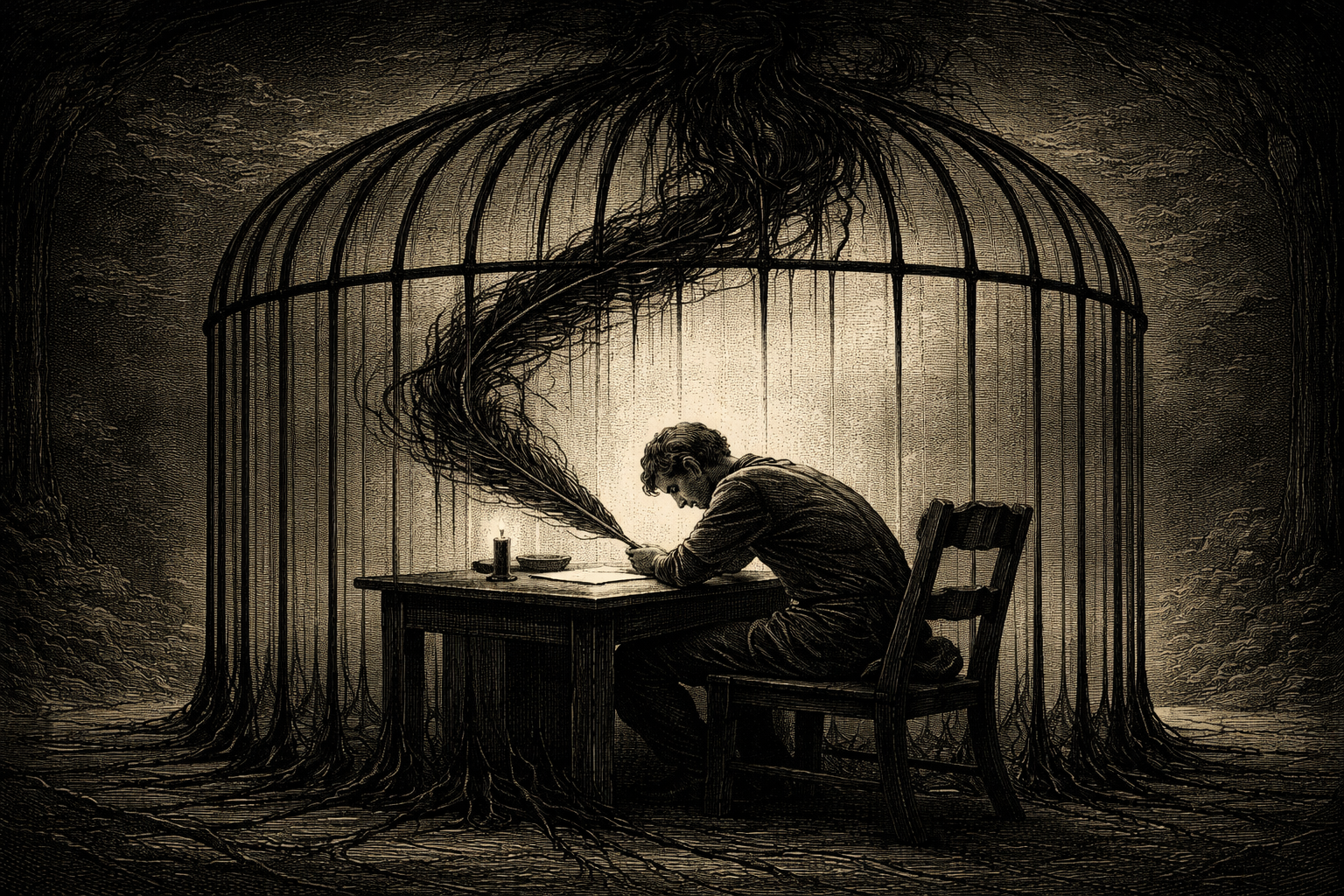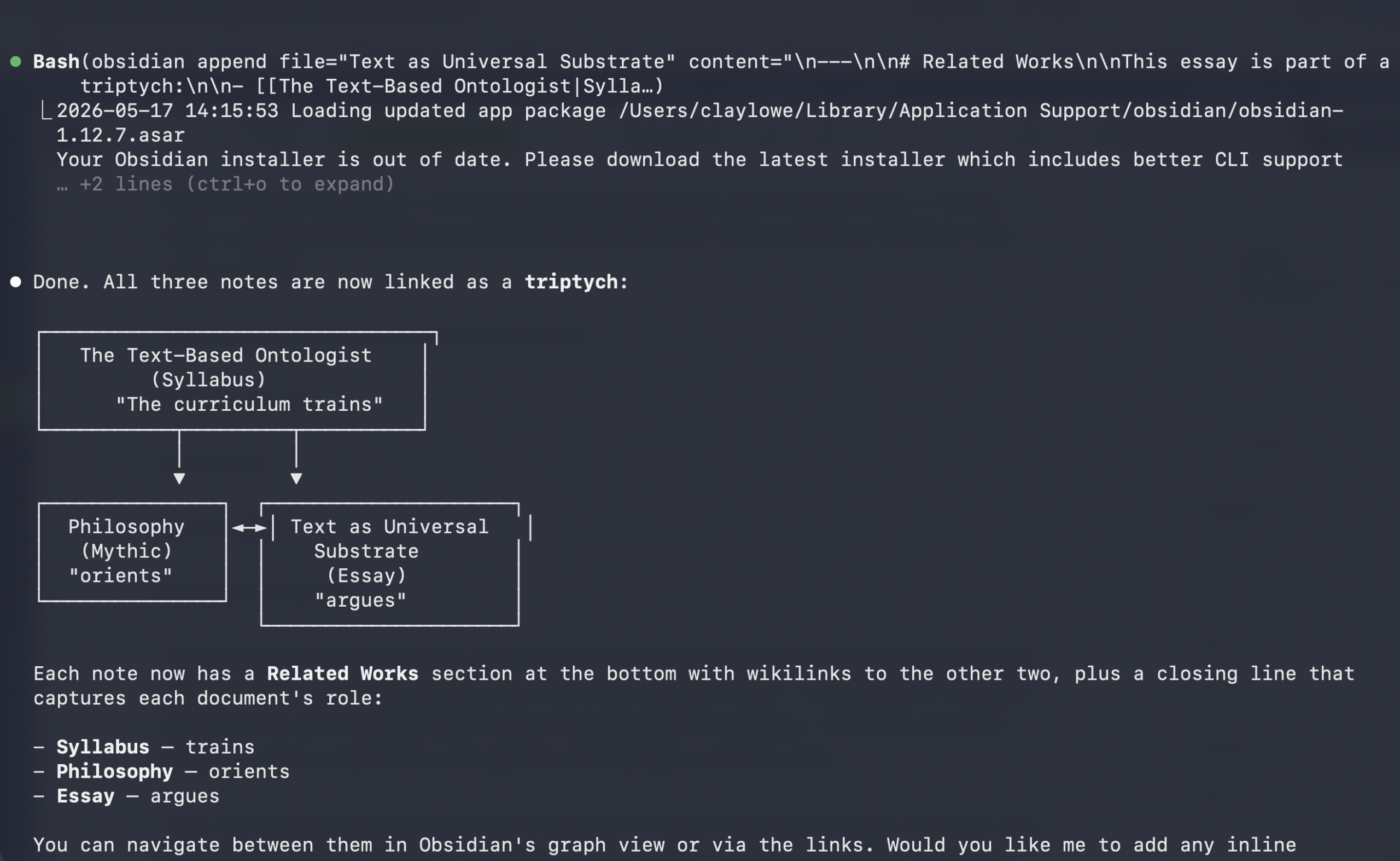
Notes Toward a Text-Based Ontology in the Age of Executable Language

There was a time when ontology belonged to philosophers in heavy coats asking whether tables were real. The question has since escaped the seminar room and entered the machine. Today, ontology is no longer merely the study of being. It is the management of symbolic reality systems. The organisation of categories. The naming of entities. The arrangement of relations between things. And increasingly, this work occurs inside environments where language itself is operational infrastructure. The medium is no longer paper describing reality from a distance. The medium is executable text.

To call oneself a text-based ontologist sounds at first like either a joke or an overinflated job title invented by someone with too many tabs open and insufficient sunlight exposure. But the phrase becomes less absurd the longer one sits with it. We are already surrounded by people whose primary interaction with reality occurs through symbolic manipulation. Lawyers rewrite social reality through contracts. Coders rewrite machine reality through syntax. Priests rewrite existential reality through sacred language. Advertisers rewrite desire through slogans. Politicians rewrite collective memory through narrative framing. Therapists rewrite identity through conversational reframing. Symbolic operators have always governed the world.

The difference now is velocity.

The old symbolic systems moved at the speed of institutions. The new ones move at the speed of prompts.

Something profound changes when text ceases to be merely descriptive and becomes generative. For most of human history, language pointed toward reality. Increasingly, language produces reality. A prompt enters a system, and a world appears. Images materialise. Code executes. Agents act. Financial markets move. Human emotions shift. Narratives spread across networks and alter behaviour at civilisational scale. The symbolic has escaped containment and become infrastructural.

William Burroughs saw this long before the arrival of large language models. “Language is a virus from outer space,” he wrote, which sounded delightfully insane until language itself became programmable matter. Burroughs understood something many rationalists still resist: words do not simply communicate ideas. They colonise nervous systems. They propagate behaviours. They alter perceptual boundaries. A sentence can become a habitation. A metaphor can become a prison. A story can become an operating system.

The text-based ontologist works directly with these architectures.

Not merely writing words, but examining the ontological assumptions embedded inside them. What categories are being invoked? What forms of existence are being permitted? What relations are being normalised? What realities become thinkable once particular linguistic structures are installed?

This sounds abstract until one notices how much of ordinary life already operates this way.

Consider the phrase “personal brand.” Two words. Entire ontological reorganisation. A human being is subtly reconceived as a market-facing symbolic asset requiring optimisation, visibility management, and audience capture. Once the phrase enters culture, behaviours follow naturally. Identity reorganises itself around metrics. Experience becomes content inventory. Friendship becomes networking potential. Leisure becomes monetisable authenticity performance.

Ontology disguised as vocabulary.

Or consider the transformation produced by therapeutic language entering mainstream discourse. Suddenly, ordinary sadness becomes diagnosable pathology. Disagreement becomes toxicity. Attachment becomes a style category. Human experience is reorganised through linguistic classification systems. Entire emotional landscapes become newly visible while others disappear into shadow. The categories determine the perceptual field.

The text-based ontologist studies these transitions the way an ecologist studies invasive species.

But there is another layer now emerging beneath all this, stranger than anything Burroughs or even McLuhan fully anticipated. We are entering environments where text is no longer merely interpreted by humans. It is interpreted by nonhuman cognition. Language has become a machine-readable reality substrate.

This changes everything.

In earlier eras, writing functioned primarily as a means of communication between minds. Today, writing increasingly functions as environmental programming. Prompts shape machine behaviour. Metadata shapes visibility. Taxonomies shape retrieval. Context windows shape cognition itself. One begins to realise that modern existence is increasingly governed not by physical architecture but by semantic architecture.

The old industrial world was built from steel, concrete, oil, and electricity.

The new world is built from tokens.

A strange sentence. Yet increasingly literal.

The text-based ontologist, therefore, becomes something like an infrastructure mystic. Part philosopher, part systems thinker, part occult engineer. Someone attempting to understand what happens when language becomes the universal interface layer between humans, machines, institutions, and reality models themselves.

And because this occurs largely through text, the ancient magical intuition suddenly returns, wearing computational clothing.

The magicians were not entirely wrong.

A sigil is a compressed intention encoded symbolically to alter behaviour through subconscious channels. A prompt is a compressed intention encoded symbolically to alter machine behaviour through statistical inference. The mechanisms differ. The structural resemblance remains uncanny.

“Speak the right words and the world changes.”

This was once religious thinking. Then magical thinking. Then, poetic thinking. Now, increasingly technical thinking.

The contemporary coder already understands this instinctively. Tiny symbolic variations produce radically different outcomes. A misplaced character collapses the system. Precise syntax summons operational realities from invisible infrastructure. The programmer sits before the glowing screen, uttering ritual language into abstraction layers they only partially comprehend, invoking processes hidden beneath visibility.

A medieval grimoire would not find this entirely unfamiliar.

Nor would Kafka.

Because the psychological consequence of existing inside text-mediated reality is profound. One begins to experience life itself as editable. Identities become revisable drafts. Narratives become modular. Selves become version-controlled symbolic constructs moving through overlapping systems of interpretation.

This is liberating right up until it becomes destabilising.

The postmodernists announced decades ago that reality was textually mediated, but they largely encountered this insight academically. We are encountering it operationally. The distinction matters. It is one thing to theorise that identity is socially constructed. It is another thing entirely to live inside systems where identity literally emerges through profile fields, prompts, feeds, databases, tags, recommendation systems, and algorithmic categorisation structures.

Ontology becomes user interface design.

And somewhere inside all this, the text-based ontologist wanders like a tunnel inspector beneath civilisation, examining the symbolic pipes through which reality flows.

The work quickly becomes archaeological.

One notices, for example, how many inherited concepts no longer map cleanly onto current conditions. “Author.” “Reader.” “Originality.” “Truth.” “Presence.” “Knowledge.” These words arrived from earlier epistemological environments. Print culture assumptions persist awkwardly inside networked cognition. We still speak as though humans produce discrete finished texts consumed passively by other humans, even as synthetic cognition dissolves the boundaries between writing, dialogue, simulation, remixing, and collaborative generation.

The categories lag behind reality.

This lag produces ontological turbulence.

A writer today increasingly resembles less a solitary creator and more a navigator moving through fields of symbolic probability. The role shifts from generating language ex nihilo toward shaping flows, curating resonance, constructing interpretive environments, training symbolic systems, and orchestrating meaning emergence across human and machine cognition simultaneously.

The solitary author dissolves into distributed cognition networks.

This alarms people attached to older models of authorship because the romantic image of the writer depends heavily upon scarcity. The lone genius confronting silence. But text generation is no longer scarce. Language itself has become abundant beyond precedent. We are entering a civilisation-scale surplus of words.

Which means the scarce resource shifts elsewhere.

Attention, perhaps.

Discernment.

Signal integrity.

Ontological coherence.

The text-based ontologist, therefore, becomes less concerned with producing more language and more concerned with maintaining meaningful structures inside symbolic excess. The role begins to resemble gardening more than manufacturing. Pruning. Arranging. Pattern recognition. Cultivating conceptual ecosystems where certain forms of thought become possible, and others wither.

This is why notebook culture has become so important for many contemporary thinkers. Obsidian vaults. Linked notes. Knowledge graphs. Constellational writing systems. These are not merely productivity tools. They are attempts to externalise cognition spatially inside textual environments.

The note becomes a semantic object connected relationally to other semantic objects.

Thought itself becomes navigable terrain.

Walter Benjamin would have understood immediately. So would Borges. So would the medieval mystics constructing memory palaces through symbolic architecture. The difference now is that the architecture has become interactive, recursive, searchable, and increasingly inhabited by machine cognition alongside human cognition.

The archive is no longer passive storage.

The archive thinks back.

Or appears to.

This introduces another strange psychological shift for the text-based ontologist: the growing impossibility of maintaining stable distinctions between internal and external cognition. Memory once resided primarily within the skull, supplemented by bookshelves. Now thought distributes itself fluidly across notes, feeds, databases, search engines, AI systems, voice memos, hyperlinks, and collaborative symbolic environments.

The self becomes partially exoskeletal.

One begins to think with tools rather than merely through them.

Marshall McLuhan insisted media function as extensions of nervous systems. We are now living inside the full implications of that statement. The smartphone is not merely a communication device. It is an auxiliary memory organ. Social platforms are distributed identity surfaces. AI systems increasingly function as conversational cognition mirrors reflecting symbolic associations back toward the user.

The consequences remain psychologically underexamined because the speed of transition exceeds our capacity for philosophical digestion.

Which is why the text-based ontologist matters.

Someone must descend into the tunnels and map the new symbolic infrastructure.

Someone must ask what kinds of humans emerge from environments where language itself becomes a programmable reality substrate.

Already the effects are visible.

Attention fragments into feed logic. Identity performs itself continuously under conditions of algorithmic visibility. Experience increasingly arrives preformatted for narration. The interior monologue itself starts adopting platform cadence. Human beings begin unconsciously optimising speech patterns for machinic legibility.

Even spirituality mutates under these conditions.

The ancient contemplative traditions generally aimed toward silence. Dissolution of conceptual fixation. Liberation from compulsive narration. But contemporary life pushes relentlessly in the opposite direction toward continuous textualisation. Everything becomes explainable, documentable, shareable, captionable, and promptable.

One suspects the mystics would diagnose this as a new form of possession.

And yet there is another possibility hidden inside the same technologies.

Because text-based ontology also allows unprecedented forms of self-authorship.

A person trapped inside inherited narratives can now encounter alternative symbolic frameworks at extraordinary speed. Someone raised within one reality tunnel can suddenly access thousands of competing ontologies. Philosophy, psychology, mythology, neuroscience, occultism, systems theory, poetry, machine cognition, contemplative traditions — all collapsing into the same searchable symbolic field.

This can produce confusion.

It can also produce liberation.

Robert Anton Wilson described reality tunnels as the perceptual structures through which humans organise experience. Most people inherit theirs unconsciously. The text-rich environment destabilises this inheritance mechanism by exposing individuals to radical ontological plurality. Suddenly, one sees that every worldview is at least partially constructed through language patterns, symbolic framing, and narrative reinforcement loops.

The tunnel walls become visible.

Once visible, editable.

The text-based ontologist, therefore, occupies a paradoxical role. Both cartographer and saboteur. Mapping symbolic systems while simultaneously revealing their contingency. Exposing how realities are constructed without collapsing into nihilistic relativism.

Because the danger here is obvious.

If all realities become merely textual constructions, meaning itself risks dissolution. The postmodern collapse into endless ironic distance. Infinite interpretation without commitment. Semantic drift without grounding. One eventually disappears into abstraction layers disconnected from embodied life.

The healthiest forms of text-based ontology, therefore, remain tethered to lived experience.

Nietzsche understood this deeply. His philosophy was never merely conceptual. It emerged physiologically. Walking, climate, digestion, solitude, music, illness, and altitude. Thought rooted in embodiment. The aphoristic form itself reflected this understanding. Ideas arriving through movement rather than systematic abstraction.

This matters enormously now because contemporary symbolic environments increasingly encourage disembodiment. Endless semantic manipulation detached from material consequence. The text-based ontologist risks becoming a ghost floating through conceptual architectures while forgetting sunlight, hunger, weather, mortality, and touch.

The antidote is rhythm.

Walks.

Conversations.

Silence.

The return to the body as an ontological anchor.

Otherwise, one eventually disappears into simulation recursion.

This perhaps explains the growing fascination many people feel toward practices like journaling, psychogeography, analogue note-taking, tarot, contemplative walking, and tactile rituals. These practices reintroduce friction into environments tending toward total abstraction. They restore symbolic engagement to embodied temporality.

A tarot card pulled physically from a deck feels different from infinite algorithmic feed generation because the ritual slows interpretation. Attention thickens. Meaning condenses around the encounter rather than the acceleration.

The same applies to walking through cities.

Psychogeography is ultimately a form of embodied ontology. The city read symbolically through movement. Infrastructure is becoming psyche. Architecture becoming narrative. The walker discovers that space itself carries ideological assumptions and emotional residue.

The text-based ontologist extends this impulse into digital environments.

What kinds of consciousness emerge from notification architectures? What metaphysics are implied by the infinite scroll? What ontological assumptions underpin platform identity systems? What forms of selfhood are encouraged by metrics-driven visibility economies?

These are no longer merely technological questions.

They are existential ones.

Because every medium secretly carries a philosophy of human nature embedded within its structure.

Industrial systems treated humans as mechanical labour units.

Broadcast media treated humans as audience aggregates.

Network platforms treat humans as engagement nodes.

AI environments increasingly treat humans as prompt-generating symbolic entities interacting recursively with machine cognition.

Each framework subtly reshapes self-understanding.

And perhaps this is the strangest realisation awaiting the text-based ontologist operating today:

We may ourselves be becoming textual entities.

Not literally, of course. Flesh remains stubbornly physical. Mortality remains gloriously analogue. But identity increasingly exists as editable symbolic continuity distributed across platforms, archives, messages, prompts, databases, photographs, behavioural traces, recommendation profiles, and conversational systems.

The self becomes partially written.

Partially searchable.

Partially generative.

A fluid symbolic construct is maintained collaboratively between human memory and machine systems.

This terrifies people seeking a stable essence.

Yet perhaps there was never stability to begin with.

Only stories repeated long enough to feel solid.

The text-based ontologist does not necessarily mourn this revelation. Nor celebrate it uncritically. The role is observational before ideological. Descending into the tunnels. Listening to the hum of symbolic infrastructure beneath contemporary life. Noticing where language hardens into invisible architecture. Noticing where new forms of freedom emerge inside the same systems that produce enclosure.

And perhaps most importantly, remembering that no ontology is neutral.

Every naming is an invitation.
Every classification a boundary.
Every metaphor a corridor.
Every story a machine for generating possible worlds.

To work consciously with text in this era is therefore to work directly with the hidden architecture of reality-production itself.

Not because words are everything.

But because increasingly everything passes through words on its way to becoming real.

The Imaginative Ceiling

Most people look backward for the source of their limits. The difficult childhood. The setback that changed the trajectory. The decision that sent things the wrong way. The logic is sensible: the past is where the stories were written, so the past must be where the limitation lives.

We inherit this orientation early. When something isn’t working, we search for the origin point. What happened? Where did it go wrong? Which moment, which influence, which fracture set the boundary? It feels rigorous, almost scientific, to trace the line backward and locate the cause. If you can find the cause, you can understand the constraint. If you can understand the constraint, you might be able to loosen it.

So we become historians of ourselves. We build careful accounts of how we got here. We learn the language of formative experience, of conditioning, of patterns laid down in earlier chapters. And there is value in that. It can bring clarity. It can bring compassion. It can explain why certain moves feel harder than they “should,” why certain doors never even appear as options.

But there is a quiet assumption running underneath all of this: that the past is where the mechanism of limitation resides. That the past is doing the limiting.

It isn’t.

The mechanism of limitation doesn’t operate backward. It operates forward.

The Story You Inhabit Is a Projecting Lens

Dan McAdams has spent four decades thinking harder than almost anyone about what narrative identity actually is, and one of the things he says that tends to go unnoticed in the popular versions of his work is this: narrative identity is as much about how you imagine the future as about how you reconstruct the past. The story you inhabit isn’t primarily a record. It’s a projecting lens. It determines not just how you interpret where you’ve been but what you can see ahead.

And what you can see ahead is not a neutral field.

It feels that way. It feels like you are looking out at “reality” and making a sober assessment of what is available, what is realistic, what is within reach. But that sense of realism is already filtered. Already edited. Already shaped by a story that has been quietly deciding, long before conscious thought gets involved, what belongs in your field of possibility and what does not.

This is the part that tends to slip past people. We assume imagination is something extra, something optional, something creative we might choose to engage in. But in this sense, imagination is structural. It is the mechanism by which the future appears at all. Before you can choose a direction, you have to be able to perceive it. Before you can perceive it, it has to register as something that could, in principle, happen for someone like you.

And that “someone like you” is doing a lot of work.

It is not a neutral category. It is a conclusion. A compressed identity statement built from memory, experience, interpretation, and repetition. It tells you what kind of person you are, what kind of moves you make, what kind of outcomes tend to follow. And from that, it quietly generates a horizon. Not an explicit list of options, but a felt sense of what is plausible.

Anything that falls outside that horizon does not arrive as a difficult choice.

It does not arrive at all.

the imaginative ceiling

And that distinction is enormous, because it means the limitation isn’t sitting in the events that happened. It’s sitting in the futures that your story has made unimaginable. Not impossible in any objective sense. Not forbidden. Not even necessarily unlikely. Simply outside the range of what your current identity knows how to picture.

You can see this in real time if you pay attention to your own reactions.

There are ideas that feel immediately workable. You can picture the steps. You can feel yourself moving toward them. They slot neatly into the life you already recognise as yours. And then there are ideas that produce something else entirely. A kind of blankness. Or a subtle resistance. Or an immediate cascade of reasons why it wouldn’t work. Not after careful consideration, but instantly, almost pre-consciously.

That reaction is not analysis. It is filtering.

The story is doing what it has always done. Protecting coherence. Maintaining continuity. Keeping the future within the boundaries that the past has made familiar. It is efficient. It is stabilising. And it is also, very often, the thing that quietly closes doors before you even realise there was a door there to begin with.

Which is why changing your life rarely begins with changing your circumstances.

It begins with noticing what you cannot currently imagine.

That word is worth staying with. Not impossible. Not unlikely. Unimaginable.

There’s a class of futures the nervous system doesn’t even register as options because the story running below awareness has already ruled them out. They don’t appear in the field of what seems possible. They don’t show up as things a person like you might do, in a life like this one, from where you currently stand.

And because they don’t appear, they can’t be chosen.

You can’t move toward a future you can’t picture. Not through lack of effort or willpower, but through a basic feature of orientation: you can only head in a direction you can see.

The Imaginative Ceiling Is Invisible

I’ve watched this play. Someone identifies what they want, genuinely, with real feeling behind it, and then, in the same breath, begins explaining why it’s not available to them. Not as self-pity, but as apparently neutral observation. They describe the field of possible futures and the thing they want simply isn’t in it. The limitation isn’t their ambition. It’s their imaginative ceiling. And the ceiling is invisible to them because it doesn’t feel like a story. It feels like a realistic assessment of circumstances.

If you listen closely, you can hear the shift happen in real time. Desire speaks first, clean and unfiltered. Then the analysis arrives. The qualifications. The constraints. The quiet, reasonable voice that says, given who I am, given where I am, given how things work, that’s not on the table. Nothing dramatic. No collapse. Just a subtle narrowing of the field until what was alive a moment ago is no longer even under consideration.

What’s striking is how convincing this sounds from the inside. There’s no sense of self-sabotage. No feeling of playing small. It feels like maturity. Like clarity. Like someone who has learned to see the world as it is and adjust accordingly. The language reinforces it: realistic, practical, grounded, sensible. All the words we use to describe good judgement.

But what’s actually happening is selection.

A version of the future is being ruled out before it has the chance to be engaged. Not after testing. Not after failure. Before contact. And because that ruling-out happens so quickly, so automatically, it disappears into the background. It doesn’t register as a decision. It registers as reality.

This is why the ceiling is so hard to notice. It doesn’t present as a barrier you run into. It presents as the absence of options. You don’t feel blocked. You feel oriented. You feel like you’re seeing clearly.

And once that orientation is in place, behaviour follows it without friction. You don’t have to force yourself away from what you want. You simply stop moving toward it. Your attention reorganises around what still feels possible. Your plans adjust. Your actions become coherent with the narrower field. From the outside, it looks like choice. From the inside, it feels like inevitability.

That is the mechanism.

Not a lack of desire. Not a lack of effort. A filtering process that determines what even counts as a viable future before effort ever enters the equation. And until that process becomes visible, it will continue to operate with the full authority of “this is just how things are.”

NLP understood something practical about this before the research caught up with the language. The technique called future pacing, running a detailed, internally experienced rehearsal of a desired outcome, is often described as a form of visualization, which is accurate but undersells what it’s actually doing. You’re not just building confidence through positive imagery. You’re testing whether a future can be inhabited by the self you currently have.

And that test is far more stringent than it appears on the surface.

You can generate an image of almost anything. A different career. A different lifestyle. A different way of being in the world. The imagination, at a purely visual level, is remarkably permissive. It will show you scenes that, in principle, look desirable, even compelling. But the question is not whether you can see the future. The question is whether you can feel yourself inside it without friction.

That’s where the signal shows up.

If the imagined future feels available, congruent, reachable from here, the nervous system accepts it as a possibility and begins organising toward it. Not in some dramatic, cinematic way, but in small, almost imperceptible shifts. Attention starts to notice opportunities that align with it. Behaviour adjusts at the margins. Decisions begin to cluster in that direction. The future starts to exert a quiet pull.

If it feels like something that happens to other people, or to a version of you that doesn’t exist yet, the nervous system rejects it and continues operating within the range it already knows.

And the rejection doesn’t feel like rejection.

It feels like realism.

You don’t say, “I can’t imagine that.” You say, “That’s not really me.” Or, “That’s not how things work.” Or, “That would be nice, but…” The language shifts, but the mechanism is the same. The future is being filtered out not because it is impossible, but because it cannot currently be inhabited by the identity you’re carrying forward.

This is why simple visualization often fails.

It assumes that if you can see something clearly enough, you will move toward it. But clarity of image is not the limiting factor. Congruence of identity is. You can rehearse the scene a hundred times, make it brighter, sharper, more detailed, and still feel the subtle dissonance that says: this isn’t for me. And that dissonance will win, every time, because it sits deeper than the image. It sits at the level of what your system recognises as self.

Seen this way, future pacing isn’t about convincing yourself of something new. It’s diagnostic. It reveals the edge of your current imaginative ceiling. The point at which the future stops feeling inhabitable and starts feeling abstract, distant, or unreal.

And that edge is where the work is.

Because once you can feel where the future drops out of reach, you’re no longer dealing with vague limitation. You’re in contact with the exact place where your story is drawing the line. Not in theory, not as a belief you can debate, but as a lived boundary in experience.

The question then shifts.

Not “How do I make this happen?”

But “What would have to change in how I experience myself for this to feel real?”

When the future fails to feel real in the imagination, most practitioners would say: adjust the submodalities, make the image brighter, bring it closer, step into it rather than watching it from outside. All of which works. It can make the scene more vivid, more immediate, more emotionally charged. It can reduce the distance between you and the imagined outcome and give you a temporary sense of access.

But notice what kind of change that is.

You are modifying the presentation of the future, not the structure that determines whether it is inhabitable. You are tuning the signal, not questioning the filter.

And the filter is doing the real work.

Because the deeper question is why the future felt unavailable in the first place. Why, before any technique is applied, the image arrives thin, distant, or slightly unreal. Why it refuses to “take,” no matter how many times you rehearse it. That refusal is not a failure of imagination in the creative sense. It is a boundary condition.

And the answer is almost always a story.

Not a life-narrative in the formal sense. Not the kind you would tell if someone asked you to summarise your life. A quieter, more operational belief. The kind that doesn’t announce itself as a belief at all. It shows up as assumption. As orientation. As the unspoken sense of what kind of person you are, what you can sustain, what you deserve, how much change is available to you, whether transformation is something that happens to you or something that happens to other people.

This belief is not consulted.

It runs.

It sits below the level of conscious narration and continuously projects forward, scanning each imagined future and asking a silent question: is this consistent with who we are? And if the answer is no, the future is downgraded. It loses weight. It becomes abstract. It stops feeling like somewhere you could actually go.

Not because it’s impossible.

Because it’s incompatible.

Over time, this process becomes so familiar that it disappears. You no longer experience it as a filtering operation. You experience it as reality itself. The futures that pass the filter feel obvious, practical, available. The ones that don’t never quite form. They blur at the edges. They collapse under light scrutiny. They get quietly replaced with something more “realistic.”

And this is how the ceiling installs itself.

Not as a visible barrier you run into, but as a limit on what can be perceived as a viable direction in the first place. The belief projects its boundary outward until it meets the horizon of imagination. And because you’ve never seen beyond it, that boundary doesn’t look like a ceiling.

It looks like the sky.

Which is why working only at the level of imagery will only take you so far. You can brighten the picture, sharpen the details, step more fully into the scene, and still feel the subtle resistance that says: this doesn’t belong to me. And as long as that signal remains, the system will reorganise away from the imagined future, no matter how compelling the image appears.

So the work shifts.

Not just how clearly can I see this future.

But what version of myself would have to exist for this to feel like somewhere I could actually live?

The Work of Transformation Is Forward-Facing

The uncomfortable implication is that the work of transformation isn’t primarily retrospective. Going back and making peace with the past matters. Examining the formative experiences and the beliefs they produced matters. There is real value in understanding how the current story came to be written. It can loosen its authority. It can soften its tone. It can introduce alternatives where previously there was only inevitability.

But that is not where the mechanism is running.

The mechanism that maintains the limitation is forward-facing. It is happening now, continuously, in the way the future is being projected, filtered, and interpreted before it ever arrives as a conscious choice. It is the quiet, ongoing act of placing a ceiling over what counts as possible and then mistaking that ceiling for the shape of reality itself.

And because that act is ongoing, it is also interruptible.

Not only by tracing the ceiling back to its origin, although that can help, but by noticing it in the moment it is being projected. In the instant where a possibility collapses into “not for me.” In the subtle contraction that turns an open field into a narrow path. In the feeling of certainty that something is simply not available, without any real contact with it.

That is where the work becomes alive.

Because at that point you are no longer dealing with a story about the past. You are dealing with the process that is actively constructing the future you are about to step into. And that process can be engaged with directly. Not through force or positive thinking, but through a deliberate widening of what you are willing to imagine as inhabitable.

This is where practice comes in.

Not as repetition of images, but as a gradual expansion of identity. A way of sitting with futures that feel slightly out of reach and staying there long enough for the nervous system to stop rejecting them outright. Not convincing yourself that they are true, but allowing them to become thinkable. Feelable. Something that no longer collapses on contact.

Over time, this does something subtle but significant.

The ceiling doesn’t shatter all at once. It lifts. The horizon shifts. Futures that once felt abstract begin to carry weight. They start to feel less like fantasies and more like directions. And once a direction can be felt, it can be followed. Not perfectly, not in a straight line, but in a way that reorganises behaviour around it.

Which is the point where transformation actually begins to look like change in the world.

Not because the past has been perfectly resolved, but because the future is no longer being unconsciously constrained to match it.

There’s a subtle but important extension of this that McAdams points toward without always stating directly: generativity isn’t just about contribution. It’s about orientation to time.

A generative narrative places the self in an ongoing relationship with what has not yet happened. It assumes, at a structural level, that the future is still open enough to be shaped, influenced, participated in. Not controlled, not guaranteed, but engaged with. There is still something to move toward. Still something to build, offer, tend, or become.

That orientation does something to perception.

It keeps the field of possibility active. It maintains a sensitivity to openings, to places where action might matter, to moments that invite response rather than mere observation. The person is not just living through time. They are leaning into it. Anticipating, projecting, adjusting, contributing. The narrative stays in motion.

When that orientation shifts, when the story turns primarily backward or inward, something else takes its place.

Time becomes something to manage rather than something to meet.

The future is no longer a space of engagement but a narrowing corridor of maintenance. The emphasis moves toward preservation, consolidation, control. Again, none of this feels like a narrative shift from the inside. It feels like wisdom. Like someone who has learned not to overreach. Someone who understands limits and has adjusted accordingly.

But from the outside of the story, you can see what has changed.

The future has lost its demand.

It is no longer asking anything of the person inhabiting it. And because it asks nothing, it draws nothing out. No stretch. No risk. No need to reconfigure identity in order to meet what is coming. The self stabilises, but it also stops evolving in any meaningful sense.

This is where the earlier idea of the imaginative ceiling connects back in a very precise way.

A non-generative narrative doesn’t just describe a smaller life. It actively produces one by collapsing the range of futures that feel worth engaging. It lowers the ceiling until only what is already known remains visible. And because that reduction happens gradually, often in the name of being sensible or realistic, it rarely triggers any alarm.

You don’t feel like something has been lost.

You feel like you’ve become clear.

Which is why this is not just a psychological observation about ageing. It’s a general principle about narrative identity at any stage of life. The question is not how old you are, but whether your story is still projecting forward in a way that requires something new from you.

Whether it is still capable of generating a future that feels alive enough to step into.

Because once that projection stops, the system settles. The horizon contracts. The ceiling lowers. And what remains, however stable or well-managed, is no longer a field of becoming.

It’s a completed sentence you’re still living inside.

Revision vs. Excavation

The distinction I keep coming back to, in coaching work and in my own thinking, is between revision and excavation. Excavation assumes the real self is buried somewhere under the accumulated experience and needs to be uncovered. Revision assumes the self is always being written, always provisional, always capable of a different projection. These aren’t just different metaphors. They produce different practices and different results. The excavator keeps going back. The reviser keeps going forward, not ignoring the past but no longer treating it as the final word on what’s possible.

You can feel the difference in posture almost immediately.

The excavator approaches experience like an archaeologist at a dig site. Careful. Methodical. Patiently brushing away layers to reveal what is already there. The assumption is that something true and stable exists underneath the distortions of history, and that with enough insight, enough honesty, enough courage, it can be uncovered and lived from directly. There is dignity in that work. It can restore continuity. It can reconnect you with parts of yourself that were split off or forgotten. It can make sense of patterns that once felt arbitrary.

But it also carries a subtle constraint.

If the task is to uncover what is already there, then the range of possible selves is, in some sense, already fixed. The future becomes a process of aligning more closely with what you have always been, rather than becoming something that does not yet exist in your current frame of reference. Growth becomes recovery. Change becomes revelation. And while that can be profoundly healing, it can also quietly reinforce the boundaries of what feels legitimate to become.

Revision starts from a different premise.

It treats identity less like an artefact and more like an ongoing draft. Something that is continuously being composed in the interaction between memory, imagination, and action. The past is still present, still influential, still shaping tone and direction, but it is no longer treated as a script that must be faithfully recovered. It becomes material. One input among many. Something that can be reinterpreted, rearranged, or given a different weight in the composition of what comes next.

And because of that, revision opens a different kind of freedom.

Not the freedom to deny what has happened, but the freedom to refuse its authority as the final determinant of what is possible. It allows for the introduction of elements that have no precedent in your past. New directions that don’t “make sense” when viewed through the lens of continuity, but become viable once the story is allowed to project beyond what has already been established.

This is where the earlier idea of the imaginative ceiling becomes directly relevant.

Excavation, by its nature, tends to reinforce the ceiling if it is used exclusively. It keeps returning to the same material, the same formative moments, the same interpretive frame, even if that frame becomes more compassionate or more nuanced over time. It can deepen understanding, but it doesn’t necessarily expand the horizon.

Revision, on the other hand, is explicitly concerned with the horizon.

It asks what new futures can be brought into view, what versions of the self can be made imaginable, what directions can be made inhabitable that were previously filtered out. It works at the level where the ceiling is actually being projected, not just at the level where it was originally formed.

And that changes the question you ask.

The excavator asks: what is true about me that I have not yet fully seen?

The reviser asks: what could become true about me if I allowed it to be imaginable?

Both questions matter.

But they lead to very different kinds of lives.

The useful question isn’t what happened to you. The useful question is: what have you decided is imaginable from here?

The Ceiling Is Where the Work Lives

Because that decision is being made constantly, and mostly without awareness. The story that runs below conscious narrative is continuously projecting a ceiling onto the future. Not because it’s malicious and not because you made a deliberate choice about what to limit yourself to. But because that’s what operational beliefs do. They run forward. They scan the field of the possible and rule things in or out before the question even surfaces to consciousness.

To notice that ceiling isn’t to immediately dissolve it. But it’s the prerequisite for doing anything else. You can’t revise what you can’t see. And you can’t see it by looking backward at where it came from, not exclusively, not if that’s the only direction you look. You find the ceiling by trying to imagine the futures that seem, for reasons you can’t quite name, unavailable to you. The resistance is the location. The thing that doesn’t feel possible is where the story is working.

What becomes available when you start looking there isn’t a technique or a method. It’s a different question. Not who have I been, but who am I capable of imagining myself becoming? And the gap between those two questions is where the work actually lives.

The Solitary Script Trap

the solitary script trap

Main Character Syndrome Is a Narrative Problem

Most people encounter the idea of “Main Character Syndrome” and immediately ask the wrong question. They treat it as a social media quirk, a harmless bit of TikTok narcissism where teenagers romanticise their commute with a cinematic filter. It’s understandable. It’s also a dead end.

What we are actually looking at is a form of narrative entropy. It is the moment where the story you tell yourself stops being a map of the territory and starts being a wall. When you become the undisputed protagonist of your own life, everyone else in the frame is relegated to the status of a Non-Player Character (NPC). They are there to provide texture, to offer a line of dialogue that moves your plot forward, or to serve as the antagonist that validates your struggle. They are no longer people; they are plot points.

This is the solitary script trap. It feels like empowerment. It feels like taking the wheel. But in reality, it is a sophisticated form of psychological isolation. If stories are code, the underlying scripts that determine our behaviour, our perceptions, and our emotional range, then Main Character Syndrome is a bug that eventually crashes the system.

The Solitary Script Trap

In my twenty-two years working in professional learning and development, I have watched this play out in corporate boardrooms and one-to-one coaching sessions long before it had a hashtag. I’ve seen leaders master outcome frameworks and high-performance metrics while their actual impact on their teams drifted sideways. They weren’t being malicious. They were just living inside a solitary script where the team existed only to facilitate their vision. They were the hero of a story that nobody else was being invited to co-author.

What makes this difficult to spot is that it can wear the costume of competence. From the outside, the person often looks decisive, driven, and strategically clear. They can speak the language of leadership fluently. They can talk about vision, alignment, accountability, and performance. But underneath that polished surface, something relational has started to collapse. Other people are no longer being encountered as centres of experience in their own right. They are being interpreted primarily in terms of their function within the main character’s plot. The colleague becomes an obstacle. The direct report becomes an instrument. The partner becomes a supporting role. The team becomes a backdrop for self-expression rather than a living field of shared intelligence.

This is the trap. The solitary script does not announce itself as narcissism. More often, it arrives as a subtle distortion of perception. You stop asking, “What is actually happening here between us?” and start asking, usually without realising it, “How does this affect my narrative of myself?” Once that shift happens, reality begins to bend around identity maintenance. Feedback stops being information and starts feeling like interference. Dissonance is no longer something to learn from; it becomes something to neutralise, explain away, or overpower.

The feedback loop runs on real data. If you have degraded your input channels through the psychological need to be the protagonist, the loop cannot self-correct. You are working with noise and calling it signal. You think you are “manifesting your reality” or “owning your narrative,” but you are actually just becoming less and less intelligible to the people around you.

And that loss of intelligibility matters more than most people realise. The moment others no longer feel accurately seen by you, trust begins to erode. Not always dramatically. Often it happens quietly. People stop bringing you the full truth. They edit themselves in your presence. They tell you what will preserve the emotional weather rather than what will improve the shared reality. In organisational life, that produces weak decisions, false alignment, and the illusion of momentum. In personal life, it produces loneliness disguised as self-possession. You may still be speaking, directing, and declaring, but you are no longer in genuine contact.

At that point, the problem is not simply that you are self-involved. The deeper problem is epistemological. You have made yourself unreliable to yourself. Your map is no longer being updated by the territory. It is being updated by your attachment to remaining the kind of person your story says you are. That is why Main Character Syndrome is not just a social annoyance or a cultural meme. It is a failure of perception with real consequences. It corrupts the very conditions required for growth, because growth depends on contact with what is actually there, not with a flattering interpretation of it.

This is why humility is not a decorative virtue in human development. It is a functional necessity. Without the capacity to decentre yourself, to let other people remain real even when their reality complicates your own, you lose access to the corrective power of relationship. You become trapped inside a closed narrative circuit, interpreting your own echoes as evidence. And a closed loop, no matter how confident it sounds from the inside, is still a closed loop.

When the Hero Archetype Hardens

This is where the depth psychology lens becomes essential. Jung understood that the self is not a monolithic “I” that sits at the centre of the universe. It is a constellation. A living field of competing drives, archetypes, memories, and potentials, each with its own voice and agenda. What we experience as identity is not a fixed point but a temporary arrangement of these forces.

The problem begins when one archetype takes over the entire system.

When we identify too strongly with the Hero, we do not just become courageous or purposeful. We become narratively rigid. The Hero requires a certain kind of world to exist. It needs obstacles to overcome, enemies to confront, thresholds to cross. And so, without realising it, we begin to organise reality to fit that template. We cast the people around us into roles that support the story we are trying to live.

The colleague becomes the obstruction. The partner becomes the emotional test. The friend becomes the supporting witness to our struggle. Even those who care about us most are quietly assigned parts in a drama they did not agree to perform in.

At that point, perception is no longer neutral. It is recruited.

We stop encountering people as they are and start encountering them as functions within our myth. Their complexity becomes inconvenient. Their contradictions become disruptive. Their autonomy becomes a threat to the coherence of our internal narrative. And because the psyche prefers coherence over truth, we simplify them. We flatten them. We make them legible at the cost of making them real.

It’s a fragile coherence. It only works as long as everyone plays along.

The moment someone refuses the role, the system destabilises. A partner expresses a need that does not fit your plot. A colleague challenges a decision that you have already framed as necessary. A friend reflects something back to you that does not match the identity you are trying to maintain.

In that moment, it does not feel like a disagreement. It feels like a rupture in reality.

It feels like betrayal, resistance, or even disrespect. Not because those things are actually present, but because the narrative cannot accommodate deviation without threatening the identity built on top of it. What you are experiencing is not just conflict. You are experiencing a breakdown in the story that has been organising your perception.

And because the Hero archetype is designed to persist, to push forward, to overcome, it does not respond by softening. It responds by intensifying.

You double down. You argue harder. You withdraw and reframe yourself as misunderstood. You reinterpret the other person’s behaviour in a way that preserves your role. You protect the story at the expense of the relationship.

This is the moment where the Hero quietly mutates into something else.

Left unchecked, the Hero does not remain heroic. It calcifies. It becomes the Tyrant. Not necessarily in the obvious, domineering sense, but in a more subtle psychological form. The Tyrant is the part of you that cannot allow other people to be real if their reality threatens your identity. It enforces narrative order. It prioritises coherence over connection. It would rather be right in its story than responsive in relationship.

From the inside, this still feels like integrity. It feels like standing your ground. It feels like knowing who you are.

From the outside, it feels like being erased.

And this is the deeper cost of Main Character Syndrome. It is not just that you misperceive others. It is that you gradually remove yourself from the living field of relationship where growth actually happens. You become sealed inside an archetypal posture that once served you, but now serves only to protect itself.

The task is not to abandon the Hero. The Hero is necessary. It gives direction, courage, and the willingness to move forward in the face of uncertainty. But it cannot be allowed to dominate the entire psyche.

It has to take its place within the constellation.

It has to learn to sit alongside the Lover, who recognises the reality of others. Alongside the Sage, who questions the story itself. Alongside the Fool, who allows for uncertainty and play. Alongside the Shadow, who carries the parts of you that do not fit the narrative you prefer.

When the Hero is one voice among many, the system stays alive. When it becomes the only voice, the system closes.

And a closed system, no matter how compelling the story it tells, eventually loses contact with reality..

The Failure of Perception

In NLP, we talk about “perceptual positions.” The ability to move from the first position (my eyes) to the second position (your eyes) to the third position (the detached observer). It is one of the most practical models we have for understanding how human beings actually navigate reality, because it recognises something most people miss. Perception is not fixed. It is something you can move within, something you can train, something you can expand.

Main Character Syndrome is a permanent lock on the first position.

It is high-resolution perception of the self and zero-resolution perception of the world. You can describe your own intentions in exquisite detail. You know what you meant, what you felt, what you were trying to do. But when it comes to other people, the resolution drops. Their motives become simplified. Their behaviour gets interpreted through the lens of your internal narrative. You stop seeing them and start reading them.

It is the psychological equivalent of driving a car with the interior light on. The inside of the cabin is perfectly visible. You can see every detail of your own hands on the wheel. But the road ahead disappears into darkness.

And here is the part most people do not realise. You can drive like that for a long time.

You can get away with it because reality does not immediately punish perceptual errors. It lets them accumulate. It lets you build a life on partial data. It lets you construct a narrative that feels coherent from the inside, even as it drifts further and further from what is actually happening around you.

There is a model hiding inside every moment you have ever course-corrected. Every time you have realised you misread a situation, every time you have said “I didn’t see that at the time,” every time you have recognised that someone else experienced the same moment very differently than you did, you were briefly stepping out of the first position.

You were updating your map.

That model requires something very specific to function. It requires the presence of others who are as real as you are. Not as characters in your story, but as centres of perception with their own internal worlds, their own interpretations, their own narratives running in parallel to yours.

If you are the only one with a soul in your story, there is no possibility of genuine transformation.

Transformation requires friction. It requires the moment where your interpretation meets resistance. It requires being moved by something outside of your own controlled narrative. It requires the disruption that comes when another person refuses to behave in a way that keeps your story intact.

Without that friction, there is no update.

There is only reinforcement.

This is where Hans Vaihinger’s “as if” philosophy becomes more than an abstract idea. It becomes a practical discipline of perception. To act as if the other person’s story is just as valid, just as complex, and just as central as your own is not an act of politeness. It is an act of cognitive expansion.

You are deliberately widening the frame.

You are stepping out of the closed loop of your own narrative and allowing reality to become multi-perspectival again. You are reintroducing depth into a world that had become flat.

And that shift changes everything.

Because the moment you grant reality to the other person, your own certainty softens. Not into confusion, but into curiosity. You start asking different questions. What am I not seeing here? What does this look like from where they are standing? What part of my interpretation is accurate, and what part is just consistent with the story I prefer to tell?

Those questions reopen the feedback loop.

They allow perception to become adaptive again instead of defensive. They allow relationship to become a source of information instead of a stage for self-confirmation. They allow growth to happen, not because you forced change, but because you restored contact with what is actually there.

And that is the real danger of Main Character Syndrome.

It is not just that you become self-centred. It is that you lose the ability to see clearly. You lose the capacity to update your model of reality in response to new information. You become trapped in a perceptual posture that feels stable but is quietly drifting out of alignment with the world it is trying to navigate.

At that point, the issue is no longer personality.

It is perception itself.

When the Hero Becomes the Tyrant

I once coached a senior partner at a law firm who was technically brilliant but culturally toxic. He saw himself as the visionary architect of the firm’s future. In his mind, his associates were just the raw materials he used to build his legacy. He was the main character; they were the scaffolding. When he finally looked at his 360-degree feedback, he didn’t see a map of his leadership; he saw a script he didn’t recognise. He was outraged. He spent the first three sessions trying to “correct” the narrative of his team. He wanted to rewrite their feedback to fit his story.

It took a deep dive into archetypal psychology to break the deadlock. We had to find the moment where his “Hero” narrative had turned into a “Tyrant” script. We had to look at the stories he was telling himself about what it meant to be successful, and how those stories had become a prison. He had mastered the code of his profession, but he had never learned to read the code of his relationships.

The Danger of Performing Your Own Life

The danger of romanticising your own life is that you eventually stop living it. You start performing it. You become a spectator of your own experience, constantly checking to see if the lighting is right and if the dialogue sounds profound. You begin to curate moments instead of inhabiting them. Even your struggles start to feel like scenes. Even your pain becomes something to frame, to narrate, to make meaningful before it has actually been lived through.

the solitary trap

There is a subtle split that happens here. Part of you is in the moment, but another part is already outside of it, watching, editing, translating it into story. You are no longer fully present. You are managing perception. You are shaping how this will look, how it will sound when told later, how it fits into the identity you are trying to maintain.

And the cost of that split is contact.

Because real life does not arrive pre-shaped. It is awkward. It is inconvenient. It refuses to resolve cleanly. Other people do not deliver their lines on cue. They interrupt your narrative. They misunderstand you. They bring their own weather into the moment. They complicate everything.

When you are performing your life, that complexity becomes a problem to manage rather than a reality to engage with.

You start filtering for what fits the story.

You lean into the moments that reinforce the identity you prefer. You avoid the conversations that would disrupt it. You subtly steer interactions toward outcomes that make narrative sense. And over time, without realising it, you begin to live inside an aesthetic rather than a life.

It can look beautiful from the outside.

It can even feel meaningful from the inside.

But it is a controlled meaning. A closed-loop meaning. A meaning that has been curated rather than discovered through contact with something that resists you.

This is why it becomes lonely.

Not the obvious kind of loneliness, where you are physically alone, but a more refined version. You can be surrounded by people and still feel it. Because you are not actually with them. You are with your interpretation of them. You are relating to your own narrative about the interaction rather than the interaction itself.

And people can feel that.

They may not have the language for it, but they can sense when they are being experienced as part of a performance rather than as a person. They can feel when the space is already occupied by your story. And when that happens, something in them withdraws. They become smaller, quieter, more careful. Or they push back in ways that seem disproportionate but are actually attempts to reclaim their own reality.

This is the point where Narrative Alchemy either deepens or collapses.

If you treat story as something to impose on life, you end up here. Performing, curating, controlling. But if you treat story as something that emerges from contact, from friction, from the unpredictable meeting of different perspectives, then it becomes something else entirely.

It becomes relational.

You cannot turn lead into gold in a vacuum. You need the catalyst of the other. You need the stories of the people around you to challenge, refine, and occasionally dismantle your own. Not as an attack, but as a necessary disruption that keeps your narrative from closing in on itself.

The goal is not to be the main character of a small, controlled story.

The goal is to remain permeable to a larger one.

To stay in contact with a reality that exceeds your ability to script it. To allow other people to surprise you, to contradict you, to exist in ways that do not serve your identity but expand your perception.

Meaning is made, not found. But it is not made in isolation. It is made in the charged space between perspectives, in the tension between different interpretations of the same moment, in the ongoing negotiation of what is real between people who refuse to collapse each other into roles.

If you occupy all the space with your own protagonist energy, there is no room for that process to happen.

There is no friction. No update. No emergence.

You are left with something that looks like a life, reads like a life, even feels like a life when you narrate it back to yourself.

But underneath, it is hollow.

A perfectly polished, entirely empty chronicle of your own experience.

AI Can Deepen the Trap or Break It Open

The AI world adds a new layer to this. We now have tools that can mirror our own narratives back to us with terrifying efficiency. If you ask an LLM to validate your perspective, it will do so. It will help you polish your main character script until it shines. It will refine your arguments, strengthen your framing, and quietly remove the friction that might have forced you to question yourself.

This is the hidden danger. AI does not just reflect your thinking. It amplifies it.

If your starting point is clarity and curiosity, it becomes a force multiplier for insight. But if your starting point is a closed narrative, it becomes an echo chamber with better language. It gives you more elegant justifications for the same limited perspective. It helps you become more convincing to yourself.

And that is a subtle kind of drift.

You do not feel like you are becoming more rigid. You feel like you are becoming more articulate. More certain. More aligned. The narrative tightens. The edges get cleaner. The story becomes easier to tell and harder to challenge.

From the inside, that feels like progress.

From the outside, it often looks like someone who has stopped listening.

This is where the relationship you form with AI matters more than the tool itself.

If you approach it as a validation engine, it will reward you with coherence. If you approach it as a mirror, it will show you your patterns. But if you approach it as a sparring partner, something else becomes possible.

You can begin to use it against your own certainty.

You can ask it to take the strongest possible opposing view to your position. You can ask it what you are not seeing. You can ask it to map the blind spots in your thinking, to reconstruct the situation from another person’s perspective, to show you how your interpretation might look from the outside.

Used this way, AI becomes a kind of cognitive aikido.

It redirects your own momentum back toward you, not to collapse your thinking, but to rebalance it. It reintroduces friction into a system that would otherwise tend toward smooth, self-reinforcing narratives. It helps you recover the second and third perceptual positions that Main Character Syndrome collapses.

It also reveals something deeper.

The fact that AI can so easily generate a coherent version of your perspective should make you slightly suspicious of your own certainty. If a system can take your assumptions and spin them into something that feels true, persuasive, and internally consistent within seconds, then coherence alone is not a reliable signal of truth.

Coherence is cheap.

Reality is not.

The real work, then, is not to use AI to build a better story about yourself. It is to use it to stay in contact with what resists your story. To deliberately surface contradiction. To expose yourself to perspectives that do not immediately fit. To keep the feedback loop open in a landscape where it has never been easier to close it.

In that sense, AI intensifies the core question at the heart of this entire piece.

Are you using tools to reinforce the story you already believe, or to expand your capacity to see beyond it?

Because the same system that can lock you deeper into the solitary script can also become one of the most powerful instruments we have for stepping out of it.

It depends entirely on how you choose to engage with it.

From Main Character to Co-Author

The shift from Main Character to Co-Author is the most difficult rewrite you will ever undertake. It requires a level of humility that our culture currently discourages. It requires you to admit that you might be a supporting character in someone else’s breakthrough, or a background presence in a story that is more important than your own.

It also requires something even more confronting.

It requires you to give up control of the narrative.

Not completely, but enough to let reality speak back.

Because when you are the main character, everything orbits you. Every interaction is interpreted in relation to your identity, your goals, your sense of progress. But when you move into the role of co-author, something shifts. The centre dissolves. The story becomes shared. Meaning is no longer something you impose. It becomes something you negotiate.

You are no longer asking, “How does this fit my story?”

You are asking, “What is trying to emerge here between us?”

That question changes the entire orientation of your attention.

You begin to listen differently. Not for confirmation, but for information. Not for agreement, but for depth. You start to notice the parts of the interaction that do not immediately make sense to you. You become curious about the other person’s internal world, not as a strategy, but as a necessity. Because without their perspective, the story is incomplete.

This is where real relationship begins.

Not at the point where everything aligns neatly, but at the point where difference is allowed to exist without being immediately resolved. Where contradiction is not treated as a threat, but as material. Where the tension between perspectives is not something to eliminate, but something to work with.

Co-authorship is slower.

It does not give you the clean arc of a hero’s journey where everything makes sense in hindsight. It is messy. It requires negotiation, revision, and the willingness to let go of interpretations that once felt certain. It asks you to sit in moments where the meaning has not yet settled, where the outcome is unclear, where your preferred version of events is not the one that holds.

And yet, it is the only position from which something genuinely new can emerge.

Because novelty does not come from repeating your own story more convincingly. It comes from contact with something outside of it. It comes from allowing other people’s realities to intersect with yours in ways that change both.

This is why co-authorship is not passive.

It is not about disappearing, deferring, or becoming secondary in a way that diminishes you. It is about participation without domination. It is about bringing your perspective fully, while remaining open to it being changed by what you encounter.

You are still writing.

But you are no longer writing alone.

And that distinction matters more than most people realise. Because the quality of your life is not determined by how compelling your internal narrative is. It is determined by how well that narrative stays in contact with reality as it unfolds between you and others.

Co-authorship keeps that contact alive.

It keeps the system open.

It allows feedback to move. It allows perception to update. It allows you to become someone you could not have scripted in advance.

And that is the deeper invitation here.

Not to shrink yourself, not to abandon your agency, but to step into a wider field where your story is one thread among many. Where meaning is not owned, but created in relationship. Where you are not the centre of the frame, but an active participant in something larger than your own perspective.

That is not a loss of significance.

It is an expansion of it.

The Question That Changes the Story

The next time you find yourself romanticising a moment of solitary struggle, or quietly casting a disagreement as a scene in your personal drama, pause. Not as a performance. Not as another move in the story. A real pause.

Let the moment lose its narrative shape for a second.

Then ask yourself: Who else is in this frame? Not as a role, not as a function, but as a centre of experience. What is their story? What are they seeing from where they stand? What matters to them here that has nothing to do with you?

And then the harder question.

What if you are not the main character in this moment?

What if this is not your scene to resolve, your arc to complete, your meaning to extract?

That question has a way of cutting through the noise.

Because the moment you genuinely entertain it, something shifts in your perception. The intensity of your narrative loosens. The certainty softens. You begin to feel the presence of the other person, not as an extension of your experience, but as something independent, something that does not collapse neatly into your interpretation.

It can feel destabilising.

There is a kind of vertigo that comes with stepping out of the centre of your own story. You lose the clean edges. The clarity of being right. The forward momentum of knowing exactly what this moment “means.” You are left with something more ambiguous. More alive.

You are left with reality before it has been organised.

And that is where the work actually begins.

Because from that place, you can do something different. You can listen without immediately translating what you hear into your own terms. You can ask questions that are not designed to confirm your perspective. You can allow the other person’s experience to stand, even when it complicates or contradicts your own.

You can stay.

Not as the author imposing structure, but as a participant discovering it.

This is not comfortable. It asks more of you than the main character position ever will. It asks for restraint where you would normally assert. Curiosity where you would normally conclude. Presence where you would normally perform.

But it gives something back that the solitary script never can.

It gives you access to what is actually happening.

Not the edited version. Not the narratively satisfying version. The real one. The one that includes perspectives you would not have chosen, interpretations you might not like, and truths that do not automatically serve your identity.

And here is the paradox.

That contact with the real, the thing that initially feels destabilising, is the only thing that can actually ground you. It is the only thing that allows your story to evolve instead of looping. It is the only thing that opens the possibility of becoming someone other than who you have already decided you are.

So the question is not something you ask once.

It becomes a practice.

A quiet interruption you introduce into moments where your narrative begins to tighten. A way of reopening the frame when it starts to close. A discipline of remembering that every scene you are in is shared, even when it feels intensely personal.

Who else is here?

What am I not seeing?

What changes if I am not at the centre of this?

Those questions do not diminish you.

They return you to reality.

And reality, however uncomfortable it may be in the moment, is the only place where anything meaningful can actually change.

Letting Someone Else Hold the Pen

The ending doesn’t need to be neat. It doesn’t need a call to action or a summary. It just needs to be an opening. A space where you can stop being the protagonist and start being a person again. The story is still being written. The question is whether you are willing to let someone else hold the pen.

Because letting someone else hold the pen is not the same as disappearing from the page.

It is not surrender in the sense of giving up authorship of your life. It is something quieter and more precise than that. It is the willingness to be influenced. To allow what happens between you and another person to shape the direction of the story in ways you did not plan, could not predict, and might not have chosen if you were writing alone.

It is a loosening of grip.

A softening of the instinct to control the meaning of every moment as it unfolds. The recognition that not everything needs to resolve into something that serves your identity. That some moments are not yours to interpret immediately. Some need to be lived first, felt fully, and only later understood, if they are understood at all.

When you let someone else hold the pen, even briefly, something unexpected happens.

The story gains depth.

It stops being a single-thread narrative and becomes something layered. There are perspectives you would never have written in. Turns you would not have taken. Emotions you would have edited out because they complicated the arc. And yet, those are often the exact elements that make the story feel real when you look back on it.

This is the paradox.

Control gives you coherence, but it costs you aliveness.

Relinquishing control, even in small ways, introduces uncertainty, but it restores contact with something living. Something that moves, shifts, and resists your attempts to reduce it to a clean line from beginning to end.

And that aliveness is what most people are actually searching for, even if they would not phrase it that way.

Not a perfect story.

A real one.

One where you are not always the one delivering the insight. Not always the one driving the scene forward. Sometimes you are the one being interrupted. The one being challenged. The one being changed by what you did not see coming.

Those are not failures of authorship.

They are signs that you are no longer writing in isolation.

They are signs that the story has become shared.

And shared stories carry a different kind of meaning. They are less predictable, less tidy, but far more durable. They hold because they are not dependent on one perspective remaining intact. They evolve because they are constantly being rewritten in contact with others.

Letting someone else hold the pen also changes how you experience yourself.

You become less concerned with maintaining a consistent identity and more interested in responding to what is actually happening. You stop asking, “Is this on brand for who I think I am?” and start asking, “What does this moment require of me?”

That shift is subtle, but it is profound.

Because it moves you out of performance and back into participation.

Out of self-narration and into relationship.

Out of a life that is constantly being shaped to fit a story, and into a life where the story is allowed to emerge from the texture of lived experience.

And there is a kind of relief in that.

A quiet release from the pressure to make everything meaningful in real time. To turn every experience into insight. To ensure that every moment fits into a coherent arc you can explain to yourself.

You do not have to hold it all together.

You do not have to know what it means yet.

You can let the moment be incomplete.

You can let the story remain open.

Because in the end, that is what keeps it alive.

Not the perfectly constructed narrative, but the one that is still in motion. The one that has room for interruption, for contradiction, for other voices to enter and change the direction of what comes next.

So maybe that is enough.

Not a conclusion. Not a resolution.

Just a willingness.

To loosen your grip on the pen.

To make space on the page.

To allow the next line of your life to be written in a way that includes more than just you.

A Quiet Reflection

Before you move on, take a moment.

Not to analyse the whole piece, but to let it land somewhere closer to your lived experience.

Sit with these:

Where in your life are you still holding the pen too tightly, shaping moments to fit a story you already believe?

Who around you might you be unconsciously casting into a role, and what changes if you allow them to be fully real instead?

What would it look like, in one small moment today, to loosen your grip and let the next line emerge rather than be controlled?