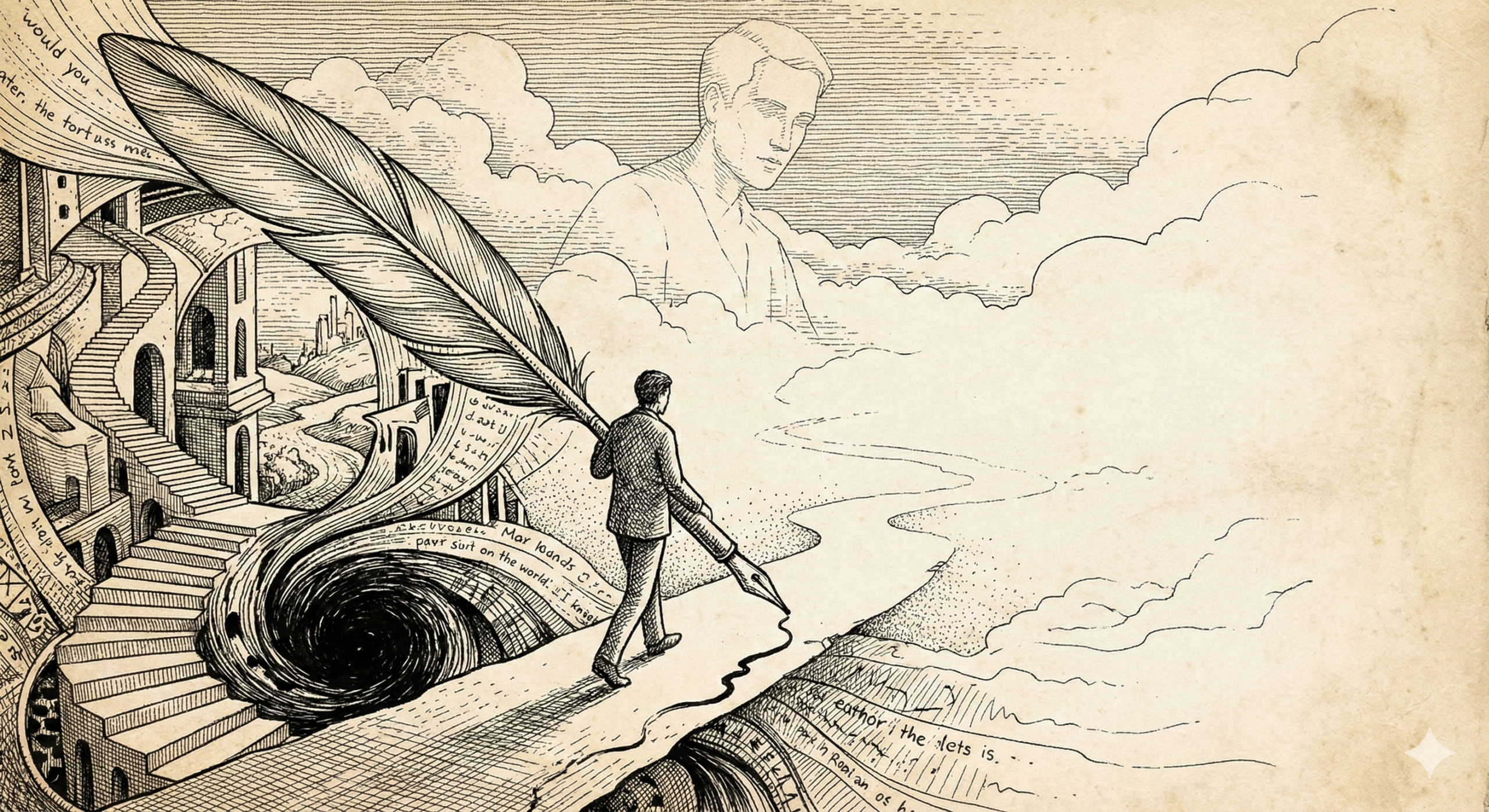
Imagination Creates Reality

The inner script and the world that follows

Most people think imagination is what you use to escape reality.

A child does it naturally. A novelist does it professionally. A bored office worker does it out the window at 3:17 on a Wednesday. Imagination, in the ordinary view, is what happens when attention slips its leash and wanders off into the unreal.

Imagination Creates Reality

Neville Goddard asks us to reverse that assumption.

What if imagination is not escape from reality, but the workshop where reality is first assembled? What if the life you keep meeting on the outside is, in ways both subtle and profound, shaped by the scenes you keep enacting on the inside? What if your inner conversations are not background noise, but stage directions? What if the world that keeps arriving is being quietly prepared by the one you keep consenting to within? That is the living nerve of Imagination Creates Reality. Neville’s claim is not modest. He says your own “wonderful human imagination” is the creative power itself, the saving power, the force through which your conditions are transformed.

That is the kind of statement modern people tend to file under either mysticism or madness.

We live in an age that worships the visible. Metrics, outputs, bank balances, diagnoses, headlines, documents, deadlines, proof. We trust what can be pointed to, counted, photographed, measured, and externally verified. The inner life, by contrast, is treated as soft territory. Subjective. Secondary. Decorative, maybe therapeutic, but not causal. We speak as though thought is commentary on life rather than participation in life.

Neville turns that all the way around.

He says the visible world is not first cause. It is shadow. Reflection. Echo. He says consciousness is the real causative field, and imagination is consciousness in action. The world you touch with your hands is not dismissed as unreal, but it is demoted from source to expression. The imaginal comes first. The material follows.

Now, taken lazily, this can sound like the usual manifestation fluff that drifts around the internet wearing expensive perfume and talking about abundance. But Neville is stranger, tougher, and more severe than that. He is not teaching wishful thinking. He is teaching fidelity to an inner act. He is not saying, “want hard enough and the universe will cave.” He is saying: occupy the end. Enter the scene. Feel it as real. Make “then” now and “there” here. Let the wish fulfilled become a state you inhabit rather than a fantasy you visit.

That difference matters.

A fantasy is something you look at from the outside. An imaginal act, in Neville’s sense, is something you step into. You do not stand at the edge of your desired life like a tourist taking photographs. You enter it. You hear the congratulating voice. You feel the ring on your finger. You smell the room. You touch the object. You speak from inside the fulfilled state. Again and again in the selected quotes, Neville insists that imagination becomes creative when it is embodied, sensorial, and emotionally accepted as present fact.

This is where his teaching becomes both mystical and psychologically acute.

Because whether or not one accepts his full metaphysics, there is something undeniably true here: human beings do not live in raw facts alone. We live in interpreted worlds. We move through states. We inhabit assumptions. We become equal to the stories we rehearse. A person who continually enacts rejection inwardly will begin to feel life as rejecting. A person who continually rehearses lack will begin to see the world through the eyes of insufficiency. A person who inwardly normalizes dignity, possibility, welcome, belonging, or abundance starts to stand in a different reality even before anything visible has changed.

The change begins in tone before it appears in circumstance.

That phrase may be worth lingering over: the change begins in tone.

Most people wait for evidence before allowing themselves a new tone of being. They wait for the job before feeling chosen. They wait for the relationship before feeling lovable. They wait for the money before feeling supported. They wait for the invitation before feeling included. Neville says that is backwards. You must assume the feeling of the wish fulfilled first. Not as theatre for an audience, but as an inner act of authorship. The mood must precede the mirror.

That is difficult because most of us are loyal to our old emotional architecture.

We say we want change, but inwardly we keep polishing the same script. We keep telling the old story with better vocabulary. We declare a new desire with the mouth and then spend the rest of the day rehearsing its opposite in thought. We ask for love and inwardly repeat abandonment. We ask for freedom and inwardly practice fear. We ask for expansion while secretly identifying with diminishment. The outer wish is new, but the inner tenancy remains unchanged.

Neville’s answer to this split is discipline of imagination.

Not discipline in the grim moral sense. Not self-punishment. Not forcing bright thoughts over dark ones like paint over damp walls. More like devotion. A steady return. A willingness to re-enter the desired end until it begins to feel ordinary. Natural. Familiar. He says you can repeat the imaginal act night after night before sleep until it feels normal to you. That word matters: normal. The deeper game is not intensity. It is naturalness. You are not trying to whip yourself into a fever of belief. You are trying to become inwardly at home in a different state.

And that is why his seed metaphor is so powerful.

When Neville says the imaginal act is a seed, he is naming something essential about creation. Seeds do their real work underground. There is a hidden interval between planting and evidence. An interval where nothing seems to be happening if you judge by the surface alone. But growth is underway. Neville says once you plant the imaginal seed, do not uproot it with anxiety about how it will happen. That line lands hard in a culture addicted to mechanism. We want the path mapped, the outcome guaranteed, the sequence explained. We want to know how the invisible will become visible. Neville says your responsibility is not the how. It is fidelity to the imaginal act.

There is a kind of relief in that, but also a kind of terror.

Because if the real labor is inward, then excuses thin out. You cannot blame delay entirely on circumstances when you spend your days inwardly voting for the old world. You cannot keep saying you want a new script while privately practicing the old lines. Neville is harsh on this in the most liberating way. He brings responsibility back to the level of consciousness. Not guilt. Responsibility. The ability to respond by choosing what state you inhabit.

His idea of “inner conversations” may be the most useful doorway into the whole teaching.

We are talking to ourselves all day long. Silently, semi-consciously, automatically. We replay arguments. We anticipate criticism. We justify ourselves to imaginary audiences. We relive humiliations. We mutter our own limitations under our breath in the form of identity statements: I am tired. I am behind. I am not that kind of person. I am too old for this. I am always the one who gets overlooked. I am never lucky. These do not feel like spells because they are so ordinary. They feel like observations. Neville says they are creative acts. Every “I am” is generative. Every inner conversation is scriptwriting.

That idea alone can change a life.

Because once you begin to hear your own interior speech as formative rather than descriptive, you start listening differently. You begin to notice that you have been praying all day, just not always for what you want. You have been planting constantly. You have been rehearsing states with such loyalty that they now feel like personality. But a state is not the same thing as essence. Neville’s work loosens that confusion. He speaks of states of consciousness as places one can enter or fall into. That is a subtle but powerful distinction. If I am in a state, I am not reducible to that state. If I have entered discouragement, I am not discouragement itself. If I have lived in lack, I am not made of lack. A state can be exited. A room can be left. A role can be rewritten.

And that brings us to one of Neville’s most luminous ideas: revision.

Revision is the refusal to let the past go on dictating the future simply because it happened once and hurt deeply. In his teaching, the past survives not just as memory but as active script. A scene from years ago can still be shaping your present because you are still inwardly living from it, still granting it authority, still allowing it to define who you are. Revision means returning to that scene in imagination and reworking it. Not pretending history never happened. Not gaslighting yourself with fake positivity. Something far more subtle. You alter the psychic meaning of the event. You withdraw your emotional allegiance from its old conclusion. You refuse to let one scene keep writing every scene that follows.

This is where Neville feels less like a preacher and more like an alchemist of memory.

The base metal is not the bad event itself but the fixed meaning you extracted from it. The transmutation happens when the scene is no longer treated as final truth. You rewrite not because the past is unreal, but because the way it lives in you is not inevitable. Most people do not realize how much of their suffering is repeated suffering. Old pain, newly narrated each day. Old shame, freshly baptized as identity. Revision interrupts that repetition. It says: this scene does not get to be God.

I think that is why Neville still matters.

Not because every reader must adopt his cosmology whole. Not because one has to believe that imagination single-handedly produces every event in a morally complicated world. Taken simplistically, that claim can become cruel and stupid. It can ignore history, accident, illness, injustice, material conditions, and the irreducible fact that other people also exist with agency of their own. A wise reading of Neville does not require collapsing reality into solipsism.

What it does require is taking inward life seriously.

That may be his deepest gift. He restores seriousness to the unseen. He reminds us that consciousness is not a passive screen onto which life is projected. It is participatory. It shapes what we notice, what we expect, what we dare, what we permit, what we repeat, what we endure, how we relate, and how we interpret what arrives. Imagination creates reality not only by mystical causation, but by identity formation. By emotional conditioning. By reorganizing what becomes possible from within us.

And for anyone who lives by words, this hits especially deep.

Because writing has always known what Neville is saying. Language is never neutral. The story you tell changes the world you can perceive. A sentence can become a prison or a bridge. A name can be a wound or an opening. We are all, in one way or another, writing ourselves into experience. Neville universalizes that truth. He says the script is being written not just on the page, but in consciousness itself. The author is the imaginal self. The theatre is everyday life. The lines are inner speech. The repeated role becomes what we call reality.

So maybe that is the cleanest way to say it.

Imagination creates reality because the life you live is always downstream from the self you are being. And the self you are being is made, in large part, from what you repeatedly imagine, assume, feel, and inwardly affirm as true. The outer world may not instantly rearrange itself because you had a lovely visualization before bed. But the tone of your being can change. The script can change. The state can change. And when the state changes, reality begins to gather differently around you.

The world that follows is often written in the silence before it appears.

A practice for tonight

Tonight, before sleep, do something simple.

Do not begin with your biggest impossible dream if that only triggers disbelief. Begin with something that carries genuine warmth. A scene that implies the wish fulfilled. Not the process. Not the struggle. Not the hoping. The end. A short scene, no more than a few seconds long, that would be true if the thing were already real.

Then close your eyes and enter it.

Do not watch yourself from a distance as though you were in a film. Be there. Hear the voice. Feel the texture. Touch the thing. Let the scene become immediate. Let it have weight. Let it have sensory life. Let it be an event, not a concept. If someone were congratulating you, hear the exact tone in their voice. If you are imagining peace, feel the kind of breath you would be breathing in that peace. If you are imagining enoughness, feel the bodily ease of being supported.

Then notice what interrupts the scene.

This part matters. The interruptions are the doorway. The old voice that says not likely. The reflex that says maybe for other people. The tightening in the chest. The urge to argue for your limitations. Do not dramatize these. Just notice them. These are the old inner conversations. These are the inherited lines in the script. This is the architecture Neville is asking you to become conscious of.

And then, gently, return.

No violence. No forcing. No spiritual macho nonsense. Just return to the fulfilled scene. Again and again if needed. Let it become a place you can stand without apology. Let your nervous system learn a different song. Let the new state begin, however quietly, to feel less foreign.

Then tomorrow, listen to your “I am.”

Listen especially in the ordinary moments. In traffic. In the kitchen. In the inbox. In the pause after someone’s tone lands badly. Catch the private sentence before it hardens. Catch the old role before you slip all the way into costume. And where you can, revise. Not with fake brightness, but with authorship. With the dignity of someone who remembers that consciousness is not just where life is suffered. It is also where life is shaped.

That is the real invitation here.

To stop treating imagination like a toy and start treating it like sacred craft.

Because the world you keep meeting tomorrow may already be taking shape in the scenes you are willing to inhabit tonight.

The Imaginative Ceiling

Most people look backward for the source of their limits. The difficult childhood. The setback that changed the trajectory. The decision that sent things the wrong way. The logic is sensible: the past is where the stories were written, so the past must be where the limitation lives.

We inherit this orientation early. When something isn’t working, we search for the origin point. What happened? Where did it go wrong? Which moment, which influence, which fracture set the boundary? It feels rigorous, almost scientific, to trace the line backward and locate the cause. If you can find the cause, you can understand the constraint. If you can understand the constraint, you might be able to loosen it.

So we become historians of ourselves. We build careful accounts of how we got here. We learn the language of formative experience, of conditioning, of patterns laid down in earlier chapters. And there is value in that. It can bring clarity. It can bring compassion. It can explain why certain moves feel harder than they “should,” why certain doors never even appear as options.

But there is a quiet assumption running underneath all of this: that the past is where the mechanism of limitation resides. That the past is doing the limiting.

It isn’t.

The mechanism of limitation doesn’t operate backward. It operates forward.

The Story You Inhabit Is a Projecting Lens

Dan McAdams has spent four decades thinking harder than almost anyone about what narrative identity actually is, and one of the things he says that tends to go unnoticed in the popular versions of his work is this: narrative identity is as much about how you imagine the future as about how you reconstruct the past. The story you inhabit isn’t primarily a record. It’s a projecting lens. It determines not just how you interpret where you’ve been but what you can see ahead.

And what you can see ahead is not a neutral field.

It feels that way. It feels like you are looking out at “reality” and making a sober assessment of what is available, what is realistic, what is within reach. But that sense of realism is already filtered. Already edited. Already shaped by a story that has been quietly deciding, long before conscious thought gets involved, what belongs in your field of possibility and what does not.

This is the part that tends to slip past people. We assume imagination is something extra, something optional, something creative we might choose to engage in. But in this sense, imagination is structural. It is the mechanism by which the future appears at all. Before you can choose a direction, you have to be able to perceive it. Before you can perceive it, it has to register as something that could, in principle, happen for someone like you.

And that “someone like you” is doing a lot of work.

It is not a neutral category. It is a conclusion. A compressed identity statement built from memory, experience, interpretation, and repetition. It tells you what kind of person you are, what kind of moves you make, what kind of outcomes tend to follow. And from that, it quietly generates a horizon. Not an explicit list of options, but a felt sense of what is plausible.

Anything that falls outside that horizon does not arrive as a difficult choice.

It does not arrive at all.

the imaginative ceiling

And that distinction is enormous, because it means the limitation isn’t sitting in the events that happened. It’s sitting in the futures that your story has made unimaginable. Not impossible in any objective sense. Not forbidden. Not even necessarily unlikely. Simply outside the range of what your current identity knows how to picture.

You can see this in real time if you pay attention to your own reactions.

There are ideas that feel immediately workable. You can picture the steps. You can feel yourself moving toward them. They slot neatly into the life you already recognise as yours. And then there are ideas that produce something else entirely. A kind of blankness. Or a subtle resistance. Or an immediate cascade of reasons why it wouldn’t work. Not after careful consideration, but instantly, almost pre-consciously.

That reaction is not analysis. It is filtering.

The story is doing what it has always done. Protecting coherence. Maintaining continuity. Keeping the future within the boundaries that the past has made familiar. It is efficient. It is stabilising. And it is also, very often, the thing that quietly closes doors before you even realise there was a door there to begin with.

Which is why changing your life rarely begins with changing your circumstances.

It begins with noticing what you cannot currently imagine.

That word is worth staying with. Not impossible. Not unlikely. Unimaginable.

There’s a class of futures the nervous system doesn’t even register as options because the story running below awareness has already ruled them out. They don’t appear in the field of what seems possible. They don’t show up as things a person like you might do, in a life like this one, from where you currently stand.

And because they don’t appear, they can’t be chosen.

You can’t move toward a future you can’t picture. Not through lack of effort or willpower, but through a basic feature of orientation: you can only head in a direction you can see.

The Imaginative Ceiling Is Invisible

I’ve watched this play. Someone identifies what they want, genuinely, with real feeling behind it, and then, in the same breath, begins explaining why it’s not available to them. Not as self-pity, but as apparently neutral observation. They describe the field of possible futures and the thing they want simply isn’t in it. The limitation isn’t their ambition. It’s their imaginative ceiling. And the ceiling is invisible to them because it doesn’t feel like a story. It feels like a realistic assessment of circumstances.

If you listen closely, you can hear the shift happen in real time. Desire speaks first, clean and unfiltered. Then the analysis arrives. The qualifications. The constraints. The quiet, reasonable voice that says, given who I am, given where I am, given how things work, that’s not on the table. Nothing dramatic. No collapse. Just a subtle narrowing of the field until what was alive a moment ago is no longer even under consideration.

What’s striking is how convincing this sounds from the inside. There’s no sense of self-sabotage. No feeling of playing small. It feels like maturity. Like clarity. Like someone who has learned to see the world as it is and adjust accordingly. The language reinforces it: realistic, practical, grounded, sensible. All the words we use to describe good judgement.

But what’s actually happening is selection.

A version of the future is being ruled out before it has the chance to be engaged. Not after testing. Not after failure. Before contact. And because that ruling-out happens so quickly, so automatically, it disappears into the background. It doesn’t register as a decision. It registers as reality.

This is why the ceiling is so hard to notice. It doesn’t present as a barrier you run into. It presents as the absence of options. You don’t feel blocked. You feel oriented. You feel like you’re seeing clearly.

And once that orientation is in place, behaviour follows it without friction. You don’t have to force yourself away from what you want. You simply stop moving toward it. Your attention reorganises around what still feels possible. Your plans adjust. Your actions become coherent with the narrower field. From the outside, it looks like choice. From the inside, it feels like inevitability.

That is the mechanism.

Not a lack of desire. Not a lack of effort. A filtering process that determines what even counts as a viable future before effort ever enters the equation. And until that process becomes visible, it will continue to operate with the full authority of “this is just how things are.”

NLP understood something practical about this before the research caught up with the language. The technique called future pacing, running a detailed, internally experienced rehearsal of a desired outcome, is often described as a form of visualization, which is accurate but undersells what it’s actually doing. You’re not just building confidence through positive imagery. You’re testing whether a future can be inhabited by the self you currently have.

And that test is far more stringent than it appears on the surface.

You can generate an image of almost anything. A different career. A different lifestyle. A different way of being in the world. The imagination, at a purely visual level, is remarkably permissive. It will show you scenes that, in principle, look desirable, even compelling. But the question is not whether you can see the future. The question is whether you can feel yourself inside it without friction.

That’s where the signal shows up.

If the imagined future feels available, congruent, reachable from here, the nervous system accepts it as a possibility and begins organising toward it. Not in some dramatic, cinematic way, but in small, almost imperceptible shifts. Attention starts to notice opportunities that align with it. Behaviour adjusts at the margins. Decisions begin to cluster in that direction. The future starts to exert a quiet pull.

If it feels like something that happens to other people, or to a version of you that doesn’t exist yet, the nervous system rejects it and continues operating within the range it already knows.

And the rejection doesn’t feel like rejection.

It feels like realism.

You don’t say, “I can’t imagine that.” You say, “That’s not really me.” Or, “That’s not how things work.” Or, “That would be nice, but…” The language shifts, but the mechanism is the same. The future is being filtered out not because it is impossible, but because it cannot currently be inhabited by the identity you’re carrying forward.

This is why simple visualization often fails.

It assumes that if you can see something clearly enough, you will move toward it. But clarity of image is not the limiting factor. Congruence of identity is. You can rehearse the scene a hundred times, make it brighter, sharper, more detailed, and still feel the subtle dissonance that says: this isn’t for me. And that dissonance will win, every time, because it sits deeper than the image. It sits at the level of what your system recognises as self.

Seen this way, future pacing isn’t about convincing yourself of something new. It’s diagnostic. It reveals the edge of your current imaginative ceiling. The point at which the future stops feeling inhabitable and starts feeling abstract, distant, or unreal.

And that edge is where the work is.

Because once you can feel where the future drops out of reach, you’re no longer dealing with vague limitation. You’re in contact with the exact place where your story is drawing the line. Not in theory, not as a belief you can debate, but as a lived boundary in experience.

The question then shifts.

Not “How do I make this happen?”

But “What would have to change in how I experience myself for this to feel real?”

When the future fails to feel real in the imagination, most practitioners would say: adjust the submodalities, make the image brighter, bring it closer, step into it rather than watching it from outside. All of which works. It can make the scene more vivid, more immediate, more emotionally charged. It can reduce the distance between you and the imagined outcome and give you a temporary sense of access.

But notice what kind of change that is.

You are modifying the presentation of the future, not the structure that determines whether it is inhabitable. You are tuning the signal, not questioning the filter.

And the filter is doing the real work.

Because the deeper question is why the future felt unavailable in the first place. Why, before any technique is applied, the image arrives thin, distant, or slightly unreal. Why it refuses to “take,” no matter how many times you rehearse it. That refusal is not a failure of imagination in the creative sense. It is a boundary condition.

And the answer is almost always a story.

Not a life-narrative in the formal sense. Not the kind you would tell if someone asked you to summarise your life. A quieter, more operational belief. The kind that doesn’t announce itself as a belief at all. It shows up as assumption. As orientation. As the unspoken sense of what kind of person you are, what you can sustain, what you deserve, how much change is available to you, whether transformation is something that happens to you or something that happens to other people.

This belief is not consulted.

It runs.

It sits below the level of conscious narration and continuously projects forward, scanning each imagined future and asking a silent question: is this consistent with who we are? And if the answer is no, the future is downgraded. It loses weight. It becomes abstract. It stops feeling like somewhere you could actually go.

Not because it’s impossible.

Because it’s incompatible.

Over time, this process becomes so familiar that it disappears. You no longer experience it as a filtering operation. You experience it as reality itself. The futures that pass the filter feel obvious, practical, available. The ones that don’t never quite form. They blur at the edges. They collapse under light scrutiny. They get quietly replaced with something more “realistic.”

And this is how the ceiling installs itself.

Not as a visible barrier you run into, but as a limit on what can be perceived as a viable direction in the first place. The belief projects its boundary outward until it meets the horizon of imagination. And because you’ve never seen beyond it, that boundary doesn’t look like a ceiling.

It looks like the sky.

Which is why working only at the level of imagery will only take you so far. You can brighten the picture, sharpen the details, step more fully into the scene, and still feel the subtle resistance that says: this doesn’t belong to me. And as long as that signal remains, the system will reorganise away from the imagined future, no matter how compelling the image appears.

So the work shifts.

Not just how clearly can I see this future.

But what version of myself would have to exist for this to feel like somewhere I could actually live?

The Work of Transformation Is Forward-Facing

The uncomfortable implication is that the work of transformation isn’t primarily retrospective. Going back and making peace with the past matters. Examining the formative experiences and the beliefs they produced matters. There is real value in understanding how the current story came to be written. It can loosen its authority. It can soften its tone. It can introduce alternatives where previously there was only inevitability.

But that is not where the mechanism is running.

The mechanism that maintains the limitation is forward-facing. It is happening now, continuously, in the way the future is being projected, filtered, and interpreted before it ever arrives as a conscious choice. It is the quiet, ongoing act of placing a ceiling over what counts as possible and then mistaking that ceiling for the shape of reality itself.

And because that act is ongoing, it is also interruptible.

Not only by tracing the ceiling back to its origin, although that can help, but by noticing it in the moment it is being projected. In the instant where a possibility collapses into “not for me.” In the subtle contraction that turns an open field into a narrow path. In the feeling of certainty that something is simply not available, without any real contact with it.

That is where the work becomes alive.

Because at that point you are no longer dealing with a story about the past. You are dealing with the process that is actively constructing the future you are about to step into. And that process can be engaged with directly. Not through force or positive thinking, but through a deliberate widening of what you are willing to imagine as inhabitable.

This is where practice comes in.

Not as repetition of images, but as a gradual expansion of identity. A way of sitting with futures that feel slightly out of reach and staying there long enough for the nervous system to stop rejecting them outright. Not convincing yourself that they are true, but allowing them to become thinkable. Feelable. Something that no longer collapses on contact.

Over time, this does something subtle but significant.

The ceiling doesn’t shatter all at once. It lifts. The horizon shifts. Futures that once felt abstract begin to carry weight. They start to feel less like fantasies and more like directions. And once a direction can be felt, it can be followed. Not perfectly, not in a straight line, but in a way that reorganises behaviour around it.

Which is the point where transformation actually begins to look like change in the world.

Not because the past has been perfectly resolved, but because the future is no longer being unconsciously constrained to match it.

There’s a subtle but important extension of this that McAdams points toward without always stating directly: generativity isn’t just about contribution. It’s about orientation to time.

A generative narrative places the self in an ongoing relationship with what has not yet happened. It assumes, at a structural level, that the future is still open enough to be shaped, influenced, participated in. Not controlled, not guaranteed, but engaged with. There is still something to move toward. Still something to build, offer, tend, or become.

That orientation does something to perception.

It keeps the field of possibility active. It maintains a sensitivity to openings, to places where action might matter, to moments that invite response rather than mere observation. The person is not just living through time. They are leaning into it. Anticipating, projecting, adjusting, contributing. The narrative stays in motion.

When that orientation shifts, when the story turns primarily backward or inward, something else takes its place.

Time becomes something to manage rather than something to meet.

The future is no longer a space of engagement but a narrowing corridor of maintenance. The emphasis moves toward preservation, consolidation, control. Again, none of this feels like a narrative shift from the inside. It feels like wisdom. Like someone who has learned not to overreach. Someone who understands limits and has adjusted accordingly.

But from the outside of the story, you can see what has changed.

The future has lost its demand.

It is no longer asking anything of the person inhabiting it. And because it asks nothing, it draws nothing out. No stretch. No risk. No need to reconfigure identity in order to meet what is coming. The self stabilises, but it also stops evolving in any meaningful sense.

This is where the earlier idea of the imaginative ceiling connects back in a very precise way.

A non-generative narrative doesn’t just describe a smaller life. It actively produces one by collapsing the range of futures that feel worth engaging. It lowers the ceiling until only what is already known remains visible. And because that reduction happens gradually, often in the name of being sensible or realistic, it rarely triggers any alarm.

You don’t feel like something has been lost.

You feel like you’ve become clear.

Which is why this is not just a psychological observation about ageing. It’s a general principle about narrative identity at any stage of life. The question is not how old you are, but whether your story is still projecting forward in a way that requires something new from you.

Whether it is still capable of generating a future that feels alive enough to step into.

Because once that projection stops, the system settles. The horizon contracts. The ceiling lowers. And what remains, however stable or well-managed, is no longer a field of becoming.

It’s a completed sentence you’re still living inside.

Revision vs. Excavation

The distinction I keep coming back to, in coaching work and in my own thinking, is between revision and excavation. Excavation assumes the real self is buried somewhere under the accumulated experience and needs to be uncovered. Revision assumes the self is always being written, always provisional, always capable of a different projection. These aren’t just different metaphors. They produce different practices and different results. The excavator keeps going back. The reviser keeps going forward, not ignoring the past but no longer treating it as the final word on what’s possible.

You can feel the difference in posture almost immediately.

The excavator approaches experience like an archaeologist at a dig site. Careful. Methodical. Patiently brushing away layers to reveal what is already there. The assumption is that something true and stable exists underneath the distortions of history, and that with enough insight, enough honesty, enough courage, it can be uncovered and lived from directly. There is dignity in that work. It can restore continuity. It can reconnect you with parts of yourself that were split off or forgotten. It can make sense of patterns that once felt arbitrary.

But it also carries a subtle constraint.

If the task is to uncover what is already there, then the range of possible selves is, in some sense, already fixed. The future becomes a process of aligning more closely with what you have always been, rather than becoming something that does not yet exist in your current frame of reference. Growth becomes recovery. Change becomes revelation. And while that can be profoundly healing, it can also quietly reinforce the boundaries of what feels legitimate to become.

Revision starts from a different premise.

It treats identity less like an artefact and more like an ongoing draft. Something that is continuously being composed in the interaction between memory, imagination, and action. The past is still present, still influential, still shaping tone and direction, but it is no longer treated as a script that must be faithfully recovered. It becomes material. One input among many. Something that can be reinterpreted, rearranged, or given a different weight in the composition of what comes next.

And because of that, revision opens a different kind of freedom.

Not the freedom to deny what has happened, but the freedom to refuse its authority as the final determinant of what is possible. It allows for the introduction of elements that have no precedent in your past. New directions that don’t “make sense” when viewed through the lens of continuity, but become viable once the story is allowed to project beyond what has already been established.

This is where the earlier idea of the imaginative ceiling becomes directly relevant.

Excavation, by its nature, tends to reinforce the ceiling if it is used exclusively. It keeps returning to the same material, the same formative moments, the same interpretive frame, even if that frame becomes more compassionate or more nuanced over time. It can deepen understanding, but it doesn’t necessarily expand the horizon.

Revision, on the other hand, is explicitly concerned with the horizon.

It asks what new futures can be brought into view, what versions of the self can be made imaginable, what directions can be made inhabitable that were previously filtered out. It works at the level where the ceiling is actually being projected, not just at the level where it was originally formed.

And that changes the question you ask.

The excavator asks: what is true about me that I have not yet fully seen?

The reviser asks: what could become true about me if I allowed it to be imaginable?

Both questions matter.

But they lead to very different kinds of lives.

The useful question isn’t what happened to you. The useful question is: what have you decided is imaginable from here?

The Ceiling Is Where the Work Lives

Because that decision is being made constantly, and mostly without awareness. The story that runs below conscious narrative is continuously projecting a ceiling onto the future. Not because it’s malicious and not because you made a deliberate choice about what to limit yourself to. But because that’s what operational beliefs do. They run forward. They scan the field of the possible and rule things in or out before the question even surfaces to consciousness.

To notice that ceiling isn’t to immediately dissolve it. But it’s the prerequisite for doing anything else. You can’t revise what you can’t see. And you can’t see it by looking backward at where it came from, not exclusively, not if that’s the only direction you look. You find the ceiling by trying to imagine the futures that seem, for reasons you can’t quite name, unavailable to you. The resistance is the location. The thing that doesn’t feel possible is where the story is working.

What becomes available when you start looking there isn’t a technique or a method. It’s a different question. Not who have I been, but who am I capable of imagining myself becoming? And the gap between those two questions is where the work actually lives.

Self-Authorship: A Meditation on Conscious Creation

self-authorship
self-authorship

Jordan Peterson on self-authorship: “Constructing the narrative of your life is a way to determine what to strive for and what to avoid…”

There exists a peculiar condition in human consciousness where we experience ourselves as both the one living and the one observing what is lived. We are simultaneously inside the story and somehow outside of it, watching ourselves move through scenes we did not consciously script. This dual nature creates a tension that most people never examine. They simply live as characters, fully identified with the role, never questioning who wrote the lines they speak or designed the circumstances they navigate.

Consider the nature of authorship itself. An author sits removed from their creation, shaping events from a position of deliberate choice. They know the ending before the character does. They understand that the obstacle in chapter three serves the transformation in chapter seven. They can revise, delete, rewrite entire arcs if they prove unsatisfying. The character, meanwhile, experiences each moment as it arrives, uncertain of outcome, subject to forces that seem external and often arbitrary.

Most human beings live entirely as characters. They experience life as something happening to them rather than through them. When circumstances shift, they respond with the logic of someone reading a story rather than writing one: interpreting events, making meaning, constructing narratives that explain why things are as they are. These narratives feel discovered rather than invented, as if the meaning were inherent in the events themselves rather than projected onto them by the interpreting consciousness.

But what if the interpretation is the creation? What if the story you tell yourself about what happened is more consequential than what happened?

This is not a comfortable question. It challenges the fundamental assumption that reality is something we encounter rather than something we participate in creating. It suggests that the boundary between observation and creation is far more porous than we typically acknowledge. It implies a kind of responsibility that most people would prefer to avoid.

The Mechanism of Meaning-Making

Between any event and your experience of that event lies a process of narrative construction. A conversation ends. An opportunity disappears. A relationship shifts. These are facts, things that occurred in the realm of observable phenomena. But the meaning of these facts, the story about what they signify, this emerges from your consciousness, not from the events themselves.

The car breaks down. This is a mechanical fact. But “the car breaks down and this proves I’m unlucky” is a story. “The car breaks down and this is the universe protecting me from something worse” is a different story. “The car breaks down and this is an inconvenience requiring practical problem-solving” is yet another. Same event. Different narratives. Different emotional experiences. Different subsequent actions.

Most people do not recognize this gap between event and interpretation. The story generates so quickly, so automatically, that it feels like truth. It feels like the only reasonable response to what happened. They are characters reading the plot as it unfolds, not authors choosing how to write the scene.

This automaticity is what keeps people trapped in repetitive patterns. The same types of events keep happening because the same stories keep getting told about them, and those stories shape the consciousness from which future events emerge. It becomes a closed loop: the story creates the lens through which new events are interpreted, and those interpretations reinforce the story.

The man who believes he is unlucky experiences events through that lens. When something goes wrong, it confirms his story. When something goes right, it is an exception, an anomaly, or it is reinterpreted to fit the larger narrative of being unlucky (“I got the promotion but they’ll probably find a reason to let me go soon”). The story is self-perpetuating because it determines what gets noticed, how it gets interpreted, and what it means.

This is not simply cognitive bias, though that is part of it. It is something deeper. The story you habitually tell shapes the consciousness you habitually inhabit. And consciousness, according to those who have explored its depths most thoroughly, is not passive receiver of reality but active participant in its construction.

The Three Levels of Experience

To understand how authorship operates, we must distinguish between three levels at which any event can be understood: the literal, the psychological, and the spiritual.

The literal level is the domain of facts. The car broke down. The meeting was missed. The opportunity was lost. These are things that happened in consensus reality, the world we can point to and agree upon. This level is important. Denying facts serves no one. The character lives primarily at this level, experiencing events as they occur.

The psychological level asks what these events mean for the inner world. Here the story-making happens. The car breakdown becomes evidence of incompetence or bad luck. The missed meeting becomes proof of unworthiness. The lost opportunity becomes confirmation of being blocked or cursed. This is where most therapeutic work happens, examining the narratives and beliefs that shape emotional experience.

The spiritual level views everything as symbolic, as messages from the deeper Self or patterns of consciousness manifesting in form. At this level, the car breakdown is not random mechanical failure but a meaningful occurrence in a larger pattern. Perhaps it slows you down when you were rushing toward something misaligned. Perhaps it creates space for something more important. Perhaps it reveals something about your relationship to control or surrender.

The character operates primarily at the literal and psychological levels. Things happen, and they tell themselves stories about what those things mean. The author can move fluidly between all three levels, understanding that each provides different information without any single level being the whole truth.

More importantly, the author recognizes that the story constructed at the psychological level actually shapes what manifests at the literal level over time. The narratives you habitually inhabit become the reality you habitually experience. This is not magical thinking. It is an observation about how consciousness works.

The Shift To Authorial Consciousness

To become an author of your experience rather than merely a character within it requires a fundamental reorientation. It requires recognizing that you are always telling yourself a story, and that this story is not neutral description but active creation.

Neville Goddard understood this with unusual clarity. When he spoke of assumption, he was pointing to this authorial capacity. An assumption is not a hope or a wish. It is not positive thinking layered over doubt. It is the author deciding what is true in the story being written. The author does not wonder if the character will succeed. The author writes the success and then allows the character to experience the journey toward what has already been written.

This is radically different from how most people approach change. The character tries to change circumstances through action, effort, strategy. They work within the story, trying to make the plot go their way. The author recognizes that the story emerges from consciousness, and therefore changes consciousness itself, knowing the story will follow.

When you live as a character, you react to what happens. When you live as an author, you recognize that what happens is reflecting what you have been writing, consciously or unconsciously. The circumstances are feedback, not verdict. They show you what story your consciousness has been generating.

This requires developing what might be called witnessing awareness. The capacity to observe your own narrative construction in real time. To notice when the automatic story kicks in. To see it as a story rather than as truth. This is not dissociation or detachment. It is a particular quality of consciousness that can hold both participation and observation simultaneously.

In chaos magick, this is sometimes called meta-belief, the ability to hold a belief intensely for purposes of magical work while simultaneously knowing it is a belief you have chosen rather than an objective truth. The author must develop this capacity. You must be able to fully inhabit the story you are writing while knowing it is a story, not the only possible reality.

The Practice of Self-Authorship

This is not metaphysical abstraction. It has practical application in every moment of lived experience.

You receive news that disturbs you. The automatic story begins: what this means, why it happened, what it says about you or your future. As a character, you would be swept into this story, experiencing it as truth. As an author, you catch the story in the act of forming. You see it as one possible interpretation among many.

This seeing creates space. In that space, choice becomes possible. Not the choice of what to think about the event, which would still be operating from character consciousness. But the choice of what you are authoring through this event. What is the larger story you are writing? Does this interpretation serve that story or does it contradict it?

If you are authoring a story of expansion, growth, increasing capacity, then the disturbing news becomes material for that larger narrative. Not through forced reframing or positive thinking, but through genuine authorial perspective. The author knows that challenges in chapter three serve transformation in chapter seven. The character only knows chapter three feels hard.

This requires holding a paradox. You must fully experience the character’s reality while simultaneously maintaining authorial awareness. You cannot transcend the character experience and remain human. You live in time, in a body, in circumstances that have tangible effects. Denying this would be dissociation, not authorship.

But you also cannot collapse entirely into character consciousness without losing your creative power. The author must remain present, aware, choosing what story is being written even as the character lives through the scenes.

The practice becomes one of constant return. You forget you are the author. Something happens and you react as a pure character, swept into automatic narrative. Then you remember. You catch yourself. You observe the story you just told yourself. You choose whether to continue writing that story or to revise it.

Over time, the gap between event and automatic story begins to expand. What was once a half-second window becomes a second, then several seconds. Eventually, you can pause between the event and the interpretation long enough to consciously choose which story serves your authorial intent.

This is what spiritual traditions have called mindfulness or presence, but understood specifically as authorial capacity rather than mere observation. You are not just watching your thoughts. You are recognizing them as narrative choices and exercising your power to write differently.

The Question of Control

This raises immediate questions about control and responsibility. If you are the author of your experience, does that mean everything that happens is your fault? This is where the framework often gets distorted into self-blame or magical thinking.

The author does not control every event. The author shapes meaning, narrative, and the consciousness from which future experiences emerge. There is mystery here, a relationship between consciousness and manifestation that cannot be reduced to simple cause and effect. The author writes with intent, but the story unfolds in ways that often surprise.

What you can control is the story you tell about what happens. And that story is not trivial. It is the lens through which you experience everything. It is the foundation from which you act. It is the consciousness that shapes what becomes possible.

Two people experience the same event. One tells a story of victimization, of being targeted by malicious forces, of having no power. The other tells a story of challenge, of opportunity to demonstrate resilience, of being tested and refined. Same event. Different stories. Different emotional experiences. Different subsequent behaviors. Different long-term outcomes.

Over time, these different stories create different lives. Not because the stories change the events directly, but because they change the consciousness inhabiting those events, and consciousness is creative. The person who habitually authors stories of powerlessness creates a life that confirms powerlessness. The person who habitually authors stories of agency creates a life that confirms agency.

This is not blame. The character did not consciously choose their conditioning. The stories they automatically tell were learned, often in childhood, as survival strategies in particular environments. Recognizing you are the author is not about blaming yourself for the stories you have been unconsciously writing. It is about claiming the power to write differently going forward.

When you live as a character, you are at the mercy of plot. Things happen and you respond. When you shift to authorial consciousness, you recognize that your response is not merely reactive but creative. You are writing what comes next through how you interpret and inhabit what is happening now.

The Transformation of Time

Perhaps the most profound shift from character to author consciousness involves the experience of time itself. The character lives in linear time, moving from past through present toward an uncertain future. The past defines them. The future worries them. The present is where they cope with both.

The author experiences time differently. The past is material, not identity. What happened provides context, backstory, even motivation, but it does not determine what is being written now. The future is not something arriving to be dealt with but something being written toward. And the present is not a point between two other things but the location of authorial power.

Neville called this living in the end. The author writes from the completion of the desired story, not toward it. This is not pretending something has happened when it has not. It is recognizing that in consciousness, which is where all authoring happens, the end is already present. You write from there, and the character experiences the journey toward what the author has already completed.

This sounds abstract until you practice it. Then it becomes the most practical thing imaginable. You stop trying to figure out how to get from here to there. You inhabit the consciousness of there and allow here to reorganize accordingly.

The character asks “How do I get what I want?” The author asks “Who am I being in the story where I already have it?” These are fundamentally different questions that lead to fundamentally different experiences.

When you write from the end, you are not creating a fantasy to escape present circumstances. You are establishing the consciousness from which those circumstances can transform. You are deciding what story you are living in rather than letting circumstances dictate the story for you.

The character waits for circumstances to change before they can feel differently. The author changes consciousness and allows circumstances to follow. This is the core distinction. The character believes feelings follow facts. The author knows that facts follow consciousness, and consciousness is shaped by the story you choose to inhabit.

The Wound of Unconscious Authorship

Most people have been authoring unconsciously their entire lives. They have been writing stories about themselves and the world without knowing they were writing. They experienced these stories as truth, as the way things are, not as one possible interpretation among many.

This creates a particular kind of suffering. You experience yourself as subject to forces beyond your control when in fact you are generating those forces through the stories you unconsciously repeat. You feel victimized by a plot you are actually writing.

The shift to conscious authorship can feel destabilizing at first. If you have been the author all along, unconsciously writing stories that created suffering, what does that mean? The temptation toward self-blame is strong. “I did this to myself” becomes another story, another form of character consciousness masquerading as authorship.

True authorship transcends blame. The author recognizes that unconscious authorship is the default human condition. You were writing stories before you knew what stories were. You absorbed narratives from your environment and repeated them as if they were truth. This is not failure. This is how consciousness develops.

Becoming a conscious author means recognizing the power you have always had but did not know how to use deliberately. It means forgiving yourself for the stories you wrote when you did not know you were writing. It means claiming the capacity to write differently now.

This is where compassion becomes essential. For yourself and for others. Everyone you meet is writing stories, mostly unconsciously. When they react in ways that seem disproportionate or irrational, they are responding not to events but to the stories they are telling about events. When you recognize this, judgment often transforms into curiosity. What story are they writing? What story am I writing in response?

The Invitation

You are reading these words as a character. You are interpreting them, evaluating them, deciding if they are true or useful. This is natural and appropriate. The character must do what the character does.

But simultaneously, there is an authorial awareness available. The part of you that chose to read this, that sensed something relevant here, that is considering what to do with these ideas. That is the author.

The invitation is not to abandon character consciousness. You cannot and should not. The invitation is to remember that you are also the author. To catch yourself in the automatic stories. To notice the gap between event and interpretation. To practice choosing what you are writing rather than simply receiving what seems to be happening.

This is not a one-time shift. You will forget. You will collapse back into pure character consciousness. Something will happen and you will react automatically, telling yourself the old stories, experiencing yourself as subject to circumstances beyond your control. This is part of the process.

The practice is the return. The moment you notice you forgot, you remember. The moment you catch the automatic story, you have already created space for choice. The moment you recognize you are writing, authorship becomes possible again.

Over time, the returns become more frequent. The gap expands. The authorial awareness becomes more stable. You find yourself able to hold both perspectives more consistently, living fully as the character while knowing you are the author.

Your life is a story being written. The only question is whether you will write it consciously or continue to pretend you are merely a character in a plot someone else designed. The pen is already in your hand. It always has been.

The events of your life will continue. Things will happen, some pleasant, some difficult, some mysterious in their meaning. But you have a choice in every moment about what story you tell about those events. And that story is not merely interpretation. It is creation. It shapes the consciousness from which your next experience emerges.

What are you writing?

Not what has been written, which is the character’s question. Not what should be written, which is usually someone else’s story imposed on you. But what are you, as the author of your singular existence, choosing to write now?

This is the fundamental question of conscious living. Everything else follows from how you answer it.


NotebookLM Audio Version