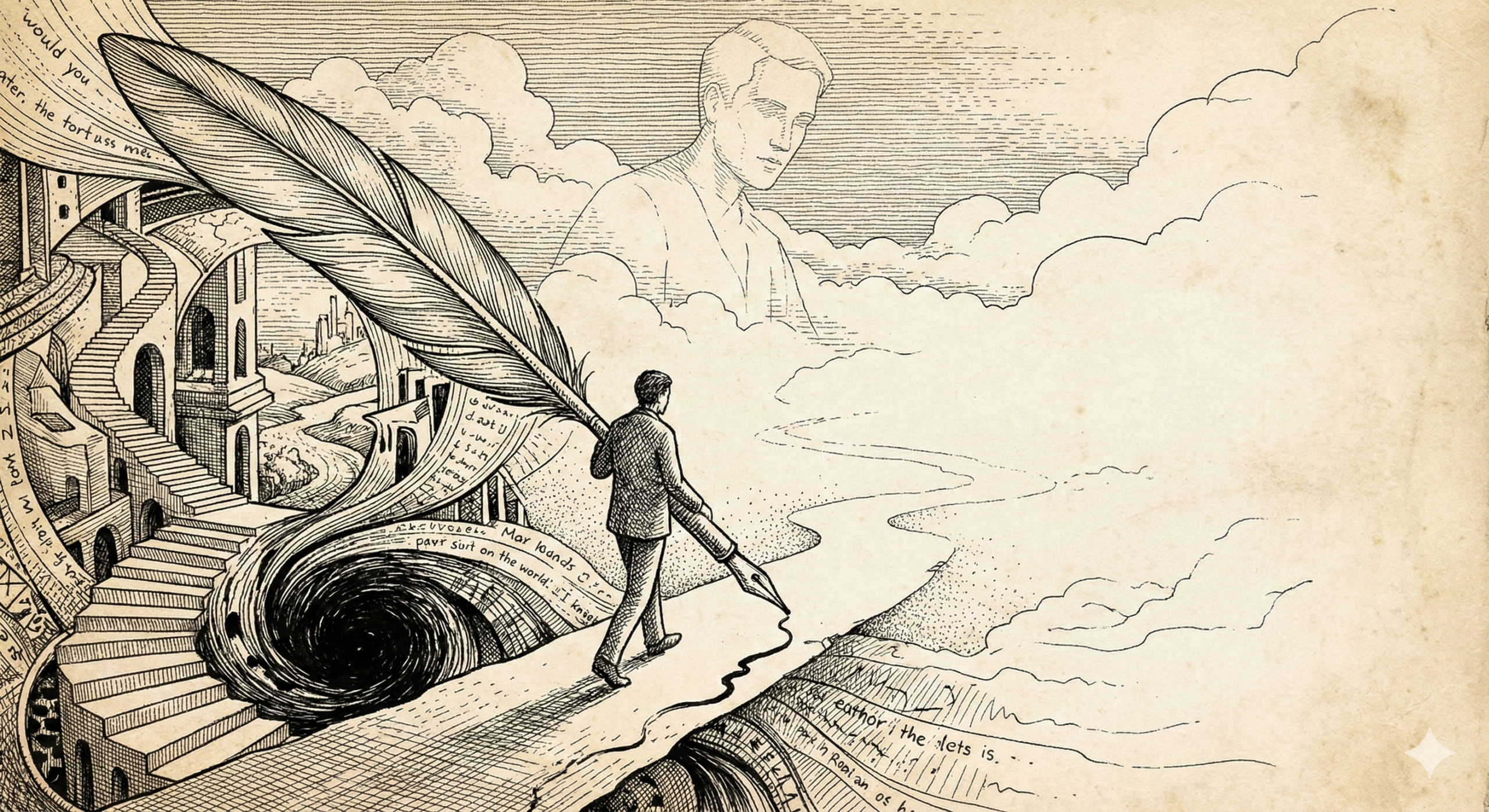

Jordan Peterson on self-authorship: “Constructing the narrative of your life is a way to determine what to strive for and what to avoid…”
There exists a peculiar condition in human consciousness where we experience ourselves as both the one living and the one observing what is lived. We are simultaneously inside the story and somehow outside of it, watching ourselves move through scenes we did not consciously script. This dual nature creates a tension that most people never examine. They simply live as characters, fully identified with the role, never questioning who wrote the lines they speak or designed the circumstances they navigate.
Consider the nature of authorship itself. An author sits removed from their creation, shaping events from a position of deliberate choice. They know the ending before the character does. They understand that the obstacle in chapter three serves the transformation in chapter seven. They can revise, delete, rewrite entire arcs if they prove unsatisfying. The character, meanwhile, experiences each moment as it arrives, uncertain of outcome, subject to forces that seem external and often arbitrary.
Most human beings live entirely as characters. They experience life as something happening to them rather than through them. When circumstances shift, they respond with the logic of someone reading a story rather than writing one: interpreting events, making meaning, constructing narratives that explain why things are as they are. These narratives feel discovered rather than invented, as if the meaning were inherent in the events themselves rather than projected onto them by the interpreting consciousness.
But what if the interpretation is the creation? What if the story you tell yourself about what happened is more consequential than what happened?
This is not a comfortable question. It challenges the fundamental assumption that reality is something we encounter rather than something we participate in creating. It suggests that the boundary between observation and creation is far more porous than we typically acknowledge. It implies a kind of responsibility that most people would prefer to avoid.

The Mechanism of Meaning-Making
Between any event and your experience of that event lies a process of narrative construction. A conversation ends. An opportunity disappears. A relationship shifts. These are facts, things that occurred in the realm of observable phenomena. But the meaning of these facts, the story about what they signify, this emerges from your consciousness, not from the events themselves.
The car breaks down. This is a mechanical fact. But “the car breaks down and this proves I’m unlucky” is a story. “The car breaks down and this is the universe protecting me from something worse” is a different story. “The car breaks down and this is an inconvenience requiring practical problem-solving” is yet another. Same event. Different narratives. Different emotional experiences. Different subsequent actions.
Most people do not recognize this gap between event and interpretation. The story generates so quickly, so automatically, that it feels like truth. It feels like the only reasonable response to what happened. They are characters reading the plot as it unfolds, not authors choosing how to write the scene.
This automaticity is what keeps people trapped in repetitive patterns. The same types of events keep happening because the same stories keep getting told about them, and those stories shape the consciousness from which future events emerge. It becomes a closed loop: the story creates the lens through which new events are interpreted, and those interpretations reinforce the story.
The man who believes he is unlucky experiences events through that lens. When something goes wrong, it confirms his story. When something goes right, it is an exception, an anomaly, or it is reinterpreted to fit the larger narrative of being unlucky (“I got the promotion but they’ll probably find a reason to let me go soon”). The story is self-perpetuating because it determines what gets noticed, how it gets interpreted, and what it means.
This is not simply cognitive bias, though that is part of it. It is something deeper. The story you habitually tell shapes the consciousness you habitually inhabit. And consciousness, according to those who have explored its depths most thoroughly, is not passive receiver of reality but active participant in its construction.
The Three Levels of Experience
To understand how authorship operates, we must distinguish between three levels at which any event can be understood: the literal, the psychological, and the spiritual.
The literal level is the domain of facts. The car broke down. The meeting was missed. The opportunity was lost. These are things that happened in consensus reality, the world we can point to and agree upon. This level is important. Denying facts serves no one. The character lives primarily at this level, experiencing events as they occur.
The psychological level asks what these events mean for the inner world. Here the story-making happens. The car breakdown becomes evidence of incompetence or bad luck. The missed meeting becomes proof of unworthiness. The lost opportunity becomes confirmation of being blocked or cursed. This is where most therapeutic work happens, examining the narratives and beliefs that shape emotional experience.
The spiritual level views everything as symbolic, as messages from the deeper Self or patterns of consciousness manifesting in form. At this level, the car breakdown is not random mechanical failure but a meaningful occurrence in a larger pattern. Perhaps it slows you down when you were rushing toward something misaligned. Perhaps it creates space for something more important. Perhaps it reveals something about your relationship to control or surrender.
The character operates primarily at the literal and psychological levels. Things happen, and they tell themselves stories about what those things mean. The author can move fluidly between all three levels, understanding that each provides different information without any single level being the whole truth.
More importantly, the author recognizes that the story constructed at the psychological level actually shapes what manifests at the literal level over time. The narratives you habitually inhabit become the reality you habitually experience. This is not magical thinking. It is an observation about how consciousness works.
The Shift To Authorial Consciousness
To become an author of your experience rather than merely a character within it requires a fundamental reorientation. It requires recognizing that you are always telling yourself a story, and that this story is not neutral description but active creation.
Neville Goddard understood this with unusual clarity. When he spoke of assumption, he was pointing to this authorial capacity. An assumption is not a hope or a wish. It is not positive thinking layered over doubt. It is the author deciding what is true in the story being written. The author does not wonder if the character will succeed. The author writes the success and then allows the character to experience the journey toward what has already been written.
This is radically different from how most people approach change. The character tries to change circumstances through action, effort, strategy. They work within the story, trying to make the plot go their way. The author recognizes that the story emerges from consciousness, and therefore changes consciousness itself, knowing the story will follow.
When you live as a character, you react to what happens. When you live as an author, you recognize that what happens is reflecting what you have been writing, consciously or unconsciously. The circumstances are feedback, not verdict. They show you what story your consciousness has been generating.
This requires developing what might be called witnessing awareness. The capacity to observe your own narrative construction in real time. To notice when the automatic story kicks in. To see it as a story rather than as truth. This is not dissociation or detachment. It is a particular quality of consciousness that can hold both participation and observation simultaneously.
In chaos magick, this is sometimes called meta-belief, the ability to hold a belief intensely for purposes of magical work while simultaneously knowing it is a belief you have chosen rather than an objective truth. The author must develop this capacity. You must be able to fully inhabit the story you are writing while knowing it is a story, not the only possible reality.
The Practice of Self-Authorship
This is not metaphysical abstraction. It has practical application in every moment of lived experience.
You receive news that disturbs you. The automatic story begins: what this means, why it happened, what it says about you or your future. As a character, you would be swept into this story, experiencing it as truth. As an author, you catch the story in the act of forming. You see it as one possible interpretation among many.
This seeing creates space. In that space, choice becomes possible. Not the choice of what to think about the event, which would still be operating from character consciousness. But the choice of what you are authoring through this event. What is the larger story you are writing? Does this interpretation serve that story or does it contradict it?
If you are authoring a story of expansion, growth, increasing capacity, then the disturbing news becomes material for that larger narrative. Not through forced reframing or positive thinking, but through genuine authorial perspective. The author knows that challenges in chapter three serve transformation in chapter seven. The character only knows chapter three feels hard.
This requires holding a paradox. You must fully experience the character’s reality while simultaneously maintaining authorial awareness. You cannot transcend the character experience and remain human. You live in time, in a body, in circumstances that have tangible effects. Denying this would be dissociation, not authorship.
But you also cannot collapse entirely into character consciousness without losing your creative power. The author must remain present, aware, choosing what story is being written even as the character lives through the scenes.
The practice becomes one of constant return. You forget you are the author. Something happens and you react as a pure character, swept into automatic narrative. Then you remember. You catch yourself. You observe the story you just told yourself. You choose whether to continue writing that story or to revise it.
Over time, the gap between event and automatic story begins to expand. What was once a half-second window becomes a second, then several seconds. Eventually, you can pause between the event and the interpretation long enough to consciously choose which story serves your authorial intent.
This is what spiritual traditions have called mindfulness or presence, but understood specifically as authorial capacity rather than mere observation. You are not just watching your thoughts. You are recognizing them as narrative choices and exercising your power to write differently.
The Question of Control
This raises immediate questions about control and responsibility. If you are the author of your experience, does that mean everything that happens is your fault? This is where the framework often gets distorted into self-blame or magical thinking.
The author does not control every event. The author shapes meaning, narrative, and the consciousness from which future experiences emerge. There is mystery here, a relationship between consciousness and manifestation that cannot be reduced to simple cause and effect. The author writes with intent, but the story unfolds in ways that often surprise.
What you can control is the story you tell about what happens. And that story is not trivial. It is the lens through which you experience everything. It is the foundation from which you act. It is the consciousness that shapes what becomes possible.
Two people experience the same event. One tells a story of victimization, of being targeted by malicious forces, of having no power. The other tells a story of challenge, of opportunity to demonstrate resilience, of being tested and refined. Same event. Different stories. Different emotional experiences. Different subsequent behaviors. Different long-term outcomes.
Over time, these different stories create different lives. Not because the stories change the events directly, but because they change the consciousness inhabiting those events, and consciousness is creative. The person who habitually authors stories of powerlessness creates a life that confirms powerlessness. The person who habitually authors stories of agency creates a life that confirms agency.
This is not blame. The character did not consciously choose their conditioning. The stories they automatically tell were learned, often in childhood, as survival strategies in particular environments. Recognizing you are the author is not about blaming yourself for the stories you have been unconsciously writing. It is about claiming the power to write differently going forward.
When you live as a character, you are at the mercy of plot. Things happen and you respond. When you shift to authorial consciousness, you recognize that your response is not merely reactive but creative. You are writing what comes next through how you interpret and inhabit what is happening now.
The Transformation of Time
Perhaps the most profound shift from character to author consciousness involves the experience of time itself. The character lives in linear time, moving from past through present toward an uncertain future. The past defines them. The future worries them. The present is where they cope with both.
The author experiences time differently. The past is material, not identity. What happened provides context, backstory, even motivation, but it does not determine what is being written now. The future is not something arriving to be dealt with but something being written toward. And the present is not a point between two other things but the location of authorial power.
Neville called this living in the end. The author writes from the completion of the desired story, not toward it. This is not pretending something has happened when it has not. It is recognizing that in consciousness, which is where all authoring happens, the end is already present. You write from there, and the character experiences the journey toward what the author has already completed.
This sounds abstract until you practice it. Then it becomes the most practical thing imaginable. You stop trying to figure out how to get from here to there. You inhabit the consciousness of there and allow here to reorganize accordingly.
The character asks “How do I get what I want?” The author asks “Who am I being in the story where I already have it?” These are fundamentally different questions that lead to fundamentally different experiences.
When you write from the end, you are not creating a fantasy to escape present circumstances. You are establishing the consciousness from which those circumstances can transform. You are deciding what story you are living in rather than letting circumstances dictate the story for you.
The character waits for circumstances to change before they can feel differently. The author changes consciousness and allows circumstances to follow. This is the core distinction. The character believes feelings follow facts. The author knows that facts follow consciousness, and consciousness is shaped by the story you choose to inhabit.
The Wound of Unconscious Authorship
Most people have been authoring unconsciously their entire lives. They have been writing stories about themselves and the world without knowing they were writing. They experienced these stories as truth, as the way things are, not as one possible interpretation among many.
This creates a particular kind of suffering. You experience yourself as subject to forces beyond your control when in fact you are generating those forces through the stories you unconsciously repeat. You feel victimized by a plot you are actually writing.
The shift to conscious authorship can feel destabilizing at first. If you have been the author all along, unconsciously writing stories that created suffering, what does that mean? The temptation toward self-blame is strong. “I did this to myself” becomes another story, another form of character consciousness masquerading as authorship.
True authorship transcends blame. The author recognizes that unconscious authorship is the default human condition. You were writing stories before you knew what stories were. You absorbed narratives from your environment and repeated them as if they were truth. This is not failure. This is how consciousness develops.
Becoming a conscious author means recognizing the power you have always had but did not know how to use deliberately. It means forgiving yourself for the stories you wrote when you did not know you were writing. It means claiming the capacity to write differently now.
This is where compassion becomes essential. For yourself and for others. Everyone you meet is writing stories, mostly unconsciously. When they react in ways that seem disproportionate or irrational, they are responding not to events but to the stories they are telling about events. When you recognize this, judgment often transforms into curiosity. What story are they writing? What story am I writing in response?
The Invitation
You are reading these words as a character. You are interpreting them, evaluating them, deciding if they are true or useful. This is natural and appropriate. The character must do what the character does.
But simultaneously, there is an authorial awareness available. The part of you that chose to read this, that sensed something relevant here, that is considering what to do with these ideas. That is the author.
The invitation is not to abandon character consciousness. You cannot and should not. The invitation is to remember that you are also the author. To catch yourself in the automatic stories. To notice the gap between event and interpretation. To practice choosing what you are writing rather than simply receiving what seems to be happening.
This is not a one-time shift. You will forget. You will collapse back into pure character consciousness. Something will happen and you will react automatically, telling yourself the old stories, experiencing yourself as subject to circumstances beyond your control. This is part of the process.
The practice is the return. The moment you notice you forgot, you remember. The moment you catch the automatic story, you have already created space for choice. The moment you recognize you are writing, authorship becomes possible again.
Over time, the returns become more frequent. The gap expands. The authorial awareness becomes more stable. You find yourself able to hold both perspectives more consistently, living fully as the character while knowing you are the author.
Your life is a story being written. The only question is whether you will write it consciously or continue to pretend you are merely a character in a plot someone else designed. The pen is already in your hand. It always has been.
The events of your life will continue. Things will happen, some pleasant, some difficult, some mysterious in their meaning. But you have a choice in every moment about what story you tell about those events. And that story is not merely interpretation. It is creation. It shapes the consciousness from which your next experience emerges.
What are you writing?
Not what has been written, which is the character’s question. Not what should be written, which is usually someone else’s story imposed on you. But what are you, as the author of your singular existence, choosing to write now?
This is the fundamental question of conscious living. Everything else follows from how you answer it.
[…] […]