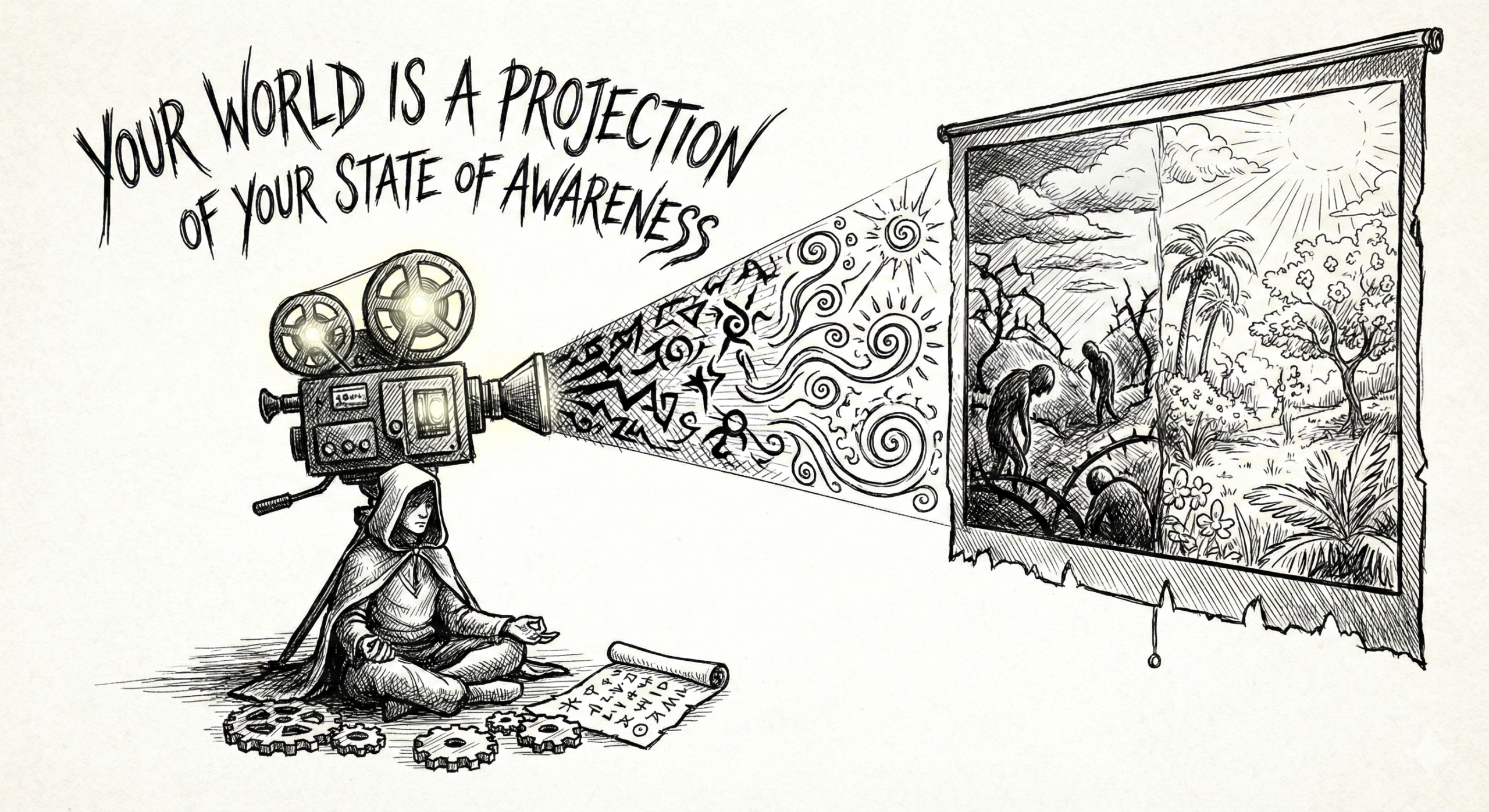

Think about this: your reality isn’t happening TO you. It’s happening THROUGH you.
Your state of awareness operates like a projector beam. The world you experience is whatever appears on the screen of perception. Most people assume the screen is the problem. They argue with the images, rearrange the furniture inside the scene, or try to force a better storyline. Very few notice the beam itself.
But the beam is doing most of the work.
When your awareness is contracted, tense, and defensive, the world doesn’t feel neutral. It feels hostile. An unread email becomes a threat. A delayed reply becomes a verdict. A casual comment carries hidden criticism. Nothing has objectively changed. Same inbox. Same people. Same environment. But the quality of awareness projecting the scene has narrowed, and so the world it reveals narrows with it.
Anxious awareness scans for danger. It highlights risk, omission, and inadequacy. It edits reality down to sharp edges and worst-case interpretations. In that state, life feels like something you must survive rather than participate in. You move carefully, brace constantly, and mistake vigilance for intelligence.
Now notice what happens when the state shifts.
In moments of calm or flow, the same external conditions tell a different story. The inbox becomes a set of possibilities rather than ambushes. Conversations feel open instead of loaded. Problems still exist, but they register as workable instead of overwhelming. The world hasn’t magically improved. Your awareness has widened, softened, and stabilized. The beam changed, so the projection did too.
This is the part most people miss. They think perception is passive. That consciousness merely observes what is already there. In reality, awareness is an active filter. It decides what gets emphasized, what fades into background noise, and what never makes it onto the screen at all.
Your nervous system, beliefs, and habitual attention patterns are constantly shaping what reality looks like to you. You don’t see the world as it is. You see the world as your current state allows it to appear.
Change the screen and nothing really changes. Change the beam and everything does.
Same external conditions. Radically different experienced realities.
This isn’t about positive thinking or manifesting parking spaces. It’s deeper and more unsettling than that. Your consciousness doesn’t merely observe reality like a camera pointed at the world. It participates. It selects, emphasizes, filters, and organizes what becomes visible and actionable for you in any given moment.
Two people can stand in the same room, face the same constraints, receive the same information, and yet inhabit entirely different worlds. One experiences friction everywhere. The other senses openings. One reads the situation as hostile or depleted. The other reads it as workable or alive with possibility. Nothing external has changed. The difference is not circumstance. It’s the state of awareness interpreting the circumstance.
Awareness determines meaning before thought ever arrives. Long before you form an opinion or tell yourself a story, your nervous system and attention have already decided what matters, what feels threatening, and what feels inviting. From there, cognition simply explains what awareness has already framed.
This is why wisdom traditions, long before neuroscience had language for it, focused obsessively on consciousness training rather than circumstance control. Meditation, contemplation, prayer, ritual, solitude. These weren’t escapes from the world. They were methods for refining the instrument through which the world is encountered. The ancient operators understood something modern culture keeps forgetting: change the quality of awareness, and the same reality reorganizes itself.
When awareness is narrow, reality appears narrow. When awareness is rigid, reality feels brittle. When awareness is spacious, reality becomes surprisingly cooperative. Not perfect. Not painless. But workable in ways that were previously invisible.
Shift the quality of the beam, and what appears on the screen changes. Not because the world bends to your wishes, but because you finally have access to more of what was always there.
Your beliefs are code. Your attention is the compiler. Your awareness is the runtime environment.
Most people spend their lives trying to rearrange the furniture in a burning building. They’re obsessed with external fixes while the projector keeps beaming out the same corrupted program. Better job, new relationship, different city. But if the quality of awareness stays the same, you just get the same movie in a different theater.
Real transformation happens when you debug the consciousness itself. When you recognize that your habitual patterns of attention, your inherited narratives, your unconscious beliefs are all actively shaping what you perceive as “reality.”
This is narrative alchemy at its core.
You’re already running code. That part isn’t optional. The question is whether you’re running legacy programs inherited from trauma, culture, and unconscious conditioning, or whether you’ve begun to consciously refactor the system.
Much of what you call “reality” is the output of automated processes you didn’t author. Early emotional experiences, social norms, survival strategies, and unexamined beliefs quietly become default settings. They determine what you notice, what you ignore, what feels possible, and what feels forbidden. Over time, these patterns harden into a background operating system you mistake for the world itself.
Your perceptual apparatus is constantly filtering an overwhelming flood of data. At any moment, your senses are receiving far more information than you could ever consciously process. So the system predicts. It compresses. It selects. Neuroscience calls this predictive processing. The brain doesn’t passively receive reality. It generates a best-guess model of what’s happening and updates it only when the prediction fails badly enough.
Magick, myth, and contemplative traditions arrived at the same insight through a different door. They noticed that expectation shapes experience, belief stabilizes perception, and attention animates what it touches. They called it manifestation, spellcraft, or world-making. Different language. Same mechanism.
Either way, you are not reacting to raw reality. You are interacting with a model generated by your current state of consciousness.
This is why repeating the same patterns produces the same outcomes even when the surface details change. New job, same exhaustion. New relationship, same conflict. New city, same dissatisfaction. The scenery updates, but the codebase stays intact, so the simulation resolves in familiar ways.
Consciousness work is not about denying the world or fantasizing a better one. It’s about taking responsibility for the interpreter that’s running. When you shift the quality of attention, loosen rigid beliefs, and interrupt unconscious narratives, you don’t force reality to comply. You simply allow different data to register. Different possibilities to render. Different responses to become available.
That’s the real leverage point.
The world you see is the world your awareness can support. As that awareness expands, stabilizes, and becomes more coherent, the experienced world reorganizes accordingly. Not because you cast a spell on reality, but because you stopped running corrupted code without realizing it.
Once you see this, you can’t unsee it. The question stops being “How do I change my circumstances?” and becomes “What state of awareness am I bringing to this moment?”
Because awareness is not neutral. It is toned. It has texture. It can be hurried or settled, defensive or curious, rigid or receptive. And that tone quietly governs what options even register as real. Some states of awareness make entire pathways invisible. Others illuminate doors you didn’t know were there.
This is why willpower fails so reliably. You can force behavior for a while, but if the underlying awareness remains contracted, the system eventually snaps back to its default pattern. You don’t rise to the level of your intentions. You fall to the level of your state.
Most self-improvement advice tries to operate at the level of the screen. Think different thoughts. Say better affirmations. Take new actions. But if the beam remains distorted, those changes feel fragile and effortful. They require constant maintenance because they’re fighting the projector instead of adjusting it.
Cultivating awareness is different. It’s slower at first, but exponentially more powerful. When awareness stabilizes, clarity becomes natural. When awareness softens, flexibility appears without force. When awareness widens, resilience emerges as a side effect rather than a goal.
This is also why the work can feel uncomfortable. Expanding awareness means noticing the habits of contraction you’ve been calling “normal.” It means seeing how often you rush, brace, assume, or defend without realizing it. There’s no moral failure here. Just mechanics. A system doing exactly what it was trained to do.
The practice is not to judge the beam, but to refine it.
As you learn to recognize your states in real time, you gain choice. Not infinite choice. Not fantasy-level control. But enough leverage to interrupt old loops and allow new responses to arise. Enough space to respond rather than react. Enough clarity to see that many of the walls you’ve been pushing against were projections all along.
This is how inner work becomes outer change without trying to be.
Change the quality of awareness, and behavior reorganizes. Relationships reorganize. Work reorganizes. Even difficulty reorganizes, showing up less as a threat and more as a challenge you can actually meet.
Same world. Different beam. Different life.
🜃