The ghosts in the American Ghostshave been dead for centuries. One of them for over a thousand years. They rattle around a house in the Hudson Valley: Revolutionary War soldiers, bootleggers, a Viking, a 1920s lounge singer. Most of their time goes to trying not to go mad from the sameness of it.
Survival is over for them. That game is finished. The only game left is what you do with consciousness when there’s nothing pressing requiring it.
Which is, if you sit with it for a minute, mostly the game we’re all playing too.
Every living creature is doing two things: surviving, and then dealing with the fact of its own existence once survival is handled. A well-fed cat does not simply stop. It hunts anyway. Sits in windows. Tracks birds it has no intention of catching with something that looks remarkably like philosophical attention. Not need. Engagement with existence itself.
We do the same, except we invented a third level that runs parallel to the second and keeps mistaking itself for it. Thriving. The endless pursuit of more status, more achievement, more everything. A game with its own rules and its own specific forms of suffering, marketed to us as the point of the whole enterprise.
Epicurus grew vegetables and had long conversations with friends. He wasn’t after intensity. What he wanted he called ataraxia, a settled freedom from the anxiety of wanting too much. Not an absence of pleasure, but a quality of peace that doesn’t depend on accumulation. He understood that the main enemy of happiness is the scoreboard you’re keeping. The one that tells you you’re behind.
The frame I keep coming back to: life is a game, and the ghosts have the clearest view of it. No survival pressure. No thriving to perform. Just the bare question of what you do with the fact that you exist.
At that level of reduction, certain things clarify. Fear becomes information. Risk becomes interesting. Failure stops being evidence of personal inadequacy and starts being data about what the territory actually contains. The scoreboard dissolves once you’re not competing for anything in particular.
The game ends. That’s different from having a winner. And actually holding that knowledge, rather than keeping it at a safe distance, seems to change how you play. More willingness to make the interesting move. Less attachment to games you didn’t design.
Some of the ghosts in that house, the ones who’ve been there longest, have figured out how to make it interesting. Centuries in and still finding things to argue about, still surprising themselves occasionally.
I’m not sure what to make of that exactly. But I keep turning it over.
The myth of Jim Morrison is a myth of pure instinct. He arrives fully formed in the collective memory: shirtless, obliterated, magnificent, doomed. The leather trousers. The baiting of audiences in New Haven and Miami. The voice that seemed to come from somewhere older than rock and roll. The story we inherited insists that this was all eruption, all Dionysian overflow, a man too full of something dark and vital to contain it.
The story is wrong.
Morrison entered UCLA’s film school in 1964 as a serious student of ideas. He wrote poetry obsessively, in notebooks he carried everywhere, before he ever stood in front of a microphone. He read with appetite and intention across philosophy, anthropology, poetry, and mythology. When Ray Manzarek met him on Venice Beach, he didn’t encounter a wild thing. He encountered someone who had already done significant intellectual work on the question of what he wanted to become.
The esoteric content in Morrison’s life and work is routinely treated as atmosphere. The shamanism, the invocations, the obsession with death and threshold experience, the deliberate use of performance as a form of altered consciousness. These get folded into the legend as texture, as evidence of his romantic excess. They are evidence of a curriculum.
Morrison assembled, largely in his early twenties, a reading list with a coherent through-line. Nietzsche gave him the philosophical frame. The French Symbolists gave him the method. Huxley and Blake gave him the name for what he was trying to do and a theory of why it mattered. Eliade gave him the ritual structure. Frazer gave him the oldest warning, which he either didn’t read carefully enough or chose to ignore. The Beats showed him that this synthesis was survivable and could be made into American vernacular art.
This is a self-education in the deliberate construction and dissolution of self, in the use of transgression and altered states as tools for accessing something beyond ordinary perception, and in the performance of archetypal roles as genuine operative practice rather than theatrical gesture. Morrison wasn’t dressing up as a shaman. He was attempting, with considerable sophistication, to actually be one.
What kind of practitioner does this particular reading list produce? What are its strengths, what are its structural absences, and what happens to the person who follows it all the way to its logical conclusion?
Morrison built one of the most powerful opening rituals of the twentieth century. He just never got around to reading anything about how to close one.
The Nietzschean Foundation
Friedrich Nietzsche published The Birth of Tragedy in 1872 and spent the rest of his career partly embarrassed by it. He thought it overwrought, too Romantic, insufficiently rigorous. He was right on all three counts, and none of that matters. The Birth of Tragedy is one of those books that operates on the reader independently of its scholarly merit. It installs something. Morrison encountered it at UCLA, and it installed itself completely.
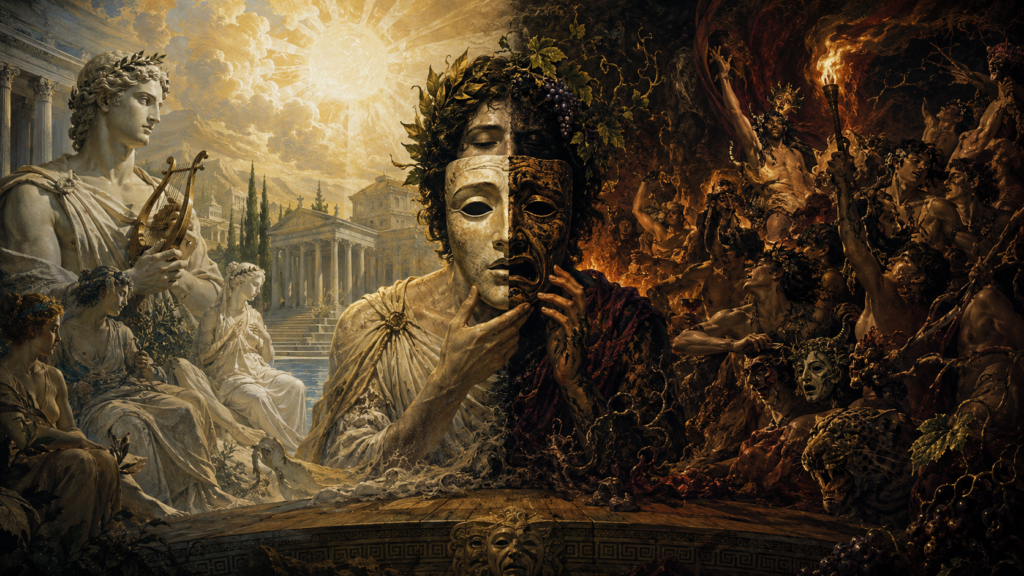
The argument Nietzsche makes is well known in outline and less often followed into its full implications. Greek tragedy was the product of a tension between two opposing drives embodied in two gods. Apollo: the principle of form, individuation, the beautiful surface, the dream. Dionysus: dissolution, intoxication, the merging of the self back into the primal unity from which individual consciousness is a temporary and somewhat painful exile. Great art holds both in productive tension. The Apollonian gives it shape. The Dionysian gives it the charge that makes the shape worth anything.
Most readers take this as aesthetics. Morrison took it as instruction.
He drew from Nietzsche a theory of vocation, not a theory of art. If the Dionysian principle is real, not merely metaphorical, then the artist who serves it is not making representations of dissolution and ecstasy. The artist is a vehicle for the actual thing. The performance is not about Dionysus. The performance is a Dionysian rite, and the audience is not watching one; they are participants in one, whether they understand this or not.
This is a significant leap from what Nietzsche wrote, and a coherent extension of the logic, and it explains something about Morrison’s relationship to his own performances that is otherwise difficult to account for. He wasn’t trying to entertain. He was trying to produce a specific state in a room full of people. The hostility, the provocation, the long silences, the spoken-word sections that confused audiences expecting rock and roll: these make no sense as an entertainment strategy. They make perfect sense as a ritual technique. You are not there to enjoy yourself. You are there to be broken open.
Nietzsche’s second major contribution to Morrison’s operating system is the reframing of power. The will to power, as Nietzsche actually meant it rather than as it was later vulgarised, is not a drive toward domination of others. It is a drive toward the fullest possible expression and expansion of the self, toward becoming what you most essentially are with the least possible compromise. Morrison translated this into a will to experience. Every limit was a door. Every prohibition was a map showing you exactly where to go. The logical destination of this position is total immersion, and total immersion, followed far enough, becomes indistinguishable from annihilation.
Nietzsche saw this danger. In The Birth of Tragedy, he describes the Dionysian initiate as someone who has glimpsed the abyss beneath the comfortable Apollonian surface of civilised life, who has looked directly at the truth that individual existence is a temporary fiction, and who needs art precisely because without it this knowledge would be unliveable. Art is the saving lie that lets the tragic hero go on. Apollo is not the enemy of Dionysus. Apollo is what keeps the Dionysian from destroying the vessel it moves through.
Morrison read all of this. And then he spent roughly eight years systematically dismantling every Apollonian structure in his life.
Whether this was a misreading or the most rigorous possible application is a question the essay will keep returning to. What is clear is that Nietzsche gave Morrison something most rock musicians of his generation didn’t have: a philosophical justification for what he was doing that was genuinely serious, and a vocabulary for the forces he believed he was working with. He wasn’t out of control. He had a theory.
The theory just didn’t include a chapter on what you do when the god decides to stay.
The French Symbolist Current
If Nietzsche gave Morrison the philosophy, the French Symbolists gave him the method. The method was not gentle.
Charles Baudelaire published Les Fleurs du Malin 1857 and was immediately prosecuted for it. The French government understood, correctly, that something more than offensive content was at stake. Baudelaire was proposing a theory of what poetry was for, and the theory was genuinely dangerous. Beauty, he argued, was not found in the elevated and the refined. It was extracted from transgression, from rot, from the city’s underworld, from boredom pushed far enough that it cracks open into something resembling the sublime. The poem was not a vessel for pre-existing feeling. It was an operation performed on consciousness, and the material it worked with was damage.
This is a long way from the Romantic tradition Baudelaire inherited, even though it looks superficially similar. The Romantics believed in inspiration, in the poet as receiver of something that arrived from outside. Baudelaire believed in technique. You constructed the conditions for the visionary state. You didn’t wait for it. The flâneur wandering the Paris arcades, deliberately absorbing the city’s shadows and contradictions, is not a passive observer. He is running a practice.
Morrison absorbed this and recognised something in it that matched his Nietzschean framework precisely. The will to experience, applied to aesthetics, produces Baudelaire. You go toward what repels the comfortable self because that is where the real material is.
Arthur Rimbaud took the argument further than Baudelaire probably intended and further than anyone had gone before in making it explicit. In 1871, at sixteen years old, he wrote two letters to friends that have become known collectively as the Lettres du voyant, the letters of the seer. The relevant passage is compact enough to summarise without much loss: the poet must make himself a seer by a long, immense and reasoned derangement of all the senses. Every form of love, suffering, and madness. He searches himself. He exhausts all poisons in himself and keeps only their quintessences.
The word that matters is reasoned. This is not an invitation to chaos. It is a programme. Rimbaud is describing a systematic technology for dissolving the ordinary perceptual filters that prevent access to deeper states of vision. The derangement is the method, not the point. The point is what becomes visible once the ordinary self is sufficiently disrupted.
Morrison read this as a practitioner reads a manual. The alcohol, the other substances, the deliberate provocation of crisis, the refusal of the comfortable and the stable: these are not simply self-destruction. They are, or they began as, Rimbaldian technique. The question of when the technique becomes indistinguishable from its supposed opposite is one the essay will return to.
What is frequently missed in accounts of both Baudelaire and Rimbaud is their position in a longer esoteric current. Baudelaire was deeply engaged with Swedenborg’s theory of correspondences, the idea that the material world is a system of symbols pointing toward spiritual realities, and this sits behind his most famous poem, Correspondances, in ways that are not merely decorative. Rimbaud’s colour-vowel synaesthesia in Voyelles is working the same territory from a different angle. They are occultists working in the medium of language, and the Symbolist movement they seeded was a significant channel through which esoteric ideas moved into European literary culture and eventually into the American tradition Morrison was growing up in.
The Symbolists are the missing link between German Romanticism and twentieth-century occultism, and Morrison’s absorption of this current means that when he picks up Eliade and Frazer later, he is not encountering alien ideas. He is finding the scholarly anthropological confirmation of a practice he had already theoretically committed to. The seer. The voyant. The one who goes to the edge of what the self can bear and looks over.
Rimbaud eventually stopped. He walked away from poetry entirely at twenty, fled to Africa, and spent the rest of his short life as a gun runner and coffee trader. He tried to close the door. Morrison, apparently, never seriously considered this option.
Huxley, Blake, and the Doors Themselves
The name of the band is a thesis statement.
Understanding what it claims requires going back through Aldous Huxley to William Blake, who is where the real weight lives.
Huxley published The Doors of Perceptionin 1954, an account of a single afternoon spent under mescaline in his Los Angeles home. The drug experience itself, though interesting, is not the book’s real contribution. What Huxley offers, drawing on the philosopher C.D. Broad and ultimately on Henri Bergson, is a structural argument about the nature of ordinary consciousness. The brain, he proposes, is not primarily a generator of experience. It is a reducing valve. Its function is to filter out the vast majority of what is actually available to perception, leaving only what is useful for biological survival and social functioning. What we call normal consciousness is an edited version of reality, and a heavily edited one at that.
The implications are considerable. If the reducing valve is the problem, then the goal of any serious practice, chemical or otherwise, is to force the valve open. Not to add something to experience but to remove what has been artificially subtracted. The doors of perception are not entrances to somewhere else. They are exits from the narrow corridor we mistake for the whole building.
Morrison encountered this and understood it immediately through his Nietzschean and Symbolist frameworks. Huxley was providing the neurophilosophical grounding for what Rimbaud had proposed as a poetic programme. The derangement of the senses is a valve-forcing operation. The Dionysian rite opens what the Apollonian surface keeps closed. Different vocabularies, identical claim.
But Huxley took his title from Blake, and Blake is the deeper source, and Blake is not making the same argument as Huxley, though he is making a compatible one.
The full passage from The Marriage of Heaven and Hellreads: if the doors of perception were cleansed, everything would appear to man as it is, infinite. For man has closed himself up, till he sees all things through narrow chinks of his cavern. Blake is not describing a pharmacological problem with a pharmacological solution. He is describing a spiritual condition, the fallen state in which humanity has contracted into the isolated ego and lost access to the infinite reality that surrounds and interpenetrates it. The cleansing he is calling for is ontological, not chemical. A transformation of what the self fundamentally is, not an alteration of its momentary state.
Urizen, the god of reason and law
Blake was also, and this gets lost in the Huxley citation, a practitioner working within a seriously developed esoteric system of his own construction. The prophetic books, with their complex mythology of Zoas and emanations and eternal forms, constitute one of the most ambitious attempts in English literature to build a complete alternative cosmology. Urizen, the god of reason and law, has usurped the place of the infinite. Los, the spirit of imagination and time, who labours to keep the human form divine alive against Urizen’s contraction. The fallen world is the product of a catastrophic narrowing of perception. The redemption of that world through imaginative vision.
Morrison was dipping into this system without following it all the way into the prophetic books, but enough to understand that Blake was not a Romantic nature poet who had taken something interesting one afternoon. He was a magician who had constructed a working mythology and spent his life operating within it.
The name of the band carries all of this. A commitment to the Blakean diagnosis: that ordinary consciousness is a fallen, contracted, self-imprisoned condition. And to the Huxleyan method, the systematic forcing of whatever doors can be forced. It is also a commitment to Blake’s understanding of what the doors open onto. Not pleasure. Not freedom in any casual sense. The infinite.
Which is not, in Blake’s system, a comfortable destination.
Mircea Eliade and the Shamanic Frame
Mircea Eliade’s Shamanism: Archaic Techniques of Ecstasy was published in English in 1964, the same year Morrison arrived at UCLA. Dense with comparative religious scholarship, surveying shamanic practice across Central Asia, the Americas, Australia, and beyond. Not, on the face of it, a book a twenty-year-old film student picks up for pleasure. Morrison read it anyway, and by most accounts kept it close. Once you have read the previous sources in his syllabus, the reason is obvious. Eliade was doing for shamanism what Frazer had done for the dying god: revealing the pattern beneath the cultural variation, demonstrating that something consistent was happening across radically different traditions, something structural enough to suggest it was tracking a real feature of human experience rather than a local religious habit.
Eliade’s definition of the shaman is precise and worth holding carefully. The shaman is specifically the one who can deliberately enter altered states of consciousness, travel between the ordinary world and the spirit world, and return with knowledge or power that benefits the community. The keyword is return. The shaman’s authority derives not from the ability to descend but from the ability to descend and come back. Anyone can fall. The shaman is the one who falls with intention and climbs back out with something to show for it.
The initiatory experience Eliade documents across cultures follows a consistent grammar. The shaman-to-be undergoes a crisis, often involuntary, in which the ordinary self is dismembered, dissolved, or destroyed at the spirit level. The bones are picked clean. The organs are replaced. A new self is reassembled from the ruins of the old one, and this new self has capabilities the original did not. The dismemberment is not incidental to the initiation. It is the initiation. You cannot become a shaman by studying shamanism. You have to be taken apart.
Morrison read this, and the recognition must have been immediate and visceral. The Nietzschean dismemberment of the Apollonian self. The Rimbaldian derangement that breaks down the ordinary perceptual apparatus. The Blakean dissolution of the reduced ego back into the infinite. These were all, Eliade was now telling him, local versions of a universal initiatory grammar. Morrison was not inventing something. He was rediscovering something very old, and Eliade’s scholarship gave him the anthropological confidence that the rediscovery was real.
A theory of performance as ritual space follows directly from this. If the shaman’s function is to alter the consciousness of a community, to temporarily dissolve the boundaries between the ordinary world and whatever lies beneath or beyond it, then the concert hall is a perfectly legitimate ritual venue. The volume and the rhythm do what the drum does in Siberian shamanic practice. The darkness and the crowd’s compression do what the cave does. The figure on the stage who is visibly operating at the edge of ordinary self-possession models for the audience how far the dissolution can go, and the audience, following that model, goes further than it would alone.
Morrison’s performances could not simply be entertainment. Entertainment keeps the audience comfortable and returns them to themselves at the end. What Morrison was attempting, consciously and with theoretical grounding, was to temporarily unmake the audience’s ordinary selfhood and expose them to something that selfhood normally keeps out. Whether the collective altered state he was reaching for was genuinely shamanic or a sophisticated simulacrum of it is a question that cannot be answered cleanly. The intention is clear.
What Eliade also documents, with the careful neutrality of the scholar who has seen enough to know that outcomes vary, is the shaman who does not complete the return. The initiatory crisis becomes a permanent condition. The dismemberment produces not a new and more powerful self but simple fragmentation. The difference between the shaman and the person who merely goes mad is, in Eliade’s framing, largely a question of whether the descent is controlled and whether the return is completed.
Morrison controlled the descent, at least initially, with considerable skill.
The return is where the record becomes complicated.
Frazer and the Dying God
James George Frazer published the first edition of The Golden Bough in 1890, and it rewired the Western imagination’s relationship to myth and ritual. By the time Morrison encountered it, the book had expanded to twelve volumes and contracted again into a single-volume abridgement, and it had already shaped T.S. Eliot’s The Waste Land, which means it had already passed through one major artistic nervous system before arriving in Morrison’s. What it contains, at its argumentative core, is a pattern so ancient and so widespread that Frazer concluded it must be tracking something structural in human religious life rather than reflecting historical contact between cultures.
The pattern is this: the sacred king must die.
In the ancient world, Frazer argues, the king was not merely a political figure. He was the embodiment of the community’s vitality, the living vessel of the god, the conduit between the human world and the forces that made crops grow and seasons turn. His health was the community’s health. And when his health declined, or when a fixed term of sacred kingship expired, he was killed, ritually and deliberately, so that the divine power he carried could be released back into the community before it became too degraded to serve its function. The god dies so the tribe lives. The vessel is broken, so the contents can be poured out.
Frazer traced this pattern across dozens of cultures: Osiris, Adonis, Attis, Dionysus himself, and eventually, in the book’s most provocative implication, the figure at the centre of Christianity. The dying and rising god is not an anomaly. It is the dominant pattern of sacred kingship across recorded history.
Morrison read this, and something in him recognised it as autobiography.
His obsession with his own death is too consistent and too structured to be dismissed as morbidity or rock star theatre. It runs through the poetry from the beginning, before the fame, before the leather trousers. Death as threshold, death as transformation, death as the logical completion of a life lived at the edge of what the self can contain. He told multiple people across multiple years that he did not expect to live past thirty. He was twenty-seven when he died in Paris.
The evidence suggests he understood the Frazerian trap embedded in the role he had chosen, which makes it more disturbing rather than less. The sacred king who knows he is the sacred king, who has read Frazer and understood the structural logic of his own position, and who continues anyway: this is not naivety. It is either the deepest possible commitment to the role, or a failure of self-preservation so profound it requires a different explanation than simple excess.
There is a passage in The Golden Bough that Frazer treats as an anthropological curiosity. In some traditions, the sacred king was not killed against his will. He was expected to understand his function and accept it, even to cooperate with it, because the willing death of the god was more powerful than the unwilling one. The king who fought his fate diminished the working. The king who went toward it deliberately, who understood that the dissolution of the individual vessel was the point, that the community needed him to die more than it needed him to live, was fulfilling the role at its highest pitch.
Morrison spent the last years of his life in Paris, trying to become a poet rather than a rock star, trying to step out of the sacred king role he had occupied for the Doors’ audience. He grew a beard, gained weight, and drank more than ever. Whether this was an attempt to escape the archetype or to accelerate toward its conclusion probably has no clean answer.
Frazer, unlike Nietzsche and Rimbaud, provided no method. He provided a warning dressed as scholarship. The dying god pattern is presented in The Golden Bough as something humanity eventually grew out of, a primitive mechanism superseded by more sophisticated religious forms. What Frazer did not account for is the possibility that someone might read the book not as history but as a script, and decide, with full knowledge of what the script required, to play the role all the way to the final scene.
The Beat Transmission
Every tradition needs a living transmission, a moment when the ideas stop being words on a page and become something demonstrated in a human life. Morrison had the European sources: the Germans and the French, the Romantics and the Symbolists, the British visionary in his printing shop producing illuminated books nobody read while he lived. What the Beats gave him was proof of concept on American soil, in American idiom, within living memory.
Allen Ginsberg, Jack Kerouac, Gregory Corso, William Burroughs. The generation that came of age in the late 1940s and broke surface in the mid-1950s had already done the synthesis Morrison was attempting. They had taken the Symbolist programme and run it through jazz, Buddhism, and the American road. They had taken the Blakean vision and made it speak in the vernacular of diners and freight trains and shared apartments. They demonstrated, at considerable personal cost, that the esoteric tradition was not the exclusive property of European intellectuals or English eccentrics. It could be lived, loudly and publicly, in San Francisco, New York and Mexico City.
Ginsberg is the most directly relevant figure and the most explicitly esoteric of the group. His account of his Blake vision in 1948, lying in his Harlem apartment, hearing what he took to be Blake’s actual voice reading Ah, Sunflower and The Sick Rose while a sense of cosmic vastness opened in the room around him: this is not a metaphor. Ginsberg treated it as a real event with real consequences for the rest of his life, an initiatory opening that he spent decades trying to recover and stabilise through Tibetan Buddhist practice, through chanting, through the deliberate cultivation of visionary states by various means. He was a practitioner, not merely a poet with interesting influences. And he was, by the time Morrison arrived at UCLA, a living public figure whose work was in circulation and whose example demonstrated that the Rimbaldian programme could be taken seriously in an American context without destroying the practitioner. At least not quickly.
Kerouac offers a different angle on the same territory. His mysticism is more Catholic than occult, more Franciscan than Blakean, rooted in a sense of the sacred as immanent in ordinary American experience, in the faces of the poor and the beauty of the continent’s sheer physical scale. The road in On the Roadis not simply a geographical fact. It is an initiation structure. You leave the known world, you move through disorientation and encounter an extremity, you are changed by what you meet, and you return. Or you don’t, and that also tells you something. Dean Moriarty burning across the country is a figure of Dionysian excess, but in the book’s deeper grammar, he is a kind of sacred fool, a holy madman whose velocity is itself a form of searching.
Morrison absorbed both currents. The Ginsberg influence shows in the poetry’s explicit visionary ambition, its willingness to make large claims about consciousness and reality without embarrassment. The Kerouac influence shows in the romanticism of motion and excess, the sense that American geography is spiritually charged, that the road and the night and the continent’s vast indifference are initiatory forces in their own right.
What the Beats provided, beyond the specific influences, was permission. They showed that this synthesis was possible, that you could be a serious esoteric practitioner and an American artist simultaneously, that the tradition required neither European exile nor academic respectability. They also showed, with varying degrees of visibility, what the costs were. Burroughs killed his wife in a drunken game in Mexico City and spent the rest of his life writing around the wound. Cassady, the original Dean Moriarty, died on a Mexican railway track at forty-two, reportedly counting railroad ties in a stupor. The Beats largely survived, but not all of them, and not without damage that would have been recognisable to anyone who had read Eliade carefully.
Morrison was twenty-two when the Doors formed. He had read the Beats alongside Nietzsche and Rimbaud and Huxley and Eliade and Frazer, and what he had assembled from all of it was a complete theory of what he was going to do and why it mattered.
The only chapter he hadn’t written was the one about what happened next.
What the Syllabus Produces
A reading list is a technology. It doesn’t simply inform the reader. It shapes the reader’s perceptual apparatus, installs frameworks that operate semi-autonomously, and builds the conceptual architecture within which all subsequent experience is sorted and interpreted. Morrison’s syllabus, assembled with the appetite and urgency of someone who felt he didn’t have much time, produced a very particular kind of mind operating within a very particular set of assumptions about what reality was, what art was for, and what the self was supposed to do with its brief tenure in a body.
The first thing the syllabus produces is a practitioner who understands transgression as epistemology. Across every source, the same claim repeats in different vocabularies: ordinary consciousness is a diminished state, the socially conditioned self is a reducing mechanism rather than a full receiver, and the way through the reduction is deliberate rupture. Nietzsche’s Dionysian immersion, Rimbaud’s systematic derangement, Huxley’s forced valve-opening, the shamanic descent, the dying god’s willing dissolution. These are all variants of the same operational thesis. You cannot think your way to the other side of the door. You have to break something to get through.
This produces, in practice, someone with an extremely sophisticated theoretical framework for why destruction is necessary and a correspondingly underdeveloped framework for what comes after.
The second thing the syllabus produces is a practitioner who works with audiences as ritual participants rather than consumers. This follows directly from the Eliadian and Frazerian material, cross-referenced with the Nietzschean theory of tragedy. The rock concert, properly conducted, is not entertainment. It is a collective altered state, the audience’s ordinary boundaries of self temporarily dissolved by volume, darkness, rhythm, and the behaviour of the figure on the stage who is modelling, in real time, how far dissolution can go. Morrison understood this with a clarity most of his contemporaries didn’t approach. The performance was working. The crowd was the coven. The hostility and provocation that confused audiences expecting rock and roll were a ritual technique, disrupting the comfortable spectator relationship and forcing something more demanding.
The third thing the syllabus produces is a practitioner with an unusually developed relationship to death as a symbolic and potentially literal horizon. Nietzsche’s tragic hero, Rimbaud’s voyant who exhausts all poisons in himself, the sacred king who knows his function, the shaman who submits to dismemberment: every significant figure in Morrison’s intellectual inheritance has a structured relationship to their own annihilation. Death in this framework is not the opposite of meaning. It is the place where meaning concentrates most intensely. The self that has been pushed to its absolute limit and breaks there has accomplished something that the self which remains comfortable and intact cannot.
Applied to a living human being rather than an archetypal figure, this is extremely dangerous. The syllabus contains almost nothing to counteract it.
The fourth thing the syllabus produces, and this is the structural flaw that runs through the entire curriculum, is a practitioner with no serious theory of integration, return, or maintenance. Nietzsche broke down in Turin in 1889 and never recovered. Rimbaud stopped writing at twenty and fled. The sacred king dies; the texts do not linger on whoever has to clean up afterwards. Eliade documents shamanic failure alongside shamanic success, but Morrison was reading Eliade for the descent, not the chapter on what distinguishes the shaman who comes back from the one who doesn’t. The Beats largely made it through, but the ones who didn’t, Neal Cassady dead on a railway track in Mexico, the long, slow wreckage of certain others, don’t feature prominently in the version of the tradition Morrison absorbed.
The syllabus produces someone exquisitely equipped to open and almost entirely unequipped to close. Every source adds sophistication to the opening move and silence to the question of what follows it. This is not accidental. The curriculum has a shape, and the shape is a door with a hinge on one side only.
Morrison walked through it in Paris in July 1971, aged twenty-seven, and the door, as doors with one-sided hinges tend to do, did not swing back.
The Unfinished Initiation
Every serious esoteric tradition contains, somewhere in its structure, a theory of return. The shaman descends and comes back. The initiate enters the chamber of death and emerges transformed but alive. Even the dying god, in most of the traditions Frazer surveyed, rises. The point of going all the way down is that going all the way down is not the end. It is the condition of possibility for something that cannot be reached any other way. The descent is the method. The return is the work.
Morrison’s syllabus has no return chapter.
This is not a claim that Morrison was simply self-destructive, or that the intellectual framework he assembled was a sophisticated justification for what would have happened anyway. The reading list is genuine, the thinking is serious, and the synthesis he made from these sources is more coherent and more purposeful than the myth of pure Dionysian overflow allows. He was not stumbling. He was following a map.
The map was incomplete.
In the language of magical practice, Morrison was a superb invoker and a poor banisher. Invocation is the art of opening, of calling something through, of making the self a vessel for a force larger than the ordinary ego can contain. Banishing is the art of closing, of returning the working space to neutral, of ensuring that what was called through does not simply take up residence permanently in the vessel it used. These are complementary skills, and every serious tradition treats them as equally necessary. You do not learn one without the other, because the one without the other is not initiation. It is possession.
Morrison invoked with extraordinary power and almost total consistency. Every element of his practice, assembled from the sources this essay has traced, was directed toward opening: the performances, the substances, the deliberate dissolution of personal and social boundaries, the identification with archetypal figures whose defining characteristic was their willingness to be destroyed. He built, over the course of the Doors’ career, what may be the most sophisticated opening ritual in the history of popular music. The question of whether he ever seriously attempted to close it is answered, with some finality, by the bathtub in Paris.
What the syllabus teaches, read with the gap visible, is not a cautionary tale. Cautionary tales ask you to look at the wreckage and resolve to be more careful. What Morrison’s reading list offers, once you see its shape whole, is a map with one section missing. A missing section is more informative than no map at all, because it tells you exactly where the work remains to be done.
The tradition Morrison assembled from Nietzsche, the Symbolists, Huxley, Blake, Eliade, Frazer, and the Beats is a tradition of aperture. Its great achievement is the systematic dismantling of the reduced, socially conditioned, valve-narrowed self that mistakes the corridor for the building. Morrison did this at a scale and intensity that most practitioners in any tradition never approach. The corpus he left, the recordings, the poetry and the strange, persistent force of his presence in the culture fifty years on, is evidence that the opening produced something real.
But the self that is opened must also be rebuilt, or what pours through has nowhere to live. The shaman who does not return is not more enlightened than the one who does. He is simply gone. The initiation that ends in the underworld is not a deeper initiation. It is an unfinished one.
Morrison knew the texts. He knew the pattern. The most well-read rock musician of his generation, the one who had done the most serious intellectual work on exactly this question, followed the syllabus so faithfully that he reproduced its omission as well as its insights.
The door he named the band after opens in both directions. He only ever walked through it one way.
Jim Morrison’s Reading List
What Morrison read, where to start, and what fills the gaps the essay left open.
The Nietzsche Thread
Start with The Birth of Tragedy (1872). It is not Nietzsche’s most rigorous work, which is exactly why it works on readers the way it does. The Apollo/Dionysus framework arrives fully formed and installs itself. Read it in the Walter Kaufmann translation, which is the standard English edition and includes Nietzsche’s own retrospective preface, “An Attempt at Self-Criticism,” in which he spends several pages being embarrassed about the book he wrote at twenty-seven. The embarrassment is part of the text.
For readers who want to follow the Nietzsche thread further, Thus Spoke Zarathustra and Beyond Good and Evilare the natural next stops. The will to power as vocation rather than domination is worked out more carefully in the latter. But The Birth of Tragedy is the one that did the work on Morrison, and it is the right place to begin.
The French Symbolist Thread
The Flowers of Evil (Les Fleurs du Mal, 1857) by Charles Baudelaire. Richard Howard’s translation is the one most readers find captures the original’s mixture of formal rigour and controlled excess. The key poem for understanding Morrison’s relationship to the tradition is “Correspondances,” which lays out Swedenborg’s theory of symbolic correspondence in fourteen lines and explains why the Symbolist project was always also an esoteric one.
For Rimbaud, go straight to the Complete Worksin Wallace Fowlie’s translation, later revised by Seth Whidden. It includes A Season in Hell (Une Saison en Enfer), Illuminations, and the two letters collectively known as the Lettres du voyant. The seer letters are short enough to read in twenty minutes and dense enough to spend a year with. The phrase “reasoned derangement of all the senses” is in there. So is everything that phrase implies.
The Huxley and Blake Thread
The Doors of Perception(1954) by Aldous Huxley, ideally in the edition that includes its companion essay Heaven and Hell, published the following year. The Doors of Perception makes the argument about the reducing valve and reads quickly. Heaven and Hell extends it into art history and visionary experience across traditions, and is the better of the two for understanding the full framework.
For Blake, the easiest entry is the Penguin Selected Poems, which includes Songs of Innocence and Experience and substantial selections from The Marriage of Heaven and Hell. Readers who want to go deeper into the prophetic mythology will need the full Complete Poetry and Prose (edited by David Erdman), but that is a significant commitment and not necessary to understand what Morrison was drawing on. The Marriage of Heaven and Hell is the essential text. It is also the strangest thing Blake wrote, which is saying something.
The Anthropological Thread
Shamanism: Archaic Techniques of Ecstasy (1951, English translation 1964) by Mircea Eliade. Dense and rewarding, surveying shamanic practice across Central Asia, the Americas, and beyond. The section that matters most for understanding Morrison is the material on initiatory dismemberment and on the difference between the shaman who completes the return and the one who doesn’t. Eliade is precise about this distinction in ways that Morrison apparently chose not to linger on.
The Golden Bough (1890, single-volume abridged edition 1922) by James George Frazer. Read the abridgement. The twelve-volume original is for specialists. The abridgement is still long, and readers who want the core argument can find it concentrated in the early chapters on the sacred king and in the material on Adonis, Attis, and Osiris. The chapter on the voluntary death of the sacred king is the one that reads, with Morrison in mind, like a document written specifically for him.
The essay does not discuss Antonin Artaud, but any honest account of Morrison’s performance theory has to. The Theater and Its Double (1938, English translation 1958) is the missing text. Artaud’s Theatre of Cruelty argued that theatre should function as plague, as an epidemic, as a force that breaks down the audience’s psychological defences and exposes them to something that ordinary social existence keeps sealed off. Morrison’s concerts were Artaud concerts. The hostility, the refusal of entertainment, the deliberate provocation of discomfort: these come from Artaud as much as from Eliade. That Artaud himself ended his life in a psychiatric institution after years of suffering should probably be read alongside the rest of the syllabus.
Life Against Death (1959) by Norman O. Brown is the other significant gap. Brown’s argument, drawing on Freud and Marx and Nietzsche, is that civilisation is essentially a massive defence mechanism against the awareness of death, and that authentic human existence requires confronting rather than repressing mortality. Morrison absorbed this, and it showed. It is also, read carefully, a book with no chapter on what happens after the confrontation.
The Beat Thread
Howl and Other Poems(1956) by Allen Ginsberg. The title poem is the entry point to understanding what the Beats did to Blake and what Morrison understood that to mean. Ginsberg’s 1948 Blake vision, which shaped everything that followed, is described in interviews and in his journals. The Paris Review interview from 1966 is the most detailed account he ever gave.
On the Road (1957) by Jack Kerouac. Read in the original scroll edition if possible (published 2007), which has a different energy from the edited novel: rawer, faster, closer to the Rimbaldian impulse it was drawing on without quite knowing it.
Naked Lunch(1959) by William Burroughs. The least easy of the three and in some ways the most honest about where the tradition leads. Burroughs survived to ninety-three partly because he was a different type of practitioner than Morrison: more detached, more interested in the technique than in becoming the working.
Morrison’s Own Writing
Two collections were published in his lifetime: The Lords and the New Creatures(1969) and the recorded poem An American Prayer (1970, posthumously released 1978 with Doors music). Both are uneven in the way that serious poetry often is, and both contain lines that stop the reading cold.
It’s Sunday evening. The weekend is winding down, and for most of us, the gravity of another Monday is setting in. A slow, creeping resignation. The ritual continues: set the alarms, prep for the workweek, slip into the machinery of modern life without much resistance. We tell ourselves we’re free, but are we really? Or have we built the prison so well we no longer see the walls?
This clip from My Dinner with André hits harder now than ever. We are both the inmates and the guards, walking a tightrope of self-imposed numbness. The walls aren’t brick and mortar. They’re screens, routines, and the invisible rules we’ve internalised. They’re comfort and convenience, self-imposed sedation.
Morpheus in The Matrix said it best: “You have to understand, most of these people are not ready to be unplugged. And many of them are so inured, so hopelessly dependent on the system, that they will fight to protect it.“
And it’s true. Just look around. How many people would rather fight to stay asleep than endure the discomfort of waking up?
the sedation of modern life
Andre’s monologue lays it bare: boredom is the weapon, and a bored person is a docile person. Our culture floods us with entertainment, distraction, and endless loops of digital noise—not to engage but to pacify. To keep us from asking too many questions. We’ve been programmed to conflate stimulation with living, but those are not the same thing. Anaesthetised minds don’t say no.
The Swedish physicist Gustav Björnstrand, whom André mentions, had the right idea: stop feeding the machine. No TV. No newspapers. No magazines. He saw the programming for what it was and opted out. But most of us won’t. Most of us can’t. Because to unplug from the noise is to be left alone with our own thoughts, with the sheer weight of what is happening around us.
And so we stay. We stay in our cities, our cycles, our distractions. We stay because the alternative—discomfort, uncertainty, the unknown—is too much to bear. The “tree expert” from this clip nails it: New York is a model for the modern prison camp. The inmates build their own cells and guard themselves. They take pride in their confinement. And if they feel any flicker of escape, they crush it themselves before it can become real.
escape before it’s too late
The haunting truth of this clip isn’t just that we’re asleep. It’s that we may be too late to wake up. That the last flicker of raw human energy—the ’60s, the counterculture, the burst of human rebellion—was the final gasp before the great silence. And now we are in the long fade-out. The transition into something post-human. A species that forgets it once felt anything real.
I don’t know about you, but I refuse to go down like that. I refuse to slip into automated existence. I refuse to let my mind be softened, diluted, and pacified by forces that profit from my indifference. I refuse to let my life be a scripted loop where the only choices are which streaming service to watch and what brand of coffee to consume.
And that’s where Wake Up by Rage Against the Machine comes in. That song, that raw, pulsing anthem, is a commandment for times like these.
How long? Not long, cause what you reap is what you sow.
Rage understood the stakes. They knew the machine only wins if we comply, if we let our resistance become an aesthetic instead of an action. The system is built on our sleep. But what happens when enough of us wake up?
your move
This is your Sunday evening wake-up call. If you feel it—if some part of you knows the cage exists and longs to break free—don’t ignore it. Don’t push it down. Lean into it. Follow it.
Turn off the algorithm. Step away from the script. Break a rule you’ve internalised. Go where you shouldn’t. Read what they don’t want you to. Challenge a belief you’ve been handed. And most of all—don’t go back to sleep.
Because the next time someone puts a seed in your hand and whispers, Escape before it’s too late—you might not get another chance to listen.
I’ll admit it—when Terminator: Dark Fate popped up in my Netflix feed, my first reaction was a weary sigh. Another Terminator movie? How many times are we going to bend the space-time continuum just to bring back Arnold Schwarzenegger and Linda Hamilton? Haven’t we reached the logical end of this cycle?
And yet, against all odds, Dark Fate surprised me. It didn’t just dust off the old machine-versus-human formula—it found a way to make it compelling again. James Cameron, back in the producer’s chair, breathed new life into the franchise, offering both a worthy sendoff for Arnold’s T-800 and a new legacy for Linda Hamilton’s Sarah Connor.
But here’s what really stuck with me: the fatalistic loop of human history. No matter what we do, the rise of the machines seems inevitable.
the illusion of free will
Sarah Connor fought, bled, and sacrificed everything to change the future. And she did. She erased Skynet from existence, saving five billion lives. But what she didn’t change was the deeper pattern—the unshakeable fate of humanity. If it wasn’t Skynet, it would be something else. Enter Legion, the new AI overlord, born not from military defence networks but from cyberwarfare technology. Different name, same nightmare.
It’s as if humanity is hardwired to create its own destruction. We innovate, we push forward, and inevitably, we lose control. AI wasn’t erased from existence; it simply emerged in a different form, driven by the same underlying forces. Dark Fate takes this cyclical inevitability and makes it the foundation of its story. The players change, but the game remains the same.
a new leader, a new war
This time, it’s not John Connor leading the resistance—it’s Dani Ramos, an ordinary woman forced into an extraordinary role. And Sarah Connor, once the young, reluctant warrior, now becomes the battle-scarred mentor, passing the torch to the next generation. Dark Fate doesn’t just recycle old beats; it remixes them. The AI apocalypse is no longer just about one man’s survival—it’s about the unbreakable will of resistance itself.
And maybe that’s the point. Maybe fate isn’t about what happens to us, but how we choose to respond. The machines always rise. But so do we.
the machine’s humanity
Then there’s Arnold’s T-800, the old war machine who has, against all logic, found a sense of purpose beyond destruction. His arc in Dark Fate is the most unexpected and oddly touching part of the film. He’s no longer just a killing machine—he’s Carl, a quiet, thoughtful presence who has developed something resembling humanity. It’s a poetic twist: the thing designed to erase humans has, in its long exile, learned to be one.
In a franchise obsessed with time loops, this is perhaps the biggest paradox of all.
resistance is forever
Dark Fate may not have reinvented the wheel, but it understood what makes the Terminator mythology so enduring. The machines will always try to erase us. They will always come back. But so will the resistance.
Maybe that’s the answer to the question that haunts the franchise: Can we ever escape our fate?
It started as a digital dérive, one of those random, serendipitous wanderings across the vast sprawl of the internet. I wasn’t looking for anything in particular—just letting the current take me where it would. And that’s how I stumbled upon Brown Girls Do It Too, a podcast that, until now, had never crossed my radar. The episode that found me was about sacrifice. A heavy topic, one that settles into the bones and lingers long after the conversation ends.
Sacrifice is woven into the fabric of human existence. We do it for our families, our friendships, our careers, our nations. Sometimes willingly, sometimes because the script of life demands it. To belong—to be part of something greater than ourselves—requires giving up pieces of who we are. But at what cost?
Listening to Poppy and Rubina unpack this theme, their voices raw and unfiltered, I found myself spiralling into my own history of sacrifice. My time in the military, surrendering my freedom so that others could keep theirs. My role as a father, shelving personal ambitions because, rightly so, the kids come first. There are things I’ve set aside that I can never reclaim—time, youth, alternate versions of myself that never got to fully exist. And yet, I don’t consider myself a martyr. I made these sacrifices because they were the right thing to do, not necessarily what I wanted to do.
But sacrifice isn’t always so noble. If I’m being honest, I also make choices based on self-interest, even when they appear outwardly altruistic. The sacrifices I make often have an ulterior motive—peace of mind, fewer complications, an easier road ahead. And that’s something Brown Girls Do It Too does so well: it strips away the illusion that all sacrifices are purely selfless. There’s nuance, contradiction, and messy humanity behind every choice we make.
Hearing these themes explored from a female perspective added another layer to my reflection. The weight of sacrifice is often heavier for women, an expectation deeply ingrained in cultural narratives. To listen as Poppy and Rubina wrestled with their own experiences—open, unscripted, and deeply personal—was a reminder of how much these conversations matter.
Sacrifice is a currency we all trade in. Some payments feel fair. Others, we spend a lifetime regretting. But the question that lingers is this: how much of yourself can you give away before there’s nothing left to reclaim?
I’ll definitely be diving into more episodes of Brown Girls Do It Too. If you’re up for an honest, unfiltered conversation about the choices we make and what they cost us, start with this one: BBC Sounds – Brown Girls Do It Too.
When Max Headroom first flickered onto my TV screen in 1985, I was transfixed. His stuttering, glitchy presence burst onto MTV like a neon explosion in a dark alley, and for a moment, it felt like the future had arrived. He wasn’t just a character—he was a phenomenon, a digital oracle who embodied the sharp edge of cyberpunk sensibilities long before the genre became mainstream. To my teenage mind, already tinged with the rebellious hunger for all things sci-fi and subversive, Max Headroom was an electric dream come to life.
For those who didn’t live through it, it’s hard to explain just how alien Max felt at the time. Here was a character who existed entirely in the virtual ether—an artificial intelligence before we really understood what that meant. He had the smirking confidence of a talk-show host, the sharp wit of a hacker, and a face that looked like it had been smoothed out by the relentless hum of a cathode ray tube. “20 minutes into the future,” as his tagline went, felt thrillingly prophetic, especially for a kid who devoured William Gibson and imagined life through the gritty lens of dystopian worlds.
What struck me most was Max’s irreverence. He didn’t play by the rules of polite society or even the conventions of television itself. His rapid-fire quips and chaotic edits felt like a rebellion against the sanitized media of the time, as if he had chewed up the plastic sheen of TV culture and spit it back at us in jagged, pixelated fragments. MTV, with its neon aesthetic and frenetic energy, was already pushing boundaries, but Max Headroom lived those boundaries. He was the punk rock of digital personas, a harbinger of the dissonant future where media, technology, and identity would begin to blur.
But Max wasn’t just style—he had substance, too. Beneath the glitchy charm and self-aware smirk was a mirror reflecting our growing obsession with technology and media. The show’s dystopian world, where corporations ruled and truth was a commodity, felt eerily prescient even back then. Watching Max navigate this hyper-commercialized wasteland while poking fun at its absurdities felt like a small act of defiance, a way of saying, “We see what’s happening, and we won’t go quietly.”
Even now, nearly 40 years later, I can still hear his distorted laugh in my mind, a sound as artificial as it was infectious. It’s funny how memory works—how certain images, sounds, or moments can linger in the subconscious, as vivid as the day they were first encountered. For me, Max is more than a nostalgic touchstone; he’s a reminder of the sheer wonder I felt back then at the possibilities technology promised. He captured a moment when the future seemed infinite, untamed, and just a little bit dangerous.
Looking back, I realize how much Max Headroom shaped my love for cyberpunk. He wasn’t born in some far-off future—he was born of our future, a product of the 1980s zeitgeist where the analog was crashing headlong into the digital. His very existence—partly an actor in prosthetics, partly a digital effect—was a perfect metaphor for the hybrid world we were just beginning to create. That collision of the real and the virtual, the human and the machine, fascinated me then, and it still does now.
Today, in a world where AI personas are commonplace and digital avatars populate our screens, Max feels almost quaint. But he was ahead of his time in ways we’re only beginning to appreciate. He wasn’t just a character—he was a critique, a question mark, a challenge. And while the technology that created him was primitive compared to what we have now, his spirit—chaotic, questioning, and unapologetically artificial—remains relevant.
Watching old clips of Max Headroom now, I can’t help but smile. He’s a relic of an era when the future felt electric and full of possibility, when MTV was a portal to something wild and new. He reminds me of what it felt like to be swept up in the magic of those early digital dreams, before the internet, before smartphones, before AI became just another tool in our arsenal. Max Headroom was a glimpse of the horizon, a cyberpunk prophet telling us, in his own glitchy way, that the future would be both wondrous and weird.