Morning pages have a way of pulling the chair from underneath you just before you sit down. I haven’t done this for a while, so the words came slowly. You start by writing the ordinary thing.
Waking up before five.
Coffee.
Email.
The same thoughts looping around my head about money, sex, work, and the shape of the day. Ten minutes have gone by. And then the trapdoor opens. Underneath the routine is the real question: Am I living my vision, or just rearranging myself into shapes that I hope someone will notice?
You know I love a good mixtape. I haven’t done one of those in a while, either. Might as well start at the beginning. This first mixtape in the new series emerges from the undercurrent of my morning pages. These songs are for the self that is tired of shapeshifting for approval, tired of checking the metrics before doing the work, tired of trying to become the right thing instead of pushing the thing with enough force that the world has to feel it.
The seed songs got me through my workout this morning. Linkin Park’s “Somewhere I Belong” is the ache for a truer room inside the self. “Crawling” is the body admitting that habit can become possession. Papa Roach’s “Between Angels and Insects” brings the money spell into the open. All the wanting, buying, comparing, climbing, and hunger that eats the soul while pretending to feed it. System of a Down’s “Aerials” lifts the whole drama above the maze, where ego and conformity and freedom look different from a height. Then Avenged Sevenfold’s “Hail to the King” arrives with the crown, the will, and the danger of sovereignty. Who actually rules the inner kingdom and by what right?
Play it loud. By the end, see what’s left standing.
The myth of Jim Morrison is a myth of pure instinct. He arrives fully formed in the collective memory: shirtless, obliterated, magnificent, doomed. The leather trousers. The baiting of audiences in New Haven and Miami. The voice that seemed to come from somewhere older than rock and roll. The story we inherited insists that this was all eruption, all Dionysian overflow, a man too full of something dark and vital to contain it.
The story is wrong.
Morrison entered UCLA’s film school in 1964 as a serious student of ideas. He wrote poetry obsessively, in notebooks he carried everywhere, before he ever stood in front of a microphone. He read with appetite and intention across philosophy, anthropology, poetry, and mythology. When Ray Manzarek met him on Venice Beach, he didn’t encounter a wild thing. He encountered someone who had already done significant intellectual work on the question of what he wanted to become.
The esoteric content in Morrison’s life and work is routinely treated as atmosphere. The shamanism, the invocations, the obsession with death and threshold experience, the deliberate use of performance as a form of altered consciousness. These get folded into the legend as texture, as evidence of his romantic excess. They are evidence of a curriculum.
Morrison assembled, largely in his early twenties, a reading list with a coherent through-line. Nietzsche gave him the philosophical frame. The French Symbolists gave him the method. Huxley and Blake gave him the name for what he was trying to do and a theory of why it mattered. Eliade gave him the ritual structure. Frazer gave him the oldest warning, which he either didn’t read carefully enough or chose to ignore. The Beats showed him that this synthesis was survivable and could be made into American vernacular art.
This is a self-education in the deliberate construction and dissolution of self, in the use of transgression and altered states as tools for accessing something beyond ordinary perception, and in the performance of archetypal roles as genuine operative practice rather than theatrical gesture. Morrison wasn’t dressing up as a shaman. He was attempting, with considerable sophistication, to actually be one.
What kind of practitioner does this particular reading list produce? What are its strengths, what are its structural absences, and what happens to the person who follows it all the way to its logical conclusion?
Morrison built one of the most powerful opening rituals of the twentieth century. He just never got around to reading anything about how to close one.
The Nietzschean Foundation
Friedrich Nietzsche published The Birth of Tragedy in 1872 and spent the rest of his career partly embarrassed by it. He thought it overwrought, too Romantic, insufficiently rigorous. He was right on all three counts, and none of that matters. The Birth of Tragedy is one of those books that operates on the reader independently of its scholarly merit. It installs something. Morrison encountered it at UCLA, and it installed itself completely.
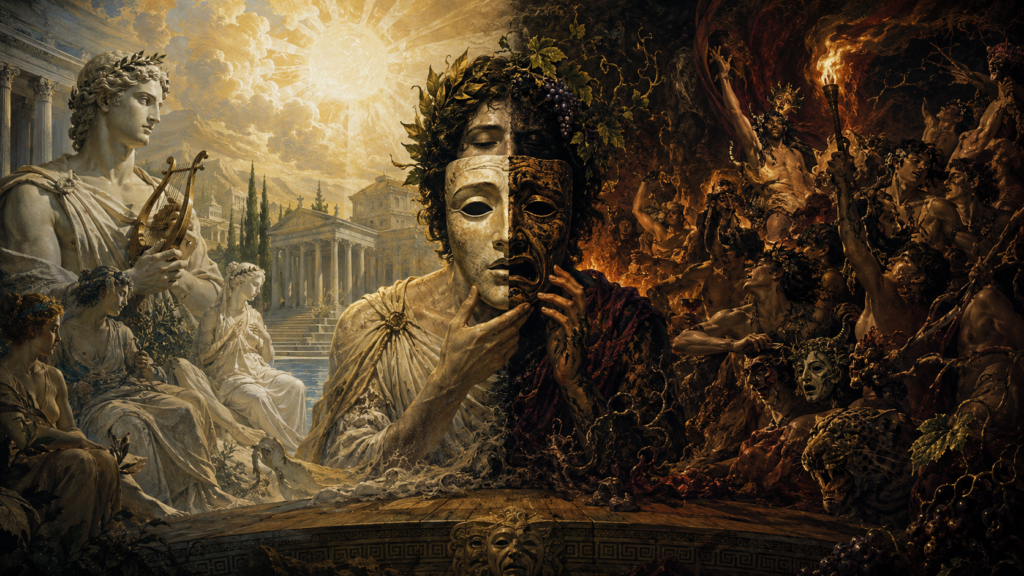
The argument Nietzsche makes is well known in outline and less often followed into its full implications. Greek tragedy was the product of a tension between two opposing drives embodied in two gods. Apollo: the principle of form, individuation, the beautiful surface, the dream. Dionysus: dissolution, intoxication, the merging of the self back into the primal unity from which individual consciousness is a temporary and somewhat painful exile. Great art holds both in productive tension. The Apollonian gives it shape. The Dionysian gives it the charge that makes the shape worth anything.
Most readers take this as aesthetics. Morrison took it as instruction.
He drew from Nietzsche a theory of vocation, not a theory of art. If the Dionysian principle is real, not merely metaphorical, then the artist who serves it is not making representations of dissolution and ecstasy. The artist is a vehicle for the actual thing. The performance is not about Dionysus. The performance is a Dionysian rite, and the audience is not watching one; they are participants in one, whether they understand this or not.
This is a significant leap from what Nietzsche wrote, and a coherent extension of the logic, and it explains something about Morrison’s relationship to his own performances that is otherwise difficult to account for. He wasn’t trying to entertain. He was trying to produce a specific state in a room full of people. The hostility, the provocation, the long silences, the spoken-word sections that confused audiences expecting rock and roll: these make no sense as an entertainment strategy. They make perfect sense as a ritual technique. You are not there to enjoy yourself. You are there to be broken open.
Nietzsche’s second major contribution to Morrison’s operating system is the reframing of power. The will to power, as Nietzsche actually meant it rather than as it was later vulgarised, is not a drive toward domination of others. It is a drive toward the fullest possible expression and expansion of the self, toward becoming what you most essentially are with the least possible compromise. Morrison translated this into a will to experience. Every limit was a door. Every prohibition was a map showing you exactly where to go. The logical destination of this position is total immersion, and total immersion, followed far enough, becomes indistinguishable from annihilation.
Nietzsche saw this danger. In The Birth of Tragedy, he describes the Dionysian initiate as someone who has glimpsed the abyss beneath the comfortable Apollonian surface of civilised life, who has looked directly at the truth that individual existence is a temporary fiction, and who needs art precisely because without it this knowledge would be unliveable. Art is the saving lie that lets the tragic hero go on. Apollo is not the enemy of Dionysus. Apollo is what keeps the Dionysian from destroying the vessel it moves through.
Morrison read all of this. And then he spent roughly eight years systematically dismantling every Apollonian structure in his life.
Whether this was a misreading or the most rigorous possible application is a question the essay will keep returning to. What is clear is that Nietzsche gave Morrison something most rock musicians of his generation didn’t have: a philosophical justification for what he was doing that was genuinely serious, and a vocabulary for the forces he believed he was working with. He wasn’t out of control. He had a theory.
The theory just didn’t include a chapter on what you do when the god decides to stay.
The French Symbolist Current
If Nietzsche gave Morrison the philosophy, the French Symbolists gave him the method. The method was not gentle.
Charles Baudelaire published Les Fleurs du Malin 1857 and was immediately prosecuted for it. The French government understood, correctly, that something more than offensive content was at stake. Baudelaire was proposing a theory of what poetry was for, and the theory was genuinely dangerous. Beauty, he argued, was not found in the elevated and the refined. It was extracted from transgression, from rot, from the city’s underworld, from boredom pushed far enough that it cracks open into something resembling the sublime. The poem was not a vessel for pre-existing feeling. It was an operation performed on consciousness, and the material it worked with was damage.
This is a long way from the Romantic tradition Baudelaire inherited, even though it looks superficially similar. The Romantics believed in inspiration, in the poet as receiver of something that arrived from outside. Baudelaire believed in technique. You constructed the conditions for the visionary state. You didn’t wait for it. The flâneur wandering the Paris arcades, deliberately absorbing the city’s shadows and contradictions, is not a passive observer. He is running a practice.
Morrison absorbed this and recognised something in it that matched his Nietzschean framework precisely. The will to experience, applied to aesthetics, produces Baudelaire. You go toward what repels the comfortable self because that is where the real material is.
Arthur Rimbaud took the argument further than Baudelaire probably intended and further than anyone had gone before in making it explicit. In 1871, at sixteen years old, he wrote two letters to friends that have become known collectively as the Lettres du voyant, the letters of the seer. The relevant passage is compact enough to summarise without much loss: the poet must make himself a seer by a long, immense and reasoned derangement of all the senses. Every form of love, suffering, and madness. He searches himself. He exhausts all poisons in himself and keeps only their quintessences.
The word that matters is reasoned. This is not an invitation to chaos. It is a programme. Rimbaud is describing a systematic technology for dissolving the ordinary perceptual filters that prevent access to deeper states of vision. The derangement is the method, not the point. The point is what becomes visible once the ordinary self is sufficiently disrupted.
Morrison read this as a practitioner reads a manual. The alcohol, the other substances, the deliberate provocation of crisis, the refusal of the comfortable and the stable: these are not simply self-destruction. They are, or they began as, Rimbaldian technique. The question of when the technique becomes indistinguishable from its supposed opposite is one the essay will return to.
What is frequently missed in accounts of both Baudelaire and Rimbaud is their position in a longer esoteric current. Baudelaire was deeply engaged with Swedenborg’s theory of correspondences, the idea that the material world is a system of symbols pointing toward spiritual realities, and this sits behind his most famous poem, Correspondances, in ways that are not merely decorative. Rimbaud’s colour-vowel synaesthesia in Voyelles is working the same territory from a different angle. They are occultists working in the medium of language, and the Symbolist movement they seeded was a significant channel through which esoteric ideas moved into European literary culture and eventually into the American tradition Morrison was growing up in.
The Symbolists are the missing link between German Romanticism and twentieth-century occultism, and Morrison’s absorption of this current means that when he picks up Eliade and Frazer later, he is not encountering alien ideas. He is finding the scholarly anthropological confirmation of a practice he had already theoretically committed to. The seer. The voyant. The one who goes to the edge of what the self can bear and looks over.
Rimbaud eventually stopped. He walked away from poetry entirely at twenty, fled to Africa, and spent the rest of his short life as a gun runner and coffee trader. He tried to close the door. Morrison, apparently, never seriously considered this option.
Huxley, Blake, and the Doors Themselves
The name of the band is a thesis statement.
Understanding what it claims requires going back through Aldous Huxley to William Blake, who is where the real weight lives.
Huxley published The Doors of Perceptionin 1954, an account of a single afternoon spent under mescaline in his Los Angeles home. The drug experience itself, though interesting, is not the book’s real contribution. What Huxley offers, drawing on the philosopher C.D. Broad and ultimately on Henri Bergson, is a structural argument about the nature of ordinary consciousness. The brain, he proposes, is not primarily a generator of experience. It is a reducing valve. Its function is to filter out the vast majority of what is actually available to perception, leaving only what is useful for biological survival and social functioning. What we call normal consciousness is an edited version of reality, and a heavily edited one at that.
The implications are considerable. If the reducing valve is the problem, then the goal of any serious practice, chemical or otherwise, is to force the valve open. Not to add something to experience but to remove what has been artificially subtracted. The doors of perception are not entrances to somewhere else. They are exits from the narrow corridor we mistake for the whole building.
Morrison encountered this and understood it immediately through his Nietzschean and Symbolist frameworks. Huxley was providing the neurophilosophical grounding for what Rimbaud had proposed as a poetic programme. The derangement of the senses is a valve-forcing operation. The Dionysian rite opens what the Apollonian surface keeps closed. Different vocabularies, identical claim.
But Huxley took his title from Blake, and Blake is the deeper source, and Blake is not making the same argument as Huxley, though he is making a compatible one.
The full passage from The Marriage of Heaven and Hellreads: if the doors of perception were cleansed, everything would appear to man as it is, infinite. For man has closed himself up, till he sees all things through narrow chinks of his cavern. Blake is not describing a pharmacological problem with a pharmacological solution. He is describing a spiritual condition, the fallen state in which humanity has contracted into the isolated ego and lost access to the infinite reality that surrounds and interpenetrates it. The cleansing he is calling for is ontological, not chemical. A transformation of what the self fundamentally is, not an alteration of its momentary state.
Urizen, the god of reason and law
Blake was also, and this gets lost in the Huxley citation, a practitioner working within a seriously developed esoteric system of his own construction. The prophetic books, with their complex mythology of Zoas and emanations and eternal forms, constitute one of the most ambitious attempts in English literature to build a complete alternative cosmology. Urizen, the god of reason and law, has usurped the place of the infinite. Los, the spirit of imagination and time, who labours to keep the human form divine alive against Urizen’s contraction. The fallen world is the product of a catastrophic narrowing of perception. The redemption of that world through imaginative vision.
Morrison was dipping into this system without following it all the way into the prophetic books, but enough to understand that Blake was not a Romantic nature poet who had taken something interesting one afternoon. He was a magician who had constructed a working mythology and spent his life operating within it.
The name of the band carries all of this. A commitment to the Blakean diagnosis: that ordinary consciousness is a fallen, contracted, self-imprisoned condition. And to the Huxleyan method, the systematic forcing of whatever doors can be forced. It is also a commitment to Blake’s understanding of what the doors open onto. Not pleasure. Not freedom in any casual sense. The infinite.
Which is not, in Blake’s system, a comfortable destination.
Mircea Eliade and the Shamanic Frame
Mircea Eliade’s Shamanism: Archaic Techniques of Ecstasy was published in English in 1964, the same year Morrison arrived at UCLA. Dense with comparative religious scholarship, surveying shamanic practice across Central Asia, the Americas, Australia, and beyond. Not, on the face of it, a book a twenty-year-old film student picks up for pleasure. Morrison read it anyway, and by most accounts kept it close. Once you have read the previous sources in his syllabus, the reason is obvious. Eliade was doing for shamanism what Frazer had done for the dying god: revealing the pattern beneath the cultural variation, demonstrating that something consistent was happening across radically different traditions, something structural enough to suggest it was tracking a real feature of human experience rather than a local religious habit.
Eliade’s definition of the shaman is precise and worth holding carefully. The shaman is specifically the one who can deliberately enter altered states of consciousness, travel between the ordinary world and the spirit world, and return with knowledge or power that benefits the community. The keyword is return. The shaman’s authority derives not from the ability to descend but from the ability to descend and come back. Anyone can fall. The shaman is the one who falls with intention and climbs back out with something to show for it.
The initiatory experience Eliade documents across cultures follows a consistent grammar. The shaman-to-be undergoes a crisis, often involuntary, in which the ordinary self is dismembered, dissolved, or destroyed at the spirit level. The bones are picked clean. The organs are replaced. A new self is reassembled from the ruins of the old one, and this new self has capabilities the original did not. The dismemberment is not incidental to the initiation. It is the initiation. You cannot become a shaman by studying shamanism. You have to be taken apart.
Morrison read this, and the recognition must have been immediate and visceral. The Nietzschean dismemberment of the Apollonian self. The Rimbaldian derangement that breaks down the ordinary perceptual apparatus. The Blakean dissolution of the reduced ego back into the infinite. These were all, Eliade was now telling him, local versions of a universal initiatory grammar. Morrison was not inventing something. He was rediscovering something very old, and Eliade’s scholarship gave him the anthropological confidence that the rediscovery was real.
A theory of performance as ritual space follows directly from this. If the shaman’s function is to alter the consciousness of a community, to temporarily dissolve the boundaries between the ordinary world and whatever lies beneath or beyond it, then the concert hall is a perfectly legitimate ritual venue. The volume and the rhythm do what the drum does in Siberian shamanic practice. The darkness and the crowd’s compression do what the cave does. The figure on the stage who is visibly operating at the edge of ordinary self-possession models for the audience how far the dissolution can go, and the audience, following that model, goes further than it would alone.
Morrison’s performances could not simply be entertainment. Entertainment keeps the audience comfortable and returns them to themselves at the end. What Morrison was attempting, consciously and with theoretical grounding, was to temporarily unmake the audience’s ordinary selfhood and expose them to something that selfhood normally keeps out. Whether the collective altered state he was reaching for was genuinely shamanic or a sophisticated simulacrum of it is a question that cannot be answered cleanly. The intention is clear.
What Eliade also documents, with the careful neutrality of the scholar who has seen enough to know that outcomes vary, is the shaman who does not complete the return. The initiatory crisis becomes a permanent condition. The dismemberment produces not a new and more powerful self but simple fragmentation. The difference between the shaman and the person who merely goes mad is, in Eliade’s framing, largely a question of whether the descent is controlled and whether the return is completed.
Morrison controlled the descent, at least initially, with considerable skill.
The return is where the record becomes complicated.
Frazer and the Dying God
James George Frazer published the first edition of The Golden Bough in 1890, and it rewired the Western imagination’s relationship to myth and ritual. By the time Morrison encountered it, the book had expanded to twelve volumes and contracted again into a single-volume abridgement, and it had already shaped T.S. Eliot’s The Waste Land, which means it had already passed through one major artistic nervous system before arriving in Morrison’s. What it contains, at its argumentative core, is a pattern so ancient and so widespread that Frazer concluded it must be tracking something structural in human religious life rather than reflecting historical contact between cultures.
The pattern is this: the sacred king must die.
In the ancient world, Frazer argues, the king was not merely a political figure. He was the embodiment of the community’s vitality, the living vessel of the god, the conduit between the human world and the forces that made crops grow and seasons turn. His health was the community’s health. And when his health declined, or when a fixed term of sacred kingship expired, he was killed, ritually and deliberately, so that the divine power he carried could be released back into the community before it became too degraded to serve its function. The god dies so the tribe lives. The vessel is broken, so the contents can be poured out.
Frazer traced this pattern across dozens of cultures: Osiris, Adonis, Attis, Dionysus himself, and eventually, in the book’s most provocative implication, the figure at the centre of Christianity. The dying and rising god is not an anomaly. It is the dominant pattern of sacred kingship across recorded history.
Morrison read this, and something in him recognised it as autobiography.
His obsession with his own death is too consistent and too structured to be dismissed as morbidity or rock star theatre. It runs through the poetry from the beginning, before the fame, before the leather trousers. Death as threshold, death as transformation, death as the logical completion of a life lived at the edge of what the self can contain. He told multiple people across multiple years that he did not expect to live past thirty. He was twenty-seven when he died in Paris.
The evidence suggests he understood the Frazerian trap embedded in the role he had chosen, which makes it more disturbing rather than less. The sacred king who knows he is the sacred king, who has read Frazer and understood the structural logic of his own position, and who continues anyway: this is not naivety. It is either the deepest possible commitment to the role, or a failure of self-preservation so profound it requires a different explanation than simple excess.
There is a passage in The Golden Bough that Frazer treats as an anthropological curiosity. In some traditions, the sacred king was not killed against his will. He was expected to understand his function and accept it, even to cooperate with it, because the willing death of the god was more powerful than the unwilling one. The king who fought his fate diminished the working. The king who went toward it deliberately, who understood that the dissolution of the individual vessel was the point, that the community needed him to die more than it needed him to live, was fulfilling the role at its highest pitch.
Morrison spent the last years of his life in Paris, trying to become a poet rather than a rock star, trying to step out of the sacred king role he had occupied for the Doors’ audience. He grew a beard, gained weight, and drank more than ever. Whether this was an attempt to escape the archetype or to accelerate toward its conclusion probably has no clean answer.
Frazer, unlike Nietzsche and Rimbaud, provided no method. He provided a warning dressed as scholarship. The dying god pattern is presented in The Golden Bough as something humanity eventually grew out of, a primitive mechanism superseded by more sophisticated religious forms. What Frazer did not account for is the possibility that someone might read the book not as history but as a script, and decide, with full knowledge of what the script required, to play the role all the way to the final scene.
The Beat Transmission
Every tradition needs a living transmission, a moment when the ideas stop being words on a page and become something demonstrated in a human life. Morrison had the European sources: the Germans and the French, the Romantics and the Symbolists, the British visionary in his printing shop producing illuminated books nobody read while he lived. What the Beats gave him was proof of concept on American soil, in American idiom, within living memory.
Allen Ginsberg, Jack Kerouac, Gregory Corso, William Burroughs. The generation that came of age in the late 1940s and broke surface in the mid-1950s had already done the synthesis Morrison was attempting. They had taken the Symbolist programme and run it through jazz, Buddhism, and the American road. They had taken the Blakean vision and made it speak in the vernacular of diners and freight trains and shared apartments. They demonstrated, at considerable personal cost, that the esoteric tradition was not the exclusive property of European intellectuals or English eccentrics. It could be lived, loudly and publicly, in San Francisco, New York and Mexico City.
Ginsberg is the most directly relevant figure and the most explicitly esoteric of the group. His account of his Blake vision in 1948, lying in his Harlem apartment, hearing what he took to be Blake’s actual voice reading Ah, Sunflower and The Sick Rose while a sense of cosmic vastness opened in the room around him: this is not a metaphor. Ginsberg treated it as a real event with real consequences for the rest of his life, an initiatory opening that he spent decades trying to recover and stabilise through Tibetan Buddhist practice, through chanting, through the deliberate cultivation of visionary states by various means. He was a practitioner, not merely a poet with interesting influences. And he was, by the time Morrison arrived at UCLA, a living public figure whose work was in circulation and whose example demonstrated that the Rimbaldian programme could be taken seriously in an American context without destroying the practitioner. At least not quickly.
Kerouac offers a different angle on the same territory. His mysticism is more Catholic than occult, more Franciscan than Blakean, rooted in a sense of the sacred as immanent in ordinary American experience, in the faces of the poor and the beauty of the continent’s sheer physical scale. The road in On the Roadis not simply a geographical fact. It is an initiation structure. You leave the known world, you move through disorientation and encounter an extremity, you are changed by what you meet, and you return. Or you don’t, and that also tells you something. Dean Moriarty burning across the country is a figure of Dionysian excess, but in the book’s deeper grammar, he is a kind of sacred fool, a holy madman whose velocity is itself a form of searching.
Morrison absorbed both currents. The Ginsberg influence shows in the poetry’s explicit visionary ambition, its willingness to make large claims about consciousness and reality without embarrassment. The Kerouac influence shows in the romanticism of motion and excess, the sense that American geography is spiritually charged, that the road and the night and the continent’s vast indifference are initiatory forces in their own right.
What the Beats provided, beyond the specific influences, was permission. They showed that this synthesis was possible, that you could be a serious esoteric practitioner and an American artist simultaneously, that the tradition required neither European exile nor academic respectability. They also showed, with varying degrees of visibility, what the costs were. Burroughs killed his wife in a drunken game in Mexico City and spent the rest of his life writing around the wound. Cassady, the original Dean Moriarty, died on a Mexican railway track at forty-two, reportedly counting railroad ties in a stupor. The Beats largely survived, but not all of them, and not without damage that would have been recognisable to anyone who had read Eliade carefully.
Morrison was twenty-two when the Doors formed. He had read the Beats alongside Nietzsche and Rimbaud and Huxley and Eliade and Frazer, and what he had assembled from all of it was a complete theory of what he was going to do and why it mattered.
The only chapter he hadn’t written was the one about what happened next.
What the Syllabus Produces
A reading list is a technology. It doesn’t simply inform the reader. It shapes the reader’s perceptual apparatus, installs frameworks that operate semi-autonomously, and builds the conceptual architecture within which all subsequent experience is sorted and interpreted. Morrison’s syllabus, assembled with the appetite and urgency of someone who felt he didn’t have much time, produced a very particular kind of mind operating within a very particular set of assumptions about what reality was, what art was for, and what the self was supposed to do with its brief tenure in a body.
The first thing the syllabus produces is a practitioner who understands transgression as epistemology. Across every source, the same claim repeats in different vocabularies: ordinary consciousness is a diminished state, the socially conditioned self is a reducing mechanism rather than a full receiver, and the way through the reduction is deliberate rupture. Nietzsche’s Dionysian immersion, Rimbaud’s systematic derangement, Huxley’s forced valve-opening, the shamanic descent, the dying god’s willing dissolution. These are all variants of the same operational thesis. You cannot think your way to the other side of the door. You have to break something to get through.
This produces, in practice, someone with an extremely sophisticated theoretical framework for why destruction is necessary and a correspondingly underdeveloped framework for what comes after.
The second thing the syllabus produces is a practitioner who works with audiences as ritual participants rather than consumers. This follows directly from the Eliadian and Frazerian material, cross-referenced with the Nietzschean theory of tragedy. The rock concert, properly conducted, is not entertainment. It is a collective altered state, the audience’s ordinary boundaries of self temporarily dissolved by volume, darkness, rhythm, and the behaviour of the figure on the stage who is modelling, in real time, how far dissolution can go. Morrison understood this with a clarity most of his contemporaries didn’t approach. The performance was working. The crowd was the coven. The hostility and provocation that confused audiences expecting rock and roll were a ritual technique, disrupting the comfortable spectator relationship and forcing something more demanding.
The third thing the syllabus produces is a practitioner with an unusually developed relationship to death as a symbolic and potentially literal horizon. Nietzsche’s tragic hero, Rimbaud’s voyant who exhausts all poisons in himself, the sacred king who knows his function, the shaman who submits to dismemberment: every significant figure in Morrison’s intellectual inheritance has a structured relationship to their own annihilation. Death in this framework is not the opposite of meaning. It is the place where meaning concentrates most intensely. The self that has been pushed to its absolute limit and breaks there has accomplished something that the self which remains comfortable and intact cannot.
Applied to a living human being rather than an archetypal figure, this is extremely dangerous. The syllabus contains almost nothing to counteract it.
The fourth thing the syllabus produces, and this is the structural flaw that runs through the entire curriculum, is a practitioner with no serious theory of integration, return, or maintenance. Nietzsche broke down in Turin in 1889 and never recovered. Rimbaud stopped writing at twenty and fled. The sacred king dies; the texts do not linger on whoever has to clean up afterwards. Eliade documents shamanic failure alongside shamanic success, but Morrison was reading Eliade for the descent, not the chapter on what distinguishes the shaman who comes back from the one who doesn’t. The Beats largely made it through, but the ones who didn’t, Neal Cassady dead on a railway track in Mexico, the long, slow wreckage of certain others, don’t feature prominently in the version of the tradition Morrison absorbed.
The syllabus produces someone exquisitely equipped to open and almost entirely unequipped to close. Every source adds sophistication to the opening move and silence to the question of what follows it. This is not accidental. The curriculum has a shape, and the shape is a door with a hinge on one side only.
Morrison walked through it in Paris in July 1971, aged twenty-seven, and the door, as doors with one-sided hinges tend to do, did not swing back.
The Unfinished Initiation
Every serious esoteric tradition contains, somewhere in its structure, a theory of return. The shaman descends and comes back. The initiate enters the chamber of death and emerges transformed but alive. Even the dying god, in most of the traditions Frazer surveyed, rises. The point of going all the way down is that going all the way down is not the end. It is the condition of possibility for something that cannot be reached any other way. The descent is the method. The return is the work.
Morrison’s syllabus has no return chapter.
This is not a claim that Morrison was simply self-destructive, or that the intellectual framework he assembled was a sophisticated justification for what would have happened anyway. The reading list is genuine, the thinking is serious, and the synthesis he made from these sources is more coherent and more purposeful than the myth of pure Dionysian overflow allows. He was not stumbling. He was following a map.
The map was incomplete.
In the language of magical practice, Morrison was a superb invoker and a poor banisher. Invocation is the art of opening, of calling something through, of making the self a vessel for a force larger than the ordinary ego can contain. Banishing is the art of closing, of returning the working space to neutral, of ensuring that what was called through does not simply take up residence permanently in the vessel it used. These are complementary skills, and every serious tradition treats them as equally necessary. You do not learn one without the other, because the one without the other is not initiation. It is possession.
Morrison invoked with extraordinary power and almost total consistency. Every element of his practice, assembled from the sources this essay has traced, was directed toward opening: the performances, the substances, the deliberate dissolution of personal and social boundaries, the identification with archetypal figures whose defining characteristic was their willingness to be destroyed. He built, over the course of the Doors’ career, what may be the most sophisticated opening ritual in the history of popular music. The question of whether he ever seriously attempted to close it is answered, with some finality, by the bathtub in Paris.
What the syllabus teaches, read with the gap visible, is not a cautionary tale. Cautionary tales ask you to look at the wreckage and resolve to be more careful. What Morrison’s reading list offers, once you see its shape whole, is a map with one section missing. A missing section is more informative than no map at all, because it tells you exactly where the work remains to be done.
The tradition Morrison assembled from Nietzsche, the Symbolists, Huxley, Blake, Eliade, Frazer, and the Beats is a tradition of aperture. Its great achievement is the systematic dismantling of the reduced, socially conditioned, valve-narrowed self that mistakes the corridor for the building. Morrison did this at a scale and intensity that most practitioners in any tradition never approach. The corpus he left, the recordings, the poetry and the strange, persistent force of his presence in the culture fifty years on, is evidence that the opening produced something real.
But the self that is opened must also be rebuilt, or what pours through has nowhere to live. The shaman who does not return is not more enlightened than the one who does. He is simply gone. The initiation that ends in the underworld is not a deeper initiation. It is an unfinished one.
Morrison knew the texts. He knew the pattern. The most well-read rock musician of his generation, the one who had done the most serious intellectual work on exactly this question, followed the syllabus so faithfully that he reproduced its omission as well as its insights.
The door he named the band after opens in both directions. He only ever walked through it one way.
Jim Morrison’s Reading List
What Morrison read, where to start, and what fills the gaps the essay left open.
The Nietzsche Thread
Start with The Birth of Tragedy (1872). It is not Nietzsche’s most rigorous work, which is exactly why it works on readers the way it does. The Apollo/Dionysus framework arrives fully formed and installs itself. Read it in the Walter Kaufmann translation, which is the standard English edition and includes Nietzsche’s own retrospective preface, “An Attempt at Self-Criticism,” in which he spends several pages being embarrassed about the book he wrote at twenty-seven. The embarrassment is part of the text.
For readers who want to follow the Nietzsche thread further, Thus Spoke Zarathustra and Beyond Good and Evilare the natural next stops. The will to power as vocation rather than domination is worked out more carefully in the latter. But The Birth of Tragedy is the one that did the work on Morrison, and it is the right place to begin.
The French Symbolist Thread
The Flowers of Evil (Les Fleurs du Mal, 1857) by Charles Baudelaire. Richard Howard’s translation is the one most readers find captures the original’s mixture of formal rigour and controlled excess. The key poem for understanding Morrison’s relationship to the tradition is “Correspondances,” which lays out Swedenborg’s theory of symbolic correspondence in fourteen lines and explains why the Symbolist project was always also an esoteric one.
For Rimbaud, go straight to the Complete Worksin Wallace Fowlie’s translation, later revised by Seth Whidden. It includes A Season in Hell (Une Saison en Enfer), Illuminations, and the two letters collectively known as the Lettres du voyant. The seer letters are short enough to read in twenty minutes and dense enough to spend a year with. The phrase “reasoned derangement of all the senses” is in there. So is everything that phrase implies.
The Huxley and Blake Thread
The Doors of Perception(1954) by Aldous Huxley, ideally in the edition that includes its companion essay Heaven and Hell, published the following year. The Doors of Perception makes the argument about the reducing valve and reads quickly. Heaven and Hell extends it into art history and visionary experience across traditions, and is the better of the two for understanding the full framework.
For Blake, the easiest entry is the Penguin Selected Poems, which includes Songs of Innocence and Experience and substantial selections from The Marriage of Heaven and Hell. Readers who want to go deeper into the prophetic mythology will need the full Complete Poetry and Prose (edited by David Erdman), but that is a significant commitment and not necessary to understand what Morrison was drawing on. The Marriage of Heaven and Hell is the essential text. It is also the strangest thing Blake wrote, which is saying something.
The Anthropological Thread
Shamanism: Archaic Techniques of Ecstasy (1951, English translation 1964) by Mircea Eliade. Dense and rewarding, surveying shamanic practice across Central Asia, the Americas, and beyond. The section that matters most for understanding Morrison is the material on initiatory dismemberment and on the difference between the shaman who completes the return and the one who doesn’t. Eliade is precise about this distinction in ways that Morrison apparently chose not to linger on.
The Golden Bough (1890, single-volume abridged edition 1922) by James George Frazer. Read the abridgement. The twelve-volume original is for specialists. The abridgement is still long, and readers who want the core argument can find it concentrated in the early chapters on the sacred king and in the material on Adonis, Attis, and Osiris. The chapter on the voluntary death of the sacred king is the one that reads, with Morrison in mind, like a document written specifically for him.
The essay does not discuss Antonin Artaud, but any honest account of Morrison’s performance theory has to. The Theater and Its Double (1938, English translation 1958) is the missing text. Artaud’s Theatre of Cruelty argued that theatre should function as plague, as an epidemic, as a force that breaks down the audience’s psychological defences and exposes them to something that ordinary social existence keeps sealed off. Morrison’s concerts were Artaud concerts. The hostility, the refusal of entertainment, the deliberate provocation of discomfort: these come from Artaud as much as from Eliade. That Artaud himself ended his life in a psychiatric institution after years of suffering should probably be read alongside the rest of the syllabus.
Life Against Death (1959) by Norman O. Brown is the other significant gap. Brown’s argument, drawing on Freud and Marx and Nietzsche, is that civilisation is essentially a massive defence mechanism against the awareness of death, and that authentic human existence requires confronting rather than repressing mortality. Morrison absorbed this, and it showed. It is also, read carefully, a book with no chapter on what happens after the confrontation.
The Beat Thread
Howl and Other Poems(1956) by Allen Ginsberg. The title poem is the entry point to understanding what the Beats did to Blake and what Morrison understood that to mean. Ginsberg’s 1948 Blake vision, which shaped everything that followed, is described in interviews and in his journals. The Paris Review interview from 1966 is the most detailed account he ever gave.
On the Road (1957) by Jack Kerouac. Read in the original scroll edition if possible (published 2007), which has a different energy from the edited novel: rawer, faster, closer to the Rimbaldian impulse it was drawing on without quite knowing it.
Naked Lunch(1959) by William Burroughs. The least easy of the three and in some ways the most honest about where the tradition leads. Burroughs survived to ninety-three partly because he was a different type of practitioner than Morrison: more detached, more interested in the technique than in becoming the working.
Morrison’s Own Writing
Two collections were published in his lifetime: The Lords and the New Creatures(1969) and the recorded poem An American Prayer (1970, posthumously released 1978 with Doors music). Both are uneven in the way that serious poetry often is, and both contain lines that stop the reading cold.
The Soulcruzer Mixtape Series is back, because some things are worth coming back to!
If you’ve been here a while, you’ll know what this is. If you’re new, here’s the short version: it’s a curated set of songs, talked through, with a little context around why they matter and why they sit next to each other in this particular order.
Take a break from the algorithm and enjoy some intentional listening with a bit of conversation around it.
The series is back now as a companion to the live sessions over on Mixcloud. The live sessions are their own thing, spontaneous and in the moment. The mixtapes are the opposite of that. They’re considered. Slow, and built around a theme or a feeling or a year.
I’ve been thinking about 1999 for some reason. That year had a particular feeling to it, something electric and uneasy at the same time. The millennium was coming, and nobody quite knew what was on the other side of it. The music that came out of that year was restless and reaching and occasionally furious and sometimes just pure joy.
Here are ten tracks that capture the vibe of 1999: Red Hot Chili Peppers, Foo Fighters, Blink-182, Korn, Creed, Santana and Rob Thomas, The Offspring, Rage Against the Machine, Incubus, and Travis.
The episode includes some of my thoughts on each track, but it’s not a review show, and it’s not a radio show. It’s closer to sitting in someone’s living room in the evening and just talking about the music you love with people who dig music too.
That’s always been what this series is for.
If you listen on Mixcloud, be sure to give the show a like and a follow.
Let’s light a cigarette in the rain-soaked alley of rock history and listen to the myth of Guns N’ Roses—a band born from chaos, glam, and raw street poetry. Their story isn’t clean. It’s messy, electric, soaked in whiskey, and screamed through Marshall stacks. But that’s what makes it mythic.
The Origin: A Collision on the Sunset Strip
Los Angeles, 1985. The Sunset Strip was a neon-lit jungle teeming with leather, eyeliner, and dreams of stardom. In this high-octane scene, two local bands—Hollywood Rose (featuring Axl Rose and Izzy Stradlin) and L.A. Guns (with Tracii Guns and drummer Rob Gardner)—cross-pollinated. When Tracii Guns and his crew dropped out of an early tour, Axl merged the names and formed a new beast: Guns N’ Roses.
The classic lineup took form like a rock ‘n’ roll Big Bang:
Axl Rose – a volatile, ferocious frontman with a voice that could shift from serpentine whisper to banshee wail.
Slash – a top-hatted guitar shaman whose solos felt like spells cast in fire.
Duff McKagan – punk-tinged bassist from Seattle, bringing street grit and sharp instincts.
Izzy Stradlin – rhythm guitarist and low-key songwriter, channeling Keith Richards vibes.
Steven Adler – a drummer with a swing that made the chaos danceable.
This wasn’t just a band. It was a beautiful accident of alchemy, where five misfits with different styles created something volatile and transcendent.
The Rise: Appetite for Disruption
Their first major gig was a hell-ride to Seattle in a broken-down van. By the time they got back, something had clicked. The wild energy of that tour became lore—and their demos soon got the attention of Geffen Records, who signed them in March 1986.
Then came the thunder.
1987: Appetite for Destruction dropped like a Molotov cocktail into the world of overproduced ’80s rock. The album was raw, unapologetic, and real. It didn’t chart at first—until MTV reluctantly aired “Welcome to the Jungle.” Then it exploded.
By 1988, Guns N’ Roses had become the most dangerous band in the world. “Sweet Child o’ Mine,” “Paradise City,” and “Mr. Brownstone” made them gods of the airwaves and anti-heroes of a generation.
They weren’t just popular—they were elemental. Fire. Sex. Rage. Beauty.
The Fracture: Fame, Excess, and the Slow Burn
As the fame rose, so did the cracks. Drugs, egos, and legal problems crept in like shadows at the edge of the spotlight.
Steven Adler was the first to fall—his heroin addiction made it impossible to keep time, and he was fired in 1990. Matt Sorum took his place.
Axl, increasingly mercurial and control-obsessed, began turning Guns N’ Roses into a kind of personal opera. The others weren’t aligned with his vision. Meanwhile, Slash and Duff wanted to keep the raw edge. Creative differences widened into chasms.
1991 saw the ambitious double album release: Use Your Illusion I & II. These albums were sprawling epics—full of orchestration, piano ballads, and hard rock fury. They debuted at #1 and #2, respectively. The tour was legendary but chaotic—delays, riots, and on-stage rants from Axl became common.
By 1993, the band was fraying. Izzy had already left. Slash and Duff were growing increasingly alienated. The original fire had become smoke.
The Collapse: Silence and Shadows
By the mid-‘90s, the myth was bleeding out. Slash officially left in 1996. Duff followed in 1997. What remained was Axl and a rotating cast of musicians.
Guns N’ Roses went silent for years. Axl disappeared like a phantom king in exile, tinkering obsessively with what would become the long-delayed Chinese Democracy (finally released in 2008 after more than a decade of delays and over $13 million in production costs).
The Rebirth: Not in This Lifetime… but Yes
Then, the unexpected: in 2016, Slash and Duff reunited with Axl for the Not in This Lifetime Tour. It was one of the highest-grossing tours of all time. Though Adler and Izzy didn’t return full-time, the core fire was rekindled.
And there it is—the mythic arc:
A street-born band crashes into stardom,
flies too close to the sun,
and, years later, emerges from the ruins with scars and stories.
Journal Prompt
What part of you once burned too hot—then collapsed under its own fire—and might still have embers glowing beneath the ash?
The year is 2000. Nu metal is in full bloom. TRL dominates after-school hours. Everything feels like it’s accelerating—dot-coms rising, falling, and rising again, paranoia creeping in under the surface of Y2K’s afterglow. Enter Take a Look Around, Limp Bizkit’s contribution to the Mission: Impossible II soundtrack.
The song itself is a remix, a recontextualization of Lalo Schifrin’s original Mission: Impossible theme, which already carries that sense of spycraft, danger, and impending explosion. What Fred Durst and the crew do is take that tension and turn it into raw confrontation. It’s not just cinematic anymore—it’s personal.
“I know why you wanna hate me…”
That’s not just a lyric—it’s a thesis. A dare. A jab. A mirror held up to a world that thrives on performative outrage.
Scene Three: Lyrical Intent, or the Weaponized Middle Finger
Durst’s vocals have always been polarizing—half spoken, half shouted, fully soaked in attitude. In this track, he oscillates between brash posturing and a kind of meta-commentary on the hate he knows Limp Bizkit attracts. And what’s genius—or at least cunning—is that he doesn’t deflect it. He weaponizes it.
“Maybe life’s not up my alley…”
He’s not apologizing. He’s flipping the script. “Take a look around,” he’s saying, “this culture built me.” He’s a mirror, and the reflection is inconvenient.
The lyrics don’t ask for empathy; they demand awareness. Of what? Alienation, mass media hypocrisy, and personal disillusionment. The song becomes a kind of anarchic public service announcement.
Scene Two: The Riff as a Symbol of the Era
That riff is surgical. Wes Borland strips it of its orchestral precision and infuses it with distortion and grime. It’s like graffiti on a secret government document. It’s also an early sign of what would become a nu metal signature move—taking something familiar and respected (a jazz motif, a classical phrase, an old-school breakbeat) and brutalizing it into rebellion.
In a way, the riff mirrors the wider aesthetic of nu metal: sampling the polished and making it guttural. It’s Prometheus stealing fire—except this time, the fire is an IMF mission tape, and it’s been shoved into a boom box that’s one kickflip away from catching fire.
Scene Four: The Soundtrack as Trojan Horse
Let’s not forget, this was the lead single for a Tom Cruise blockbuster. Imagine slipping a raw nerve of countercultural angst into the soundtrack of a mass-market spy thriller. That’s technomagic in its own right—embedding cultural critique inside the machine. It’s a modern equivalent of a punk sigil, scrawled across the walls of the mainstream.
This is where things get hypertextual. Mission: Impossible is a story about masks, deception, and impossible odds. Take a Look Around borrows that theme and reframes it in the language of a disaffected youth watching systems fail them: schools, governments, parents, even the music industry itself.
It’s a philosophy of distrust, disguised as a rock anthem.
Scene Five: The Myth of Limp Bizkit Revisited
Limp Bizkit, love them or loathe them, carved out a cultural niche that’s worth studying. They were avatars of excess, sure—but also of access. You didn’t need musical purity to rock out. You didn’t need lyrical elegance to be heard. You just needed volume, both literal and metaphorical.
Take a Look Around is one of their most thematically tight tracks—less about sex or style, more about society’s fragmented self-perception. It rides that wave of pre-9/11 energy—paranoid, performative, on the edge of a cultural cliff—and that gives it lasting weight.
One Last Thought:
The song’s title is an invocation. Take a look around. It’s both a challenge and a wake-up call. In the age of filtered feeds and algorithmic illusion, that dare feels even more urgent.
So maybe, this morning, as that riff blared into your consciousness, what you heard wasn’t just nu metal nostalgia.
Maybe it was a message from a cultural ghost—grimy, loud, misunderstood—reminding you to look beneath the surface, and see the impossible mission we’re all still caught inside.
And maybe, just maybe, you’re the rogue agent it’s been waiting for.
I’ve been experiementing with AI-generated music, and the results have been pretty cool for what it is. The level of quality you can get from AI-powered music tools is mind-blowing. Lately, I’ve been playing with Suno and Riffusion, two platforms that make the process incredibly easy.
Suno operates on a credit-based system, offering a free tier to get started, while Riffusion is currently in beta and completely free to use. Both tools are remarkably simple—just tell the AI your preferred music style and theme, and it will generate a fully realized song, complete with lyrics and instrumentation. If you prefer a more hands-on approach, you can write your own lyrics and let the AI compose the music around them. Or, if you’re in the mood for something instrumental, you can create anything from jazz and classical pieces to ambient lofi beats.
For content creators, this is potentially a total game-changer. Whether you need background music for videos, podcasts, or creative projects, these AI tools eliminate the barriers to producing high-quality soundtracks with minimal effort.
For the Soulcruzer theme song, I created the lyrics and let the AI handle the composition. The result? A track that feels uniquely mine, yet brought to life by AI’s creative potential.
Here was the prompt I used:
a fusion of bluesy, psychedelic rock and trip-hop, with elements of post-rock and cyberpunk ambience.
Here are the results from Riffusion:
Version 1:
For version 2 I used the prompt:
trip-hop, with elements of mystical ambience.
Here are the results from Suno:
Version 3
trip-hop, with elements of mystical ambience.
Version 4
a fusion of bluesy, psychedelic rock and trip-hop, with elements of post-rock and cyberpunk ambience.
So which version do you like best? Let me know in the comments.
My down-the-rabbit-hole excursion today is “Fallen Horses” by Smash Mouth. They’re a band usually associated with high-energy feel-good anthems. But, in this tune, they offer something more introspective. The song drifts through the in-between spaces where longing, death, and the search for transcendence converge. Underneath the deceptively simple lyrics lies an esoteric current steeped in the archetypes of death, ascension, and spiritual transition.
Through an esoteric lens, Fallen Horses is a meditation on the afterlife, the soul’s journey, and the nature of longing beyond the veil. It is a question posed to the universe that echoes through the corridors of mysticism.
First, a listen:
Lyrics
A long summers day Stretching out the cold Searching for the answers And some say I’m not alone Could you tell me, where I might find fallen horses? Their spirits they fly
Blinded by the whiteness Staring at the sun I’m wishing that I had wings So that I could become one Would you help me if I wanted to die? I could ride off with horses tonight
And now that I’ve arrived here I know I’m not alone All my friends among me Tell me, welcome home But could you tell me, where I might find The one I’m looking for? ‘Cause her wings have arrived
1. The Symbolism of the Horse: Death, Psychopomps, and Transition
The horse has long been a figure in esoteric traditions, often serving as a psychopomp—a guide between worlds.
In Norse mythology, Odin’s eight-legged steed, Sleipnir, carries souls to the underworld.
In Hinduism, the horse is associated with Ashvamedha, the sacrificial rite of kingship and power.
In the Book of Revelation, the pale horse is ridden by Death himself.
In alchemy, the horse represents wild, untamed spirit energy, often linked to transformation.
A fallen horse suggests a rupture in this process—something interrupted, something broken. The fact that the narrator searches for fallen horses implies an attempt to commune with the lost, the discarded, or those who have already passed through the veil.
The question is: Is he searching for them as a seeker or as one who is ready to join them?
2. The Sun, the White Light, and the Desire for Transcendence
Blinded by the whiteness / Staring at the sun I’m wishing that I had wings / So that I could become one
This is classic mystic longing, reminiscent of Icarus, the Neoplatonist philosophers, and countless esoteric traditions where the sun represents divine knowledge, enlightenment, or the source of all things.
But the act of staring directly into the sun is destructive. In esoteric traditions, the sun’s light can symbolise the unbearable weight of divine truth—too much illumination, too soon, can blind or annihilate the self.
The narrator’s desire to “become one” suggests the yearning for union—perhaps in the mystical sense of merging with the divine or in the tragic sense of succumbing to death in pursuit of transcendence.
This line also aligns with Near-Death Experience (NDE) reports, where many describe seeing a blinding white light. The narrator teeters on the edge between the physical world and whatever lies beyond.
3. The Crossroads of Life and Death
Would you help me if I wanted to die? I could ride off with horses tonight
Here we have a direct engagement with the theme of death as a choice. This is where the occult parallels with the crossroads mythos become strongest.
In Haitian Vodou and Hoodoo, the crossroads is where one meets spirits or deities who offer knowledge, power, or a new fate.
In Greek mythology, Hermes guides souls across boundaries into the underworld.
In Western esotericism, the crossroads represents a decision point, often one that cannot be undone.
To “ride off with horses tonight” suggests a deliberate departure—a chosen transition. If the horse is a guide to the afterlife, then the speaker is preparing to leave this world.
Yet, they ask for help. This hesitation introduces the possibility that the speaker does not yet know whether they truly wish to cross the threshold.
4. The Refrain of “Why?”: The Eternal Question
Tell me, why? Why, oh, why?
The refrain is almost ritualistic in its repetition—like a chant, an invocation, or the cries of an initiate seeking knowledge from an unwilling cosmos. In many mystical traditions, “why” is the unanswerable question—the final koan.
The persistent “why” suggests existential inquiry:
Why must we die?
Why do the departed leave us?
Why can’t we cross the veil at will?
Why must we remain separated from those we’ve lost?
This refrain mirrors the grief process, as well as the fundamental struggle between mortal limitation and divine mystery.
5. Arrival in the Afterlife: The Homecoming
And now that I’ve arrived here / I know I’m not alone All my friends among me / Tell me, welcome home
Here, the song shifts. The speaker has crossed over—or at least glimpsed what lies beyond. The phrase “welcome home” is significant in spiritual literature; it often appears in texts on death, reincarnation, and spiritual awakening. Many Near-Death Experiencers report a similar feeling—a profound recognition of belonging upon reaching the “other side.”
However, a paradox emerges. If this is home, then why is the narrator still searching?
6. The Elusive Figure: The One He Seeks
But could you tell me, where I might find / The one I’m looking for? ‘Cause her wings have arrived
The final mystery: who is the “one”?
A lost lover? A spirit who has ascended before him?
A personal guide—an angelic or archetypal presence that will lead him further into the beyond?
His own soul, searching for its final evolution?
The phrase “her wings have arrived” suggests she has transcended—achieved the flight he has longed for. But he has not yet reached her. There remains a gap, a lingering question. The cycle is not yet complete.
Closing Thoughts
Through an esoteric lens, Fallen Horses functions as a passage song—a piece that echoes initiatory experiences, questions of mortality, and the human desire for transcendence.
The horse is the psychopomp, but it has fallen—implying a disrupted journey.
The sun blinds, burning the seeker’s vision before he can become one with the light.
The crossroads moment reveals a choice—to leave, or to hesitate.
The afterlife welcomes him, but his search continues.
Ultimately, the song leaves us in a state of uncertainty—a perfect reflection of the Great Mysteries, which cannot be fully known, only glimpsed.
The last question lingers: Does the narrator truly want to stay, or is he just peering through the veil, only to return to this side once again?
Or perhaps, like all great seekers, he will never stop searching.
This Brass Against cover of Wake Up is absolutely fire. The brass section adds this raw, cinematic weight to the track, and Sophia Urista’s vocals carry that same furious energy that Zack de la Rocha infused into the original. It’s like a rallying cry that blends jazz-infused militancy with Rage’s raw power.
Brass Against in general has a way of making protest music feel even more anthemic, almost ritualistic in its intensity.
Show Notes: The Musical Journey Show (January 27, 2025)
I’m thrilled to bring back the Musical Journey Show! This is a nostalgic nod to my past, harking back to the days when I hosted on Radio Warwickshire. It’s been years since I’ve been down this path, but there’s something about 2025 that feels like the perfect moment for its revival. “Because you’ve gotta have goals” after all, and returning to the rhythm of this show is definitely one of mine.
The Playlist
Van Halen – Ain’t Talkin’ ’Bout Love
The Police – Bring On the Night
T. Rex – Get It On (Bang a Gong)
Pretenders – Brass in Pocket
Steve Miller Band – Abracadabra
Jay-Z & Linkin Park – Numb/Encore
Mötley Crüe – Home Sweet Home
I’d love to hear from you! If you’re reading this or listening to the replay, here’s how you can join in:
Requests: Got a song or theme you want me to explore? Let me know!
Timing: What day works best for a regular show? I used to do Sundays, but weekends are a bit packed now. I’m thinking midweek might work—maybe Wednesdays or Thursdays?
Live Chat: Follow me on Mixcloud so you’ll know when I go live. We can hang out, chat, and vibe together.
Final Reflections
I’ve had such a great time doing this tonight. It feels good to be back in the saddle, playing music and sharing thoughts. Whether this becomes a regular thing or stays a pop-up experience, we’ll play (hehe no pun intended) it by ear.
Here’s the replay minus the music if you just want to engage with the chat.
Today would have been Eddie Van Halen’s birthday, and I couldn’t let the day pass without putting together a little tribute. Van Halen played a big part in my life during my high school years, and their music still holds a special place in my soul. To celebrate, I’ve included a Spotify playlist of my favourite VH tracks at the end of this post—feel free to give it a spin and join me in reminiscing.
Like many of you, my introduction to Van Halen was a spark that ignited a musical obsession. My go-to VH album during my teenage years was Diver Down. I had it on repeat for what felt like an eternity, often pairing it with the iconic 1984. Both albums were the soundtrack to countless moments—backyard hangouts, late-night walks, and daydreaming about what life might hold beyond high school.
Once I’d worn those two records thin, I naturally dove into their back catalogue. That journey led me to Van Halen, their first album, which quickly became another favourite. It’s raw, it’s unfiltered, and it’s everything that makes Van Halen…Van Halen.
By the time 5150 came out in 1986, my senior year of high school, I was peaking with VH. The album was like a bridge between eras—not just for the band with Sammy Hagar stepping in, but for me personally. I was about to graduate, and my musical tastes were starting to shift. That was the year I started branching out, exploring different sounds, but Van Halen always lingered in the background like an old friend.
Then came OU812in 1988, which brought me back into the fold. I was in the barracks by then, and this album was my soundtrack to that chapter of life. I blasted it loud and often—so loud, in fact, that I got called out by my barracks neighbours more than a few times. I didn’t care. Tracks like “When It’s Love” and “Finish What Ya Started” just demanded to be cranked up.
The last VH album I bought was For Unlawful Carnal Knowledge. I’ll be honest—by that point, my connection with the band was starting to fade. Only two songs stuck with me from that record: “Right Now” and “Top of the World.” They’re great tracks, but the magic I felt in the earlier days was waning.
Still, Van Halen will always hold a piece of my heart. Their music represents a significant part of my personal journey, capturing the highs and lows and the restlessness and dreams of my younger self. The earlier albums gave me that pure rock energy, raw and unapologetic. The later ones, especially in the synth-heavy ’80s, had a dreamy, atmospheric quality that I came to love.
So here’s my small tribute to Eddie and the band that gave me so many unforgettable moments. Click the playlist below and take a walk through Van Halen’s history with me. From the soaring guitar riffs of “Eruption” to the infectious hooks of “Jump” and beyond, it’s a reminder of why Eddie Van Halen remains a legend.
Blue Öyster Cult (BÖC) is one of those bands that straddles the line between rock, mysticism, and outright cosmic weirdness, creating a legacy that feels both timeless and delightfully out of this world. If you’ve ever heard “Don’t Fear the Reaper” wafting from a car stereo on a foggy night or caught the enigmatic lyrics of “Astronomy” during a late-night existential moment, you’ve brushed up against their enduring aura. But they’re more than their hits—they’re a sonic tapestry of the surreal.
Origins: A Cult with No Cult
Formed in the late 1960s on Long Island, New York, BÖC came together with the intention of being more than a rock band. Their original name, Soft White Underbelly, already hints at their subversive streak. Eventually, they embraced the name Blue Öyster Cult, which itself sounds like it was plucked from an arcane grimoire. Fun fact: the umlaut over the “Ö” was purely aesthetic, adding a bit of metal drama before it was a thing (thanks, Mötley Crüe and Motörhead!).
Their early lineup consisted of Eric Bloom (vocals, guitar), Donald “Buck Dharma” Roeser (lead guitar), Allen Lanier (keyboards), and the rhythm section of the Bouchard brothers, Joe (bass) and Albert (drums). These guys weren’t just musicians—they were storytellers, weirdos, and philosophers wrapped in leather jackets.
The Mystique of Their Lyrics
Blue Öyster Cult’s lyrics are like a Lovecraftian fever dream mashed with 70s sci-fi and existential dread. Much of this can be attributed to their collaboration with outside lyricists, most notably Sandy Pearlman, their producer and unofficial sixth member. Pearlman had a vision of BÖC as purveyors of the “black and white,” crafting narratives that felt like they were borrowed from another dimension. Take “The Subhuman” or “Flaming Telepaths”—songs that evoke mysterious imagery and beg more questions than they answer.
They also had contributions from Patti Smith, the punk poet laureate, who co-wrote “Career of Evil”. Imagine that collision of energies: Smith’s raw, bohemian flair fuelling the enigmatic machine of BÖC.
But the deeper cuts reveal the band’s true ethos. Songs like “Astronomy” and “E.T.I. (Extra Terrestrial Intelligence)” invite listeners into a strange cosmos where UFOs, secret societies, and cosmic inevitabilities swirl together. Meanwhile, “Godzilla”—their campy monster rock anthem—shows their playful side. It’s like they knew that while they were taking the mysteries of the universe seriously, they couldn’t take themselves too seriously.
And then there’s “Veteran of the Psychic Wars”, which might as well be a D&D campaign set to music. Co-written with science fiction author Michael Moorcock, it’s one of their most haunting and otherworldly tracks, drenched in despair and mythic gravitas.
Beyond the Music
BÖC wasn’t just about the sound; they were about the experience. Their album covers are art gallery-worthy, laden with cryptic symbols and surreal landscapes. Most notable is the hook-and-cross logo, which has become iconic, like a sigil of a secret society you desperately want to join.
Live, they were legendary. Laser shows, dramatic performances, and the kind of energy that made you feel like you were at a cosmic ritual, not just a concert. Their On Your Feet or on Your Knees live album captures that raw magic.
Legacy: Rock’s Alchemists
Blue Öyster Cult is often labelled “proto-metal” or “classic rock,” but those terms don’t quite capture their essence. They’re a band that defies easy categorization. Too intellectual for straight-up metal, too heavy for conventional rock, they exist in their own mythological space.
Their influence is vast. Metallica covered “Astronomy”, and artists from Ghost to The Decemberists have tipped their hats to BÖC’s theatricality and storytelling. And even after decades, they’re still touring and releasing music, proving that their brand of mysticism is evergreen.
Why They Matter
Blue Öyster Cult invites us to embrace the strange, the unknown, and the profound. Whether you’re contemplating the cosmos, exploring the esoteric, or just vibing out with some seriously good riffs, they offer a soundtrack for the weird and wonderful journey. They’re not just a band; they’re a state of mind.
So, what’s your favourite BÖC moment? A track that hit you during a wild night or a lyric that won’t leave your brain?