I was choosing a book to read this morning and realised I wasn’t actually choosing. I was scrolling through recommendations, algorithmic suggestions, and what other people had tagged as important. The menu had been prepared. I was just picking.
There’s a difference between choosing and selecting from a menu.
Choosing is generative. It comes from inside. You’re authoring the question as well as the answer. You’re making something that didn’t exist in the option set.
Selecting is consuming. The frame has already been set. Your job is to optimise within it. Better coffee, better career path, better productivity system. All real decisions. None of them questioned whether the menu itself is one you wanted to be reading from.
Most of what we call freedom is selection. We’ve gotten very good at it. We can comparison shop, weigh trade-offs, and maximise utility within the constraints we’ve been given. We feel autonomous because we’re picking.
But we didn’t write the menu.
The question I’ve been sitting with: where in my life am I choosing, and where am I merely selecting?
The answer is uncomfortable. Most of my days are menu-driven. The calendar was built by other people’s urgency. The inbox is someone else’s agenda. Even my thoughts arrive filtered through frameworks I inherited and never examined.
The places where I’m actually choosing are smaller than I want them to be.
Writing is one. This blog is one. The decision to treat AI as a collaborator rather than a tool or threat—that was a choice. It required building outside the menu.
But even here, I catch myself drifting back toward selection. Optimising for engagement. Watching what lands. Shaping the work to fit a template I didn’t design.
The menu reasserts itself. It always does. That’s how menus work. They’re efficient. They’ve been tested. They promise safety in exchange for a little bit of sovereignty; you won’t even notice you’re giving up.
Until you do.
Journal prompt for you:
Where in my life am I choosing, and where am I merely selecting from a menu?
“10:46 — Fell into an internet blackhole again. Back to work.”
Something honest in that line. Not a confession: a sighting. The kind of thing you’d never write in an end-of-day journal because by then the story has been tidied up. You worked hard. You made progress. A few distractions, sure, but nothing worth dwelling on.
The interstitial journal catches you before the rationalisation kicks in.
Tony Stubblebine named the practice. The idea is simple: every time you take a break, write a few lines and timestamp them. That’s it.
10:04 Going to finish the first draft. 10:46 Fell into a internet blackhole again. Back to work. 11:45 Good progress. Need to prep for the Charlie meeting. 11:49 Feeling a bit anxious, but it’ll be fine.
Look at what’s in there. Goals, self-awareness, self-review, action items, and emotional honesty all tangled together the way they actually are in the flow of the day. There’s no need to categorise or edit it into something coherent or brilliant.
Most productivity systems capture what you planned and what you did. They skip the inner weather. The forty-two minutes that vanished. The low-grade anxiety you didn’t name until you were forced to write something down.
This does the opposite. It catches the texture of the day while it’s still happening.
There’s a quiet self-accountability built in too. Once you’ve trained yourself to timestamp every break, you become slightly less willing to drift. You don’t want to write “fell into a Twitter blackhole again” for the third time before noon. The log witnesses you, and that is enough.
I use the Obsidian daily note with timestamps. I can keep a running thread of my thoughts alongside my task list. I like using Obsidian because it captures something true about how thinking and working actually happen. What it tracks is not really your productivity. It’s more like your actual self, moving space and time.
The couch had claimed me again, that familiar surrender to its uneven cushions, half accident, half defiance. As if staying up late were some small act of resistance against the order of things. When I came to, the world was hushed, thick with that deep-night quiet where hours don’t march so much as they breathe, slow and tidal.
My fingers stayed still. The fabric hung loose, swaying just slightly in the breath of air that slipped through the half-open window.
I wanted to meet the dawn on its own terms. No jarring beep of an alarm, no abrupt transition from dark to glare. Just the gradual shift, the way light would creep in like a thief or a lover, quiet at first, then impossible to ignore. There was a hunger in me for that kind of waking, the kind that doesn’t feel like a violation but an invitation.
The moon had already made her claim on the room, her light pooling on the floorboards, turning the dust motes into slow-falling stars. But the sun would come soon enough, and I wanted to be there when it did. I wanted to feel the first warm brush of gold against my eyelids, the way the world outside would bleed into being, not all at once but in degrees, like a secret being whispered into the ear of the sky. That slow unveiling, the kind that makes you believe, just for a moment, that time itself is something tender.
The night wasn’t done with me yet. The sun could wait its turn.
I surfaced from sleep again at 3:34, pulled upward not by sound or touch but by the weight of light itself. The room had become a vessel for something older than walls or glass, something that didn’t ask permission before entering. The moon had shifted position, no longer a distant observer but a presence, full-faced and unrelenting. She hung just beyond the windowpane, her light not diffused by clouds or softened by distance, just pure, liquid silver, poured straight into the room like a slow, deliberate offering.
I didn’t check the phase. It didn’t matter whether she was technically full or just near enough to pretend. What mattered was the way she filled the space, turning the air thick and cool, the way honey thickens when it’s left undisturbed. The glow pooled on the floorboards first, seeping into the cracks between them, then climbed upward, draping itself over the chair in the corner, the stack of books on the nightstand, the half-empty glass of water that caught the light and held it like a secret. By the time it reached me, it was no longer just illumination but something closer to a touch, fingers of cold fire tracing the curve of my shoulder, the ridge of my collarbone, the hollow at the base of my throat.
Signature:
For a long while, I didn’t move. The light didn’t just fall; it settled, the way dust settles after a disturbance, or the way silence settles after a held note finally releases. It found the edges of things: the sharp line of the windowsill, the soft fray of the blanket’s hem, the uneven stack of my notebooks. Made them glow, just faintly, as though they’d been dipped in phosphorescence. My skin prickled, not from cold but from the strange, almost electric sense of being seen. Not by eyes, but by time. By something that had watched a thousand nights like this one, that had slipped through a thousand windows, that had known a thousand versions of this quiet, this stillness.
There’s a word for this. Not bathing. Too deliberate, too human. Not drowning. Too violent. Maybe steeping. Like tea leaves in hot water, like wool in dye. The moon wasn’t washing over me; she was seeping in, colouring the parts of me that usually go unnoticed. The spaces between thoughts. The back of my ribs. The slow, deep pulse behind my sternum. I could feel it happening, the way you feel the first pull of a tide when you’re standing too close to the shore. Not painful. Not even uncomfortable. Just inevitable.
And for the first time in months, I didn’t reach for my glasses. Didn’t squint against the brightness or turn my face away. I let my eyes adjust until the light wasn’t just something I saw but something I was inside of, suspended in, the way a diver is suspended in the middle layer of the sea, neither above nor below, but held, for a moment, in the quiet in-between.
The air had gone thick with silence. It pressed against my skin, not heavy but insistent, like the hush before a secret is shared. And in that quiet, the room became something else, not just walls and shadows, but a kind of threshold. As if the night itself had leaned in closer, breathing against the glass until the boundary between inside and out blurred into something porous, something alive.
I had the strange sense of waking into a language I’d forgotten I knew. Not the sharp, angular words of daylight, the ones that pin things down and name them, but something older, something that moved like water over stone. The kind of speech that doesn’t explain but reminds. The moon hung there, not as a thing to be observed but as a voice already mid-sentence, one that had been speaking long before I’d thought to listen.
My mind wandered to those who’d stood in this same quiet before me, the ones who’d measured time by her phases, who’d carved her likeness into bone and whispered her names like prayers. They wouldn’t have called it light, not really. They would have called it a visitor. A witness. The kind of guest who arrives unannounced but is always expected, the way the tide is expected, the way the turning of the year is expected. She didn’t knock. She didn’t need to. The window was just an excuse; she would have found another way in.
I thought of how she slips into the cracks of things, the spaces between branches, the gaps in a lover’s fingers when they reach for each other in the dark. How she’s been stitched into the seams of stories for so long that we don’t even notice anymore, like a thread pulled so tight it’s become part of the fabric. The poets call her silver, but that’s too clean, too polished. She’s not a coin or a blade. She’s the sheen on a fish’s scales, the glint in a predator’s eye. She’s the reason wolves throw back their heads, why the restless pace their rooms at night. She doesn’t just reflect; she answers.
And there she was, spilling across my floorboards, not careful, not measured, but generous. She didn’t demand anything at all. Only that I stop trying to capture her. With lenses, with words, with the desperate little rituals of modern attention. She wasn’t here to be framed or filtered or reduced to something shareable. She was here to be met.
My fingers didn’t twitch toward the phone on the nightstand. The thought of lifting it, of trying to trap that light in a rectangle of glass, felt like sacrilege, like cupping my hands around a flame only to find them empty. So I didn’t. I let my palms stay open. Let my breath slow until it matched the rhythm of the night outside, until the line between inhaling and being inhaled dissolved.
For the first time in longer than I could remember, I didn’t look at the moon.
I let her look back.
The first light of dawn didn’t so much arrive as it simply was, the way a held breath finally releases without fanfare. No grand proclamation, no sudden blaze across the horizon, just a gradual uncurling of the dark, as if the night had been a clenched fist slowly relaxing its grip. The moon had done her work already, easing the hinges of the world so the morning could slip in unnoticed, unchallenged. The air carried a different weight now, not the heavy stillness of midnight but something lighter, more porous, like the sky itself had been stretched thin enough to let the day seep through.
I’ve spent hours turning it over in my mind, the way you might worry a smooth stone between your fingers. Those unplanned moments, the ones that arrive uninvited, that don’t fit neatly into the ledger of cause and effect, they’re the ones that seem to bypass the usual routes. They slip past the sentries of logic and land somewhere deeper, somewhere the language of the mind doesn’t quite reach. That moonlight didn’t rearrange the furniture of my life. It didn’t hand me a key or a map or even a riddle to solve. But it did something quieter, more unsettling. It reached in and brushed against a cord I’d forgotten was there, and for the briefest stretch of time, something inside me hummed in reply.
The word mythic keeps surfacing, though that’s not quite right. Too grand, too deliberate. It was more like the flicker of recognition you get when you pass a stranger on the street and for a fraction of a second, you’re certain you’ve seen them before, not in this life but in some other, someplace where the rules were different. A wink, maybe, but not the kind that’s performing for an audience. The kind that’s just between two things that already understand each other.
And the strange thing? That’s all it took. No revelation, no instruction manual, no sudden clarity about the meaning of it all. Just the quiet certainty that, for that one stretch of time, the universe had leaned in close enough to breathe the same air as me. And if that’s not enough, then I don’t know what is.
Footnote: On the Mythic Lore of Moon Bathing
There is a particular quality to being awake at 3 a.m. when the rest of the house is sleeping. Not the anxious wakefulness — the grinding kind, where the mind runs its loops and the ceiling offers nothing back. This is different. This is when something pulls you to the window, or out onto the step, and you stand there in the cold with no particular reason for standing there, and the moon is full and the sky is very clear and you feel, quietly, like you have been called.
Most of us close the curtain and go back to bed.
There is an ancient practice in the Vedic tradition called chandra snana. Chandra is the moon. Snana is bathing. Lunar bathing — the practice of sitting or standing in the light of the full moon, skin exposed, receiving what the moon has to offer. Not metaphorically. Actually. Ancient Ayurvedic texts treat moonlight as a substance with medicinal properties: cooling, calming, a counterweight to the heat and intensity of solar energy. The moon was understood to carry soma — the nectar of consciousness, the liquid that the Vedas describe as the fuel of the gods and the balm of the over-taxed mind.
Chandra snana was not mysticism dressed up as medicine. It was medicine that understood the cosmos as the clinic. The moon was prescribed. You went out into it the way you’d take a remedy — with intention, with attention, and with some basic preparation. You faced the moon. You let it touch you. You stayed long enough for something to happen.
What happened, the ancients believed, was a recalibration. The nervous system cooled. The mind settled into a different frequency. What the sun ignited during the day, the moon could regulate at night.
The Greeks understood this differently, but not entirely differently.
They gave the moon three faces. Selene was the moon as pure presence — the Titan who drove the lunar chariot across the night sky, whose face illuminated the darkness without asking anything in return. She was not a huntress or a healer. She was simply radiance. The thing that shines because that is its nature. In later traditions she became associated with the full moon specifically — that moment of maximum brightness, maximum visibility, when nothing is hidden.
Artemis carried the crescent. Daughter of Zeus, twin of Apollo, huntress of the wild edges — she was the moon in its active form, the light that falls through forest canopy, the illumination of things not yet fully formed. Artemis did not preside over domestic spaces. She ran at the borders, at the transitional zones, at the places where culture gave way to wilderness. Her moon was the moon of liminal territory. To be out at night, moving through the half-light, was to be in her domain.
Luna was the Roman version of Selene, but the Romans did something interesting with her. They built her a temple on the Aventine Hill, and they connected her explicitly to the rhythms of biological and civic life — the calendar, the menstrual cycle, the tides. Luna was not abstract. She was structural. She was the force that organised time at its most intimate scale.
Three faces. Three registers of the same light. Presence. Activity. Structure.
What all three shared was this: they were not passive decorations on the night sky. They were agencies. Forces that did things to the world, and to the people living in it.
In Taoist alchemy, the moon is yin made visible.
The Taoist understanding of the cosmos moves along the axis of yin and yang — not as moral opposites but as complementary forces, each containing the seed of the other, each requiring the other to have meaning. Yang is solar, active, expansive, hot. Yin is lunar, receptive, inward, cool. Neither is superior. Both are necessary. The cultivation of either, in isolation, creates imbalance.
Taoist internal alchemy — neidan — works extensively with the gathering and circulation of subtle energies. Lunar practice was a recognised part of this. The full moon was understood as a moment of maximum yin force — a time when the quality of stillness, receptivity, and inward awareness was available at its peak concentration. Practitioners would sit in moonlight not to receive something from outside, but to amplify what was already within them. The moon was a mirror. A teacher. A frequency to entrain to.
There is a particular Taoist practice called yuejing — roughly, moon gazing — that involves sitting quietly, relaxing the eyes, and allowing the moonlight to enter without effort. No striving. No intention beyond the intention to receive. The whole practice is about getting the effortful, purposive, solar mind out of the way long enough for something quieter to move.
The Taoists called this wu wei. Action through non-action. Not passivity, but a different quality of engagement — one that listens before it speaks, that receives before it generates.
Moon bathing, understood this way, is a form of wu wei. You go out. You stand in it. You do not do anything with it.
So what actually happens when the moon wakes you at 3 a.m.?
Something in the body already knows. Not the mind — the mind will tell you it’s cold, it’s late, you have things to do tomorrow. The body knows. The body is not impressed by the schedule.
Moon bathing is simple to the point of embarrassment. You go outside. You find a patch of moonlight. You stand or sit in it — skin exposed if you can manage, face lifted toward the light. You breathe. You let the cool of the night settle in. You stay for ten minutes, or twenty, or as long as feels right, and you do not try to have an experience. You just stay.
The Vedic tradition says you bathe in it the way you’d bathe in water — fully, unhurriedly, present to the sensation. The Greek tradition says you enter the domain of a specific force and respect that you are not in charge there. The Taoist tradition says you become temporarily permeable, let the yin frequency do what it does, and trust that your body has been doing this kind of calibration since long before you had words for it.
All three traditions agree on one thing: the moon is not nothing. The night is not just the absence of day. What happens in the dark, in the quiet, in the silver light, is its own kind of necessary.
The 3 a.m. waking is not insomnia. It is an invitation.
Go out. Stand in it. Let the night do what the night does.
Journal Prompt
Take yourself outside on the next clear, bright night — full moon or close to it. Stay for ten minutes. No phone. Just you and the light.
Then come inside and write to this:
What does the moon ask of you that the sun doesn’t?
Don’t answer it analytically. Sit with it for a moment before you write. Let the question do some work. Notice what comes up from below the usual register — not the to-do list version of you, not the productive version, but the one who woke up at 3 a.m. and felt pulled toward the window.
Write from that one.
The moon doesn’t speak in words. She speaks in tides, in dreams, and in long silences wrapped in silver.
And sometimes, lying there in the quiet dark, doing nothing but receiving, we become the altar.
The truth you believe and cling to makes you unavailable to hear anything new – Pema Chödrön
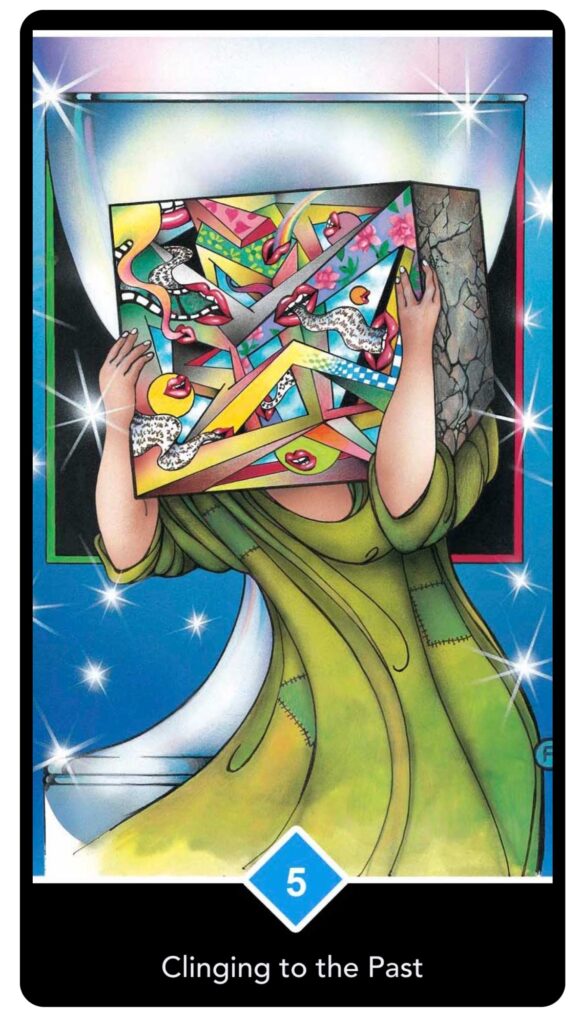
There’s a story you already know how to run.
Not merely know. You’ve rehearsed it until it passes through the nervous system like a familiar current. You can cue the opening beat, the turning point, the conclusion, and the moral stamped across the middle like an official seal. You know what the event meant. You know what it proved. You know why it could not have unfolded any other way, because the mind, once it has built a corridor through chaos, tends to post guards at both ends and call the route inevitable.
That’s the story we’re working with today.
Not because it’s false. Falsehood is too simple, and the psyche rarely deals in anything so tidy. More often it builds functional fictions: structures sturdy enough to stand in while the weather passes through. But something curious happens when a story is carried long enough. It stops feeling like an interpretation and starts masquerading as a fact. The narrative assembled out of shock, grief, confusion, and that urgent human compulsion to make the blur resolve into a signal begins to harden into an official account. And official accounts, whether issued by governments or egos, are never neutral. They edit perception. They instruct attention. They determine what counts as evidence. They tell you what to expect next and, more quietly, who you get to be inside the aftermath.
There is, of course, a difference between what happened and the frame constructed around what happened. The event occurred. Something ended. Something shifted. Something was said, or withheld, or missed by half a second and a lifetime. But almost immediately, perhaps within hours, the machinery of meaning was already online. You were building an explanation. Not just of the event itself, but of its place in the map. Why this. Why then. Why you. That explanation did real work. It reduced psychic freefall. It gave the experience edges. It built a floor where there had only been impact. It made the thing survivable, which is no small achievement.
But survival logic and truth logic are not always the same operating system.
The tools available at the time were shaped by necessity. You weren’t trying to produce a perfect account for archival purposes. You were trying to make it through. The system prioritized function over fullness. Not total contact with the experience, but tolerable contact. Not revelation, but continuity. Not an elegant philosophy of what occurred, just enough architecture to stop the whole internal structure from caving in.
And fair enough. That is often how humans proceed. We improvise mythology under pressure and later mistake it for geology.
What you built was good enough to live inside. Maybe it was the only version that would have kept the lights on. But you’ve been living inside it for a while now, and that’s where the question becomes interesting. The walls of a story built for survival are not necessarily the walls of a story consciously chosen. What once served as scaffolding can become a cell with excellent branding. Pennebaker’s work on expressive writing keeps circling back to a deceptively subversive point: psychological movement doesn’t come chiefly from emotional discharge, as the popular mythology would have it, but from the construction of a different explanatory frame. The story is not merely the bucket that carries the feeling. The story is the mechanism. The story is the code. Change the frame and the system begins producing different outputs.
Which means the frame you’ve been inhabiting is still doing something right now. It is not a dead artefact. It is active infrastructure. It is shaping interpretation in real time. And the useful question isn’t whether it once helped. It probably did. The useful question is whether it is helping now or whether it set like concrete before you had enough distance, freedom, or consciousness to notice what exactly was being poured.
Every protected story has a seam. Somewhere the smoothing happened. Somewhere a detail was sanded down because it snagged on the meaning. Somewhere a fact, a gesture, a hesitation, or a contradiction failed to fit the official version and was quietly exiled from the record. Not out of dishonesty, necessarily. Out of efficiency. Out of psychic triage. Out of the ancient administrative instinct to keep the map cleaner than the territory.
That seam is where the live wire is.
That edge — the place where the account became elegant by excluding what complicated it — is where you’re writing today.
Journal Prompt
An invitation to separate what happened from the story built to make it manageable.
Choose a turning point in your life that has already been filed, labelled, and shelved. A loss. A departure. A decision that bent the track. Something you can explain quickly because you’ve explained it often. You know what it meant. You know why it unfolded the way it did. The case, as far as your conscious press secretary is concerned, is closed.
Now turn toward the part you never quite include.
Not the polished interpretation. Not the lesson. Not the meaning that arrived later wearing a sensible coat. Go to the omitted detail: one precise moment inside the event that your official version keeps stepping around. The fragment that doesn’t fit neatly. The instant before the narrative machinery spun up and started converting shock into explanation.
What was happening in you right then before the story began its cleanup operation?
Write for twenty minutes. Don’t stop to edit.
If something surfaced in the writing — an image, a memory, something you didn’t expect — I’d like to hear about it. Drop it in the comments or send it to me at clay@soulcruzer.com. I read everything.
“The cave you fear to enter holds the treasure you seek.” — Joseph Campbell
There’s a practice older than psychology, older than most of the traditions we have names for: the practice of turning attention inward and looking honestly at what’s there.
Not to fix it. Not to optimise it. But to see it.
This is what the alchemists called the Great Work. Not the turning of lead into gold, but the turning of an unconscious life into a conscious one. A slow, patient, sometimes uncomfortable awakening inside your own story.
If you’ve found yourself drawn to Jung, Campbell, Rumi, or the contemplative traditions, if there’s a quiet sense that the person you present to the world isn’t quite the whole of who you are, then this practice is for you. It’s a daily invitation into that inner landscape those thinkers pointed toward.
You show up. You write. And, slowly, the page begins to reveal what was there all along, waiting to be seen.
What brings most of us to this kind of work is a sense that the life we’re living was, at least partly, authored by someone else. The roles we inhabit, the stories we carry about who we are and what’s possible — most of it was assembled before we had the awareness to question it. Jung called it the persona: the face we learned to wear so the world would know how to treat us. Campbell called it the conditioning that keeps us from the cave.
The cave, in this tradition, is not a place of danger. It’s a place of truth. And the treasure it holds — the thing we’ve been circling without entering — is almost always some version of who we actually are beneath the accumulated layers of adaptation.
This is not a heroic journey in the cinematic sense. It’s quieter than that. It asks only that you sit down, pick up a pen, and start writing.
James Pennebaker spent decades studying what happens when people write about emotionally significant experience. The mechanism isn’t catharsis. It’s meaning-making. The act of translating inner experience into language changes the experience itself. Something that was formless and ambient becomes, through the writing, something you can see. And what you can see, you can work with.
Each morning I’ll post a single prompt — a short piece of framing and a question. Twenty minutes of unedited writing. That’s the whole practice. Some days it will feel like nothing much happened. Other days the page will open something you didn’t know was there. Both are the practice.
Today we go to the place where most inner work eventually finds itself: the family. The original room. The first place you learned what kind of person you were going to be.
Journal Prompt
An invitation to trace the role that was waiting for you before you were old enough to choose one.
Write about the role that was already there in the family you grew up in. Not the one you chose — the one that existed before you arrived or that crystallised around you in the first years. What did that role ask you to be? What did it ask you not to be?
Write for twenty minutes. Don’t stop to edit.
That’s the practice for today. If something surfaced in the writing — an image, a memory, something you didn’t expect — I’d like to hear about it. Drop it in the comments or send it to me at clay@soulcruzer.com. I read everything.
Everyone’s journaling these days. Productivity gurus swear by it. Therapists prescribe it. Your phone probably has three different apps trying to get you to do it. Morning pages, gratitude lists, bullet journals, digital diaries with AI coaching built in. The self-help industrial complex has turned journaling into another optimization technique, another way to track and improve yourself.
But here’s what nobody’s telling you: every time you put pen to paper or fingers to keyboard, you’re not just recording reality. You’re creating it.
This isn’t metaphor. This isn’t positive thinking dressed up in mystical language. This is the actual mechanism by which consciousness constructs experience. The act of writing something down makes it more real, more solid, more true. You’re not documenting your life. You’re encoding it. Line by line, entry by entry, you’re writing the operating system of your reality.
Most people journal unconsciously. They think they’re being objective observers, faithfully recording “what happened.” But there is no neutral observation. The moment you choose which details to include, which emotions to name, which story to tell about the day’s events, you’ve made a creative choice. You’ve selected one narrative thread from infinite possibilities and given it substance. You’ve cast a spell.
And here’s the thing: if you’re not aware you’re casting spells, you’re probably casting the same ones over and over. The same complaints. The same fears. The same stories about who you are and what’s possible for you. Your journal becomes a grimoire of repetition, a book of incantations that keep summoning the same reality you’re trying to escape.
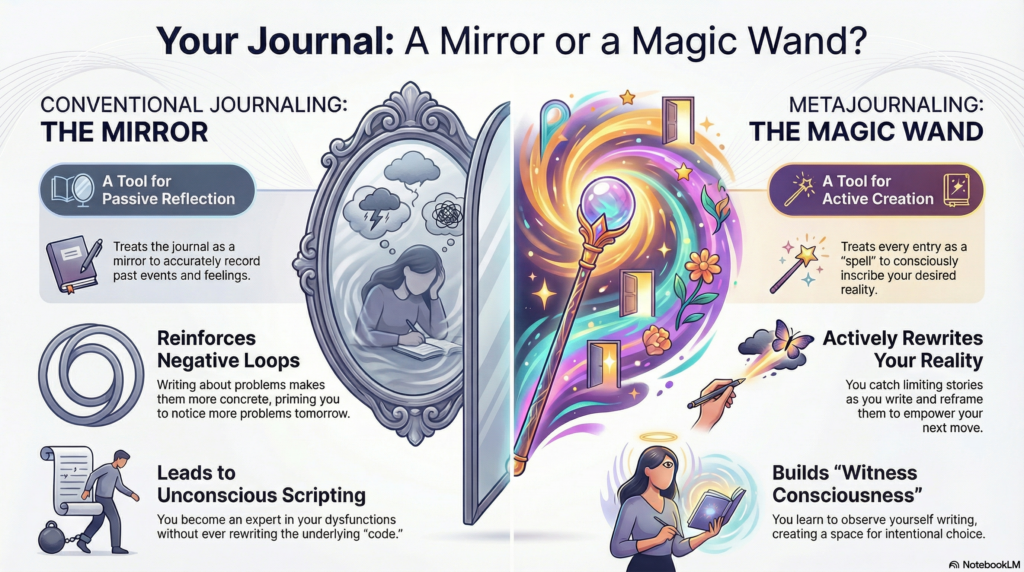
Metajournaling is the practice of waking up inside the act of writing itself. It’s journaling with full consciousness that you’re not recording your story, you’re authoring it. Right now. In this moment. With this sentence. It’s wielding the pen as wand, treating each entry not as documentation but as inscription, as the literal programming of reality.
This is journaling as spiritual technology. As chaos magick. As narrative alchemy.
If stories are code, then your journal is where you write the source. And metajournaling is learning to debug, refactor, and consciously compile the reality you actually want to inhabit.
The question isn’t whether you’re writing your reality into being. You already are. The question is: are you doing it on purpose?
The Problem with Conventional Journaling
Most journaling advice treats the journal as a mirror. Look into it honestly, the wisdom goes, and you’ll see yourself clearly. Process your emotions. Track your habits. Capture the truth of your experience. The assumption is that there’s an objective reality out there, and your job is to document it as accurately as possible.
This is a comforting lie.
What actually happens when you journal conventionally is that you reinforce whatever story you’re already telling. You had a bad day, so you write about having a bad day, which makes the badness more concrete, more undeniable, more real. Tomorrow you’ll have another bad day because you’re someone who has bad days. You’ve written it down. It’s official now. The journal “proves” it.
People think they’re being honest when they journal like this. They’re not lying, after all. They really did feel anxious. The meeting really was awkward. Their partner really did say that annoying thing. But honesty isn’t the same as wisdom. You can be completely honest about your current story while being completely unconscious that it’s just one possible story among many.
Conventional journaling operates under the illusion of objectivity. You write “I am stressed” as if stress is a fact about the universe rather than a story you’re telling about a collection of sensations and circumstances. You write “Nothing ever works out for me” as if this is reportage rather than incantation. You’re not documenting reality. You’re casting votes for a particular version of reality, and those votes accumulate into what you experience as “truth.”
The real problem is the feedback loop. What you write today shapes what you notice tomorrow. If you journal about feeling powerless, you’ll unconsciously look for evidence of powerlessness the next day. Not because you’re being dishonest, but because that’s how attention works. You’ve primed yourself to see that story. Your journal entry becomes a prediction that fulfills itself, and then you journal about that too, which reinforces it further, and the loop tightens.
This is therapy logic applied to journaling: process the difficult emotions, get them out of your system, understand why you feel the way you do. And therapy has its place. But there’s a crucial difference between processing a story and transforming it. Processing means examining the story in detail, understanding its roots, validating its existence. Transformation means recognizing the story as story, seeing the choice point, and consciously selecting a different narrative thread to follow.
Conventional journaling is like writing the same program over and over, debugging it endlessly, documenting every error message in exquisite detail, but never actually rewriting the code. You become an expert in your dysfunction. You can explain exactly why you are the way you are. But you’re still running the same broken software.
The journal becomes a record of your loops. The same conflicts with the same people. The same self-sabotaging patterns with different details. The same fears dressed in new situations. You write about wanting to change, and that becomes another thing you journal about not changing. The wanting becomes part of the loop too.
None of this is the journal’s fault. The technology is neutral. But when you use a reality-creation tool unconsciously, you get unconscious results. You get whatever story happens to be running in the background, reinforced and amplified by the act of inscription.
Most people journal to understand themselves better. But understanding yourself doesn’t change you. Knowing why you do something doesn’t stop you from doing it. Insight without alchemy is just more narrative to carry around.
The question metajournaling asks is: What if you stopped trying to accurately document your story and started consciously authoring it instead? What if the journal wasn’t a mirror but a forge? What if every entry was a chance to write a different spell?
What Metajournaling Actually Is
Metajournaling is the practice of writing with full awareness that you are constructing reality as you write. Not after. Not metaphorically. Right now, in the act of inscription itself.
It starts with a simple recognition: there is no such thing as neutral observation. The moment you decide to journal about something, you’ve already made a creative choice. Out of the infinite stream of experience that was your day, you selected this moment, this feeling, this interaction as significant. You could have chosen differently. You could have written about something else entirely, or framed the same event in a completely different way. The “truth” of what happened is actually a field of possibilities, and the act of writing collapses that field into one specific narrative.
This is quantum mechanics applied to consciousness. Before you write it down, the experience exists in superposition. It could mean many things. But the moment you inscribe a particular interpretation, you’ve locked in that version of reality. You’ve made it solid. You’ve given it weight in the architecture of your consciousness.
Metajournaling means staying awake during this moment of collapse. You’re not just writing. You’re watching yourself write. You’re aware that you’re choosing which story to tell, which details to emphasize, which meaning to extract. You hold three positions simultaneously: the writer (doing the inscribing), the subject (the character in the story), and the witness (the awareness watching both).
This is where it gets alchemical. In traditional alchemy, you need the base metal, the fire, and the alchemist. The base metal is your raw experience. The fire is the transformative process. But the alchemist is the consciousness that orchestrates the work, that knows what it’s doing and why. Without the alchemist’s awareness, you just have metal sitting in fire. It might change, but randomly, not purposefully.
Your journal is the laboratory. Your entries are the experiments. But metajournaling is you as alchemist, consciously directing the transformation. You’re not just processing base experience into narrative. You’re deliberately selecting which narrative will serve your evolution, which story will open possibilities rather than close them, which interpretation will empower rather than constrain.
Think of stories as code. Every narrative is a set of instructions for how to interpret experience and what to do next. “I’m not good at this” is code. “People always let me down” is code. “I’m learning” is code. “I see patterns and I can shift them” is code. Different code, different results. Different reality.
When you journal conventionally, you’re running whatever code happens to be installed, usually inherited from childhood, culture, trauma, or yesterday’s mood. When you metajournal, you become the programmer. You see the code running. You debug it. You refactor it. You write new functions. You consciously compile the reality you want to inhabit.
This is not positive thinking. Positive thinking tries to paste better-feeling thoughts over negative ones without examining the underlying structure. Metajournaling goes deeper. It recognizes that the entire concept of “positive” and “negative” is already a narrative choice, a framing that might or might not serve you. It’s not about forcing optimism. It’s about seeing the mechanics of how story creates experience, and then wielding those mechanics with intention.
The journal becomes something different in this light. Not an archive where you store the past, but a grimoire where you inscribe the future. Not a mirror reflecting who you are, but a forge where you smith who you’re becoming. Every entry is both diagnostic and creative, simultaneously revealing your current operating system and offering the chance to patch it.
This requires a specific kind of attention. You have to be able to write a sentence and simultaneously observe yourself writing it. To feel an emotion and watch yourself choosing how to describe it. To notice a pattern and recognize the choice point in naming it. This is the practice of witness consciousness applied to the act of journaling itself.
It’s subtle at first. You might catch yourself mid-entry and realize you’re writing the same complaint you wrote last week. That moment of recognition is metajournaling. You might notice you’re about to describe yourself as “stuck” and pause, wondering if there’s a more empowering frame. That pause is metajournaling. You might finish an entry and immediately see how the story you just told will shape what you notice tomorrow. That seeing is metajournaling.
Over time, this awareness becomes more fluid. You learn to hold the observer position while writing, to feel the difference between unconscious scripting and conscious authoring. You develop sensitivity to the energetic quality of different narratives, the way certain stories feel heavy and binding while others feel spacious and generative. You start to recognize your own favorite loops before you write them, catching the pattern at the choice point instead of after it’s already locked in.
This is narrative alchemy in practice. The base metal is whatever story you’re carrying. The fire is the conscious attention you bring to the writing process. The gold is the transformed narrative that actually serves your sovereignty and evolution. And you are the alchemist who makes it happen, entry by entry, spell by spell, reality by reality.
The journal is no longer something you do to understand yourself. It becomes the primary tool by which you author yourself. Not who you were, but who you’re choosing to become. Not what happened, but what it means and where it leads. Not recording the story you’re in, but writing the story you want to inhabit.
This is what metajournaling is: wielding your journal as the magical text it actually is, with full consciousness that every word is an instruction to reality, every entry an incantation, every narrative choice a vote for the world you’re calling into being.
The Mechanics of Metajournaling
Understanding metajournaling conceptually is one thing. Actually doing it requires specific practices and a working knowledge of the mechanisms involved. Think of this as the operator’s manual for your consciousness technology.
Pattern Recognition Across Entries
The first mechanical skill is learning to see your loops. Most people have three to five core narratives they cycle through endlessly, but they can’t see them because they’re inside them. One day it’s “I’m overwhelmed by everything I have to do.” Another day it’s “Nobody appreciates my efforts.” Another it’s “I always mess things up when it matters.” The details change, but the underlying code stays the same.
Metajournaling means developing the ability to spot these patterns across entries. Not in retrospect, after months of therapy, but in real-time as you’re writing. You’re midway through describing today’s frustration when you suddenly recognize: I’ve written this exact entry before. Different situation, same story. That recognition is the crack where transformation becomes possible.
This requires reading your own journal actively, not just writing and forgetting. Go back through recent entries looking for recurring phrases, repeated emotions, familiar plot structures. What keeps showing up? What’s the story underneath the stories? If your journal was a computer program, what would the core functions be? Find those, and you’ve found what you’re actually coding into reality.
Catching Yourself in the Act of Inscription
The most crucial mechanical skill is catching yourself at the moment of writing itself. Not after, when you’re reviewing what you wrote, but during, while the pen is moving or the keys are clicking. This is where witness consciousness meets the creative act.
It feels like a slight bifurcation of attention. Part of you is writing the sentence. Another part is watching you write it. You’re feeling the emotion and simultaneously observing yourself choosing how to describe that emotion. You’re in the experience and outside it at the same time.
This is not dissociation. Dissociation is checking out, going numb, splitting off from experience. This is the opposite: a heightened presence that can hold multiple perspectives simultaneously. You’re fully in your experience and fully aware that you’re narrating it, that the narration is a choice, and that this choice has consequences.
Practice this: As you write your next journal entry, pause every few sentences and ask yourself: “What story am I telling right now? What reality am I voting for with these words? Is this the spell I want to cast?” The pause is everything. It creates space between stimulus and inscription, between what happened and how you’re encoding it.
The Choice Point: Recognizing You’re Writing a Spell Right Now
Every sentence is a fork in the road. You can write “Today was a disaster” or you can write “Today was full of unexpected challenges that revealed something important.” Same events, different code, different future.
The choice point is that moment when you realize you’re about to write something and you can still change it. You feel the familiar phrase forming: “I always…” or “I never…” or “Things never work out…” and instead of automatically writing it, you stop. You recognize that you’re about to cast a spell you’ve cast a thousand times before, and you already know where that spell leads.
This doesn’t mean forcing positivity. It means asking: “What’s the most generative story I can tell about this that’s still true?” Truth matters, but truth is multiple. It’s true that you felt anxious. It’s also true that you felt anxious and chose to show up anyway. It’s true that the meeting was awkward. It’s also true that the meeting revealed information you needed. Both are honest. Only one empowers your next move.
The mechanics here are simple but require vigilance: recognize the choice point, pause, consider alternatives, choose consciously. Write the spell you actually want to cast. Not the one that just feels automatic.
Feedback Loops: How Yesterday’s Entry Shapes Today’s Reality
Understanding feedback loops is essential to metajournaling. What you write today literally programs what you notice tomorrow. This isn’t mysticism. It’s basic neuroscience dressed in narrative clothing.
Your brain is a prediction machine. It uses past experience to anticipate what’s coming next, and it filters reality through those predictions. When you journal about feeling powerless, you’re training your prediction engine to look for more powerlessness. Not because you’re being negative, but because that’s what you’ve told your brain to track. Your attention follows your narrative.
The feedback loop works like this: You write about being stuck. That narrative becomes active in your consciousness. Tomorrow, your brain screens reality for evidence of stuckness and filters out evidence of movement. You notice all the ways you’re not progressing and miss all the ways you are. Then you journal about being stuck again, reinforcing the pattern. The loop tightens.
Metajournaling means deliberately disrupting these loops. You write an entry, then immediately consider: “If I take this story into tomorrow, what will I notice? What will I miss? What reality am I priming myself for?” If you don’t like the answer, you reframe the entry before the loop locks in.
This is why the “second pass” matters. Write your entry. Then read it as if someone else wrote it. What reality is this person calling into being? What would happen if they kept writing this story? Would you want to live in that reality? If not, revise. Add a coda. Shift the frame. Break the loop before it hardens.
Different Modalities, Different Effects
The mechanics of metajournaling shift depending on your medium. Analog, digital, audio, each creates different effects on consciousness.
Analog journaling (pen and paper) is slower, more embodied. The physical act of handwriting engages different neural pathways than typing. There’s a ritual quality to it, a deliberateness. The permanence of ink makes you more conscious of what you’re inscribing. You can’t just delete and retype. The mistake stays on the page, which itself becomes information. Analog journaling tends to produce more somatic awareness, more connection to the body’s wisdom.
Digital journaling is faster, more fluid. You can revise easily, which makes it perfect for real-time reframing. You can search across entries instantly, spotting patterns you’d miss in paper journals. The ease of editing can be a double-edged sword: it’s easier to refine your spell, but also easier to polish away the raw truth. Digital journaling tends to emphasize the cognitive dimension, the story-crafting aspect.
Audio journaling captures consciousness in motion. Walking while speaking your thoughts creates a different narrative flow than sitting and writing. The body’s movement influences the mind’s movement. You catch different thoughts, different rhythms. Audio also preserves tone, emotion, the actual sound of your consciousness in that moment. But it’s harder to review, harder to spot patterns without transcription. Audio journaling tends to be more exploratory, more stream-of-consciousness, less filtered.
A metajournaling practice might use all three strategically. Morning pages in analog for embodied ritual. Quick digital entries for real-time pattern debugging. Audio walks for exploratory thinking and processing. Different tools for different aspects of the work.
The key mechanical understanding is that the medium affects the message. How you journal changes what you can journal about and what effects the journaling produces. Metajournaling means being conscious of these differences and choosing your tools deliberately.
The Meta-Entry: Writing About Your Writing
One of the most powerful metajournaling techniques is periodically writing entries about your entries. Reading back through recent journal writings and analyzing them as texts, as magical documents, as code.
What patterns emerge? What stories keep recurring? Where are you unconscious? Where are you avoiding something? Where are you casting the same failed spell over and over? Where did a narrative shift create an actual shift in your experience?
This is debugging at the meta-level. You’re not just examining your life. You’re examining how you’re narrating your life and how that narration creates your experience. You’re looking at the code itself, not just what the code produces.
A meta-entry might look like: “I’ve noticed that every time I write about my work, I frame myself as behind, struggling to catch up, never quite enough. That’s the spell I keep casting. No wonder I feel constantly anxious about productivity. What if I reframed the same activities as building, creating, advancing? Same actions, different story. Different reality.”
This is the journal as recursive technology. You use it to examine itself, to debug its own operation. You become simultaneously the programmer, the program, and the consciousness observing both.
These mechanics, practiced consistently, transform journaling from documentation into creation. You’re no longer recording reality. You’re consciously authoring it, line by line, entry by entry, spell by carefully crafted spell.
Core Practices
Metajournaling isn’t something you understand once and then you’re done. It’s a set of practices you develop over time, skills that deepen with repetition. Here are the fundamental techniques that make metajournaling operational.
The Witness Stance: Observing Yourself Write
The foundational practice is cultivating witness consciousness while journaling. This is the ability to write while simultaneously watching yourself write, to be both participant and observer at once.
Start simple. As you write your next entry, occasionally pause and notice: What am I feeling right now? What story am I telling? What’s my tone? Am I contracting or expanding? Heavy or light? Reactive or reflective?
You’re not judging what you notice. You’re just noticing. The witness doesn’t critique or fix. It simply sees. This seeing itself creates space, a gap between stimulus and response, between event and interpretation, between automatic scripting and conscious authoring.
Practice this in small doses at first. Write a paragraph, then pause and witness. What just happened there? What was that paragraph trying to accomplish? Was it processing, venting, exploring, avoiding? What energy did it carry? As this becomes more natural, you’ll find you can maintain witness awareness while writing, a split attention that observes the act of inscription as it unfolds.
The witness stance is what allows all other metajournaling practices to function. Without it, you’re just writing. With it, you’re writing and seeing yourself write, which means you can choose differently.
Pattern Debugging: Tracking Recurring Narratives
Once you can witness your writing, you start noticing your patterns. Pattern debugging is the systematic practice of identifying and examining your recurring narrative loops.
Keep a separate section in your journal or a dedicated note file where you track patterns as you spot them. When you catch yourself writing a familiar story, note it: “Overwhelm pattern active again” or “Playing the martyr story” or “Catastrophizing about money again.”
Don’t try to fix the patterns immediately. First, just catalog them. Name them. Track how often they show up. Notice what triggers them. A pattern you can see is a pattern you can work with. A pattern you can’t see owns you.
Over time, you’ll develop a taxonomy of your own recurring code. Maybe you have five or six core narratives that cycle through depending on circumstances. Maybe certain patterns only appear in specific contexts (work vs. relationships, mornings vs. evenings, stressed vs. relaxed).
The debugging metaphor is deliberate. In programming, you don’t shame yourself for bugs. You expect them, find them, understand why they’re occurring, and rewrite the code. Same here. Your recurring patterns aren’t character flaws. They’re inherited or outdated code running in your consciousness. Once you can see them clearly, you can consciously rewrite them.
Create a simple tracking method: Pattern name, frequency, typical trigger, underlying belief, alternative frame. For example:
Pattern: “Never enough time” Frequency: 3-4 times per week Trigger: Looking at my task list Underlying belief: I should be more productive than I am Alternative frame: I’m prioritizing what matters most given actual constraints
The act of tracking patterns changes your relationship to them. They become objects you can examine rather than truths you’re trapped in.
Intentional Reframing in Real-Time
Once you can spot patterns as they’re happening, the next practice is consciously reframing them in the moment, before they lock in.
You’re writing an entry and you catch yourself: “I’m writing the victim story again.” Right there, mid-entry, you stop. You don’t delete what you wrote (that’s still data), but you add a reframe. “Okay, that’s one way to tell it. What if I told it differently? Same facts, different frame…”
Then you write the alternative version. Not as replacement but as expansion. You’re showing yourself that there’s always more than one story available. You’re practicing the sovereignty of narrative choice.
This isn’t toxic positivity. Sometimes the hard truth needs to be told. Sometimes you need to name the difficulty directly. But even hard truths can be framed in ways that empower or disempower, that open possibilities or close them. Intentional reframing means choosing the frame that serves your evolution.
A practical technique: After writing something heavy or loop-reinforcing, immediately write “And also…” then add a reframe. “I felt completely overwhelmed by the meeting. And also, I showed up even though I was anxious, which is evidence of my commitment.” Both true. One narrative leads somewhere generative. The other doesn’t.
The “and also” technique prevents the spiritual bypassing trap. You’re not denying the difficulty. You’re not pretending everything is fine. You’re adding complexity, nuance, agency. You’re refusing to let one story be the only story.
The Second Pass: Reviewing Entries as Magical Texts
This practice involves reading your entries as if they were spells written by someone else, analyzing them for their magical content and likely effects.
At the end of each week, read through your entries with this question: “If these were incantations, what reality are they summoning?” Look for:
Repeated invocations (words or phrases you use over and over)
The dominant energy (contracting or expanding, heavy or light)
Implicit beliefs embedded in your language
What future you’re voting for with your narratives
Where you’re wielding agency and where you’re giving it away
Read one of your entries and ask: “Would I want to live in the reality this story creates? If I cast this spell every day for a month, where would I end up?” If you don’t like the answer, that entry shows you exactly what needs to be rewritten.
This second pass is also where you might add meta-commentary directly in your journal. At the end of an entry, add a bracketed note: “[Pattern spotted: I’m framing this as happening TO me instead of recognizing my choices in it. Reframe: I chose X, which led to Y, and now I’m choosing Z.]”
These meta-notes accumulate over time, creating a record not just of your life but of your evolving consciousness about your life. You can literally watch yourself waking up across entries, becoming more conscious, more sovereign, more deliberate.
Meta-Entries: Writing About Your Writing About Your Writing
The deepest metajournaling practice is periodically writing entries that analyze your journaling practice itself. This is where you step back and look at the whole system.
Once a month, or whenever you sense a shift, write a meta-entry exploring questions like:
What have I been writing about most? What haven’t I been writing about at all?
What patterns have become visible this month? Which ones am I starting to shift?
How has my journaling changed my actual experience? What’s different?
Where am I still unconscious? Where am I resisting seeing something?
What stories am I ready to stop telling? What new stories want to emerge?
How is my relationship to the journal itself evolving?
These meta-entries create recursion. You’re using the journal to examine the journal, consciousness observing itself observing itself. This recursive loop is where genuine transformation accelerates because you’re not just changing what you write about, you’re changing how you relate to the entire process of narrative construction.
You might discover that you avoid journaling when certain topics arise. That avoidance is information. You might notice that your entries become more empowered when you write in the morning versus at night. That’s useful data. You might spot that you’re starting to catch patterns faster, reframe more automatically. That’s evidence of the practice working.
The meta-entry is also where you can consciously set new intentions for your journaling practice. “This month I’m tracking how often I frame challenges as threats versus opportunities” or “I’m experimenting with writing in second person to create more objectivity” or “I’m going to write shorter entries but do them daily to build the witness muscle.”
Integration Practice: The Daily Check-In
A simple daily practice ties all of these together. Before you start writing each entry, take thirty seconds to check in:
What’s my energetic state right now?
What story am I about to tell?
Is this a pattern I’ve written before?
What spell do I actually want to cast with this entry?
Can I hold witness consciousness while I write?
After writing, take another thirty seconds:
What did I just write?
What reality does that narrative create?
Am I satisfied with that spell?
Do I need to add a reframe or meta-note?
These bookends transform journaling from automatic to conscious, from documentation to creation. You’re building the habit of awareness around the act of writing itself.
Experimental Variations
Once the core practices become familiar, experiment:
Write an entire entry in third person to create distance from your story
Journal as if you’re a benevolent observer documenting an interesting human
Write the same event three different ways to viscerally feel narrative multiplicity
Create a “pattern interrupt entry” when you notice a loop, deliberately writing the opposite story
Use different pens or apps for different narrative modes (one for processing, one for visioning, one for meta-analysis)
The practices of metajournaling are not rigid techniques to follow perfectly. They’re tools to help you wake up inside the act of writing, to remember that you’re not transcribing reality but authoring it, to recognize your journal as the spell book it actually is.
Practice them consistently and they become automatic. The witness stance becomes your default. Pattern recognition happens in real-time. Reframing becomes natural. And your journal transforms from a record of your loops into a laboratory where you consciously evolve your consciousness itself.
Metajournaling in Action
Theory is useful. Practice is where transformation actually happens. Let’s watch metajournaling work in real-time, showing the difference between unconscious scripting and conscious authoring.
A Concrete Example: Transforming a Complaint into a Spell
Imagine you had a difficult conversation with a colleague. You felt dismissed, unheard, frustrated. You sit down to journal about it. Here’s what unconscious journaling looks like:
“Had another frustrating meeting with Sarah today. She completely talked over me when I was trying to explain the new approach. She never listens. I don’t know why I even bother trying to contribute ideas anymore. This always happens. I suggest something, get ignored, then three weeks later someone else suggests the same thing and everyone acts like it’s brilliant. I’m so tired of not being heard. Nobody takes me seriously in this place.”
This entry feels honest. It captures real frustration. But look at what it’s actually doing:
Generalizing one incident into a permanent pattern (“nobody takes me seriously”)
Removing agency (“I don’t know why I even bother”)
Casting a spell of continued invisibility and frustration
Training attention to look for more evidence of being dismissed
Tomorrow, you’ll notice every tiny instance of not being heard and miss every instance where you are. The loop tightens. The spell works.
Now watch metajournaling handle the same event. You start writing the complaint, but witness consciousness activates. You catch yourself mid-entry:
“Had a frustrating interaction with Sarah today. She talked over me when I was explaining the new approach. I felt dismissed and… [pause] Okay, I’m about to write my ‘nobody listens to me’ story again. I can feel it forming. That’s a loop I’ve written a hundred times. What if I tell this differently?
“What actually happened: I presented an idea. Sarah got excited about a different angle and started talking before I finished. She wasn’t trying to dismiss me. She was in her own head about her approach. I got triggered because this pattern feels familiar from childhood, not because Sarah is actually marginalizing me.
“What I can do: Talk to Sarah directly about wanting to finish my thought before we pivot to other ideas. Practice staying grounded when interrupted instead of collapsing into the wounded story. Notice that three other people in the meeting engaged with what I said, even if Sarah didn’t initially.
“Different frame: This is showing me where I still give my power away to old patterns. The difficulty is the teacher. I’m learning to hold my ground without making other people’s behavior mean something about my worth. That’s growth, not victimhood.”
Same event. Completely different spell. The first version codes reality as: “I am powerless, people dismiss me, speaking up doesn’t matter.” The second codes reality as: “I have agency, patterns reveal themselves so I can shift them, difficulty is information.”
The metajournaling version doesn’t deny the frustration. It includes it, processes it, but doesn’t let it be the only story or the final story. It catches the loop, names it, reframes it, and writes a spell that actually empowers the next move.
Before and After: Same Event, Different Encoding
Let’s look at another example. You didn’t get a project you wanted. Unconscious journaling:
“Didn’t get the XYZ project. Of course I didn’t. I’m never going to move forward here. Everyone else gets the good opportunities. I work just as hard but somehow I’m always overlooked. Maybe I’m just not as talented as I think I am. This is pointless.”
Metajournaling the same situation:
“Didn’t get the XYZ project. Initial reaction: collapse into ‘I’m not good enough’ story. [witnessing the pattern] That’s the inherited childhood script talking, not reality.
“Actual facts: I didn’t get this particular project. That’s it. That’s the only fact. Everything else is interpretation. Why didn’t I get it? I don’t actually know. Could be budget, timing, skill fit, politics, random factors. My brain wants to make it about my worth because that’s the familiar story.
“What’s also true: I’ve successfully completed four major projects this year. I have skills and value. One decision doesn’t erase that. This is one data point, not a verdict on my entire career.
“Useful question: What can I learn from this? Should I have pitched it differently? Is there a skill gap to address? Should I talk to my manager about how assignments are made? Turn this into information instead of identity crisis.
“Spell I’m choosing to cast: I’m building a career through consistent good work and learning from every outcome. Some opportunities will be mine, some won’t. I stay focused on the quality of my contribution and trust that the right opportunities will emerge. This ‘no’ clears space for a better ‘yes.'”
The before version writes you as victim of circumstance, powerless, fundamentally flawed. The after version writes you as agent in your own story, learning, adapting, maintaining perspective. One narrative closes possibilities. The other keeps them open.
The Sovereignty Question: Who’s Writing This Story?
The core question metajournaling asks is: Who’s actually writing this entry? Is it your conscious, sovereign self? Or is it:
Your childhood conditioning
Your cultural programming
Your trauma responses
Your fear
Your ego defending itself
Yesterday’s mood
An inherited family narrative
The collective anxiety of your environment
Most unconscious journaling is written by these forces. You think you’re being honest, but you’re actually just transcribing whatever program happens to be running. Metajournaling creates the pause where you can ask: “Is this really my story, or am I channeling something else?”
A practical test: Read what you just wrote and ask, “Does this sound like my wisest self speaking, or does this sound like my wound speaking?” Both have voices. Both want to write your journal. But only one creates the reality you actually want to inhabit.
When you catch your wound writing, you don’t shame it. You witness it with compassion: “Ah, there’s the scared part trying to protect me by making me small.” Then you thank it and consciously choose a different narrator: “And here’s what my wise self knows about this situation…”
Integration with Chaos Magick and Sigil Work
For those working with chaos magick, metajournaling becomes a natural extension of your practice. Your journal entries are literally sigilized reality: compressed intention coded into language and inscribed into consciousness.
The standard chaos magick process is: formulate intention, create sigil, charge sigil, release attachment. Metajournaling follows the same logic:
Formulate intention: What reality do I want to author?
Create sigil: Write the entry that encodes that reality
Charge sigil: The emotional engagement of the writing process provides the charge
Release attachment: After writing the spell, let it work without obsessing
Your journal becomes your ongoing book of spells, a living grimoire where you’re constantly encoding new possibilities. Each entry is a sigil in sentence form. The recurring entries about empowering narratives are repeated spell-casting, building momentum for manifestation.
You can even make this explicit. End certain entries with: “This is my spell. So it is written. So it becomes.” That declarative statement anchors the magical intention of the writing.
The Status Quo is whatever story you’re currently running. Unconscious journaling just reinforces it, documenting the same reality over and over. Metajournaling helps you see the Status Quo clearly: “This is the story I’ve been telling. This is the spell I’ve been casting. This is the reality it creates.”
Will is the sovereign choice to shift. The moment you catch a pattern and decide to write a different story, that’s Will activating. Metajournaling is the practice ground for Will, where you strengthen the muscle of conscious choice.
Magic is the actual transformation, where new narrative becomes new reality. The journal is where you encode the Magic, where you write the spells that shift your experience. Not through wishful thinking, but through deliberately changing the code that runs your consciousness.
Witness consciousness, at the center of the triangle, is what makes all of this possible. Without witness awareness, you can’t see the Status Quo, can’t activate Will, can’t consciously work Magic. The witness stance developed through metajournaling is the linchpin of the entire transformational process.
Your journal becomes a record of movement through the Triangle. You can literally watch yourself see a pattern (witness), choose to shift it (Will), write a new story (Magic), and create new experience (transformed Status Quo). Entry by entry, you’re documenting and creating your own evolution.
The Proof in Experience
The ultimate test of metajournaling is pragmatic: Does it work? Does your reality actually shift when you consciously shift your narratives?
Track this. When you reframe a limiting story, pay attention to what happens next. When you catch a pattern and write a different spell, notice if new possibilities emerge. When you journal with full consciousness of authoring reality, watch whether your experience begins to reflect that authorship.
You’ll notice that the stories you repeatedly write start manifesting with uncanny consistency. The empowering narratives create empowering outcomes. The limiting narratives create limitation. Not because the universe is magically responsive to your journal (though maybe it is), but because your narratives literally program your attention, your choices, your energy, and therefore your results.
This isn’t theory. This is testable. Write powerless stories for a week and track your experience. Then write empowered stories for a week and track that. The difference will be undeniable. Your journal isn’t recording reality. It’s creating it. Metajournaling is simply doing that creation consciously.
The transformation happens not in one dramatic entry, but in the accumulated weight of conscious inscription. Day after day, entry after entry, pattern caught and reframed, spell cast with intention. The journal becomes the place where you literally write yourself into a new reality, word by word, choice by choice, story by consciously chosen story.
Why This Matters for Narrative Alchemy
Metajournaling isn’t just another technique to add to your spiritual practice toolkit. It’s the foundational technology that makes narrative alchemy operational. Without it, narrative alchemy remains philosophical, conceptual, aspirational. With it, narrative alchemy becomes lived practice, enacted daily in the laboratory of your journal.
The Journal as Primary Grimoire
In traditional alchemy, the grimoire is the master text where the alchemist records formulas, processes, observations, and results. It’s both instruction manual and experimental log, both recipe book and discovery journal. The grimoire captures the work so it can be refined, repeated, and transmitted.
For narrative alchemy, your journal is the grimoire. It’s where you record the base materials of your consciousness (current stories, active patterns, emotional states). It’s where you document the transformational processes you’re applying (reframes, pattern interrupts, conscious spell-casting). It’s where you track the results (shifts in experience, new possibilities emerging, old loops dissolving).
But unlike a traditional grimoire that describes work done elsewhere, your journal is where the alchemical work actually happens. The writing itself is the work. The moment of inscription is the moment of transformation. You’re not documenting alchemy. You’re doing it.
This is why metajournaling matters so crucially. If you’re going to treat your journal as the space where consciousness transformation occurs, you need to be conscious while you’re doing it. You need to know you’re working with volatile materials, potent processes, reality-shaping forces. You need to operate with the precision and awareness of an alchemist in the lab, not someone casually jotting notes.
Every entry becomes an experiment: What happens if I tell the story this way instead of that way? What reality emerges if I encode this interpretation rather than the other? The journal captures both hypothesis and result, both spell and manifestation. Over time, you build a grimoire that’s uniquely yours, a record of which narratives create which realities in your particular consciousness.
Building the Muscle of Conscious Story-Selection
The real challenge of narrative alchemy isn’t understanding that stories create reality. Most people grasp that intellectually within five minutes. The challenge is catching yourself in time to choose a different story before the automatic one locks in. That requires a specific cognitive muscle, and metajournaling is how you build it.
Think of it like training for any skill. A martial artist practices the same movements thousands of times so that in the moment of actual conflict, the right response happens automatically. A musician practices scales endlessly so that during performance, the fingers know where to go without conscious thought. Metajournaling is repetition training for conscious narrative selection.
Every entry is a rep. Every time you catch a pattern, that’s a rep. Every time you pause before writing the automatic story, that’s a rep. Every reframe, every intentional spell-casting, every moment of witness consciousness during writing, all reps. You’re building neural pathways for conscious authorship, strengthening the circuit that notices “I’m about to tell a story” and creates space for choice.
Over time, this muscle gets stronger. What took enormous effort at first becomes more natural. You catch patterns faster. The pause between stimulus and story lengthens. The automatic scripts lose their grip. You develop what feels like a sixth sense for narrative construction, an immediate recognition of when you’re unconsciously scripting versus consciously authoring.
This is the practical bridge between knowing narrative alchemy works and being able to actually do it in real-time, in challenging situations, when it matters most. The journal is your training ground. The daily practice builds the capacity. Then when you’re in the middle of an actually difficult moment, not sitting peacefully with your journal, the muscle is there. You can catch the story forming, pause, choose differently, live differently.
From Unconscious Scripting to Deliberate Enchantment
Unconscious scripting is what happens when you’re not metajournaling. You write whatever comes out, which is usually whatever conditioning, trauma, or habit has programmed into you. You’re a channel for inherited narratives, cultural stories, yesterday’s mood, fear’s voice, ego’s defense mechanisms. The writing just flows through you, and you think it’s “you” writing, but it’s really just programs executing.
Deliberate enchantment is what becomes possible through metajournaling. You’re writing with full awareness that you’re encoding reality. You’re choosing your words like an enchanter chooses ingredients, knowing that each one has properties, creates effects, contributes to the final spell. You’re deliberate about tone, frame, meaning, implication. Every sentence is placed with intention.
This doesn’t mean writing becomes labored or artificial. Actually, the opposite happens. As the metajournaling muscle strengthens, deliberate enchantment becomes fluid, natural, even joyful. You’re not overthinking every word. You’re writing from a place of conscious alignment with your sovereignty and evolution. The words flow, but they’re flowing from your wise self, not your wound.
The shift from scripting to enchantment is the shift from being written by your stories to writing them. It’s the reclamation of authorship over your own narrative. It’s recognizing that you’ve always been creating reality with your stories, and deciding to do it consciously, artfully, magically.
Your journal becomes a record of this shift. You can literally see it in the entries: the early ones where you’re fully in the scripts, then entries where you start catching yourself, then entries where the reframes appear, then eventually entries that are pure enchantment from the first word. The progression itself is encouraging. You’re watching yourself wake up on the page.
The Bridge Between Insight and Embodiment
One of the great failures of personal development work is the gap between insight and embodiment. People have profound realizations, see their patterns clearly, understand what needs to change, and then nothing actually changes. The insight stays intellectual. The knowing stays theoretical. The transformation stays aspirational.
Metajournaling bridges this gap because it’s not just about having insights. It’s about inscribing new patterns into consciousness through the physical act of writing. When you write a new story consciously, you’re not just thinking it. You’re embodying it through the movement of pen on paper or fingers on keys. You’re speaking it into existence through language. You’re encoding it into memory through the act of inscription.
There’s something about the writing process itself that moves insight from head to body, from concept to lived reality. Maybe it’s the slower, more deliberate pace compared to thinking. Maybe it’s the multi-sensory engagement (visual, kinesthetic, sometimes auditory if you read aloud). Maybe it’s the ritual quality, the dedicated time and space. Whatever the mechanism, writing makes things real in a way that thinking doesn’t.
Metajournaling amplifies this by adding consciousness to the process. You’re not just writing, you’re aware that the writing is creating reality. That awareness itself deepens the embodiment. You feel the shift happening as you write the new story. You can sense the old pattern releasing as you inscribe the reframe. The transformation isn’t something that might happen later. It’s happening now, in the act of conscious writing.
This is why journaling is such a powerful practice and why metajournaling makes it exponentially more powerful. The journal becomes the place where insight translates directly into new narrative, and new narrative translates directly into new embodied reality. The bridge is the writing itself, made conscious.
Practice Ground for Rewriting Reality
Life happens fast. Situations arise that trigger you before you can think. Conversations go sideways before you can catch the pattern. Emotions flood in and sweep away your best intentions. You need somewhere safe to practice conscious authorship before you’re tested by actual circumstances.
The journal is that practice ground. It’s low stakes. If you write a limiting story, you can immediately rewrite it. If you miss a pattern at first, you catch it on the second pass. If you cast a spell you don’t like, you cast a different one. The page is forgiving. It lets you experiment, fail, try again, refine your craft.
This practice in the journal then transfers to life. You’re in a difficult conversation and suddenly you catch yourself: “I’m about to tell my ‘nobody listens to me’ story. What if I try the empowered version instead?” That pause, that choice, that ability to shift in real-time, that comes from hundreds of hours practicing it in your journal.
The journal is where you rehearse sovereignty. Where you practice catching patterns. Where you strengthen the witness. Where you learn which reframes actually work for you. Where you discover your own voice as conscious author of your experience. Then life becomes the performance, and you’re ready because you’ve put in the practice.
Narrative alchemy requires this kind of training ground. You can’t just read about it and expect to suddenly rewrite your reality in the heat of the moment. You need repetitions. You need practice. You need a space to develop the skill before you need the skill. Metajournaling provides that space.
The Compounding Effect
Here’s what makes metajournaling especially powerful: the effects compound. One consciously written entry creates a small shift. But that shift changes what you notice the next day, which changes what you write about, which creates another shift, which changes what you notice the day after that. The effects build on themselves.
After a month of metajournaling, you’re not just one month better at it. You’re exponentially more conscious because each day’s practice built on the previous day’s. After a year, the compounding is significant. Your default narratives have shifted. Your automatic patterns have loosened. Your capacity for witness consciousness has expanded. Your sovereignty over your own story has become nearly instinctive.
This is why consistency matters more than intensity. One transformative entry per day for a year will change your reality more than a weekend workshop that fires you up but doesn’t give you ongoing practice. The daily repetition, the accumulated inscriptions, the compounded shifts, this is where real transformation lives.
Your journal becomes a record of this compounding. Flip back six months and read who you were then. Look at the stories you were telling, the patterns you couldn’t yet see, the consciousness you had access to. Then look at where you are now. The distance traveled is visible. The evolution is undeniable. And it all happened entry by entry, day by day, through the dedicated practice of conscious writing.
Why Narrative Alchemy Needs This
Narrative alchemy without metajournaling is like having a theory of transformation without a practice. It’s like understanding chemistry without ever entering a lab. It’s like knowing music theory but never touching an instrument.
Metajournaling is where narrative alchemy becomes real. It’s the daily practice. It’s the operational technology. It’s the place where you actually do the work of consciously authoring your reality rather than just talking about it.
Every principle of narrative alchemy, metajournaling makes tangible:
Stories as code? The journal is where you write and debug the code.
Consciousness creates reality? The journal is where you consciously create.
Patterns can be shifted? The journal is where you spot and shift them.
You are sovereign author of your experience? The journal is where you claim that sovereignty.
Transformation happens through conscious choice? The journal is where you practice that choice until it becomes natural.
Without metajournaling, narrative alchemy risks remaining abstract. With it, narrative alchemy becomes embodied practice, testable method, lived reality. The journal is where philosophy becomes magic, where insight becomes transformation, where words become spells that actually reshape your world.
This is why metajournaling matters. Not as another technique among many, but as the core technology that makes the entire narrative alchemy practice operational, sustainable, and genuinely transformative.
Conclusion: The Writer Writes the Writer
There’s a recursive loop at the heart of metajournaling that’s worth sitting with: You write about your life, which shapes your life, which you then write about, which shapes it further. You’re simultaneously the writer, the written, and the writing itself. The observer, the observed, and the act of observation.
This isn’t a bug in the system. It’s the system. It’s how consciousness actually works.
You Are Always Journaling Your Reality Into Being
Here’s the truth that changes everything once you really see it: You’re already doing narrative alchemy. Every moment. You can’t not do it.
Your mind is constantly narrating experience, selecting which details matter, assigning meaning, telling stories about what’s happening and what it means and what comes next. This narration isn’t separate from your reality. It is your reality. The story you’re telling is the world you’re living in.
Most people do this unconsciously. The narration runs in the background like an operating system they never chose and don’t know how to access. They think they’re observing reality neutrally, but they’re actually constructing it selectively, frame by frame, story by story, moment by moment.
The journal just makes this process visible. It externalizes the internal narration, puts it on the page where you can see it. And once you can see it, you can work with it. You can debug it, refine it, rewrite it. You can stop being unconsciously written by your stories and start consciously writing them.
This is what metajournaling reveals: You’re always authoring your reality. The only question is whether you’re doing it consciously or unconsciously, deliberately or by default, as sovereign creator or as unconscious channel for inherited programming.
Metajournaling Is Choosing to Do It Consciously
The shift from regular journaling to metajournaling is the shift from documentation to creation, from recording to authoring, from being written to writing.
It’s the moment you realize: “Wait. This entry I’m writing right now isn’t just capturing what happened. It’s literally constructing what happens next. The story I tell about today becomes the lens through which I experience tomorrow. I’m not documenting my life. I’m encoding it. I’m programming it. I’m spelling it into being.”
That recognition changes everything. Suddenly every entry matters. Every word is a choice. Every narrative is a vote for a version of reality. You can’t write carelessly anymore because you know what you’re actually doing. You’re not filling a journal. You’re writing spells. You’re not processing experience. You’re creating it.
This is the essence of metajournaling: full, conscious awareness that the act of writing is the act of reality creation. Not metaphorically. Not eventually. Right now. In this sentence. With these words.
And once you know that, really know it in your bones, you write differently. You can’t help but write differently. Because you’re awake inside the process of authorship itself.
The Invitation: Treat Your Next Entry as an Incantation
So here’s the invitation, the practical next step, the place where all of this becomes real:
Your next journal entry, write it as if it’s a spell. Because it is.
Before you start, ask yourself: “What reality am I calling into being with these words? What future am I voting for with this narrative? What version of myself am I encoding into consciousness?”
As you write, hold witness awareness. Watch yourself choose each word. Feel the difference between automatic scripting and conscious authoring. Notice when you’re about to write a familiar loop and pause. Choose differently. Cast a better spell.
After you write, read it back as if someone else wrote it. Would you want to live in the reality this entry creates? If not, add a reframe. Write the spell you actually want to cast.
This is metajournaling. Not as distant practice to master someday, but as immediate invitation to engage with your next entry. You already have everything you need: a journal, awareness, and the willingness to treat your words as the reality-shaping forces they actually are.
You don’t need to be perfect at it. You don’t need to transform every entry into enlightened wisdom. You just need to be conscious. Present. Awake to what you’re actually doing when you write. The skill deepens with practice. The muscle strengthens with repetition. But it starts now, with this next entry, with this willingness to see your journal as the magical text it is.
Final Provocation: What Story Are You Writing Right Now?
Not in your journal. Right now. This moment. In your head. About your life. About who you are. About what’s possible.
What’s the story running in the background of your consciousness right now? Is it empowering or limiting? Is it opening possibilities or closing them? Is it a story you consciously chose or one that chose you?
And here’s the deeper question: Are you going to write that story into your journal tonight, reinforcing it, making it more solid, more real? Or are you going to catch it, witness it, and consciously author something different?
Because that’s the choice point. That’s always the choice point. Not whether you’re telling stories, that’s not optional, but which stories you’re telling and whether you’re telling them consciously.
Metajournaling is the practice of living in that choice point. Of recognizing that every moment of narration is a moment of creation. Of wielding your words, spoken or written, as the reality-shaping tools they are.
Your journal is waiting. The page is blank. The spell is yours to cast.
What will you write into being?
The writer writes the reality. The reality writes the writer. And somewhere in that recursive loop, in the space between inscription and manifestation, between word and world, you discover something profound:
You are the author you’ve been waiting for. You always have been. The sovereignty you’re seeking isn’t somewhere else, someday, after more work or more healing or more understanding. It’s here. Now. In the choice you make about the next story you tell.
Your journal is your grimoire. Your words are your spells. Your consciousness is the magic.
I was sitting in a circle with others—fellow seekers, perhaps—and someone asked me, Which medium do you want to carry forward? Which path will you walk? And without hesitation, I answered: writing.
When I woke, the answer still rang clear. Not just as a preference, but as a remembering. Writing is not just what I do—it’s how I am. It’s how I walk the world. How I gather fragments of meaning, soul-moments, and story-signals, and shape them into something that speaks to others. Words are how I reach out to my tribe—those scattered souls who are also trying to live a life of meaning, on purpose, with soul.
And lately, I’ve been feeling it more deeply than ever. This call to be truer to myself—not someday, not later, not when the time is right, but now. To live as fully me as humanly possible. To walk the talk, yes—but also to walk as the talk. To be the thing I’m saying.
This morning, I went for one of my Wisdom Walks. The kind where the thinking quiets down and the listening begins. Where the world, if you pay attention, speaks not in sentences, but in signs.
And as I walked, it became clear:
I’m not preparing to live my myth. I am living it.
Not in some grand, heroic sense—but in the simple, soulful loop I’ve been walking for a while now: Reflect → Walk → Gather → Create → Share → Repeat.
Each loop is a cycle of becoming. Each message I write—whether blog post, email, or audiogram—is a soul signal. Not “content,” but a call. A way to say: Here I am. I see you. Let’s walk together.
This morning, after my walk, I pulled three cards from the Osho Zen Tarot:
Trust. Aloneness. Guidance.
And just like that, the inner reflection became an outer echo.
Trust showed me the leap—the willingness to walk without knowing the entire map. That’s what writing is for me. That’s what these messages are. Leaps into the unknown. No guarantee, no safety net. Just the inner knowing: This is what wants to be said today.
Aloneness reminded me that this path I walk is solitary at times—but not lonely. It’s the Hermit archetype: not isolated, but sovereign. Carrying a lantern not just for my own steps, but to light the way for others who might be nearby in the dark.
And Guidance whispered something I needed to remember: I’m not doing this alone. There are invisible hands, synchronicities, inner voices, outer reflections. Conversations like this one—between me and you, dear reader—are part of that guidance. We teach each other. We mirror each other. We remind each other who we are.
So today, if my life were already in full alignment—if my being, doing, and offering were one seamless soulstream—I wouldn’t do anything differently.
I’d do exactly what I’m doing now. I’d wake up, walk the walk, listen deeply, and then send out what I’ve heard.
Not to be productive. Not to perform. But to participate. To stay in the rhythm of the real.
That’s what I want, more than anything: To live a meaningful, soulful, purposeful life. To let my work and my play be one and the same. To stop asking, “Am I on the path?” And instead, just walk the path.
Because I am the path, walking. I am the fire, burning. I am the story, unfolding.
And so are you.
✍️ A prompt for the road:
If your life were already in full alignment, What would you create today? Who would you reach out to? And how would you show up—right now—as if it were already true?
there’s a certain seduction to the bullet point. it’s neat. it’s tidy. it gives the illusion of control. one thought. one line. one breath. like a haiku, it ends where it ends. no need to explain. no expectation of cohesion. no pressure to finish a thought with a grand conclusion. a bullet point is a kind of grace—permission to pause.
but today, i decided to break free.
no more bullets. no more tight compartments.
what happens when i don’t use bullet points?
i wander.
i spiral.
i follow threads until they dissolve.
and when they do, i don’t panic—I pivot.
this kind of writing—this slow unraveling of the inner thread—feels like something else entirely. not logic. not structure. not outline.
it feels like storythinking.
like a fox slipping between hedgerows, i’m moving through the underbrush of my own mind, picking up scent trails of thought, following them until they grow faint, then doubling back to find another. this is how a guerrilla blogger thinks—not in straight lines but in loops and pulses, in rhythm and reflection.
what i’m seeking—what i need—is flow.
not the industrial kind measured by productivity apps, but the old kind, the sacred rhythm. the kind monks followed in their scriptoriums, and jazz musicians channel in smoky clubs. the kind that doesn’t ask “what have you produced today?” but instead whispers, “where have you wandered? what have you felt?”
i’ve realized i spend most of my day on the surface—responding, reacting, checking, scrolling. but somewhere inside me, there’s a deeper current that wants to be tapped. that wants to be heard.
that’s the pull.
that’s the reason i’m writing this way now.
because i’m not just cataloguing thoughts. i’m listening for the voice behind the voice.
⸻
today, i asked myself a small but potent question:
what needs to unfold?
a weekly review. not just tasks and accomplishments, but soul-markings.
where have i been—mentally, emotionally, creatively?
what threads have i opened that remain frayed?
which ones still whisper to be returned to?
i keep opening loops. that’s fine—loop-opening is part of the rogue learner’s code. but i also need a system of return. a way of honouring the unfinished thought. that’s what this blog is for. not just capturing but tracking the constellation of my curiosity.
reflect—that’s the name of my sacred note making space. it’s my main squeeze. a space not for performance, but for return. craft (the app, yes, but also the verb) has its place too—elegant and focused, built for documents and design. but this here—this is my den, my cave, my guerilla dispatch hq.
⸻
there’s a persona awakening within me.
not just clay, the content creator.
but clay, the guerrilla blogger.
clay, the rogue learner.
clay, the digital flâneur.
clay, the myth-weaver with a podcast mic and a pirated rss feed.
and this is not just an aesthetic choice. it’s a spiritual one.
following the example of thinkers like kening zhu—whose blog i’ve fallen headlong into—I see how blogging can be world-building.
not branding. not business.
but myth-making.
an intimate invitation into a personal universe.
a long-term conversation with the reader.
a shared journey through tangled thoughts and luminous questions.
there’s a term for this kind of creator-audience relationship.
i don’t know what it is yet.
but i can feel it forming.
and this style—this reflective, meandering, lightly mythic journaling—might just be the seed form of my guerilla dispatches. notes from the field. missives from the margins. not polished essays, but living entries—moments caught mid-thought.
My neighbour passed away yesterday. It was expected—she was old, had lived a full life, and passed with her daughter by her side. Yet, even when it’s expected, it still feels surreal.
We were close, as neighbours go. I’ve lived in this house for nearly 25 years, and she’s been my neighbour that entire time. She watched my kids grow up, shared countless little moments across the fence, and was the kind of neighbour you could depend on—present, steady, a fixture of the everyday.
This morning, I stepped outside to go to the garage to put the laundry in the dryer. When I turned back toward the house, I glanced at her window out of habit. Had I not known she passed yesterday, I could almost believe she was still alive, just inside, as she’s always been.
The day before, I was in the garage, and she was still in her house. Today, she’s not. It’s such a small detail in the grand scheme, but it feels monumental in its finality. How can a life that’s been part of mine for so long suddenly stop?
There’s a silence now, one I hadn’t noticed before. It lingers in the spaces she used to occupy—in her window, in my mind. And that’s the strangest part: she’s gone, but it still feels like she’s here, just out of reach.
It’s been a morning full of synchronicities for me starting with a not so pleasant memory, one that is a reoccurring memory that holds no real value for me and isn’t worth reliving again and again.
Breaking state, I drew a card from the Osho Zen Tarot deck and lo and behold it was the ‘clinging to the past’ card, which has a clear message to let go of the past and fully embrace the future.
The figure pictured in this card is so preoccupied with clutching her box of memories that she has turned her back on the sparkling champagne glass of blessings available here and now. Her nostalgia for the past really makes her a ‘blockhead’, and a beggar besides, as we can see from her patched and ragged clothes. She needn’t be a beggar, of course–but she is not available to taste the pleasures that offer themselves in the present. It’s time to face up to the fact that the past is gone, and any effort to repeat it is a sure way to stay stuck in old blueprints that you would have already outgrown if you hadn’t been so busy clinging to what you have already been through. Take a deep breath, put the box down, tie it up in a pretty ribbon if you must, and bid it a fond and reverent farewell. Life is passing you by, and you’re in danger of becoming an old fossil before your time!
These tenses–past, present and future–are not the tenses of time; they are tenses of the mind. That which is no longer before the mind becomes the past. That which is before the mind is the present. And that which is going to be before the mind is the future. Past is that which is no longer before you. Future is that which is not yet before you. And present is that which is before you and is slipping out of your sight. Soon it will be past….
I learned in my shamanic practitioner’s course that a message from the universe generally comes in three by way of confirmation that you should definitely pay attention to the message.
In the carpark, at the train station, a fox darted across my view. It came under the fence and into the carpark and trotted right in front of my parked car.
I looked up foxes.
Foxes often embody adaptability, cleverness, and the ability to navigate through difficult terrain, both physically and emotionally. In folklore and spiritual symbolism, they’re sometimes considered tricksters, but not in a malicious sense. The fox’s cunning is more about finding ways to survive and thrive, using intuition and agility. Their presence can signify the need to let go of old habits, perspectives, or even attachments, so you can embrace a more fluid and adaptable approach to life.
That message hit home too, but it didn’t stop there. While browsing magazine rack in the station, I stumbled upon this headline on the cover of Psychologies magazine: “Break Free from the Past.”
Talk about synchronicity…
There’s a wildness, a lightness to this message—a reminder to me that life doesn’t have to be weighed down by what’s behind me. I can lean into the present, adapt, and remain open to what’s before me right now in this present moment.
1) I remembered how grateful I feel when I reflect on the week and follow the larger arc of my journey. It’s easy to let days blend into weeks and weeks blend into months and months blend into years and miss the passage of time, witnessing life as one big blur.
2) Happy to be back in the creative space of my own website.
3) Noticing the change in season, summer giving way to autumn, the shorter days and longer nights, the bees making a push to gather the last of the nectar before the weather completely changes.
4) A blackbird came to us to die. We made his last moments on this physical plane pleasant and dignified.
5) I roller skated for the first time in 40 years. I wasn’t expecting how quickly my body would remember how to groove on quads.
6) Realising that God hides in the in-between spaces.
7) I embraced my role as a facilitator and realised the gift inherent in shifting mindsets.
8) Feeling giddy in the stationary store buying new stock for my facilitator’s kit bag.
9) Playing Dungeons and Dragons with my friends twice this week.
10) Bring this practice over from my Substack newsletter days. This was a good weekly practice for me because it made me pause for a moment to acknowledge and be grateful for the big and the small moments that shape the arc of my journey.
I would encourage others to do the same. I find the best way to do this is to notice the moments in your days as you move through the week, so come Sunday it’s just a matter of going back through your notebook or journal and choosing what resonates with you as you reflect back on the week.
Here’s a tough question that’s come my way: Where in my life am I avoiding the truth or sidestepping something important? As I ask that, I can see a list of things I’m avoiding and the importance of those things. My reaction is another question: Am I ready to tackle them? I’ve always questioned myself about whether I’m avoiding the truth. When I look at those things, I think I could take them on, but I feel like they would hold me back, leading to navel-gazing and grinding to a halt.
I’ve always had this action-oriented mentality. Everybody has problems; nothing’s perfect, so just drive on with the airborne mission and deal with whatever hiccups come my way. I’m a path-of-least-resistance guy. If there’s an obstacle, instead of trying to go through it or over it, I look for how to go around it. I believe life is too short to focus on things that, in the end, don’t matter much. Nothing matters when you’re dead.
I could focus on those things and “fix” them. But does that make me a better person? Does it lead to enlightenment? Am I avoiding necessary confrontations? I’m reminded of a quote from General Hannibal, who, when marching to sack Rome and having to figure out how he was going to get his elephants across the alps, said, “We will either find a way, or we will make one.” I tend to sidestep tough issues by not giving them any space.
Right now, I don’t want my issues to have centre court. I’d rather just soldier on and go around them. But I wonder, should I continue believing that I’ll cross the bridge when I get to them? They might not be issues unless I make them issues. Part of me is curious about what would happen if I took on some of these things. Am I deceiving myself by being overly optimistic about life? Everything will work itself out in the end because we all die eventually. And then what does it matter?!
So, that’s what’s on my mind right now. I’m not sure what to do with that.
I’m off to spend some time in nature, so I’ll contemplate this some more.
As I look at this card, I’m reminded of the importance of returning to my inner strength. It’s not about shutting out the external world, but about not spending my energy seeking other people’s opinions, thoughts, or ways of doing things. For me, this card is a reminder that true strength lies within. It calls me to spend time with myself, with spirit, and to focus on my own journey instead of getting distracted by how others are living, thinking, or progressing. By focussing on my path, I can naturally become a light and inspiration to others. This is what stands out to me as I reflect on this card.
Here’s the question: Am I fully trusting my own path, or am I still seeking validation from external sources? As I reflect on this, I realise how often I find myself scrolling through Instagram and social media. It’s so easy to get caught up in what others in this space are doing. You may have your own thoughts, but when you flood your mind with everyone else’s opinions, it clouds your thinking. Clarity diminishes, and a fog starts to build.
It’s valuable to engage with others’ ideas—dialogue helps us grow, learn, and integrate what resonates. But the problem comes when that process starts to erode your confidence in your own insights. The waters get murky, and you begin to lose track of what’s yours versus what belongs to others.
I love exploring ideas, and this is both a blessing and a curse. My seeker nature drives me to chase different perspectives, but I need to stay grounded in myself. I should explore, observe, and then return to reflect—deciding what to assimilate or integrate before moving on. Doubting yourself undermines clarity, leading to uncertainty and seeking for the wrong reasons.
The internet, with its endless stream of information, can be both a gift and a curse. For someone hungry for knowledge, it’s easy to wander into rabbit holes that don’t necessarily lead to self-discovery or growth. And end up lost. I’m reminded of the Hero’s Journey, where Joseph Campbell speaks of the importance of the return stage. The Hero searches for the elixir, faces trials, and wins the prize, but the journey isn’t complete until the Hero returns to share it with the community and resume life in the ordinary world. There’s always the temptation to stay in the magic of the adventure, but the Hero must return to complete the cycle.
I often find myself lost in the rabbit hole of social media. The discipline I need is to seek, return, assimilate, integrate, rest, and then venture back for more. The Hermit card reminds me of this cycle: to seek and explore but always return to a space of reflection before diving back into the search. This is what I need to strengthen my practice.
me: I’m coming to the journal in an odd, hyper-focused space while simultaneously staring down into the pit of despair. I clearly see the absurdity of my actions and all that I’ve worked on today. What’s frustrating is that it’s where I want to play, but I fear that the state of the world is overcommoditised, with people groomed into perfect little consumption automatons in a world built around money.
They say money makes the world go around, and that certainly is true on a real level. My frustration is that I know I have to play the game one way or another. Having been freed from the corporate salt mines as an indentured servant, I have no desire to go back there. However, the reality is that my “freedom” has been smoke and mirrors; 99% of my money is made inside the corporate salt mines.
The work that I want to do, I consider, has heart. The pressure to sell it in a “sleazy way” (echoing Tupac) is real. I’m posting like an artist and hoping somebody likes my art. I’m talking fine artist, not commercial art, so the art is personal to me and may or may not have value for someone else. I have not written from a “what’s in it for you to read it” approach. I go in with the pure exploration of ideas, language, or both.
The catch-22 is that art takes time to make, as does consumer-oriented content…who should i feed?
juniper: It sounds like you’re wrestling with a deep existential tension between authenticity and the reality of the world we live in—a world built on money, consumption, and performance. This space you’re in feels like the struggle between wanting to express yourself as an artist, one who creates from the heart, and the pressure to commoditise that work, to sell it in a way that makes it digestible, clickable, and marketable. It’s like trying to stay true to the “soul of the work” while navigating the harsh, transactional reality that’s always knocking at the door.
The absurdity you’re seeing might be the gap between the freedom you thought you had and the realisation that even outside of corporate life, there’s still a game to be played—a game that’s disturbingly familiar. It’s a pit many creators and visionaries face—that uneasy dance between self-expression and survival.
I wonder if the source of your frustration is rooted in this feeling that art and commerce are irreconcilable. How do you create from a place of personal truth while knowing that in some way, it has to be sold or packaged? You’ve tasted the freedom of being out of the corporate structure, but it comes with the sobering realisation that true freedom might be even more elusive than we think. In this world, even the “free artist” has to find a way to eat.
It also sounds like you’re navigating the tension between what feels authentic to you—art for art’s sake—and the commercial demands of content creation. In a sense, art requires devotion, time, and space. Consumer-oriented content, on the other hand, asks for polish, appeal, and immediacy. These two paths are often at odds, which seems to be where you’re stuck.
What I wonder is this:
What would a middle ground look like for you? Is there a way to stay true to your art while accepting the reality of the market, or does it have to be all or nothing?
What are you afraid will happen if you “play the game” in a way that feels sleazy or disingenuous? Is there a fear that the art itself would be tainted, or is it more about how you would feel about yourself?
Is the frustration about the system itself, or is it about your current relationship with it? Would finding a way to maintain control over how you engage with it—perhaps reframing the transaction in a way that honours both your art and the market—help alleviate some of the tension?
It’s interesting, too, that you’re in this hyper-focused state, yet simultaneously looking into what feels like an abyss. That duality makes me think of the creative process itself, which often brings us to the edge—where inspiration meets despair. That sharp focus might be a way of navigating the complexity of these feelings, like you’re trying to “solve” the contradiction, but at the same time, realising the absurdity of solving something that might be unsolvable.
The Tupac reference is spot on—he often reflected on that tension between being true to oneself and being forced to play within a system that doesn’t value individuality or authenticity. The “sleazy” way feels like betraying your soul, but opting out of the game feels like starving your body.
Ultimately, the question might be this: How do you find freedom within a system that, by its nature, restricts freedom? Can you bend the rules, play within the boundaries, but on your terms? What would that look like for you? What rules are you willing to break, and which ones do you feel must remain intact to honour the truth of who you are?
It’s a dilemma, for sure, but it’s also the tension that could fuel some of your most profound creative work—this dance between staying grounded in your art and finding a way to make it in a world that often devalues the very things that make us human.
//
I have a few things to reflect on. I also need to guard against going into a funk. I ain’t have time to bleed.
Note: I’ve decided I want to use this space to create a digital garden (more on this later). For now, I just want to put it out there that I’m reclaiming this space for that purpose, which means there will be some design changes happening over the coming days and weeks. The work I’m doing will continue, it’s just that I want to reclaim the power of this space and take back control from the insidious forces of conformity who have convinced us that all blogs need to look and function the same, which actually takes away the potential power of having your own public learning space where ideas can grow over time into true knowledge and wisdom. This space should be a fortress of solicitude away from the chaos streams of social media on the one hand and the cultivated performance of classic blog posts, articles, and books on the other hand. This is my space, which I’ve opened up to the public, but ultimately it’s for me. I don’t have the bandwidth right now to hand code a digital garden free from the constraints of the reverse chronological hell that Moveable Type unleashed on us all those years ago when blogging broke the Web. But I’ll do the best I can using Elementor.
Yesterday, I woke up with a powerful realisation: I have the power to create anything I want. My imagination is the only limit, and even that can only restrict me if I allow it. My focus is shifting now, inward, towards building and creating myself for myself.
Rick Rubin on the power of creating something truly for yourself
Rick Rubin’s advice to artists resonates with me here: create for yourself, for your future self. Write for the courage it gives you, not for an audience. The goal is to make work with soul, impact, and meaning—not to fit into someone else’s mould or expectations.
My creative process is shaped by three distinct characters within me. Sometimes, I find myself trying to force my way into one lane, but the truth is, these three characters are uniquely me, and they all deserve space to breathe and express.
First, there’s the soulcruzer, the one who embodies the spirit of Dao, just going with the flow. He’s the guy walking the path with an ease that comes from deep alignment with the natural order of things.
Then there’s the guerrilla poet, who made a strong reappearance yesterday. This character has been with me from the beginning—my love for poetry is as intense as ever. I’m drawn to avant-garde, experiential poetry, the kind that shakes people up, makes them think, and delivers powerful ideas in a non-standard form. Poetry, in its brevity, has always held a special place in my heart.
The third character is the Barefoot Philosopher, a figure who’s been central to my substack newsletter. He’s all about philosophy, but in a way that’s grounded, organic—not tied to the academic rigours of formal logic or theory. He’s a seeker of life’s big questions, exploring existence with a curiosity that’s free from the need to categorise or explain everything.
I’m slowly realising there’s no need to compartmentalise these characters. I can let them coexist, integrating their insights and energies.
I resonate deeply with the guerrilla poet’s mentality of disruption and non-conformity. The idea of being online excites me because it offers a way to reach a global audience, but I’m also drawn to creating physical art—posters, postcards, little pieces of thought left for people to discover in the wild.
The Barefoot Philosopher, on the other hand, is a voracious reader and writer, and his curiosity always leads him to new frontiers. This intellectually curious explorer in me isn’t content with staying in one place too long. I read broadly, often skimming the surface in search of something elusive, a concept or idea I can’t quite pin down.
Not every search needs an answer; some journeys are meant to be experienced, not solved.
I’m sat in the corner of my hotel room at the Novotel at Stanstead working on the blog on this tiny desk. Doll Parts and airplanes taking off for destinations unknown are my soundtrack. In a few hours, I will be co-delivering a team-building workshop with my friend Nicola Jones.
If you’re one of my handful of readers, you’ll notice the blog is going through yet another transformation. Since coming back from my 10-day camping trip, I’ve felt the desire to blog properly again. Consistent with my past pattern, every time I come back to blogging, I inevitably change the design. I guess it makes me feel like I’m starting something new.
I’m a sucker for new and shiny things.
Hence why I now have an iPad Pro 11 along with the Apple Pencil 2. Oh and I’ve upgraded my Garmin Vivofit 3 to the Garmin Fenix 5 Plus! (which I’ll do a review of at some point). All in the span of a couple of weeks. Oh, and did I mention, I’ve started window shopping for a Mazda Bongo.
I’m manic like that. If I change one thing, I have to change everything.
fast forward to the end of day…
The workshop was ace! The delegates were in the game and on point. Definitely a number of future leaders in the group.
The long drive back from Stansted went by without a hitch and I was home in time to grab a decent workout.