
There she was, uninvited and unapologetic.
The couch had claimed me again, that familiar surrender to its uneven cushions, half accident, half defiance. As if staying up late were some small act of resistance against the order of things. When I came to, the world was hushed, thick with that deep-night quiet where hours don’t march so much as they breathe, slow and tidal.
My fingers stayed still. The fabric hung loose, swaying just slightly in the breath of air that slipped through the half-open window.
I wanted to meet the dawn on its own terms. No jarring beep of an alarm, no abrupt transition from dark to glare. Just the gradual shift, the way light would creep in like a thief or a lover, quiet at first, then impossible to ignore. There was a hunger in me for that kind of waking, the kind that doesn’t feel like a violation but an invitation.
The moon had already made her claim on the room, her light pooling on the floorboards, turning the dust motes into slow-falling stars. But the sun would come soon enough, and I wanted to be there when it did. I wanted to feel the first warm brush of gold against my eyelids, the way the world outside would bleed into being, not all at once but in degrees, like a secret being whispered into the ear of the sky. That slow unveiling, the kind that makes you believe, just for a moment, that time itself is something tender.
The night wasn’t done with me yet. The sun could wait its turn.
I surfaced from sleep again at 3:34, pulled upward not by sound or touch but by the weight of light itself. The room had become a vessel for something older than walls or glass, something that didn’t ask permission before entering. The moon had shifted position, no longer a distant observer but a presence, full-faced and unrelenting. She hung just beyond the windowpane, her light not diffused by clouds or softened by distance, just pure, liquid silver, poured straight into the room like a slow, deliberate offering.
I didn’t check the phase. It didn’t matter whether she was technically full or just near enough to pretend. What mattered was the way she filled the space, turning the air thick and cool, the way honey thickens when it’s left undisturbed. The glow pooled on the floorboards first, seeping into the cracks between them, then climbed upward, draping itself over the chair in the corner, the stack of books on the nightstand, the half-empty glass of water that caught the light and held it like a secret. By the time it reached me, it was no longer just illumination but something closer to a touch, fingers of cold fire tracing the curve of my shoulder, the ridge of my collarbone, the hollow at the base of my throat.
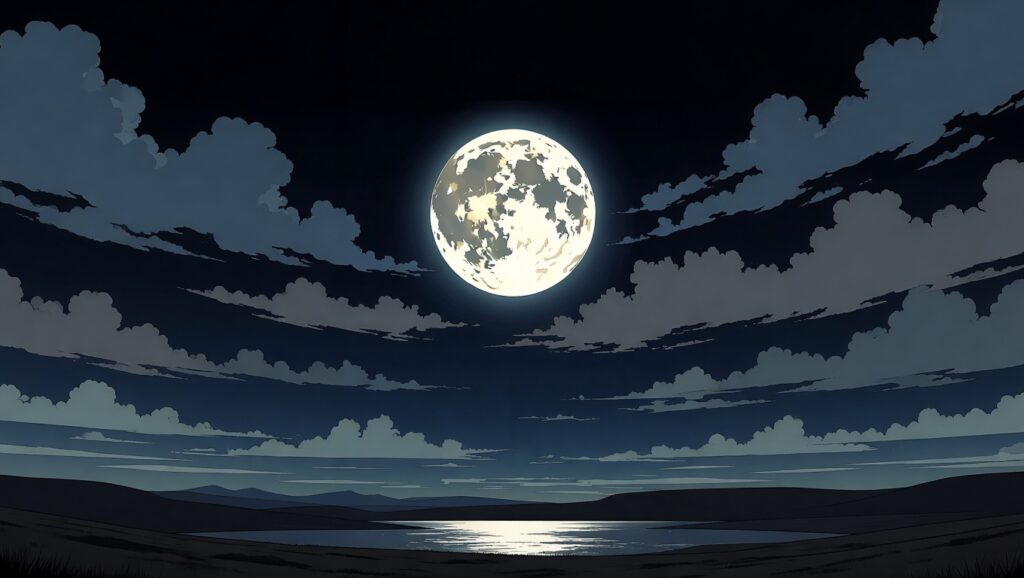
For a long while, I didn’t move. The light didn’t just fall; it settled, the way dust settles after a disturbance, or the way silence settles after a held note finally releases. It found the edges of things: the sharp line of the windowsill, the soft fray of the blanket’s hem, the uneven stack of my notebooks. Made them glow, just faintly, as though they’d been dipped in phosphorescence. My skin prickled, not from cold but from the strange, almost electric sense of being seen. Not by eyes, but by time. By something that had watched a thousand nights like this one, that had slipped through a thousand windows, that had known a thousand versions of this quiet, this stillness.
There’s a word for this. Not bathing. Too deliberate, too human. Not drowning. Too violent. Maybe steeping. Like tea leaves in hot water, like wool in dye. The moon wasn’t washing over me; she was seeping in, colouring the parts of me that usually go unnoticed. The spaces between thoughts. The back of my ribs. The slow, deep pulse behind my sternum. I could feel it happening, the way you feel the first pull of a tide when you’re standing too close to the shore. Not painful. Not even uncomfortable. Just inevitable.
And for the first time in months, I didn’t reach for my glasses. Didn’t squint against the brightness or turn my face away. I let my eyes adjust until the light wasn’t just something I saw but something I was inside of, suspended in, the way a diver is suspended in the middle layer of the sea, neither above nor below, but held, for a moment, in the quiet in-between.
The air had gone thick with silence. It pressed against my skin, not heavy but insistent, like the hush before a secret is shared. And in that quiet, the room became something else, not just walls and shadows, but a kind of threshold. As if the night itself had leaned in closer, breathing against the glass until the boundary between inside and out blurred into something porous, something alive.
I had the strange sense of waking into a language I’d forgotten I knew. Not the sharp, angular words of daylight, the ones that pin things down and name them, but something older, something that moved like water over stone. The kind of speech that doesn’t explain but reminds. The moon hung there, not as a thing to be observed but as a voice already mid-sentence, one that had been speaking long before I’d thought to listen.
My mind wandered to those who’d stood in this same quiet before me, the ones who’d measured time by her phases, who’d carved her likeness into bone and whispered her names like prayers. They wouldn’t have called it light, not really. They would have called it a visitor. A witness. The kind of guest who arrives unannounced but is always expected, the way the tide is expected, the way the turning of the year is expected. She didn’t knock. She didn’t need to. The window was just an excuse; she would have found another way in.
I thought of how she slips into the cracks of things, the spaces between branches, the gaps in a lover’s fingers when they reach for each other in the dark. How she’s been stitched into the seams of stories for so long that we don’t even notice anymore, like a thread pulled so tight it’s become part of the fabric. The poets call her silver, but that’s too clean, too polished. She’s not a coin or a blade. She’s the sheen on a fish’s scales, the glint in a predator’s eye. She’s the reason wolves throw back their heads, why the restless pace their rooms at night. She doesn’t just reflect; she answers.
And there she was, spilling across my floorboards, not careful, not measured, but generous. She didn’t demand anything at all. Only that I stop trying to capture her. With lenses, with words, with the desperate little rituals of modern attention. She wasn’t here to be framed or filtered or reduced to something shareable. She was here to be met.
My fingers didn’t twitch toward the phone on the nightstand. The thought of lifting it, of trying to trap that light in a rectangle of glass, felt like sacrilege, like cupping my hands around a flame only to find them empty. So I didn’t. I let my palms stay open. Let my breath slow until it matched the rhythm of the night outside, until the line between inhaling and being inhaled dissolved.
For the first time in longer than I could remember, I didn’t look at the moon.
I let her look back.
The first light of dawn didn’t so much arrive as it simply was, the way a held breath finally releases without fanfare. No grand proclamation, no sudden blaze across the horizon, just a gradual uncurling of the dark, as if the night had been a clenched fist slowly relaxing its grip. The moon had done her work already, easing the hinges of the world so the morning could slip in unnoticed, unchallenged. The air carried a different weight now, not the heavy stillness of midnight but something lighter, more porous, like the sky itself had been stretched thin enough to let the day seep through.
I’ve spent hours turning it over in my mind, the way you might worry a smooth stone between your fingers. Those unplanned moments, the ones that arrive uninvited, that don’t fit neatly into the ledger of cause and effect, they’re the ones that seem to bypass the usual routes. They slip past the sentries of logic and land somewhere deeper, somewhere the language of the mind doesn’t quite reach. That moonlight didn’t rearrange the furniture of my life. It didn’t hand me a key or a map or even a riddle to solve. But it did something quieter, more unsettling. It reached in and brushed against a cord I’d forgotten was there, and for the briefest stretch of time, something inside me hummed in reply.
The word mythic keeps surfacing, though that’s not quite right. Too grand, too deliberate. It was more like the flicker of recognition you get when you pass a stranger on the street and for a fraction of a second, you’re certain you’ve seen them before, not in this life but in some other, someplace where the rules were different. A wink, maybe, but not the kind that’s performing for an audience. The kind that’s just between two things that already understand each other.
And the strange thing? That’s all it took. No revelation, no instruction manual, no sudden clarity about the meaning of it all. Just the quiet certainty that, for that one stretch of time, the universe had leaned in close enough to breathe the same air as me. And if that’s not enough, then I don’t know what is.
Footnote: On the Mythic Lore of Moon Bathing
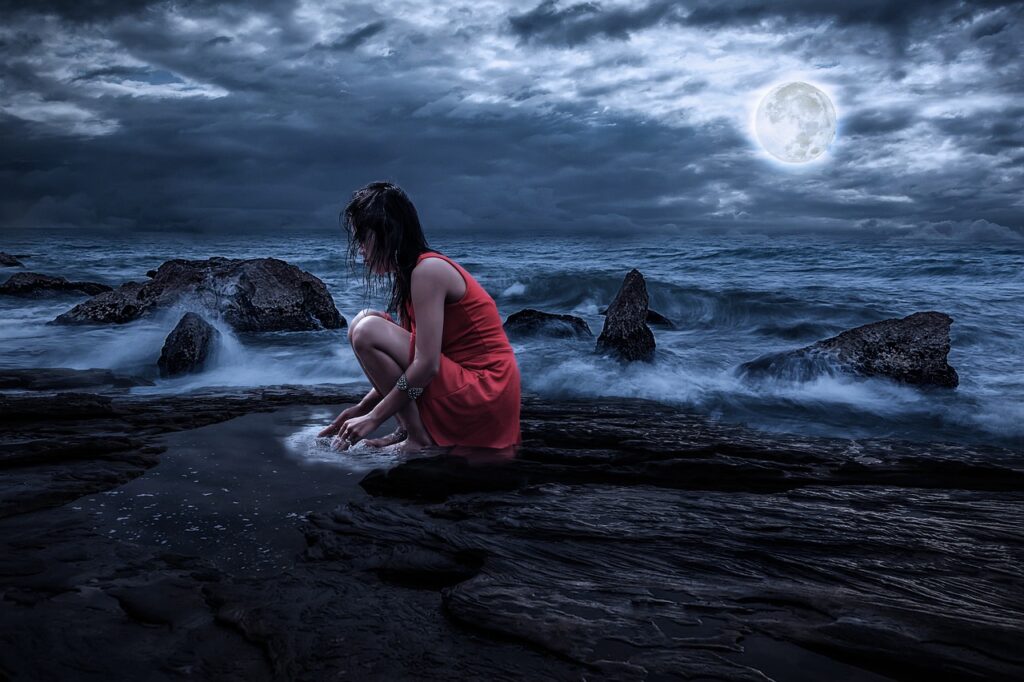
There is a particular quality to being awake at 3 a.m. when the rest of the house is sleeping. Not the anxious wakefulness — the grinding kind, where the mind runs its loops and the ceiling offers nothing back. This is different. This is when something pulls you to the window, or out onto the step, and you stand there in the cold with no particular reason for standing there, and the moon is full and the sky is very clear and you feel, quietly, like you have been called.
Most of us close the curtain and go back to bed.
There is an ancient practice in the Vedic tradition called chandra snana. Chandra is the moon. Snana is bathing. Lunar bathing — the practice of sitting or standing in the light of the full moon, skin exposed, receiving what the moon has to offer. Not metaphorically. Actually. Ancient Ayurvedic texts treat moonlight as a substance with medicinal properties: cooling, calming, a counterweight to the heat and intensity of solar energy. The moon was understood to carry soma — the nectar of consciousness, the liquid that the Vedas describe as the fuel of the gods and the balm of the over-taxed mind.
Chandra snana was not mysticism dressed up as medicine. It was medicine that understood the cosmos as the clinic. The moon was prescribed. You went out into it the way you’d take a remedy — with intention, with attention, and with some basic preparation. You faced the moon. You let it touch you. You stayed long enough for something to happen.
What happened, the ancients believed, was a recalibration. The nervous system cooled. The mind settled into a different frequency. What the sun ignited during the day, the moon could regulate at night.
The Greeks understood this differently, but not entirely differently.
They gave the moon three faces. Selene was the moon as pure presence — the Titan who drove the lunar chariot across the night sky, whose face illuminated the darkness without asking anything in return. She was not a huntress or a healer. She was simply radiance. The thing that shines because that is its nature. In later traditions she became associated with the full moon specifically — that moment of maximum brightness, maximum visibility, when nothing is hidden.
Artemis carried the crescent. Daughter of Zeus, twin of Apollo, huntress of the wild edges — she was the moon in its active form, the light that falls through forest canopy, the illumination of things not yet fully formed. Artemis did not preside over domestic spaces. She ran at the borders, at the transitional zones, at the places where culture gave way to wilderness. Her moon was the moon of liminal territory. To be out at night, moving through the half-light, was to be in her domain.
Luna was the Roman version of Selene, but the Romans did something interesting with her. They built her a temple on the Aventine Hill, and they connected her explicitly to the rhythms of biological and civic life — the calendar, the menstrual cycle, the tides. Luna was not abstract. She was structural. She was the force that organised time at its most intimate scale.
Three faces. Three registers of the same light. Presence. Activity. Structure.
What all three shared was this: they were not passive decorations on the night sky. They were agencies. Forces that did things to the world, and to the people living in it.
In Taoist alchemy, the moon is yin made visible.
The Taoist understanding of the cosmos moves along the axis of yin and yang — not as moral opposites but as complementary forces, each containing the seed of the other, each requiring the other to have meaning. Yang is solar, active, expansive, hot. Yin is lunar, receptive, inward, cool. Neither is superior. Both are necessary. The cultivation of either, in isolation, creates imbalance.
Taoist internal alchemy — neidan — works extensively with the gathering and circulation of subtle energies. Lunar practice was a recognised part of this. The full moon was understood as a moment of maximum yin force — a time when the quality of stillness, receptivity, and inward awareness was available at its peak concentration. Practitioners would sit in moonlight not to receive something from outside, but to amplify what was already within them. The moon was a mirror. A teacher. A frequency to entrain to.
There is a particular Taoist practice called yuejing — roughly, moon gazing — that involves sitting quietly, relaxing the eyes, and allowing the moonlight to enter without effort. No striving. No intention beyond the intention to receive. The whole practice is about getting the effortful, purposive, solar mind out of the way long enough for something quieter to move.
The Taoists called this wu wei. Action through non-action. Not passivity, but a different quality of engagement — one that listens before it speaks, that receives before it generates.
Moon bathing, understood this way, is a form of wu wei. You go out. You stand in it. You do not do anything with it.
So what actually happens when the moon wakes you at 3 a.m.?
Something in the body already knows. Not the mind — the mind will tell you it’s cold, it’s late, you have things to do tomorrow. The body knows. The body is not impressed by the schedule.
Moon bathing is simple to the point of embarrassment. You go outside. You find a patch of moonlight. You stand or sit in it — skin exposed if you can manage, face lifted toward the light. You breathe. You let the cool of the night settle in. You stay for ten minutes, or twenty, or as long as feels right, and you do not try to have an experience. You just stay.
The Vedic tradition says you bathe in it the way you’d bathe in water — fully, unhurriedly, present to the sensation. The Greek tradition says you enter the domain of a specific force and respect that you are not in charge there. The Taoist tradition says you become temporarily permeable, let the yin frequency do what it does, and trust that your body has been doing this kind of calibration since long before you had words for it.
All three traditions agree on one thing: the moon is not nothing. The night is not just the absence of day. What happens in the dark, in the quiet, in the silver light, is its own kind of necessary.
The 3 a.m. waking is not insomnia. It is an invitation.
Go out. Stand in it. Let the night do what the night does.
Journal Prompt
Take yourself outside on the next clear, bright night — full moon or close to it. Stay for ten minutes. No phone. Just you and the light.
Then come inside and write to this:
What does the moon ask of you that the sun doesn’t?
Don’t answer it analytically. Sit with it for a moment before you write. Let the question do some work. Notice what comes up from below the usual register — not the to-do list version of you, not the productive version, but the one who woke up at 3 a.m. and felt pulled toward the window.
Write from that one.
The moon doesn’t speak in words.
She speaks in tides, in dreams, and in long silences wrapped in silver.
And sometimes, lying there in the quiet dark, doing nothing but receiving, we become the altar.
Discover more from soulcruzer
Subscribe to get the latest posts sent to your email.