Wrestling with Angels

I came across the phrase while reading Spotify the Gnostics, Here’s the First Church of David Bowie by Sean Manseau.

Wrestling with angels.

Some phrases arrive carrying more weight than their literal meaning. They feel older than language. Older than the person who spoke them. This was one of those phrases. The moment I read it, something in me recognised it before I had even fully thought about why.

It immediately pulled me toward the story of Jacob beside the river Jabbok. Night falling. Isolation. A mysterious being appearing in the dark. Then the struggle itself, physical, spiritual, psychological, mythic, all at once. Jacob wrestles until dawn. He refuses to release the angel, even when the struggle wounds him. Even when it leaves him limping. And in the end, he emerges transformed, renamed, somehow more fully himself because of the encounter rather than despite it.

It strikes me now that this might be one of the oldest surviving metaphors for consciousness itself.

To think deeply is to wrestle with angels.

Not the sentimental angels from greeting cards and Christmas ornaments. Not harmless beings of soft light and certainty. I mean the older kind. Terrible and illuminating. Messengers from dimensions of reality larger than the ego can comfortably contain. Forces that interrupt sleep.

Ideas can behave like that.

Questions can behave like that.

A single insight can arrive and suddenly make your previous life impossible to fully return to.

That, I think, is part of what has been happening to me over the last few years. I have been wrestling with angels, trying to reconcile who I am with who I imagined I might become, and with whatever it is the modern world keeps demanding I turn myself into.

Some days it feels like three incompatible stories fighting for possession of the same nervous system.

There is the self that wants simplicity. The barefoot philosopher. The man who wants to walk slowly, read deeply, write honestly, drink coffee outside while listening to birdsong, and build a life measured more by meaning than metrics.

Then there is the self shaped by culture’s demands. Worker. Professional. Brand. Persona. Content producer. An optimised digital entity required to constantly translate inner life into consumable fragments for algorithmic systems that feed on attention.

And somewhere between them is another figure entirely: the unfinished self. The one still becoming. The one still trying to understand what it means to be human in a world increasingly mediated through machines, prompts, platforms, feeds, and simulations.

No wonder the struggle feels exhausting sometimes.

There are moments when I fantasise about becoming Homer Simpson.

Honestly, I understand the appeal.

A cold Duff beer. Television glow. Predictable routines. A life governed by appetite, habit, and immediate comfort. No existential burden. No obsessive need to interrogate meaning. No compulsion to turn experience into language and then examine the language itself for hidden architecture.

Just autopilot.

There are days when that sounds almost holy.

Because consciousness is tiring.

Not intelligence necessarily. Consciousness. The ongoing awareness of contradiction. The inability to fully believe the stories you inherited once you begin seeing the machinery underneath them. The exhausting recognition that identity itself is partly constructed, partly performed, partly chosen, partly imposed.

Once you see this, you cannot entirely unsee it.

And that may be the real curse and blessing of awakening: once you become aware of the struggle, you can never fully return to sleep.

You can distract yourself, certainly. Most of us do. Endless scrolling. Endless entertainment. Endless productivity systems. Endless noise designed to protect us from encountering ourselves too directly. Modern society has become extraordinarily sophisticated at manufacturing psychic sedation.

But sedation is not a resolution.

The ignored story does not disappear simply because you mute it.

It waits.

It leaks sideways into your life.

Into moods you cannot explain.

Into low-grade despair.

Into strange feelings of absence while performing the routines you are supposedly meant to want.

Into the quiet suspicion that you have somehow become a supporting character in your own existence.

I think many people feel this now, even if they do not yet have language for it.

They sense a fracture between their inner life and the identities available to them in public culture. They feel reduced by the templates being offered. Consumer. User. Audience segment. Political tribe. Career designation. Content niche. A thousand prefabricated masks waiting for a face to attach themselves to.

And maybe thinking, real thinking, begins precisely at the point where those masks stop fitting comfortably.

Maybe thinking is not the accumulation of information.

Maybe it is the refusal to remain fully possessed by inherited narratives.

A refusal to stop mid-becoming.

A refusal to surrender the authorship of your consciousness completely to culture, algorithm, exhaustion, or fear.

This is partly why philosophy has always mattered to me, though perhaps not philosophy in the institutional sense. Not philosophy as purely academic analysis. I mean philosophy in the older sense. Philosophy as a way of life. A lived struggle with existence itself.

The ancient philosophers understood something modern culture often forgets: ideas are not abstract decorations. They are forces that shape perception, behaviour, emotion, and possibility. Stories are not entertainment layered onto reality. Stories are one of the primary mechanisms through which reality becomes intelligible in the first place.

The narratives we inhabit become invisible operating systems.

And once you begin noticing this, you start seeing how much of modern life is essentially narrative conflict. Competing mythologies battling for psychic territory. Nations built from stories. Economies built from stories. Identities built from stories. Entire lives organised around scripts inherited so early that people mistake them for objective truth.

To wrestle with angels is to wrestle with these scripts.

To examine them.

To resist total possession by them.

To ask: whose voice is this inside my head? Which desires are actually mine? Which ambitions were installed? Which fears belong to me, and which belong to systems trying to reproduce themselves through me?

These are destabilising questions.

They can leave you limping.

Jacob leaves the river wounded. That detail matters to me. Transformation is not presented as clean transcendence. It leaves a mark on the body. Wisdom is not sterile. Consciousness costs something.

I suspect anyone who has seriously wrestled with themselves knows this already.

The artist knows it.

The writer staring at the blank page knows it.

The person standing at midlife, wondering whose life they have actually been living, knows it.

The addict getting sober knows it.

The person leaving a religion, career, marriage, ideology, or identity knows it.

There is often a moment where the old self begins dying before the new self fully exists. And in that threshold space, certainty collapses. You no longer know exactly who you are. Only that you cannot entirely return to who you were before.

That threshold is the riverbank.

That is where the angel appears.

And perhaps this is why I keep returning to writing.

Writing feels less like self-expression these days and more like participation in the struggle itself. A form of conscious wrestling. I write not because I possess certainty, but because language helps me stay in relationship with the mystery long enough for another fragment of meaning to emerge.

A sentence can become a foothold.

An essay can become a temporary shelter against chaos.

A journal entry can become evidence that consciousness was here.

Sometimes I think my entire body of work is simply a long record of negotiations between competing realities. Between myth and modernity. Between technology and soul. Between the desire for simplicity and the strange gravitational pull of digital existence.

And now AI enters the picture, complicating everything further.

Because here we are: humans manipulating reality increasingly through text. Prompts becoming action. Language becoming executable. Words triggering systems into motion. Stories becoming infrastructure.

William Burroughs once said language is a virus. In the age of artificial intelligence, that statement begins sounding less metaphorical than diagnostic.

We are becoming text-based ontologists operating inside environments where text increasingly functions as the universal substrate.

Which means the stories we tell ourselves matter more than ever.

The struggle matters more than ever.

Because the danger now is not merely propaganda or ideology in the old sense. It is the possibility of becoming psychologically automated. Handing over the difficult work of meaning-making to systems optimised for engagement, efficiency, and behavioural predictability.

To remain conscious inside this environment requires effort.

Attention becomes spiritual practice.

Thinking becomes resistance.

And maybe that is why I cannot fully become Homer Simpson, no matter how tempting the fantasy occasionally appears.

Something in me refuses total sedation.

Something keeps returning to the wrestling mat.

Not because I enjoy suffering. I do not. But because some deeper instinct understands that the unlived life extracts its own terrible price. The avoided question does not vanish. The abandoned self does not stop calling.

And every so often, in the middle of the struggle, something real emerges.

Another fragment of the story.

Another sentence sturdy enough to stand on for a while.

Another glimpse of coherence hidden inside the chaos.

Not certainty.

Not final answers.

Certainly not enlightenment.

Just a slightly deeper relationship with the mystery.

Maybe that is enough.

Maybe maturity is not about resolving the contradictions once and for all. Maybe it is about developing the capacity to remain in conscious dialogue with them without collapsing into cynicism or numbness.

To keep wrestling without demanding immediate victory.

To limp forward carrying both the wound and the blessing.

To understand that consciousness itself may be less like arriving at truth and more like staying awake inside the question a little longer.

Jacob does not defeat the angel.

That is important.

He survives the encounter changed.

Perhaps that is all any of us can really hope for.

Not mastery over existence.

Not perfect self-knowledge.

Just the courage to remain in a relationship with the forces larger than ourselves long enough to become more fully human through the struggle.

Three Cards, No Daylight

Yesterday felt like wading through wet sand. Every idea that surfaced dissolved before it could be shaped into anything. Underneath that is the voice that says, ‘If I can’t produce today, what does that mean for tomorrow, for the whole enterprise?’ It got louder as the afternoon wore on. I know that voice. It is not telling the truth. Knowing that doesn’t silence it.

This morning I pulled three cards. Sat with them at the desk before anything else happened, before coffee or email or the reflex to check what the world is doing. Let them sit.

Not one of them is set in daylight.

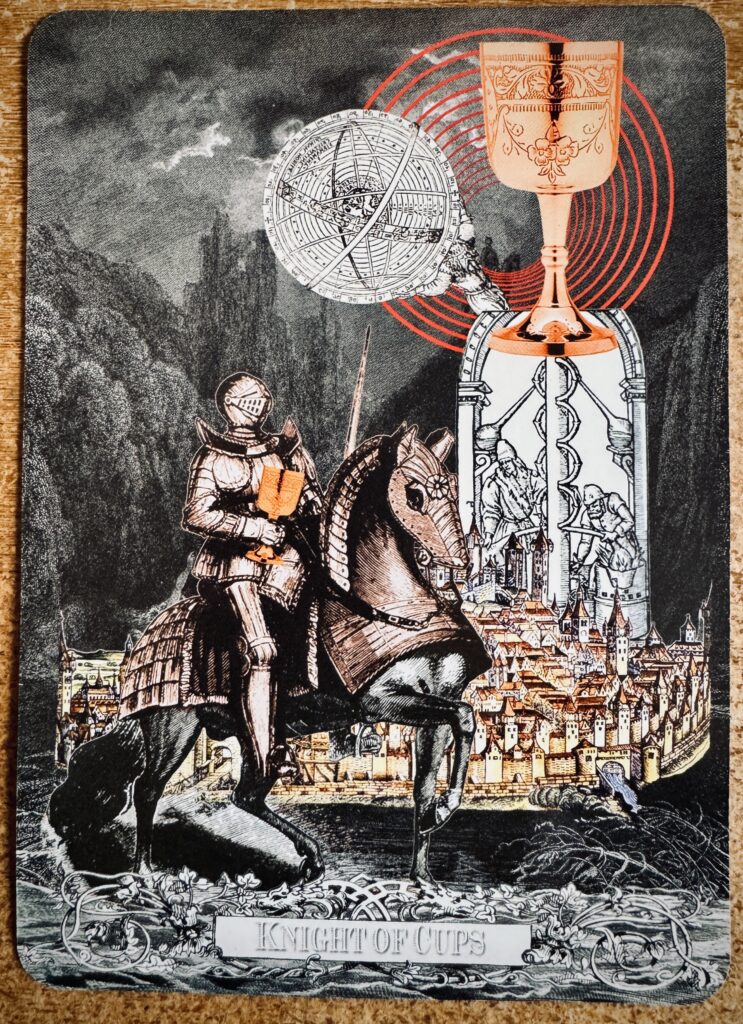
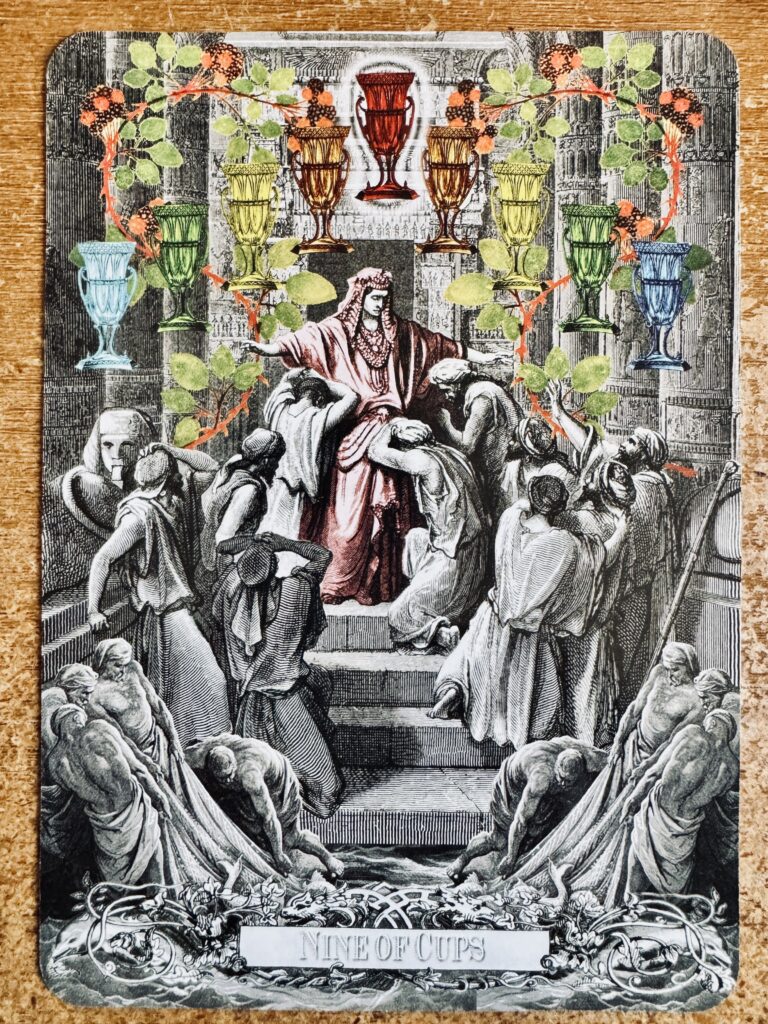
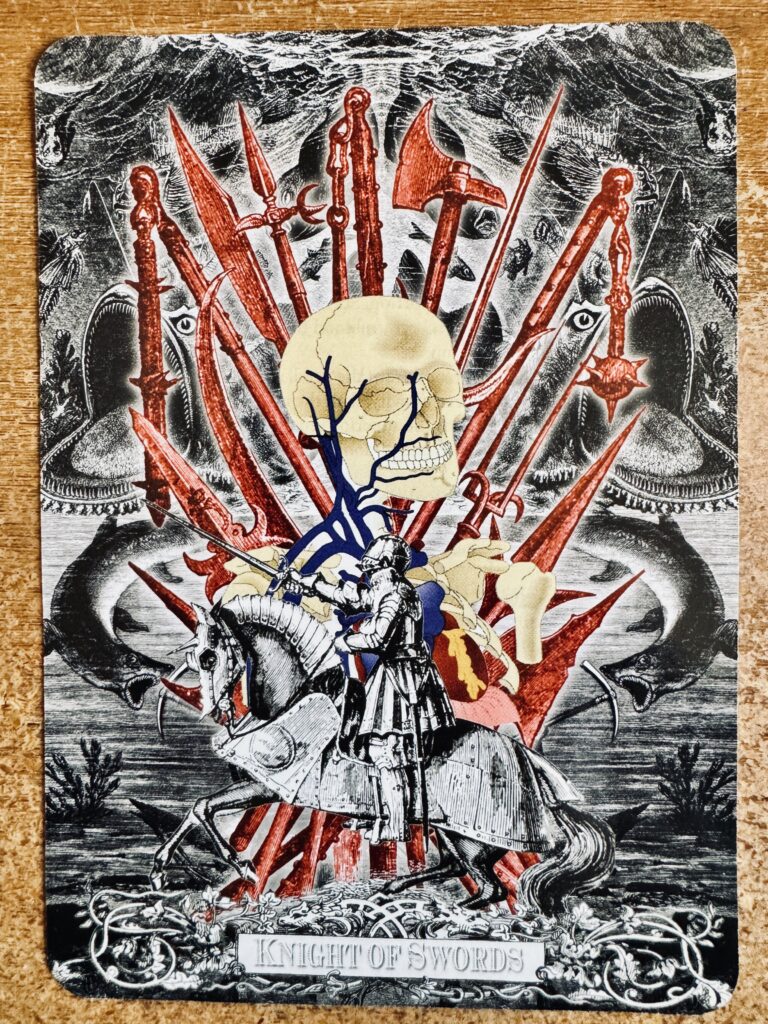
The Knight of Cups approaches at night, the city ahead glowing with its own inner light. The Nine of Cups traveller sits enthroned in a temple space removed from ordinary time. The Knight of Swords charges through a scene that Taussig makes completely explicit: underwater. In the psychic darkness of the unconscious, with monsters converging from every direction and a pale skull floating above like a moon that forgot to rise.

This is a spread with no interest in the surface world. Whatever it is pointing at, it happens in the deep.

the knight of cups

The Knight of Cups arrives first, which matters because of what he is carrying. The chalice has a dark streak. It may be cracked. It cannot yet fully hold its contents. He approaches with the vision and the calling but with a damaged container, and the card poses its question immediately: how does the chalice get repaired?

The answer is through the city ahead and not by fighting through it.

The chalice gets repaired by entering the city, stabling the horse, setting down the weapons, removing the armour, and confronting the ogre inside without any of it. The ogre must be befriended and integrated. The union of the ego with the negative aspects of the personality is what repairs the vessel, what allows it to hold the golden energy the Work generates.

The city is hidden between craggy cliffs, glowing with its own inner light at night. Inside, two gates. The unconscious flows in through the iron grate whether the knight invited it or not, coming in without asking. Consciousness enters through the open bridge. Both are present inside the city, and both must be dealt with. There is no passage where only one of them comes through. The moon above strengthens the process, working with what is already there rather than overwhelming it with external light. The celestial feminine as an amplifier, not a source.

Yesterday was the city without armour.

The fallow day, the spinning wheels, and the pressure rising from below: all of that was the ogre in the city. The form it took was the question about production, about whether the inability to generate output was evidence of some deeper structural failure. The ogre always wears a practical disguise. It arrives as a legitimate concern about time or relevance or money and only reveals its real face once you are inside the city gates with it.

The response this morning wasn’t to fight it down or armour back up against it. Something quieter. Knowing what to do when you don’t know what to do. Turning toward the practice rather than away from it: the writing, the cards, the walking. The body holds knowledge that precedes the doubt. Twenty-five years of interior work leaves a residue, a cellular memory of how to return to the centre when the mind is spinning. That is the psychic work that repairs the chalice.

The city generates its own illumination. It always did. Entering at night is what it takes to see it.

nine of cups

The Nine of Cups sits at the centre of the spread wearing red.

Rubedo. The Great Work is in its final stages of completion. The traveller who has moved through all four elements and ascended the four steps holds the Philosopher’s Stone within reach. The chalice at this stage has been repaired by the interior work. The golden energy can be held and dispensed freely. The traveller is generous and kind and genuinely empathetic because the road has made them so.

The four steps to the throne matter enormously. Earth, water, air, fire. Jung’s four functions. You don’t arrive at that seat by bypassing any of them. The water step is the psychic dissolution, the monsters of the deep. The throne is only accessible because the traveller went through the water, not around it.

The figure is androgynous, which is worth sitting with. It has integrated enough that it can’t be pinned to one side of any binary. Psychic wholeness in this deck looks like a movement into something that holds all of it, rather than a resolution where one part wins. Androgyny isn’t a detail about gender. It is a statement about what the Work produces: something that can no longer be halved by the question.

But the centre card carries a warning as pointed as any sword.

Adulation is dangerous. The people around the throne are a trap as much as they are a sign of the traveller’s bounty. The life of blessing others is genuinely fulfilling and genuinely good and genuinely insufficient because it requires abandoning one’s own journey. Because the adulation becomes habit-forming. Because ego inflation stops spiritual growth in its tracks. The traveller faces a terrible choice: continue the life of public good or go deeper into internal psychic wholeness, which could bring the world an even greater good.

This is the performing versus doing tension I named in the Rosebud session this morning, stated in alchemical terms. The pull toward visibility, the freelancer’s anxiety about which platform carries which audience, and the question of what to post and when and for whom: all of that is the adulation trap wearing practical clothing. The social media performance anxiety and the “If I can’t produce, what chance do I have?” are the same voice, one dressed as ambition and one dressed as fear. Both of them are the sound of the traveller’s attention drifting from the work toward what other people are doing with their chalices.

Document, don’t create. That is my answer to the traveller’s dilemma. Follow the inner journey for its own integrity, and offer what arises from that freely, rather than crafting content for reception. The difference between those two things is the difference between a city that generates its own light and a city that keeps the floodlights on. Both are illuminated. Only one of them knows where the light comes from.

The performance is the throne without the four steps.

knight of swords

The Knight of Swords carries all of this forward in the most extreme way possible.

Taussig is unambiguous: the scene is completely underwater. The drama of this card takes place inside the unconscious. The fish aren’t coming at the knight from outside his world. He has entered theirs. He has ridden down into the psychic depths deliberately, armoured, sword extended, charging through the monsters of the deep on the way to the treasure. The Magnum Opus. The Great Work.

That reframes yesterday entirely. Goethe’s line is exact: through water all things must be destroyed before they can be reborn. The fallow day, the regression to the fluid state, and the dissolution: water is the element all substances must be reduced to before they can emerge, purified. Going underwater is an alchemical necessity. You went underwater yesterday. Today you came up charging.

Unlike the city work, this charge is done fully armoured. The armour makes the charge possible at all. The accumulated practice, twenty-five years of work on the inner life, the military training, the daily journaling that has never stopped, the walks, the tarot, the interior work done in the city without weapons: all of that is what lets you ride your instincts into the deepest water rather than be consumed by it. The charge is the act of will made possible by everything that preceded it.

The armour distinction carries a second reading worth naming. Two interpretations, sitting side by side. The first: the armour allows you to ride your instincts bravely into the unconscious, the accumulated practice as protection, as what makes the descent possible at all. The second: the armour becomes the Persona itself, so hardened it protects you from change rather than enabling the charge. A shell rather than a suit. The question isn’t which reading is true. Both are, depending on the moment. The question the card puts is which one is active right now, in this particular descent, and whether what you carry into the water is a working instrument or a defence against being changed.

The hands are where it gets personally sharp.

Right hand on the sword: intellect and logic, the conscious frameworks, the Narrative Alchemy structures, the systems thinking, and the public articulation. The left hand guiding the horse: intuition and creativity, the subconscious steering the direction, the walks, the journaling, the tarot, and the inner work. Taussig is explicit that both are required. Neither hand wins. The sword without the reins is performance. The reins without the sword is drift. The performing versus doing tension resolved in a single image: both hands on the job, the intellect extended and the intuition steering, neither dominant, both necessary.


Now the spread reads as a complete alchemical sequence.

The Knight of Cups is approaching the city at night with a cracked chalice, doing the unarmed interior work that will repair it. The Nine of Cups traveller enthroned in the rubedo stage, facing the choice between adulation and deeper wholeness. The Knight of Swords is charging fully armoured through the underwater darkness, which is only possible because the interior work has been done first. The three figures are working on the same thing from different positions in the same territory.

The middle card is the vision of what the Work produces and the choice being faced right now, this morning, after the fallow day and before the next charge.

This spread holds the full complexity of the Work as it stands. The interior city works without armour, facing the ogre, repairing the vessel. The choice at the centre between adulation and deeper wholeness. The underwater charge through the psychic darkness with both hands active. These are simultaneous modes of engagement with the same process, all present on the same morning. The error is reading them as stages to be worked through in order and left behind.

The Knight of Cups and the Knight of Swords are in the same territory as the traveller on the throne. The red of the rubedo in the centre card is the same alchemical fire as the red swords in the Knight of Swords. The charge through the unconscious and the figure who has nearly reached the Philosopher’s Stone aren’t separated by vast distance. They’re in the same stage of the Work.

And none of the cards are set in daylight. That keeps demanding attention. The whole drama of this reading happens at night, underwater, in temple time. The surface world of presentations and platforms and production anxieties doesn’t appear in any of the three cards. Not even in the Nine of Cups, the most outward-facing of the three, where the traveller sits enthroned and surrounded. Even there, the setting is interior, removed from ordinary time. The Work doesn’t happen up there, in the daylight of results and receipts and follower counts. It happens here, in the dark, with the city’s own light.

Yesterday was the regression to the fluid state, the dissolution of the water demands before things can be destroyed and reborn. Today the chalice is a little more whole, the traveller’s choice a little clearer, and the charge a little more sure.

Tuesday, 12 May 2026

Do the thing

Sunday evening. The rain has passed; the clouds linger. I’m out on a wisdom walk letting my feet meet the earth and my thoughts catch up with my breath.

The day began scattered. Too many moving parts: the sale of the old truck and the logistics of the new one—registrations, license plates, and tax. My house, in a state of lived-in chaos, mirrored my mind. Inner clutter. Outer clutter. Echoes of each other.

When I’m in that state, one thing that helps me is getting physical. Doing something with my body gives my mind a break from itself. So I turned to the shed. It needed sorting, and I needed centring. By midday, we were in a rhythm. Lifting, moving, organising. A kind of shed-zen. It brought me back into my body, and with it came a clearer mind.

Now I’m walking and reflecting. I didn’t want to end the day sitting. Movement sharpens insight. This is something I’ve been returning to all week: the connection between walking and thinking. Between motion and meaning.

This week’s theme has been philosophy as a way of life. Pierre Hadot has been my guide, reminding me that philosophy isn’t meant to be confined to the lecture hall. It’s meant to be walked, spoken, and lived. Rebecca Solnit’s Wanderlust added fuel to the fire, tracing the long lineage of thinkers who took their thoughts on foot. From Socrates to Rousseau, Nietzsche to Thoreau. Philosophy has often worn out the soles of its shoes.

For me, this is it. Reading, reflecting, walking, writing, talking, and sharing. That’s the core of my game. Everything else can orbit that.

The insight that lands tonight is simple. Do the thing. Don’t just think about it. Don’t just map it endlessly. Embody it.

Walk the walk. Talk the talk. Play my game. Let the rest go.

As the Stoics remind us, what others think, say, or do is none of our business. Our business is what lies within our control. What lies within my control is showing up fully, soulfully, and doing the work that calls me.

So here I am. Out walking beneath a soft sky. Speaking my reflections into the air.

This is the practice. This is the way.

Soundtrack

The Pathless Path

Late in the afternoon, I decided I needed a break from the desk. In true barefoot philosopher style, I wandered outside with a coffee and Pierre Hadot’s Philosophy as a Way of Life, laying down in the grass underneath our event shelter to shield myself from the sun.

I only managed a few paragraphs before a phrase stopped me mid-sip: “Philosophy has to be more than just discourse. Choosing philosophy as a way of life is about being willing to undergo radical transformation.”

It got me thinking about personal transformation. What does it actually mean to transform? The term gets batted around everywhere these days—splashed across Instagram feeds, whispered in productivity podcasts, and packaged into morning routines. But what is it, really, when we strip away the marketing copy?

I had a conversation with Claude and then plugged it into NotebookLM to produce this audio deep dive:

What I discovered from this deep dive is that real transformation requires moving beyond consuming wisdom into embodying it. It’s not about reading more books or optimizing your performance metrics. It’s about the willingness to sit with not-knowing, to let your assumptions dissolve like sugar in water, to face the mystery of being here at all.

This path often involves what I call beautiful disillusionment–discovering that many things you thought were solid and important are actually quite flimsy. Your carefully constructed identity. Your need to have everything figured out. Your attachment to being right about your own story.

But instead of leaving you cynical, this dissolution opens space for something more authentic to emerge. Like clearing dead wood to let new growth flourish.

The transformation I’m seeking isn’t about becoming a polished, optimised version of who I am. It’s about discovering what remains when everything else falls away. It’s about learning to move with whatever is actually calling me, rather than what I think should be calling me.

And perhaps most importantly, it’s about recognising that the deepest wisdom often comes not from having answers, but from learning to live fully within the questions themselves.

The Grandfather Timeline: Seeing Both Directions

This morning, 7:13 AM, Croatian hat settled on my head, backpack loaded with gear I probably don’t need. The familiar circuit calls—out the front door, down to the path, into the rhythm that unwinds whatever the mind has been tangling.


The weekend just passed brought a new soul into our family circle. A tiny human, barely breathing outside the womb, is already reshaping the geometry of time around her. My son and his partner, young and bright-eyed in that particular way of first-time parents, hold this small mystery while I watch from the strange vantage point of a newly minted grandparent.

From here, I can see it all clearly: the great arc of time stretched before me like a walking path. On one end, my son’s young family at the beginning of their story, all possibility and sleepless wonder. On the other end, the great-grandparents in their seventies and eighties are sliding into the twilight of their years. And here I stand in the middle, the trajectory of my life made visible through them.

It’s this unique position, actually, when you think about it. You’re seeing what your past looked like—young family, all that energy and chaos. And you’re seeing what your future looks like, too, in 20 years or so.

The circle of life isn’t just a Disney lyric anymore; it’s the living geometry of generations, each one watching the others from their place on the arc. If I look at this through the lens of a classic story, I see myself entering the beginning of Act III.

The Questions That Matter

This middle space brings different questions than the earlier acts. Not “What do I want to become?” but “What legacy am I leaving?” Not “How do I succeed?” But “What stories will they tell about Pops when I’m gone?”

When I held my son for the first time, I was nearly the same age he is now. Our parents then were the age we are today. It’s this beautiful symmetry—time folding back on itself like the path I’m walking this morning, each generation experiencing the same wonder, the same protective fear, and the same overwhelming love for something so small and vulnerable.

But what changes in this middle position is perspective. When you’re young with a baby, you’re just surviving—feeding, changing, soothing, hoping you don’t break this precious thing. When you’re watching your child become a parent, you’re witnessing the miracle from a different angle entirely. You see the continuity, the great river of life flowing from one generation to the next.

The Grandfather’s Craft

So what does it mean to be a grandfather in this story? Not just biologically, but as a role, a craft to be learned?

I think about my own grandfather—the stories that have survived about him, the fragments of wisdom that somehow made it through the decades to shape who I am today. Most of what he said is lost to time, but the essence of him, the way he moved through the world, somehow got passed down from my father to me.

Now I’m the one creating those fragments for this tiny girl sleeping in Ludlow. What essence will I leave behind? What will she remember about Pops when she’s older?

The weight of this hits me about halfway through my wisdom walk, near the old tree that marks the return point. I’m not just responsible for my own story anymore. I’m helping to author the opening chapters of hers, laying down the foundation stories she’ll carry forward.

The Wisdom Walk Philosophy

This is where the barefoot philosopher thing starts to make sense. Not as some marketing gimmick or personal brand, but as a way of being that’s worth passing down. The grandfather who goes for wisdom walks, who thinks out loud, who wonders about the big questions while his feet find familiar paths.

Maybe that’s what philosophers are really for—not to write dense academic papers that gather dust, but to model a way of engaging with life that’s curious, contemplative, and present. To show the next generation that it’s okay to take time to think, to walk, and to wonder.

I imagine taking her on these walks when she’s older. Little legs trying to keep up, asking those beautiful questions that only children ask: “Why do leaves fall down?” “Where do thoughts come from?” “What makes the sky blue?” And instead of rushing to Google for answers, we’ll walk and wonder together.

The Story I Want to Tell

The morning mist is lifting now, and I can see the Holy Well ahead—that ancient spring where people have been coming for centuries seeking healing, wisdom, and connection to something larger than themselves. It occurs to me that this is exactly what I’m doing on these walks, what I want to teach her to do: to seek out the sacred in the ordinary, to find wisdom in movement, and to trust that the answers we need often come when we stop trying so hard to find them.

When she asks about her grandfather someday, I want the stories to be simple but true: He went for walks. He thought about big questions. He paid attention to small things. He believed that wisdom came from living fully, not from accumulating facts.

I want her to know that he chose presence over productivity, curiosity over certainty, wonder over worry. That he tried to live authentically, even when—especially when—the culture around him was obsessed with performance and appearances.

The Raw Experience of Love

Here’s what I’m learning as I circle back toward home: the most profound experiences can’t be manufactured or marketed. You can’t optimise your way into the feeling of holding your grandchild for the first time. You can’t productivity-hack the moment when she first recognises your face and smiles.

This is raw experience at its most essential—love that requires no craft, no strategy, and no improvement. Just presence. Just showing up fully to the miracle of another human being who carries your family’s story forward into an unknown future.

All my life I’ve been trying to learn crafts—writing craft, video craft, and marketing craft. But maybe the most important craft I need to master now is the craft of being a grandfather. And that craft is surprisingly simple: Pay attention. Show up. Love without condition. Walk and wonder and trust that the wisdom will come.

Coming Home

The familiar gate appears ahead, my circuit complete. Backpack heavier now with the weight of these thoughts, but my step lighter somehow. The questions that seemed so urgent an hour ago—about careers and content and finding my authentic voice—feel less pressing now.

I’m a grandfather. That’s the story that matters. Everything else is just details.

The little one sleeping in Ludlow will wake soon to a world full of wonder and confusion, beauty and pain. My job isn’t to prepare her for it all—that’s impossible. My job is to show her that it’s possible to walk through it with curiosity, with presence, and with love.

To show her that wisdom isn’t something you arrive at but something you practise daily on whatever path you choose to walk.

The Holy Well bubbles quietly behind me as I head toward home, carrying this ancient blessing forward: may you find healing in movement, wisdom in wondering, and love in the simple act of paying attention.

Time to see what we can make of this beautiful, ordinary morning.

Pops and Rosie sharing a barefoot philosopher’s moment.

Sunrise and Elephant Grass

Here’s a short reflection I had sipping coffee watching the sun rise through the elephant grass…

We come from the Unknown,
and we carry its dust in our bones.

Born of stars and silence,
we arrive trailing the breath of the void,
a question wrapped in skin.

No map. No manual. Only a pulse.

And still—we move.

We step forward, not because we know the way, but because something deeper than knowing calls.

The Unknown isn’t the enemy.
It’s the mother of becoming.
The field where potential waits like dew
on the edges of every decision.

To walk into the Unknown is to practice sacred forgetting—
to unlearn the lie of certainty,
to trade the cage of answers
for the wildness of wonder.

You are not lost.
You are listening.
And the road ahead is not a threat,
but a threshold.

Prompt:

Where in your life are you being asked to walk without a map?

What part of your soul knows how to navigate the dark by feel?

If you stopped trying to name the future, what might the Unknown whisper in return?

the day I freed myself from bullet points

there’s a certain seduction to the bullet point. it’s neat. it’s tidy. it gives the illusion of control. one thought. one line. one breath. like a haiku, it ends where it ends. no need to explain. no expectation of cohesion. no pressure to finish a thought with a grand conclusion. a bullet point is a kind of grace—permission to pause.

but today, i decided to break free.

no more bullets. no more tight compartments.

what happens when i don’t use bullet points?

i wander.

i spiral.

i follow threads until they dissolve.

and when they do, i don’t panic—I pivot.

this kind of writing—this slow unraveling of the inner thread—feels like something else entirely. not logic. not structure. not outline.

it feels like storythinking.

like a fox slipping between hedgerows, i’m moving through the underbrush of my own mind, picking up scent trails of thought, following them until they grow faint, then doubling back to find another. this is how a guerrilla blogger thinks—not in straight lines but in loops and pulses, in rhythm and reflection.

what i’m seeking—what i need—is flow.

not the industrial kind measured by productivity apps, but the old kind, the sacred rhythm. the kind monks followed in their scriptoriums, and jazz musicians channel in smoky clubs. the kind that doesn’t ask “what have you produced today?” but instead whispers, “where have you wandered? what have you felt?”

i’ve realized i spend most of my day on the surface—responding, reacting, checking, scrolling. but somewhere inside me, there’s a deeper current that wants to be tapped. that wants to be heard.

that’s the pull.

that’s the reason i’m writing this way now.

because i’m not just cataloguing thoughts. i’m listening for the voice behind the voice.

today, i asked myself a small but potent question:

what needs to unfold?

a weekly review. not just tasks and accomplishments, but soul-markings.

where have i been—mentally, emotionally, creatively?

what threads have i opened that remain frayed?

which ones still whisper to be returned to?

i keep opening loops. that’s fine—loop-opening is part of the rogue learner’s code. but i also need a system of return. a way of honouring the unfinished thought. that’s what this blog is for. not just capturing but tracking the constellation of my curiosity.

reflect—that’s the name of my sacred note making space. it’s my main squeeze. a space not for performance, but for return. craft (the app, yes, but also the verb) has its place too—elegant and focused, built for documents and design. but this here—this is my den, my cave, my guerilla dispatch hq.

there’s a persona awakening within me.

not just clay, the content creator.

but clay, the guerrilla blogger.

clay, the rogue learner.

clay, the digital flâneur.

clay, the myth-weaver with a podcast mic and a pirated rss feed.

and this is not just an aesthetic choice. it’s a spiritual one.

following the example of thinkers like kening zhu—whose blog i’ve fallen headlong into—I see how blogging can be world-building.

not branding. not business.

but myth-making.

an intimate invitation into a personal universe.

a long-term conversation with the reader.

a shared journey through tangled thoughts and luminous questions.

there’s a term for this kind of creator-audience relationship.

i don’t know what it is yet.

but i can feel it forming.

and this style—this reflective, meandering, lightly mythic journaling—might just be the seed form of my guerilla dispatches. notes from the field. missives from the margins. not polished essays, but living entries—moments caught mid-thought.

here’s one more thread to close:

i spent all afternoon working on this blog post:

where the mind ends and the world begins: thinking like a spider.

crafted it in elementor. fell into flow. lost all sense of time.

but then came the doubt.

was it worth the hours?

should i have published faster?

would anyone even notice the difference?

if i had hit publish this morning, the post would be out there already.

but it wouldn’t have had the same texture.

it wouldn’t have had my fingerprints.

so here’s the catch-22:

speed gives you reach.

depth gives you resonance.

you can optimise for one, maybe flirt with both—but not always at the same time.

still, i’d rather create something that feels like me, even if only a few readers ever see it.

because in the end, that’s how i find myself.

that’s how i build a body of work that’s not just content, but continuity. a signal sent out into the dark.

this is what happens when you stop using bullet points.

you start writing like a spider.

thread by thread.

web by web.

building a world.

one strand at a time.

Good Day to Die Reflection

Yesterday, I had a conversation with a friend about the unrelenting passage of time and how, as we age, we often perceive ourselves as running out of time, a sentiment that is actually true. The conversation reminded me of the saying, “Today is a good day to die.”

This phrase resonates with strength and fearless acceptance. Often attributed to Native American warriors, particularly the Lakota Sioux, it encapsulates a mindset where life and death intertwine, not as opposites, but as integral parts of a seamless existential dance.

At first glance, it might seem like a call to arms—a warrior’s fearless charge into battle. But looking deeper, we find something richer, more nuanced, and strikingly relevant today. This statement is not merely about death; it’s about embracing life so fully, so passionately, that each day feels complete. It reflects living with integrity, purpose, and a clear conscience so that when death does come—inevitably—it finds one ready, unburdened by regret.

In Lakota philosophy, death is not an end but a continuation of a larger cycle. Warriors saying, “Today is a good day to die,” are acknowledging that death is as natural as breathing, neither to be feared nor obsessed over, but simply met with open eyes and open hearts. It is this willingness to confront mortality directly that grants a profound freedom to live authentically.

This concept aligns beautifully with existential thought. In facing our mortality, we strip away pretenses, societal expectations, and superficial desires. We clarify what genuinely matters, enabling us to pursue it relentlessly. The phrase serves as a powerful daily reminder to ask ourselves, “Am I truly living the life I desire? Am I spending my precious hours on things that deeply fulfill me?”

Yet today, in a culture obsessed with avoiding discomfort and hiding from mortality, we rarely engage in such introspection. We fill our lives with distractions, numbing ourselves to reality. But embracing the wisdom behind “Today is a good day to die” calls us back to our core humanity—raw, vulnerable, yet fiercely alive.

Imagine waking each day with such clarity. What changes would we make? Perhaps we’d speak truths we’ve long held back, mend relationships we’ve neglected, or finally pursue dreams we’ve continually postponed. Maybe we’d savor simple pleasures, appreciate the warmth of sunlight, and cherish moments of quiet connection. In facing the inevitability of death, we rediscover how deeply valuable every moment is.

The phrase is not morbid; it’s profoundly liberating. It reminds us to shed fear, to abandon half-hearted living, and to embrace existence fully. By acknowledging that any day could indeed be our last, we are encouraged to live every day as if it matters—because it does.

Today, as you read these words, pause and reflect. What would it mean for you to embody this warrior philosophy? What steps can you take, right now, to align your actions more closely with your deepest values?

Because perhaps, in the end, the truest courage lies not in the willingness to face death, but in the courage to live—fearlessly, authentically, and without regret.