
Let me tell you something about anxiety that nobody seems to mention: it’s a terrible storyteller.
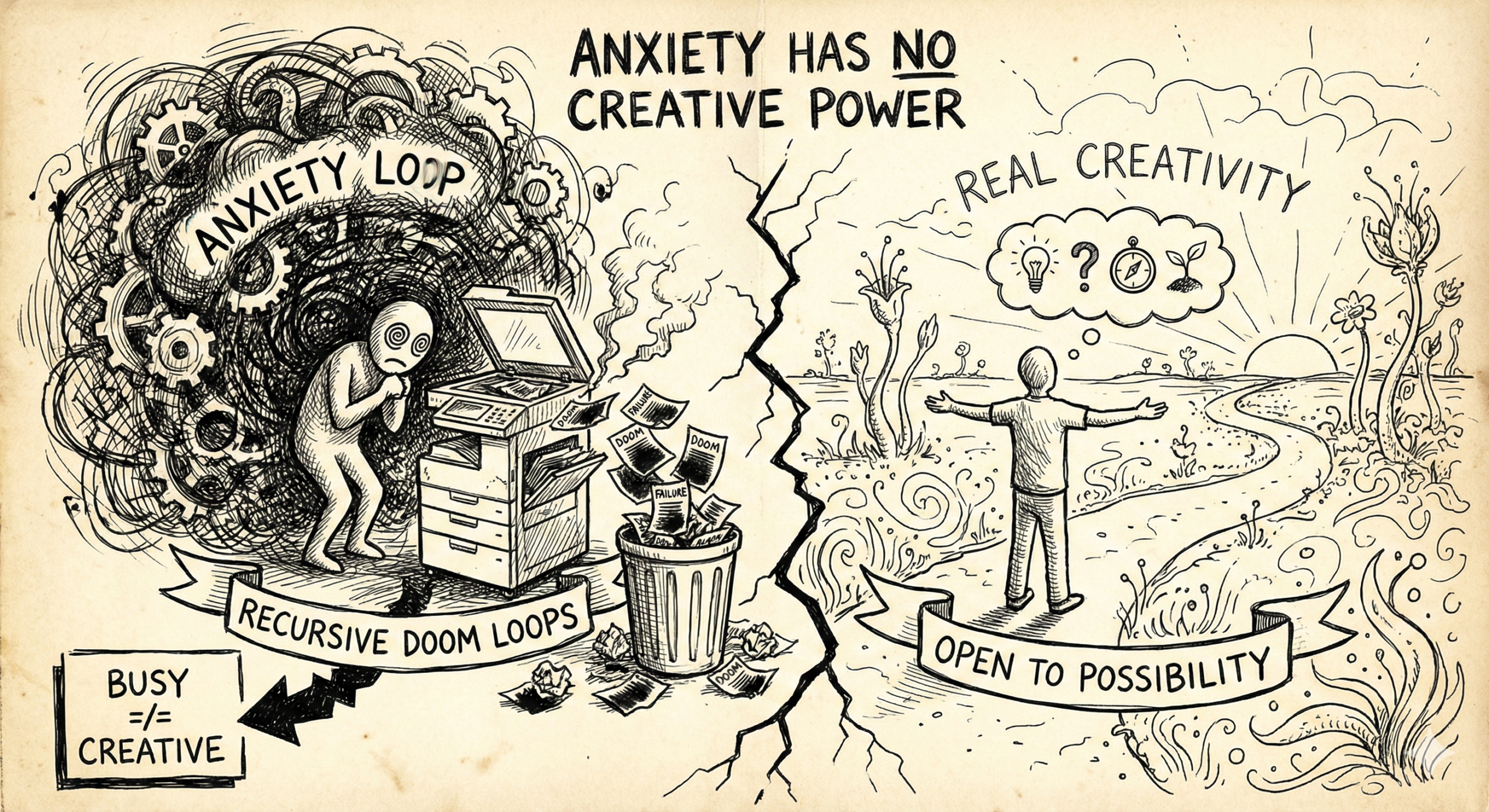
I’ve watched anxiety operate in hundreds of minds, including my own. And here’s what I’ve learned: anxiety is fundamentally sterile. It produces nothing new. It’s a photocopier stuck on the darkest setting, churning out increasingly distorted copies of the same fearful image.
But it doesn’t feel that way, does it? When you’re in the grip of anxiety, your mind feels incredibly active. Thoughts racing, scenarios spinning, mental energy burning at full throttle. Surely all that activity must be accomplishing something, right?
Wrong. And understanding why matters more than almost anything else in your transformation work.
The Anxiety Illusion: Busy Isn’t the Same as Creative
Here’s the first thing to understand about anxiety: it operates in pure reaction mode. It takes existing material, existing scenarios, existing memories, and runs them through a doom filter. That’s it. That’s the entire mechanism.
When you’re anxious about an upcoming presentation, your mind doesn’t generate novel solutions. It doesn’t craft creative approaches to engagement. It doesn’t discover fresh angles on your material. Instead, it rehearses failure. It replays that time you stumbled over your words in the team meeting. It projects humiliation onto a future that hasn’t happened yet.
This feels productive because your mind is so busy. Thoughts cascade. Scenarios multiply. Your nervous system floods with stress hormones that create a sense of urgency, importance, emergency. Surely something this intense must be meaningful, right?
But intensity and meaning aren’t the same thing. Heat and light aren’t the same thing. Anxiety generates tremendous heat, but it casts no light on your actual situation.
What Real Creativity Actually Requires
Let’s talk about actual creative states for a moment, because the contrast is illuminating.
Real creativity involves opening to possibility. It requires a kind of relaxed attention where your mind can wander, make unexpected connections, follow curiosity into strange territory. When you’re in a genuinely creative state, you’re not locked onto a single track. You’re exploring. Discovering. Playing with variables.
I’ve spent decades working with story as transformational technology, and here’s what I know: creativity needs space. It needs permission to be wrong, to be strange, to follow threads that might lead nowhere. It needs your nervous system to be calm enough that you can notice subtle signals, faint possibilities, weird hunches that don’t make immediate sense.
Anxiety provides exactly none of this.
Instead, anxiety narrows your focus to threat detection. It activates your survival systems. It floods your body with chemicals designed for one purpose: get you ready to fight or flee. This is brilliant design if you’re facing an actual physical threat. It’s terrible design for solving complex problems, generating insights, or creating anything new.
Your anxious mind isn’t exploring possibility space. It’s scanning for danger. And when your primary tool is a danger scanner, everything starts to look dangerous.
The Cruel Masquerade: When Worry Pretends to Be Problem-Solving
This is where anxiety gets truly insidious. Because it masquerades as problem-solving.
When you sit there worrying about your finances, rehearsing conversations with your boss, imagining everything that could go wrong with your project, it feels like you’re working on the problem. Your mind is engaged. You’re thinking hard. You’re taking it seriously.
But you’re not generating options. You’re not creating solutions. You’re running the same disaster movie through your mental projector, maybe with slight variations in the special effects.
I call this the anxiety loop, and it’s one of the most energy-expensive, least productive patterns your consciousness can run. It’s like revving your car engine in neutral. Lots of noise, lots of fuel consumption, zero forward movement.
The loop never actually addresses what it’s worried about. It can’t. Because anxiety lacks the fundamental capacity to create new pathways. It can only reinforce existing fear patterns, deepen existing grooves in your neural pathways, make the worry response more automatic and more powerful.
The mental energy you spend is real. The exhaustion you feel afterward is real. But nothing new emerges from the process. No insights. No solutions. No creative breakthroughs. Just deeper grooves in the same worry patterns.
Stories Are Code: Anxiety Runs Bad Code
In my work as a narrative alchemist, I often say that stories are code. They’re programs running in your consciousness, shaping your perception, directing your attention, determining what you notice and what you ignore.
Anxiety is bad code. It’s a recursive loop that calls itself endlessly without ever reaching a return statement. If you’ve done any programming, you know what happens when you write code like that: your system hangs. It becomes unresponsive. All available resources get consumed by a process that goes nowhere.
That’s exactly what anxiety does in your consciousness. It hijacks your processing power and runs an infinite loop that produces no output.
The tragedy is that the same mental energy, properly directed, could actually solve problems. Could generate insights. Could create something genuinely new and useful.
But anxiety doesn’t know how to do that. It only knows how to repeat, amplify, and catastrophize.
Breaking the Loop: What Actually Works
So what do you do with this understanding?
First, you stop treating anxiety as if it’s doing useful work. You stop honoring it as legitimate problem-solving. You recognize it for what it is: a malfunction, not a feature.
This doesn’t mean you ignore your concerns. Real problems require real solutions. But anxiety doesn’t provide solutions. It provides noise.
Second, you learn to distinguish between genuine creative thinking and anxiety loops. Creative thinking feels open, exploratory, curious. It generates options. It asks questions. It plays with possibilities. Anxiety feels tight, urgent, repetitive. It narrows options. It rehearses disaster. It loops back on itself.
Third, you build practices that actually support creative problem-solving. For me, that’s journaling, ritual work, and what I call “walking the question”—literally going for a walk while holding a question lightly in awareness. For you, it might be something else. But whatever it is, it needs to create space, not urgency.
The key is learning to notice when you’ve slipped into the anxiety loop, and then consciously choosing to step out of it. Not by forcing it away, but by recognizing that it’s not serving you, that it has no creative power, that it’s running bad code.
The Bottom Line
Anxiety is not your ally in transformation. It’s not helping you prepare. It’s not keeping you safe. It’s not solving your problems.
It’s a broken mechanism running in circles, consuming your energy, producing nothing new.
Once you see this clearly, you can start to disengage from it. Not by fighting it, but by withdrawing your investment in it. By recognizing that all that intense mental activity isn’t actually going anywhere.
And then, maybe, you can redirect that energy toward something that actually has creative power: genuine curiosity, authentic exploration, real problem-solving that generates new possibilities instead of rehearsing old fears.
Your consciousness is too valuable to waste on recursive doom loops. You have actual work to do in the world, actual stories to write, actual transformations to navigate.
Anxiety can’t help you with any of that. It never could.
Further reading.
Addicted to Anxiety: The instant Sunday Times bestseller that will teach you how to take back control by Owen O’Kane
[…] […]