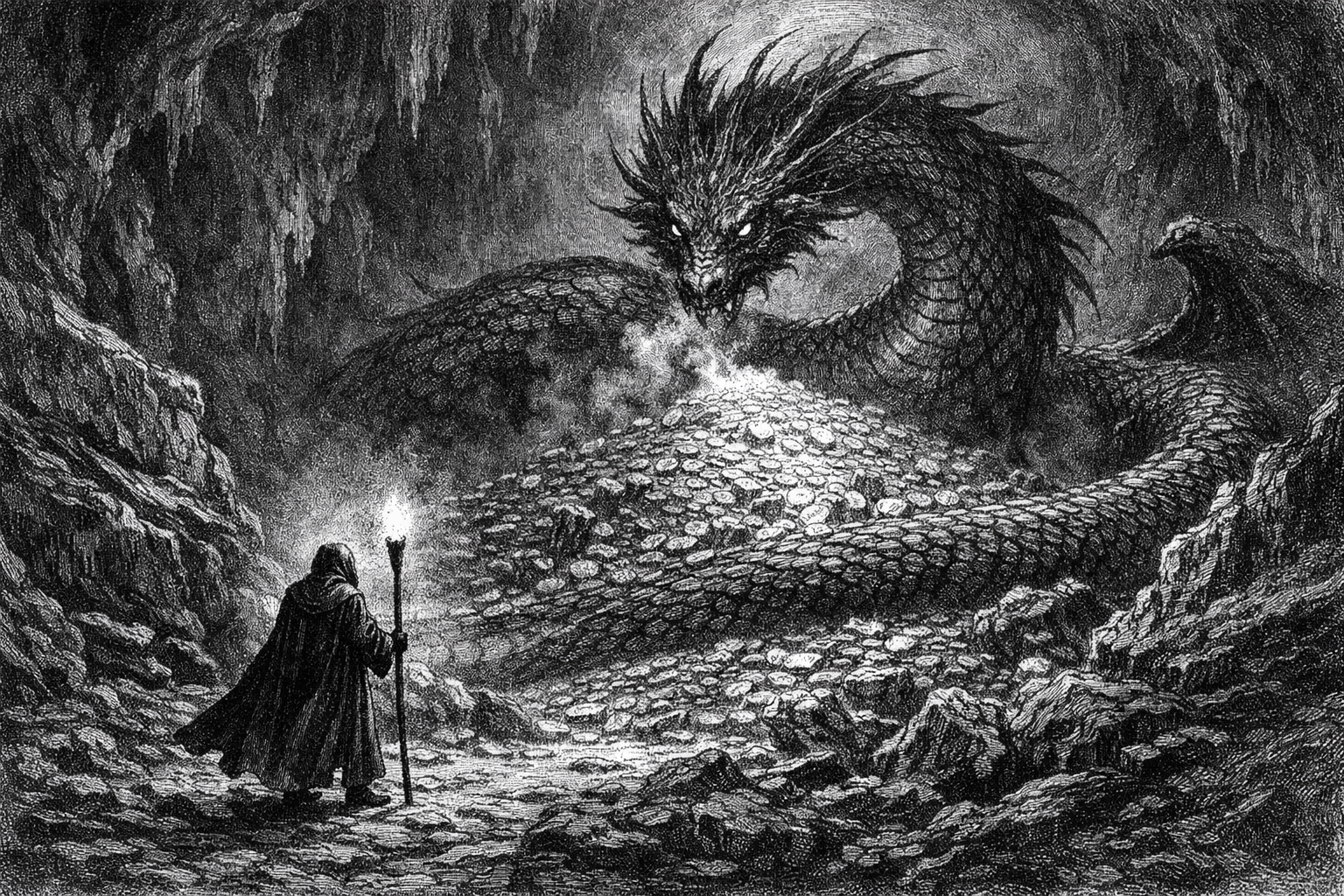
I was reading Jung the other day, and this phrase caught my attention: The unconscious as dragon and treasure. Five words that contain, if you sit with them long enough, the entire architecture of inner transformation. Not a theory. Not a clinical framework, but a map drawn in mythic language that tells you something essential about the terrain you will cross if you ever decide to do the real work on yourself.
Podcast version:
To think of the unconscious as both dragon and treasure is to recognise that the very thing that frightens you, disrupts you, and destabilises you is often guarding something essential. The dragon is the fear, the resistance, the chaos, and the parts of yourself you would rather not face. The treasure is the life energy, the vitality, the truth, the creativity, and the wholeness locked up behind that fear. In Jungian terms, the unconscious is not just a basement of repressed junk. It is also a buried kingdom. It contains wounds, yes. But it also contains unrealised gold.
That single image reframes everything we think we know about what it means to go inward.
The Dragon at the Threshold
Here is why inner work feels paradoxical. You go looking for clarity and instead meet confusion. You go looking for peace and first encounter conflict. You try to become more fully yourself and immediately run into the parts of yourself you have spent years avoiding. The dragon appears at the threshold. Not because you are doing something wrong, but because you are getting close to something valuable.
In myth, the dragon almost always guards a hoard. A princess, a sacred spring, a hidden chamber, and some precious object that the hero needs but cannot simply take. The dragon has to be faced first. Psychologically, that image holds with extraordinary precision. The dragon is not random. It is a guardian figure. It stands over what the conscious ego has not yet earned the right to possess.
That might be your buried anger, which, when integrated, becomes strength and self-protection. It might be your grief, which becomes depth and tenderness. It might be your unlived creativity, your desire, your authority, your instinct, your capacity to say no, your capacity to love without performing love, your ability to live from a deeper centre rather than from the surface.
The dragon marks the border between the self you have constructed and the self that is waiting.
And the critical thing to understand is that the dragon is not a sign that something has gone wrong. It is a sign that something is trying to go right. The resistance, the fear, the visceral pull to turn back: these are not evidence that you should stop. They are evidence that you are approaching the place where the gold is buried. Every tradition that has taken the inner life seriously knows this. The cave you fear to enter holds the treasure you seek. Joseph Campbell said it. Jung mapped it. And anyone who has ever done genuine work on themselves has lived it.
The Dragon Is Not the Problem
A lot of people meet the dragon and think the dragon is the problem. That is too shallow a reading. The dragon is terrifying, but it is also meaningful. It is an image of psychic intensity. It marks the place where your life has become knotted. Where there is a dragon, there is usually what Jung called a complex: a charged cluster of emotion, memory, fear, and fantasy that has gathered mass beneath the surface.
This is why certain situations provoke reactions far bigger than the moment itself. A casual comment from a colleague that sends you spiralling. A silence from a partner that feels like abandonment. A small failure that triggers a disproportionate shame response. You are no longer dealing with the present. You have wandered into the dragon’s territory. The complex has been activated, and the emotional charge stored in that knot floods the moment with meaning it cannot bear on its own.
The treasure, then, is not some neat reward handed over for good behaviour. It is the deeper value trapped inside the knot. The person who fears conflict may discover, beneath that fear, a lost capacity for sovereignty. The right to take up space, to hold a boundary, to say what is true even when it is uncomfortable. The person who avoids intimacy may find, beneath the dragon of vulnerability, the treasure of real relatedness: the ability to be known rather than merely admired. The person who compulsively performs a pleasing persona may discover that what has been guarded is not just pain but a more authentic face, a truer way of being in the world.
In NLP terms, this is the deep structure beneath the surface structure. The presenting problem, the trigger, and the emotional reaction: that is the surface. The story running beneath it, the belief that has been installed and never examined, and the identity that was formed in response to conditions that no longer apply: that is where the real material lives. And it is precisely there, in the place you least want to look, that the transformation is waiting.
Persona, Mask, and What Gets Buried
This is where the dragon connects to one of Jung’s most practical concepts: the persona. The social face. The adaptation. The role you learned to wear in order to belong, survive, succeed, or be loved. The persona is useful. Necessary, even. Sometimes elegant. We all wear masks, and there is nothing inherently wrong with that. The problems begin when the mask hardens into identity. When you forget that the persona is something you are wearing and begin to believe it is something you are.
When a persona calcifies like that, it becomes a gatekeeper. It keeps the deeper psyche out of view, not just from others but from you. You become over-identified with the mask. And what gets buried behind that mask does not disappear. It drops into the unconscious, where it gathers force. The dragon forms precisely around what the persona cannot allow.
If your persona is “the good one,” then the unconscious starts storing your anger. If your persona is “the competent one,” then your vulnerability gets locked away. If you are “the strong one,” your grief goes underground. If you are “the easygoing one,” your ambition, your edge, your capacity for fierce directness, all of it gets pushed below the surface. Over time, those disowned elements become dragon-like. They seem dangerous. They carry a charge that feels threatening. But what they threaten is not your true self. What they threaten is your overmanaged identity. The construct. The performance. The too-small version of yourself that you have mistaken for the whole.
I see this constantly in coaching. Someone arrives presenting one problem, and beneath it is a persona that has been running the show for decades. The stories they tell themselves about who they are and who they must be have become invisible. They cannot see the mask because they have been wearing it so long it feels like skin. The work is not to rip it off. The work is to help them see it, to recognise that the mask is not the face, and that what has been stored behind it is not a threat. It is an invitation.
The Deeper Invitation
The dragon is often defending you from a too-small life.
That sentence is worth sitting with. Because most people assume the dragon is defending them from something terrible. From pain, from chaos, from falling apart. And in a sense it is. But what it is really defending is the boundary of the life you have built so far. The identity you have assembled. The story you have told yourself about what is safe, what is possible, and what you are allowed to want, to feel, and to become. The dragon guards that boundary. And on the other side of it is not destruction. On the other side is expansion.
This is where Jung becomes less moralistic and more initiatory. The goal is not to kill the dragon in the simplistic heroic sense. That is the Hollywood version. The real mythic pattern is more interesting than that. In many old stories, the hero does not merely slay the beast. He enters its cave. He survives its fire. He takes back what was lost. And he emerges changed. Not triumphant in the chest-beating sense. Transformed. Different from who he was when he went in.
That is a much better image for what Jung called individuation. Not self-improvement in the shallow sense: better habits, better productivity, a more optimised version of the same limited self. But descent, encounter, and return. The willingness to go into the cave, to face what is there, and to let the encounter change you. The unconscious confronts you with the cost of becoming whole. And the cost is always the same: you have to give up the too-small story.
This is where depth psychology and NLP converge in my practice. NLP understood, from the beginning, that it is the stories we tell ourselves that set the tone for everything. Our behaviour, our perceptions, and our habits of thinking, believing, and feeling. Those scripts can be rewritten. Jung goes further and says that some of those scripts are not just limiting beliefs sitting at the surface waiting to be swapped out. Some of them are guarded by dragons. Some of them are buried deep enough that you have to go down to get them. And the going-down is not a technique. It is an initiation.
Reclaiming the Energy
There is a practical dimension to all of this that is worth naming. Jung used the word libido not in the Freudian sexual sense but to mean psychic energy. Life force. Vitality. And his observation was this: whatever is repressed does not just sit there inert. It holds energy. A dragon coils around psychic energy that has been bound up in defence, shame, fear, or refusal. The unconscious is not a dead archive. It is a living system, and the material stored there is charged.
This is why people who begin genuine inner work, whether through shadow work, dream work, active imagination, depth coaching, or therapy, often report feeling more alive. More creative. More present. More magnetic, even. It is not because they have learned a new skill or adopted a new mindset. It is because they have started reclaiming the treasure. Energy that was trapped in symptoms, in anxiety, in people-pleasing, in numbness, and in repetitive patterns that never quite resolved starts to come back online.
I have watched this happen in coaching sessions. Someone faces the thing they have been avoiding, names the story that has been running them, and within weeks there is a shift that goes beyond the specific issue. They are more energised. More creative. More willing to take risks. It is not a miracle. It is physics, of a kind. Energy that was bound up in maintaining the dragon’s vigil gets released when the dragon is finally faced. The gold was always there. It was just inaccessible.
The Treasure Is Rarely What You Expected
Here is the final twist, and it is the one that keeps the work honest. The treasure is rarely what the ego expected to find.
You go down thinking you are looking for confidence and find sorrow. You go looking for your purpose and find rage. You reach for peace and find the grief you never let yourself feel. The conscious mind has a plan. It wants clarity, resolution, and a neat package it can take back to the surface and use. But the unconscious does not work on the ego’s schedule. It gives you what you need, not what you asked for.
And yet, once that buried thing is welcomed, metabolised, and given language or image or expression, it often changes form. The sorrow becomes depth. The rage becomes sovereignty. The grief becomes the capacity for genuine tenderness. The dragon was guarding the doorway, not the end of the story. What felt monstrous on the threshold reveals itself, once faced, as something generative. Something that was trying to come through all along.
This is what makes the image of a dragon and treasure so much more useful than the clinical language of “addressing your issues” or “working through your blocks.” Those phrases flatten the experience into something manageable and therapeutic. They are not wrong, exactly, but they miss the scale of what is actually happening. When you face the dragon, you are not solving a problem. You are entering a story. And the story has its own logic, its own timing, and its own intelligence.
So when Jungian thought points toward the unconscious as dragon and treasure, it is offering a map of transformation. What disturbs you most deeply may be connected to what is most deeply yours. Your fear may be a signpost. Your avoidance may indicate buried gold. The symptoms, the fantasies, the dreams, the recurring patterns, the strange charges and resistances of your life may all be saying the same thing: here. Here. Dig here.
The treasure is not elsewhere. It is hidden in the place you have been taught not to enter.
And that, to me, is one of Jung’s great gifts. He does not reduce the inner life to pathology. He treats it as mythic terrain. The dragon is real, but so is the gold. The cave is dark, but it is also a place of initiation. What waits in the unconscious is not simply what has wounded you. It may also be what wants to renew you.
Want to go deeper?
