You finish a conversation and realise the other person learned nothing about you. They spoke, you listened, and somewhere along the way your role became clear: hold the space, ask the follow-up question, keep the exchange moving. Later, you replay the conversation and wonder whether they were uninterested or simply unaware.
Claire Lester describes the questions that might have changed the encounter:
How are you, really?
What was that like for you?
Did that land badly?
Are you happy?
Each question asks someone to pause long enough to acknowledge that another person has an interior life. I agree with her that such questions are rare. I also think their absence can become too easy to interpret.
Questions reveal curiosity, but they are not the only form curiosity takes.
Some people ask directly. Others leave a door open and wait for you to walk through it. Some offer practical help. Some sit beside you without knowing how to name what they sense. Some grew up in families where asking personal questions felt intrusive, so they learned to express care through food, errands, lifts to the station, or the quiet repetition of showing up.
None of those gestures replaces a needed conversation. Still, if we treat questions as the primary evidence of love, we may overlook the dialects in which other people learned to care.
Then there is the question the essay left me asking:
Why am I waiting for permission to tell you who I am?
The Secret Test
Many of us conduct a private test inside our relationships.
We mention that work has been difficult. We say we haven’t slept well. We refer to the hospital appointment, the argument, the strange heaviness that has followed us through the week. Then we wait.
Will they ask?
If they do, we feel seen. If they change the subject, something closes.
The other person seldom knows a test is taking place. They may think we have told them everything we want to tell. They may worry that a follow-up question would feel intrusive. They may hear the invitation and lack the courage to accept it. They may simply be distracted.
Meanwhile, we interpret their silence as information about our value to them.
I understand why we do this. An unprompted disclosure feels risky. Being asked gives us cover. We can tell ourselves that we are answering rather than imposing. The question absolves us of the fear that our inner life might be too heavy, too complicated, or too much.
But waiting also hands responsibility for our visibility to someone who cannot read our mind.
Sometimes the honest response to “How are you?” is not “Fine, unless you ask me again with sufficient sincerity.”
Sometimes it is: “I know that’s usually a greeting, but I’m not doing well.”
That sentence carries its own risk. It also gives the relationship a chance to become real.
Curiosity Needs Reciprocity
The final scene in Lester’s essay contains the tension that interests me most.
She calls her friend back. She asks the deeper version of the question and discovers a whole hidden life: a declining father, repeated drives to Hexham, a painful conflict with a brother. Her irritation gives way to compassion.
Her friend still asks her nothing.
Lester notices, but it matters less.
There is generosity in that response. Understanding another person often loosens the stories we have built around their behaviour. Marcus Aurelius returned to this practice because he knew how quickly we turn someone’s limitations into a personal insult. Once we glimpse the fear, grief, habit, or exhaustion behind an action, resentment can lose some of its grip.
Yet understanding can become a trap when one person does all of it.
If I continually explain why you cannot meet me, I may become highly compassionate while disappearing from the relationship. Your history explains your lack of curiosity. Your workload explains your absence. Your wounds explain why every conversation returns to you. All of those explanations may be true. I still have to live inside the relationship they create.
Stoic practice asks us to examine our judgements. It does not require us to pretend that every arrangement is nourishing.
Compassion and discernment belong together.
A friendship can survive seasons of imbalance. Illness, grief, parenthood and crisis rearrange what each person can give. Trouble begins when the season becomes the structure and nobody names it.
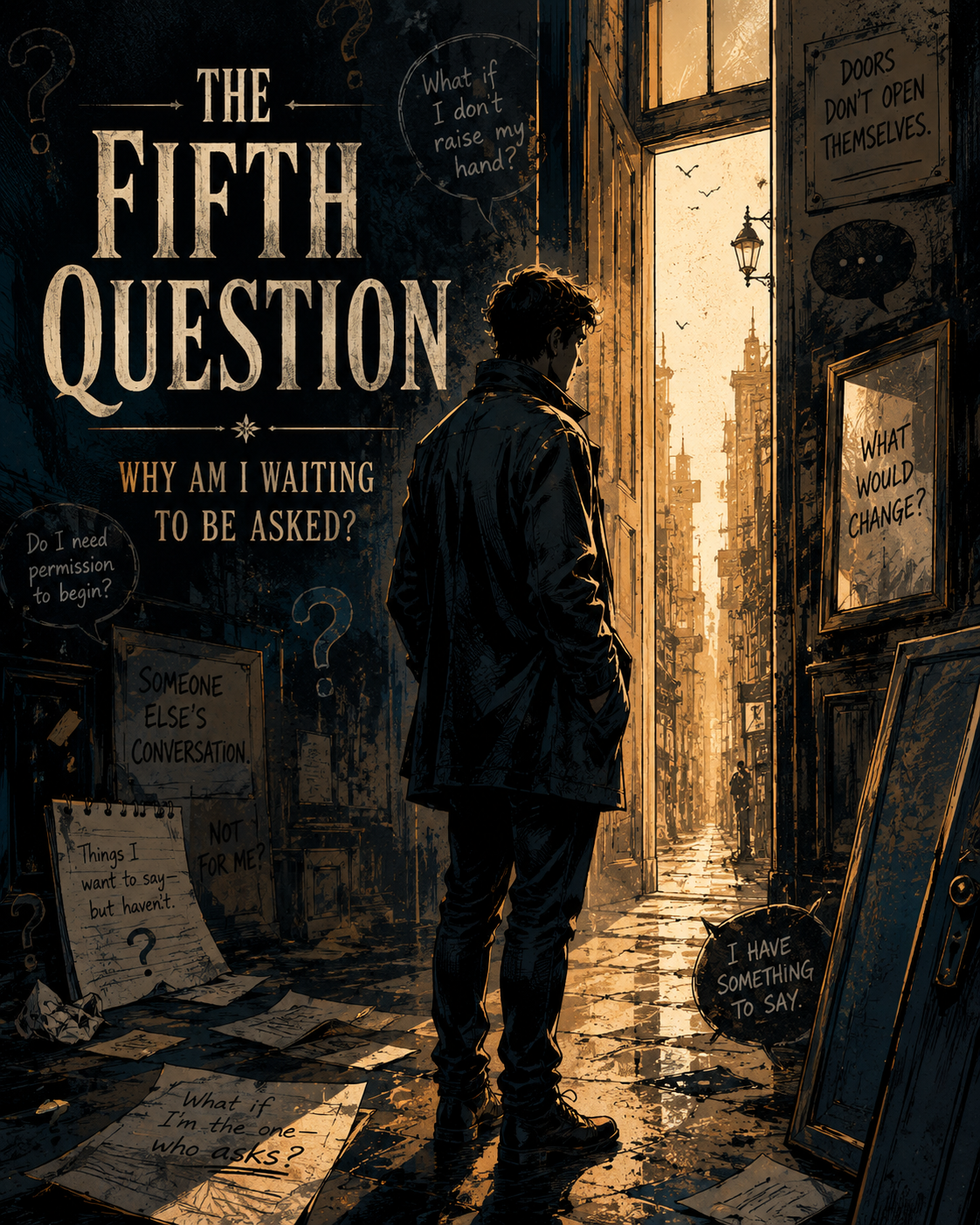
The Fifth Question
Perhaps we need a fifth question:
Is there room for me in this relationship?
That question does not ask whether the other person is good or bad. It asks what happens between us.
Can I speak without waiting for an invitation?
When I speak, do you stay with me?
Can I tell you that something landed badly without managing your reaction?
Do we know one another, or have we settled into the roles of speaker and witness?
Can I ask for more without turning the request into an accusation?
These questions move us away from counting conversational turns as though intimacy were an accounting exercise. They also prevent generosity from becoming self-erasure.
A person may love us and lack the ability to ask what we need them to ask. We can teach them something about how to reach us. We can say, “When I mention my father, ask me how I’m coping.” We can say, “I need you to check in after difficult conversations.” We can say, “I’ve realised I know much more about your life than you know about mine.”
That conversation may feel less magical than being understood without explanation. It may also build a stronger relationship because both people can participate in it consciously.
Asking and Telling
Lester is right that we should ask better questions.
Ask the second version of “How are you?” Stay through the pause. Ask what the experience felt like, not only what happened. Check when the atmosphere changes. Risk discovering that someone you love has become unhappy.
Then take the other risk.
Answer the first question honestly. Tell the story beneath the facts. Name the bruise before it hardens into distance. Let someone know that you need their attention rather than waiting to see whether they offer it unaided.
There will still be people who do not turn toward us. A direct answer may expose their limits more clearly than any secret test could. That knowledge can hurt, but at least we will know which relationship we are standing in.
We cannot build intimacy through questions alone. Someone must also decide to answer before the perfect question arrives.
If this post gave you something to carry into your day, consider supporting my work by buying me a coffee or making a monthly donation or subscribing (free) to the blog.