I’m sure one of the worst nightmares for …


I’m sure one of the worst nightmares for any parent is your child going missing.

I was out on my morning Wisdom Walk today and noticed an unusual number of people in the fields where I usually walk. There are often dog walkers about, but this felt different.

At one point, I saw a woman looking into an old cowshed. I thought maybe she was a photographer trying to catch the shed in the morning light. But then she came toward me and explained that she was searching for a young girl who had gone missing. No one had seen or heard from her since about 5 PM yesterday. According to her cousin, who posted the callout to the community on our local news group on Facebook, the girl has no mobile phone or money.

Suddenly, I felt the dread that all those people out searching must have been carrying.

I checked the Facebook group to get more details and to see what the girl looked like so I could keep an eye out for her as I completed my circuit around the fields.

If you felt that same dread as I was telling this story, you can relax now too. The young girl has been found. There are no details yet, but it appears she is unharmed..

The walk is the encounter

I walked to the gym this morning.

That sounds too ordinary to announce, which is probably why it matters. The gym is only seven minutes away by car. My normal routine is to get in, drive there, work out, drive back, eat something, shower, and be behind the desk by nine like a good citizen of the industrial clock. That’s the sensible move.

The 9-to-5 clock still lives in me. I can feel it. Even now, self-employed, answering to no manager hovering over my shoulder, I can still feel the old tribunal warming itself up somewhere behind my eyes. By nine o’clock, it says, you should be at the machine. You should look available. You should look as if work has started.

But I’d been reading about mythogeography, and the book had me thinking about walking as a way of meeting the world before the day hardens into tasks — the walk itself as the encounter, rather than fitness content, rather than a lifestyle hack with a ring closing at the end of it.

There’s something funny buried in that distinction. For most of human history people walked because they had to. To the next village, the field, the market, the church, the pub, and the place of work. Then the factories arrived, and the whistle, and the shift, and the mass-produced automobile, and life needed standardising to keep the machines running on time. Once walking stopped being necessary, it became romantic. It became leisure. It became something we schedule and recover with, on purpose, because the rest of the day has been arranged to make it unnecessary.

This morning I could feel that little historical joke in my legs.

The efficient version of the morning wanted the car. The wiser version, or at least the version I decided to listen to, wanted the path. So I walked.

A half hour there. An hour’s workout. A half hour back. Two hours, against one hour and fourteen minutes if I’d driven. On paper that’s a bad trade. I spent close to an extra fifty minutes doing what the car could have done in a fraction of the time. But the paper is using the wrong measure. The point was never to get my body from house to gym at maximum efficiency. The point was to be present in the morning instead of managing it, watch-checked and task-shaped, on the way to somewhere else.

I noticed, walking, how quickly my mind wanted to turn inward. I had the recorder going, talking through my thoughts as I went, which is useful and also slightly comic — there I was, trying to practise noticing, while mostly noticing the inside of my own head. The trees were there. The dogs were there. The pavement, the people saying good morning, and the small choreography of an ordinary street going about its business whether or not anyone pays attention to it. And I was “being productive” by running three things at once instead of looking at any of it properly. Something else for me to work on.

The bigger thing I was circling is this: work doesn’t have to happen in front of the screen that’s become the little altar where work proves it exists. The walk wasn’t a delay before the real work started. The walk was part of it. I forget that constantly, paying fealty to the desk as the one legitimate site of thinking when some thoughts flatly refuse to arrive there. Some thoughts need breath. They need footfall, a hedge, a stranger passing at the exact moment a sentence was about to form.

Everything becomes source material out there. Not in the hungry content-machine sense, where every living thing gets stripped for parts and fed into a content calendar. In the older, stranger, more generous sense. The world offers fragments. The walker gathers them. The blogger lays them next to each other and listens for the hum between them.

That’s what mythogeography and remix culture and old-school blogging all seem to share, now that I’m circling it directly. You wander. You collect. You juxtapose without rushing to judge what you’ve picked up. You let the field itself decide what kind of thing wants to come out of it — a walk, a note, a post, a question, a half-formed practice you’ll only recognise as a practice once you’ve done it three or four more times.

What if walking to the gym isn’t inefficient? What if it’s one of the ways I keep finding my way back to the actual ground of the work, rather than the desk that only pretends to be it?

The car would have got me there faster. The walk brought more of me with it.

Episode #422: Why My Blog Is Still My Home on the Internet

In this episode, I take the Soulcruzer podcast out of the studio and into the fields.

What starts as an experiment in mobile podcasting/vlogging turns into a wandering meditation on labels, blogging, AI, morning rituals, and the strange abundance of media tools we now carry in our pockets.

Show notes:

 Why I still think of myself as a blogger first
– Podcasting, vodcasting, and the pressure to become “multimodal”
– The problem with labels: “When you label me, you negate me”
– soulcruzer.com as the central hub/home on the internet
Wisdom Walks as thinking time
– Walking, motion, and changing perspective
– The “barefoot philosopher” approach to everyday philosophy
– AI as an extension of cognition rather than just a productivity tool
– The “soft cyborg” and the library of Alexandria in your pocket
– Morning reality tunnels and the sacred space before breakfast
– Coffee, barefoot grounding, and choosing what enters your mind first
– Indie blogging, platforms, Substack, distribution, and the open web
– Why these episodes may stay loose, minimally edited, and stream-of-consciousness

Listen on Spotify or Apple Podcast.

The answer I got back from the question …

The answer I got back from the question I carried this morning…


Tuesday. Early morning walk. The question I carried out with me was this:

What is already true in me that I’ve been pretending I don’t know?

The answer came fast. That’s how you know it’s the real one. You ask and the thing just stands up.

I’m not a niche-down person.

I’ve known this for years. And I keep learning it again, which means I haven’t quite accepted it yet. The Narrative Alchemy pivot was the latest version of the same story: find the through-line, package it, make it easy for people to classify. There’s a real idea underneath Narrative Alchemy. I believe in it. But when I turned the whole blog toward it, something happened that I should have caught earlier. I got bored. Not mildly bored. Bored in that way where the writing goes hollow because the person writing it has quietly left the room.

I was posting because I was supposed to be posting.

You can always tell. The blog knows the difference and apparently so does the traffic, eventually.


Michael Moorcock‘s first novel is called The Golden Barge. A man leaves his village to chase it. He glimpses it on the river, something in him recognises it, he drops everything. And the whole of his life becomes the pursuit. Every time he draws close, the barge rounds a bend and disappears. He keeps going. More adventures, more distance from where he started, always the barge ahead of him, just out of reach.

The fact that this novel has surfaced again — the title itself, not just the metaphor — feels like something worth noting. Not coincidence exactly. More like the kind of thing that happens when you’re paying the right quality of attention.

I’ve thought about that image for years. This morning I walked with it again.

Narrative Alchemy was the latest bend. I came close enough to almost touch it. I could see the gilding on the hull. And then it went around the corner, as it does. As it always does.

The strange thing is I don’t feel defeated by that. I feel something more like recognition. Like the barge is doing exactly what it’s supposed to do.


The question beneath the question is always: what function am I actually here to perform?

I’ve been a warrior. West Point, the Army, the whole formation in that tradition. That chapter is done. I came out of it and moved into the healer work — coaching, mindset, and helping people with their inner landscape. That was real, that mattered. But underneath both of those there has always been something else. Something I’ve given less oxygen.

The shaman.

Not as a label. I’m wary of the labels right now; the cards said so this morning, and I feel it. But as a description of a function: part healer, part explorer, part storyteller, and part magician. Someone who wanders. Who is always in between villages, carrying stories from one place to the next, arriving somewhere and people making way because they want to hear what’s been seen out there in the world. Some want a story. Some want something more. In exchange, a meal. A place to sleep. And then gone again.

I’ve been domesticated. Robert Anton Wilson’s phrase: the domesticated primate. I became one and didn’t fully notice. Or noticed and didn’t do anything about it.

The shaman doesn’t stay in one village long enough to build a personal brand.


There’s a war going on online about AI and I’ve been caught in it sideways.

You can see the sides forming from a long way off. On one side: the people who are in it, building with it, finding what’s possible. On the other hand, the people who have the pitchforks out, who call it slop, who unfollow when they catch you using it. Underneath both positions is the same existential anxiety, expressed differently.

I find myself softening my enthusiasm when I can see the pitchfork crowd gathering. Which is a bad habit. Because honestly, I think AI is the closest thing to the Library of Alexandria I’m ever going to touch. I grew up living in libraries. That was always the dream. And now the library fits in a conversation window and knows which shelf to start on. That’s not nothing.

But I also don’t want to be a missionary for it. I just want to use it. The way I use my phone. Without a manifesto.

What I’m trying to get clear on is the difference between using a tool and playing a platform’s game. They look the same from the outside, but they feel completely different from the inside. When I was optimising Narrative Alchemy content for the algorithm, I was playing the game. When I’m on a wisdom walk and the thing that happens to capture it best is a voice note that goes through Claude, that’s just the atelier working.

Document, don’t perform. There’s the line.


The cards pulled the Queen of Cups this morning. Re-listen. Reawaken. Not: plan more, build the system, write the manifesto and post it on a Tuesday. Just listen.

So that is the instruction for now. Not silence. Not inaction. But a particular quality of attention. The pathfinder doesn’t plan the path from the kitchen table. He walks.

I’ve been spending too much energy on the architecture. WordPress, Typefully, the IndieWeb connectors, and the workflow that syndicates the thing to the right places. That’s all real, and I’ll figure it out. But the error is when the system becomes the thing you’re working on instead of the thing you’re working through.

Stop optimising the net. Get in the water.

The philosopher is back at the root. Everything else — writer, teacher, healer, magician — is still there, still running. They know what they’re doing. But the root function is clear again, clearer than it’s been in a while.

What is already true in me that I’ve been pretending I don’t know?

This. This is.
Wisdom Walk: What Do You Do When You’ve Done Everything?

Saturday afternoon, passing the polo grounds

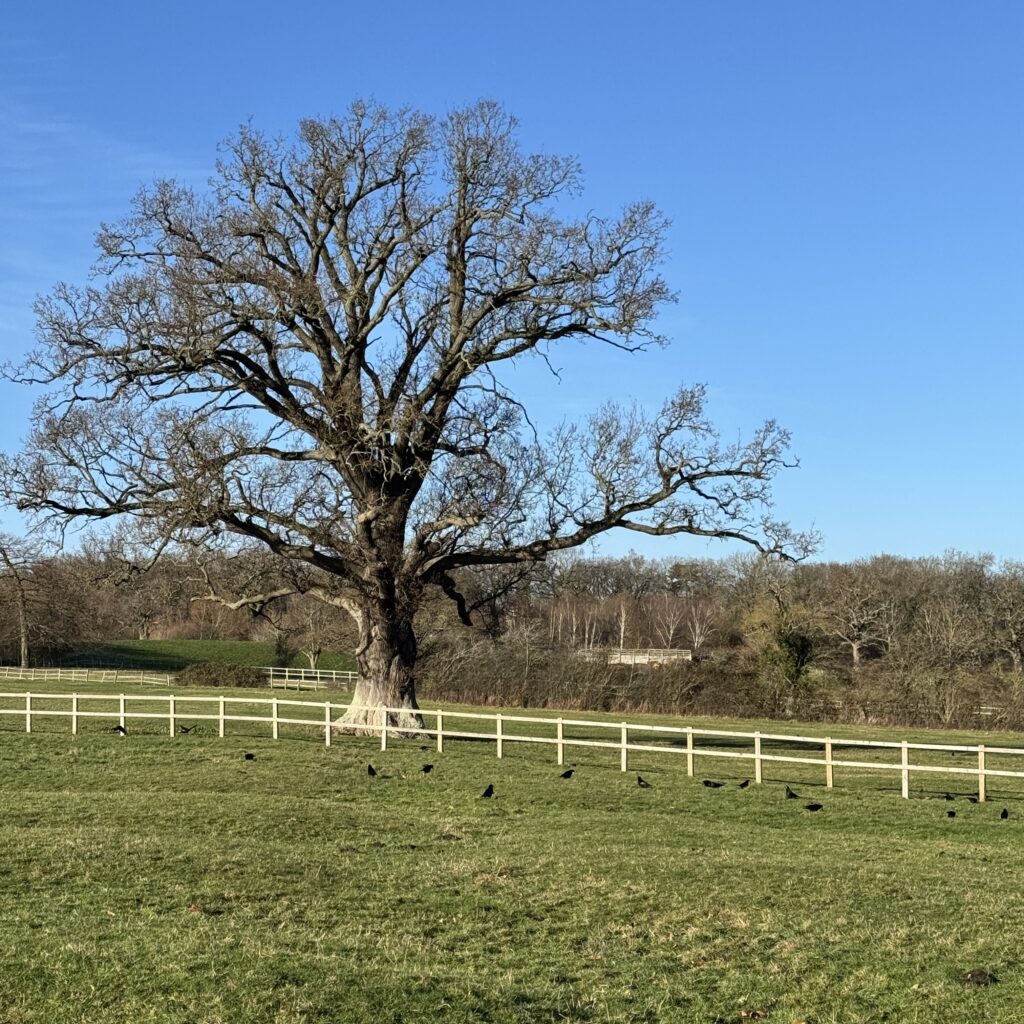
Out on today’s walk, I came across a field full of ravens (or rooks, I can never quite tell without a close-up). Hundreds of them, clustered around my favorite tree. These birds have always felt significant to me, in fact, at one point, they were my spirit animal. I love encountering them out in the wild at some random moment that insignificantly significant.

I was out unpacking my reflections from my morning quiet time. A simple question: what to do with a Saturday?

Odd that such a simple question spiraled into a philosophical reflection on the passage of time and more importantly, how I spend my time.

The Archaeology of Saturdays

Single. Days belonged to randomness then. Friends and impulse and whatever came next.

**

Marriage without children: a curatorial phase. Museums as weekend ritual. Art galleries. New cities mapped by their cultural coordinates. Restaurants collected like stamps.

**

Then: children.

The weekend stopped being mine. Became theirs. Prams pushed through parks. Playgrounds. Play groups. Days structured around their wonder, their growth, their needs. I was infrastructure now. The one who built the world they explored.

**

Later, when they needed me less: I remembered myself.

The sports hippie returning. Mountain bike tires on dirt trails. Rock face under fingertips. Paddle cutting water. Adventure races that pushed the body past what it thought possible.

North Face. Salomon. Leather bracelets. Granola eating… Every stereotype, fully inhabited. Not ironically. Earnestly.

**

Then Radio Warwickshire shifted everything again.

Weekends became sonic. Live music in small venues. Community events across Warwickshire. Interviewing unsigned bands. Photographing the indie scene. Connected to artists, to sound, to the underground pulse of things.

**

Each phase: a different Saturday.
Each Saturday: a different self.

The Slump

And then… a dead period.

I remember asking on a podcast: “What do you do when you’ve done everything?”

Not literally everything, of course. But when you’ve climbed mountains before, when you’ve been to museums, when you’ve experienced the activities that once excited you, and the novelty fades. Yes, it’s a different mountain, a different painting, but the act is the same.

I hit that wall. The sameness of it all.

(Pausing here at a seasonal creek turned river by recent rain and snow. Someone’s built a dodgy crossing. Kid-me would have leaped across without thinking. Approaching-60-me is putting the phone in a dry bag first.)

Act Three Eyes

Maybe the answer isn’t finding completely new things. Maybe it’s revisiting old passions with new eyes.

A scaled-down sports hippie revival. More mountain biking. Wisdom walks in different locations (even if it means driving to the trailhead rather than rolling out my front door).

But now I’m experiencing these things through Act Three eyes. As a 57-year-old grandfather in the final act.

You know what Act Three is in movies, right? The climax has happened. You’re sliding toward the conclusion. UK male life expectancy: 82-84. I’m 57. Do the math.

So what do I focus on in Act Three?

I wrote about this recently on the blog. I need to revisit it myself as I orient toward 2026.

But first, I’m going to attempt this makeshift creek crossing.

Wish me luck.

P.S.
Easy peasy, lemon squeasey, made it across, no problem

Do the thing

Sunday evening. The rain has passed; the clouds linger. I’m out on a wisdom walk letting my feet meet the earth and my thoughts catch up with my breath.

The day began scattered. Too many moving parts: the sale of the old truck and the logistics of the new one—registrations, license plates, and tax. My house, in a state of lived-in chaos, mirrored my mind. Inner clutter. Outer clutter. Echoes of each other.

When I’m in that state, one thing that helps me is getting physical. Doing something with my body gives my mind a break from itself. So I turned to the shed. It needed sorting, and I needed centring. By midday, we were in a rhythm. Lifting, moving, organising. A kind of shed-zen. It brought me back into my body, and with it came a clearer mind.

Now I’m walking and reflecting. I didn’t want to end the day sitting. Movement sharpens insight. This is something I’ve been returning to all week: the connection between walking and thinking. Between motion and meaning.

This week’s theme has been philosophy as a way of life. Pierre Hadot has been my guide, reminding me that philosophy isn’t meant to be confined to the lecture hall. It’s meant to be walked, spoken, and lived. Rebecca Solnit’s Wanderlust added fuel to the fire, tracing the long lineage of thinkers who took their thoughts on foot. From Socrates to Rousseau, Nietzsche to Thoreau. Philosophy has often worn out the soles of its shoes.

For me, this is it. Reading, reflecting, walking, writing, talking, and sharing. That’s the core of my game. Everything else can orbit that.

The insight that lands tonight is simple. Do the thing. Don’t just think about it. Don’t just map it endlessly. Embody it.

Walk the walk. Talk the talk. Play my game. Let the rest go.

As the Stoics remind us, what others think, say, or do is none of our business. Our business is what lies within our control. What lies within my control is showing up fully, soulfully, and doing the work that calls me.

So here I am. Out walking beneath a soft sky. Speaking my reflections into the air.

This is the practice. This is the way.

Soundtrack

sleeping beneath the stars: thoreau, simplicity & the sacred ordinary

It’s not exactly Walden Woods, but this morning I find myself in what Southam has to offer in the way of a small pocket of trees I’ve come to call the Southam Woods. It’s here I’ve paused, mid-walk, to speak into the rhythm of the morning. I stop and catch a moment to let my breath sync with the birdsong.

Last night, I slept under the stars. No tent, no fanfare. Just a sleeping bag, the summer heat still lingering in the air (29 degrees, which is amazing for the UK), and the wide-open sky above me. There’s no air conditioning in most UK homes anyway, so I figured, why not go full elemental?

It was beautiful. Quiet. Honest. The kind of sleep that feels like a return to our primal essence.

This morning, perhaps carried by the residue of starlight or the earthy simplicity of it all, Walden came to mind—Henry David Thoreau’s ode to deliberate living. As I wandered into these local woods, his voice echoed through my mind, and I found myself revisiting a few truths I’ve carried from that little cabin in Concord.

1. Be Alive to Where You Are

Thoreau reminds us—most men live lives of quiet desperation. Not because they lack things, but because they lack presence. We’re often asleep in the midst of our own lives, always longing to be somewhere other than where we are.

What if we didn’t need to escape? What if the field before us—the street, the kitchen, the woods—was already enough? This morning walk reminds me that aliveness doesn’t require a plane ticket or a major life change. Sometimes it just asks for attention.

2. The Things You Own End Up Owning You

I remember reading Thoreau’s reflections on simplicity and feeling the taste of truth in his words. We build lives filled with objects, and then we spend those lives maintaining them. Cleaning them. Upgrading them. Guarding them. We work to buy, then we buy to reward our work. The cycle turns.

None of this is inherently wrong. It’s just that, somewhere along the way, ownership turns into bondage. As I lay staring up into the sky last night, all I needed was the ground and the sky. The less we carry, the more room we have to be alive and free.

So, the question returns: what owns you?

3. Nature as Antidote to Consumer Madness

In a world engineered to sell us more of what we don’t need, returning to the natural world feels quietly rebellious. Sleeping under the stars isn’t just romantic—it’s radical. It says, I have everything I need right here.

Nature doesn’t charge subscription fees. She doesn’t ask us to optimise, improve, or hustle. She just is, and she invites us to do the same. Maybe that’s why Thoreau withdrew to Walden in the first place. Not to escape life, but to remember how to live it.

4. Make the Ordinary Extraordinary

Thoreau teaches us to find the extraordinary in the ordinary. A leaf, a ripple in the pond, or a cat licking its paw with care are not lesser things. They are sacred.

And here I am, walking through a small wood flanked by the drone of traffic and the occasional roar of a passing jet. Even here, the invitation remains: listen. There’s the chatter of birds, the hum of a wasp nearby, and the low percussive thrum of machines. It’s all music, if we let it be.

Presence is not the absence of noise but the attention we bring to whatever is happening.

5. Mindfulness Isn’t a Practice Hall—It’s a Way of Being

Lately, I’ve been deepening my mindfulness practice, not by sitting cross-legged in a quiet room, but by walking like this. Breathing like this. Washing the dishes. Typing notes. Drinking my morning coffee.

You don’t need to go somewhere to be present. You just need to stop long enough to hear what your life is saying to you. Not what your goals say. Not what your schedule demands. But what your life, your breath, your body, and your being are whispering.

This, too, is Thoreau’s teaching: that awakening isn’t a moment; it’s a mindset. And that mindset begins with paying attention.


So wherever this finds you, morning or evening, in traffic or solitude, I hope it offers a gentle nudge toward presence. I hope it reminds you that the sacred is never far away. Sometimes it’s just beneath your feet. Or above your head. Or tucked between two breaths you’ve forgotten to notice.

As for me, I’ll keep walking. I will continue to listen to the wind, the planes, and the birds. Practising the art of being right here.

And you?

Where are your Walden Woods today?

Walking the Long Game

a Wisdom Walk Contemplation

This morning, I walked with the Strategist.

Not the schemer. Not the manipulator. But the quiet sentinel of foresight and focus—he with arms crossed like twin roads diverging, pipe clenched between thoughtful lips, eyes scanning the board beyond the board.

He came to me not with answers, but with questions. The kind that stick in your chest and stir up old dust. The kind you don’t rush. You walk with them.

And so I did.

I walked the narrow path behind the studio, past the budding hawthorn and the mud-slick bend where the water gathers. I listened to the rhythm of my boots and breath, and I heard the Strategist speak—not in commands, but in challenges:

“This is what you asked for. Now get to it. Make it happen.”

It wasn’t stern. It was clear.

I’ve been circling this threshold for weeks now—tugged between the noise of the digital souk and the signal of the soul-work I know I’m here to do. The webzine is calling. The deep work—the essays, the zines, the prompts, the transmissions—they’re all there, waiting to be built like cairns on the mythic trail.

But still, I’ve lingered. Distracted by the mirage of movement that social media offers. It feels like momentum, but it’s mostly churn. Easy to confuse activity with progress. The Strategist sees through that illusion.

He doesn’t move for the sake of moving. He waits. He watches. And when he acts—he acts with precision.

So today, I listened. And now, I pass the lantern to you.

If you find yourself walking with the Strategist—perhaps in the quiet hour between tasks, or in the murmur of your morning coffee—see what arises when you ask yourself the following:

Wisdom Walk Prompts | In the Company of the Strategist

1. Where am I placing my attention out of habit, and where could I position it with intention?
What rituals, patterns, or digital distractions have I inherited without reflection? What would it look like to move my attention like a chess piece—not out of reaction, but with mythic foresight?

2. What is the larger narrative arc of my work or life—and how does what I’m doing today serve that unfolding myth?
Is the task before me an echo of my true story, or a detour dressed as productivity? How do the pieces of my creative life fit into a larger soul-map?

3. What tools, stories, or signals do I want to leave behind—for future travellers who may one day follow this path?
What am I building not just for now, but for legacy? What will outlast the scroll, the likes, the fleeting noise?

The Strategist archetype isn’t cold or calculating. He’s soulful. He teaches us to align our effort with our essence. To see through the clutter and move with meaning. To remember that we’re not just playing the game—we’re shaping the story beneath it.

So take a walk. Listen to the rhythm of your steps. And if you feel the presence of the Strategist, don’t run. Don’t rush. Just ask the right questions—and trust that the next move will reveal itself when you’re ready to make it.

The Leap Between Moments

wisdom walk contemplation

At the peak of the trapeze act, in that heartbeat between letting go and being caught, everything is on the line.

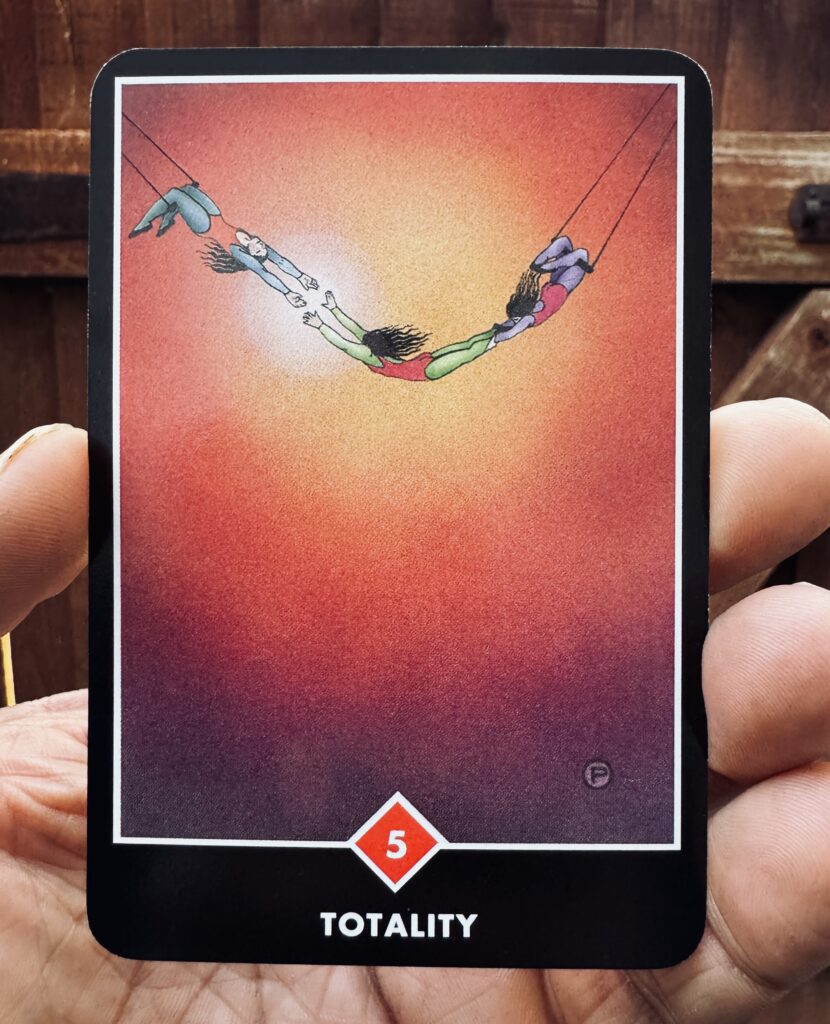
The card Totality captures that split-second moment suspended in trust, focus, and surrender. Three acrobats are mid-air, held not by certainty but by presence—each giving their all, knowing that hesitation would break the arc, and the fall would be inevitable. This is not a card of half-measures. It speaks to the luminous edge where mastery meets vulnerability, where control dissolves into flow.

In the mythic imagination, Totality is the realm of the Fool mid-leap, the moment before Icarus knows if he’ll soar or burn, the point in the story when the hero must commit, heart and bone, to the quest. No more testing the water. No more holding the rope with one hand. You are either in, or you are not.

To live in totality is to offer yourself completely to the moment—not recklessly, but wholeheartedly. It is not about perfection; it is about presence. The leap only works if you’re all in—mind, body, spirit, and will aligned like a tuned bowstring, aimed at the sacred now.

We spend much of life on the edge of that platform—delaying the jump, running rehearsals in our minds, waiting for the perfect conditions. But Totality doesn’t ask for your plan. It asks for your presence. Your Yes. Your sacred risk.

So I ask you, fellow storythinker:

  1. Where in your life are you still clinging to the swing instead of leaping toward what calls you?
    (What have you been hesitating to say Yes to?)
  2. What would it mean to give yourself fully to this moment, this work, this relationship, without holding anything back?
    (What would Totality look like in your current threshold?)
  3. What are you afraid will happen if you let go of control and surrender to full participation?
    (And what might happen if you don’t?)

Let these questions hang in the air like a moment of flight. Don’t rush the answers. Let them arise like wind through the silence. And when you’re ready—leap.