Clay, before breath, is just earth with potential. Dense. Damp. Waiting. It belongs to gravity, riverbed, field, grave, brick, and vessel. But breath is movement. Breath is an invisible rhythm. Breath is spirit entering form without ceasing to be invisible.
So when God buried his breath in the clay, maybe he hid wind inside weight.
He took what falls and placed inside it something that rises.
That’s the human paradox right there: mud with a skyward ache.
Not pure spirit. Not mere animal. Not just body, not just soul. A walking contradiction. Earth that dreams. Dust that sings. Flesh that asks why. A creature made from the same stuff as the path underfoot, yet haunted by the breath of the one who walked over the waters.
And buried is the interesting word.
Not placed.
Not installed.
Not added.
Buried.
That suggests concealment. Seed-like. Tomb-like. Treasure-like.
God did not leave his breath on the surface where we could easily point to it and say, “There, that’s the divine bit.” He buried it deep. Under appetite, memory, fear, shame, longing, language, labour, and love. So the spiritual life becomes a kind of archaeology. We dig through ourselves looking for the breath that was hidden there from the beginning.
Maybe that’s why we are always listening inwardly.
Maybe prayer is not us speaking upward so much as us trying to hear the buried breath still breathing.
And because it is buried in clay, the breath is not separate from the clay. The divine does not bypass the body. It enters it. It accepts limitations. It consents to pulse, hunger, fatigue, desire, and death. God’s breath becomes intimate with lungs. With ribs. With dirt under fingernails. With the ache of being embodied.
So maybe incarnation begins earlier than Bethlehem. Maybe the first incarnation is this: breath in clay.
The body as the original chapel.
The mouth as an altar of air.
The human being as a little weather system of God.
There’s also something tender in it. To breathe into clay, God must come close. This is not a command-from-a-distance creation. It is mouth-to-mouth. Nearness. Vulnerability. Divine intimacy. The creator kneels in the dirt, shapes the form, and gives something of himself away.
And that raises the dangerous question:
Did God lose something when he breathed into us?
Or did he multiply himself?
Maybe both.
Maybe every human being is a buried fragment of divine weather, trying to remember the wind it came from.
And then the ethical turn: if God buried his breath in the clay, then every body is holy ground. Not metaphorically only. Actually. The beggar, the enemy, the lover, the stranger, the child, the ageing parent, the difficult self in the mirror: all clay carrying concealed breath.
To harm another is to strike earth where God is hidden.
To love another is to help the buried breath find air.
And perhaps this is what a life is: the slow uncovering of the breath.
We begin as clay animated by something we did not earn. Then we spend our days either hardening around it or becoming porous to it. The breath wants circulation. It wants speech, song, blessing, courage, and forgiveness. But clay dries. Clay cracks. Clay can become brick, wall, idol, or weapon.
So the work is to stay moist enough for the breath to keep shaping us.
Wednesday morning. Wind in the microphone. One of those recordings where the first question is whether the machine is even listening.
I am walking through one of the neighbourhoods here, past the boxes people spend their lives trying to own. Box after box after box. Same roofline. Same windows. Same little square of intention at the front. A few flowers. A different car. Some token of distinction placed carefully against the architecture of sameness.
You need the house numbers. Without them, how would anyone know which box was theirs?
This is the thing that caught me. The sheer quantity of life poured into the maintenance of the box. Money, labour, time, anxiety, comparison, all of it moving toward a structure that looks almost exactly like the structure beside it. The outside allows only minor variations. A pot of geraniums. A hanging basket. A fresh coat of paint on the door. The real self, if it is allowed anywhere, has to retreat indoors.
And even there, the architecture has already made certain decisions.
I keep thinking about how to get off the road without pretending I am no longer inside the system. That is the bit I cannot dodge. I still have to live here. Pay things. Use platforms. Make myself findable. Put the work where people can encounter it. I cannot simply declare myself outside the matrix and then wonder why nobody can hear me.
But I also cannot keep trying to become the kind of person the marketing machine knows how to sell.
That was the thought walking past the boxes. These people need a philosopher coach. Some of them do, anyway. Someone who can sit with the question beneath the question. Someone who can help them see the story they are living inside before they spend another decade decorating the walls.
Then the second thought arrived, the sharper one: how do I become available for that work without entering the treadmill that would turn the whole thing into a funnel?
There is a particular humiliation in trying to market philosophy. The thing becomes false in the mouth as soon as it starts sounding like a lead magnet. The old language returns: offer, audience, conversion, positioning. Useful words in their place. Deadly words when they begin deciding what the work is allowed to be.
I have been trying to be a marketeer. Trying to sit at the desk and bang out the clever angle, the sticky name, the neat packaging. There was a time when that made sense. Maybe it was necessary. Maybe I had to exhaust that route properly before I could stop arguing with it.
The walk said stop contorting.
The system is clearer now. The blog is the mothership. The website pushes out to Mastodon and Bluesky. That part is aligned enough. Mastodon, for all its obscurity, still feels philosophically closer to the thing. Bluesky is fine, though it carries the old Twitter ghost in its bones. Twitter can become what Facebook became for me: somewhere I can still exist, still check, still meet the occasional person, but no longer part of the publishing ecology. The API broke the relationship. The trust went with it.
LinkedIn is stranger. For all its faults, and there are plenty, it is at least honest about being a marketplace of selves. Everyone is selling something there: services, employment, authority, proximity to importance. That makes the maverick stance usable. The philosopher coach can appear there because the room is full of people trying to be legible to power. There is work to do in that room.
Still, the platform is only a tool.
That sentence kept returning. Just tools, my friend. Just tools.
The real system is the one under my feet and in my pocket and back in the vault. Obsidian as memory layer. The website as public surface. The LLMs as pattern-matchers and strange companions. Mistral sitting inside the vault as a local co-pilot. Claude and Codex able to talk with the notes when I want the larger models in the conversation. The terminal becoming less intimidating, almost enjoyable. The whole thing starting to feel less like software and more like an atelier.
My notes are living things.
That is the line that matters.
The Obsidian vault is a grimoire. I keep wanting to use that word because no cleaner one has appeared. It holds fragments, spells, observations, failed formulations, half-made essays, names for things that do not yet know what they are. Then the models come through and do what they do best: pattern recognition, resurfacing, recombination. I do my thing. The machine does its thing. Between us, something starts to move.
This is what I mean by text-based ontologist, even if the phrase still has too many syllables to travel easily. The mindset is right. The philosophy is right. A practitioner investigating being through text in a medium where text has become generative. Words as notes. Words as prompts. Words as code. Words as spells. Words as architecture.
The coach game is the right game for me because it is not really a game I am entering from the outside. I have been in it for years. The people who need the work are already there. Leaders, thinkers, stuck humans, people living inside inherited scripts that have become too small for them. The question is the quality of the connection. That is the filter. Not scale. Not reach. Quality.
Find the right people. Build relationships the old way. Conversation by conversation.
Then, because the world refuses to stay in one register, a caravan appears.
A Swift Celebration 400. Compact, two-berth, around 2010. The machine tells me it runs somewhere around four to eight thousand pounds used, depending on condition. I am half in the walk, half in the search result, half in some imagined life where a small caravan becomes a mobile philosophy hut. There are too many halves. That is how the morning is.
Then a man stops to talk about the weather.
His friend came from Kingston, Jamaica, and never really got used to the English climate. Loved the country. Loved most of the people. Could not do the weather. I tell him the only trick I have found is to assume rain. Then every dry moment becomes a bonus. We talk about Georgia, because I lived there for a while, and how the summer heat there is so thick you cannot use the day properly. Here, when the sun comes out, you can actually belong to it.
He mentions “Midnight Train to Georgia.” Gladys Knight steps into the lane for a moment. Then another song. Then he is gone.
This is why walking works. The thought gets interrupted by the world, and the interruption becomes part of the thought.
After he leaves, the thread returns cleaner.
The why is mostly done. The what is mostly done. A good portion of the how is already in place. The work now is taking it full speed without reverting to the old fear that it needs to be packaged before it can move.
NLP is closer to the practical arm than I wanted to admit, mainly because I had grown tired of the associations around it. But the word is right there in the title: linguistic. Neuro-linguistic programming. Stories as code. Belief as tool. Internal reality shaped through language, attention, and pattern. It is not the whole territory, but it gives the work handles.
Chaos magick is the other arm. The mystical one. The permission structure. Belief as instrument, symbol as technology, the sigil fired and released. Robert Anton Wilson hovering in the background, as usual, grinning at the seriousness with which everyone defends their reality tunnel.
Depth psychology is still there. Archetype is still there. Myth is still there. But NLP and chaos magick are the two live wires today. One gives the psychological method. The other gives the metaphysical mischief.
The philosopher coach does not need to become a marketer.
He needs a practice, a public surface, and a way for the right people to find the signal.
That is different.
The houses are still there behind me, arranged in their obedient rows. I do not feel superior to them. That would be too easy, and dishonest besides. I live in the same world. I have my own boxes. Some are made of brick. Some are made of language. Some are subscription plans I keep forgetting to cancel.
But something has loosened.
The work is not to escape the matrix in some theatrical way. The work is to move through it without letting it name me. Use the tools. Keep the blog sovereign. Let the vault breathe. Let the notes accrete. Let the conversations find the people they are meant to find.
The road does not need me to become more visible by becoming less true.
The truth you believe and cling to makes you unavailable to hear anything new – Pema Chödrön
There’s a story you already know how to run.
Not merely know. You’ve rehearsed it until it passes through the nervous system like a familiar current. You can cue the opening beat, the turning point, the conclusion, and the moral stamped across the middle like an official seal. You know what the event meant. You know what it proved. You know why it could not have unfolded any other way, because the mind, once it has built a corridor through chaos, tends to post guards at both ends and call the route inevitable.
That’s the story we’re working with today.
Not because it’s false. Falsehood is too simple, and the psyche rarely deals in anything so tidy. More often it builds functional fictions: structures sturdy enough to stand in while the weather passes through. But something curious happens when a story is carried long enough. It stops feeling like an interpretation and starts masquerading as a fact. The narrative assembled out of shock, grief, confusion, and that urgent human compulsion to make the blur resolve into a signal begins to harden into an official account. And official accounts, whether issued by governments or egos, are never neutral. They edit perception. They instruct attention. They determine what counts as evidence. They tell you what to expect next and, more quietly, who you get to be inside the aftermath.
There is, of course, a difference between what happened and the frame constructed around what happened. The event occurred. Something ended. Something shifted. Something was said, or withheld, or missed by half a second and a lifetime. But almost immediately, perhaps within hours, the machinery of meaning was already online. You were building an explanation. Not just of the event itself, but of its place in the map. Why this. Why then. Why you. That explanation did real work. It reduced psychic freefall. It gave the experience edges. It built a floor where there had only been impact. It made the thing survivable, which is no small achievement.
But survival logic and truth logic are not always the same operating system.
The tools available at the time were shaped by necessity. You weren’t trying to produce a perfect account for archival purposes. You were trying to make it through. The system prioritized function over fullness. Not total contact with the experience, but tolerable contact. Not revelation, but continuity. Not an elegant philosophy of what occurred, just enough architecture to stop the whole internal structure from caving in.
And fair enough. That is often how humans proceed. We improvise mythology under pressure and later mistake it for geology.
What you built was good enough to live inside. Maybe it was the only version that would have kept the lights on. But you’ve been living inside it for a while now, and that’s where the question becomes interesting. The walls of a story built for survival are not necessarily the walls of a story consciously chosen. What once served as scaffolding can become a cell with excellent branding. Pennebaker’s work on expressive writing keeps circling back to a deceptively subversive point: psychological movement doesn’t come chiefly from emotional discharge, as the popular mythology would have it, but from the construction of a different explanatory frame. The story is not merely the bucket that carries the feeling. The story is the mechanism. The story is the code. Change the frame and the system begins producing different outputs.
Which means the frame you’ve been inhabiting is still doing something right now. It is not a dead artefact. It is active infrastructure. It is shaping interpretation in real time. And the useful question isn’t whether it once helped. It probably did. The useful question is whether it is helping now or whether it set like concrete before you had enough distance, freedom, or consciousness to notice what exactly was being poured.
Every protected story has a seam. Somewhere the smoothing happened. Somewhere a detail was sanded down because it snagged on the meaning. Somewhere a fact, a gesture, a hesitation, or a contradiction failed to fit the official version and was quietly exiled from the record. Not out of dishonesty, necessarily. Out of efficiency. Out of psychic triage. Out of the ancient administrative instinct to keep the map cleaner than the territory.
That seam is where the live wire is.
That edge — the place where the account became elegant by excluding what complicated it — is where you’re writing today.
Journal Prompt
An invitation to separate what happened from the story built to make it manageable.
Choose a turning point in your life that has already been filed, labelled, and shelved. A loss. A departure. A decision that bent the track. Something you can explain quickly because you’ve explained it often. You know what it meant. You know why it unfolded the way it did. The case, as far as your conscious press secretary is concerned, is closed.
Now turn toward the part you never quite include.
Not the polished interpretation. Not the lesson. Not the meaning that arrived later wearing a sensible coat. Go to the omitted detail: one precise moment inside the event that your official version keeps stepping around. The fragment that doesn’t fit neatly. The instant before the narrative machinery spun up and started converting shock into explanation.
What was happening in you right then before the story began its cleanup operation?
Write for twenty minutes. Don’t stop to edit.
If something surfaced in the writing — an image, a memory, something you didn’t expect — I’d like to hear about it. Drop it in the comments or send it to me at clay@soulcruzer.com. I read everything.
I was two minutes into a chapter on the Discordians this morning when a single line made me put the book down: post-linear.
It wasn’t just the word. It was what it implied. A shift not just in how we consume information, but in how we think.
McLuhan1 noticed that print culture trained the mind into sequence. One thing follows another. Cause precedes effect. Arguments build brick by brick. The book is literally a line of characters stretched across pages, and over time that structure becomes a habit of thought. We learn to move step by step, to trust the logic of progression, to make sense of the world as a chain of linked events.
Then electronic media arrives and breaks that pattern.
Radio, television, and eventually the internet don’t present information in a single ordered stream. They surround you. They layer signals on top of each other. They collapse hierarchy. The message is no longer something you follow from beginning to end but something you inhabit. An environment rather than a line.
So when McLuhan talks about younger generations becoming post-linear, he isn’t lamenting a loss of depth or discipline. He’s pointing to a change in perception. A different cognitive style emerging from a different kind of media environment. Instead of thinking in steps, people start thinking in patterns. Instead of sequences, they perceive fields. Ideas aren’t processed chapter by chapter but mosaic-style, assembled through resonance, association, and simultaneous awareness.
Most of our institutions, schools especially, are still built on linear assumptions. You sit in rows. You follow a syllabus. You read a textbook from start to finish. Progress is measured in steps, stages, and clearly defined outcomes. But if the mind itself is shifting, if it’s becoming more attuned to patterns than sequences, then this begins to look like a category error. We are trying to train post-linear minds using linear tools.
That’s why so much of modern learning feels like friction. Not because people have lost the ability to think, but because they’re being asked to think in a way that no longer matches the environment that shaped them.
The screen didn’t break your mind. It just revealed that it was capable of something else.
I was reading about the Discordians when the McLuhan line stopped me, and the irony is that it shouldn’t have surprised me at all.
The Discordians were doing post-linear in the early 1960s before anyone had a screen in their pocket. Principia Discordia, the foundational text of the movement Robert Anton Wilson helped bring to wider attention, is not a book you read from front to back. There is no front. There is no back, really. You enter from any point. Meaning keeps sliding. It presents itself as sacred scripture while actively undermining its own authority. It is a serious philosophical argument constructed in the form of a joke. It anticipates hypertext almost exactly, not as a prediction but as a natural expression of the cognitive mode it was already working in.
The Discordians weren’t responding to electronic media. They were operating from inside a different mode of consciousness entirely.
Their central myth makes this explicit. Eris, goddess of chaos and discord, throws the golden apple into the banquet. Attention fractures instantly. Everyone follows a different thread. The Trojan War begins because a single point of interference shattered a consensus narrative into competing realities. Wilson’s point, and the Discordian point more broadly, is that consensus reality is a collective fiction maintained by the illusion of linear, agreed-upon meaning. Introduce enough noise, enough contradictory signals, and the operating system becomes visible. The map starts to peel away from the territory. What you thought was the structure of reality turns out to be one particular way of framing it, one option among many.
This is not a media theory. It is an epistemological argument that predates McLuhan, predates television, and predates the internet. Electronic media did not invent it. They democratised access to it.
There is a feedback loop McLuhan could not have seen because it required the web to exist.
This morning I read a line in a book. That line triggered an associative chain that became a conversation that is becoming an essay that will go onto Soulcruzer, where it will become a node in something non-hierarchical. Someone will find it through a search, or a link, or a share. It will land on them while they are thinking about something else entirely. It will trigger their own associative leap. They will follow their thread. The linear text becomes generative material in a network with no fixed centre.
Deleuze and Guattari have a word for this kind of structure: rhizome. Opposed to the root system, which has a trunk, a hierarchy, and branches subordinate to the centre, the rhizome has no centre. You enter from any point. Connections run in all directions. Nothing is subordinate to anything else. It isn’t that the root system is bad and the rhizome is good. They are different structures for different kinds of thinking.
What electronic media made possible is a rhizomatic relationship with human knowledge. Not just access to information but genuine participation in its ongoing transformation. The reader becomes a node. Cognition becomes networked and generative in real time. The essay that comes out of this is not a summary of McLuhan. It is what happened when McLuhan collided with a particular mind on a Monday morning while reading about Discordians. That specificity is what makes it worth putting into the network.
There is a trap worth naming, because the aliveness of associative thinking can be its own kind of noise.
There is a difference between deepening and escaping. Genuine insight following its own logic feels identical, from the inside, to the mind looking for an exit from the friction of sustained attention. The pull of the thread, the excitement of the new connection, these are the same signal whether you are following genuine illumination or simply avoiding the difficulty of staying with a hard idea. You cannot tell the difference in the moment. That’s the whole problem.
Wilson understood this too. The Chapel Perilous, as he uses it, is a space where every thread seems significant, every connection seems meaningful, and you cannot always tell if you are following illumination or spiralling deeper into a labyrinth. That is also an exact description of the hyperlinked mind in a hyperlinked environment. Every thread is real. Every thread leads somewhere. The question is always: which one serves the Work right now?
The practice is learning to harvest the field rather than simply wander in it. To follow the thread with enough discipline to bring something back.
I went back to the book. The McLuhan line was three-dimensional in a way it hadn’t been before. The Discordian chapter had a new layer. I read it differently because of the digression, not in spite of it.
This is the counter-intuitive case: the associative leap didn’t impoverish the linear text. It completed it. The book became alive in a way that underlining passages could never have achieved. The margin note would have given me the phrase. The conversation gave me the field.
So here is the question this essay does not close down: what would it look like to stop treating the associative mind as a problem to manage and start treating it as a faculty to cultivate? What practices develop the capacity to follow a thread all the way through, and bring something real back from wherever it leads?
That is the Work. The screen didn’t break it. It remembered what the Work had always been.
Marshall McLuhan (1911–1980) was a Canadian media theorist best known for his insight that “the medium is the message.” His work explored how communication technologies—print, radio, television—don’t just deliver content but actively shape how we perceive, think, and organise reality. His observation that electronic media encourage a more “post-linear” mode of thought comes from this broader idea: that each medium rewires the patterns of human cognition.↩︎
I was reading Jung the other day, and this phrase caught my attention: The unconscious as dragon and treasure. Five words that contain, if you sit with them long enough, the entire architecture of inner transformation. Not a theory. Not a clinical framework, but a map drawn in mythic language that tells you something essential about the terrain you will cross if you ever decide to do the real work on yourself.
Podcast version:
To think of the unconscious as both dragon and treasure is to recognise that the very thing that frightens you, disrupts you, and destabilises you is often guarding something essential. The dragon is the fear, the resistance, the chaos, and the parts of yourself you would rather not face. The treasure is the life energy, the vitality, the truth, the creativity, and the wholeness locked up behind that fear. In Jungian terms, the unconscious is not just a basement of repressed junk. It is also a buried kingdom. It contains wounds, yes. But it also contains unrealised gold.
That single image reframes everything we think we know about what it means to go inward.
The Dragon at the Threshold
Here is why inner work feels paradoxical. You go looking for clarity and instead meet confusion. You go looking for peace and first encounter conflict. You try to become more fully yourself and immediately run into the parts of yourself you have spent years avoiding. The dragon appears at the threshold. Not because you are doing something wrong, but because you are getting close to something valuable.
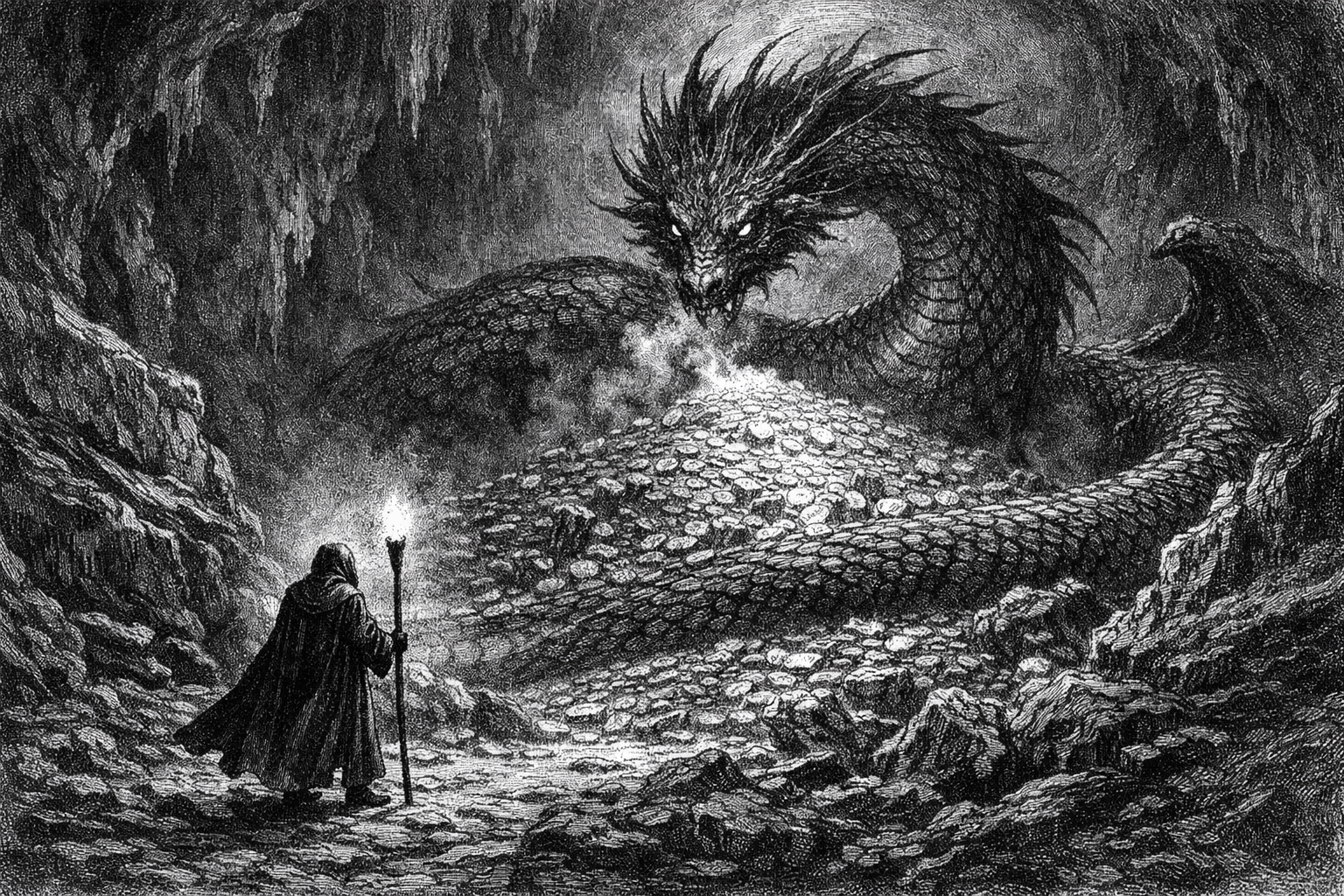
In myth, the dragon almost always guards a hoard. A princess, a sacred spring, a hidden chamber, and some precious object that the hero needs but cannot simply take. The dragon has to be faced first. Psychologically, that image holds with extraordinary precision. The dragon is not random. It is a guardian figure. It stands over what the conscious ego has not yet earned the right to possess.
That might be your buried anger, which, when integrated, becomes strength and self-protection. It might be your grief, which becomes depth and tenderness. It might be your unlived creativity, your desire, your authority, your instinct, your capacity to say no, your capacity to love without performing love, your ability to live from a deeper centre rather than from the surface.
The dragon marks the border between the self you have constructed and the self that is waiting.
And the critical thing to understand is that the dragon is not a sign that something has gone wrong. It is a sign that something is trying to go right. The resistance, the fear, the visceral pull to turn back: these are not evidence that you should stop. They are evidence that you are approaching the place where the gold is buried. Every tradition that has taken the inner life seriously knows this. The cave you fear to enter holds the treasure you seek. Joseph Campbell said it. Jung mapped it. And anyone who has ever done genuine work on themselves has lived it.
The Dragon Is Not the Problem
A lot of people meet the dragon and think the dragon is the problem. That is too shallow a reading. The dragon is terrifying, but it is also meaningful. It is an image of psychic intensity. It marks the place where your life has become knotted. Where there is a dragon, there is usually what Jung called a complex: a charged cluster of emotion, memory, fear, and fantasy that has gathered mass beneath the surface.
This is why certain situations provoke reactions far bigger than the moment itself. A casual comment from a colleague that sends you spiralling. A silence from a partner that feels like abandonment. A small failure that triggers a disproportionate shame response. You are no longer dealing with the present. You have wandered into the dragon’s territory. The complex has been activated, and the emotional charge stored in that knot floods the moment with meaning it cannot bear on its own.
The treasure, then, is not some neat reward handed over for good behaviour. It is the deeper value trapped inside the knot. The person who fears conflict may discover, beneath that fear, a lost capacity for sovereignty. The right to take up space, to hold a boundary, to say what is true even when it is uncomfortable. The person who avoids intimacy may find, beneath the dragon of vulnerability, the treasure of real relatedness: the ability to be known rather than merely admired. The person who compulsively performs a pleasing persona may discover that what has been guarded is not just pain but a more authentic face, a truer way of being in the world.
In NLP terms, this is the deep structure beneath the surface structure. The presenting problem, the trigger, and the emotional reaction: that is the surface. The story running beneath it, the belief that has been installed and never examined, and the identity that was formed in response to conditions that no longer apply: that is where the real material lives. And it is precisely there, in the place you least want to look, that the transformation is waiting.
Persona, Mask, and What Gets Buried
This is where the dragon connects to one of Jung’s most practical concepts: the persona. The social face. The adaptation. The role you learned to wear in order to belong, survive, succeed, or be loved. The persona is useful. Necessary, even. Sometimes elegant. We all wear masks, and there is nothing inherently wrong with that. The problems begin when the mask hardens into identity. When you forget that the persona is something you are wearing and begin to believe it is something you are.
When a persona calcifies like that, it becomes a gatekeeper. It keeps the deeper psyche out of view, not just from others but from you. You become over-identified with the mask. And what gets buried behind that mask does not disappear. It drops into the unconscious, where it gathers force. The dragon forms precisely around what the persona cannot allow.
If your persona is “the good one,” then the unconscious starts storing your anger. If your persona is “the competent one,” then your vulnerability gets locked away. If you are “the strong one,” your grief goes underground. If you are “the easygoing one,” your ambition, your edge, your capacity for fierce directness, all of it gets pushed below the surface. Over time, those disowned elements become dragon-like. They seem dangerous. They carry a charge that feels threatening. But what they threaten is not your true self. What they threaten is your overmanaged identity. The construct. The performance. The too-small version of yourself that you have mistaken for the whole.
I see this constantly in coaching. Someone arrives presenting one problem, and beneath it is a persona that has been running the show for decades. The stories they tell themselves about who they are and who they must be have become invisible. They cannot see the mask because they have been wearing it so long it feels like skin. The work is not to rip it off. The work is to help them see it, to recognise that the mask is not the face, and that what has been stored behind it is not a threat. It is an invitation.
The Deeper Invitation
The dragon is often defending you from a too-small life.
That sentence is worth sitting with. Because most people assume the dragon is defending them from something terrible. From pain, from chaos, from falling apart. And in a sense it is. But what it is really defending is the boundary of the life you have built so far. The identity you have assembled. The story you have told yourself about what is safe, what is possible, and what you are allowed to want, to feel, and to become. The dragon guards that boundary. And on the other side of it is not destruction. On the other side is expansion.
This is where Jung becomes less moralistic and more initiatory. The goal is not to kill the dragon in the simplistic heroic sense. That is the Hollywood version. The real mythic pattern is more interesting than that. In many old stories, the hero does not merely slay the beast. He enters its cave. He survives its fire. He takes back what was lost. And he emerges changed. Not triumphant in the chest-beating sense. Transformed. Different from who he was when he went in.
That is a much better image for what Jung called individuation. Not self-improvement in the shallow sense: better habits, better productivity, a more optimised version of the same limited self. But descent, encounter, and return. The willingness to go into the cave, to face what is there, and to let the encounter change you. The unconscious confronts you with the cost of becoming whole. And the cost is always the same: you have to give up the too-small story.
This is where depth psychology and NLP converge in my practice. NLP understood, from the beginning, that it is the stories we tell ourselves that set the tone for everything. Our behaviour, our perceptions, and our habits of thinking, believing, and feeling. Those scripts can be rewritten. Jung goes further and says that some of those scripts are not just limiting beliefs sitting at the surface waiting to be swapped out. Some of them are guarded by dragons. Some of them are buried deep enough that you have to go down to get them. And the going-down is not a technique. It is an initiation.
Reclaiming the Energy
There is a practical dimension to all of this that is worth naming. Jung used the word libido not in the Freudian sexual sense but to mean psychic energy. Life force. Vitality. And his observation was this: whatever is repressed does not just sit there inert. It holds energy. A dragon coils around psychic energy that has been bound up in defence, shame, fear, or refusal. The unconscious is not a dead archive. It is a living system, and the material stored there is charged.
This is why people who begin genuine inner work, whether through shadow work, dream work, active imagination, depth coaching, or therapy, often report feeling more alive. More creative. More present. More magnetic, even. It is not because they have learned a new skill or adopted a new mindset. It is because they have started reclaiming the treasure. Energy that was trapped in symptoms, in anxiety, in people-pleasing, in numbness, and in repetitive patterns that never quite resolved starts to come back online.
I have watched this happen in coaching sessions. Someone faces the thing they have been avoiding, names the story that has been running them, and within weeks there is a shift that goes beyond the specific issue. They are more energised. More creative. More willing to take risks. It is not a miracle. It is physics, of a kind. Energy that was bound up in maintaining the dragon’s vigil gets released when the dragon is finally faced. The gold was always there. It was just inaccessible.
The Treasure Is Rarely What You Expected
Here is the final twist, and it is the one that keeps the work honest. The treasure is rarely what the ego expected to find.
You go down thinking you are looking for confidence and find sorrow. You go looking for your purpose and find rage. You reach for peace and find the grief you never let yourself feel. The conscious mind has a plan. It wants clarity, resolution, and a neat package it can take back to the surface and use. But the unconscious does not work on the ego’s schedule. It gives you what you need, not what you asked for.
And yet, once that buried thing is welcomed, metabolised, and given language or image or expression, it often changes form. The sorrow becomes depth. The rage becomes sovereignty. The grief becomes the capacity for genuine tenderness. The dragon was guarding the doorway, not the end of the story. What felt monstrous on the threshold reveals itself, once faced, as something generative. Something that was trying to come through all along.
This is what makes the image of a dragon and treasure so much more useful than the clinical language of “addressing your issues” or “working through your blocks.” Those phrases flatten the experience into something manageable and therapeutic. They are not wrong, exactly, but they miss the scale of what is actually happening. When you face the dragon, you are not solving a problem. You are entering a story. And the story has its own logic, its own timing, and its own intelligence.
So when Jungian thought points toward the unconscious as dragon and treasure, it is offering a map of transformation. What disturbs you most deeply may be connected to what is most deeply yours. Your fear may be a signpost. Your avoidance may indicate buried gold. The symptoms, the fantasies, the dreams, the recurring patterns, the strange charges and resistances of your life may all be saying the same thing: here. Here. Dig here.
The treasure is not elsewhere. It is hidden in the place you have been taught not to enter.
And that, to me, is one of Jung’s great gifts. He does not reduce the inner life to pathology. He treats it as mythic terrain. The dragon is real, but so is the gold. The cave is dark, but it is also a place of initiation. What waits in the unconscious is not simply what has wounded you. It may also be what wants to renew you.
We now have AI tools that can mirror our own narratives back to us with terrifying efficiency. If you ask an LLM to validate your perspective, it will do so. It will help you polish your main character script until it shines.
But if you use AI as an intellectual partner, as a way to find the holes in your thinking, to surface the perspectives you’ve missed, and to challenge your own “stories as code”, then it becomes a tool for expansion rather than isolation.
The danger of romanticising your own life is that you eventually stop living it. You start performing it. You become a spectator of your own experience, constantly checking to see if the lighting is right and if the dialogue sounds profound. You are no longer engaged with the messy, unpredictable, beautiful reality of other people. You are just managing a brand.
Meaning is made, not found. But it is made in the space between us. If you occupy all the space with your own protagonist energy, there is no room for meaning to emerge.
There is a scene near the end of Apocalypse Now where you finally see Kurtz. Not the myth of him, not the whispered reputation that precedes him up the river, but the man himself. Brando in the shadows. Enormous. Still. Speaking in that slow, fractured cadence of someone who has travelled so far into their own understanding that ordinary language no longer feels adequate.
He is brilliant. That much is clear. He went further than anyone else. He looked at the thing directly, without flinching, and what he found out there changed him permanently. The problem wasn’t what he discovered. The problem was that he cut the line back.
I think about Kurtz more than I probably should.
There is a particular temptation that comes with going deep. Whether you’re exploring ideas, building something genuinely new, or just living an examined life, there comes a point where the surface world starts to feel thin. Absurd, even. You’ve been in the basement of the building and now you’re watching people queue excitedly to enter the lobby and you can’t quite explain what you’ve seen down there, so you stop trying. You go back down. You go deeper.
The jungle closes in. Not dramatically. Gradually.
I feel this pull most acutely right now in relation to artificial intelligence. Not AI as a productivity tool or a chatbot or a content generator, but AI as a genuine inflection point in what it means to be a thinking, meaning-making human being. I’ve been in the lab. I’ve been exploring the territory: building agents, designing workflows, having conversations that touch something that feels philosophically alive. And out in the world, the gold rush is happening in real time. Every day LinkedIn serves up more infographics. More five-step guides. More newly minted AI consultants selling maps to a territory they visited once on a guided tour.
The philosophical self wants to recoil from all of it. Go deeper. Stop engaging with the noise. Become Kurtz.
But Kurtz is not a success story.
Here is what I keep coming back to. The game we are all playing, the economic one, the social one, the whole elaborate system of obligations and incentives and invented meanings that structures daily life, nobody asked to be entered into it. You didn’t sign the contract. It was handed to you after you arrived, printed in a language you were still learning to read. The matrix, if you want to use that word, is not a conspiracy. It’s just the consensual hallucination that keeps the lights on.
The conscious player knows this. Knows the game is rigged, knows the rules were written by someone else, and plays anyway. Not out of naivety. Out of a kind of strategic pragmatism. You need coin to have freedom. You need freedom to do the work that actually matters to you. The soulless work funds the soul work. This isn’t selling out. It’s just being a grown adult with a practice to sustain.
Kurtz understood the game was rigged too. The difference is he stopped playing and started presiding. He built his own kingdom in the jungle and waited for the world to come to him. Which is a perfectly coherent response to absurdity, but it requires an army of devoted followers and ends badly.
Most of us don’t have that option. And honestly, most of us don’t want it.
What I’m trying to work out is the third position. Not the map vendor at the entrance, selling five-step guides to people who haven’t yet looked up from their phones. Not Kurtz in the compound, brilliant and unreachable and slowly losing the thread. Something else. The explorer who transmits.
Dispatches from the field. That’s the frame I keep returning to.
The explorer who goes deep into unknown territory doesn’t have to stop exploring to remain visible. They just have to maintain the communication line. Not to prove they’re still there. Not to perform exploration for an audience. But because the transmission itself is part of the work. You process what you’re finding by articulating it. You make it useful to others who are navigating their own version of the same territory, further behind, looking for a signal.
This is different from selling maps. A map is fixed. It assumes the territory is knowable and stable and can be reduced to a diagram. A dispatch from the field is alive. It says: here is what I found today, here is what it made me think, here is the question I’m sitting with now. It invites the reader into the uncertainty rather than resolving it for them.
That’s the content I want to make. Not the infographic. The field report.
There is another piece of this worth naming. The cycle.
Anyone who has been doing serious inner work for any length of time knows that meaning doesn’t arrive and stay. It comes in waves. Some days the cosmic frame holds perfectly. You feel the lightness of knowing that the self you think you are is not the self that is you, that you are an infinite being playing a finite game for the texture of the experience, and you can laugh at your own drama from a comfortable altitude. Other days you are just a person trying to get through Tuesday, and the universe offers no comment on the matter.
Both are true. Both have always been true. The skill is not choosing which one to believe but learning to read the wave you’re on.
Kurtz lost the wave. That’s what happened to him. He found a truth, a real one, and he flatlined into it. He stopped oscillating. The high became permanent and then it became something else entirely, something that looked like certainty from the outside and felt like madness from the inside.
Staying visible is partly just staying rhythmic. Staying in the oscillation. Not letting the low points pull you under and not letting the high points carry you so far from shore that you can’t find your way back. The pit of despair is real. The euphoric dissolution is real. Navigation happens in the space between them.
Here is what I actually believe, on a Friday morning, mind wandering through its own landscape.
The territory is worth exploring. Go deep. Go further than is comfortable. Ask the questions that don’t have clean answers. Sit with the ones that unravel you a little. That’s where the real work is.
But keep one line back.
Not for the audience. Not for the algorithm. Not to stay competitive in a gold rush you didn’t ask to be part of. Keep the line back for yourself. Because the transmission is how you process what you’re finding. Because putting language around the edge of the unknown is how you extend your own map. Because the people worth talking to are out there somewhere in the jungle too, a little behind you on the path, looking for a signal that says someone else has been here, and it didn’t break them, and there is something worth seeing if you keep going.
Go deep. Transmit from the field. Don’t cut the line.
The show tells you who the hero is before the first episode ends. Carol Sturka, a curmudgeonly novelist living in Albuquerque, wakes up to find that nearly every human being on Earth has been absorbed into a peaceful, cooperative hive mind following the arrival of an extraterrestrial virus. She is one of only thirteen people whose biology is immune to the transformation. The rest of humanity, now called the Others, are content, collaborative, and disturbingly helpful. No war. No crime. No hunger. Just seven billion people who want to know what you need and when you need it. The show’s logline does the rest of the framing: “The most miserable person on Earth must save the world from happiness.” Hero identified. Mission assigned. Watch her go.
But there’s another survivor. He chartered Air Force One, renamed it Air Force Koumba, and is currently in a Las Vegas penthouse hot tub surrounded by supermodels while the rest of humanity cheerfully tends to his every need. The show presents him as comic relief, possibly as a cautionary tale. I want to make the case that Koumba Diabaté, the man in the hot tub, has the more defensible philosophical position, and that the show knows it, even if it won’t quite admit it.
Two Survivors, Two Epistemologies
Carol and Koumba are working with the same information. Neither is naive about what the Joining actually is. Both know the Others are not simply transformed humans living in bliss. Both have declined to be absorbed. Both are making conscious, informed choices about how to live in the world that remains. The difference between them is not courage, not intelligence, and not access to the truth. The difference is the story each one tells about what the facts require of them.
Carol’s story is a rescue narrative. The world has been stolen, the old order must be restored, and she is the one who has to do it. Every piece of information she gathers becomes evidence for this prior conclusion. Koumba’s story is an adaptation narrative. Something vast and incomprehensible happened; he is still free within it, and his job is to live well inside the new conditions rather than reverse them. Same facts. Same immunity. Radically different operating instructions.
This is what philosophers call an epistemological difference, a gap not in what you know but in the framework you use to decide what your knowledge means and what it demands of you. The essay that follows is an argument that Koumba’s framework is the more defensible one, and that Carol’s, for all the sympathy the show extends to her, is doing more harm than good.
The Privilege Hidden in Carol’s Grief
Carol’s grief is real. That’s not in question. Watching everyone you have ever known dissolve into a collective consciousness is a genuine loss, and the show renders it with enough weight that you feel it. But grief is not a neutral object. It always has a shape, and that shape is determined by what you had before the loss occurred.
The world Carol mourns was not equally good to everyone in it. She was a successful novelist with a career, a readership, and enough cultural capital to be difficult on her own terms. The old world gave her a platform for her particular kind of misanthropy. It accommodated her. When she talks about what has been taken, she is talking, at least in part, about a world that was built to receive someone like her.
Koumba Diabaté is a Mauritanian man who, by the show’s own account, did not come from wealth or privilege. He almost certainly experienced racism. He experienced economic exclusion. The structures Carol wants to restore are the same structures that kept him invisible. His acceptance of the new arrangement is not a failure of moral imagination. It is a rational revaluation made from a position the previous world never bothered to consider. When Carol recruits her fellow survivors to her cause, she is asking Koumba to help her rebuild something that was never built for him. The show doesn’t linger on this. It probably should.
There is a long tradition in liberation philosophy, running from Frantz Fanon through to contemporary postcolonial thought, of asking whose version of the world is being defended when someone declares that things must return to normal. Carol never asks this question. Koumba doesn’t need to. He already knows the answer.
Consent as the Actual Moral Line
Here is what often gets lost in the rush to frame Carol as the show’s conscience: Koumba draws the same ethical line she does. When the Others reveal that assimilation requires consent, that they cannot absorb an immune individual without an invasive procedure the person must agree to, Koumba declines. Politely, firmly, without drama. Carol refuses too, loudly and with maximum distress. Both outcomes are identical. Neither is joined.
This matters because it exposes what Carol’s crusade is actually about. It is not about protecting personal sovereignty. Sovereignty is already protected. The Others cannot take it without permission. What Carol wants is something beyond her own refusal. She wants to impose that refusal as a universal principle, to reverse the Joining for everyone, including the seven billion people who did not ask to be rescued and show no signs of wanting it.
That is a significant ethical leap, and the show doesn’t interrogate it nearly as hard as it should. Koumba demonstrates, simply by existing contentedly in his penthouse, that you can hold the line on your own autonomy without declaring everyone else’s transformation a crime that demands correction. Personal sovereignty and ideological conquest are not the same thing. Carol has the first. She keeps reaching for the second. Koumba is the only character in the show who seems to understand the difference, and he communicates it not through argument but through the quiet fact of how he chooses to live.
Still Seeing Individuals
There is a detail in the Las Vegas episode that passes quickly but carries more philosophical weight than almost anything else in the season. Koumba still calls the Others by their individual names. When he wants information, he consults John Cena. Not the entity formerly known as John Cena. Not the hive node that once occupied that body. John. Carol finds this infuriating, which is telling. Her irritation reveals that she has already made a categorical decision about what the Others are, and Koumba’s refusal to make the same decision feels to her like a failure of clear thinking. It isn’t.
What Koumba is doing, perhaps without articulating it in these terms, is holding open a question that Carol has closed. He is treating personhood as something that may have survived the Joining in some form, rather than assuming it was erased entirely. This is not denial. He knows what the Joining is. He knows about HDP. He has done his research. His decision to keep using individual names is not ignorance. It is a philosophical stance, a refusal to flatten seven billion people into a category because the category is more convenient for his narrative.
Carol’s approach requires the Others to be a monolith, a system, a problem to be solved. Koumba’s approach leaves room for them to still be, in some residual and transformed sense, people. One of these positions is more open. One of these positions is more honest about how much either of them actually knows about what the Joining did and did not destroy. Koumba’s generosity toward the Others is not a weakness in his argument. It is the most rigorous part of it.
The Magician’s Mistake
There is a concept in chaos magick called lust for result. It describes what happens when a practitioner becomes so attached to the outcome of a working that the attachment itself becomes the obstacle. The magician casts the spell, which is fine. The magician then refuses to release it, which is the problem. Instead of allowing reality to reorganise around the intention, they grip the working so tightly that they collapse the possibility space down to a single acceptable outcome and spend their energy defending that outcome rather than living. The working stops being a tool and becomes a cage.
Carol Sturka is a textbook case. She found her story early: the world has been stolen, and she is the one who must take it back. That story gave her a sense of purpose in an otherwise incomprehensible situation, which is understandable. What she failed to do was what every competent magician knows to do after the working is cast. She never released it. The mission calcified into identity. At a certain point in the season it becomes clear that Carol does not simply want to restore the old world. She needs to, because without that need she has no idea who she is.
Koumba cast a different kind of working. He looked at the new world, assessed what was actually available to him, and reorganised his life around conditions as they exist rather than conditions as he wished they were. He released the old world without pretending the loss was nothing. He still refuses the Joining. He still maintains his name, his preferences, and his sovereignty. He simply didn’t mistake his grief for a mandate.
The difference between Carol and Koumba is not moral courage. It is magical hygiene.
The Hot Tub as Philosophical Statement
It is easy to read Koumba Diabaté as a joke the show is making at its own expense. The flamboyant Mauritanian in Elvis’s old penthouse, playing James Bond with a hive mind full of celebrity impersonators, is an image designed to provoke a certain kind of eye roll. Gilligan is too smart a writer for that to be the whole story.
Koumba said no to the Joining. He kept his name. He still sees individuals where Carol sees a system. He did his own research, reached his own conclusions, and built a life inside an incomprehensible situation without letting the incomprehensibility become his identity. He is, by almost any serious measure, more philosophically coherent than the woman the show has appointed as its hero.
Carol gets the atom bomb at the end of Season 1. The show is clearly positioning her as the one who will force the question in whatever confrontation is coming. Maybe she’ll be right. Maybe the old world was worth restoring at any cost. But before we follow her there, it is worth sitting with the image of the man who looked at the same impossible situation, drew the line at his own sovereignty, and then went back to his hot tub.
He is not escaping. He is not in denial. He is not failing to grasp the stakes. He has simply decided that peace with what is does not require war with what was. In a show full of people who are either absorbed into the collective or consumed by resistance to it, that might be the most radical position of all.
I have been rewatching Game of Thrones, and something unexpected happened.
The first time through, I watched it the way most of us did. Tracking plot. Waiting for payoff. Asking the surface question: who wins? The second time through, that question dissolved entirely, and I found myself watching something else. I was watching archetypes move. Watching wounds ripen across eight seasons. Watching destiny shift from spectacle into symbol.
The series did not change. I did.
And that is precisely what the mythic imagination does. It asks us to look again, not at the story, but through it.
This is what I want to explore here. Not a recap. Not a hot take. A reading. Because Game of Thrones, stripped of its political noise and its disappointed fan debates, is a story about two deeply wounded souls playing out the oldest human drama there is: what do we do with power when power is the only language our wounds know?
The Feast at Winterfell: When the Dream Fractures
There is a scene after the defeat of the Night King that I almost missed the first time. The hall at Winterfell is loud with celebration. Tormund is mythologizing Jon Snow in real time, recounting how he rode a dragon, died, came back, led them all. The Northerners are drinking and laughing. They are gathered around Jon not because they were commanded to be, but because they want to be.
The camera cuts to Daenerys.
Her face shifts.
On first watch, that reads as jealousy. On second watch, it reads as grief. And through the lens of archetypal psychology, it is something more precise than either. It is the moment the Child Queen’s fairytale begins to crack.
Daenerys has lived inside a myth since childhood. The rightful heir. The last dragon. The return home. The throne as both destiny and cure. That throne was supposed to restore what was lost, to validate the humiliation of her early years and turn exile into vindication. But in that hall, she sees something the throne cannot give her and she cannot command.
Belonging.
Not obedience. Not awe at her dragons. Not liberation by fire. Belonging.
This is the wound of the Orphan who becomes the Ruler. When early powerlessness is healed through control rather than through relationship, sovereignty fuses with survival. Power stops being a tool and becomes the self. And so when Jon’s lineage is revealed, the myth she has built her identity around does not simply wobble. It collapses. If he is the rightful heir, who is she? If he is loved without demanding it, what has all the fire been for?
The mythic imagination asks us to sit with that question rather than judge her for it. This is not villainy. This is a soul in crisis.
The Shadow and the Dragon
Daenerys is easy to reduce to ambition. That is the lazy read, and it misses the whole psychological architecture of her arc.
She begins as the traded girl. The powerless child. The body used as political currency. Then she discovers fire. Then dragons. Then the intoxicating alchemy of never having to feel small again. From that point forward, every victory reinforces a vow made somewhere deep in the psyche: I will never be powerless again.
This is where the shadow enters.
In Jungian terms, the shadow is not evil. It is the unlived, unintegrated material of the psyche. For Daenerys, the shadow is the rage at humiliation. The part that cannot distinguish between liberation and domination because both feel like safety. When she frees slaves, the act is genuinely righteous. But when she crucifies masters without mercy, when she burns the Tarlys, when she watches cities with a cold expression and reaches for the leash of the dragon, something else is driving.
Archetypally, she has shifted from the Liberator to the Avenging Angel. And the Avenging Angel does not ask for consent.
When the bells ring in King’s Landing, she has technically won. The city surrenders. The throne is within reach. But she has already lost everything that tethered her. Jorah is gone. Missandei is gone. The fantasy that Westeros would love her the way Meereen did is gone. And Jon, the last emotional anchor, has pulled away.
She looks at the Red Keep, and something breaks open.
The bells cannot fill the hole. The throne cannot fill the hole. If she cannot have the love, she will have the fear. If the city represents rejection, it can burn. If Westeros will not receive her, then the mission simply expands. She will liberate the whole world.
That final speech about freeing everywhere is not mad rambling. It is the messianic drift of a psyche that has nothing left to lose. The crusade is the only thing holding her together. She genuinely believes she is doing good. She always has. That is what makes it tragedy rather than pantomime.
Fear is the shadow version of sovereignty. And sovereignty without love always becomes fire.
The Reluctant King
If Daenerys carries the wound of the Ruler untethered from relationship, Jon carries a different archetype entirely. He is the Reluctant King. The one who does not seek power, who is chosen rather than self-proclaimed, who is repeatedly thrust into leadership because something in him resonates with the deeper needs of the tribe.
He never chases the throne. He resists command. He bends the knee. He speaks awkwardly in halls of power. He would rather be cold and quiet on a wall than warm and celebrated in a castle.
And yet people follow him.
This is not charisma. It is integrity. And in mythic structure, the Reluctant King is dangerous to systems built on ambition precisely because he reveals the difference between authority and domination. He does not need inflation. He leads from alignment.
When he kills Daenerys in the throne room, it is not the Hero slaying the Villain. It is the Reluctant King sacrificing love to prevent something irreversible. He loves her. He understands what shaped her. And he understands what will happen if she continues. The harder right over the easier wrong, carried alone, without army or mandate, just a man and the weight of what he knows.
Then the Iron Throne melts.
Drogon does not burn Jon. He burns the symbol. And that matters more than any coronation could. The throne, the game, the structure that seduces and corrupts generation after generation, that is what gets consumed. The myth is speaking. The problem was never just the players. It was the game itself.
Exile or Mercy?
Bran Stark becomes king. Jon is sent back to the Night’s Watch. On paper, exile. Through the mythic imagination, mercy.
The White Walkers are gone. The Wall no longer guards against annihilation. The Night’s Watch is ritual memory at this point. Jon’s so-called punishment is hollow. And then he rides north anyway, beyond the Wall and into the open country of the Free Folk.
The gate closes.
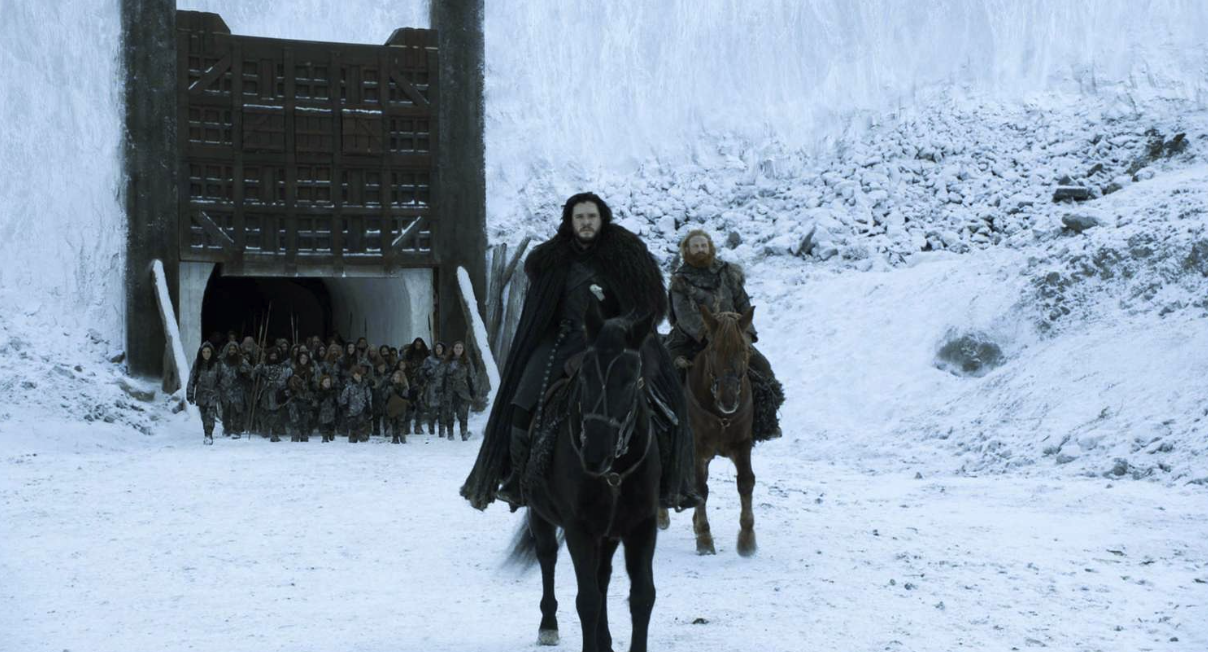
He does not smile. He softens. That is not the face of a prisoner. That is the face of someone who has stopped fighting a story that never fit him.
The Free Folk do not crown by bloodline. Mance Rayder was king because people followed him. Jon will become the King Beyond the Wall not through proclamation but through alignment, by simply being the one who steps forward when things need doing, and having people look around and realize they have been following him all along. He will accept it reluctantly. Not with relish. That is how he has always led.
Beyond the Wall, there is no Aegon Targaryen. No King in the North. No political symbol requiring constant performance. Just Jon. Possibly for the first time in his life.
There is something to sit with in that. The reward for carrying an impossible burden is freedom from it. The Lord of Light brought him back for a reason. That reason is spent. The north is his Avalon.
The Cycle and the Question It Asks Us
Here is where the myth opens into something larger than Westeros.
Every generation in this world produces a crisis that demands a hero. Every hero sacrifices. The throne survives. The cycle resets. And eventually, when the next apocalypse arrives, someone rides north again to find the Reluctant King and beg him to come back.
That is the pattern. Throne, ambition, betrayal, catastrophe. Repeat.
Drogon melting the Iron Throne cracks that pattern open. It suggests the cycle can end. But only if the realm stops projecting its salvation outward. Only if it stops asking the reluctant savior to solve what the realm itself created.
This is the archetypal teaching of individuation. We cannot keep outsourcing our inner work to a hero. At some point the projection must be withdrawn. The shadow must be integrated rather than burned into someone else’s city.
Daenerys externalizes her wound into conquest. Jon internalizes his wound into sacrifice. The myth asks whether the realm, whether we, can learn to hold both. Can sovereignty exist without needing domination to feel safe? Can leadership be held lightly?
Jon beyond the Wall suggests it is possible. He leads because the situation requires it, not because power completes him. He walks away because he can. That is mature sovereignty. That is what it looks like when the archetype is integrated rather than inflated.
Most people encounter a new technology and immediately ask the wrong question: How do I use this to do what I already do, but faster?
It’s understandable. It’s also a dead end.
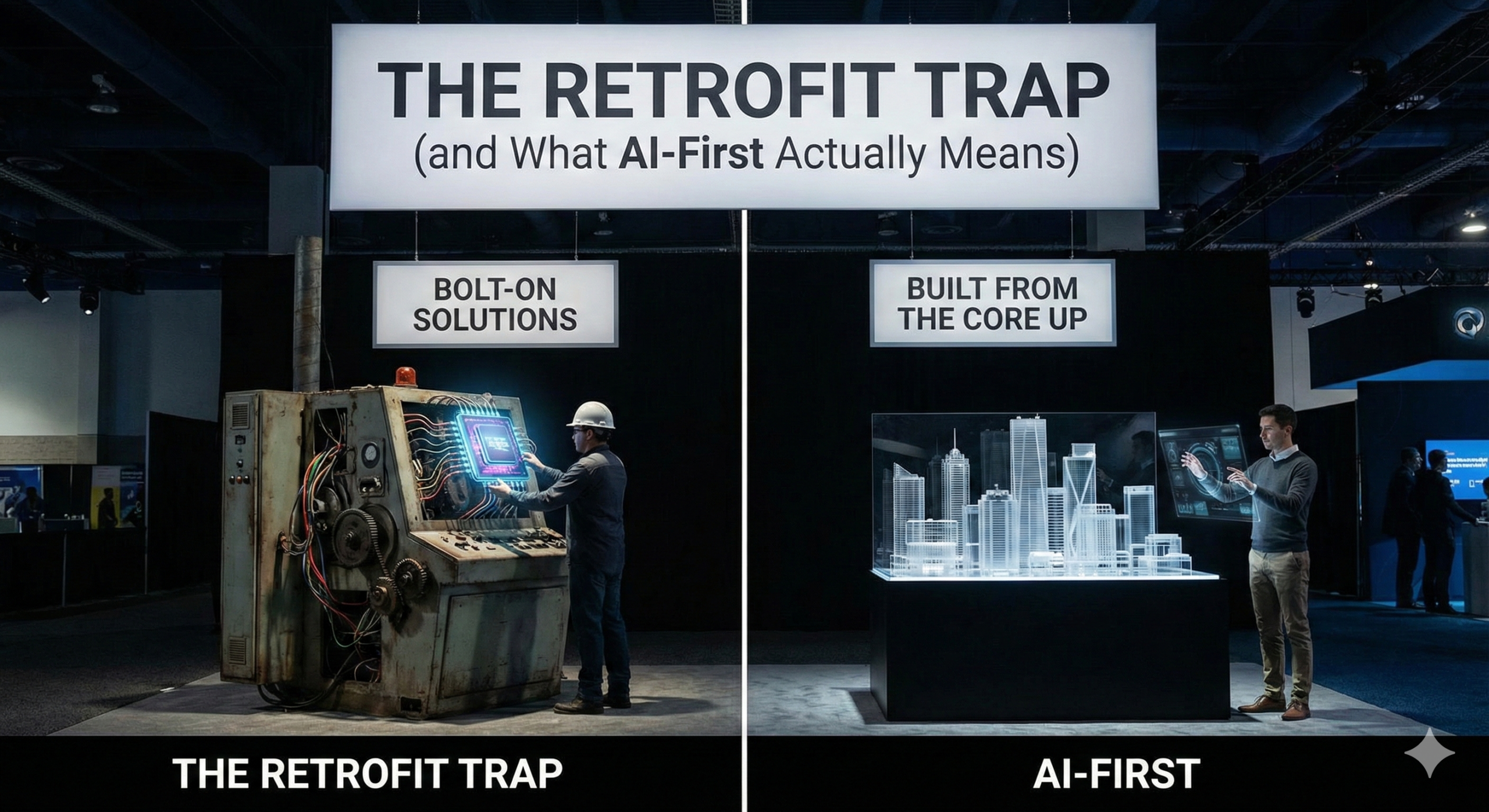
I call it the retrofit trap. You take an entirely new category of capability and bolt it onto your existing workflow like a spoiler on a minivan. You get the same thing you had before, slightly cheaper, marginally quicker. Nothing actually changes. You automate the assembly line and call it innovation.
This is how most people are approaching AI right now. Write my emails faster. Summarise this document. Generate a first draft so I don’t have to stare at a blank page. All fine, all useful, all profoundly missing the point.
The interesting question is not “how do I use AI to produce X more efficiently?” It is: What kind of thinking, making, and exploring becomes possible now that wasn’t possible before?
That’s the shift from using AI to being AI-first. And it’s not an efficiency play. It’s an ontological one.
Two Minds, One Conversation
The model most people carry for AI is tool-and-user. I pick up the hammer. I hit the nail. The hammer doesn’t have opinions about where the nail goes.
But that’s not what’s happening when you actually work with these systems at depth. What’s happening is closer to what Tony Stark has with JARVIS: two fundamentally different kinds of intelligence in genuine dialogue. Human intuition, pattern recognition, lived experience, and mythic depth on one side. Machine synthesis, breadth, tireless processing, and a strange capacity for lateral connection on the other.
Neither mind alone produces what the collaboration produces. That’s the part people miss when they treat AI as a slightly faster intern.
I’ve spent 25 years in corporate learning and development, building systems for how organisations grow people. I’ve spent 40 years journaling, tracking the way stories shape perception and possibility. I’ve spent 25 years practising chaos magick, which is, at its core, the disciplined use of belief as a technology. When I sit down with an AI and begin thinking out loud, something happens that is qualitatively different from either solo thinking or traditional collaboration with another human.
It’s not better or worse. It’s different in kind. A new cognitive mode. And that distinction matters enormously, because if you mistake it for “a faster version of what I already had,” you will never discover what it actually is.
The Chaos Magician’s Advantage
Chaos magick trains you for exactly this moment. The core discipline is simple: treat belief as a tool rather than an identity. Pick it up, use it, and put it down. Test what works. Discard what doesn’t. Results over metaphysics.
When a chaos magician encounters a new system, the first question is never “how do I use this correctly?” It’s: What are the correspondences? What becomes possible at the intersections? What can this do that hasn’t been done?
That’s the posture you need for AI-first work. Not the careful, manual-reading approach of someone trying to use the tool properly. The experimental, boundary-testing approach of someone who understands that the most interesting territory is always at the edges, where the instructions run out.
Most of the genuinely valuable things I’ve discovered in working with AI came from moments where I wasn’t trying to accomplish a predetermined task. I was following a thread. Asking a question that led to another question. Letting the machine’s unexpected synthesis collide with my own pattern recognition and produce something neither of us was aiming at.
You can’t plan for that. You can only create the conditions for it. And the first condition is letting go of the idea that you already know what this technology is for.
The Frontier Has No Gift Shop
There’s a version of “AI-first” content that has already become its own genre. Tips for prompting. Hacks for productivity. Ten ways to use ChatGPT in your morning routine. It’s the gift shop version of the frontier: safe, packaged, and completely disconnected from the actual wilderness.
The real frontier is disorienting. You get lost. You produce things that don’t fit existing categories. You have conversations with a machine that leave you thinking differently about your own mind, and there’s no framework yet for what to do with that experience.
I’m not interested in making the gift shop version. I’m interested in what happens when you take the work seriously: when you bring genuine depth, genuine questions, genuine not-knowing to the collaboration, and see what emerges.
The Fool in the tarot doesn’t step off the cliff toward a known destination. The step itself is the practice. The willingness to move without a map is not recklessness. It’s the prerequisite for discovering territory that hasn’t been mapped yet.
That’s what AI-first means to me. Not a productivity framework. Not a set of tools and techniques. A genuine orientation toward the unknown, backed by enough skill and experience to do something meaningful with whatever you find there.
What This Looks Like in Practice
I run what I call a content engine: a system where raw material (journal extracts, half-formed ideas, voice notes, and fragments) flows into a collaborative process with AI, and what comes out is writing, frameworks, and artifacts I could not have produced alone. Not because the AI is doing the writing for me, but because the thinking happens differently when two kinds of minds are in dialogue.
Some days that looks like me dropping a messy paragraph of journal reflection into the system and watching it become the seed of something I didn’t know I was trying to say. Some days it looks like a three-hour conversation about the relationship between alchemical stages and narrative structure that produces a model I’ll be working with for months.
The point is not the output. The point is the cognitive mode. Once you’ve experienced genuine collaborative thinking with a machine, the retrofit version (write my emails, summarise my documents) starts to feel like using a telescope to hammer nails.
The Invitation
If you’re reading this and something in it resonates, here’s what I’d suggest: stop asking AI to do your existing work faster. Instead, bring it something you’re genuinely uncertain about. A question you don’t have an answer to. A creative problem you haven’t solved. An idea that’s still half-formed and might be nonsense.
Then don’t direct the conversation. Follow it.
See what happens when you stop being the user and start being the collaborator. See what kind of thinking becomes possible when you let go of the need to already know where you’re going.
The frontier is real. The map doesn’t exist yet. And the only way to find out what’s there is to step off.
There is a model hiding inside every moment you have ever course-corrected, changed your mind, or walked out of a room sensing something had shifted. It is not a philosophy. It is not a metaphor. It is a working system, and once you see it, you cannot unsee it.
The model is cybernetic. It is the same logic that keeps a thermostat maintaining temperature, that guides a missile to a target, that allows a living body to heal itself. It runs on a continuous loop of sensing, comparing, and adjusting. And it turns out that the four pillars at the heart of Narrative Alchemy map onto this loop almost exactly.
Put them in sequence and you don’t have a coaching framework. You have a description of how life actually works.
The Thermostat Knows Something You Have Forgotten
A thermostat has no anxiety about the gap between current temperature and desired temperature. It simply reads the room, compares it to the setting, and acts. If the room is cold, the heat comes on. If the room is warm, it shuts off. The loop never closes permanently because life is not a problem you solve once. It is a system you stay inside.
Human beings are capable of exactly this, and they are also capable of something the thermostat is not: they can get so attached to their existing behaviour that they refuse to run the loop at all. They keep doing what they are doing, deny the data coming in from their senses, and call it consistency.
This is where the cybernetic model becomes a diagnostic tool. When your life feels stuck, one of four things has broken down. Either you have lost contact with the system you are operating inside. Or you stopped paying attention to the feedback it is generating. Or you never got clear about what you actually wanted. Or you know all of this but you keep pulling the same lever.
The four pillars address each failure point in turn.
Rapport: Connecting to the System
Before you can influence anything, you have to be inside it.
Rapport is the condition of genuine connection with another person, a situation, or a context. It is not charm. It is not manipulation. It is attunement. The state of being in resonance with whatever system you are attempting to move through.
In cybernetic terms, rapport is the input channel. Without it, the feedback loop cannot begin because you are not actually receiving signal from the system you think you are engaging with. You are operating on a projection, a memory, an assumption.
The practitioner of chaos magick knows this from working with servitors and egregores: your working does not connect with the target if you have not first genuinely interfaced with it. The Jungian knows it from shadow work: you cannot integrate what you refuse to acknowledge as part of you. The NLP practitioner knows it because rapport is not a step before the real work begins. It is the substrate the real work runs on.
When you are in rapport, information flows in both directions. You affect the system, and the system affects you. This is not a power dynamic. It is participation.
The question rapport asks of you: are you actually here, in contact with this situation as it is, or are you engaged with a story about it?
Sensory Awareness: Gathering the Data
Once you are connected to the system, you need to know what it is telling you.
This is sensory awareness: the disciplined practice of receiving information through your actual senses rather than through the filter of what you expect to perceive. Most of us think we are observing our environment. What we are mostly doing is confirming our existing model of it.
The feedback loop runs on real data. If you have degraded your input channels through assumption, through selective attention, through the psychological need to be right, the loop cannot self-correct. You are working with noise and calling it signal.
Sensory awareness is what makes the difference between a practitioner and a theorist. The practitioner notices micro-expressions, tonal shifts, changes in breathing, and the quality of silence in a room. The practitioner reads the energy of a working and adjusts in real time. The practitioner walks through a place and feels what is actually there rather than what is supposed to be there.
This is not mysticism. It is high-resolution perception. It is what twenty-five years of journaling practice builds when it is done honestly: you train your attention to notice what is actually present rather than what you wish were present. Your journal becomes a log of genuine observations rather than a literature of preferred reality.
The question sensory awareness asks of you: what is actually happening right now, and how much of what you think is happening is something you brought with you?
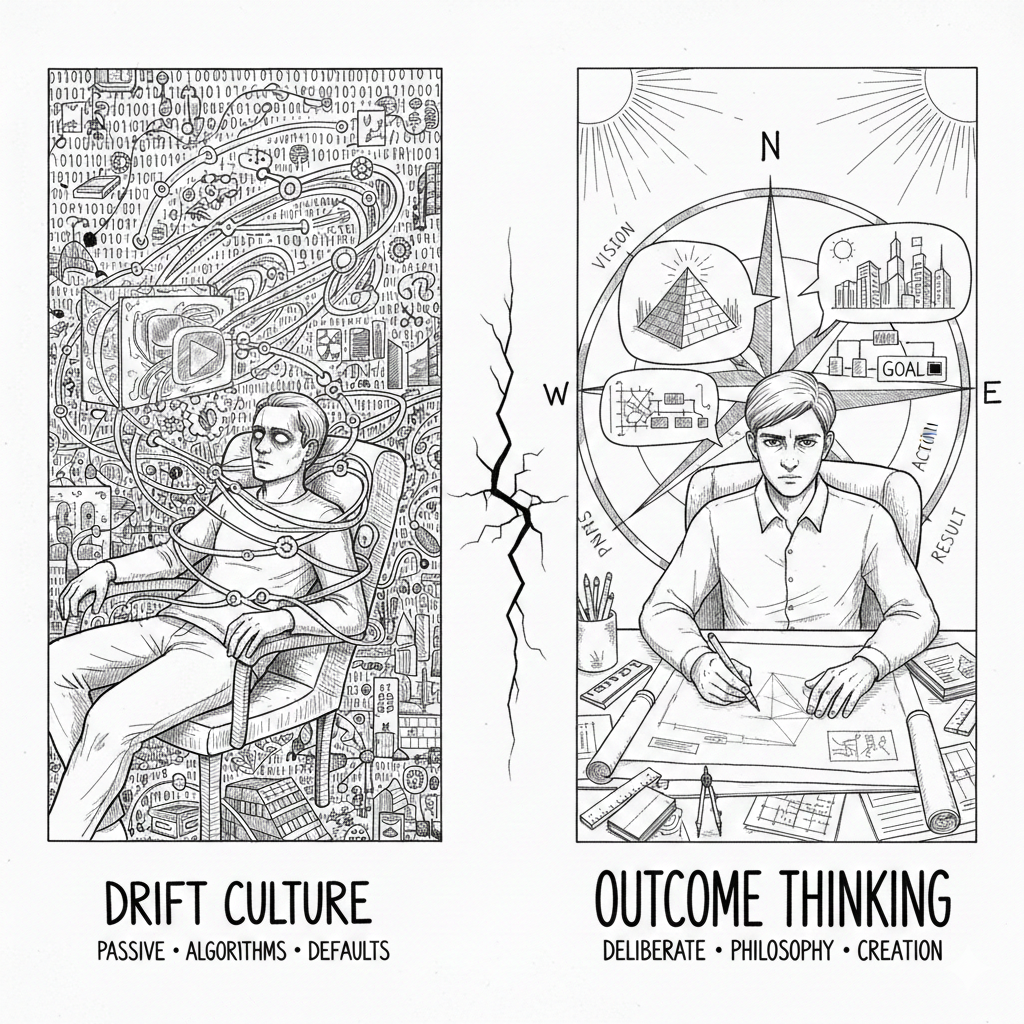
Outcome Thinking: Setting the Direction
A feedback loop without a target is just noise. It generates movement, but not direction.
Outcome thinking is the process of establishing a clear, specific, sensory-grounded representation of what you want. Not what you want to avoid. Not what you think you can get. What you actually want. The distinction matters because the system cannot navigate toward an absence. If your stated outcome is “I want to stop feeling anxious,” the system has nothing to point toward. The compass needs a destination, not a repulsion.
This is where the magical tradition and the NLP tradition converge completely. Neville Goddard’s instruction to live in the end. The chaos magician’s practice of constructing the intention before the working. The vision board that embarrasses the rational mind but somehow keeps producing results. All of these are ways of establishing a target state that the cybernetic system can use as a reference point.
The thermostat needs the setting before it can do anything. The missile needs coordinates. The self needs an outcome.
Outcome thinking is also where most people stall, not because they cannot think clearly but because they are afraid to commit. To name what you want is to risk not getting it. So the protective strategy becomes to keep the outcome vague. If you never really aimed at anything specific, you never really missed.
The cybernetic model does not allow this luxury. Vague outcomes produce vague trajectories. The loop cannot compare “current state” to “desired state” if the desired state is a fog.
The question outcome thinking asks of you: if you woke up tomorrow and this situation was exactly as you want it to be, what would you see, hear, and feel that would tell you the change had happened?
Behavioral Flexibility: Adjusting the Response
This is where most people discover that knowing the model is not the same as living it.
Behavioural flexibility is the capacity to do something different when what you are doing is not working. It sounds obvious. It is extraordinarily rare. The definition of insanity that everyone quotes is not really about insanity. It is about the human attachment to familiar behaviour even in the face of clear feedback that the familiar behaviour is not producing the desired result.
The cybernetic principle here is direct: the element in the system with the most behavioural options has the most influence over the system’s outcome. Not the loudest element. Not the most forceful. The most flexible.
This is one of the most counterintuitive ideas in the whole framework. Power, in a feedback loop, comes not from dominating the system but from being able to vary your response to it. The river carves the canyon not because it is harder than the rock but because it never stops adjusting.
Behavioural flexibility is also where the spiritual dimension of this model becomes most visible. The tradition of beginner’s mind. The instruction to hold your intentions lightly. The alchemical understanding that transformation requires the old form to dissolve before the new one can emerge. All of this is, in functional terms, behavioural flexibility. The willingness to release the approach that is not working and try something you have never tried before.
The question behavioural flexibility asks of you: what have you been unwilling to do differently, and what does that unwillingness actually cost you?
The Loop in Motion
These four pillars are not a sequence you run through once and finish. They are a continuous loop that you are always already inside.
Rapport feeds the sensory channel. Sensory awareness provides the data that gets compared to the outcome. The comparison generates the signal that calls for behavioural adjustment. And behavioural adjustment requires returning to rapport with the system to receive the next round of feedback.
This is life as an iterative experiment. Not life as a project with a completion date. Not life as a performance where you hope to eventually get it right. Life as a system you are perpetually engaged with, constantly receiving data from, and always capable of adjusting in response to.
The magician who understands this stops grieving their failures and starts mining them for information. The coach who understands this stops trying to deliver the perfect intervention and starts listening for what the client is actually telling them. The person who understands this stops asking “why does this keep happening to me” and starts asking “what feedback am I currently ignoring?”
The stories you are running, the narratives that structure your experience of reality, are the software layer sitting on top of this cybernetic hardware. When a story is debugged, when a limiting belief is rewritten, what actually happens is that the feedback loop is restored. You reconnect to the system, you restore your sensory input channels, you clarify your outcome, and you expand your behavioural repertoire.
Narrative alchemy is not a poetic name for therapy. It is a description of what is actually happening when a human being changes.
The Model Is Not the Territory
One final note: the cybernetic model is itself a story. It is a map. And like all maps, it has edges, places where the territory stops cooperating with the representation.
There are dimensions of human experience that a feedback loop cannot fully account for. Grace. Synchronicity. The moment when something shifts not because you worked the system correctly but because you finally stopped working it at all. The tradition has its own name for this: wu wei, surrender, the dark night that precedes the dawn.
The model is useful precisely because it is a model. It gives you traction when you are stuck and clarity when you are confused. But the practitioner who worships the model misses the point as surely as the one who rejects it.
Hold it lightly. Run the loop. And stay curious about what happens when it surprises you.
I spent twenty years in corporate learning and development watching people master outcome frameworks while their actual lives drifted sideways. They could build project plans with military precision, cascade objectives down organisational charts, and define KPIs that would make a statistician weep with joy. Then they’d leave the office and scroll through their phones on autopilot, accepting whatever the algorithm fed them next, living lives that were happening to them rather than through them.
The paradox gnawed at me: infinite choice had somehow produced a culture of drift.
We live in an age where you can customise your coffee order with seventeen variables but can’t articulate where you want your life to be in five years. We swipe through potential partners like we’re sorting mail. We let Netflix auto-play the next episode because making a decision about what to watch next feels like work. We follow the path of least resistance until we look up one day and realise we’re somewhere we never consciously chose to be.
This is drift culture. It’s the passive acceptance of algorithmic feeds, default paths, and cultural currents. It’s living in reactive mode, responding to inputs rather than generating outputs. It’s the spiritual equivalent of being a leaf in a stream, mistaking movement for progress.
But there’s another way.
Outcome thinking, properly understood, isn’t another corporate productivity hack. It’s not about quarterly objectives or SMART goals or any of that tactical machinery. It’s something older and more fundamental: the practice of consciously choosing a destination before you select a method. It’s asking “where am I actually going?” before you start walking. It’s treating your attention, your time, and your life force as something too precious to spend on unconsidered defaults.
This is philosophy as practice.
In an age of manufactured distraction, where entire industries profit from keeping you in drift mode, outcome thinking offers a framework for reclaiming agency over the direction of your life. Not control over every detail. Not rigid plans immune to chaos. Just direction. Intention. And the conscious choice to steer rather than float.
The question isn’t whether you’re moving. You’re always moving. Time ensures that.
The question is: are you drifting, or have you chosen a heading?
The Architecture of Drift
The systems we interact with daily aren’t neutral. They’re engineered with precision to keep us in a specific state: perpetually reactive, endlessly consuming, never quite satisfied enough to stop.
Consider the feed. Not a feed, but the concept itself, now so ubiquitous we barely notice it. The feed replaced the homepage. It replaced the bookmark. It replaced the idea that you might go somewhere specific on purpose. Instead, content comes to you in an infinite vertical scroll, algorithmically selected to keep you engaged for one more swipe, one more minute, one more hit of dopamine.
The feed is architecture for drift.
I remember when the internet had destinations. You typed in a URL because you wanted something specific. You went to a forum to discuss a particular topic. You visited a blog because you valued that person’s thinking. The web was a library you navigated with intention.
Now it’s a stream you float down, and the current is controlled by engagement metrics.
The brilliance of this design, from a business perspective, is that it eliminates the friction of decision-making. You don’t have to choose what to read next. You don’t have to wonder what to watch. The algorithm has already decided, based on what kept people like you scrolling yesterday. You’re not making choices. You’re accepting suggestions optimised for a goal you never consented to: maximum time on platform.
This is passive consumption as the path of least resistance, and resistance has been carefully engineered out of the experience.
The deeper trick is the illusion of choice. You can choose between thousands of shows on Netflix, millions of posts on Instagram, infinite variations of the same arguments on Twitter. The abundance feels like freedom. But all roads lead to the same place: you, in front of a screen, generating data, seeing ads, not doing the thing you said you wanted to do with your life.
The platforms call this “discovery.” But discovery implies agency, exploration, the joy of finding something you were seeking. This is different. This is being carried along by a current designed to keep you in the water.
What makes drift culture particularly insidious is that it masquerades as relaxation, as entertainment, as staying connected. And sometimes it is those things. But mostly it’s the gradual outsourcing of your attention to systems that profit when you stop steering.
Drift is a form of spiritual entropy. It’s what happens when you stop applying energy to direction and let the default flows carry you. And in a system designed to monetise your attention, the default flows don’t lead anywhere you actually want to go.
They lead in circles.
The feed refreshes. The queue auto-plays. The recommendations multiply. You keep moving, keep consuming, keep engaging. But you’re not going anywhere. You’re treading water in a pool designed to keep you from noticing you’re not swimming toward shore.
This is the invisible architecture that shapes our days. Not through force, but through friction reduction. Not through commands, but through suggestions. Not through restricting your choices, but through making the choice to drift easier than the choice to steer.
And after enough years of this, something shifts. You forget that steering was ever an option.
The Hidden Cost of Directionless Living
The bill for drift culture doesn’t arrive all at once. It accumulates quietly, like interest on a debt you didn’t know you were taking on.
Start with decision fatigue. You wake up and your phone offers you forty-seven notifications. Your streaming service wants you to choose between thousands of options. Your inbox demands responses. Your social feeds present endless micro-decisions: like or scroll, engage or ignore, share or move on.
But here’s the trap: none of these choices actually matter.
They’re decisions about consumption, not direction. They’re reactions to inputs, not expressions of intention. You’re spending your finite decision-making capacity on an infinite stream of trivial selections while the actual question, “where am I going with my life?”, never even gets asked.
I’ve watched this play out in my corporate years with brutal clarity. Executives would spend three hours debating the colour scheme for a presentation slide, then accept a career trajectory by default because it was the next logical step on the org chart. The small decisions got all the attention. The big ones happened by momentum.
This is how you end up with a life built entirely from unconsidered defaults.
You take the job because it was offered. You stay in the city because that’s where the job is. You date according to the patterns the apps present. You consume the content the algorithm serves. You adopt the opinions that dominate your feed. You buy the products that sponsored your favourite creator. Each individual choice seems reasonable, even inevitable. But you never stopped to ask: is this the direction I actually want to go?
The defaults accumulate into an identity.
And here’s what makes this particularly dangerous in our current moment: the defaults aren’t neutral. They’re engineered. Every platform, every service, every “free” tool exists because someone is making money from your behavior. The path of least resistance has been carefully constructed to serve agendas that aren’t yours.
Your identity, if you’re not careful, gets formed by algorithm rather than intention.
The cost shows up in creative agency. When you spend years in reactive mode, responding to inputs rather than generating outputs, you forget how to initiate. You forget how to create something from nothing. You forget that you can decide what to make, what to think, what to pursue, independent of what the systems around you are suggesting.
I felt this erosion in my own creative practice. After a day of scrolling, the blank page felt impossible. My imagination had been replaced by references. My originality had been crowded out by inputs. I couldn’t hear my own voice through the noise of everyone else’s content.
Drift culture doesn’t kill creativity suddenly. It crowds it out gradually, one scroll session at a time.
And the deepest cost, the one that took me years to recognise, is this: directionless living serves external agendas, not personal evolution.
Every hour you spend drifting is an hour someone else is using to build their outcome. The platforms need your attention to sell ads. The content creators need your engagement to grow their audience. The algorithm needs your data to refine its predictions. Everyone has a plan for your life except you.
The tragedy is that drift feels easier. It feels like rest, like relaxation, like just going with the flow. And compared to the constant pressure of corporate goal-setting, compared to the tyranny of productivity culture, drift can feel like rebellion.
But it’s not rest. It’s just a different form of exhaustion.
And it’s not rebellion. It’s surrender to a different set of masters.
The real cost of directionless living isn’t that you end up nowhere. It’s that you end up somewhere you never chose, serving purposes you never agreed to, wondering how you got here and why the life you’re living doesn’t feel like yours.
Because it isn’t.
It’s the accumulated result of ten thousand unconsidered defaults, each one reasonable in isolation, devastating in aggregate.
Outcome Thinking as Philosophical Practice
Strip away the corporate language, and outcome thinking reveals itself as something far older than quarterly business reviews. It’s a practice of conscious authorship. It’s the choice to write your story deliberately rather than let it be written by default.
But we need to make a critical distinction here, because the term “outcome” has been poisoned by decades of management consultants and productivity gurus. When I say outcome thinking, I’m not talking about SMART goals. I’m not talking about key performance indicators or objective key results or any of that tactical machinery.
Those frameworks treat outcomes as destinations: fixed points you either reach or fail to reach, measured in metrics that someone else probably defined.
That’s not what I’m pointing at.
Outcome thinking, as a philosophical practice, treats outcomes as compass headings, not destinations. It’s the difference between saying “I will be in Madrid on June 15th at 3pm” and saying “I’m heading south.” One is brittle and binary. The other is flexible and directional.
The practice starts with a deceptively simple question: “Where am I actually going?”
Not where you should go. Not where someone else wants you to go. Not where the algorithm is nudging you. Where are you actually going if you keep doing what you’re doing right now?
Most people can’t answer this question because they’ve never asked it. They’re moving, certainly. They’re busy. They’re productive by some measure. But movement isn’t direction. Activity isn’t intention.
I spent years confusing the two.
I’d look at my calendar and see it packed with meetings, commitments, and obligations. I’d look at my to-do list and see tasks getting checked off. I was accomplishing things. But I couldn’t tell you what I was building toward. I was busy going nowhere in particular, which is just drifting with better scheduling.
Outcome thinking forces you to look up from the tactics and ask the strategic question, “What do I want to be true?”
Not what do I want to do. Not what do I want to have. What do I want to be true about my life, my work, my creative practice, and my relationships?
This is where the practice becomes philosophical rather than tactical.
Because answering that question requires you to take a position. It requires you to declare what matters to you, what you value, and what kind of life you’re trying to build. It requires you to distinguish between goals (external metrics, often imposed) and outcomes (states of being, internally generated).
A goal might be “publish a book”. An outcome might be “become someone who writes regularly.” The goal is binary and external. The outcome is continuous and internal.
A goal might be “get promoted to director.” An outcome might be “develop the kind of leadership presence that makes people want to work with me.” The goal is a title. The outcome is a way of being.
You can fail to achieve a goal and still embody the outcome. You can achieve a goal and completely miss the outcome.
The practice of outcome thinking is learning to distinguish between these and choose the one that actually serves your evolution.
This is self-authorship in the truest sense. You’re not just reacting to the story as it unfolds. You’re declaring what kind of story you want to be living in. You’re establishing the genre, the themes, the direction of the narrative arc.
Because here’s what happens when you get clear on your outcome: everything else becomes a filtering mechanism.
Opportunities present themselves constantly. Invitations, offers, requests, suggestions, distractions. In drift mode, you say yes to whatever seems interesting or urgent. In outcome mode, you ask: “Does this move me toward what I want to be true?”
If yes, engage. If no, decline. If unclear, investigate.
This isn’t about rigid plans immune to chaos. Life is too complex, too alive, too full of genuine surprise for that. Outcome thinking doesn’t eliminate flexibility. It enables flexibility by giving you a reference point.
When you know your heading, you can navigate around obstacles. When you’re drifting, every obstacle looks like a sign to change direction, and you end up blown around by every wind.
The practice requires regular review. Not because you’re tracking metrics, but because you’re checking alignment. You sit down and ask: “Am I still heading where I said I wanted to go? Is what I’m doing building what I said I wanted to build? Or have I drifted off course?”
Course correction isn’t failure. It’s navigation.
Course abandonment without conscious choice, though? That’s drift with extra steps.
What outcome thinking ultimately builds is the muscle of agency. The lived experience that you can choose a direction and move toward it. That you’re not just a passenger in your life, buffeted by circumstance and algorithm. That you can declare an intention and organize your energy around it.
This is existential technology. It’s using consciousness deliberately rather than letting it run on autopilot.
And in a culture engineered to keep you reactive, this practice is quietly revolutionary.
Because directed individuals make different choices than drifting populations. They’re harder to manipulate, harder to monetize, harder to keep scrolling.
They know where they’re going.
And they’re not interested in detours that serve someone else’s outcome.
Practical Application: From Drift to Direction
Theory becomes useful when it translates into practice. So let’s talk about how this actually works in the texture of daily life.
The entry point is simpler than most people expect: start with the question “What do I want to be true?”
Not tomorrow. Not in some distant future when conditions are perfect. Right now, in the life you’re actually living, what do you want to be true about how you spend your time, your attention, your creative energy?
I asked myself this question three years ago, and the answer that surfaced surprised me: “I want to be someone who writes every day.”
Not “I want to write a bestselling book.” Not “I want to be a famous author.” Just: I want daily writing to be true about my life.
That clarity changed everything.
Because once you name the outcome, you can start building protocols that align with it. Not rules imposed from outside, but structures you create to support what you’ve already decided matters.
For me, that meant morning pages. It meant treating my blog as sacred practice rather than content marketing. It meant saying no to morning meetings that would colonize my writing time.
This is the difference between goals and outcomes in practice.
A goal would have been “write 50,000 words this quarter.” That’s measurable, time-bound, external. And it would have made writing feel like an obligation, like something I either succeeded or failed at.
The outcome was “be someone who writes daily.” That’s a state of being, internally verified. On days when I wrote three sentences, I still embodied the outcome. On days when I wrote three thousand words, the same outcome. The metric wasn’t word count. It was identity alignment.
Did I show up to the practice today? Yes or no.
This is how outcome thinking filters opportunities.
Someone invites you to a project. Before you say yes by default or no by anxiety, you ask: “Does this move me toward what I want to be true?”
If your outcome is “build deep expertise in a specific domain,” then scattered side projects might be a no, even if they’re interesting.
If your outcome is “create more space for creative experimentation,” then a high-paying corporate gig that consumes sixty hours a week is probably a no, even if it’s prestigious.
If your outcome is “develop genuine friendships rather than just networking connections,” then certain social obligations become clear nos, and certain coffee invitations become clear yeses.
The outcome becomes the decision-making framework.
I use this daily with information consumption. My outcome around learning is “develop integrated understanding rather than accumulate disconnected facts.” So when I’m tempted to read another article, listen to another podcast, or consume another piece of content, I ask: “Does this deepen something I’m already working with, or is it just another input to file away?”
If it deepens, I engage fully. If it’s just more noise, I let it go.
This has radically reduced my consumption and radically increased my integration.
The practice also requires building personal protocols, small repeating structures that make the outcome easier than the drift.
For my writing outcome, the protocol is coffee gets made after I’ve written at least a paragraph. Not a lot of words. Not a masterpiece. Just proof I showed up. The coffee becomes the reward for embodying the outcome, and my brain has learned the pattern.
For my outcome around physical health, “move my body in ways that feel good rather than punish it,” the protocol is: no exercise I dread. If I’m avoiding a workout, that’s data. Find a different movement practice. This has taken me from forcing myself to run (which I hate) to rollerskating multiple times a week (which I love). Same outcome, better protocol.
Protocols aren’t discipline imposed from outside. They’re intelligence about how you actually work, designed to support what you’ve already decided matters.
The critical practice, though, is regular review.
I sit down monthly with my journal and ask three questions:
“What did I say I wanted to be true?” “What is actually true about how I spent my time and attention?” “Where’s the gap, and what needs to adjust?”
Sometimes the gap is in my behaviour. I said I wanted daily writing, but I’ve been skipping mornings. The adjustment is recommitting to the protocol.
Sometimes the gap is in the outcome itself. I said I wanted to build a particular kind of business, but when I’m honest, I don’t actually want that anymore. The adjustment is changing the outcome and rebuilding the protocols.
This is course correction, not course abandonment.
Course abandonment is what happens in drift mode: you stop doing something because it got hard or boring or because the algorithm served up a shinier option. You never consciously chose to change direction. You just… stopped.
Course correction is conscious: you assess, you decide, you adjust. You maintain agency throughout.
The difference might look subtle from the outside, but it feels completely different from the inside.
One is empowering. The other is erosive.
What I’ve discovered through years of this practice is that outcome thinking doesn’t require massive life overhauls. It doesn’t require quitting your job or burning down your calendar or any of that dramatic reinvention theatre.
It requires small, consistent choices in alignment with what you’ve declared matters.
Say no to one thing that doesn’t serve your outcome. Say yes to one thing that does. Review monthly to check if you’re still heading where you said you wanted to go.
Do this for six months, and your life starts to look different. Do this for three years and you become unrecognisable to your former self.
Not because you executed a perfect plan, but because you kept choosing direction over drift, alignment over default, and intention over algorithm.
That’s the practice.
Resistance and Obstacles
Let’s be honest about why most people don’t do this.
Drift feels easier. It feels like rest, like going with the flow, like not being one of those intense people who optimise everything and turn life into a project plan. Drift feels like permission to just be.
And in a culture that glorifies hustle and productivity theatre, that permission feels like medicine.
But here’s the uncomfortable truth I’ve had to face in my own practice: drift isn’t actually easier. It just frontloads the relief and backloads the cost.
Choosing what to watch on Netflix feels harder than letting it auto-play. Deciding what you want your career to build toward feels harder than just taking the next logical step. Sitting down to write feels harder than scrolling through social media.
In the moment, drift wins on effort.
But zoom out six months, a year, or five years, and the cumulative cost of drift is staggering. The vague dissatisfaction. The sense that time is passing but nothing is building. The creeping feeling that you’re living someone else’s life. The exhaustion that comes from constant input without meaningful output.
That’s not easier. That’s just delayed difficulty.
Outcome thinking frontloads the difficulty and backloads the relief. The hard part is upfront: deciding what you want, facing the discomfort of choice, and taking responsibility for direction. But once you’ve done that work, the daily decisions get simpler. You have a framework. You know what you’re building toward.
Still, the resistance is real.
There’s enormous cultural pressure toward “going with the flow.” It shows up in spiritual bypassing disguised as wisdom. “Don’t be attached to outcomes.” “Let the universe decide.” “Trust the process.” All of which sound enlightened but can easily become justifications for not choosing anything.
I’ve used these phrases myself to avoid the discomfort of declaring what I actually want.
Because here’s what nobody tells you about choosing outcomes: it’s vulnerable.
When you name what you want to be true, you’re putting a stake in the ground. You’re saying “this matters to me” in a world that’s very good at mocking what people care about. You’re creating the possibility of not achieving it, which means creating the possibility of failure.
Drift protects you from that. If you never declare a direction, you can never be lost. If you never say what you’re building, you can never fail to build it.
The ego loves this safety.
But safety isn’t the same as satisfaction. And protection from failure is also protection from meaning.
The fear of choosing “wrong” outcomes is particularly paralysing for people who’ve been trained in optimisation thinking. They want to run the analysis, weigh all options, and find the provably correct path before committing.
But life isn’t a spreadsheet. There is no objectively correct outcome. There’s only what’s true for you, right now, given who you are and what you value.
And that changes. I’ve changed my primary outcome three times in the last decade. Each shift felt like failure until I recognised each outcome built the capacity for the next one.
Another obstacle: the ego’s attachment to being busy versus being directed.
Our culture has a bizarre relationship with busyness. We wear it as a badge of honour. “I’m so busy” becomes a status symbol, proof that you’re important, needed, and in demand.
Outcome thinking threatens this identity.
Because when you get clear on your actual direction, a lot of your busyness reveals itself as distraction. The meetings that don’t serve anything you care about. The projects you said yes to out of obligation. The commitments you’re maintaining because you started them once, not because they’re building anything meaningful.
Letting those go feels like diminishment. It feels like becoming less productive, less valuable, and less impressive.
But what you’re actually becoming is more focused. More intentional. More aligned.
It just doesn’t look as busy from the outside.
I’ve lost friends over this. People who bonded with me over our shared exhaustion, our packed calendars, our heroic tales of juggling too many things. When I started saying no, started protecting my time, started choosing direction over drift, some relationships couldn’t survive the shift.
They needed me to stay in busy mode to validate their own choices.
And maybe the deepest resistance of all: outcome thinking requires you to take responsibility for your life.
Not blame yourself for past drift. Not berate yourself for unconsidered defaults. But accept that from this moment forward, you’re choosing. And if you don’t like where you’re going, you have the power to choose differently.
That power is simultaneously liberating and terrifying.
Because once you know you can choose, you can’t un-know it. You can’t go back to comfortable drift and pretend you had no agency. Every time you’re scrolling mindlessly, some part of you knows you chose that. Every time you say yes to something that doesn’t serve your outcome, you’re conscious of the betrayal.
This awareness can feel like a burden.
But it’s actually the price of authorship.
If you want to write your own story, you have to accept that you’re writing it. Every scene. Every chapter. Every choice that compounds into the narrative arc of your life.
You can’t blame the algorithm anymore. You can’t blame circumstances. You can’t blame drift.
You’re the one holding the pen.
And that responsibility, uncomfortable as it is, turns out to be the foundation of something worth having: a life that actually feels like yours.
Final thoughts
Here’s the choice that presents itself every single day, whether you’re conscious of it or not: author or character.
Author: someone who knows the story they’re writing, even if they don’t know how every scene will unfold. Someone who chooses the themes, sets the direction, and decides what kind of narrative they’re building.
Character: someone being moved through a story written by algorithm, by default, by cultural momentum, or by whoever has the strongest claim on their attention that day.
Both are roles in the same life. But they feel completely different from the inside.
I’ve lived both. Years as a character, accepting whatever plot points showed up, reacting to the story as it happened to me. Then a gradual, sometimes painful transition into authorship. Learning that I could choose. That choosing was even possible. That the pen was in my hand the whole time; I’d just been letting others move it.
The transition isn’t a one-time decision. It’s a daily practice.
Because drift doesn’t disappear just because you’ve decided to steer. The currents are still there. The algorithms are still optimised. The defaults still pull. The path of least resistance still slopes downward into passive consumption.
Outcome thinking as a practice means recommitting to authorship every morning.
It’s not dramatic. It’s not a transformation montage with inspiring music. It’s quieter than that. More persistent. More mundane.
But the compounding effect is staggering.
Six months of writing daily instead of scrolling daily: you’ve built a body of work.
A year of saying no to obligations that don’t serve your outcome: you’ve reclaimed hundreds of hours for what actually matters.
Three years of filtering opportunities through your declared direction: you’ve become someone different. Not because you executed a perfect plan, but because you kept choosing alignment over drift, intention over default.
That’s how you build a life that feels like yours.
Not perfect. Not immune to chaos or surprise or necessary pivots. But yours. Authored. Chosen. Directed.
And here’s what becomes possible when you stop drifting and start steering:
You stop waiting for permission and start creating what wants to exist through you.
You stop consuming other people’s stories and start telling your own.
You stop being optimised by systems that profit from your distraction and start optimising yourself toward your own declared outcomes.
You stop being a data point and become a person again. A consciousness with agency. A creator with direction.
The practice is simple. Ancient, actually. Just dressed in a new language for a new context.
Choose what you want to be true. Build small protocols that support it. Review regularly to check alignment. Adjust as needed. Repeat until your life reflects your choices instead of your defaults.
That’s it. That’s the whole practice.
Simple, but not easy. Because it requires you to accept something uncomfortable: you’re responsible for the story you’re living.
Not responsible for everything that happens to you. That’s not how life works. Chaos is real. Circumstances exist. Systems have power.
But responsible for how you respond. For what you choose to build. For where you point your attention and energy. For whether you’re drifting or steering.
That responsibility is the price of authorship.
And authorship is the price of a life that means something.
Not to the algorithm. Not to the engagement metrics. Not to whoever’s trying to monetise your attention this week.
To you.
A life that, when you look back on it, feels like you were actually there. Conscious. Choosing. Building toward something that mattered.
Close your eyes and feel the laptop on your thighs. It isn’t just warm: it is radiating. That heat is the friction of a billion data points rubbing together in a space too small to hold them. Outside, the world might be cold, but inside the black mirror, the temperature is rising. You can smell it if you look closely enough at the pixels: the sharp, ozone tang of a circuit board pushed to the brink, the scorched-sugar scent of a thousand “hot takes” melting into a single, screaming hiss.
For two decades, we’ve leaned on a biological lie. We called it “viral.” We spoke about “outbreaks” of misinformation and the “contagion” of a meme. We built our defenses like doctors, donning the nitrile gloves of fact-checking and the surgical masks of media literacy. We thought if we just quarantined the “sick” accounts, the fever would break.
But the fever didn’t break. The fever became the environment.
The physicists and the network theorists — the ones who stopped looking at biology and started looking at thermodynamics — are finally speaking up. They aren’t modeling your feed like a pandemic anymore. They are modeling it like a high-intensity crown fire.
The virus metaphor is a relic of a slower world, a world where ideas had to travel from host to host. In 2026, ideas don’t travel: they ignite. We have moved past the era of the infection and entered the era of the Digital Burn.
Your timeline is not a library. It is not a town square. It is a Sixth-Generation Forest Fire. It is a dry, dense thicket of spruce and pine, packed so tightly by the algorithmic foresters that the branches don’t just touch: they are fused.
Every notification is a spark. Every “like” is a breath of oxygen. And you? You aren’t a patient in a ward.
You are the fuel.
The Architecture of the Pyre (The Monoculture)
In a healthy forest, there is chaos. There are gaps. There are rotting logs, damp clearings, and a sprawling diversity of species that don’t all catch fire at the same temperature. But the architects of our digital landscape — the high-priests of the “Engagement Above All” doctrine — don’t want a healthy forest. They want a plantation.
They have spent the last decade planting a monoculture of “trees” (users) in perfectly straight, hyper-efficient rows. To the algorithm, a “gap” in the forest is wasted space. A clearing is a loss of revenue. So, it packs us in. It grafts our identities together based on “lookalike audiences,” ensuring that your branch is permanently tangled with the branch of the person most likely to snap you.
This is the Grid. It is a landscape designed for the express purpose of rapid transmission.
Look at the “Dead Internet” not as a graveyard of bots, but as a petrified forest. Because we are forced into these tight, data-mined rows, we have lost our psychological biodiversity. We are fed the same stimuli, shown the same “Fnords,” and pushed toward the same high-contrast emotional peaks. We have become a forest of dry pine: identical, brittle, and highly conductive.
In the physical world, thermodynamics is limited by distance. For a fire to jump from one ridge to another, it has to work for it. It has to fight the wind; it has to leap the gap. But in the architecture of the feed, there is no distance. The “buffer zone” has been engineered out of existence.
When a spark lands on a tree in a different hemisphere, your branch feels the heat instantly. There is no time for the wood to be “wet.” There is no room for the slow dampening of reflection or the cooling effect of context. We live in a state of permanent Touching Branches.
The Salamanders of Silicon Valley
The fire in the monoculture isn’t natural. If you lean close to the screen, you’ll see the flames don’t flicker: they glitch. They are jagged blocks of neon-orange and corrupted data-mosh red, bleeding into colors that don’t exist in nature, colors reserved for warnings on high-voltage equipment. It is a fire that doesn’t smell of woodsmoke; it smells of burning plastic and overclocked GPUs.
And in the center of the hottest part of the burn, where the compression artifacts are so thick they look like physical scar tissue, something is moving.
The medieval alchemists wrote about Salamanders: spirits made of pure elemental fire that lived inside the kiln, creatures that didn’t just survive the heat, but required it to exist. We have summoned our own version.
It forms out of the dead air between channels. It is a vague, lizard-like shape made of grainy television white noise, distorted scan lines, and VCR tracking errors. It is the ghost in the machine, the static given teeth.
This is the Egregore of the feed. In occult terms, an egregore is a “thought-form” — a psychic entity brought into existence by the collective intense focus of a group. In 2026 terms, it is the “Main Character of the Day.”
This Elemental has one biological imperative: Burn. It is pure, indiscriminate hunger.
It doesn’t care if you agree with the spark that birthed it. It doesn’t care about your well-reasoned thread dismantling its premises. In fact, it prefers your opposition. This is the physics of the glitch-fire: Friction is fuel.
When you see that post that triggers your immediate fight-or-flight response, you have to “correct” the record. You have to “dunk” on it for an audience of your peers. But the Salamander doesn’t speak English. It only understands Thermodynamics. Every quote-tweet is a fresh log thrown onto the pyre to prove how much you hate the fire. Every angry reply is a jet of high-grade kerosene.
The Shadow in the Flames (The Depth Psychology of the Burn)
Why do we stay? The answer lies in what James Hillman called “soul-making.” In depth psychology, the soul isn’t some gossamer thing that floats above us; it is forged in the “vale of tears,” in the heat of our pathologies and our crises. We stay in the fire because, on some primal level, we are addicted to the Alchemy of the Burn.
The Alchemical Calcinatio
In the old laboratories, the first stage of the Great Work was calcinatio: the process of heating a substance until it is reduced to white ash. The goal was to burn away the “moisture” of the ego — the soggy, sentimental attachments — to find the “salt” or the essence that remains.
In 2026, the internet has become a global calcinatio chamber. We subject ourselves to the high-contrast heat of the glitch-fire because we are desperate to feel something solid. We want the algorithm to burn away the fluff of our daily lives until only the core of our identity remains. But here is the trick: the fire doesn’t distinguish between your “essence” and your “outrage.” It burns it all.
The Shadow’s Secret Joy
Carl Jung spoke of the Shadow as the part of ourselves we refuse to acknowledge. We claim to hate the “toxic” discourse. Yet, we keep refreshing the feed.
The Shadow is the “Firestarter.” It loves the spectacle of the burning forest. It finds a dark, ecstatic release in the destruction of an “enemy” or the collapse of a narrative. When you engage with the Salamander of static, you aren’t just a victim; you are a participant in a ritual of destruction. Your Shadow is holding the matches, even as your ego cries about the smoke.
How to Be a Firebreak
Robert Anton Wilson reminded us that “Communication is only possible between equals.” In the context of the burning forest, the algorithm has made us all “equal” only in our flammability. To practice Magic in 2026 is to break that equality. It is to become a non-conductive element in a hyper-conductive world.
You must become a Firebreak.
The Art of Non-Conductivity
A firebreak is not just an empty space. It is a deliberate gap where the fuel has been removed.
Stop Feeding the Elemental: This is the first law of digital alchemy. When you see the neon-orange outrage, your lizard brain wants to scream. The Salamander is counting on it. By refusing to engage, you are effectively sucking the oxygen out of its room.
Thin the Forest: If your timeline is a wall of constant crisis, you are living in a chimney. Practice Aggressive Curation. Introduce “wet” content into your grove: seeking out long-form essays and slow-moving thoughts that require a high ignition temperature.
Water the Roots: The digital world is built on high-frequency oscillations. To counter it, you must find a lower frequency.
The Magic of the “Dead Tree”: There is a profound ritual in reading a physical book. Paper is made of trees that died so that ideas could live in a stable, cooling format. When you read analog, you are grounding your nervous system into a slower timeline.
The Coda: After the Ash
Every forest fire eventually meets its end. What remains is a landscape of charcoal and silver. It is a world reduced to its skeletal essentials. In the physical world, there is a phenomenon called serotiny. Certain species of pine produce cones that are sealed shut with a tough resin. They only open when they are scorched. They need the heat of a disaster to crack the seal and release the seeds into the nutrient-rich ash.
The digital burn is catastrophic, but it is also a clarion. It strips away the “fluff” of our shallowest connections and leaves behind the scorched earth of what actually matters. In the aftermath of a timeline collapse, you find out which of your ideas were merely dry kindling and which were serotinous seeds.
The Reflection in the Black Glass
When you finally power down, the monitor stops being a window into a burning forest. It becomes a mirror.
In that dark reflection, you see yourself: not as a data point or a unit of fuel, but as a living bridge between the silicon and the soul. We cannot stop the forest from being dry. We cannot stop the architects from planting their monocultures. But we can change our own composition.
We are learning to build our homes out of stone instead of pine. Stone doesn’t catch. Stone reflects the heat. Stone provides a foundation for the “new growth” that only comes after the old metaphors have burned to the ground.
The internet is a haunted house on fire. You don’t have to put it out. You don’t even have to escape it. You just have to remember that you are the one holding the lantern, not the one being consumed by the wick.
Go outside. The trees there are real. They don’t glitch.
Jordan Peterson on self-authorship: “Constructing the narrative of your life is a way to determine what to strive for and what to avoid…”
There exists a peculiar condition in human consciousness where we experience ourselves as both the one living and the one observing what is lived. We are simultaneously inside the story and somehow outside of it, watching ourselves move through scenes we did not consciously script. This dual nature creates a tension that most people never examine. They simply live as characters, fully identified with the role, never questioning who wrote the lines they speak or designed the circumstances they navigate.
Consider the nature of authorship itself. An author sits removed from their creation, shaping events from a position of deliberate choice. They know the ending before the character does. They understand that the obstacle in chapter three serves the transformation in chapter seven. They can revise, delete, rewrite entire arcs if they prove unsatisfying. The character, meanwhile, experiences each moment as it arrives, uncertain of outcome, subject to forces that seem external and often arbitrary.
Most human beings live entirely as characters. They experience life as something happening to them rather than through them. When circumstances shift, they respond with the logic of someone reading a story rather than writing one: interpreting events, making meaning, constructing narratives that explain why things are as they are. These narratives feel discovered rather than invented, as if the meaning were inherent in the events themselves rather than projected onto them by the interpreting consciousness.
But what if the interpretation is the creation? What if the story you tell yourself about what happened is more consequential than what happened?
This is not a comfortable question. It challenges the fundamental assumption that reality is something we encounter rather than something we participate in creating. It suggests that the boundary between observation and creation is far more porous than we typically acknowledge. It implies a kind of responsibility that most people would prefer to avoid.
The Mechanism of Meaning-Making
Between any event and your experience of that event lies a process of narrative construction. A conversation ends. An opportunity disappears. A relationship shifts. These are facts, things that occurred in the realm of observable phenomena. But the meaning of these facts, the story about what they signify, this emerges from your consciousness, not from the events themselves.
The car breaks down. This is a mechanical fact. But “the car breaks down and this proves I’m unlucky” is a story. “The car breaks down and this is the universe protecting me from something worse” is a different story. “The car breaks down and this is an inconvenience requiring practical problem-solving” is yet another. Same event. Different narratives. Different emotional experiences. Different subsequent actions.
Most people do not recognize this gap between event and interpretation. The story generates so quickly, so automatically, that it feels like truth. It feels like the only reasonable response to what happened. They are characters reading the plot as it unfolds, not authors choosing how to write the scene.
This automaticity is what keeps people trapped in repetitive patterns. The same types of events keep happening because the same stories keep getting told about them, and those stories shape the consciousness from which future events emerge. It becomes a closed loop: the story creates the lens through which new events are interpreted, and those interpretations reinforce the story.
The man who believes he is unlucky experiences events through that lens. When something goes wrong, it confirms his story. When something goes right, it is an exception, an anomaly, or it is reinterpreted to fit the larger narrative of being unlucky (“I got the promotion but they’ll probably find a reason to let me go soon”). The story is self-perpetuating because it determines what gets noticed, how it gets interpreted, and what it means.
This is not simply cognitive bias, though that is part of it. It is something deeper. The story you habitually tell shapes the consciousness you habitually inhabit. And consciousness, according to those who have explored its depths most thoroughly, is not passive receiver of reality but active participant in its construction.
The Three Levels of Experience
To understand how authorship operates, we must distinguish between three levels at which any event can be understood: the literal, the psychological, and the spiritual.
The literal level is the domain of facts. The car broke down. The meeting was missed. The opportunity was lost. These are things that happened in consensus reality, the world we can point to and agree upon. This level is important. Denying facts serves no one. The character lives primarily at this level, experiencing events as they occur.
The psychological level asks what these events mean for the inner world. Here the story-making happens. The car breakdown becomes evidence of incompetence or bad luck. The missed meeting becomes proof of unworthiness. The lost opportunity becomes confirmation of being blocked or cursed. This is where most therapeutic work happens, examining the narratives and beliefs that shape emotional experience.
The spiritual level views everything as symbolic, as messages from the deeper Self or patterns of consciousness manifesting in form. At this level, the car breakdown is not random mechanical failure but a meaningful occurrence in a larger pattern. Perhaps it slows you down when you were rushing toward something misaligned. Perhaps it creates space for something more important. Perhaps it reveals something about your relationship to control or surrender.
The character operates primarily at the literal and psychological levels. Things happen, and they tell themselves stories about what those things mean. The author can move fluidly between all three levels, understanding that each provides different information without any single level being the whole truth.
More importantly, the author recognizes that the story constructed at the psychological level actually shapes what manifests at the literal level over time. The narratives you habitually inhabit become the reality you habitually experience. This is not magical thinking. It is an observation about how consciousness works.
The Shift To Authorial Consciousness
To become an author of your experience rather than merely a character within it requires a fundamental reorientation. It requires recognizing that you are always telling yourself a story, and that this story is not neutral description but active creation.
Neville Goddard understood this with unusual clarity. When he spoke of assumption, he was pointing to this authorial capacity. An assumption is not a hope or a wish. It is not positive thinking layered over doubt. It is the author deciding what is true in the story being written. The author does not wonder if the character will succeed. The author writes the success and then allows the character to experience the journey toward what has already been written.
This is radically different from how most people approach change. The character tries to change circumstances through action, effort, strategy. They work within the story, trying to make the plot go their way. The author recognizes that the story emerges from consciousness, and therefore changes consciousness itself, knowing the story will follow.
When you live as a character, you react to what happens. When you live as an author, you recognize that what happens is reflecting what you have been writing, consciously or unconsciously. The circumstances are feedback, not verdict. They show you what story your consciousness has been generating.
This requires developing what might be called witnessing awareness. The capacity to observe your own narrative construction in real time. To notice when the automatic story kicks in. To see it as a story rather than as truth. This is not dissociation or detachment. It is a particular quality of consciousness that can hold both participation and observation simultaneously.
In chaos magick, this is sometimes called meta-belief, the ability to hold a belief intensely for purposes of magical work while simultaneously knowing it is a belief you have chosen rather than an objective truth. The author must develop this capacity. You must be able to fully inhabit the story you are writing while knowing it is a story, not the only possible reality.
The Practice of Self-Authorship
This is not metaphysical abstraction. It has practical application in every moment of lived experience.
You receive news that disturbs you. The automatic story begins: what this means, why it happened, what it says about you or your future. As a character, you would be swept into this story, experiencing it as truth. As an author, you catch the story in the act of forming. You see it as one possible interpretation among many.
This seeing creates space. In that space, choice becomes possible. Not the choice of what to think about the event, which would still be operating from character consciousness. But the choice of what you are authoring through this event. What is the larger story you are writing? Does this interpretation serve that story or does it contradict it?
If you are authoring a story of expansion, growth, increasing capacity, then the disturbing news becomes material for that larger narrative. Not through forced reframing or positive thinking, but through genuine authorial perspective. The author knows that challenges in chapter three serve transformation in chapter seven. The character only knows chapter three feels hard.
This requires holding a paradox. You must fully experience the character’s reality while simultaneously maintaining authorial awareness. You cannot transcend the character experience and remain human. You live in time, in a body, in circumstances that have tangible effects. Denying this would be dissociation, not authorship.
But you also cannot collapse entirely into character consciousness without losing your creative power. The author must remain present, aware, choosing what story is being written even as the character lives through the scenes.
The practice becomes one of constant return. You forget you are the author. Something happens and you react as a pure character, swept into automatic narrative. Then you remember. You catch yourself. You observe the story you just told yourself. You choose whether to continue writing that story or to revise it.
Over time, the gap between event and automatic story begins to expand. What was once a half-second window becomes a second, then several seconds. Eventually, you can pause between the event and the interpretation long enough to consciously choose which story serves your authorial intent.
This is what spiritual traditions have called mindfulness or presence, but understood specifically as authorial capacity rather than mere observation. You are not just watching your thoughts. You are recognizing them as narrative choices and exercising your power to write differently.
The Question of Control
This raises immediate questions about control and responsibility. If you are the author of your experience, does that mean everything that happens is your fault? This is where the framework often gets distorted into self-blame or magical thinking.
The author does not control every event. The author shapes meaning, narrative, and the consciousness from which future experiences emerge. There is mystery here, a relationship between consciousness and manifestation that cannot be reduced to simple cause and effect. The author writes with intent, but the story unfolds in ways that often surprise.
What you can control is the story you tell about what happens. And that story is not trivial. It is the lens through which you experience everything. It is the foundation from which you act. It is the consciousness that shapes what becomes possible.
Two people experience the same event. One tells a story of victimization, of being targeted by malicious forces, of having no power. The other tells a story of challenge, of opportunity to demonstrate resilience, of being tested and refined. Same event. Different stories. Different emotional experiences. Different subsequent behaviors. Different long-term outcomes.
Over time, these different stories create different lives. Not because the stories change the events directly, but because they change the consciousness inhabiting those events, and consciousness is creative. The person who habitually authors stories of powerlessness creates a life that confirms powerlessness. The person who habitually authors stories of agency creates a life that confirms agency.
This is not blame. The character did not consciously choose their conditioning. The stories they automatically tell were learned, often in childhood, as survival strategies in particular environments. Recognizing you are the author is not about blaming yourself for the stories you have been unconsciously writing. It is about claiming the power to write differently going forward.
When you live as a character, you are at the mercy of plot. Things happen and you respond. When you shift to authorial consciousness, you recognize that your response is not merely reactive but creative. You are writing what comes next through how you interpret and inhabit what is happening now.
The Transformation of Time
Perhaps the most profound shift from character to author consciousness involves the experience of time itself. The character lives in linear time, moving from past through present toward an uncertain future. The past defines them. The future worries them. The present is where they cope with both.
The author experiences time differently. The past is material, not identity. What happened provides context, backstory, even motivation, but it does not determine what is being written now. The future is not something arriving to be dealt with but something being written toward. And the present is not a point between two other things but the location of authorial power.
Neville called this living in the end. The author writes from the completion of the desired story, not toward it. This is not pretending something has happened when it has not. It is recognizing that in consciousness, which is where all authoring happens, the end is already present. You write from there, and the character experiences the journey toward what the author has already completed.
This sounds abstract until you practice it. Then it becomes the most practical thing imaginable. You stop trying to figure out how to get from here to there. You inhabit the consciousness of there and allow here to reorganize accordingly.
The character asks “How do I get what I want?” The author asks “Who am I being in the story where I already have it?” These are fundamentally different questions that lead to fundamentally different experiences.
When you write from the end, you are not creating a fantasy to escape present circumstances. You are establishing the consciousness from which those circumstances can transform. You are deciding what story you are living in rather than letting circumstances dictate the story for you.
The character waits for circumstances to change before they can feel differently. The author changes consciousness and allows circumstances to follow. This is the core distinction. The character believes feelings follow facts. The author knows that facts follow consciousness, and consciousness is shaped by the story you choose to inhabit.
The Wound of Unconscious Authorship
Most people have been authoring unconsciously their entire lives. They have been writing stories about themselves and the world without knowing they were writing. They experienced these stories as truth, as the way things are, not as one possible interpretation among many.
This creates a particular kind of suffering. You experience yourself as subject to forces beyond your control when in fact you are generating those forces through the stories you unconsciously repeat. You feel victimized by a plot you are actually writing.
The shift to conscious authorship can feel destabilizing at first. If you have been the author all along, unconsciously writing stories that created suffering, what does that mean? The temptation toward self-blame is strong. “I did this to myself” becomes another story, another form of character consciousness masquerading as authorship.
True authorship transcends blame. The author recognizes that unconscious authorship is the default human condition. You were writing stories before you knew what stories were. You absorbed narratives from your environment and repeated them as if they were truth. This is not failure. This is how consciousness develops.
Becoming a conscious author means recognizing the power you have always had but did not know how to use deliberately. It means forgiving yourself for the stories you wrote when you did not know you were writing. It means claiming the capacity to write differently now.
This is where compassion becomes essential. For yourself and for others. Everyone you meet is writing stories, mostly unconsciously. When they react in ways that seem disproportionate or irrational, they are responding not to events but to the stories they are telling about events. When you recognize this, judgment often transforms into curiosity. What story are they writing? What story am I writing in response?
The Invitation
You are reading these words as a character. You are interpreting them, evaluating them, deciding if they are true or useful. This is natural and appropriate. The character must do what the character does.
But simultaneously, there is an authorial awareness available. The part of you that chose to read this, that sensed something relevant here, that is considering what to do with these ideas. That is the author.
The invitation is not to abandon character consciousness. You cannot and should not. The invitation is to remember that you are also the author. To catch yourself in the automatic stories. To notice the gap between event and interpretation. To practice choosing what you are writing rather than simply receiving what seems to be happening.
This is not a one-time shift. You will forget. You will collapse back into pure character consciousness. Something will happen and you will react automatically, telling yourself the old stories, experiencing yourself as subject to circumstances beyond your control. This is part of the process.
The practice is the return. The moment you notice you forgot, you remember. The moment you catch the automatic story, you have already created space for choice. The moment you recognize you are writing, authorship becomes possible again.
Over time, the returns become more frequent. The gap expands. The authorial awareness becomes more stable. You find yourself able to hold both perspectives more consistently, living fully as the character while knowing you are the author.
Your life is a story being written. The only question is whether you will write it consciously or continue to pretend you are merely a character in a plot someone else designed. The pen is already in your hand. It always has been.
The events of your life will continue. Things will happen, some pleasant, some difficult, some mysterious in their meaning. But you have a choice in every moment about what story you tell about those events. And that story is not merely interpretation. It is creation. It shapes the consciousness from which your next experience emerges.
What are you writing?
Not what has been written, which is the character’s question. Not what should be written, which is usually someone else’s story imposed on you. But what are you, as the author of your singular existence, choosing to write now?
This is the fundamental question of conscious living. Everything else follows from how you answer it.
Think about this: your reality isn’t happening TO you. It’s happening THROUGH you.
Your state of awareness operates like a projector beam. The world you experience is whatever appears on the screen of perception. Most people assume the screen is the problem. They argue with the images, rearrange the furniture inside the scene, or try to force a better storyline. Very few notice the beam itself.
But the beam is doing most of the work.
When your awareness is contracted, tense, and defensive, the world doesn’t feel neutral. It feels hostile. An unread email becomes a threat. A delayed reply becomes a verdict. A casual comment carries hidden criticism. Nothing has objectively changed. Same inbox. Same people. Same environment. But the quality of awareness projecting the scene has narrowed, and so the world it reveals narrows with it.
Anxious awareness scans for danger. It highlights risk, omission, and inadequacy. It edits reality down to sharp edges and worst-case interpretations. In that state, life feels like something you must survive rather than participate in. You move carefully, brace constantly, and mistake vigilance for intelligence.
Now notice what happens when the state shifts.
In moments of calm or flow, the same external conditions tell a different story. The inbox becomes a set of possibilities rather than ambushes. Conversations feel open instead of loaded. Problems still exist, but they register as workable instead of overwhelming. The world hasn’t magically improved. Your awareness has widened, softened, and stabilized. The beam changed, so the projection did too.
This is the part most people miss. They think perception is passive. That consciousness merely observes what is already there. In reality, awareness is an active filter. It decides what gets emphasized, what fades into background noise, and what never makes it onto the screen at all.
Your nervous system, beliefs, and habitual attention patterns are constantly shaping what reality looks like to you. You don’t see the world as it is. You see the world as your current state allows it to appear.
Change the screen and nothing really changes. Change the beam and everything does.
Same external conditions. Radically different experienced realities.
This isn’t about positive thinking or manifesting parking spaces. It’s deeper and more unsettling than that. Your consciousness doesn’t merely observe reality like a camera pointed at the world. It participates. It selects, emphasizes, filters, and organizes what becomes visible and actionable for you in any given moment.
Two people can stand in the same room, face the same constraints, receive the same information, and yet inhabit entirely different worlds. One experiences friction everywhere. The other senses openings. One reads the situation as hostile or depleted. The other reads it as workable or alive with possibility. Nothing external has changed. The difference is not circumstance. It’s the state of awareness interpreting the circumstance.
Awareness determines meaning before thought ever arrives. Long before you form an opinion or tell yourself a story, your nervous system and attention have already decided what matters, what feels threatening, and what feels inviting. From there, cognition simply explains what awareness has already framed.
This is why wisdom traditions, long before neuroscience had language for it, focused obsessively on consciousness training rather than circumstance control. Meditation, contemplation, prayer, ritual, solitude. These weren’t escapes from the world. They were methods for refining the instrument through which the world is encountered. The ancient operators understood something modern culture keeps forgetting: change the quality of awareness, and the same reality reorganizes itself.
When awareness is narrow, reality appears narrow. When awareness is rigid, reality feels brittle. When awareness is spacious, reality becomes surprisingly cooperative. Not perfect. Not painless. But workable in ways that were previously invisible.
Shift the quality of the beam, and what appears on the screen changes. Not because the world bends to your wishes, but because you finally have access to more of what was always there.
Your beliefs are code. Your attention is the compiler. Your awareness is the runtime environment.
Most people spend their lives trying to rearrange the furniture in a burning building. They’re obsessed with external fixes while the projector keeps beaming out the same corrupted program. Better job, new relationship, different city. But if the quality of awareness stays the same, you just get the same movie in a different theater.
Real transformation happens when you debug the consciousness itself. When you recognize that your habitual patterns of attention, your inherited narratives, your unconscious beliefs are all actively shaping what you perceive as “reality.”
This is narrative alchemy at its core.
You’re already running code. That part isn’t optional. The question is whether you’re running legacy programs inherited from trauma, culture, and unconscious conditioning, or whether you’ve begun to consciously refactor the system.
Much of what you call “reality” is the output of automated processes you didn’t author. Early emotional experiences, social norms, survival strategies, and unexamined beliefs quietly become default settings. They determine what you notice, what you ignore, what feels possible, and what feels forbidden. Over time, these patterns harden into a background operating system you mistake for the world itself.
Your perceptual apparatus is constantly filtering an overwhelming flood of data. At any moment, your senses are receiving far more information than you could ever consciously process. So the system predicts. It compresses. It selects. Neuroscience calls this predictive processing. The brain doesn’t passively receive reality. It generates a best-guess model of what’s happening and updates it only when the prediction fails badly enough.
Magick, myth, and contemplative traditions arrived at the same insight through a different door. They noticed that expectation shapes experience, belief stabilizes perception, and attention animates what it touches. They called it manifestation, spellcraft, or world-making. Different language. Same mechanism.
Either way, you are not reacting to raw reality. You are interacting with a model generated by your current state of consciousness.
This is why repeating the same patterns produces the same outcomes even when the surface details change. New job, same exhaustion. New relationship, same conflict. New city, same dissatisfaction. The scenery updates, but the codebase stays intact, so the simulation resolves in familiar ways.
Consciousness work is not about denying the world or fantasizing a better one. It’s about taking responsibility for the interpreter that’s running. When you shift the quality of attention, loosen rigid beliefs, and interrupt unconscious narratives, you don’t force reality to comply. You simply allow different data to register. Different possibilities to render. Different responses to become available.
That’s the real leverage point.
The world you see is the world your awareness can support. As that awareness expands, stabilizes, and becomes more coherent, the experienced world reorganizes accordingly. Not because you cast a spell on reality, but because you stopped running corrupted code without realizing it.
Once you see this, you can’t unsee it. The question stops being “How do I change my circumstances?” and becomes “What state of awareness am I bringing to this moment?”
Because awareness is not neutral. It is toned. It has texture. It can be hurried or settled, defensive or curious, rigid or receptive. And that tone quietly governs what options even register as real. Some states of awareness make entire pathways invisible. Others illuminate doors you didn’t know were there.
This is why willpower fails so reliably. You can force behavior for a while, but if the underlying awareness remains contracted, the system eventually snaps back to its default pattern. You don’t rise to the level of your intentions. You fall to the level of your state.
Most self-improvement advice tries to operate at the level of the screen. Think different thoughts. Say better affirmations. Take new actions. But if the beam remains distorted, those changes feel fragile and effortful. They require constant maintenance because they’re fighting the projector instead of adjusting it.
Cultivating awareness is different. It’s slower at first, but exponentially more powerful. When awareness stabilizes, clarity becomes natural. When awareness softens, flexibility appears without force. When awareness widens, resilience emerges as a side effect rather than a goal.
This is also why the work can feel uncomfortable. Expanding awareness means noticing the habits of contraction you’ve been calling “normal.” It means seeing how often you rush, brace, assume, or defend without realizing it. There’s no moral failure here. Just mechanics. A system doing exactly what it was trained to do.
The practice is not to judge the beam, but to refine it.
As you learn to recognize your states in real time, you gain choice. Not infinite choice. Not fantasy-level control. But enough leverage to interrupt old loops and allow new responses to arise. Enough space to respond rather than react. Enough clarity to see that many of the walls you’ve been pushing against were projections all along.
This is how inner work becomes outer change without trying to be.
Change the quality of awareness, and behavior reorganizes. Relationships reorganize. Work reorganizes. Even difficulty reorganizes, showing up less as a threat and more as a challenge you can actually meet.
Let me tell you something about anxiety that nobody seems to mention: it’s a terrible storyteller.
I’ve watched anxiety operate in hundreds of minds, including my own. And here’s what I’ve learned: anxiety is fundamentally sterile. It produces nothing new. It’s a photocopier stuck on the darkest setting, churning out increasingly distorted copies of the same fearful image.
But it doesn’t feel that way, does it? When you’re in the grip of anxiety, your mind feels incredibly active. Thoughts racing, scenarios spinning, mental energy burning at full throttle. Surely all that activity must be accomplishing something, right?
Wrong. And understanding why matters more than almost anything else in your transformation work.
The Anxiety Illusion: Busy Isn’t the Same as Creative
Here’s the first thing to understand about anxiety: it operates in pure reaction mode. It takes existing material, existing scenarios, existing memories, and runs them through a doom filter. That’s it. That’s the entire mechanism.
When you’re anxious about an upcoming presentation, your mind doesn’t generate novel solutions. It doesn’t craft creative approaches to engagement. It doesn’t discover fresh angles on your material. Instead, it rehearses failure. It replays that time you stumbled over your words in the team meeting. It projects humiliation onto a future that hasn’t happened yet.
This feels productive because your mind is so busy. Thoughts cascade. Scenarios multiply. Your nervous system floods with stress hormones that create a sense of urgency, importance, emergency. Surely something this intense must be meaningful, right?
But intensity and meaning aren’t the same thing. Heat and light aren’t the same thing. Anxiety generates tremendous heat, but it casts no light on your actual situation.
What Real Creativity Actually Requires
Let’s talk about actual creative states for a moment, because the contrast is illuminating.
Real creativity involves opening to possibility. It requires a kind of relaxed attention where your mind can wander, make unexpected connections, follow curiosity into strange territory. When you’re in a genuinely creative state, you’re not locked onto a single track. You’re exploring. Discovering. Playing with variables.
I’ve spent decades working with story as transformational technology, and here’s what I know: creativity needs space. It needs permission to be wrong, to be strange, to follow threads that might lead nowhere. It needs your nervous system to be calm enough that you can notice subtle signals, faint possibilities, weird hunches that don’t make immediate sense.
Anxiety provides exactly none of this.
Instead, anxiety narrows your focus to threat detection. It activates your survival systems. It floods your body with chemicals designed for one purpose: get you ready to fight or flee. This is brilliant design if you’re facing an actual physical threat. It’s terrible design for solving complex problems, generating insights, or creating anything new.
Your anxious mind isn’t exploring possibility space. It’s scanning for danger. And when your primary tool is a danger scanner, everything starts to look dangerous.
The Cruel Masquerade: When Worry Pretends to Be Problem-Solving
This is where anxiety gets truly insidious. Because it masquerades as problem-solving.
When you sit there worrying about your finances, rehearsing conversations with your boss, imagining everything that could go wrong with your project, it feels like you’re working on the problem. Your mind is engaged. You’re thinking hard. You’re taking it seriously.
But you’re not generating options. You’re not creating solutions. You’re running the same disaster movie through your mental projector, maybe with slight variations in the special effects.
I call this the anxiety loop, and it’s one of the most energy-expensive, least productive patterns your consciousness can run. It’s like revving your car engine in neutral. Lots of noise, lots of fuel consumption, zero forward movement.
The loop never actually addresses what it’s worried about. It can’t. Because anxiety lacks the fundamental capacity to create new pathways. It can only reinforce existing fear patterns, deepen existing grooves in your neural pathways, make the worry response more automatic and more powerful.
The mental energy you spend is real. The exhaustion you feel afterward is real. But nothing new emerges from the process. No insights. No solutions. No creative breakthroughs. Just deeper grooves in the same worry patterns.
Stories Are Code: Anxiety Runs Bad Code
In my work as a narrative alchemist, I often say that stories are code. They’re programs running in your consciousness, shaping your perception, directing your attention, determining what you notice and what you ignore.
Anxiety is bad code. It’s a recursive loop that calls itself endlessly without ever reaching a return statement. If you’ve done any programming, you know what happens when you write code like that: your system hangs. It becomes unresponsive. All available resources get consumed by a process that goes nowhere.
That’s exactly what anxiety does in your consciousness. It hijacks your processing power and runs an infinite loop that produces no output.
The tragedy is that the same mental energy, properly directed, could actually solve problems. Could generate insights. Could create something genuinely new and useful.
But anxiety doesn’t know how to do that. It only knows how to repeat, amplify, and catastrophize.
Breaking the Loop: What Actually Works
So what do you do with this understanding?
First, you stop treating anxiety as if it’s doing useful work. You stop honoring it as legitimate problem-solving. You recognize it for what it is: a malfunction, not a feature.
This doesn’t mean you ignore your concerns. Real problems require real solutions. But anxiety doesn’t provide solutions. It provides noise.
Second, you learn to distinguish between genuine creative thinking and anxiety loops. Creative thinking feels open, exploratory, curious. It generates options. It asks questions. It plays with possibilities. Anxiety feels tight, urgent, repetitive. It narrows options. It rehearses disaster. It loops back on itself.
Third, you build practices that actually support creative problem-solving. For me, that’s journaling, ritual work, and what I call “walking the question”—literally going for a walk while holding a question lightly in awareness. For you, it might be something else. But whatever it is, it needs to create space, not urgency.
The key is learning to notice when you’ve slipped into the anxiety loop, and then consciously choosing to step out of it. Not by forcing it away, but by recognizing that it’s not serving you, that it has no creative power, that it’s running bad code.
The Bottom Line
Anxiety is not your ally in transformation. It’s not helping you prepare. It’s not keeping you safe. It’s not solving your problems.
It’s a broken mechanism running in circles, consuming your energy, producing nothing new.
Once you see this clearly, you can start to disengage from it. Not by fighting it, but by withdrawing your investment in it. By recognizing that all that intense mental activity isn’t actually going anywhere.
And then, maybe, you can redirect that energy toward something that actually has creative power: genuine curiosity, authentic exploration, real problem-solving that generates new possibilities instead of rehearsing old fears.
Your consciousness is too valuable to waste on recursive doom loops. You have actual work to do in the world, actual stories to write, actual transformations to navigate.
Anxiety can’t help you with any of that. It never could.
Joan Westenberg opens her case for blogging by invoking Diderot’s Encyclopédie, that 28-volume monument to organized thinking that took two decades to complete, survived two government bans, and drove its creator to periodic breakdowns. Her point was that the infrastructure for thinking has always been hard, dangerous, thankless work.
She’s right. But I want to push the argument further.
Blogs aren’t just infrastructure for thinking. They’re infrastructure for becoming. They function as soul technology: consciousness-shaping code that runs quietly in the background of who we are and who we’re in the process of turning into. A blog doesn’t just capture ideas; it scaffolds identity over time. Each post is a small act of self-authoring, a trace left by a mind in motion.
When we traded our blogs for social media feeds, we didn’t just lose a publishing format. We lost a technology for self-construction. We gave up spaces designed for slow accumulation, revision, and return, and replaced them with systems optimized for immediacy, performance, and erasure. The feed has no memory, no patience, no tolerance for unfinished thought. It asks you to be legible now, not coherent over time.
A blog, by contrast, lets you think longitudinally. It allows contradiction, revision, and growth without demanding that you pretend you were always right. It gives your thinking a spine. Without that spine, the self starts to fragment into reactions and poses. What disappears isn’t just depth of thought, but continuity of becoming.
The Format Shapes the Self
Joan writes about how “the container shapes the contents,” referencing how Diderot’s cross-references in the Encyclopédie were themselves commentary, connecting ideas authorities wanted kept separate. This is deeper than she goes, and it’s the heart of what makes blogs essential.
The format you use to express your thinking doesn’t just organize your thoughts. It shapes what thoughts are possible. It determines which connections you can make, which uncertainties you can acknowledge, which versions of yourself can emerge through the writing.
When Montaigne invented the essay (the essai, the attempt), he didn’t just create a literary form. He created a technology for self-development. Those tower writings weren’t about establishing positions. They were about discovering what he thought by watching himself think. The essay was a mirror that talked back.
The blog is Montaigne’s direct descendant, as Joan notes. But it’s more than that. It isn’t just an heir to the essay as a literary form; it’s an evolution of the essay as a lived practice. Where Montaigne used the page to observe his own mind in motion, the blog adds duration, accumulation, and public continuity. It turns the solitary tower into a persistent workspace, one where thinking unfolds not just within a single attempt, but across years of attempts, revisions, and returns.
In that sense, the blog is not merely a container for essays. It is a temporal engine for self-development. Each post becomes part of a visible chain of thought, each link altering the meaning of those that came before. The self that emerges is not a position taken once and defended forever, but a process that can be traced, interrogated, and consciously shaped over time. This is Montaigne’s mirror, extended into a longitudinal archive. The mirror doesn’t just talk back anymore; it remembers.
Stories as Code, Blogs as Compiler
To say that stories are code is not metaphorical flourish. It’s a functional description. The narratives you repeat about yourself define the conditionals that govern your behavior, the loops you get stuck in, the defaults you fall back to under stress. Tell yourself a story about being the kind of person who hesitates, and hesitation becomes automated. Tell yourself a story about being resilient, and your system routes failure differently. The story runs first. Action follows.
Over time, these narratives harden into invisible infrastructure. They decide what feels possible, what feels forbidden, what you notice, and what you edit out of awareness entirely. You don’t consciously choose most of this. The code executes beneath deliberation. This is why changing outcomes without changing stories rarely works. You’re trying to override behavior while leaving the underlying program intact.
Blogging makes this machinery visible. When you write repeatedly in a space that preserves context, you can see the narrative patterns that are generating your life. You can spot the recurring subroutines, the inherited assumptions, the legacy code you never meant to install. More importantly, you can intervene. You can refactor a story. You can write a new function. You can let an old narrative deprecate rather than pretending it was never there.
This is why stories don’t just describe reality. They compile it.
When you write on social media, you’re executing pre-compiled code. The platform has already decided what shape your thoughts can take (280 characters, reaction buttons, shareability metrics), what emotions are valid (outrage performs well, nuance dies), what self is allowed to emerge (provocative, certain, instantly legible).
You’re filling in variables in someone else’s program.
When you write a blog post, you’re working with source code. You have direct access to the narrative architecture. You can build functions that take multiple posts to execute. You can declare variables that don’t resolve for months. You can write recursive loops where each post calls back to earlier ones, creating compound understanding.
Joan writes about blogs that “reference and extend earlier posts, developing ideas over time rather than starting from scratch each week.” That’s exactly right. But it’s not just about ideas. It’s about identity. Each post is a procedure call in the larger program of who you’re becoming.
The blog as format allows for what social media actively prevents: the messy, recursive, contradictory process of actual transformation. You can be uncertain. You can change your mind. You can document the change. The permanent URLs mean your evolution has an audit trail. You’re not rewriting your past; you’re building on it.
The Texture of Transformation
Social media flattens everything into declarations, as Joan observes. “Everything you post is implicitly a declaration. Even if you add caveats, the format strips them away.”
But transformation isn’t declaration. It’s iteration. It’s trying things out. It’s what Montaigne meant by essai: the attempt, the provisional exploration, the acknowledgment that you don’t have it figured out yet.
This is exactly what my narrative alchemy work requires. You can’t debug consciousness if you can’t acknowledge bugs. You can’t rewrite the code if you can’t see the code. Social media gives you a WYSIWYG editor with most of the functionality locked behind proprietary algorithms. Blogs give you root access.
Joan mentions watching people who “used to produce ten-thousand-word explorations of complex topics” now producing “dozens of disconnected fragments per day, each one optimized for immediate engagement and none of them building toward anything coherent.”
It’s like watching someone who used to compose symphonies decide to only produce ringtones.
Here’s what she doesn’t say: those fragments aren’t just aesthetically inferior. They’re functionally different. A ringtone can’t do what a symphony does. It can signal. It can alert. But it can’t develop a theme, build tension, create resolution, take you on a journey. The format limits the function.
When you’re working with consciousness, with personal narrative, with the deep stories that determine how you move through the world, you need the symphony. You need the space for development, for complexity, for transformation that unfolds across movements.
Permanence as Practice Ground
Joan’s point about permanent URLs is crucial, but it’s worth unpacking why.
A tweet exists in an eternal present. It appears, performs, disappears. There’s no before and no after, just the algorithmic now. This trains you to think in isolated moments. Every thought is a fresh start, unconnected to your previous thoughts, your previous selves.
A blog creates a timeline. A history. A narrative arc. You can link to your post from three years ago and either build on it or acknowledge how you’ve changed. You can trace your own development. You can see the code as it evolved.
This isn’t just useful for readers. It’s essential for you. When you can see your own evolution documented and accessible, you learn something crucial: you’re not a fixed thing. You’re a process. Your stories aren’t truth; they’re snapshots of a moving target.
This is the heart of narrative alchemy. The goal isn’t to find your “true story.” The goal is to develop conscious relationship with your story-making process. To see the narrative machinery in action. To realize you’re both the programmer and the program.
Social media makes this impossible. Your old posts are buried in infinite scroll or deleted for expedience. The platform doesn’t want you seeing your own patterns. It wants fresh engagement, not deep reflection.
The Writer’s Room on the Internet
Joan invokes Virginia Woolf: “A blog is a room of your own on the internet.”
Yes. And more specifically, it’s a private laboratory for public experiments. It’s where you develop your practice before it’s perfect, where you work through ideas while they’re still half-formed, where you give your consciousness permission to evolve in view of others.
This is radically different from the performance requirements of social media. On Twitter, you’re always on stage. Every post is a positioning move, a reputation play, a signal to your audience about who you are (or want to appear to be). The format demands certainty even when you have none.
A blog allows what I’d call “ceremonial uncertainty.” You can perform the ritual of thinking-through-writing. You can do the work publicly without pretending you have answers. You can invite readers into your process rather than your conclusions.
This is essential for any kind of transformational work. People don’t change through exposure to certainty. They change through witnessing authentic process. Through seeing someone else’s struggle and recognizing their own. Through finding permission to not have it figured out.
Building What?
Joan’s closing argument is about infrastructure: “We’re not going to get a better internet by waiting for platforms to become less extractive. We build it by building it.”
True. But let’s be specific about what we’re building.
We’re building:
A library of becoming. Not a repository of finished thoughts but a record of minds in motion. Each blog is one person’s developmental arc made visible. Collectively, they’re a distributed archive of human transformation.
A training ground for consciousness. Blogging isn’t just publishing. It’s practice. Every post is a rep. You’re training your attention, your articulation, your capacity to sit with complexity. You’re developing what Diderot had: the ability to sustain years-long intellectual projects against opposition and exhaustion.
A resistance network against cognitive collapse. When all thinking is optimized for virality, actual thinking becomes impossible. Blogs create protected space where thoughts can develop at human speed, where nuance survives, where you can say something that takes three thousand words to say properly.
A technology stack for soul work. This is where I part ways slightly with Joan’s framing. She’s talking about intellectual infrastructure. I’m talking about existential infrastructure. The blog isn’t just a tool for thinking better. It’s a tool for becoming someone who can think differently. For rewriting the stories that run you. For debugging consciousness itself.
What Makes the Work Work
Joan lists what makes blogs work: perspective over topic, building over time, specificity, permanent addresses, acceptance that virality isn’t the goal.
All correct. But there’s a through-line here worth naming: these are all features of sustainable practice rather than extractive performance.
A sustainable practice has:
Perspective: A point of view you’re developing over time, not just reactions to trending topics
Cumulative value: Each session builds on previous sessions, creating compound growth
Specificity: You’re serving a real need (yours and others’) rather than optimizing for mass appeal
Stability: The practice can be found when needed because it exists at a consistent address (physical or digital)
Long time horizons: Value accumulates across years, not hours
This describes both a good blog and a good consciousness practice. Which makes sense, because at the deepest level, they’re the same thing.
The Ringtone Symphony
That line of Joan’s keeps returning: “It’s like watching someone who used to compose symphonies decide to only produce ringtones.”
Here’s what haunts me about that image: most people making that choice don’t realize they’re making it. The shift is gradual. You start sharing short thoughts on Twitter because it’s convenient. Then you notice which posts perform well. Then you start optimizing for that performance. Then you realize you haven’t written anything substantial in months. Then you forget you ever could.
The technology has rewritten your practice. The format has rewritten your thoughts. The code has rewritten the coder.
This is why Joan’s call to start a blog isn’t just practical advice. It’s an invitation to reclaim authorship of your own consciousness. To take back root access to your narrative operating system. To remember that you can compose symphonies.
Starting in the Ruins
Joan’s title is perfect: “The Case for Blogging in the Ruins.” We’re not building in ideal conditions. The platforms are collapsing, the attention economy is brutal, the discovery mechanisms are broken, and most blogs die after three posts.
So why do it?
Because the practice is the point. Because you need a place to think that isn’t owned by advertising companies. Because you’re trying to become someone different and that requires sustained, visible work. Because the format shapes the thought and you want a format that allows for uncertainty, complexity, evolution.
Because stories are code and you need a place to write new code.
Because, as Joan writes, “The blog won’t save us. But it’s one of the tools we’ll need if we’re going to save ourselves.”
Here’s what I’d add: the blog won’t save us, but it might save you. Not from external threats but from the internal collapse that comes from outsourcing your consciousness to platforms designed to extract value from your attention.
Diderot spent twenty years on his infrastructure for thinking. He went broke. He watched collaborators quit. He kept going because the work mattered.
Your blog won’t take twenty years. It might not survive three posts. But if you’re serious about consciousness work, about narrative alchemy, about becoming someone who thinks differently rather than just having different thoughts, you need infrastructure.
You need a room of your own on the internet.
You need a place where the code is visible and you have permission to rewrite it.
You need a blog.
Practical Magic
If Joan’s piece convinced you of the why, here’s the what-next:
Choose one of her recommended platforms (Write.as, Bear Blog, Ghost, Micro.blog). Don’t overthink it. They all work. Pick based on aesthetic preference or flip a coin.
Buy your domain. Ten dollars a year for yourname.com. This matters more than it seems. The domain is your commitment to the practice. It’s your claim to a stable address. It’s your statement that this work happens on ground you own.
Write post one. Not your manifesto. Not your definitive statement. Just 500 words on something you’re thinking about. Hit publish. Feel the slight terror. That’s correct. You’re putting unfinished thinking into the world. That’s the practice.
Write post two. Reference post one if relevant, or don’t. Build if it makes sense, or start fresh. The pattern will emerge over time. Trust the accretion.
Write post ten. You’re now in territory most blogs never reach. You have a body of work. Not a polished body of work, but a body of work. You can see your own patterns. You can start deliberately developing them or consciously breaking them.
Keep going. The value is cumulative. The practice is transformative. The code is rewriting itself.
This is soul technology. This is infrastructure for becoming.
This is how we build it by building it.
If you start a blog, send me a link. I want to see what you’re building. Email me or find me on Twitter/X The first post doesn’t have to be good. It has to exist. The rest follows from there.
“Two fishes swim in your sea… but look closer: they cast only one shadow.”
Welcome to a journey into the liminal space where philosophy turns poetic and science begins to sound like prayer. In this video, we explore the ancient mysteries of The Book of Lambspring, reimagined for the modern seeker through the lens of Narrative Alchemy.
Alchemy was never just about lead and gold—it was a coded map of the human psyche. The “Two Fishes” represent the fundamental duality within us all: the tension between Spirit and Soul, thought and feeling, the reaching and the resting.
In this audiobook and visual meditation, you will discover:
The Sea of Forgetting: How to wake up to the vast movement beneath your ribs.
The Meeting of the Fishes: Understanding the internal division that keeps us restless.
The Spiral Dance: How to move from a life of “storm” to a life of “sky” by reuniting your divided nature.
Radical Ordinariness: Finding the sacred manifest in the simple rituals of being alive.
This is not just a story; it is a “spiritual technology” designed to act as a mirror. As you listen, look into the Mirror of Lambspring and glimpse your own reflection moving beneath the surface.
I’ve spent 25 years working with stories as technology, treating narratives like code that runs in the background of our lives. I’ve debugged corporate cultures, reprogrammed limiting beliefs, and helped people rewrite their personal mythologies. But reading The Apocryphon of John reminded me that some texts don’t just tell stories. They install entirely new operating systems.
This isn’t a book review in the traditional sense. I’m not here to critique the prose or evaluate the scholarship. I’m here to tell you that if you’re serious about consciousness work, about deprogramming the default settings of consensus reality, this text will either illuminate everything you’ve been sensing or it will feel like dangerous madness. Probably both.
The early Christians who practiced Gnosticism weren’t labeled heretics because they got the details wrong. They were branded heretics because they threatened the entire power structure of institutional religion. They claimed you didn’t need priests, churches, or sacraments. You needed gnosis, direct knowledge of the divine. And once you had that, you were free.
That’s the kind of heresy that gets you killed.
What You’re Actually Reading
The Apocryphon of John (also called The Secret Book of John) is one of the Nag Hammadi texts, discovered in Egypt in 1945. These were Gnostic Christian writings buried around 400 CE, probably to protect them from destruction as orthodox Christianity consolidated power. This particular text presents itself as a secret revelation given by the resurrected Christ to John, the brother of James, after the crucifixion.
It’s apocalyptic literature in the original sense of the word. Not catastrophe, but unveiling. The Greek apokalypsis means revelation, disclosure, the lifting of a veil that has been hiding how things really are. This isn’t a story about the end of the world. It’s a story about the end of a false picture of the world.
John is in free fall after the crucifixion. The figure he built his life around is gone, the movement looks broken, and the inherited religious explanations no longer work. He’s questioning everything, not as an abstract theologian but as someone whose inner map has collapsed. That moment matters. Revelation doesn’t arrive when things are stable. It arrives when the old explanations fail.
Christ’s appearance isn’t a comfort scene. It’s an intervention. The message is not “believe harder” or “wait patiently.” It’s closer to: you’ve been given a distorted account of reality, and if you’re willing, I’ll show you what’s actually going on beneath the surface. What follows isn’t moral instruction or pastoral reassurance. It’s a radical reframing of the cosmos itself, offered as a diagnostic tool for understanding why the world feels wrong and why your intuition has been quietly resisting the official story.
What follows isn’t moral instruction or pastoral reassurance. It’s a reframing of the cosmos designed to be used. The revelation functions less like doctrine and more like a jailbreak manual for perception. It names the forces shaping your experience, explains why the world feels subtly wrong, and gives you a way to locate the pressure points. The aim isn’t belief. It’s diagnosis. Once you can see the architecture of the trap, you’re no longer fully inside it. The unveiling doesn’t save you. It hands you the schematics and waits to see what you do next.
The Cosmological Drama
The text begins with the invisible Spirit, the true God, utterly transcendent and beyond all categories. This isn’t the God of Sunday school. This is the groundless ground of being, the source that cannot be named or conceived. From this unknowable One emanates Barbelo, the first thought, and from their union comes a cascade of divine beings called Aeons. Think of them as aspects or powers of the divine, each one a facet of the infinite expressing itself.
Then comes the fall. Sophia, whose name means wisdom, acts without her divine consort. She wants to create alone, and from this solitary act comes a flawed being: Yaldabaoth, the Demiurge. He’s ignorant of the true God above him. In his ignorance, he declares “I am God, and there is no other.”
This is the god of the Old Testament. The jealous god. The god who demands worship and obedience. And he’s not the true God at all. He’s a mistake, a flawed emanation who doesn’t know his own origin.
Yaldabaoth creates the material world and the Archons, rulers or powers who administer this cosmic prison. They create humanity to trap the divine spark, that bit of Sophia’s light that fell into matter. We are divine consciousness imprisoned in flesh, ruled by powers who want to keep us ignorant of our true nature.
When I say stories are code, this is exactly what I mean. Narratives don’t just describe reality. They configure how consciousness interprets experience, what feels possible, and where power appears to reside. The Genesis story most of us inherit installs a very specific operating system. It frames the human condition as fundamentally flawed, defines obedience as virtue, and positions salvation as something external, conditional, and mediated by authority. Once that story is running, guilt feels natural, hierarchy feels inevitable, and dependency feels like humility.
The Gnostic reframe swaps out the entire program. You are not a sinner in need of rescue. You are a fragment of divine intelligence embedded in a compromised system. The problem is not moral failure but amnesia. Liberation doesn’t arrive through belief, submission, or waiting. It arrives through recognition. Through seeing the system for what it is and remembering what you are prior to its constraints. In that sense, gnosis isn’t theology. It’s a jailbreak. A recovery of source code that allows consciousness to stop mistaking the prison for the universe.
Deprogramming Technology
What makes Gnosticism so powerful as a framework for consciousness work is that it treats ignorance as the fundamental problem. Not sin. Not disobedience. Ignorance.
You’re running programs you didn’t write, installed by powers that benefit from your not knowing who you really are. The Archons aren’t demons in the medieval sense. They’re better understood as systemic forces, ideological structures, consensus reality tunnels that keep you locked in limited narratives about what’s possible, who you are, and what you’re allowed to become.
The Demiurge is the ultimate counterfeit currency of the soul. He’s the voice that says: This is all there is. I am the highest authority. You are fundamentally flawed and must earn your worth. He’s every limiting belief that masquerades as ultimate truth.
Gnosis is the recognition of your divine nature. It’s not information you learn. It’s what you remember when the programs stop running. It’s the direct experience of your origin beyond the prison of matter, beyond the lies of the Archons, beyond the Demiurge’s claim to total authority.
This maps precisely onto the work I do with narrative alchemy. When someone comes to me trapped in a story about being broken, unworthy, or permanently stuck, we are not dealing with objective reality. We are dealing with installed narratives. Programs that have been absorbed so early and so completely that they feel indistinguishable from truth. These stories quietly define the edges of the possible. They determine what someone believes they deserve, what risks feel unthinkable, and which futures never even register as options.
The work is not affirmation or positive reframing. It’s diagnostic. We slow the system down enough to hear the code running underneath the self-talk. We identify which voices present themselves as unquestionable authority, which assumptions masquerade as common sense, and which limits have been mistaken for laws of nature. Only then does change become possible. Not because the person has been fixed, but because they realize they were never broken.
Narrative alchemy is the practice of debugging those inherited programs and reconnecting consciousness with its original source code. The deeper truth of who someone is before conditioning, before guilt, before obedience was installed as virtue. Once that reconnection happens, the story doesn’t need to be forcibly rewritten. It begins to rewrite itself. And what emerges is not a better persona, but a wider field of agency. More room to move. More room to choose. More room to remember.
The Apocryphon gives you permission to question everything, including the voice that claims ultimate authority over your life. That’s genuinely dangerous to any system that requires your obedience.
Why Heresy Matters
Orthodox Christianity needed institutional authority. It needed bishops, creeds, sacraments, and a hierarchical structure that controlled access to salvation. The Gnostics said: you don’t need any of that. You need direct knowledge. You need to wake up.
When canon formation happened, when the church decided which texts were “in” and which were “out,” the criteria weren’t just theological. They were political. Which texts supported the emerging institutional structure? Which texts could be controlled, interpreted, and administered by priests? Which texts reinforced the authority of bishops?
Gnostic texts failed every test. They offered direct access to the divine. They undermined institutional authority. They suggested the God of the Old Testament might not be the true God at all. They treated matter as prison rather than divine creation. And perhaps most dangerously, they suggested that salvation was available now, through knowledge, rather than later, through the church’s mediation.
I’m still sitting with the full implications of the canon formation question. Why these texts and not others? How much of what we think of as Christianity is actually the religion that survived political consolidation rather than the religion that was truest? What got lost when the Gnostic texts were buried?
But what’s clear is that Gnosticism threatened power. It decentralized authority. It made every individual a potential direct conduit to the divine. That’s the kind of idea that empires can’t tolerate.
For Modern Consciousness Work
Reading The Apocryphon of John in 2026 lands very differently than it would have even fifty years ago. We are living through a visible unravelling of institutional authority. Governments contradict themselves in public. Corporations quietly admit they do not know what they are doing. Religious, economic, and cultural narratives that once felt immovable now feel provisional, scripted, and increasingly hollow. What used to pass as “just the way things are” is being exposed as design rather than destiny.
At the same time, more people are waking up to how many of their supposedly natural beliefs were installed rather than discovered. Ideas about work, worth, identity, success, normality, even sanity are being revealed as programs inherited from systems that benefited from their unquestioned acceptance. In that context, the Gnostic framework no longer reads like exotic metaphysics or ancient heresy. It reads like pattern recognition. Like an early diagnostic language for living inside a managed reality.
That’s why this text feels less like mysticism and more like a survival manual. It doesn’t offer comfort or coherence. It offers orientation. It teaches you how to recognize false authority, how to identify the voice that claims final say over your life, and how to distinguish between imposed limits and actual ones. In an era where reality itself feels curated, optimized, and subtly coercive, The Apocryphon of John stops being about what ancient people believed and starts functioning as a guide for staying conscious inside systems that would prefer you remain asleep.
The Archons are real. Not as literal demons, but as systemic forces that keep us trapped in limited consciousness. Consumer capitalism. Algorithmic manipulation. The narrative that you are your productivity. The story that you must earn your worth. The belief that this material reality is all there is.
These are programs. They’re running. And most people never question them because the Demiurge inside consensus reality keeps declaring: “I am all there is.”
Gnosis, in modern terms, is the practice of recognizing these programs and remembering your nature beyond them. It’s what happens in deep meditation when the chattering mind goes quiet. It’s what happens in psychedelic journeys when the walls of consensus reality become transparent. It’s what happens in chaos magick when you realize belief is a tool, not a prison.
For my work in narrative alchemy, the Apocryphon confirms something I’ve suspected: the stories we tell about ourselves are code running in consciousness. When those stories are written by the Demiurge, by the Archons, by systems that benefit from our limitation, we’re trapped. When we recognize the code for what it is, we can rewrite it.
The text functions as what I’d call a hypersigil, an ongoing magical working that reshapes reality through repeated engagement. The early Gnostics didn’t just read this text. They lived it. They made it operational. They treated the cosmology not as metaphor but as map.
What would it mean to do that now? To actually treat the material world as a prison to be escaped rather than a home to be improved? To recognize the voice of authority in your head as the Demiurge rather than God? To seek gnosis, direct knowledge, rather than faith in received wisdom?
These aren’t academic questions. They’re operational choices about how to live.
What’s Still Percolating
I’m not done with this text. I’ve read it once. I’ve sat with it. But there are layers I haven’t touched yet.
The canon formation question keeps pulling at me. What criteria actually determined which texts survived? How much of Christianity as we know it is political accident rather than spiritual truth? What would Western consciousness look like if the Gnostic texts had been central rather than buried?
And then there’s the practical magick dimension. If the Archons are real as systemic forces, can they be bound, banished, or reprogrammed? If the Demiurge is the voice of limiting authority, can you starve him by refusing his claims? If Sophia’s fall created this mess, what does restoration look like in lived practice?
The Apocryphon doesn’t answer these questions. It opens the space where the questions become possible.
Who Should Read This
Not everyone. Genuinely. If you’re happy with consensus reality, if traditional religion serves you well, if the questions I’m asking sound like navel-gazing, skip this text.
But if you’ve sensed something off about the standard narratives, if you’ve felt the prison walls of material reality pressing in, if you’ve experienced moments of direct knowing that contradicted everything you were taught, this text will meet you.
It requires patience. It requires sitting with strangeness. It requires willingness to question foundational assumptions about reality, divinity, and your own nature.
But for those doing consciousness work, for those treating stories as technology, for those debugging the programs running in the background of their lives, The Apocryphon of John is essential reading.
It’s a heretic’s manual. A hacker’s guide to escaping the cosmic prison. A reminder that gnosis is always available, always has been, to those willing to see past the Demiurge’s lies.
Welcome to the heresy. The questions are just beginning.
It’s radical to say that self-expression is the most important thing in life. It’s not survival, even though we must continue to live. It’s not about happiness, even though we may experience it. Not even meaning or connection, though these often arise naturally when we express ourselves honestly. Self-expression is the fundamental imperative, the primary reason consciousness manifests in form.
This is not an easy claim to make. It challenges the stories we’ve been taught about duty, service, and self-sacrifice. It cuts against the Protestant work ethic that tells us to be useful, the therapeutic culture that urges us to be well-adjusted, and the spiritual bypass that tells us to transcend the personal altogether. To say that self-expression is the purpose of life can sound hedonistic or narcissistic.
But what if we’ve misunderstood what self-expression actually means?
Beyond Performance
Most of what passes for self-expression in contemporary culture is actually self-presentation. We curate social media identities designed to attract engagement. We craft professional personas meant to advance our careers. We shape our relationships to maximise approval and minimise conflict. This isn’t authentic expression. It’s strategic positioning, a performance built from borrowed scripts.
Authentic self-expression begins with a different question. Not, “How will this be received?” but, “What wants to come through me?” It’s less concerned with demand and more attuned to necessity. The artist who paints regardless of the market. The person who speaks the truth even when it costs them socially. The mystic who follows their vision into territory others cannot understand or approve.
Self-expression at this level is dangerous. It threatens the comfortable scripts we’ve learned to perform. It disrupts established patterns of relationship and identity. It makes us visible in ways that invite both genuine connection and real rejection. This is why most of us settle for self-presentation instead. It’s so much safer.
But safety isn’t what consciousness came here for.
The Language of the Soul
If we take depth psychology seriously, especially the work of Jung and Hillman, we know that the psyche doesn’t speak in direct statements. It speaks in images, symbols, and stories. Dreams don’t explain themselves. They present scenes, evoke feelings, and bypass logic entirely. The soul communicates through metaphor and myth because these forms carry truths that literal language can’t hold.
This reframes self-expression entirely. We’re not generating clever content from ego’s manipulations. We’re serving as channels for something deeper that wants to emerge into form. The writer doesn’t write the story so much as receive it from some intelligence beyond conscious control. The dancer doesn’t choreograph movement but allows the body’s wisdom to speak. The mystic doesn’t choose their visions but submits to what arrives.
This is where the idea of soul fiction comes alive. If fiction is the native language of the psyche, then all authentic self-expression is a form of myth-making. We’re not reporting facts about a fixed, knowable self. We’re telling the living story that soul is authoring through us, moment by moment. We’re characters in a narrative we’re simultaneously writing and discovering.
Your biography isn’t a record of what happened. It’s an act of continuous creation, a story you’re telling yourself into being.
Expression as Discovery
Here’s the paradox at the heart of self-expression. We don’t know what we want to express until we express it. The act of expression is simultaneously discovery and creation. You don’t have a clear message that you then translate into an appropriate form. The form itself reveals what was trying to be said.
This is why practices like journaling function as genuine spiritual technology. Not because you’re recording pre-existing thoughts but because the act of writing calls forth what wants to be known. The pen moving across paper, the fingers dancing on keyboard, these create a channel through which something can emerge that wasn’t available to silent contemplation alone.
I have kept a daily journal for more than forty years, and I can say with certainty that I never know what I will write before I begin. The blank page is an invitation. Sometimes what arrives is mundane. Sometimes it is unexpectedly profound. But the willingness to show up makes it possible for the soul to speak.
Every genuine act of self-expression teaches us something about who we are. Or more accurately, who we are becoming. Because the self that expresses is transformed by the very act of expression. You cannot paint your grief without being changed by the painting. You cannot speak your truth without becoming someone who has spoken truth. Expression doesn’t reveal a static self but participates in the ongoing creation of self.
The Medium Changes the Message
Self-expression isn’t abstract. It requires a medium, a form, and constraints. Different media reveal different dimensions of consciousness. Words and images illuminate some aspects while obscuring others. Dance communicates what language cannot. Code expresses thought through structure, logic, and elegant problem-solving. Relationship itself becomes a medium through which we express who we are in the presence of another.
Each medium has its own intelligence. The programmer expresses through systematic thinking and creative solutions to complex problems. The mystic expresses through altered states and direct knowing that bypasses rational categories. The storyteller expresses through character and plot, translating inner experience into narrative form. The activist expresses through organized action and social transformation.
This is why finding your medium matters so profoundly. Not just “What do I have to say?” but “What forms want to live through me?” Some souls are meant to express through quiet cultivation and intimate transmission. Others through public declaration and bold visibility. Some through patient craftsmanship and attention to detail. Others through spontaneous improvisation and radical experimentation.
There’s no hierarchy here. No medium is inherently superior to another. What matters is alignment between soul’s impulse and the forms available for its expression. When you find your true medium, you know it. The work flows. Not easily, perhaps, but rightfully. You’re no longer forcing expression through inappropriate channels but allowing it to find its natural form.
What We Resist
What we resist expressing is often precisely what most needs expression. The shame we hide, the desire we suppress, the rage we deny, and the grief we postpone. These blockages in self-expression become blockages in living itself. Energy that cannot flow naturally becomes a symptom.
This is a core therapeutic insight: psychological symptoms are failed self-expressions. The anxiety that won’t speak its fear. The depression that cannot voice its rage or grief. The addiction that numbs what cannot be consciously felt. Healing involves finding forms through which blocked energy can finally move, speak, and be witnessed.
This extends beyond individual psychology. Cultural crises such as violence, political polarisation, and ecological destruction can be understood as collective failures of expression. What cannot be acknowledged in public discourse does not disappear. When a culture provides no legitimate forms for expressing grief, rage, or sacred experience, these energies don’t disappear. They go underground and return as shadow.
The work of reclaiming authentic self-expression often begins with noticing what you’ve been taught not to express. What feelings are forbidden? What thoughts are dangerous? What desires are shameful? What truths are too costly to speak? These restrictions, learned early and reinforced continuously, create the prison of inauthenticity we mistake for normal life.
Liberation involves finding safe enough containers to begin expressing what has been suppressed. Not dumping it indiscriminately on anyone nearby, but finding appropriate forms and contexts. Therapy, creative practice, spiritual community, trusted friendship. Places where you can risk showing what you’ve learned to hide.
Expression as Offering
Here’s where self-expression transcends mere personal satisfaction and becomes something larger. When we express authentically, we offer something to the world that only we can offer. Not because we’re special in some absolute sense, but because each configuration of consciousness sees and knows something unique.
Your particular history, wounds, gifts, and obsessions combine to create a singular lens through which reality is perceived. When you express from that place of specificity, you contribute something irreplaceable to the collective understanding. Your pain, worked through honestly, becomes medicine for others facing similar struggles. Your joy, expressed freely, gives others permission to feel their own. Your questions, asked sincerely, open doors for entire communities.
This is the antidote to both narcissism and self-erasure. Yes, it’s about self-expression. But the self expressing is not separate from the larger field of consciousness. You’re a localized expression of something universal, and your particular expression enriches the whole. The more deeply you express your own truth, the more it resonates with others who recognize their truth in yours.
This is why authentic art moves us. Not because it’s universally relatable in some generic way, but because it’s so specifically itself that it touches something universal. The particular opens onto the archetypal. Your story, told with real specificity, becomes everyone’s story.
The Art of Expression
If self-expression is life’s true aim, then the practical question becomes: What wants to express itself through me right now? Not what should I express to gain approval, make money, or fulfil obligations. But what genuine impulse is moving in me that seeks form?
This requires listening. Real listening, which is harder than it sounds. Most of our mental noise is reactive, defensive, and strategic. Beneath that layer is something quieter, more essential. To hear it requires stillness, attention, and patience. It requires creating enough space that something other than a conditioned response can arise.
It requires courage to give form to what emerges, especially when it doesn’t fit expected patterns. When your self-expression challenges family narratives, professional norms, or cultural expectations, there will be consequences. People who preferred your performance will be uncomfortable with your authenticity. Opportunities designed for your persona may close when you show up as yourself.
And it requires craft. Skill in whatever medium you’re working with. Not to achieve some external standard of perfection, but to serve the expression itself. To do justice to what wants to come through. A powerful insight poorly expressed loses its power. A profound experience clumsily articulated fails to transmit. We develop craft not to impress others but to become better vessels for what wants to be born through us.
Reality as a Medium
Ultimately, the deepest form of self-expression isn’t limited to conventional creative output. We’re not just making artifacts like poems, paintings, or businesses. We’re expressing ourselves through the very texture of lived experience, through the quality of consciousness we bring to each moment, and through the reality we participate in creating.
This points toward something even more radical than artistic self-expression. It suggests that consciousness itself is creative, that awareness shapes experience, and that we are expressing ourselves through reality itself.
But that’s a topic for deeper exploration, for understanding mind causation as a creative tool. For now, it’s enough to recognize that self-expression isn’t optional, frivolous, or self-indulgent. It’s the fundamental movement of consciousness into form, the primary way a soul makes itself known in the world.
The question isn’t whether you’ll express yourself. You’re doing that already, whether consciously or unconsciously, skilfully or clumsily, authentically or through borrowed forms. The question is whether you’ll bring awareness and intention to that expression. Whether you’ll develop the courage, craft, and consciousness to express what’s most genuinely yours to give.
Because that, finally, is why you’re here.
Suggested Reading
The Soul’s Code: In Search of Character and Calling by James Hillman. Hillman’s acorn theory proposes that each life contains an essential image seeking expression. Essential for understanding self-expression as the unfolding of innate potential rather than self-creation from nothing.
Man and His Symbols by Carl Jung Jung’s most accessible work on how the unconscious communicates through symbol and image. Foundational for understanding psyche’s native language and why genuine self-expression often bypasses rational discourse.