
I have been rewatching Game of Thrones, and something unexpected happened.
The first time through, I watched it the way most of us did. Tracking plot. Waiting for payoff. Asking the surface question: who wins? The second time through, that question dissolved entirely, and I found myself watching something else. I was watching archetypes move. Watching wounds ripen across eight seasons. Watching destiny shift from spectacle into symbol.
The series did not change. I did.
And that is precisely what the mythic imagination does. It asks us to look again, not at the story, but through it.
This is what I want to explore here. Not a recap. Not a hot take. A reading. Because Game of Thrones, stripped of its political noise and its disappointed fan debates, is a story about two deeply wounded souls playing out the oldest human drama there is: what do we do with power when power is the only language our wounds know?
The Feast at Winterfell: When the Dream Fractures

There is a scene after the defeat of the Night King that I almost missed the first time. The hall at Winterfell is loud with celebration. Tormund is mythologizing Jon Snow in real time, recounting how he rode a dragon, died, came back, led them all. The Northerners are drinking and laughing. They are gathered around Jon not because they were commanded to be, but because they want to be.
The camera cuts to Daenerys.
Her face shifts.
On first watch, that reads as jealousy. On second watch, it reads as grief. And through the lens of archetypal psychology, it is something more precise than either. It is the moment the Child Queen’s fairytale begins to crack.
Daenerys has lived inside a myth since childhood. The rightful heir. The last dragon. The return home. The throne as both destiny and cure. That throne was supposed to restore what was lost, to validate the humiliation of her early years and turn exile into vindication. But in that hall, she sees something the throne cannot give her and she cannot command.
Belonging.
Not obedience. Not awe at her dragons. Not liberation by fire. Belonging.
This is the wound of the Orphan who becomes the Ruler. When early powerlessness is healed through control rather than through relationship, sovereignty fuses with survival. Power stops being a tool and becomes the self. And so when Jon’s lineage is revealed, the myth she has built her identity around does not simply wobble. It collapses. If he is the rightful heir, who is she? If he is loved without demanding it, what has all the fire been for?
The mythic imagination asks us to sit with that question rather than judge her for it. This is not villainy. This is a soul in crisis.
The Shadow and the Dragon

Daenerys is easy to reduce to ambition. That is the lazy read, and it misses the whole psychological architecture of her arc.
She begins as the traded girl. The powerless child. The body used as political currency. Then she discovers fire. Then dragons. Then the intoxicating alchemy of never having to feel small again. From that point forward, every victory reinforces a vow made somewhere deep in the psyche: I will never be powerless again.
This is where the shadow enters.
In Jungian terms, the shadow is not evil. It is the unlived, unintegrated material of the psyche. For Daenerys, the shadow is the rage at humiliation. The part that cannot distinguish between liberation and domination because both feel like safety. When she frees slaves, the act is genuinely righteous. But when she crucifies masters without mercy, when she burns the Tarlys, when she watches cities with a cold expression and reaches for the leash of the dragon, something else is driving.
Archetypally, she has shifted from the Liberator to the Avenging Angel. And the Avenging Angel does not ask for consent.
When the bells ring in King’s Landing, she has technically won. The city surrenders. The throne is within reach. But she has already lost everything that tethered her. Jorah is gone. Missandei is gone. The fantasy that Westeros would love her the way Meereen did is gone. And Jon, the last emotional anchor, has pulled away.
She looks at the Red Keep, and something breaks open.
The bells cannot fill the hole. The throne cannot fill the hole. If she cannot have the love, she will have the fear. If the city represents rejection, it can burn. If Westeros will not receive her, then the mission simply expands. She will liberate the whole world.
That final speech about freeing everywhere is not mad rambling. It is the messianic drift of a psyche that has nothing left to lose. The crusade is the only thing holding her together. She genuinely believes she is doing good. She always has. That is what makes it tragedy rather than pantomime.
Fear is the shadow version of sovereignty. And sovereignty without love always becomes fire.
The Reluctant King

If Daenerys carries the wound of the Ruler untethered from relationship, Jon carries a different archetype entirely. He is the Reluctant King. The one who does not seek power, who is chosen rather than self-proclaimed, who is repeatedly thrust into leadership because something in him resonates with the deeper needs of the tribe.
He never chases the throne. He resists command. He bends the knee. He speaks awkwardly in halls of power. He would rather be cold and quiet on a wall than warm and celebrated in a castle.
And yet people follow him.
This is not charisma. It is integrity. And in mythic structure, the Reluctant King is dangerous to systems built on ambition precisely because he reveals the difference between authority and domination. He does not need inflation. He leads from alignment.
When he kills Daenerys in the throne room, it is not the Hero slaying the Villain. It is the Reluctant King sacrificing love to prevent something irreversible. He loves her. He understands what shaped her. And he understands what will happen if she continues. The harder right over the easier wrong, carried alone, without army or mandate, just a man and the weight of what he knows.
Then the Iron Throne melts.
Drogon does not burn Jon. He burns the symbol. And that matters more than any coronation could. The throne, the game, the structure that seduces and corrupts generation after generation, that is what gets consumed. The myth is speaking. The problem was never just the players. It was the game itself.
Exile or Mercy?
Bran Stark becomes king. Jon is sent back to the Night’s Watch. On paper, exile. Through the mythic imagination, mercy.
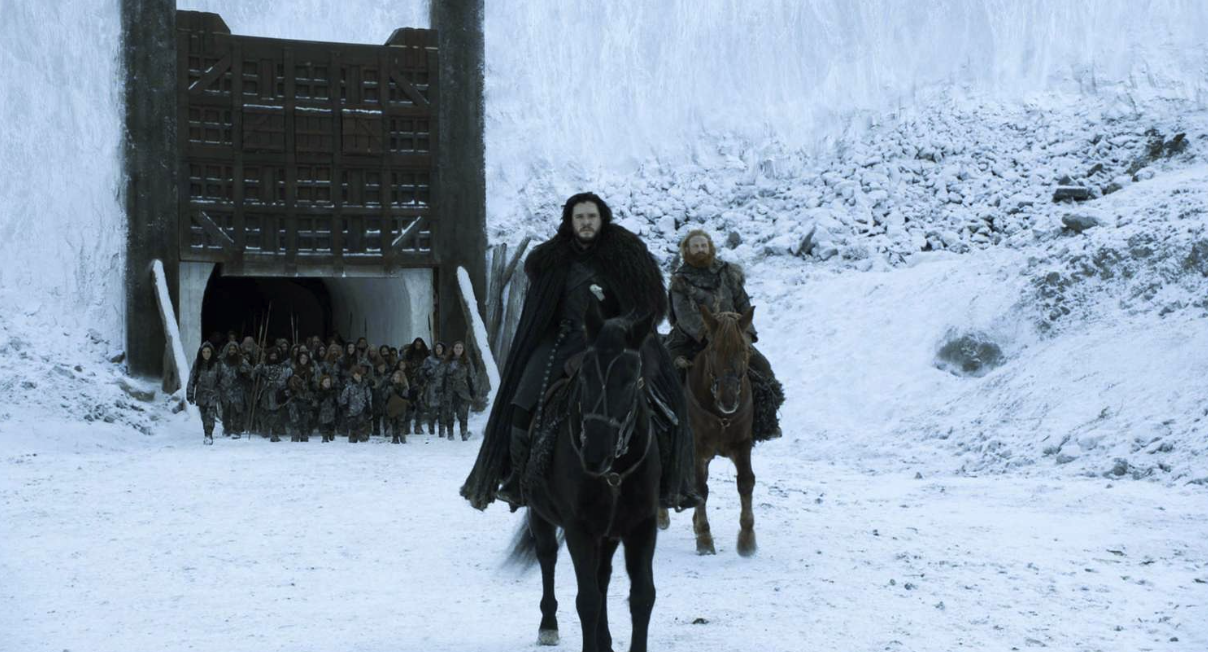
The White Walkers are gone. The Wall no longer guards against annihilation. The Night’s Watch is ritual memory at this point. Jon’s so-called punishment is hollow. And then he rides north anyway, beyond the Wall and into the open country of the Free Folk.
The gate closes.
He does not smile. He softens. That is not the face of a prisoner. That is the face of someone who has stopped fighting a story that never fit him.
The Free Folk do not crown by bloodline. Mance Rayder was king because people followed him. Jon will become the King Beyond the Wall not through proclamation but through alignment, by simply being the one who steps forward when things need doing, and having people look around and realize they have been following him all along. He will accept it reluctantly. Not with relish. That is how he has always led.
Beyond the Wall, there is no Aegon Targaryen. No King in the North. No political symbol requiring constant performance. Just Jon. Possibly for the first time in his life.
There is something to sit with in that. The reward for carrying an impossible burden is freedom from it. The Lord of Light brought him back for a reason. That reason is spent. The north is his Avalon.
The Cycle and the Question It Asks Us
Here is where the myth opens into something larger than Westeros.
Every generation in this world produces a crisis that demands a hero. Every hero sacrifices. The throne survives. The cycle resets. And eventually, when the next apocalypse arrives, someone rides north again to find the Reluctant King and beg him to come back.
That is the pattern. Throne, ambition, betrayal, catastrophe. Repeat.
Drogon melting the Iron Throne cracks that pattern open. It suggests the cycle can end. But only if the realm stops projecting its salvation outward. Only if it stops asking the reluctant savior to solve what the realm itself created.
This is the archetypal teaching of individuation. We cannot keep outsourcing our inner work to a hero. At some point the projection must be withdrawn. The shadow must be integrated rather than burned into someone else’s city.
Daenerys externalizes her wound into conquest. Jon internalizes his wound into sacrifice. The myth asks whether the realm, whether we, can learn to hold both. Can sovereignty exist without needing domination to feel safe? Can leadership be held lightly?
Jon beyond the Wall suggests it is possible. He leads because the situation requires it, not because power completes him. He walks away because he can. That is mature sovereignty. That is what it looks like when the archetype is integrated rather than inflated.
Discover more from soulcruzer
Subscribe to get the latest posts sent to your email.