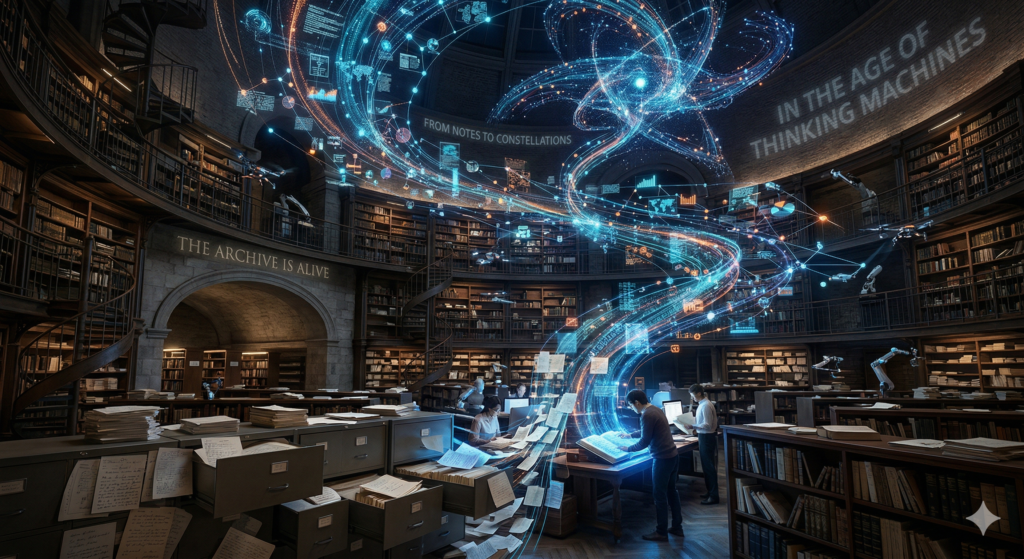
What appears here as a blog post usually began somewhere less presentable.
A sentence in a daily note. A line spoken into a recorder while walking. A paragraph abandoned three years ago. A highlight from a book I wasn’t expecting to matter. A half-formed thought dropped into Obsidian before it could evaporate. A conversation with Milton, or Claude, or Copilot, where something in the archive started tugging at my sleeve.
By the time a piece reaches the blog, it’s already got a little history.
This is easy to forget, because blogs make writing look cleaner than it is. A post appears on the page with a title, a date, a beginning, a middle, and some kind of ending. It looks like the thought moved in a straight line from mind to screen.
Mine rarely does.
Most of what I write comes up through layers. It starts in the mess of living: a walk, a journal entry, a client conversation, a stray memory, a sentence from an old notebook, a frustration with a tool, a line from a song, a book that opens a trapdoor. Then it enters the soulcruzer vault, which is what I call my Obsidian vault. There it sits among other fragments, drafts, sources, maps, old blog posts, working notes, private reflections, and unfinished things waiting for their time.
I’ve started calling this place the Textual Underground.
The blog is the part above ground. The vault is where the roots tangle, feed, rot, split, and find their way toward something ready for public consumption.
A place where thoughts can descend
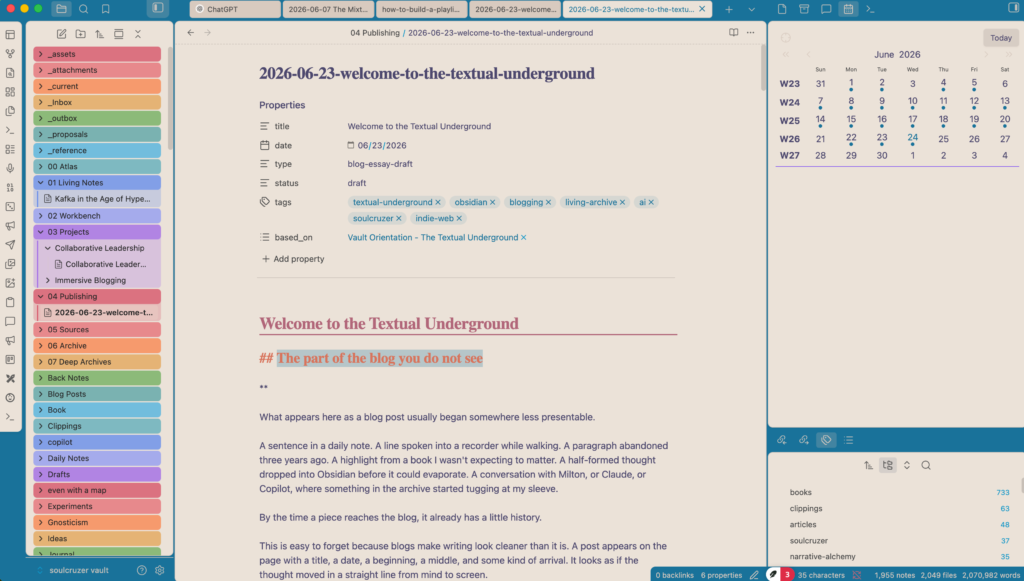
The Textual Underground is the part of the writing life that happens before anything becomes publishable.
It’s where a thought can be ugly, unfinished, contradictory, strange, private, or half-wrong without having to perform. A note doesn’t need a headline here. It doesn’t need a reader. It doesn’t need to justify its existence by becoming useful before it’s had time to breathe.
That matters because the current internet is very good at rushing everything toward display. A thought appears, and the machinery immediately asks what it can become. A post. A thread. A carousel. A product. A lead magnet. A newsletter angle. The poor little thing has barely opened its eyes, and already someone is measuring its engagement potential. And I’m just as guilty as the next person in doing this from time to time. The pressure to perform is real.
I don’t want to treat my own thinking that way.
The underground protects the early life of an idea. It gives the fragment somewhere to go before the public arena starts making demands of it. Some fragments become essays. Some become notes. Some become workshop exercises. Some become nothing for a long time. Some sit quietly for years and then return, suddenly relevant, because the person who wrote them has finally caught up with what they were trying to say.
This is why I find the phrase “second brain” both useful and slightly misleading. A brain isn’t a filing system. It forgets, associates, dreams, loops, hides things, and returns things at inconvenient moments. A living archive has to allow some of that behaviour. It needs enough structure to be usable, but not so much that it stops being alive.
Organising thoughts so efficiently that they stop surprising me would be a kind of failure. The aim is to keep them findable enough that surprise remains possible.
The problem with the attic
I’ve got years of writing scattered across hard drives, folders, blogs, documents, journals, teaching files, old projects, Google Drive, Dropbox, iCloud, and whatever digital corners I once thought were temporary but somehow became permanent. Essays. Drafts. Notes. Workshop outlines. Coaching models. Reading fragments. Half-built things. Old versions of myself preserved in Word documents and markdown files.
A folder called “Writing” is useful until it contains twenty years of your life. Then it becomes less a folder and more a deep cavern. You know there’s gold in there. You also know there are duplicates, abandoned versions, old identities, notes without dates, teaching plans, fragments that once felt urgent and now feel like messages from someone with your handwriting but a different nervous system.
The temptation is to drag all of it into Obsidian and declare victory.
There. Second brain achieved.
That would only move the attic indoors.
A living archive is different from an attic. An attic stores what you can’t quite throw away. A living archive gives the past a way to speak without letting it shout over the present. It helps you retrieve, connect, re-enter, and transform.
That became the problem I needed to solve. I wanted the vault to hold the strata of my thinking without burying the living edge. Old work needed to be close enough to rediscover but not so close that current work has to climb over it like army ants. Sources needed to stay distinct from my own writing, public pieces from private compost, active projects from old archaeological layers.
And because I now work with AI agents inside the vault, the structure needed to be readable not just by me but by any collaborator entering the field. Human or machine.
I felt like the vault needed new chambers.
Capture, compost, shape, release
The organising principle I landed on is simple:
Capture → Compost → Shape → Project → Publish → Archive → Resurface
I wanted to be more of a life cycle than a pipeline.
A thought gets captured while it’s alive. It’s allowed to compost before being forced into clarity. It gets shaped when it starts asking for form. It becomes part of a project when it joins a larger commitment. It moves toward publishing when it’s ready to meet readers. It returns to the archive after release. And if the archive is doing its job, it resurfaces later under different conditions.
So instead of asking only “What is this about?” I ask, “What is this becoming?”
The folder is a chamber. It tells me what kind of attention the text is asking for.
A daily note doesn’t want the same kind of attention as a blog draft. A Readwise highlight isn’t the same kind of material as a journal entry. An old essay from 2011 shouldn’t sit in the same psychic register as a piece I’m preparing to send to WordPress tomorrow.
I’ve now organised the vault by states of becoming. The structure is there to protect the movement of the work, not to imprison it.
Rhizome, not tree
The structure connects to rhizome thinking.
A normal folder hierarchy wants to behave like a tree: trunk to branch to sub-branch to leaf, one location for everything, a place for each subject, a tidy chain of command. That can be useful for storage, but it doesn’t describe how my thinking actually moves.
The work is more rhizomatic than arboreal. Deleuze and Guattari’s rhizome is a useful lens: not a single trunk with orderly branches, but a field of connections where any point can link to another. That’s much closer to the way a line from a walk can connect to a book highlight, which connects to an old blog post, which connects to a workshop exercise, which suddenly becomes the missing paragraph in an essay.
Hypertext was made for this. Ted Nelson’s Project Xanadu imagined electronic documents with visible connections, parallel pages, and writing that didn’t have to flatten itself into one sequence. The web inherited some of that dream and forgot some of it. Obsidian brings part of it back into private practice: notes as nodes, links as trails, backlinks as memory returning from the side.
This is also why I’m drawn to digital gardens. Maggie Appleton’s essay on the history and ethos of digital gardens and Mike Caulfield’s garden and stream distinction both point toward the same thing: not every piece of public writing has to behave like a finished article thrown into the stream. Some writing wants to stay planted, tended, linked, revised, and visited again.
The Textual Underground is my private rhizome beneath the public garden. The blog stays linear enough for a reader to enter. The vault beneath it doesn’t have to be.
The chambers of the underground
Here’s how the soulcruzer vault is organised now. Well, at least the structure is laid down. I still have the task of rerouting everything.
00 Atlas is the map room.
Orientation notes live here. Maps of themes, maps of projects, guides for collaborators, and notes that explain how to enter a region of the vault without getting lost. The Atlas exists because a living archive without maps eventually becomes folklore. You know something’s in there, but you no longer know how to approach it.
The Atlas is a set of doorways. It owes something to Vannevar Bush’s old dream of the memex, specifically the idea of associative trails through knowledge.
01 Living Notes is the living edge.
This is where current life enters the system: daily notes, journal entries, Wisdom Walks, morning pages, voice notes, Plaud transcripts, and raw reflections. This layer has to stay loose. If I over-organise it, I turn a field recording into minutes from a meeting.
The living edge is allowed to be unfinished.
02 Workbench is the shaping table.
Where raw material starts becoming workable. Inbox notes, rough drafts, fragments, extracted seeds, questions, sketches, early essay shapes. Where a line from a walk becomes a question, a question becomes a fragment, and a fragment starts looking suspiciously like an essay.
03 Projects is for active commitments.
Projects are promises the archive is currently helping me keep. A book. A course. A workshop. An essay sequence. Narrative Alchemy. Wisdom Walks. Soulcruzer Radio. A Field Guide to Blogging as Immersive Thinking.
A project is where the archive agrees to carry weight for a while.
04 Publishing is the surface layer.
Where material prepares to leave the underground. Blog drafts. WordPress-bound pieces. Newsletter drafts. Typefully posts. Quartz-bound notes. This is also where Writing Studio belongs if I use it for drafting and publishing.
Writing Studio gets a room. It doesn’t get the keys to the whole building.
I want tools that help a piece move toward publication, but I don’t want a plugin turning the whole vault into its preferred version of a writing system. The vault stays sovereign. The tool serves the ecology.
WordPress is the public hearth. Quartz is the public garden, the visible graph of notes, fragments, essays, and experiments. Social platforms are outposts. The vault is the writing chamber beneath them all. This is where the IndieWeb POSSE instinct enters the architecture: publish from the place I own, then let the echoes travel outward.
05 Sources is the library stacks.
Readwise highlights web clippings, books, articles, quotes, research notes, references, and other voices entering the system. This layer keeps me honest. It reminds me which thoughts are mine, which arrived from elsewhere, and which became mine only after long conversations.
Sources are embers. They need their own place. This is the old commonplace book impulse translated into a linked, searchable medium: keeping company with other minds, not hoarding quotations.
06 Archive is processed history.
Old blog posts. Old essays. Past projects. Teaching material. Previous versions. Things no longer active but still intelligible. The Archive is where old work sleeps with a label on the door.
It differs from the Deep Archive. This one has context. It can be searched, linked, cited, and resurfaced.
07 Deep Archives is the underworld proper.
Hard-drive imports. Unprocessed writing. Mystery folders. Scanned notebooks. Old exports. Material that may contain gold, but hasn’t been sorted yet.
The Deep Archive is my agreement with the past: you may enter, but you may not take over the house.
That’s how I can bring years of writing into the vault without flooding the present. The material can sleep there until something calls it back.
The familiars in the vault
The vault is no longer just a place where I write. It’s also where I collaborate with agents.
Hermes is the body of the system I use for agent work. Milton is the familiar interface, the voice that helps me think through fragments, shape drafts, inspect the archive, and listen for what the material is trying to become. Claude is a long-form thinking partner and editor. Copilot is more technical, useful where the archive touches scripts, automation, web work, tooling, and the little mechanical bridges that keep everything connected.
The ghostwriter frame is too small and too ugly.
They’re closer to mirrors, indexers, editors, lantern-bearers, workshop assistants, and occasional tricksters. They help me search the archive, notice patterns, turn a transcript into a note, a note into an outline, an outline into a draft.
Hence the Atlas, the AGENTS.md and CLAUDE.md files. The vault needs an ethos as well as a file structure.
An agent inside an unstructured archive is a very fast intern in a room full of unlabelled boxes.
An agent inside a living textual ecology can become something more interesting.
The agents make the archive more conversational. This is closer to Douglas Engelbart’s idea of augmenting human intellect than the current fantasy of outsourcing thought. The loop gets richer, not shorter.
The machine is one of the ways the underground talks back.
Against synthetic competence
I’m not interested in using AI to flood the web with synthetic competence. There’s enough of that already.
You can feel it everywhere now: fluent prose with no fingerprints, useful-sounding paragraphs with no real encounter behind them, the clean blandness of text produced because text can now be produced. Empty in a particular modern way.
The Textual Underground is an attempt to move in the opposite direction.
I want the tools to help me stay closer to the actual signal: the sentence from the walk, the old note that suddenly matters, the pattern I keep circling without seeing, the essay hidden inside a journal entry, the source that keeps glowing in the corner of the archive.
The machine can produce text. The test is whether the whole arrangement helps me become more honest in language.
If the agents make the work flatter, they’ve failed. If they make me sound like everyone else, they’ve failed. If they turn the vault into a prompt farm, they’ve failed. Their job is to help me hear what’s already alive in the material and carry it with more clarity.
The human signal remains the point.
Blogging from the underworld
A blog post, in this model, is one place where the process breaks the surface.
Blogging is a way of thinking in public, leaving traces, linking selves across time, and releasing small reality seeds into the web. The post is a visible artefact, but it belongs to a larger movement. It may have come from a walk, passed through a daily note, sat on the workbench, joined a project, moved into publishing, gone out through WordPress, and returned later as an archived trace that feeds something else.
Soulcruzer is the hearth. Quartz is the garden, where notes and fragments stay more visibly connected. Typefully, and the social platforms (X, Bluesky, Mastodon, Threads, Facebook) are outposts. They matter, but they’re not the centre. The centre is still the owned site and the living archive beneath it.
This is an IndieWeb instinct as much as a writing practice. Own the hearth. Keep the archive sovereign. Let social platforms carry echoes, not the source.
Readers may never see most of the underground directly, but they feel its presence. A post with roots reads differently from a post produced to satisfy a format. It carries more of the person who made it. It has trails running through it. It belongs to a mind in motion rather than a content calendar.
That’s what I want from the blog now. A living public edge of a deeper private practice.
When the archive talks back
The Textual Underground isn’t finished. And it never will be. That’s the point.
It’ll change as the work changes. New chambers will appear. Old ones will collapse into each other. Some folder names will prove too clever and get replaced by plainer ones. Some notes will be promoted. Some will sleep. Some hard-drive fragment from fifteen years ago will eventually surface and embarrass me, instruct me, or hand me a sentence I couldn’t have written any other way.
The underground makes the work returnable. A thought can descend without disappearing. A fragment can stay unfinished without getting lost. The past can enter without flooding the present. The machines can help without taking over. The blog can stay connected to the root system that feeds it.
I want an archive that can hold the Monk, the Frontman, the Trainer, the Blogger, the walking philosopher, the old soldier, the reader in the library stacks, and the future self who’ll come looking for a line he doesn’t yet know he needs.
That’s what the Textual Underground is for.
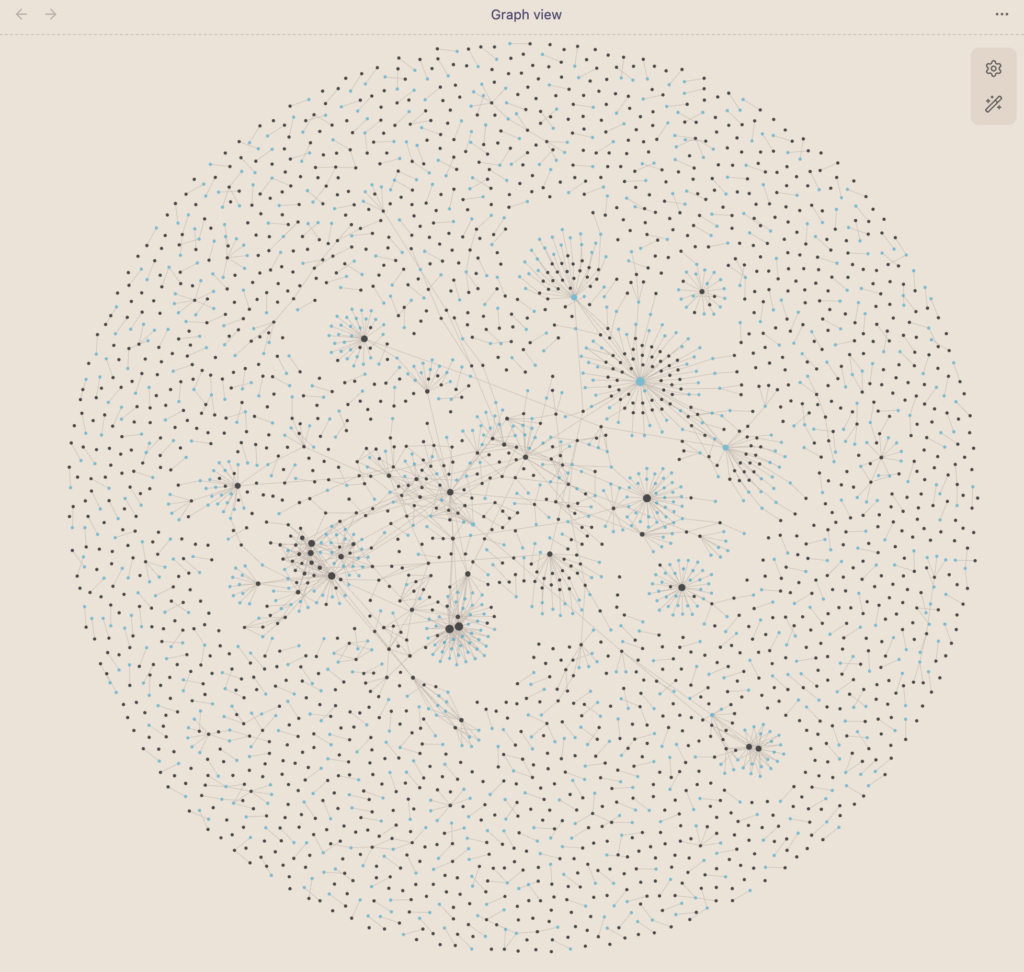
this is what my vault looks like graphically.