
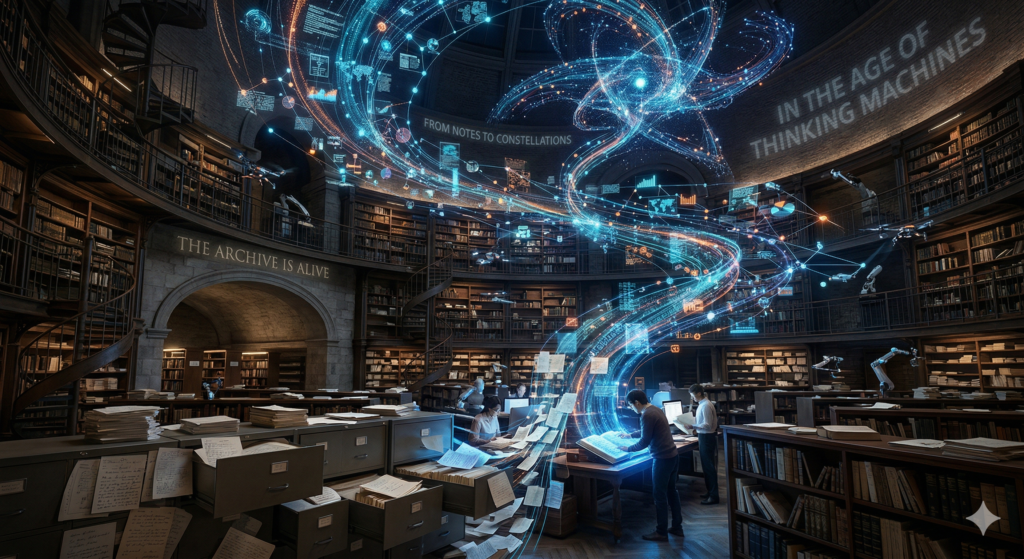
From Notes to Constellations in the Age of Thinking Machines
I opened Obsidian expecting to find a note I’d written three months earlier about liminality and threshold states. What I found instead was a cluster of connections I hadn’t consciously built. Six notes reaching backward through NLP reframe patterns, Jungian individuation, and something I’d scribbled at midnight about rivers carving canyons. The note I was looking for was there. But it was not alone. It was alive inside a web I had been unconsciously weaving for months without knowing I was doing it.
I thought I was building a second brain.
What I found was something that talked back.
This is the discovery that a personal knowledge system quietly springs on you, if you stay long enough and go deep enough. The archive is no longer a place where knowledge is stored. It is a conversational field of memory where meaning is continuously re-authored. The philosophers have been circling this question for decades. What is the archive, really? Now the tools have caught up with the theory, and the question is no longer abstract.

The classical dream of the personal knowledge system is seductive precisely because it is so orderly. You capture everything. You tag, you nest, you link. You choose between PARA and Zettelkasten and spend more time than you’d like to admit deciding how you feel about folders. You read Sönke Ahrens on the slip-box and resolve to be more systematic. You restructure the vault on a Saturday and feel, briefly, that the work of understanding is mostly a problem of organisation. If you could only get everything in the right place, it would add up to something.
This is the animating belief of the productivity-as-optimisation culture that has grown up around tools like Notion, Roam, Obsidian, and Logseq: knowledge is an asset, and like any asset, it compounds when well managed. The second brain becomes an internal balance sheet. Information in, insights out.
But here is what that model gets wrong. Structure is not insight. Storage is not meaning. You can build the most elegant taxonomy in the world and still have nothing to say. You can tag a hundred notes about identity and transformation and still not understand what they are pointing toward. The organisation gestures at meaning without producing it.
Vannevar Bush understood this in 1945. In “As We May Think,” he imagined the Memex — a device for associative retrieval rather than categorical filing. The human mind, he observed, does not operate by indexes. It operates by association. One idea instantly suggests another along a web of connections traced through thought, experience, and analogy. Every attempt to impose a hierarchical structure on that web is, at some level, a suppression of how thinking actually moves.
The Zettelkasten preserves one version of this insight. Luhmann’s slip-box was not an archive in the traditional sense. It was a dialogue partner. Notes were written to talk to other notes. The system was designed to surprise you. But it was still static. The notes did not respond. They had to be arranged and read into relationship by a human doing the connecting.
Something strange happens when the system becomes dense enough. The dots begin to behave differently.
There is a useful image for what happens next: notes that began as isolated dots, over time, form constellations. And constellations have a fractal quality — the patterns at one scale recur at another. A thought about grief turns out to have the same structural shape as a thought about creative block. A note on alchemical transformation echoes a note on narrative identity written eight months later, by what felt like a different version of the writer. The resonance is real. The geometry repeats.
Obsidian makes this visible. The graph view, the backlinks, the quiet surfacing of related notes as you type — these are not just navigation aids. They are mirrors. You begin to see not just what you have been collecting but what you have been circling. The recurring themes, the obsessions beneath the surface interests, the deep attractor patterns in your own thinking.
This is where hypertext promised to take us in the 1990s. Ted Nelson’s vision of a docuverse was, at its heart, a vision of associative, non-linear knowledge. The link was meant to be generative. One document pointing to another, pointing to another, creating a topology of meaning rather than a sequence. Jorge Luis Borges had already written it, in the Library of Babel, as fiction: a total archive containing all possible books, which becomes not a resource but a labyrinth, precisely because it lacks any principle of living connection.
The limitation of hypertext was that it was static. The documents did not synthesise. They pointed, but they did not speak. Connections were visible if you chose to traverse them, but meaning had to be assembled by hand and stayed assembled only for as long as the reader held it in their head.
That is what changes with language models.
When you bring an LLM into relationship with your archive, you are not adding a search function. You are adding a participant.
This distinction is the one that matters. A search engine finds what you already know you’re looking for. A conversational layer finds what you didn’t know was there. It surfaces patterns across notes you wrote years apart. It suggests that the thing you’ve been calling a problem is structurally identical to something you solved in a different domain three years ago. It reads your own thinking back to you in a way that reveals its architecture rather than merely its contents.
The archive becomes conversational. Memory becomes dynamic. Interpretation becomes iterative. Insight becomes emergent — not retrieved from storage, but generated in the encounter between past thinking and a present question.
This is what I mean by a conversational field of memory where meaning is continuously re-authored. The word field matters here. A field is not a container. It is a zone of interaction, with its own dynamics, its own resonances, its own strange attractors. When you enter the archive now, you do not simply retrieve. You stir the field. And the field responds.
Derrida, in Archive Fever, writes that the archive is always about the future as much as the past. The drive to archive is a drive toward what will have been — a structuring of the present so that some version of it persists. What he could not have anticipated is a system in which the archive does not merely persist but actively interprets itself. In which the past becomes material for ongoing sense-making rather than fixed record.
Foucault understood the archive not as a library but as a system of enunciability — the set of conditions that determines what can be said, and how. The LLM-augmented archive is, in a precise sense, a new system of enunciability. It changes not just what you can find. It changes what you can think.
Andrej Karpathy has been approaching this from the other direction. His LLM-Wiki proposal is a structured, densely interlinked knowledge document designed not for human navigation but for LLM ingestion — and the insight is precise. Most of the web was built for human readers. The formatting, the cross-references, the implied context: all of it assumes a reader who arrives with background knowledge and can resolve ambiguity on the fly. LLMs can do this too, but they do it better when the structure is explicit, the connections are surfaced, and the material is dense with meaning rather than optimised for search engines.
The practical move Karpathy proposes is to build your knowledge base as a document an LLM can reason over well. Not a folder of notes. A living interface over your own thinking.
I built a version of this using Claude Code — feeding my Obsidian vault into a structured interface that can be queried conversationally. The notes remain where they are. But I am no longer searching them. I am querying my mind-in-time.
The difference is not small. When I search my notes, I retrieve answers I already had. When I query the living archive, I generate understanding I am only arriving at now. The LLM does three things that transform the experience: it summarises across notes I would never read together, it connects ideas across domains I have kept artificially separate, and it reframes familiar material in ways that make the obvious suddenly strange. That third function is underrated. The ability to take something you have been staring at and rotate it so the light falls differently — that is not retrieval. It is cognition. And now it is available as a collaborative act between the writer and the machine.
If you want to work in a living archive rather than a static one, five moves will serve you.
Write for resonance, not retrieval. The note you are writing is not a document to be filed. It is a signal sent into a field. Write in a way that will vibrate against other notes, other ideas, other versions of your thinking. Forget the tag. Find the language that carries the feeling of the idea, even if the feeling is only half-formed.
Use links lightly and trust emergence. Over-tagging is a way of imposing premature closure. When everything is labelled, nothing is discovered. Leave space for the system to surprise you. The connections you did not make deliberately are often the most generative.
Ask better questions than you store answers. The archive is not an answer bank. It is a question generator. When you bring a language model into the conversation, the most productive prompts are not “summarise my notes on X” but the harder ones: what patterns am I missing here, where have I thought this before, what is the deeper narrative running through this cluster? These questions invite the system to do what it does best — read across the grain of your own thinking.
Use the AI as a pattern amplifier, not an authority. It surfaces connections. It does not define truth. The interpretation is still yours. What the model offers is a kind of cognitive peripheral vision — it sees things you are too close to see. The judgement about what matters belongs to you.
Treat old notes as living material. A note from three years ago is not a document. It is an artefact of the person you were then. When you read it now, you read it differently. When you query it through an LLM, you read it differently again. Let it evolve. The meaning is not fixed in the text. It lives in the encounter.
There is a risk here, and it is worth naming directly.
The more fluent you become in working with a conversational archive, the easier it is to mistake the system’s interpretation for your own thinking. The LLM surfaces a pattern, and you accept it. It suggests a connection, and you stop asking whether that connection is right. You begin navigating by the model’s map rather than your own perception of the territory.
This is narrative drift applied to cognition. You outsource interpretation and gradually lose authorship — not of your notes, but of your mind. The archive starts writing you.
Identity, in the depth psychology tradition, is not a fixed entity. It is a narrative. We are the stories we tell about ourselves, and those stories are formed through interpretation, through the ongoing act of meaning-making that is never fully conscious and never fully finished. If you hand that act entirely to a machine, you have not augmented your intelligence. You have abdicated the most important part of it.
The archive should be a collaborator. The distinction requires vigilance, and it requires that you bring your own reading — your own felt sense of what resonates, what rings true, what sits wrong — to every encounter with the system. The machine reads widely. Only you know what matters.
Which brings us to what I think is the deepest possibility inside all of this.
When I return to a note I wrote two years ago, I am not simply reading it. I am rewriting it. Not the words — the meaning. The same language, filtered through everything that has happened since, becomes something different. Something that could not have existed when the words were first laid down.
This is narrative alchemy. The revisiting of notes changes their meaning. The change in meaning changes the story you tell about yourself. The change in story changes who you are in the present, which changes what you do next. The archive is not preserving the past. It is continuously rewriting it.
That rewriting is where identity work actually happens — not in the dramatic moments of crisis or breakthrough, but in the quiet, iterative act of returning to old material and finding it transformed by new context. Metajournaling is a practice built on this principle. You do not merely journal; you journal about your journal. You read your past self as a text. You ask what the patterns meant, what stories were running beneath the surface, what the earlier you was trying to work out.
The LLM-augmented archive makes this practice deeper. The machine can read your past self more thoroughly than you can, across more notes over more time, with less of the psychological resistance that makes us skim past the uncomfortable entries. It holds the whole field steady while you do the interpretive work.
Walter Benjamin wrote about the constellation as a method for reading history — not as a sequence of causes and effects, but as a sudden flash of recognition in which distant moments illuminate each other across time. The dialectical image: the past and present colliding in a single, charged instant of understanding. That is what the living archive makes possible, not as an occasional accident, but as a practice, as a way of working deliberately with your own intellectual life.
What is emerging here is a genuinely different mode of thinking.
The old mode was linear, fixed, and archival. You wrote something down. It stayed where you put it. You retrieved it when you needed it. Meaning was deposited in documents and extracted from documents. The knower and the archive were separate, the archive passive, the knower doing all the moving.
The new mode is associative, conversational, and generative. Thinking is no longer solitary. It is co-evolutionary — a dynamic between the human and the machine, between the present self and the recorded past, between the single note and the constellation it belongs to without knowing it. The knower and the archive are in dialogue. The boundary between them is porous and productive.
This does not mean thought has been automated. It means the conditions for thought have changed. The field in which thinking occurs has new properties. It is denser, more resonant, more responsive. Ideas find each other faster. Patterns surface that would have stayed buried for years, or stayed buried forever. The question of who is thinking is genuinely more interesting than it used to be.
I came back to the note I was looking for.
Liminality. Threshold states. The moment between what you were and what you are becoming.
I found it in the middle of a constellation I had not noticed I was building. Six notes deep in a web of connections that only made sense because I could see all of them at once — because the archive had held them together long enough for the shape to surface.
You are not building a second brain. You are cultivating a living system of meaning.
A second brain is still a tool. It is external, supplementing you, doing your retrieval so your biological memory can rest. A living archive is something different. It is a relationship. It has its own texture, its own history, its own dynamics. You change it every time you write in it. It changes you every time you re-enter it.
Not a library. Not a database. A landscape you walk through, and which is altered by the walking.
The archive is alive. And every time you enter it, it becomes something new — because so do you.
Discover more from soulcruzer
Subscribe to get the latest posts sent to your email.