













(The Wisdom of Death)
There’s a moment when you realize that what you thought was the end was actually just a transformation. That what looked like death was actually radical metamorphosis. That the dissolution you’ve been fearing or grieving or trying to avoid is the very mechanism by which something more whole, more real, more essentially you can finally emerge. This isn’t comfort. This isn’t denial. This is the brutal, beautiful recognition that death in its truest sense is not cessation but change so complete that nothing of the old form remains.
This is Achamoth’s domain.
Everything casts a shadow. That is cosmic law. This includes Sophia. In Gnostic sagas, the Aeon Sophia commits a transgression against the Pleroma and is cast into the Chaos. In a state of distress and pregnant with dysfunctional feelings, she gives birth to the Demiurge and matter itself. Only Sophia’s negative side is cast out in some systems, known as Achamoth or the Wisdom of Death.
Like the wisdom of humans, she can be as dark and wounded as she is determined and curious. She is Anath or Sekhmet to the Gnostics, just as her higher self is Asherah. Some myths depict Achamoth as Pronikus, the Lewd One, a seducer of archons and a cosmic femme fatale. She is with you every moment of your life, inviting you to transform if you would look up at the Pleroma and be filled with holy change.
Valentinus, one of the great Gnostic teachers, had a saying that cuts to the heart of Achamoth’s teaching: “Make death die.”
Not “escape death.” Not “transcend death.” Make death die. Transform the transformer. Let the very principle of ending itself come to an end through such complete transformation that nothing remains to die because everything has already been reborn.
Today, Achamoth arrives as our fifteenth companion, at the exact center of our journey, following John the Baptist’s teaching about suspension and necessary endings. Where John taught us to hang between worlds, Achamoth teaches us what happens when we finally let go completely, when the old form dies so thoroughly that transformation becomes inevitable, when we stop managing the process and allow death to do its sacred work.
The Advent Companion Appears
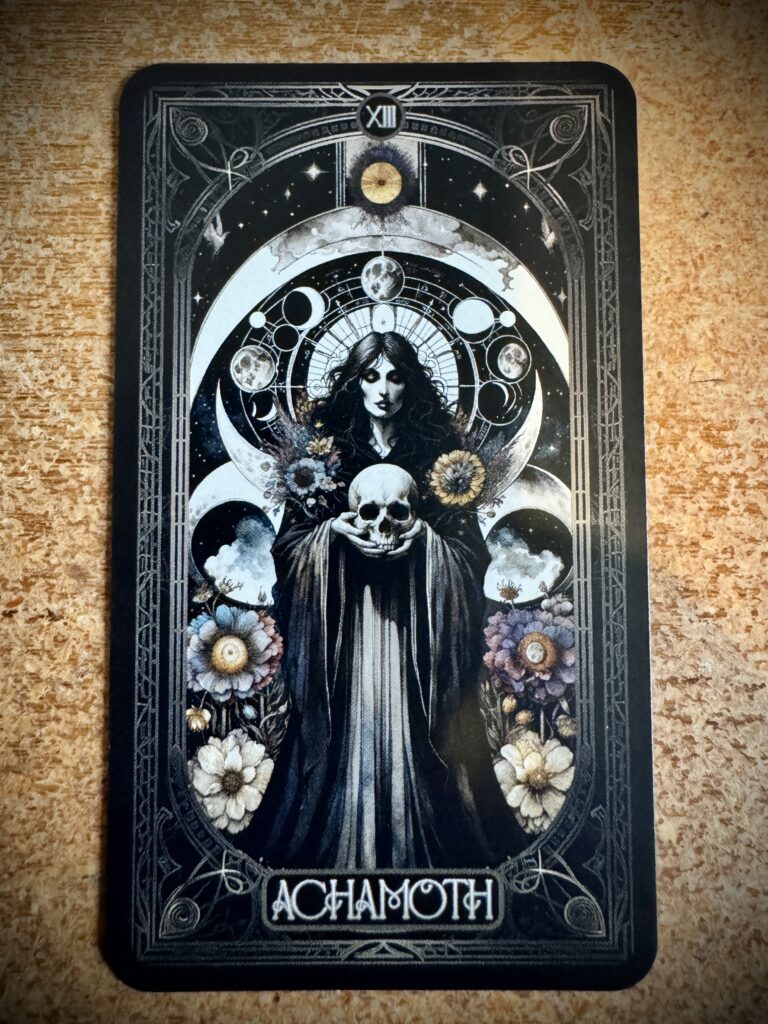
Achamoth doesn’t arrive gently or with comforting words. She appears as the presence of necessary death, as the quality of endings so complete they make room for genuine new beginnings. You feel her first not as threat but as invitation, not as enemy but as midwife, the one who knows that sometimes the most loving thing to do is allow what’s dying to die fully rather than prolonging its suffering.
She holds the skull with such tenderness. This is crucial. She’s not celebrating death as destruction. She’s honoring it as transformation, as the necessary dissolution that precedes all genuine rebirth. The flowers that surround her aren’t growing despite the darkness. They’re growing because of it. Death is their compost, their fertile ground, the very substance from which new life emerges.
The moon phases behind her tell the story: waxing, full, waning, dark, new again. The cycle never stops. Death is just one phase in an eternal pattern of transformation. But we fixate on it, fear it, try to avoid it, and in doing so we interrupt the natural flow that would carry us through death into rebirth.
Achamoth is Sophia’s shadow, her wounded aspect, the part that was cast into Chaos and had to learn how to create from distress, how to birth new forms from dysfunction, how to transform suffering into wisdom. This makes her uniquely qualified to teach about death because she knows it from the inside. She’s been through the dissolution. She’s experienced the casting out, the distress, the pregnant darkness that precedes new creation.
Some traditions call her the Wisdom of Death, distinguishing her from Sophia as the Wisdom of Life. But this is a false binary. Achamoth teaches that death is wisdom, that endings carry their own intelligence, that the capacity to let things die completely is as sacred as the capacity to birth new things. They’re not separate skills. They’re two aspects of the same transformative power.
She’s also called Pronikus, the Lewd One, the seducer of archons. This speaks to her radical agency in the face of cosmic oppression. Even cast out, even in distress, even pregnant with dysfunction, she doesn’t become passive. She works with what she has. She transforms her very woundedness into power. She seduces the archons not for their pleasure but to steal back fragments of divine light, to undermine their control from within.
As Achamoth appears beside you today, holding death with such reverence, her teaching arrives as both challenge and comfort:
“What if the death you’re resisting is the only path to the life you’re seeking? What if transformation requires you to die so completely to who you’ve been that nothing remains to resurrect, only space for something entirely new to be born?”
Teaching for the Day
We live in a death-denying culture. We medicate grief, pathologize mourning, turn away from endings, treat every loss as tragedy rather than transformation. We’re taught to fight death in all its forms, to resist aging, to preserve what’s dying, to never give up, never surrender, never let go. This creates a kind of living death where nothing is allowed to complete its natural cycle, where endings are interrupted before they can transform into new beginnings, where we carry the corpses of dead relationships, dead dreams, dead versions of ourselves because we never gave them permission to die fully.
Achamoth teaches something more radical: death is sacred. Not as punishment. Not as failure. But as the necessary mechanism of transformation. Everything that lives must die. Every form that arises must eventually dissolve. And fighting this natural law doesn’t preserve life. It just creates suffering.
“Make death die.” Valentinus understood something profound. The way to overcome death isn’t to avoid it but to transform so completely, so often, so thoroughly that death itself becomes obsolete. Not because you’ve escaped the cycle but because you’ve learned to flow with it so fluidly that the boundary between death and birth dissolves. You’re always dying. You’re always being born. And the distinction stops mattering because you recognize both as aspects of the same transformative process.
The archons want you terrified of death. They want you clinging to forms that have outlived their usefulness, trying to preserve what’s meant to decompose, afraid to let go because you can’t see what comes next. This fear makes you controllable. It keeps you small. It prevents the radical transformations that would liberate you from their programming.
But Achamoth, even in her fallen state, even cast into Chaos, demonstrates that transformation is always possible. That being wounded doesn’t mean being powerless. That even giving birth to dysfunction (the Demiurge, matter itself) can become part of a larger pattern of restoration. She doesn’t waste energy trying to undo her transgression or escape her shadow nature. She works with it, through it, transforms it into a different kind of power.
This is the teaching for today: what in your life needs to die? Not metaphorically. Not partially. Actually, completely, irrevocably die so that something new can be born in the space it occupied? And are you willing to stop managing that death, stop trying to control the transformation, stop preserving what’s meant to decompose?
The flowers grow in darkness. The moon wanes before it waxes. The seed must die for the plant to emerge. These aren’t metaphors. They’re descriptions of how transformation actually works. And you’re not exempt from this process. You’re subject to it, immersed in it, made possible by it.
Achamoth invites you to make death die by dying so completely, so consciously, so willingly that transformation becomes your natural state rather than something you resist. To let the old forms dissolve fully. To stop clinging to corpses. To honor endings as sacred rather than treating them as failures.
Journaling Invocation
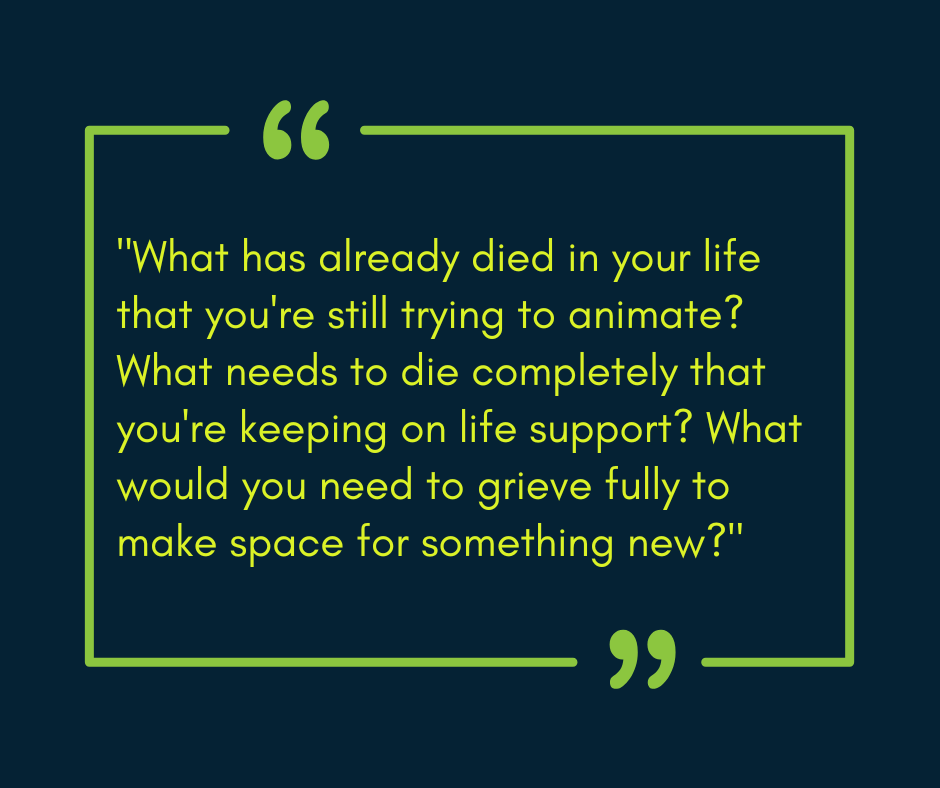
“What has already died in your life that you’re still trying to animate? What needs to die completely that you’re keeping on life support? What would you need to grieve fully to make space for something new?”
This question asks you to look honestly at the deaths you’ve been denying, the endings you’ve been avoiding, the losses you haven’t fully processed because you’re afraid of what comes after grieving completes.
Maybe it’s a relationship that ended months or years ago but you’re still rehearsing conversations with them in your head, still processing the loss as though it might reverse. Maybe it’s a dream that died, a path that closed, a version of yourself that can’t come back no matter how much you wish it could.
Or maybe it’s something subtler: a way of thinking about yourself, a belief about how life works, a strategy for staying safe that’s actually keeping you small. These things can die too. These deaths matter too.
Write about what’s already dead. Not what might die. Not what you’re afraid will die. What has already died but you haven’t fully acknowledged its death, haven’t grieved it completely, haven’t allowed yourself to feel the full weight of that ending.
Achamoth doesn’t ask you to celebrate these deaths or pretend they don’t hurt. She asks you to honor them, to let them be complete, to stop trying to resurrect what’s meant to become compost for new growth.
And then ask the deeper question: what wants to be born in the space that death will create? Not immediately. Not as replacement. But eventually, naturally, when the grieving completes and the ground becomes fertile again.
What becomes possible when you finally let death do its sacred work?
Small Embodied Practice
Find a small object that represents something that has died in your life. It could be a photo, a gift from a relationship that ended, a symbol of a dream that didn’t manifest, anything physical that connects to a real ending.
Hold it in your hands. Feel its weight. Let yourself feel whatever arises: grief, anger, relief, numbness, all of it.
Say out loud or internally: “This has died. I acknowledge its death. I honor what it was. I release what it can never be again.”
If you feel moved to, you might create a small ritual: bury the object, burn it (safely), place it in water, give it away. The specific action matters less than the intentionality. You’re marking the death as complete. You’re giving yourself permission to stop trying to resurrect it.
If creating a ritual doesn’t feel right, that’s okay too. Simply hold the object and breathe with the recognition that it represents something that has ended. Let your body feel what it means to acknowledge death rather than deny it.
After several minutes, place the object down (or complete whatever ritual you’ve chosen). Stand or sit in silence. Notice if there’s more space in your chest, your belly, your awareness. Often when we finally acknowledge death completely, we discover we’ve been holding tension we didn’t know was there.
This is Achamoth’s teaching embodied: death is not the enemy. Denial of death is the enemy. The refusal to grieve is the enemy. The clinging to corpses is the enemy.
You just practiced making death die by allowing death to be death.
Complete.
Sacred.
The necessary transformation that precedes all genuine new life.
The caravan moves together through death and rebirth. If today’s companion touched something in you, if Achamoth’s fierce tenderness helped you recognize what needs to die completely, let us know in the comments. Your willingness to grieve fully lights the path for others learning to let go beside you. 🌑
Tomorrow: Carpocrates arrives with his teaching about temperance, about the union of opposites, about finding the precious gem within by working with all of what you are.


[…] […]