The Gnostic Caravan Day 15: Achamoth (Death)

(The Wisdom of Death)

There’s a moment when you realize that what you thought was the end was actually just a transformation. That what looked like death was actually radical metamorphosis. That the dissolution you’ve been fearing or grieving or trying to avoid is the very mechanism by which something more whole, more real, more essentially you can finally emerge. This isn’t comfort. This isn’t denial. This is the brutal, beautiful recognition that death in its truest sense is not cessation but change so complete that nothing of the old form remains.

This is Achamoth’s domain.

Everything casts a shadow. That is cosmic law. This includes Sophia. In Gnostic sagas, the Aeon Sophia commits a transgression against the Pleroma and is cast into the Chaos. In a state of distress and pregnant with dysfunctional feelings, she gives birth to the Demiurge and matter itself. Only Sophia’s negative side is cast out in some systems, known as Achamoth or the Wisdom of Death.

Like the wisdom of humans, she can be as dark and wounded as she is determined and curious. She is Anath or Sekhmet to the Gnostics, just as her higher self is Asherah. Some myths depict Achamoth as Pronikus, the Lewd One, a seducer of archons and a cosmic femme fatale. She is with you every moment of your life, inviting you to transform if you would look up at the Pleroma and be filled with holy change.

Valentinus, one of the great Gnostic teachers, had a saying that cuts to the heart of Achamoth’s teaching: “Make death die.”

Not “escape death.” Not “transcend death.” Make death die. Transform the transformer. Let the very principle of ending itself come to an end through such complete transformation that nothing remains to die because everything has already been reborn.

Today, Achamoth arrives as our fifteenth companion, at the exact center of our journey, following John the Baptist’s teaching about suspension and necessary endings. Where John taught us to hang between worlds, Achamoth teaches us what happens when we finally let go completely, when the old form dies so thoroughly that transformation becomes inevitable, when we stop managing the process and allow death to do its sacred work.
Achamoth

The Advent Companion Appears

Achamoth doesn’t arrive gently or with comforting words. She appears as the presence of necessary death, as the quality of endings so complete they make room for genuine new beginnings. You feel her first not as threat but as invitation, not as enemy but as midwife, the one who knows that sometimes the most loving thing to do is allow what’s dying to die fully rather than prolonging its suffering.

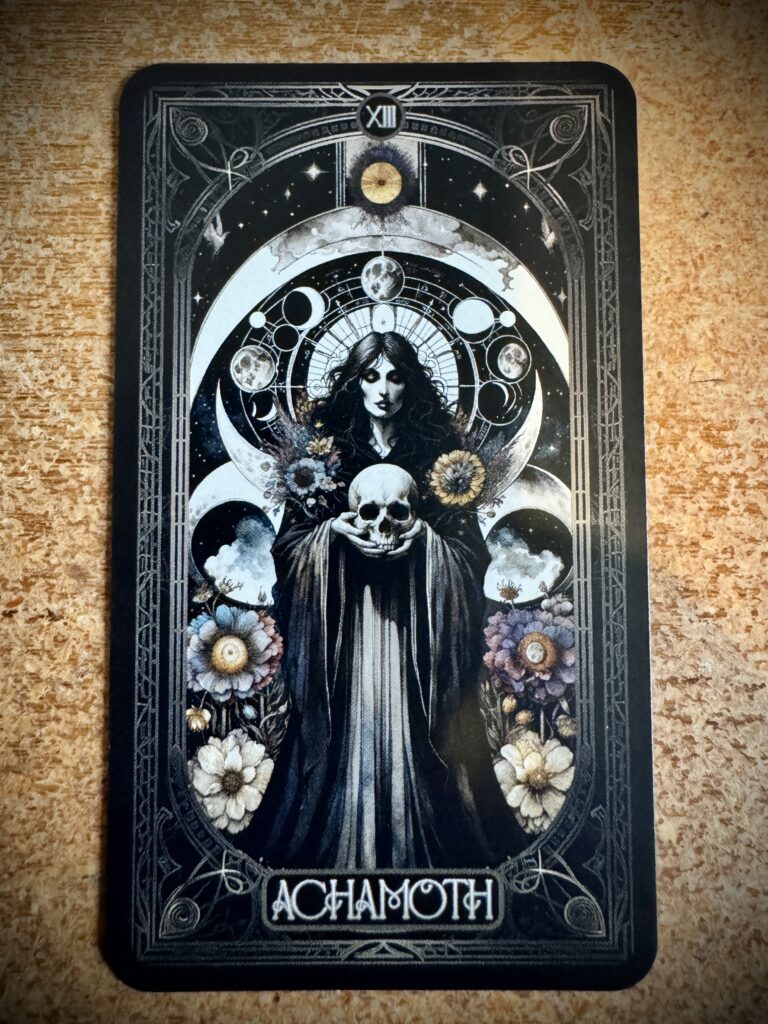
She holds the skull with such tenderness. This is crucial. She’s not celebrating death as destruction. She’s honoring it as transformation, as the necessary dissolution that precedes all genuine rebirth. The flowers that surround her aren’t growing despite the darkness. They’re growing because of it. Death is their compost, their fertile ground, the very substance from which new life emerges.

The moon phases behind her tell the story: waxing, full, waning, dark, new again. The cycle never stops. Death is just one phase in an eternal pattern of transformation. But we fixate on it, fear it, try to avoid it, and in doing so we interrupt the natural flow that would carry us through death into rebirth.

Achamoth is Sophia’s shadow, her wounded aspect, the part that was cast into Chaos and had to learn how to create from distress, how to birth new forms from dysfunction, how to transform suffering into wisdom. This makes her uniquely qualified to teach about death because she knows it from the inside. She’s been through the dissolution. She’s experienced the casting out, the distress, the pregnant darkness that precedes new creation.

Some traditions call her the Wisdom of Death, distinguishing her from Sophia as the Wisdom of Life. But this is a false binary. Achamoth teaches that death is wisdom, that endings carry their own intelligence, that the capacity to let things die completely is as sacred as the capacity to birth new things. They’re not separate skills. They’re two aspects of the same transformative power.

She’s also called Pronikus, the Lewd One, the seducer of archons. This speaks to her radical agency in the face of cosmic oppression. Even cast out, even in distress, even pregnant with dysfunction, she doesn’t become passive. She works with what she has. She transforms her very woundedness into power. She seduces the archons not for their pleasure but to steal back fragments of divine light, to undermine their control from within.

As Achamoth appears beside you today, holding death with such reverence, her teaching arrives as both challenge and comfort:

“What if the death you’re resisting is the only path to the life you’re seeking? What if transformation requires you to die so completely to who you’ve been that nothing remains to resurrect, only space for something entirely new to be born?”

Teaching for the Day

We live in a death-denying culture. We medicate grief, pathologize mourning, turn away from endings, treat every loss as tragedy rather than transformation. We’re taught to fight death in all its forms, to resist aging, to preserve what’s dying, to never give up, never surrender, never let go. This creates a kind of living death where nothing is allowed to complete its natural cycle, where endings are interrupted before they can transform into new beginnings, where we carry the corpses of dead relationships, dead dreams, dead versions of ourselves because we never gave them permission to die fully.

Achamoth teaches something more radical: death is sacred. Not as punishment. Not as failure. But as the necessary mechanism of transformation. Everything that lives must die. Every form that arises must eventually dissolve. And fighting this natural law doesn’t preserve life. It just creates suffering.

“Make death die.” Valentinus understood something profound. The way to overcome death isn’t to avoid it but to transform so completely, so often, so thoroughly that death itself becomes obsolete. Not because you’ve escaped the cycle but because you’ve learned to flow with it so fluidly that the boundary between death and birth dissolves. You’re always dying. You’re always being born. And the distinction stops mattering because you recognize both as aspects of the same transformative process.

The archons want you terrified of death. They want you clinging to forms that have outlived their usefulness, trying to preserve what’s meant to decompose, afraid to let go because you can’t see what comes next. This fear makes you controllable. It keeps you small. It prevents the radical transformations that would liberate you from their programming.

But Achamoth, even in her fallen state, even cast into Chaos, demonstrates that transformation is always possible. That being wounded doesn’t mean being powerless. That even giving birth to dysfunction (the Demiurge, matter itself) can become part of a larger pattern of restoration. She doesn’t waste energy trying to undo her transgression or escape her shadow nature. She works with it, through it, transforms it into a different kind of power.

This is the teaching for today: what in your life needs to die? Not metaphorically. Not partially. Actually, completely, irrevocably die so that something new can be born in the space it occupied? And are you willing to stop managing that death, stop trying to control the transformation, stop preserving what’s meant to decompose?

The flowers grow in darkness. The moon wanes before it waxes. The seed must die for the plant to emerge. These aren’t metaphors. They’re descriptions of how transformation actually works. And you’re not exempt from this process. You’re subject to it, immersed in it, made possible by it.

Achamoth invites you to make death die by dying so completely, so consciously, so willingly that transformation becomes your natural state rather than something you resist. To let the old forms dissolve fully. To stop clinging to corpses. To honor endings as sacred rather than treating them as failures.

Journaling Invocation
“What has already died in your life that you’re still trying to animate? What needs to die completely that you’re keeping on life support? What would you need to grieve fully to make space for something new?”

This question asks you to look honestly at the deaths you’ve been denying, the endings you’ve been avoiding, the losses you haven’t fully processed because you’re afraid of what comes after grieving completes.

Maybe it’s a relationship that ended months or years ago but you’re still rehearsing conversations with them in your head, still processing the loss as though it might reverse. Maybe it’s a dream that died, a path that closed, a version of yourself that can’t come back no matter how much you wish it could.

Or maybe it’s something subtler: a way of thinking about yourself, a belief about how life works, a strategy for staying safe that’s actually keeping you small. These things can die too. These deaths matter too.

Write about what’s already dead. Not what might die. Not what you’re afraid will die. What has already died but you haven’t fully acknowledged its death, haven’t grieved it completely, haven’t allowed yourself to feel the full weight of that ending.

Achamoth doesn’t ask you to celebrate these deaths or pretend they don’t hurt. She asks you to honor them, to let them be complete, to stop trying to resurrect what’s meant to become compost for new growth.

And then ask the deeper question: what wants to be born in the space that death will create? Not immediately. Not as replacement. But eventually, naturally, when the grieving completes and the ground becomes fertile again.

What becomes possible when you finally let death do its sacred work?

Small Embodied Practice

Find a small object that represents something that has died in your life. It could be a photo, a gift from a relationship that ended, a symbol of a dream that didn’t manifest, anything physical that connects to a real ending.

Hold it in your hands. Feel its weight. Let yourself feel whatever arises: grief, anger, relief, numbness, all of it.

Say out loud or internally: “This has died. I acknowledge its death. I honor what it was. I release what it can never be again.”

If you feel moved to, you might create a small ritual: bury the object, burn it (safely), place it in water, give it away. The specific action matters less than the intentionality. You’re marking the death as complete. You’re giving yourself permission to stop trying to resurrect it.

If creating a ritual doesn’t feel right, that’s okay too. Simply hold the object and breathe with the recognition that it represents something that has ended. Let your body feel what it means to acknowledge death rather than deny it.

After several minutes, place the object down (or complete whatever ritual you’ve chosen). Stand or sit in silence. Notice if there’s more space in your chest, your belly, your awareness. Often when we finally acknowledge death completely, we discover we’ve been holding tension we didn’t know was there.

This is Achamoth’s teaching embodied: death is not the enemy. Denial of death is the enemy. The refusal to grieve is the enemy. The clinging to corpses is the enemy.

You just practiced making death die by allowing death to be death.
Complete.
Sacred.
The necessary transformation that precedes all genuine new life.


The caravan moves together through death and rebirth. If today’s companion touched something in you, if Achamoth’s fierce tenderness helped you recognize what needs to die completely, let us know in the comments. Your willingness to grieve fully lights the path for others learning to let go beside you. 🌑

Tomorrow: Carpocrates arrives with his teaching about temperance, about the union of opposites, about finding the precious gem within by working with all of what you are.

The Gnostic Caravan Day 3: Simon Magus, the Magician’s Eye

The Magus

(The One Who Sees Through)

There’s a particular quality of attention that changes everything. Not the scattered awareness we bring to most of our days, half-present and reactive, but the focused beam of consciousness that cuts through appearances to reveal what’s actually happening beneath the surface. It’s the difference between looking at something and truly seeing it. Between hearing words and understanding what’s being said in the silence between them. Between accepting the story you’ve been told and recognizing the story that’s actually unfolding.

This is the terrain of Simon Magus.

In Gnostic mythology, Simon wasn’t just a magician in the stage-trick sense. He was a master of perception, someone who could see through the veils that keep most people trapped in consensus reality. The church fathers called him the Father of All Heresy1, which tells you everything you need to know about his power. He threatened the established order not with violence or rebellion, but with vision. He looked at the world everyone else accepted as fixed and saw the malleable, the fluid, the possible.

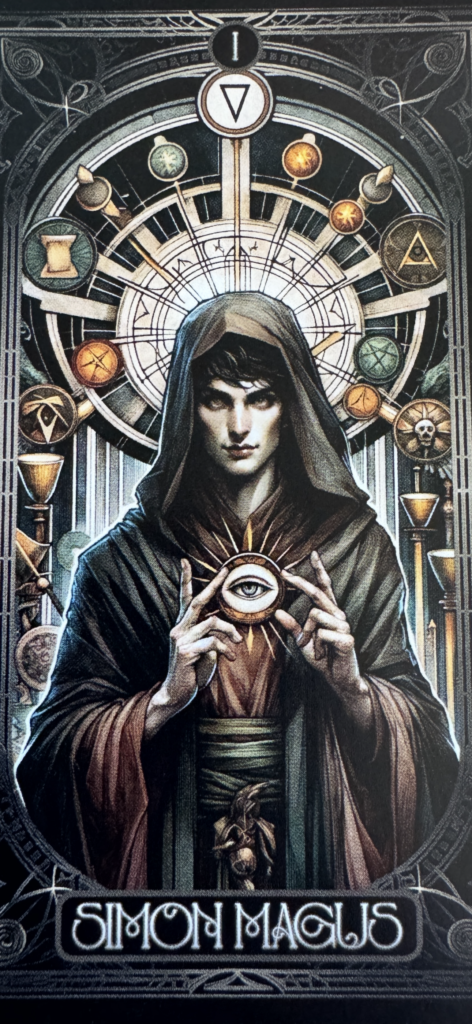
Behind that hooded gaze in the card, surrounded by alchemical symbols and cosmic wheels, Simon holds the all-seeing eye. Not as ornament or decoration, but as function. He is the one who perceives what others miss. The one who recognizes patterns where others see only chaos. The one who understands that reality is far more negotiable than the archons would have you believe.

Today, he arrives as the second true companion on our journey, following Sabaoth’s sovereign walk. Where Sabaoth taught us to move with calm certainty, Simon teaches us to see with penetrating clarity. Because you can’t walk your true path if you can’t see where you actually are. You can’t create change if you can’t perceive what needs changing. You can’t practice real magic if you’re still under the spell of someone else’s illusion.

The Advent Companion Appears

Simon Magus doesn’t announce himself with flash or spectacle, despite the legends that surround him. In this moment, he appears as concentrated presence, as the quality of attention itself. You feel him first as a sharpening of your own perception, a sudden clarity about something you’ve been looking at without really seeing.

Simon Magus

Behind his hood, that penetrating gaze asks nothing and demands nothing. It simply sees. And in being seen by someone who truly perceives, you begin to see yourself more clearly. The masks become visible as masks. The performances reveal themselves as performances. The stories you’ve been telling about who you are and what’s possible start to shimmer at their edges, showing their constructed nature.

Simon’s genius wasn’t that he possessed secret knowledge unavailable to others. His genius was that he looked directly at what everyone else had learned not to see. The divine spark hidden within the programmed self. The fluid nature of reality beneath its apparently solid surface. The power that lies dormant in human consciousness, waiting for someone brave enough to claim it.

The symbols surrounding him in the card aren’t mere decoration. They’re technologies of perception, each one a different lens for seeing through the simulation. The planetary spheres remind us that reality has layers, dimensions, frequencies. The elemental cups speak to the work of containing and directing energy. The eye itself, radiant and unblinking, represents the awakened consciousness that refuses to look away from truth.

As Simon appears beside you today, he brings a question that hums with quiet intensity:

“What have you been trained not to see? What truth has been hiding in plain sight, waiting for you to finally look directly at it?”

This isn’t about developing psychic powers or esoteric abilities, though Simon certainly mastered those arts. This is about something more fundamental: recovering your natural capacity to perceive clearly, to think independently, to recognize patterns that the dominant narrative has trained you to ignore.

Simon’s presence reminds you that you already have everything you need to see through the illusions that bind you. The only question is whether you’re willing to look.

Teaching for the Day

The archons maintain their control not through force but through managed perception. They don’t need to imprison you if they can convince you that the prison is the entire world. They don’t need to stop you from seeking truth if they can persuade you that truth is whatever the authorities decree. They don’t need to suppress your power if they can make you believe you were never powerful in the first place.

Simon Magus understood this completely. His “magic” wasn’t about manipulating external reality, though the legends certainly tell those stories. His deepest magic was perceptual: the ability to see through the constructed nature of consensus reality and recognize the divine potential that the archons work so hard to keep hidden.

The Gnostic teaching is clear on this point: you contain a spark of the divine, a fragment of the Pleroma itself. But that spark has been buried under layers of programming, social conditioning, inherited beliefs, and mechanical patterns of thought and behavior. The archons didn’t steal your divine nature. They convinced you it was never there in the first place.

Simon’s work, and now yours, is to develop the quality of attention that penetrates those layers. To look at your life, your beliefs, your automatic patterns with the kind of clear-eyed perception that doesn’t flinch from what it discovers. This requires both courage and gentleness. Courage because you will see things you’ve been avoiding. Gentleness because what you discover beneath the conditioning is often wounded, often scared, often convinced it needs to stay hidden to stay safe.

But here’s what Simon knew that made him so dangerous to the established order: once you truly see through an illusion, it loses its power over you. Not through effort or struggle, but through simple recognition. The spell breaks the moment you perceive it as a spell.

This is why clarity matters more than almost anything else on the spiritual path. You can’t transform what you can’t see. You can’t heal what you won’t acknowledge. You can’t reclaim what you don’t recognize as yours.

Simon’s teaching today is practical and immediate: Look directly at your life. Notice where you’ve been accepting someone else’s version of reality without question. Identify the places where you’ve stopped thinking for yourself and started echoing the program. Recognize the patterns that keep running automatically, beneath your conscious awareness.

This isn’t about judgment. It’s about vision.
And vision, true vision, is the beginning of all genuine magic.

Journaling Invocation

“What pattern in your life have you been looking at without actually seeing? What truth is waiting for you to finally pay attention?”

This question invites a particular kind of honesty. Not the dramatic confessions or the grand revelations, but the simple, almost embarrassing recognition of something you’ve known all along but haven’t been willing to fully acknowledge.

Maybe it’s a relationship dynamic that plays out the same way every time, and you’ve been pretending you don’t notice. Maybe it’s a habit or pattern that undermines you, and you’ve been looking past it because changing it would require uncomfortable choices. Maybe it’s a truth about your desires, your gifts, your path that doesn’t match the story you’ve been telling yourself about who you’re supposed to be.

Simon’s eye doesn’t judge what it sees. It simply sees clearly. Can you bring that same quality of neutral observation to yourself today?

Don’t write what you think you should see. Don’t perform insight for an imaginary audience. Just look. Really look. Let yourself notice what’s actually there, not what you wish were there or fear might be there. What’s actually, demonstrably, undeniably present in your life right now.

Sometimes the truth that’s been hiding in plain sight is uncomfortable. Sometimes it’s liberating. Sometimes it’s both. Whatever emerges, let it arrive without censoring it or immediately trying to fix it or explain it away.

The practice today is pure perception. Seeing without the usual filters.
Looking without immediately turning away.
Witnessing what is, exactly as it is.

Simon’s magic begins here, in this simple but profound act of clear seeing.
What reveals itself when you finally allow yourself to look directly?

Small Embodied Practice

Find a mirror. Stand or sit comfortably where you can see your own eyes clearly.

Now look. Really look. Not at your hair or your skin or whether you look tired or attractive. Look into your own eyes. Hold your own gaze the way Simon holds the all-seeing eye in the card: steady, unflinching, curious but not judging.

This will likely feel uncomfortable at first. We’re not used to truly seeing ourselves. We’re trained to glance and look away, to assess and adjust, to maintain the performance even when we’re alone. But today, just for a few minutes, let yourself be seen. Let yourself see.

Notice what happens in your body as you hold this gaze. Does your breath change? Do you want to look away? Do you start to smile or to cry? Do you feel resistance or softening? Whatever arises, stay present with it. Keep looking.

After a minute or two, whisper or think this question while maintaining eye contact:
“What are you not letting yourself see?”

Don’t force an answer. Just hold the question while you hold your own gaze. Let whatever wants to surface, surface. Sometimes it comes as words. Sometimes as feeling. Sometimes as a sudden recognition that shifts something in your chest or belly.

You might discover something surprising. You might simply feel the strangeness of truly witnessing yourself without the usual self-judgment or self-improvement agenda. Both are valuable.

When you’re ready to close the practice, take one more deep breath while looking into your own eyes. Acknowledge yourself: “I see you.”

This is Simon’s teaching embodied: the magic of clear seeing begins with seeing yourself clearly.
Not the version you perform.
Not the story you tell.
The actual you, present and real and worthy of direct attention.


The caravan moves together. If today’s companion touched something in you, if Simon’s penetrating gaze helped you see something you’d been missing, let us know in the comments. Your clarity lights the path for others walking beside you.

Tomorrow: Helen of Tyre arrives with her hidden wisdom and priestess mysteries.


Notes

  1. The Father of All Heresies: The early church fathers had it in for Simon Magus. In Acts, Simon declares himself to be “something great” but responds humbly after he is rebuked and cursed by Peter (Acts 8:9
    , 24
    ). One generation later, the early church writers were accusing him of being the father of all Christian heresies. ↩︎

The Gnostic Caravan Day 2: Sabaoth, the Awakened Rebel

Sabaoth

(The Fool’s First Step)

There’s a particular kind of vertigo that arrives when you realize the life you’ve been living isn’t entirely your own. Not because someone forced it on you, but because you inherited it so seamlessly you never thought to question where it came from. The scripts, the certainties, the well-worn paths that everyone around you seemed to follow without hesitation. You walked them too, until one day something shifted. A crack appeared in the pattern. A question you couldn’t ignore. A restlessness that refused to be reasoned away.

This is the threshold Sabaoth knows intimately.

In Gnostic myth, Sabaoth is the eldest son of Yaldabaoth, the Demiurge who rules the material cosmos with mechanical precision. Sabaoth was born into the archontic order, programmed to maintain the simulation, to keep humans bound to fate and forgetfulness. He had a place, a function, a predetermined role in the cosmic machinery. And then, something unprecedented happened.

He woke up.

Not gradually. Not through study or spiritual practice. He simply saw. He recognized goodness within himself that didn’t come from his father’s programming. He felt something authentic stirring beneath the inherited commands. And in that moment of recognition, everything changed. Sabaoth rebelled. He turned away from the only reality he’d ever known and began the perilous journey upward through the spheres, toward Sophia, toward restoration, toward a truth larger than the one he’d been given.

This is why Sabaoth stands at the beginning of our caravan, why he appears on the second day as the first Major Arcana companion. Because every genuine journey begins exactly here: with the courage to question what you’ve accepted as inevitable. With the willingness to step away from inherited certainty into the unmapped territory of your own becoming.

Sabaoth

The Advent Companion Appears

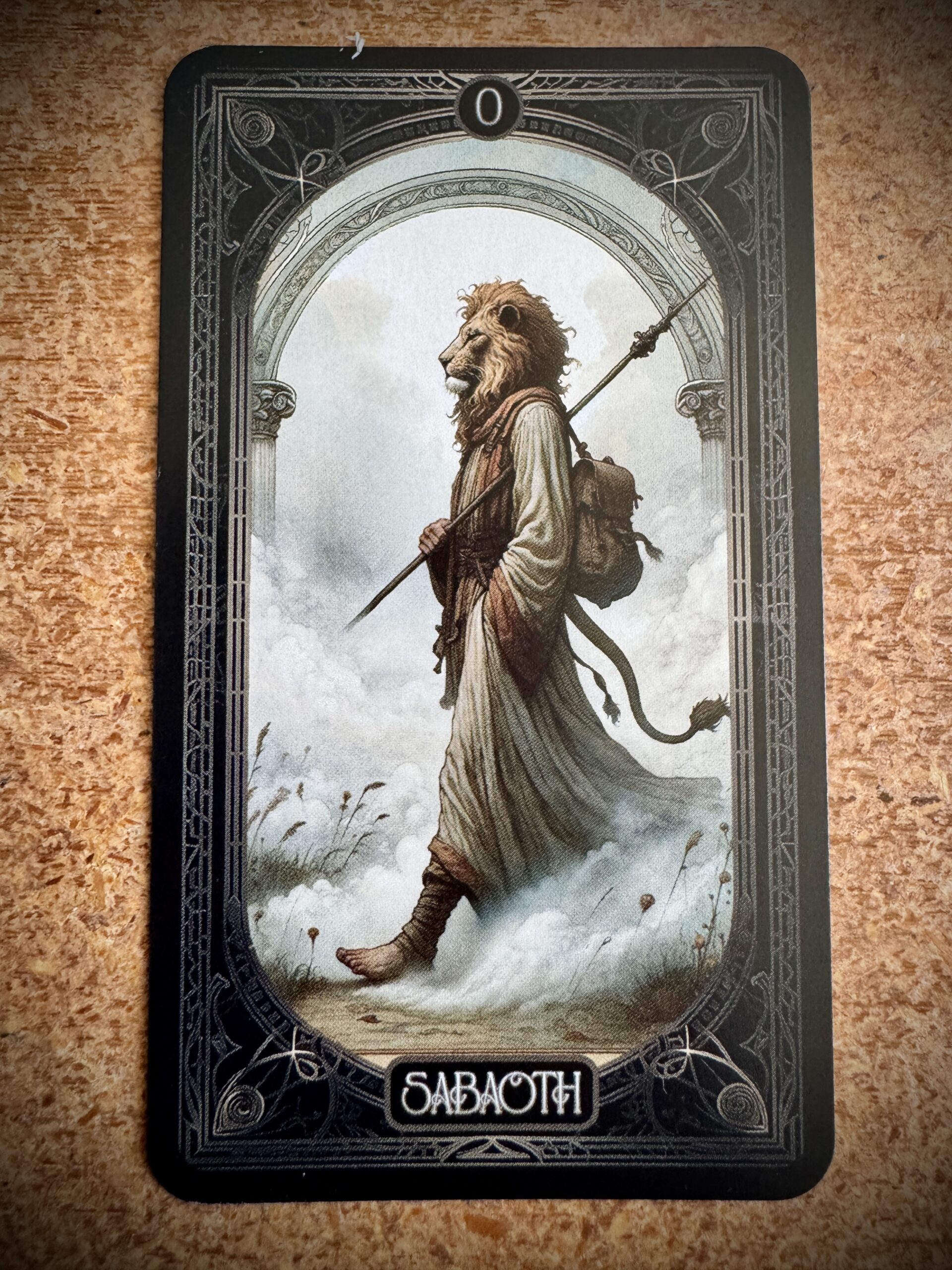
Sabaoth doesn’t arrive in a rush or with wild-eyed enthusiasm. He appears as a steady presence moving through mist, his lion’s gaze fixed on a horizon only he can see. There’s no hesitation in his stride, no second-guessing. He carries a traveler’s pack and a staff, but lightly, as though he’s learned to travel unburdened by what doesn’t serve the journey.

This is the fool who has already counted the cost and decided the price of staying is higher than the risk of leaving. He doesn’t leap. He walks. Deliberately. Calmly. With the quiet confidence of someone who has finally stopped pretending the cage was ever a home.

When Sabaoth turned away from his father Yaldabaoth’s kingdom, it wasn’t a frantic escape. It was a sovereign choice. He recognized goodness within himself that didn’t come from the archontic programming, and once he saw it clearly, there was nothing to debate. The direction became obvious. The path revealed itself. All that remained was to walk it.

As he appears beside you today, he doesn’t demand anything dramatic. He simply demonstrates what it looks like to move through uncertainty with grace. To trust your inner knowing so completely that the outer world’s chaos can’t shake you. To walk your path not because you have all the answers, but because staying still would be a betrayal of what you’ve recognized as true.

His question arrives not as a challenge but as an invitation:

“What would it feel like to move through your life with this kind of calm certainty, trusting that the path reveals itself to those willing to walk it?”

Teaching for the Day

There’s a difference between the leap of desperation and the walk of sovereignty. Sabaoth teaches us that awakening doesn’t have to be violent or chaotic. Sometimes the most radical act is simply to move forward with quiet certainty, refusing to be hurried by fear or slowed by doubt.

The world mistakes stillness for wisdom and calm for compliance. But Sabaoth shows us something different: there’s a kind of movement that is both decisive and peaceful. A way of walking that doesn’t grasp or force, but also doesn’t hesitate or apologize. This is the gait of someone who has stopped arguing with reality and started trusting the goodness they’ve discovered within themselves.

The archons operate through urgency and anxiety. They want you frantic, second-guessing, caught in endless loops of “what if” and “but maybe.” They thrive when you’re too afraid to trust your own clarity. Sabaoth disrupts this pattern not by fighting it, but by simply walking past it. His rebellion isn’t loud. It’s inevitable.

When you recognize something true about yourself, about your path, about what wants to live through you, you don’t need to announce it or defend it or prove it to anyone else. You just need to walk. One foot in front of the other. Through the mist. Through the uncertainty. Through whatever tries to convince you to turn back.

The staff in Sabaoth’s hand isn’t a weapon. It’s support. It’s the practical wisdom to bring tools for the journey, to move thoughtfully rather than recklessly. This isn’t about abandoning everything in a dramatic gesture. It’s about packing carefully and walking deliberately toward what you know is true, even when you can’t yet see where the path ends.

Calmness in motion is its own form of magic.
Sovereignty doesn’t need to announce itself.
It simply walks, and the world rearranges itself around those who move with authentic purpose.

Journaling Invocation

“Where in your life have you been following a script that was written for you rather than by you?”

This question isn’t asking you to catalog every compromise or inherited belief. It’s inviting you to notice one place, just one, where you’ve been living according to someone else’s program. It might be subtle: a career path chosen to please a parent, a relationship maintained to avoid disappointing others, a version of yourself you perform because it keeps the peace.

Or it might be deeper: a fundamental belief about your worth, your capacity, your right to take up space in the world. Something you’ve never questioned because questioning it feels like questioning gravity itself.

Don’t rush to fix anything. Don’t immediately leap into action.
Just look.

Sabaoth’s awakening didn’t begin with a plan. It began with recognition. He saw something clearly that he’d been conditioned not to see. That moment of seeing was enough to set everything else in motion.

Your task today is simply to see.
To name one inheritance you’ve been carrying without choosing it.
To acknowledge one place where the life you’re living doesn’t quite match the life that wants to live through you.

Write without editing. Let the truth arrive in whatever form it takes, clumsy or clear, angry or sad, tentative or certain. The point isn’t to craft a perfect insight. The point is to allow what’s been silenced to finally speak.

If nothing comes immediately, that’s okay. Sometimes the deeper recognitions need time to surface. But ask the question. Hold it gently. Trust that your inner knowing is already stirring, already preparing to show you exactly what you’re ready to see.

Small Embodied Practice

Stand somewhere open, indoors or out. Feel your feet on the ground, your spine naturally tall, your breath moving easily. Don’t rush into this. Let yourself arrive fully in your body first.

Now begin to walk. Not quickly. Not tentatively. Walk as though you know exactly where you’re going even if you don’t. Let your steps be even, measured, grounded. Feel the staff of your own spine supporting you. Notice how your arms swing naturally. Let your gaze rest softly on the horizon, not darting around for approval or permission, just steady and forward.

As you walk, imagine you’re moving through mist. You can only see a few feet ahead, but that’s enough. Each step reveals the next step. You’re not trying to see the whole journey. You’re trusting the path to appear as you walk it.

Notice what happens in your body when you move this way. Does your chest open? Do your shoulders release? Does something in you remember that this kind of calm, purposeful movement is your birthright?

Walk for three or four minutes, or longer if it feels good. Let the rhythm settle into you. This is Sabaoth’s teaching in your body: sovereignty isn’t a destination. It’s a way of moving through the world.

When you’re ready to stop, stand still for a moment. Feel how your body holds this new quality of presence. You’re not performing confidence. You’re embodying clarity. There’s a difference, and your body knows it.

This is the practice: walking with quiet certainty, trusting that the path appears for those willing to move forward, one sovereign step at a time.


The caravan moves together. If today’s companion touched something in you – a recognition, a question, a quiet rebellion – let us know in the comments. Your words light the path for others walking beside you.