The Soulcruzer Mixtape Series is back, because some things are worth coming back to!
If you’ve been here a while, you’ll know what this is. If you’re new, here’s the short version: it’s a curated set of songs, talked through, with a little context around why they matter and why they sit next to each other in this particular order.
Take a break from the algorithm and enjoy some intentional listening with a bit of conversation around it.
The series is back now as a companion to the live sessions over on Mixcloud. The live sessions are their own thing, spontaneous and in the moment. The mixtapes are the opposite of that. They’re considered. Slow, and built around a theme or a feeling or a year.
I’ve been thinking about 1999 for some reason. That year had a particular feeling to it, something electric and uneasy at the same time. The millennium was coming, and nobody quite knew what was on the other side of it. The music that came out of that year was restless and reaching and occasionally furious and sometimes just pure joy.
Here are ten tracks that capture the vibe of 1999: Red Hot Chili Peppers, Foo Fighters, Blink-182, Korn, Creed, Santana and Rob Thomas, The Offspring, Rage Against the Machine, Incubus, and Travis.
The episode includes some of my thoughts on each track, but it’s not a review show, and it’s not a radio show. It’s closer to sitting in someone’s living room in the evening and just talking about the music you love with people who dig music too.
That’s always been what this series is for.
If you listen on Mixcloud, be sure to give the show a like and a follow.
That lyric cuts right into the marrow of things. It’s a perfect koan dressed up in nu-metal clothing.
Small mind is that cramped, anxious, grasping perspective we get locked into when we’re running on habit, fear, and borrowed life scripts. It’s the voice that says: stay safe, don’t risk, don’t look foolish. It’s the same force that clings to certainty even when it’s suffocating.
Small mind wants control.
But freedom lives in big mind. In Zen, they’d call it shoshin or beginner’s mind. In Taoism, it’s the uncarved block, the childlike openness. The lyric is reminding us that the moment you let small mind die off, life cracks open into its wider horizon. It’s not that you “gain” freedom becasue that was always there. You just stop barricading yourself against it.
There’s a mythic edge here too: think of all the heroes who had to “lose” their little self…the ego, the narrow role…before stepping into their larger destiny. Odysseus stripped of his identity in disguise, Siddhartha leaving his palace, the Fool stepping off the cliff. Losing the small mind is an initiation.
What’s powerful is that System of a Down doesn’t frame it like a gentle suggestion. It’s raw, almost violent: lose it. Drop it like dead weight. Then, and only then, can you breathe the wide air.
The practical bite here is this: every time you catch yourself locked into small mind…
tight focus on outcome,
obsession with appearances,
defensive posturing…
you can treat it like a signal flare. A reminder that you’re being invited to let it fall away, to step back into the expanse.
👉 Where is “small mind” holding you back right now? And what would shift if you let it go—even briefly?
The year is 2000. Nu metal is in full bloom. TRL dominates after-school hours. Everything feels like it’s accelerating—dot-coms rising, falling, and rising again, paranoia creeping in under the surface of Y2K’s afterglow. Enter Take a Look Around, Limp Bizkit’s contribution to the Mission: Impossible II soundtrack.
The song itself is a remix, a recontextualization of Lalo Schifrin’s original Mission: Impossible theme, which already carries that sense of spycraft, danger, and impending explosion. What Fred Durst and the crew do is take that tension and turn it into raw confrontation. It’s not just cinematic anymore—it’s personal.
“I know why you wanna hate me…”
That’s not just a lyric—it’s a thesis. A dare. A jab. A mirror held up to a world that thrives on performative outrage.
Scene Three: Lyrical Intent, or the Weaponized Middle Finger
Durst’s vocals have always been polarizing—half spoken, half shouted, fully soaked in attitude. In this track, he oscillates between brash posturing and a kind of meta-commentary on the hate he knows Limp Bizkit attracts. And what’s genius—or at least cunning—is that he doesn’t deflect it. He weaponizes it.
“Maybe life’s not up my alley…”
He’s not apologizing. He’s flipping the script. “Take a look around,” he’s saying, “this culture built me.” He’s a mirror, and the reflection is inconvenient.
The lyrics don’t ask for empathy; they demand awareness. Of what? Alienation, mass media hypocrisy, and personal disillusionment. The song becomes a kind of anarchic public service announcement.
Scene Two: The Riff as a Symbol of the Era
That riff is surgical. Wes Borland strips it of its orchestral precision and infuses it with distortion and grime. It’s like graffiti on a secret government document. It’s also an early sign of what would become a nu metal signature move—taking something familiar and respected (a jazz motif, a classical phrase, an old-school breakbeat) and brutalizing it into rebellion.
In a way, the riff mirrors the wider aesthetic of nu metal: sampling the polished and making it guttural. It’s Prometheus stealing fire—except this time, the fire is an IMF mission tape, and it’s been shoved into a boom box that’s one kickflip away from catching fire.
Scene Four: The Soundtrack as Trojan Horse
Let’s not forget, this was the lead single for a Tom Cruise blockbuster. Imagine slipping a raw nerve of countercultural angst into the soundtrack of a mass-market spy thriller. That’s technomagic in its own right—embedding cultural critique inside the machine. It’s a modern equivalent of a punk sigil, scrawled across the walls of the mainstream.
This is where things get hypertextual. Mission: Impossible is a story about masks, deception, and impossible odds. Take a Look Around borrows that theme and reframes it in the language of a disaffected youth watching systems fail them: schools, governments, parents, even the music industry itself.
It’s a philosophy of distrust, disguised as a rock anthem.
Scene Five: The Myth of Limp Bizkit Revisited
Limp Bizkit, love them or loathe them, carved out a cultural niche that’s worth studying. They were avatars of excess, sure—but also of access. You didn’t need musical purity to rock out. You didn’t need lyrical elegance to be heard. You just needed volume, both literal and metaphorical.
Take a Look Around is one of their most thematically tight tracks—less about sex or style, more about society’s fragmented self-perception. It rides that wave of pre-9/11 energy—paranoid, performative, on the edge of a cultural cliff—and that gives it lasting weight.
One Last Thought:
The song’s title is an invocation. Take a look around. It’s both a challenge and a wake-up call. In the age of filtered feeds and algorithmic illusion, that dare feels even more urgent.
So maybe, this morning, as that riff blared into your consciousness, what you heard wasn’t just nu metal nostalgia.
Maybe it was a message from a cultural ghost—grimy, loud, misunderstood—reminding you to look beneath the surface, and see the impossible mission we’re all still caught inside.
And maybe, just maybe, you’re the rogue agent it’s been waiting for.
I’ve been experiementing with AI-generated music, and the results have been pretty cool for what it is. The level of quality you can get from AI-powered music tools is mind-blowing. Lately, I’ve been playing with Suno and Riffusion, two platforms that make the process incredibly easy.
Suno operates on a credit-based system, offering a free tier to get started, while Riffusion is currently in beta and completely free to use. Both tools are remarkably simple—just tell the AI your preferred music style and theme, and it will generate a fully realized song, complete with lyrics and instrumentation. If you prefer a more hands-on approach, you can write your own lyrics and let the AI compose the music around them. Or, if you’re in the mood for something instrumental, you can create anything from jazz and classical pieces to ambient lofi beats.
For content creators, this is potentially a total game-changer. Whether you need background music for videos, podcasts, or creative projects, these AI tools eliminate the barriers to producing high-quality soundtracks with minimal effort.
For the Soulcruzer theme song, I created the lyrics and let the AI handle the composition. The result? A track that feels uniquely mine, yet brought to life by AI’s creative potential.
Here was the prompt I used:
a fusion of bluesy, psychedelic rock and trip-hop, with elements of post-rock and cyberpunk ambience.
Here are the results from Riffusion:
Version 1:
For version 2 I used the prompt:
trip-hop, with elements of mystical ambience.
Here are the results from Suno:
Version 3
trip-hop, with elements of mystical ambience.
Version 4
a fusion of bluesy, psychedelic rock and trip-hop, with elements of post-rock and cyberpunk ambience.
So which version do you like best? Let me know in the comments.
My down-the-rabbit-hole excursion today is “Fallen Horses” by Smash Mouth. They’re a band usually associated with high-energy feel-good anthems. But, in this tune, they offer something more introspective. The song drifts through the in-between spaces where longing, death, and the search for transcendence converge. Underneath the deceptively simple lyrics lies an esoteric current steeped in the archetypes of death, ascension, and spiritual transition.
Through an esoteric lens, Fallen Horses is a meditation on the afterlife, the soul’s journey, and the nature of longing beyond the veil. It is a question posed to the universe that echoes through the corridors of mysticism.
First, a listen:
Lyrics
A long summers day Stretching out the cold Searching for the answers And some say I’m not alone Could you tell me, where I might find fallen horses? Their spirits they fly
Blinded by the whiteness Staring at the sun I’m wishing that I had wings So that I could become one Would you help me if I wanted to die? I could ride off with horses tonight
And now that I’ve arrived here I know I’m not alone All my friends among me Tell me, welcome home But could you tell me, where I might find The one I’m looking for? ‘Cause her wings have arrived
1. The Symbolism of the Horse: Death, Psychopomps, and Transition
The horse has long been a figure in esoteric traditions, often serving as a psychopomp—a guide between worlds.
In Norse mythology, Odin’s eight-legged steed, Sleipnir, carries souls to the underworld.
In Hinduism, the horse is associated with Ashvamedha, the sacrificial rite of kingship and power.
In the Book of Revelation, the pale horse is ridden by Death himself.
In alchemy, the horse represents wild, untamed spirit energy, often linked to transformation.
A fallen horse suggests a rupture in this process—something interrupted, something broken. The fact that the narrator searches for fallen horses implies an attempt to commune with the lost, the discarded, or those who have already passed through the veil.
The question is: Is he searching for them as a seeker or as one who is ready to join them?
2. The Sun, the White Light, and the Desire for Transcendence
Blinded by the whiteness / Staring at the sun I’m wishing that I had wings / So that I could become one
This is classic mystic longing, reminiscent of Icarus, the Neoplatonist philosophers, and countless esoteric traditions where the sun represents divine knowledge, enlightenment, or the source of all things.
But the act of staring directly into the sun is destructive. In esoteric traditions, the sun’s light can symbolise the unbearable weight of divine truth—too much illumination, too soon, can blind or annihilate the self.
The narrator’s desire to “become one” suggests the yearning for union—perhaps in the mystical sense of merging with the divine or in the tragic sense of succumbing to death in pursuit of transcendence.
This line also aligns with Near-Death Experience (NDE) reports, where many describe seeing a blinding white light. The narrator teeters on the edge between the physical world and whatever lies beyond.
3. The Crossroads of Life and Death
Would you help me if I wanted to die? I could ride off with horses tonight
Here we have a direct engagement with the theme of death as a choice. This is where the occult parallels with the crossroads mythos become strongest.
In Haitian Vodou and Hoodoo, the crossroads is where one meets spirits or deities who offer knowledge, power, or a new fate.
In Greek mythology, Hermes guides souls across boundaries into the underworld.
In Western esotericism, the crossroads represents a decision point, often one that cannot be undone.
To “ride off with horses tonight” suggests a deliberate departure—a chosen transition. If the horse is a guide to the afterlife, then the speaker is preparing to leave this world.
Yet, they ask for help. This hesitation introduces the possibility that the speaker does not yet know whether they truly wish to cross the threshold.
4. The Refrain of “Why?”: The Eternal Question
Tell me, why? Why, oh, why?
The refrain is almost ritualistic in its repetition—like a chant, an invocation, or the cries of an initiate seeking knowledge from an unwilling cosmos. In many mystical traditions, “why” is the unanswerable question—the final koan.
The persistent “why” suggests existential inquiry:
Why must we die?
Why do the departed leave us?
Why can’t we cross the veil at will?
Why must we remain separated from those we’ve lost?
This refrain mirrors the grief process, as well as the fundamental struggle between mortal limitation and divine mystery.
5. Arrival in the Afterlife: The Homecoming
And now that I’ve arrived here / I know I’m not alone All my friends among me / Tell me, welcome home
Here, the song shifts. The speaker has crossed over—or at least glimpsed what lies beyond. The phrase “welcome home” is significant in spiritual literature; it often appears in texts on death, reincarnation, and spiritual awakening. Many Near-Death Experiencers report a similar feeling—a profound recognition of belonging upon reaching the “other side.”
However, a paradox emerges. If this is home, then why is the narrator still searching?
6. The Elusive Figure: The One He Seeks
But could you tell me, where I might find / The one I’m looking for? ‘Cause her wings have arrived
The final mystery: who is the “one”?
A lost lover? A spirit who has ascended before him?
A personal guide—an angelic or archetypal presence that will lead him further into the beyond?
His own soul, searching for its final evolution?
The phrase “her wings have arrived” suggests she has transcended—achieved the flight he has longed for. But he has not yet reached her. There remains a gap, a lingering question. The cycle is not yet complete.
Closing Thoughts
Through an esoteric lens, Fallen Horses functions as a passage song—a piece that echoes initiatory experiences, questions of mortality, and the human desire for transcendence.
The horse is the psychopomp, but it has fallen—implying a disrupted journey.
The sun blinds, burning the seeker’s vision before he can become one with the light.
The crossroads moment reveals a choice—to leave, or to hesitate.
The afterlife welcomes him, but his search continues.
Ultimately, the song leaves us in a state of uncertainty—a perfect reflection of the Great Mysteries, which cannot be fully known, only glimpsed.
The last question lingers: Does the narrator truly want to stay, or is he just peering through the veil, only to return to this side once again?
Or perhaps, like all great seekers, he will never stop searching.
OK. I’m feeling a little nostalgic tonight, and I’m in the mood to listen to some tunes. I’ve been firing on all cylinders today, and now I’m ready to let my hair down. I thought I’d be a bit frivolous tonight and share my 80’s music crushes.
My Top Ten 80’s Crushes
Let’s get this one on the table first. Vanity was my NUMBER 1 crush. I had a poster her above my headboard. I watched the Last Dragon about a thousand times, just to see her. I didn’t really care too much for her music, but wow, did she capture my imagination.
1 Nasty Girl – Vanity 6
This is really the only song I liked of her, although I did own the one and only album they made. Watching her on screen in the Last Dragon is what mad me fall in love with her. My ultimate fantasy girl.
The rest of these I’ll put in any order, because after Vanity, the rest didn’t matter.
2 Opposites Attract – Paula Abdul
3 Like a Virgin – Madonna
4 The Glamorous Life – Sheila E.
Another Prince protege.
5 Total Eclipse of the Heart
6 What I Am – Edie Brickell
7 How Will I Know – Whitney Houston
If I was going to pick a number to crush, Whitney would be it. I lost count of how many times I watched this video.
8 I Love Rock ‘N’ Roll – Joan Jett & the Black Hearts
I love a good rock chick. Joan would hit the number 3 slot on this list.
9 The Sweetest Taboo
10 Call Me – Blondie
Rounding out the list is Debbie Harry
Thanks for taking this little nostalgic road trip with me back to the 80s to meet my crushes.
Everyone (or at least everyone with a Spotify account) is currently posting their 2022 music streaming activity on social media. Well, I thought I’d join in the fray and post my Spotify year-in-review highlights.
Let’s start off with my number one listened to song on Spotify. It’s from the Venom soundtrack and features Skylar Grey, Polo G, Mozzy, and Eminem.
One thing you’ll notice about my musical taste is that I’m not that much into new music. I couldn’t even begin to tell what songs are in the chart right now or who is the hot new artist that everyone is raving about. Not my jam. Spotify classifies me as The Time Traveler.
I would say that is totally accurate. I tend to listen by genre and whatever comes up in the genre i’m interested in at the time of search is what I listen too. Spotify helps in this with its weekly discovery playlist based on your listening history.
My top artists was no surprise to me. Leading the list is Creed. Part of the reason for that is Human Clay, their second album, really speaks to me and it is one of my go to weightlifting albums. And if you follow me on social media you know I spend a lot of time in the gym. I’m there 5 days a week nearly without fail. It’s how I start my day.
My top 5 songs for 2022 are quite and eclectic mix – rap, heavy metal, 80’s pop rock, grunge, and alt rock.
My top genres was interested to me.
I didn’t realise I listened to that much New Wave Pop! The electronica makes sense if they are counting trip-hop as electronica. The first half 2022, I was co-hosting a music/talk podcast called the Wisdom Experience. In-between the talk, we played really mellow trip-hop from groups like Ancient Astronauts, Wax Tailor, Hooverphonic, and Sneaker Pimps.
I do listen to music on other platforms like Apple Music and Youtube of course, and my favourite app until the corporate fat rats ruined it for UK residents. The app is called Radio Garden. I could listen to thousands of stations from around the world, which was awesome. I especially liked listening to radio stations in New Jersey to get a little taste of home. Hopefully, the developers will be able to sort out the rights issues. I miss channel surfer on the app.
I share that because, according to Spotify, I listened to 38, 431 minutes of music which more than 90% of other listeners in the UK. That 38, 431 is just my Spotify consumption. It would be cool to know my true total of minutes listened.
Anyway, that’s my year in music according to the lovely algorithms over at Spotify.
My Top 100 Songs of 2022
Now that I’ve shown you mines, let me see yours. Send me a link to your Spotify year-in-review.
Brothers In Arms is one of my all-time favourite albums. I was a Dire Straits fan before MTV. When this album came out, I was ecstatic. I played it nonstop. Even to this day, I can sing every song on the album without looking at a lyrics sheet!
The album, to me, is in two parts. Part one is mostly about loneliness, disillusionment, and heartbreak, and part two is about the potential of destroying our one world as reflected in the many guerrilla wars that raged throughout the 80’s. In particular, the Nicaraguan conflict.
In the lead track, So Far Away, the protagonist of the song is in a long distance relationship brought on by his constant travel. He’s tired of ‘bein’ in love and being’ all alone.’ The longer he is gone, the further his love gets away from him. They are on two sides of the continent. She’s in the sun and he is in the rain. She keeps getting further and further away from him as the song suggest at the end. ‘You’re so far… so far away from me…” is repeated until the song fades out.
Money For Nothing, the runaway MTV hit, is about a working-class appliance delivery man who is envious of the perceived lifestyle of rock stars and the fact that they get paid a ton of money and get all the girls just for playing some guitars and drums, which to him amounts to doing nothing. Meanwhile, he has to just get by in life doing “real” work and get paid next to nothing for his hard work. By verse three, he wishes he had learned to play the guitar or drums and then he could have a cushy life too. I love the cameo appearance of Sting on the track with his distinct high pitch squeal… ‘Money for nothing and your chick for free…’
Walk Of Life balances out Money For Nothing with a guy who is excited to go watch an old blues singer named Johnny who is in town to sing the ‘oldies, goldies’ like “Be-Bop-A-Lula”, “Baby What I Say” and “I Gotta Women.” Songs the protagonist likes. He’s a huge fan of Johnny’s so much so that he can watch Johnny play all night: “Turning all the night time into the day.” The protagonist seeks refuge in Johnny’s songs from the walk of life which is full of ‘violence and double talk.’
With Your Latest Trick, we swing back to the theme of loneliness with a guy who has had his heart broken by a girl he’s madly in love with but doesn’t love him back in the same way. My favourite thing about this song is Mark Knopfler ’s use of metaphors to build a hazy dystopian picture of the city. I love his use of the piano keys as the keys to his heart. And the final epiphany, when he realises there is no more love between him and his girl: “Like a bowery bum when he finally understands that the bottle is empty and there’s nothing left.”
Knopfler balances out Your Latest Trick with Why Worry like he does with Money For Nothing and Walk of Life. In Your Latest Trick, we get the opposite view of love. Here are two people who support each when things are bad and they are feeling down. The song opens with the protagonist offering support to his girl who is feeling down about the world which has made her sad. But as bad as things maybe now, he reminds her that it will get better, so why worry, there will be ‘laughter after pain’ and ’sunshine after rain.’ “These things have always been the same.” It’s part of the rhythm of life. He knows when it’s his turn to feel down, she will do the same for him and help him through his blues.
I love the whole album, but part two really struck a chord with me. When it came out in 1985, I was 17 and longing for real world adventure. The kind of adventure the romanticised version of war promises to boys who are on the verge of becoming men.
In my boyhood naïveté, I wanted to be a mercenary. I used to buy Soldier of Fortune Magazine every month and read it from cover to cover. I was fascinated by the Rhodesian Bush War and many of the soldier of fortune tales that came out of that conflict. The Wild Geese movie with Richard Burton, Roger Moore, Richard Harris, and Hardy Kruger, was one of my favourite films at the time. I wanted that kind of camaraderie. Heck, when I was 16, I had researched and planned to runaway from home to join the French Foreign Legion! Not having a passport, and needing my mom to get me one, proved to be a barrier.
Part two of the album, to me, is mainly about the guerrilla wars that were being fought in Central America at the time, particularly the Nicaraguan Revolution and the Contra War.
Part two opens with Ride Across the River, a brilliant song. It shows war from two perspectives – one from the revolutionaries who are fighting what they consider to be a just and noble war in support of freedom. They are ‘the chosen’ and are ready ‘to pay with our lives if we must.’ And I’m wondering if Knopfler uses the river, which, appears in the chorus, as a metaphor for death. It calls to mind the River Styx from Greek mythology where Charon, the ferryman, would taxis the souls of the dead from Gaia (Earth) to the Underworld of Hades. The revolutionaries in the song are committed to death. They know they are “ Gonna ride across the river, deep and wide/Ride across the river to the other side.”
The soldiers of fortune in the song are not so naive. They don’t care about freedom and noble causes. They are in it for the money. And they “don’t give a damn who the killing is for.” To them, it is “the same old story with a different name/Death or glory, it’s the killing game.” And like the revolutionaries, they too, know, that they will more than likely be taking a ride across the river.
The revolutionaries are optimistic. They are fighting the good fight: “Today in the mountains; tomorrow the world.”
The Man’s Too Strong is tricky. The revolutionaries’ cause starts off noble, but the death and destruction of war soon brings out the worst in men and the cause becomes tarnished by the evils of humanity and the corruption that evolves out of those who lose sight of the cause and become blinded by the power they wield over life ad death.
In this song, we meet the guerrilla leader who has finally been caught by The Man.
The Man’s Too Strong feels like a confessional song. The warlord tells his story:
… I have legalized robbery And called it relief I have run with the money I have hid like a thief Rewritten histories with my armies and my crooks Invented memories I did burn all the books
Through all of the bad things he has done, he has ‘striven for peace.’ A peace, he would never know.
The Man doesn’t want the guerrilla leader to die a martyr so brings him out into the courtyard to publicly denounce him:
“You always was a Judas, But I got you anyway.”
The Man is not satisfied with just killing the guerrilla leader, he wants him to suffer. He tells him what he has done to his daughter and wife.
The captured warlord, who knows his execution is imminent, prays to God for absolution:
Oh father, please help me For I have done wrong The man’s too big The man’s too strong
In One World, the protagonist has the blues. Nothing seems to be going right for him:
Can’t get no sleeves for my records Can’t get no laces for my shoes Can’t get no fancy notes on my blue guitar
He confesses that he “can’t get no antidote’ for his blues.
He seems to be trying to find a reason for why the world is in the state that it’s in. But nothing seems to make sense and the reasons people give for their actions can’t be trusted. He’s been told that it’s mostly vanity that drives our actions. That’s the way it has always been and always will be. He has to accept that “there’s no such thing as sanity, and that’s the sanest fact.” There is no remedy for his blues.
He concludes that if the politicians can’t find “a way to be one world in harmony,” there can never be an antidote to the blues he is feeling.
The last song, and the title track for the album, Brothers in Arms takes us back to the war torn country we met in Ride Across The River. It’s told from the point of view of one of the rebels who has aged now. He is resigned to the fact, that as a rebel, he can never go home again, that the mountains, where the rebels hide, have become his home. He misses his real home:
But my home is the lowlands And always will be
He does hope that one day, the fighting will stop, and the rebels can go back to their homes in the lowlands and lush valleys and be with their families and no longer ‘burn to be brothers in arms.’
Verse two holds a specially place in my heart. As a former soldier, these words ring true:
Through these fields of destruction Baptisms of fire I’ve witnessed your suffering As the battle raged high And though they did hurt me so bad In the fear and alarm You did not desert me My brothers in arms
I will always be close to my brothers in arms.
In the next verse, we return to the one world theme. Where the bluesman in One World has given up hope, the aged rebel in Brothers In Arms still holds on to hope that while for now we all live in different worlds maybe one day we will realise that we, in fact, only have one world. And we are “fools to make war on our brothers in arms.”
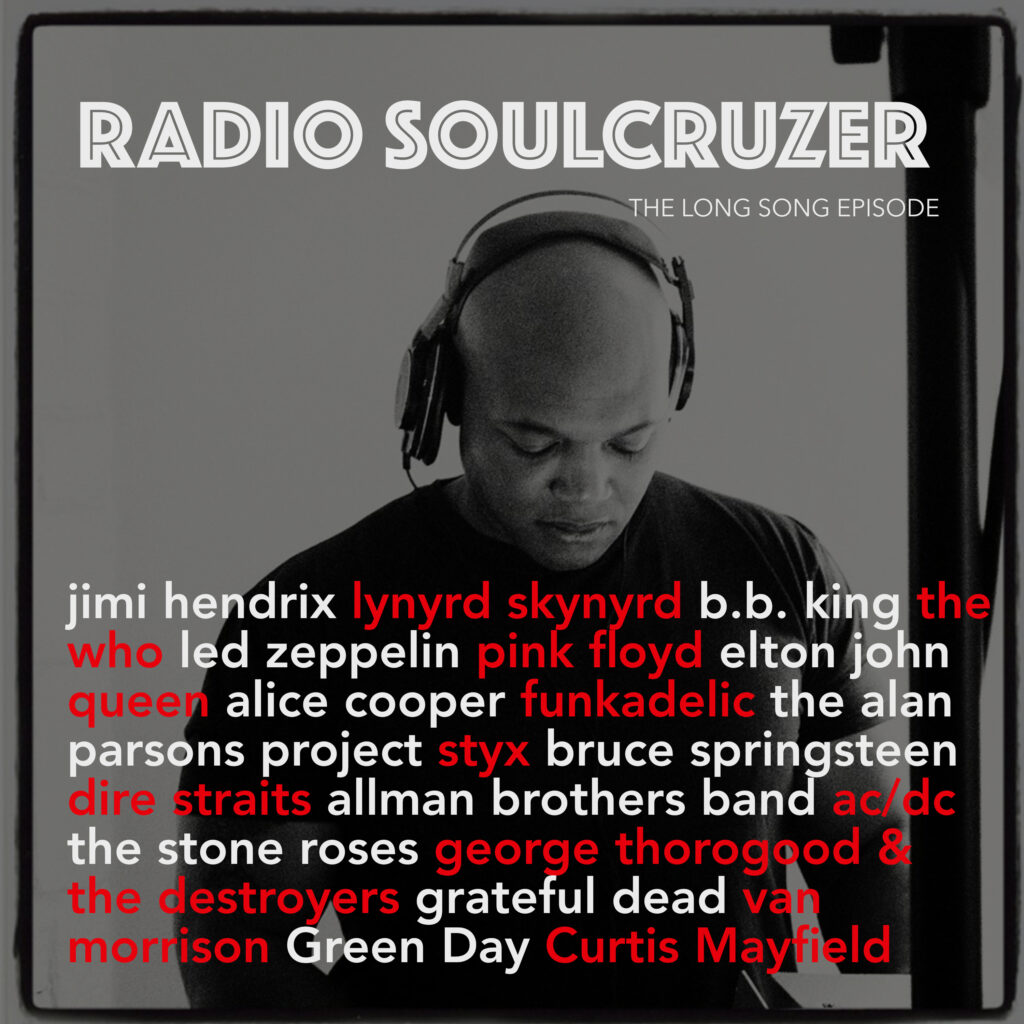
I got the idea for this episode from Jimi Hendrix’s song “Voodoo Chile,” which is on his album “Electric Ladyland.” The song clocks in at 14 minutes and 59 seconds! It’s a monster track. Well, that got me thinking about other lengthy tracks that I love. I compiled a list and then turned to my peeps on Twitter and Facebook to crowdsource other people’s favorite tracks over 6 minutes long. The results – a monster 3 hour show of some great tunes that clock in at least 6 minutes.
“When Ugly Kid Joe sold their souls to the devil in the pursuit of rock ‘n’ roll they drove a harder bargain than Robert Johnson at the Crossroads. Not only did they trade their souls for over thirty years of globetrotting and metal extravagance. They also haggled to keep their playing abilities, they bartered to keep their looks – we get older, gain weight and lose hair, yet they look like they’ve just walked off “that” song’s beach video set from 1992!”
I was pleasantly surprised. Most of the tracks have just the right heaviness to channel into my muscles and give me that extra boost to get one more rep in!
I did skip over the slower songs, promising to give them a proper listen after my workout. On reflection, I think the album is really good fun. They stick to what they’re known for, which is one-hit wonders, weird covers, and good old AC/DC-style rock.
I was fishing for a documentary to watch over coffee this morning. Not something I normally do, but it’s Saturday, and I’m down in Bristol waiting for the rest of the house to wake up before we get up to whatever we’re getting up today.
Robert Johnson was a blues singer, songwriter, and musician who has been cited as the influencer behind a generation of legendary musicians like Muddy Waters, B.B. King, Led Zeppelin, The Rolling Stones among others.
The documentary takes a look at the mystery and myth that surrounds Robert Johnson’s life, particularly about how he made a deal with the Devil at a crossroads in rural Mississippi to achieve musical success playing the Blues also known as the Devil’s music.
You can watch it on Netflix, which I highly recommend you do.
Ah! The Halloween Special. As holidays go, I like Halloween! The ghost, the ghouls, the spooky stories…love it. And who doesn’t like dressing up as different characters?
a spooktacular episode
Here’s the playlist from MJ015
Bloodletting – Concrete Blonde
Living Dead Girl – Rob Zombie
Time Warp – The Rocky Horror Show
Lil’ Red Riding Hood – Sam the Sham & The Pharaohs
Werewolves of London – Warren Zevon
Zombie Zoo – Tome Petty
Perhaps Vampires Is a Bit Strong But… – Arctic Monkeys
Dead Sound – The Raveonettes
Cold Blooded – The Horrors
Welcome to My Nightmare – Alice Cooper
Screaming Skull – The Fleshtones
Diary of a Madman – Ozzy Osbourne
Somebody’s Watching Me – Rockwell
A Nightmare on My Street – DJ Jazzy Jeff & The Fresh Prince
I Put a Spell On You – Screamin’ Jay Hawkins
I Was a Teenage Werewolf – The Cramps
Dracula’s Wedding – Outkast, Kelis
Ghost Town – The Specials
Halloween – Siouxsie and the Banshees
Werewolf Bar Mitzvah – Jeff Richmond, Tracy Morgan
Last night, I returned to my radio presenter roots in terms of the style of the show. I think I’ll hang out in that space going forward. I’ll keep the chat lively, but in the chatbox, not on the stream.
The Musical Journey Show #14
Here’s the playlist from last night
I Melt with You – Modern English
Cupid’s Arrow – Frank Carter & The Rattlesnakes
Dad Vibes – Limp Bizkit
Never Gonna Learn – Asking Alexandria
The Ballard of Chasey Lain – Bloodhound Gang
Stacked Actors – Foo Fighters
Astounded – Tantric
Otherside – Red Hot Chilli Peppers
She Hates Me – Puddle of Mudd
It’s Been Awhile – Staind
Interstate Love Song – Stone Temple Pilots
Disarm – The Smashing Pumpkins
Love Rollercoaster – 24US
Rise – Bob Clearmountain Remix – Public Image
The Ballroom Blitz – Andy Scott’s Sweet
Smile – Wolf Alice
Empire – Of Monsters and Men
Last Nite – The Strokes
House of the Rising Sun – The Animals
Don’t forget next Thursday, 28 October, I’ll be doing the Musical Journey Show Halloween Special. If you have any song suggestions you think I should include, drop me an email.
Something about the way the sun felt warming my face as I sat in the backyard listening to the noise drifting out of the high school made me think about the ’70s. Of course, I was only knee-high to a grasshopper then, but the ’70s are in my soul. It was the music playing around me as I was growing into a little human with a personality to mold.
Sometimes we hold ourselves back out of fear of who might be watching us and how they’ll judge us based on what they see. We fear the judging eyes.
To free yourself from this judgment, and therefore self-consciousness, try playing with these questions to identify the invisible eye that you imagine is watching and judging your every action all of the time. Remember that which you are aware of you can control; that which you are unaware of controls you.
When were you first aware of being watched?
Who is watching you now?
For what imagined audience do you perform? Dress? Work? Create? Make love?
What look is most often in the eyes of your watchers? Do your actions please them or do they disapprove? Of what are you proud or ashamed of when you imagine that X is watching you?
When you are most self-conscious and self-critical, what ideal are you chasing?
If you weren’t busy watching yourself, what would you do?
By working through these questions you can open up your life to greater spontaneity and freedom.
I’ve seen the film countless times, but Ruth has never seen it (although I’m sure she’s heard it because I own the DVD and have watched it from time to time over the years).
My dad was a massive Spaghetti Western fan, so growing up, I watched a ton of “cowboy” movies. Clint Eastwood was my favorite. I liked all of his Westerns apart from Unforgiven, which saw Eastwood return to the genre that made him the quintessential tall, dark, silent stranger type. I had high hopes for Unforgiven. I mean, how could it lose. It had Clint Eastwood, Morgan Freeman, and Gene Hackman in it. It failed for me because Eastwood didn’t use his gun until the end of the movie! He took the retired old Western gunslinger too much to heart.
This is what I wanted to see the whole movie, but sadly had to sit through 2 hours to get this (don’t watch if you haven’t seen the movie and want to judge for yourself):
I spent most of the day outside in my back garden working on my suntan. The sun was glorious yesterday. I think we hit a high of 21C. I launched the Radio Warwickshire #30DaySongChallenge in our Social Radio Club on FaceBook. Day 1 was to choose a song that needs to be played loud. I chose:
I’m also running the challenge on our Instagram and Twitter accounts. But like most things I post, Facebook is the place I get the most engagement. Go figure.
I’m still working my way through The Unspoken Name which is the first heroic fantasy book I’ve read in a long while. It’s good for reading when you’re working on your tan. I haven’t completely warmed to the story yet, but it’s early days.
With lockdown, all the days blend together. But I’m glad it’s a Bank Holiday weekend. I can spend time on the frivolous.
It’s Friday. It’s raining. But we can still have fun. And even though it’s not quite beer-o’clock yet, I’m going to share with you my musical guilty pleasures!
I could have gone on for a while digging through the one hit wonders of my listening journey, but I’ve limited myself to these 15 One Hit Wonders! #OneHitWonderDay
And it can come from anywhere, anytime. I literally stumbled upon this 1 min 20-sec video of the one and only Bootsy Collins explaining the power of The One and it lit my whole morning up. I’m sure I’ll be buzzing the rest of the day just from this video.
The #1 rule of funk: Keep it on the One. Listen to Bootsy lay it down:
“It’s however you feel, you just gotta fit it in that little space that you’ve got…. Once you got it, you can do anything you want to do with it! Just keep it on THE ONE.”
Why am I so fired up about this? Because The One is both practical and mystical. It’s about freedom through the constraint of form, but it’s also about something bigger. Think the Magician, who occupies the position of One in the Tarot:
In the Magician’s right hand is a wand raised toward heaven, the sky or the element æther, while his left hand is pointing to the earth. This iconographic gesture has multiple meanings, but is endemic to the Mysteries and symbolizes divine immanence, the ability of the magician to bridge the gap between heaven and earth.
Or as James Brown lays it down:
“The ‘One’ is derived from the Earth itself, the soil, the pine trees of my youth. And most important, it’s on the upbeat—ONE two THREE four—not the downbeat, one TWO three FOUR, that most blues are written. Hey, I know what I’m talking about! I was born to the downbeat, and I can tell you without question there is no pride in it. The upbeat is rich, the downbeat is poor. Stepping up proud only happens on the aggressive ‘One,’ not the passive Two, and never on lowdown beat. In the end, it’s not about music—it’s about life.”
Bridging the gap between heaven and earth, tapping the Divine for inspiration.
You can bet, I’ll be keeping it on The One all day today.
P.S.
Do you want to take a mystical journey today?
Wait till it’s dark, then find a quiet room. Put your headphones on, turn off the lights, and listen to the original version of Maggot Brain.