












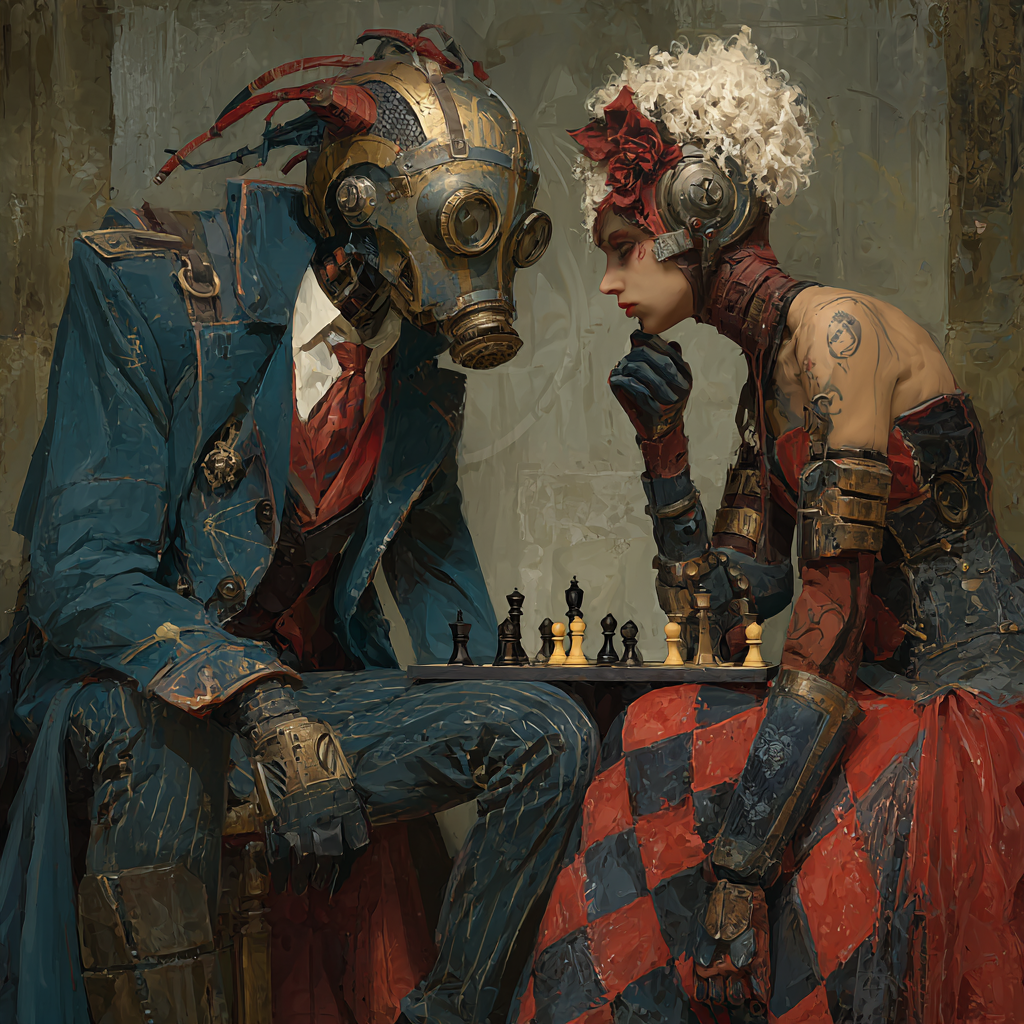
The chessboard is the world; the pieces are the phenomena of the universe; the rules of the game are what we call the laws of Nature. The player on the other side is hidden from us. We know that his play is always fair and patient. But also we know, to our cost, that he never overlooks a mistake, or makes the smallest allowance for ignorance. – Thomas Huxely
Here’s a short take before I head into the weekend. This week I’ve been reading Alley Wurd‘s book, Sub/Urban Butoh Fu and he has me interested in exploring the meta-games we play or fail to play. And so, I wrote this piece.
The chess master stares at the board for seventeen minutes. Not at the pieces, she memorised their positions three moves ago, but at her opponent’s breathing. The slight quickening when he considers the knight fork. The held breath before he touches his queen. She’s not playing chess anymore. She’s playing the player.
This is the meta-game. The game beneath the game, where victory belongs not to those who master the rules but to those who master the rule-makers.
I learned this watching my brother-in-law’s daughter negotiate bedtime. She never argues about the time directly. Instead, she questions the authority of clocks. “Why does eight o’clock get to decide when I’m tired?” A four-year-old deconstructing temporal tyranny. She’s not fighting the bedtime; she’s rewriting the operating system that makes bedtime possible.
Every interaction contains at least three games: the surface game (what we pretend we’re playing), the psychological game (what we’re actually playing), and the meta-game (the awareness that we’re playing at all). Most people never leave the first level. They argue about chess moves while someone else redesigns the board.

The Cheshire Cat materialises on my coffee table, grinning around a cigarette that exists only on Wednesdays.
“You humans,” he purrs, “are so delightfully unaware of your own machinery. You think you’re choosing chocolate over vanilla, but you never question who built the ice cream shop.”
He gestates toward my laptop, where I’m writing about meta-games. “Even now, you think you’re explaining something to your readers. But the real game is what happens when they realise they’ve been meta-gamed by your explanation of meta-gaming.”
The cigarette becomes a question mark, then dissolves. The Cat’s grin lingers long enough to wink.
The meta-game operates everywhere, invisible as air until you learn to see it. The job interview where you’re not being evaluated on qualifications but on how well you perform as a “person who deserves employment.” The marriage where the fight about dishes is really about who gets to define what love looks like. The democracy where citizens think they’re choosing policies, unaware they’re being played by algorithms that learned their preferences before they did.
To play the meta-game requires a peculiar form of double-consciousness. You must participate sincerely in the surface game while simultaneously recognising its constructed nature. Like being an actor who forgets they’re performing while never forgetting they’re on stage.
The danger isn’t ignorance; it’s the nihilism that comes with too much awareness. Once you see how many games are rigged, the temptation is to stop playing altogether. But withdrawal is just another move on the meta-board, observed and countered by players who anticipated your retreat.
The wisdom lies in playing multiple levels simultaneously without losing your humanity to the mechanics. The chess master who reads her opponent’s breathing but still loves the beauty of a well-executed gambit. The parent who recognises their child’s rhetorical strategies but remains genuinely moved by their questions about fairness.
Perhaps the highest form of meta-gaming isn’t winning but maintaining wonder and seeing through the illusion while preserving its capacity to enchant. Playing the game, playing the player, but never forgetting that all games, even meta-games, are ultimately elaborate forms of play.
The real question isn’t whether you’re being played, because, well, you are, constantly, by systems both visible and hidden. The question is whether you’re awake enough to play back, consciously and with compassion, in the vast recursive game where players play players playing games.
What game do you think you’re playing right now?
And who taught you the rules?