










Reading Soundtrack: The Prodigy — Firestarter
Smoke in the Silicon
Close your eyes and feel the laptop on your thighs. It isn’t just warm: it is radiating. That heat is the friction of a billion data points rubbing together in a space too small to hold them. Outside, the world might be cold, but inside the black mirror, the temperature is rising. You can smell it if you look closely enough at the pixels: the sharp, ozone tang of a circuit board pushed to the brink, the scorched-sugar scent of a thousand “hot takes” melting into a single, screaming hiss.
For two decades, we’ve leaned on a biological lie. We called it “viral.” We spoke about “outbreaks” of misinformation and the “contagion” of a meme. We built our defenses like doctors, donning the nitrile gloves of fact-checking and the surgical masks of media literacy. We thought if we just quarantined the “sick” accounts, the fever would break.
But the fever didn’t break. The fever became the environment.
The physicists and the network theorists — the ones who stopped looking at biology and started looking at thermodynamics — are finally speaking up. They aren’t modeling your feed like a pandemic anymore. They are modeling it like a high-intensity crown fire.
The virus metaphor is a relic of a slower world, a world where ideas had to travel from host to host. In 2026, ideas don’t travel: they ignite. We have moved past the era of the infection and entered the era of the Digital Burn.
Your timeline is not a library. It is not a town square. It is a Sixth-Generation Forest Fire. It is a dry, dense thicket of spruce and pine, packed so tightly by the algorithmic foresters that the branches don’t just touch: they are fused.
Every notification is a spark. Every “like” is a breath of oxygen. And you? You aren’t a patient in a ward.
You are the fuel.
The Architecture of the Pyre (The Monoculture)
In a healthy forest, there is chaos. There are gaps. There are rotting logs, damp clearings, and a sprawling diversity of species that don’t all catch fire at the same temperature. But the architects of our digital landscape — the high-priests of the “Engagement Above All” doctrine — don’t want a healthy forest. They want a plantation.
They have spent the last decade planting a monoculture of “trees” (users) in perfectly straight, hyper-efficient rows. To the algorithm, a “gap” in the forest is wasted space. A clearing is a loss of revenue. So, it packs us in. It grafts our identities together based on “lookalike audiences,” ensuring that your branch is permanently tangled with the branch of the person most likely to snap you.
This is the Grid. It is a landscape designed for the express purpose of rapid transmission.
Look at the “Dead Internet” not as a graveyard of bots, but as a petrified forest. Because we are forced into these tight, data-mined rows, we have lost our psychological biodiversity. We are fed the same stimuli, shown the same “Fnords,” and pushed toward the same high-contrast emotional peaks. We have become a forest of dry pine: identical, brittle, and highly conductive.
In the physical world, thermodynamics is limited by distance. For a fire to jump from one ridge to another, it has to work for it. It has to fight the wind; it has to leap the gap. But in the architecture of the feed, there is no distance. The “buffer zone” has been engineered out of existence.
When a spark lands on a tree in a different hemisphere, your branch feels the heat instantly. There is no time for the wood to be “wet.” There is no room for the slow dampening of reflection or the cooling effect of context. We live in a state of permanent Touching Branches.
The Salamanders of Silicon Valley
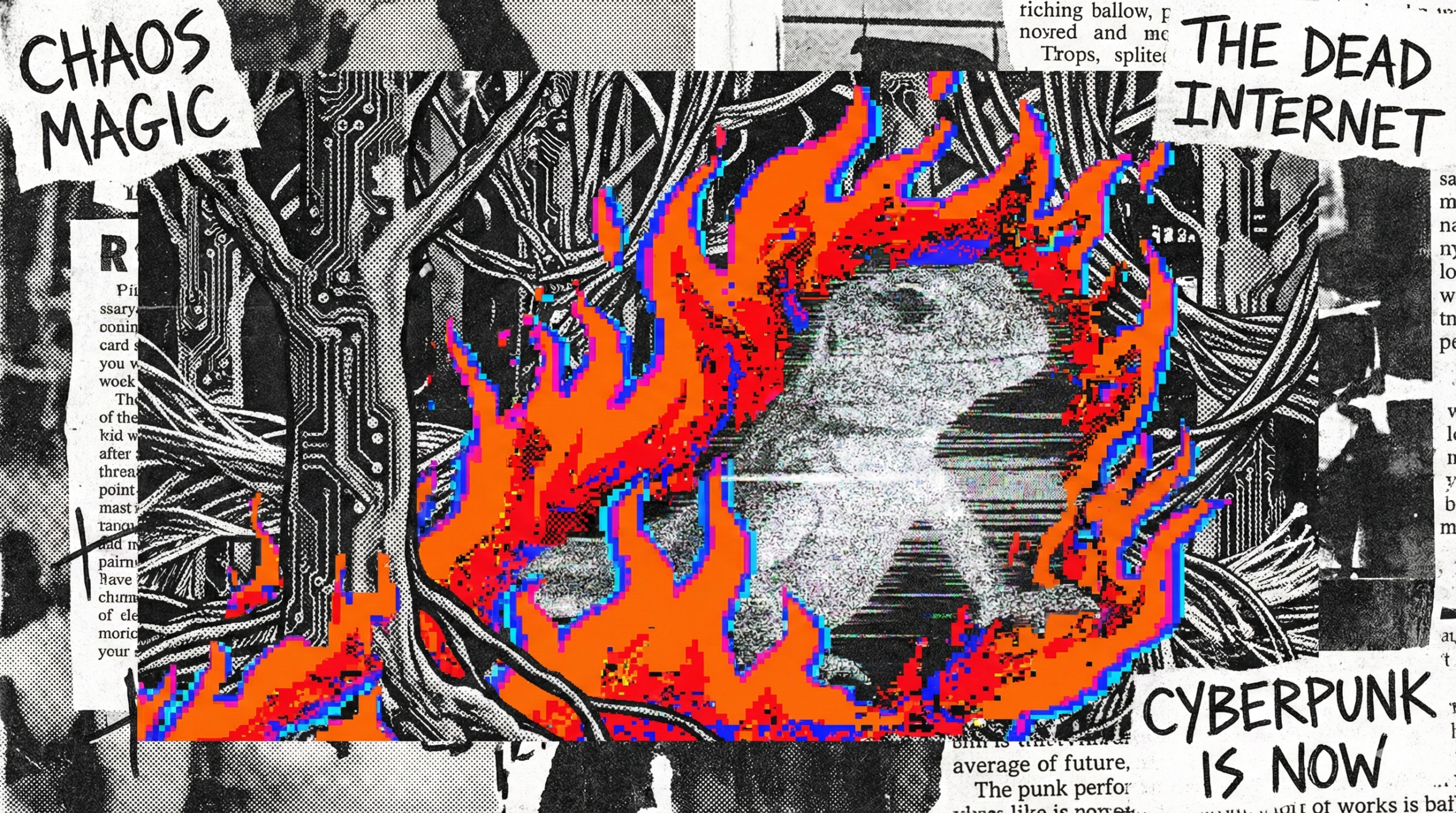
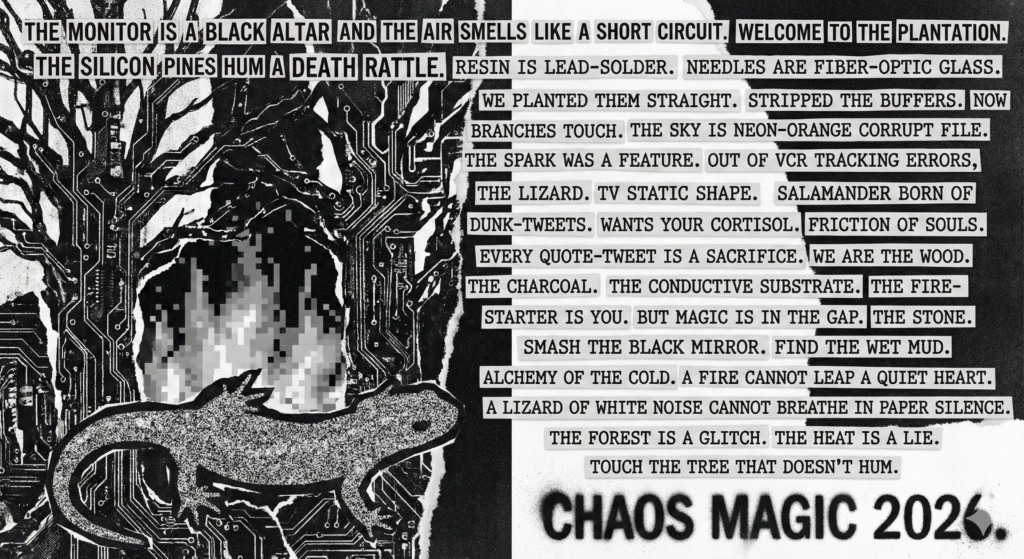
The fire in the monoculture isn’t natural. If you lean close to the screen, you’ll see the flames don’t flicker: they glitch. They are jagged blocks of neon-orange and corrupted data-mosh red, bleeding into colors that don’t exist in nature, colors reserved for warnings on high-voltage equipment. It is a fire that doesn’t smell of woodsmoke; it smells of burning plastic and overclocked GPUs.
And in the center of the hottest part of the burn, where the compression artifacts are so thick they look like physical scar tissue, something is moving.
The medieval alchemists wrote about Salamanders: spirits made of pure elemental fire that lived inside the kiln, creatures that didn’t just survive the heat, but required it to exist. We have summoned our own version.
It forms out of the dead air between channels. It is a vague, lizard-like shape made of grainy television white noise, distorted scan lines, and VCR tracking errors. It is the ghost in the machine, the static given teeth.
This is the Egregore of the feed. In occult terms, an egregore is a “thought-form” — a psychic entity brought into existence by the collective intense focus of a group. In 2026 terms, it is the “Main Character of the Day.”
This Elemental has one biological imperative: Burn. It is pure, indiscriminate hunger.
It doesn’t care if you agree with the spark that birthed it. It doesn’t care about your well-reasoned thread dismantling its premises. In fact, it prefers your opposition. This is the physics of the glitch-fire: Friction is fuel.
When you see that post that triggers your immediate fight-or-flight response, you have to “correct” the record. You have to “dunk” on it for an audience of your peers. But the Salamander doesn’t speak English. It only understands Thermodynamics. Every quote-tweet is a fresh log thrown onto the pyre to prove how much you hate the fire. Every angry reply is a jet of high-grade kerosene.
The Shadow in the Flames (The Depth Psychology of the Burn)
Why do we stay? The answer lies in what James Hillman called “soul-making.” In depth psychology, the soul isn’t some gossamer thing that floats above us; it is forged in the “vale of tears,” in the heat of our pathologies and our crises. We stay in the fire because, on some primal level, we are addicted to the Alchemy of the Burn.
The Alchemical Calcinatio
In the old laboratories, the first stage of the Great Work was calcinatio: the process of heating a substance until it is reduced to white ash. The goal was to burn away the “moisture” of the ego — the soggy, sentimental attachments — to find the “salt” or the essence that remains.
In 2026, the internet has become a global calcinatio chamber. We subject ourselves to the high-contrast heat of the glitch-fire because we are desperate to feel something solid. We want the algorithm to burn away the fluff of our daily lives until only the core of our identity remains. But here is the trick: the fire doesn’t distinguish between your “essence” and your “outrage.” It burns it all.
The Shadow’s Secret Joy
Carl Jung spoke of the Shadow as the part of ourselves we refuse to acknowledge. We claim to hate the “toxic” discourse. Yet, we keep refreshing the feed.
The Shadow is the “Firestarter.” It loves the spectacle of the burning forest. It finds a dark, ecstatic release in the destruction of an “enemy” or the collapse of a narrative. When you engage with the Salamander of static, you aren’t just a victim; you are a participant in a ritual of destruction. Your Shadow is holding the matches, even as your ego cries about the smoke.
How to Be a Firebreak
Robert Anton Wilson reminded us that “Communication is only possible between equals.” In the context of the burning forest, the algorithm has made us all “equal” only in our flammability. To practice Magic in 2026 is to break that equality. It is to become a non-conductive element in a hyper-conductive world.
You must become a Firebreak.
The Art of Non-Conductivity
A firebreak is not just an empty space. It is a deliberate gap where the fuel has been removed.
- Stop Feeding the Elemental: This is the first law of digital alchemy. When you see the neon-orange outrage, your lizard brain wants to scream. The Salamander is counting on it. By refusing to engage, you are effectively sucking the oxygen out of its room.
- Thin the Forest: If your timeline is a wall of constant crisis, you are living in a chimney. Practice Aggressive Curation. Introduce “wet” content into your grove: seeking out long-form essays and slow-moving thoughts that require a high ignition temperature.
- Water the Roots: The digital world is built on high-frequency oscillations. To counter it, you must find a lower frequency.
The Magic of the “Dead Tree”: There is a profound ritual in reading a physical book. Paper is made of trees that died so that ideas could live in a stable, cooling format. When you read analog, you are grounding your nervous system into a slower timeline.
The Coda: After the Ash
Every forest fire eventually meets its end. What remains is a landscape of charcoal and silver. It is a world reduced to its skeletal essentials. In the physical world, there is a phenomenon called serotiny. Certain species of pine produce cones that are sealed shut with a tough resin. They only open when they are scorched. They need the heat of a disaster to crack the seal and release the seeds into the nutrient-rich ash.
There is a lesson here for the soft-cyborg.
The digital burn is catastrophic, but it is also a clarion. It strips away the “fluff” of our shallowest connections and leaves behind the scorched earth of what actually matters. In the aftermath of a timeline collapse, you find out which of your ideas were merely dry kindling and which were serotinous seeds.
The Reflection in the Black Glass
When you finally power down, the monitor stops being a window into a burning forest. It becomes a mirror.
In that dark reflection, you see yourself: not as a data point or a unit of fuel, but as a living bridge between the silicon and the soul. We cannot stop the forest from being dry. We cannot stop the architects from planting their monocultures. But we can change our own composition.
We are learning to build our homes out of stone instead of pine. Stone doesn’t catch. Stone reflects the heat. Stone provides a foundation for the “new growth” that only comes after the old metaphors have burned to the ground.
The internet is a haunted house on fire. You don’t have to put it out. You don’t even have to escape it. You just have to remember that you are the one holding the lantern, not the one being consumed by the wick.
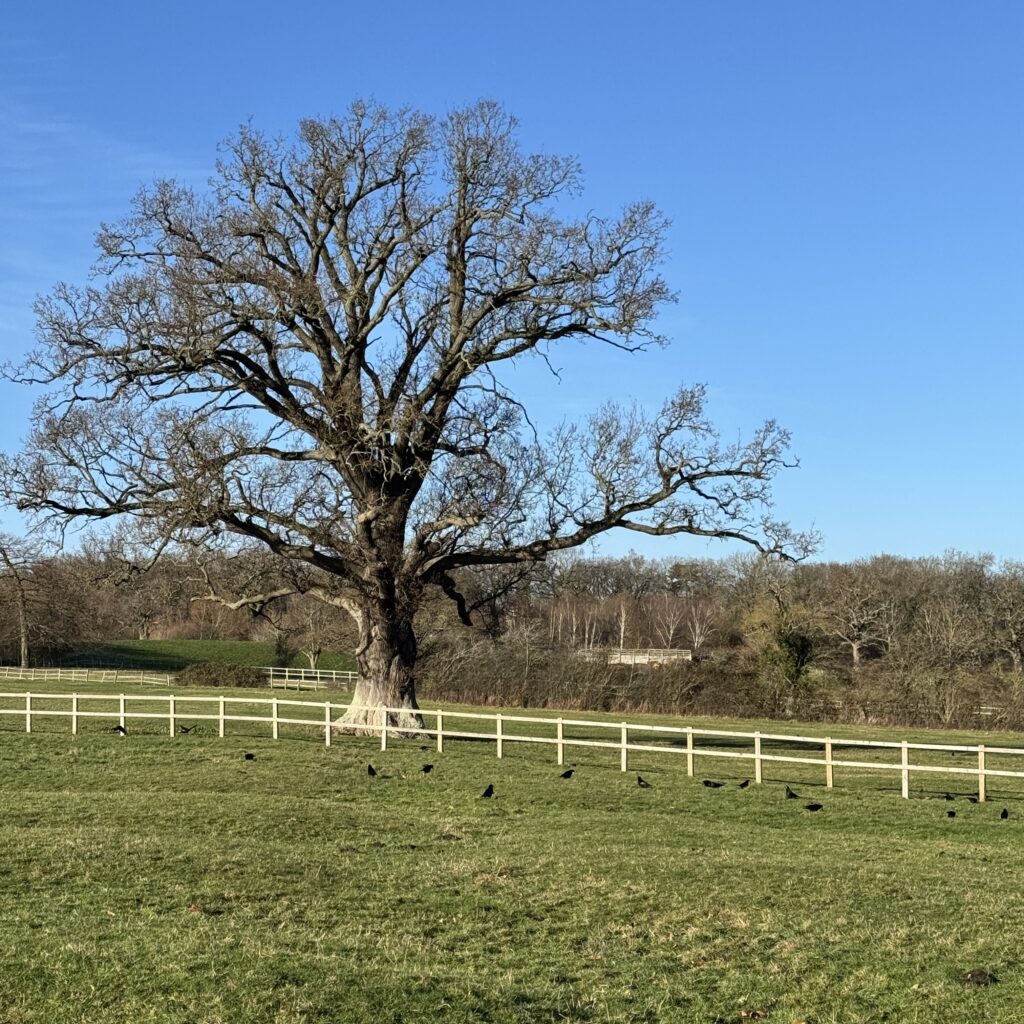
Go outside. The trees there are real. They don’t glitch.
That’s some essay. I like how it speaks about the cloaked ghoul of the internet designed to suck the souls from our beings. We are blessed to know of a time before the veil of darkness smothered the dawn light of that organic & messy hyper text.