









The medieval alchemist’s laboratory notebook wasn’t just a record of experiments. It was where the Great Work actually happened. Every observation, every failed attempt, every successful transmutation got inscribed onto parchment because the act of recording was inseparable from the process itself. The notebook was the laboratory.
Your journal functions the same way. It’s not documentation of your transformation. It’s not a diary where you record what happened to you. It’s the actual site where consciousness transmutes. The page becomes your athanor, the alchemical vessel where raw experience gets heated, pressurized, and refined into wisdom. This is why journaling isn’t just helpful for inner work. It’s essential. It’s the foundation upon which all other practices rest.
By the end of this post, you’ll understand why serious transformation work is nearly impossible without a journaling practice, and you’ll learn the three-stage alchemical approach that turns writing from passive recording into active magic.
The Journal as Alchemical Laboratory
Understanding the Athanor
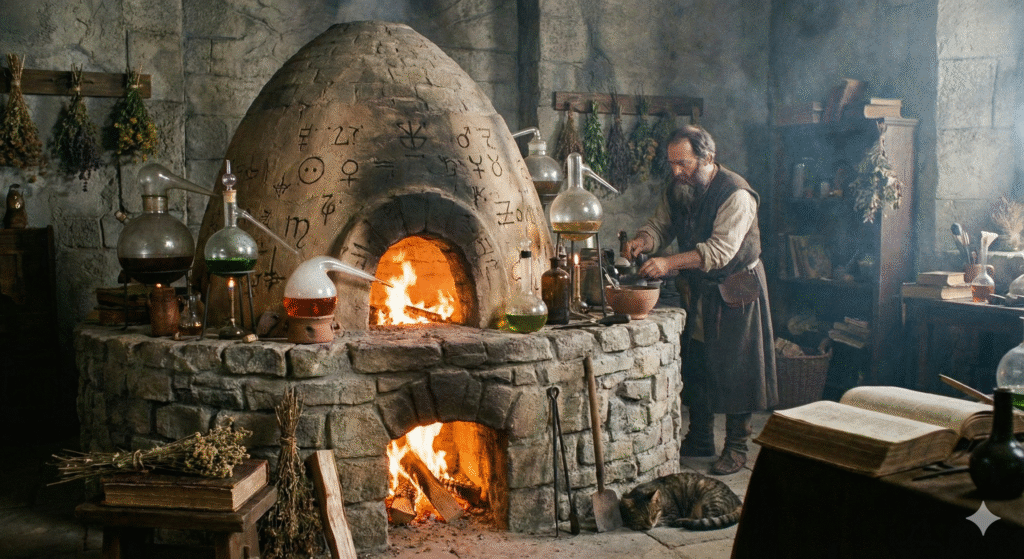
In alchemical tradition, the athanor is the furnace, the sealed vessel where base materials undergo transformation. It’s not just a container. It’s a carefully controlled environment where heat, pressure, and time work together to change the fundamental nature of what’s placed inside. Lead doesn’t become gold through wishful thinking. It requires the precise conditions the athanor provides.
Your journal page is your athanor. When you write, you’re not simply transcribing thoughts that already exist fully formed in your mind. You’re creating a contained space where the messy, formless experience of being human can undergo genuine transformation. The blank page provides constraint. The act of writing applies heat. The linear nature of text creates pressure. These aren’t metaphors. They’re the actual conditions under which consciousness changes.
Think about what happens when you try to explain something complex to another person. The act of articulation forces clarity. You discover what you actually think by trying to put it into words. Writing does this but with even more power because the page doesn’t interrupt, doesn’t judge, doesn’t mishear. It simply receives and reflects.
Prima Materia: Your Raw Experience
The alchemists called their starting material prima materia, the first matter. It was crude, undifferentiated, chaotic. Your raw experience is the same. The anger you feel but can’t quite name. The confusion about a relationship. The vague sense that something needs to change. The repetitive thought patterns that run in circles. The emotional residue from yesterday or last year.
This is what you bring to the page. Not polished insights. Not carefully crafted narratives. Not the story you tell at dinner parties. You bring the actual mess of being conscious, the unprocessed flow of thoughts and feelings that constitutes your inner life.
Most people never examine this material directly. They live inside it, react from it, make decisions based on it, but they never put it outside themselves where they can actually see it. This is like trying to perform chemistry while the substances are still inside their original containers, mixed together, unlabeled. You can’t work with what you can’t see.
Writing externalizes the internal. It takes what’s formless and gives it form. It takes what’s invisible and makes it visible. This alone is transformative, but it’s just the beginning.
The Three Stages of Alchemical Journaling
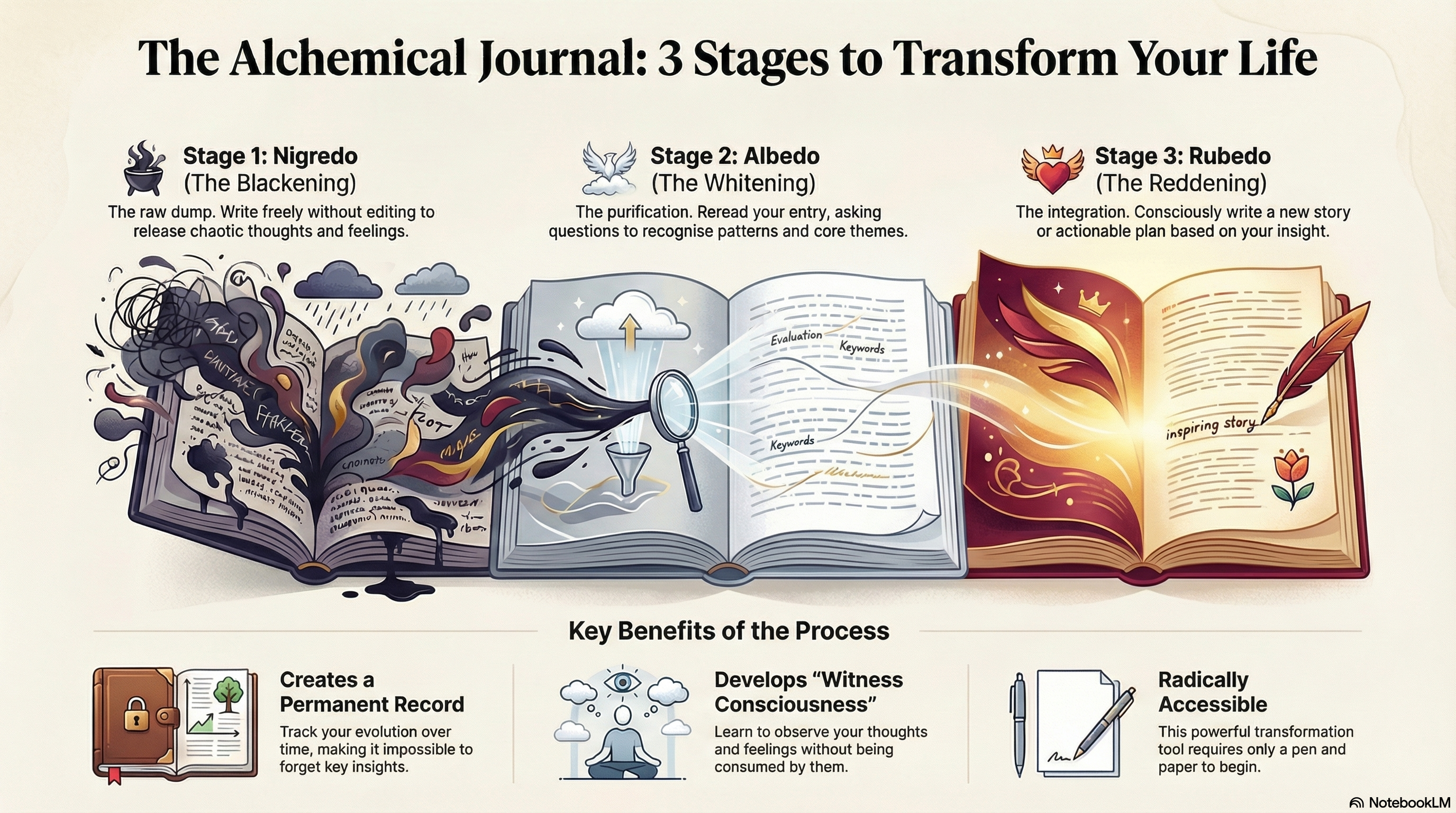
The alchemical tradition describes transformation as a three-stage process: nigredo, albedo, and rubedo. Blackening, whitening, and reddening. Most people who journal never move past the first stage. They experience some of the benefits, but they miss the real magic that happens in stages two and three.
Nigredo (The Blackening Phase): Dumping the Chaos
Nigredo is decomposition, the breaking down of existing structures. In your journal, this is the raw dump. You write whatever comes. You don’t edit, don’t make it coherent, don’t worry about grammar or sense or whether future-you will understand. You let the darkness onto the page.
This might look like: “I’m so angry at him and I don’t even know why, it’s not rational, I know I’m being unfair, but I can’t stop feeling this way, and then I feel guilty about feeling angry which makes me more angry, and underneath that is something else, fear maybe? Or just exhaustion? I don’t know, I’m so tired of having the same argument, why does this keep happening…”
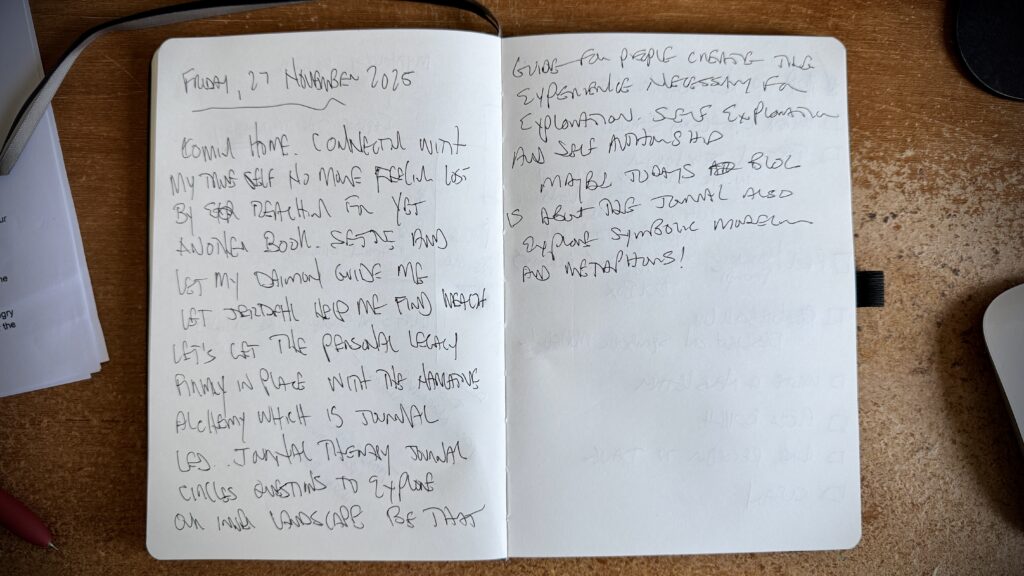
No punctuation, no structure, just the stream. This is emotional and cognitive compost. It needs to decompose before anything new can grow.
The benefits of nigredo are real. You get emotional release. You externalize what was eating at you from the inside. You create some distance between you and your experience. Many people stop here and think this is journaling. They feel better after venting, so they assume they’re done.
But nigredo alone doesn’t create transformation. It creates space for transformation. If you stop at the blackening phase, you’re just repeatedly dumping your psychological waste without processing it. You’ll feel temporary relief, but the same patterns will keep recurring because you haven’t actually changed the underlying structure.
Albedo (The Whitening Phase): Recognizing Patterns
Albedo is purification, the separation of essential from non-essential. In your journal practice, this is when you read back what you wrote and start asking questions.
You become your own analyst. You look at the text on the page not as the person who wrote it but as an observer. You ask: What patterns do I see here? What words do I keep using? What assumptions am I making? What’s the story underneath the story?
Using the example from nigredo, you might notice in albedo that every time you write about this relationship, the word “exhausted” appears. You might notice that your anger always contains guilt. You might see that you’re running a story about being unfair or irrational, which prevents you from taking your own feelings seriously.
This is where signal separates from noise. You start to see the themes that run through your life. The archetypal patterns. The repeated narratives. The places where you’re stuck in a loop.
The questions you ask in albedo are crucial:
- What’s the core feeling under the surface emotions?
- What story am I telling myself about this situation?
- Where else in my life does this pattern show up?
- What would I need to believe for this to make sense?
- What am I protecting or avoiding by staying in this pattern?
You write these questions in your journal. You answer them. Sometimes the answers surprise you. Often they reveal something you already knew but hadn’t admitted to yourself.
Albedo develops witness consciousness, the capacity to observe your own mind without being completely identified with it. This is arguably the most important skill in transformation work. When you can watch yourself thinking, you’re no longer entirely trapped by your thoughts.
Rubedo (The Reddening Phase): Integration and Action
Rubedo is the final stage, the creation of something new and stable. The gold. In your journal, this is when you consciously write the new story.
You take what you learned in albedo and you craft something you can actually use. You move from insight to practice. You ask: Given what I now understand, what do I choose to do differently? What new narrative can I construct that serves me better than the old one?
This isn’t positive thinking or affirmations. It’s not denying the difficult reality you uncovered in nigredo or the patterns you recognized in albedo. It’s consciously choosing how you’ll relate to that reality going forward.
Continuing with our example, rubedo might look like: “I see now that my exhaustion comes from trying to manage his emotions while suppressing my own. The new story is that my feelings are data, not character flaws. I choose to treat my anger as information about my boundaries rather than evidence that I’m a bad person. Next time this situation arises, I’ll name what I’m feeling without apologizing for it. I’ll say ‘I notice I’m feeling angry’ instead of ‘I’m sorry, I know this is stupid but…’ This is the practice.”
This is wisdom. This is actionable understanding. This is the philosopher’s stone, the catalyst that transforms everything it touches.
Rubedo creates new narratives that actually function better than the old ones. It gives you scripts you can run in real situations. It closes the loop between understanding and behavior change.
Why Journaling Outperforms Other Transformation Tools
The Power of the Written Record
Unlike meditation, therapy, or conversation with friends, journaling creates a permanent record. You can return to what you wrote last week, last month, last year. You can track patterns across time in a way that’s impossible when everything stays in your head or disappears into spoken words.
This matters enormously. Memory is unreliable and self-serving. We forget the insights we had. We minimize past pain. We rewrite our own history to maintain consistency. The journal doesn’t let you do this. It holds you accountable to what you actually thought and felt.
When you read entries from six months ago, you see how far you’ve come. You see which patterns have genuinely shifted and which ones are still running. You can’t gaslight yourself when the evidence is right there in black and white.
The written record also reveals long-term patterns that are invisible in the moment. You might not notice that every January you go through a period of existential questioning. But your journal shows you. You might not realize how often a particular person’s name appears in your anxious thoughts. But the pattern becomes obvious when you review your entries.
This longitudinal data about your own consciousness is invaluable. It’s research. It’s evidence. It’s proof that transformation is actually happening or clear indication of where you’re stuck.
Develops Witness Consciousness
There’s a profound difference between being angry and writing “I feel angry.” The moment you write it, you’ve created a gap between yourself and the emotion. You’re no longer completely identified with the anger. You’re the one observing and naming the anger.
This is witness consciousness, the capacity to watch your own mental and emotional states without being entirely consumed by them. It’s the foundation of all serious inner work. You can’t change what you can’t observe. You can’t observe what you’re completely identified with.
Journaling trains this capacity better than almost any other practice. Every time you write about your experience, you’re practicing the observer position. You’re strengthening the part of you that can watch the rest of you without judgment, with curiosity, with compassion.
This isn’t dissociation. You’re not disconnecting from your feelings. You’re developing the flexibility to be in them when that’s appropriate and to step back and examine them when that’s more useful. This flexibility is freedom.
Democratizes the Great Work
The real magic of journaling is its radical accessibility. You don’t need a teacher. You don’t need special training. You don’t need expensive equipment or years of study. You need something to write with and something to write on. That’s it.
This democratizes transformation work in a way that few other practices do. Meditation requires learning technique. Therapy requires money and access. Many spiritual practices require initiation or community. Journaling requires only honesty and a blank page.
This doesn’t make it easy. Honesty is hard. Facing what’s actually happening in your inner life is hard. But the barrier to entry is low, and the potential payoff is enormous.
Anyone can start right now. That’s powerful.
Journaling vs. Other Practices
Journaling isn’t the only transformation tool, and it works best in combination with other practices. But it has unique advantages.
Meditation develops present-moment awareness and the capacity to not react to every thought. But it doesn’t help you understand the content and patterns of your thoughts. Journaling does.
Therapy provides expert guidance and a relational container for healing. But it’s limited to the hour you’re in session. Journaling is available anytime, as often as you need it.
Tarot and other divination practices offer archetypal frameworks for understanding your situation. But they don’t capture the granular, specific details of your actual inner experience. Journaling does.
The unique benefit of journaling is that it combines active transmutation with tangible record. You’re not just having insights that evaporate. You’re creating a document of your own consciousness evolving. You can literally watch yourself change across the pages.
Getting Started with Alchemical Journaling
What You Need
Minimally: a notebook or digital document and a writing implement. That’s actually all you need.
Some people prefer physical notebooks because the act of handwriting engages the brain differently than typing. Others prefer digital for searchability and ease of review. Either works. Choose what you’ll actually use.
Optional enhancements: a dedicated space, a specific time, a ritual that signals to your mind that you’re entering the laboratory. But don’t let the lack of perfect conditions stop you from starting.
Your First Alchemical Writing Session
Set aside 20-30 minutes where you won’t be interrupted.
Begin with Nigredo (10 minutes): Write whatever is present for you right now. Don’t think about it, don’t plan it, just start writing and let it flow. Write about what’s bothering you, what you’re excited about, what you’re confused about, whatever wants to come out. Don’t edit. Don’t judge. Just dump it onto the page.
Move to Albedo (10 minutes): Read what you just wrote. As you read, ask yourself: What patterns do I notice? What words keep appearing? What’s the underlying feeling or belief? Write your observations. Write your questions. Write your answers to those questions.
Finish with Rubedo (5-10 minutes): Based on what you discovered in albedo, write what you want to remember or practice. What’s the insight you want to carry forward? What’s the new story or approach you want to try? Make it specific and actionable.
That’s the complete cycle. You’ve just performed the Great Work.
Building a Sustainable Practice
For journaling to become transformative rather than just occasionally helpful, it needs to be consistent. Daily is ideal. Three times a week is good. Once a week is better than nothing, but you’ll miss some of the pattern recognition that comes from frequent practice.
Many people find morning works best because your defenses are down and you haven’t yet constructed the day’s persona. Others prefer evening as a way to process the day. Experiment and find what actually works for your life.
The key is to make it so easy that you’ll actually do it. Better to journal for 10 minutes every day than to plan an elaborate hour-long practice you never get around to.
Resistance is normal. Your psyche doesn’t always want to be examined. When you feel resistance, write about the resistance. That’s valid nigredo material.
Common Journaling Mistakes to Avoid
Stopping at nigredo: Venting feels good, but it doesn’t create change by itself. Always move through all three stages, even if you spend different amounts of time in each.
Performing for an imagined audience: Write as if no one will ever read this. The moment you start crafting your words for how they’ll sound to someone else, you lose the raw honesty that makes journaling powerful. This is your laboratory, not your public relations department.
Skipping the review phase: Albedo requires that you read back what you wrote. Many people write and then immediately close the journal. They get the emotional release of nigredo but miss the insight of albedo. Build in time to read and reflect.
Inconsistent practice: Journaling once when you’re in crisis and then not again for months means you never build the longitudinal understanding of your patterns. The magic is in the accumulation. Make it regular.
Using it as a weapon against yourself: The journal is for honest observation, not harsh self-judgment. If you find yourself writing cruel things about yourself, notice that pattern in albedo and work with it in rubedo. The journal should make you freer, not more trapped in negative self-talk.
The Great Work Begins With a Blank Page
The medieval alchemists spent lifetimes in their laboratories, pursuing the transformation of lead into gold. They understood something we often forget: real change requires work. It requires a container, a process, and consistent practice. It requires you to actually engage with the raw materials of your life rather than just thinking about them.
Your journal is that laboratory. The page is your athanor. The three stages of nigredo, albedo, and rubedo are your process. The raw material is your own consciousness, and the gold you’re creating is a life lived with more awareness, more freedom, more alignment with who you actually are.
This is why journaling isn’t optional for serious transformation work. It’s not a nice addition to your practice. It’s the foundation. It’s where you learn to observe your own mind, recognize your patterns, and consciously rewrite the narratives that run your life.
The Great Work doesn’t require special gifts or mystical experiences. It requires honesty, consistency, and the willingness to look at what’s actually happening beneath the surface of your daily life.
It requires a blank page and the courage to fill it.
Start today. Open your notebook or create a new document. Write whatever is present for you right now. Don’t make it perfect. Just begin. The transformation happens in the doing, not in the planning.
Your laboratory awaits.