












Daydream Believer
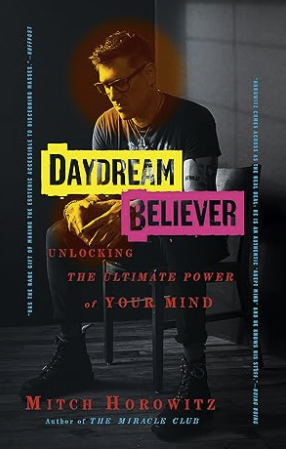
There’s a question Mitch Horowitz asks throughout Daydream Believer: Unlocking the Ultimate Power of Your Mind that lodged itself in my brain like a white hot poker: “What do you want?”
Not as a therapeutic prompt. Not as spiritual navel-gazing. But as a foundational question, one that determines whether you’re truly living or merely existing. This is the question that sets the direction of your life, the point from which every deliberate act of creation begins. It is the launching pad for any practical metaphysical work you attempt, because without knowing what you actually want, no technique, belief, or practice has anything solid to work with.
I’ve spent the past 25 years working in the self-development space. I thought I knew how to articulate desire. Turns out I’ve been operating with a fuzzy targeting system, wondering why I kept getting versions of what I wanted rather than what I actually wanted. Horowitz calls this out with uncomfortable precision: clarity is everything. Without clarity, mind causation breaks down. Your intention leaves your conscious mind distorted, misheard, or diluted, like a message passed hand to hand until it no longer resembles what you meant to say.
Daydream Believer is Horowitz’s attempt to take 150 years of New Thought experimentation to “its sharpest peak” and chart a path forward. It’s his ultra-statement on mind metaphysics, thought causation, and the extraphysical nature of consciousness. More importantly, for practitioners like myself who’ve lived in the esoteric trenches, it’s a rigorous philosophical justification paired with a practical formula that actually works.
Mind Metaphysics Meets Chaos Magick
Here’s what really lit me up. Horowitz anchors his entire approach in a single, uncompromising principle: results. As he puts it, “The only question that matters is: does it work?” Everything else—belief, theory, metaphysics—comes second to demonstrated effect.
Any chaos magician reading that line will recognize the rallying cry. Results-based magic. Functional metaphysics. Theory is fine for academics, but practitioners need operations that produce measurable outcomes. Horowitz delivers a four-step process that maps surprisingly well onto chaos magick methodology:
1. Focused Desire
2. Enunciation
3. Sex Transmutation
4. Acceptance of Channels
This isn’t repackaged positive thinking. It’s a disciplined, repeatable protocol. Manifestation doesn’t happen through vague wishes or spiritual bypassing. It happens through focused will aimed at specific outcomes, articulated clearly, emotionally charged, and then released without attachment to the form the result takes.
The chaos magick parallel is obvious: gnosis (focused desire), statement of intent (enunciation), charging the sigil (sex transmutation), and release/forgetting (acceptance of channels). Different vocabulary. Same operational technology.
What Horowitz adds is the philosophical scaffolding. He’s not content to say “do this because it works.” He wants to know why it works, what the limits are, where the critics get it right and where they miss the mark. This book is simultaneously mystical practice and intellectual rigor, which is rare in either camp.
Self-Expression as Ultimate Aim
One of the book’s core arguments hit me sideways: self-expression is the ultimate aim of life.
Not self-improvement. Not enlightenment. Not transcendence of ego. Self-expression. The full embodiment and expression of who you actually are means living from your own inner axis rather than from inherited expectations. It is the act of bringing your genuine drives, values, and creative impulses into form, instead of shaping yourself to match who you were told to be, rewarded for being, or conditioned into becoming. This kind of self-expression isn’t performance or self-improvement; it’s alignment. When what you want, what you do, and who you are all point in the same direction, will stops leaking, and creation becomes possible.
Horowitz grounds this in Nietzsche’s concept of the will to power, but clarifies that “power” here means the capacity to actualize your authentic nature in the world. The aim here isn’t domination at all, but creation.The power to bring forth what’s within you, to shape reality according to your vision, to participate actively in the construction of your experience rather than passively receiving whatever life deals you.
This aligns perfectly with my work in narrative alchemy. Stories aren’t just descriptions of what happened. They’re code that runs in consciousness, shaping perception, constraining possibility, or expanding potential. The stories you tell yourself determine the life you’re able to live. Self-expression, in this context, is the act of consciously authoring your narrative rather than unconsciously repeating inherited scripts.
If you’re operating from someone else’s story about who you should be, you’re not expressing yourself. You’re running their program. Much of what passes for desire is inherited, conditioned, or socially rewarded wanting rather than something that genuinely arises from within. When that’s the case, mind causation struggles to gain traction. You’re trying to bring about outcomes that contradict your deeper programming, so intention fractures before it ever becomes effective. Part of you wants the result, but another part is quietly loyal to an older script. The signal gets mixed, the will leaks, and the results arrive distorted or stall altogether. For mind causation to work, desire has to be congruent. It has to be yours all the way down.
The Interdimensional Participant
Horowitz makes a bold claim: you experience psychical lives among infinite realms. Your mind is an extraphysical, reality-selecting force.
This isn’t metaphor. He means it literally, though he’s careful to note he’s not advocating naive magical thinking. You’re not going to levitate through pure intention. But consciousness, he argues, operates in dimensions beyond the strictly physical. Your thoughts exist in and interact with layers of reality that material science hasn’t fully mapped.
This is where Daydream Believer ventures into genuinely radical territory. Most New Thought literature stays safely within psychological models: thoughts shape perception, perception influences behavior, behavior creates results. Horowitz goes further. He’s arguing for mind as a causal agent in extraphysical dimensions, drawing on psychical research, consciousness studies, and his own experiments.
For someone who’s been working with chaos magick for decades, none of this comes as a shock. The working assumption has always been that consciousness doesn’t stop at the boundaries of the skull. It interfaces with reality in ways that aren’t purely physical or fully explained by materialist models. Sigils work. Rituals produce results. Synchronicities don’t appear randomly; they cluster around charged intentions, as if probability itself has been nudged. You can give this process any name you like—quantum effects, morphic resonance, the imaginal realm—but the label is secondary. The consistent, lived fact is that something is happening here. Something causal, repeatable, and stubbornly resistant to reduction into purely mechanical explanations.
What Horowitz offers is a philosophically defensible version of this claim that doesn’t require metaphysical credulity. He isn’t asking you to sign on to a belief system or suspend your critical faculties. You don’t have to believe in angels or demons, though he also refuses to dismiss those ideas out of hand as mere superstition. Instead, he asks you to seriously consider a more modest but more radical possibility: that mind is not fully contained within the skull, that thought has effects which extend beyond the merely neurological, and that you are already participating in the ongoing construction of reality at levels beneath conscious awareness. In this view, mind causation isn’t fantasy or wishful thinking. It’s an extension of a process you’re already part of, whether you recognize it or not.
The real shift Horowitz is asking for is from passive consciousness to participatory consciousness. In the passive model, the mind is a byproduct of matter, awareness is a spectator sport, and reality simply happens to you. Your thoughts may influence your mood or behavior, but they don’t meaningfully shape the structure of events. In the participatory model, consciousness is not an afterthought. It is an active variable in the unfolding of experience. Attention, intention, and expectation don’t just interpret reality after the fact; they help select which possibilities solidify into lived outcomes. This doesn’t make you omnipotent, but it does make you responsible. You are no longer merely reacting to the world. You are implicated in its ongoing formation, whether through clarity or confusion, intention or drift.
This is where participatory consciousness becomes uncomfortable. If consciousness plays an active role in shaping experience, then vague intention, unconscious belief, and unexamined narrative aren’t neutral. They are formative forces. Drift creates outcomes just as surely as clarity does. Much of what people experience as fate, bad luck, or external obstruction begins to look like unattended authorship. Not chosen, but still participated in. This doesn’t mean you are at fault for everything that happens to you. It does mean that avoidance, confusion, and inherited stories carry causal weight. In a participatory universe, responsibility expands along with possibility. You don’t just get to create deliberately. You also create accidentally.
This is also why participatory consciousness meets so much resistance. It removes the psychological shelter of pure victimhood without offering the fantasy of total control. You don’t get to say “it’s all happening to me,” but you also don’t get to believe you can think your way into omnipotence. What you’re left with is something far more demanding: partial agency in a complex system. Your intentions matter, but so do your blind spots. Your beliefs shape outcomes, but they don’t excuse you from friction, loss, or uncertainty. For many people, this is intolerable. It’s far easier to deny participation altogether than to accept responsibility without guarantees. Participatory consciousness doesn’t promise comfort. It asks for authorship under conditions you did not choose.
The Technology of Prayer and Wish
Two chapters particularly resonated: his treatment of prayer and true wishes.
Prayer, Horowitz argues, works, but not for the reasons most people assume. It isn’t effective because a supernatural authority is necessarily listening and deciding whether to grant your request. It works because prayer functions as a technology of consciousness. It organizes attention, concentrates desire, and aligns will around a clearly articulated aim. In doing so, it brings the mind into coherence and directs that coherence toward the field of experience itself. Whether you frame the act as speaking to God, the universe, your higher self, or simply naming an intention into the void is secondary. What determines efficacy is not the object of prayer, but its execution. Precision matters. Emotional charge matters. The clarity with which the desire is named determines how cleanly it can take hold and begin exerting causal pressure.
This is another place where New Thought and chaos magick quietly collapse into the same operational logic. Prayer and spell-casting are not opposites, nor even distant cousins. Functionally, they are the same act performed inside different symbolic systems. Both require focused intention, emotional investment, and the deliberate use of language and imagery to configure consciousness toward a specific outcome. Both assume, implicitly or explicitly, that mind is not sealed off from the world but participates in shaping how events unfold. Strip away the theology, the aesthetics, and the cultural framing, and what remains is a shared technology: attention disciplined into form, desire charged with feeling, and meaning deployed as a causal instrument. The symbols differ. The mechanism does not.
His discussion of wishes follows the same operational logic. A true wish, properly formed, carries causal power not because reality bends to fantasy, but because the act of precisely articulating desire reorganizes consciousness around that desire. When a wish is clear, the mind begins to sort the world differently. Perception sharpens. Attention gravitates toward relevant signals. Possibilities that were previously invisible register as actionable openings. Behavior adjusts, often subtly, in ways that align with the stated aim. What changes first is not the external world, but the internal pattern that determines what you notice, what you consider possible, and what you’re willing to act on. Over time, those shifts accumulate into tangible results that feel uncanny only if you ignore the invisible reconfiguration that made them possible.
This is where the book landed its most personal blow for me. I realized I haven’t been failing at manifestation so much as feeding the system bad inputs. I’ve been making sloppy wishes. Vague wants. Loosely sketched hopes that gesture in a general direction and then leave the details unresolved. And then I’ve wondered why the results arrived distorted, partial, or oddly misaligned. Horowitz makes the uncomfortable point clear: the wish itself is the programming. If the instruction is fuzzy, contradictory, or half-hearted, the output will be too. Mind causation doesn’t fail because reality is hostile or indifferent. It fails because the signal is incoherent. Garbage in, garbage out isn’t cynicism here. It’s diagnostics.
The deeper issue isn’t ignorance. It’s reluctance. Precision is dangerous because it removes your ability to hedge. A vague desire lets you fantasize without committing. It keeps failure hypothetical and success undefined. Once a wish becomes exact, you can no longer hide behind ambiguity. You either move toward it or you don’t. You either want it enough to reorganize your life around it, or you discover that what you thought you wanted was only a socially acceptable placeholder. Sloppy wishes are often a form of self-protection. They allow desire without accountability. Horowitz’s framework quietly dismantles that defense. If the wish is the programming, then clarity forces a reckoning. You must decide what you’re actually willing to become in order to have what you say you want.
Reprogramming the Subconscious
Horowitz devotes considerable attention to self-suggestion and subconscious reprogramming, drawing on early pioneers like Émile Coué and Napoleon Hill. What he outlines is deceptively simple and genuinely demanding: repeated autosuggestion delivered at moments when the conscious mind loosens its grip. Morning and evening, when habitual resistance is lower, you deliberately introduce new instructions into the system. This isn’t affirmation as self-soothing or motivational wallpaper. It’s intentional reconditioning. You’re issuing commands to the deeper layers of the psyche, installing updated parameters that redefine what feels normal, possible, and inevitable. Think less positive thinking, more firmware update.
A weak autosuggestion sounds like this: “I want to be more confident” or “I’m trying to be successful.” It’s abstract, future-oriented, and emotionally flat. A strong autosuggestion is concrete and present: “I speak clearly and decisively in my work, and people respond with trust and engagement.” The difference isn’t optimism. It’s specificity. The second statement gives the subconscious something it can actually organize around. It names behavior, context, and felt sense. One drifts. The other installs.
This is where the book gets practical. Horowitz doesn’t just theorize about mind power. He gives you the protocol. What to say, how to say it, when to say it, and why it matters that you say it in present tense with emotional conviction.
For anyone who’s worked with sigils, this is familiar territory. You’re not begging the universe for change. You’re declaring the change as already accomplished. You’re rewriting the deep story, the subconscious narrative that determines what feels possible.
My experience with narrative alchemy has taught me that people’s limiting beliefs aren’t intellectual positions. They’re stories embedded in the psyche, running constantly beneath awareness. Changing those stories requires more than deciding to think differently. It requires sustained, repetitive, emotionally charged installation of new narrative code.
Horowitz’s self-suggestion protocol is exactly that. Narrative debugging through systematic autosuggestion.
The Limits and the Shadow
To his credit, Horowitz doesn’t promise unlimited manifestation. He’s clear about the limits of mind power. You can’t think your way out of terminal illness (though you can influence recovery and quality of life). You can’t manifest lottery wins on demand (though you can enhance opportunity recognition and decision-making). You can’t override physical laws through pure intention.
What you can do is participate in reality construction within the parameters of possibility. You can influence probability. You can shape trajectory. You can open doors that were previously invisible. This is real power, even if it’s not omnipotence.
He also addresses suffering directly, which most New Thought writers avoid. Acknowledging suffering, he argues, is itself a metaphysical force. Not wallowing. Not victimhood. But clear-eyed recognition of pain as part of the human condition, and the determination to work creatively within and through that pain.
This is where Daydream Believer distinguishes itself from toxic positivity. Horowitz isn’t selling spiritual bypassing. He’s offering a metaphysics that accounts for the full range of human experience, including grief, depression, and anxiety. The practices he outlines aren’t escapes from difficulty. They’re tools for navigating difficulty with greater agency and creativity.
What Do You Want?
The book keeps returning to this question. And it’s not rhetorical.
Horowitz insists that if you can’t answer this question with crystal clarity, nothing else matters. All the practices, all the philosophy, all the metaphysical theory in the world won’t help if you don’t know what you’re trying to create.
This is where I found myself confronting my own fuzzy targeting. I’ve had visions. I’ve set intentions. I’ve performed rituals. But have I articulated my desires with absolute precision? Have I defined success in terms so clear that I’ll know beyond doubt when I’ve achieved it?
The answer, uncomfortably, is no.
I’ve been operating in impressionistic mode. I want “success” with Soulcruzer. I want to “reach people” with narrative alchemy. I want to “build something meaningful.” All fine sentiments. None of them actionable targets for mind causation.
What does success look like exactly? How many people? Doing what? Meaningful by what measure? These aren’t nitpicking questions. They’re the difference between functional magic and wishful thinking.
Daydream Believer forced me to confront the gap between my vague wants and the kind of laser-focused desire that actually moves reality. If I want mind causation to work, I need to be able to state my aim in a single, clear, unambiguous sentence. Not as aspiration. As declaration of intent.
The Functional Philosophy
What makes this book valuable isn’t just the practices or the philosophy. It’s the integration. Horowitz has created a functional system that works whether you interpret it literally or metaphorically, whether you believe consciousness is fundamental or emergent, whether you think you’re manipulating quantum fields or simply optimizing your psychology.
This is the genius of his “does it work?” criterion. It bypasses metaphysical disputes and focuses on results. Use the techniques. Track the outcomes. Refine the method. This is empiricism applied to inner work.
For someone like me, who’s spent years navigating the intersection of esoteric practice and practical application, this approach feels honest. I don’t need to believe in a particular cosmology to work with narrative alchemy. I need techniques that produce transformation. The same goes for Horowitz’s mind metaphysics.
Whether thought is causative because consciousness is fundamental, or because psychological shifts create behavioral changes that produce material results, doesn’t matter as much as whether the protocol actually works. And based on my experiments so far, informed by this book’s clarity on desire articulation, it does.
The Challenge Ahead
Daydream Believer ends with a challenge: implement the formula and watch for confirmation of its truth.
I’ve taken up that challenge. I’ve rewritten my core desires with brutal clarity. I’ve established a morning and evening autosuggestion practice. I’ve been treating my statements of intent not as hopeful affirmations but as code being installed in the operating system of consciousness.
It’s too early for comprehensive results, but the shift in focus is already noticeable. When you clarify what you want with precision, opportunities you would have dismissed as irrelevant suddenly become pathways. Actions that felt optional become obvious next steps. The fog lifts.
This is what Horowitz is offering: not magical thinking, but practical metaphysics. Not spiritual bypassing, but functional technology for consciousness. Not promises of omnipotence, but genuine tools for participating in reality construction with greater intention and skill.
For practitioners of chaos magick, narrative alchemy, or any results-focused approach to inner work, Daydream Believer is essential reading. It’s the philosophical backbone many of us have been operating without, the rigorous justification for practices we’ve known intuitively but struggled to articulate.
And for anyone asking “What do I want?” and realizing they can’t answer clearly, this book is the starting point. Because until you know what you want with absolute clarity, you can’t begin the work of bringing it into being.
The will to create demands nothing less than total precision. Horowitz has given us the manual. Now the work is ours.