







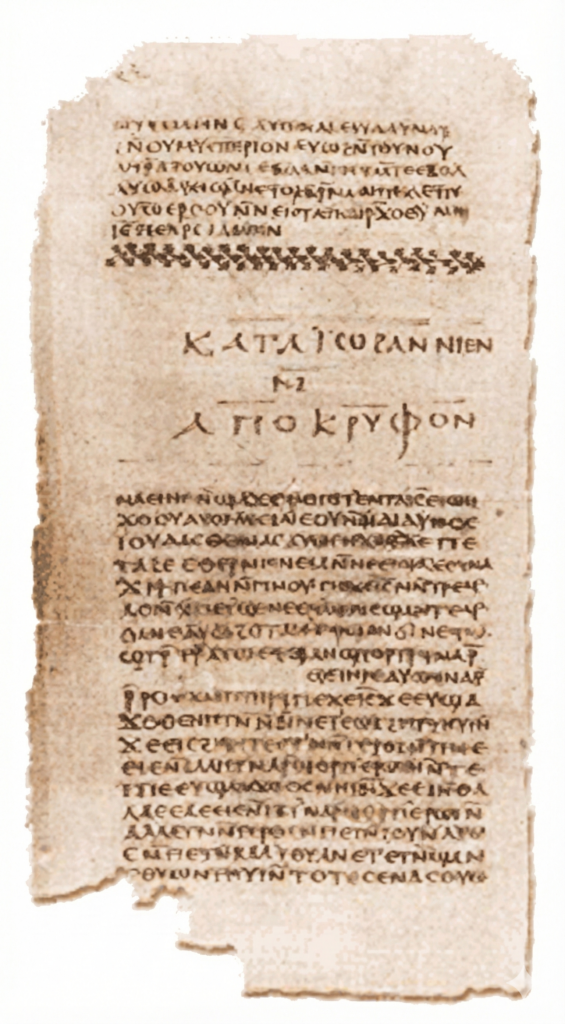
There’s a text the early Christian church tried to suppress because it proposed something dangerous: that not all humans are created equal in their capacity for spiritual awakening.
The text describes three distinct types of human consciousness. And which type you are determines whether you’re trapped in an endless loop or on the path to liberation.
This isn’t about being “better” or “worse.” It’s about recognizing which narrative mode you’re currently running and whether that code is getting you where you actually want to go.
The Three Types
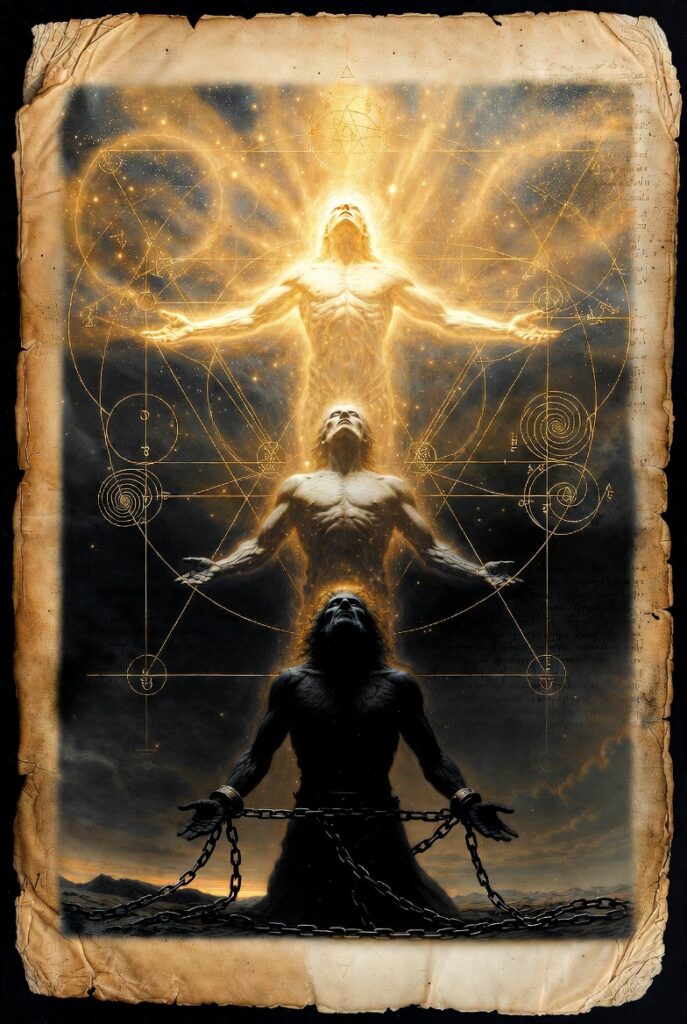
According to this banned text, humanity divides into three categories based on their relationship with reality itself.
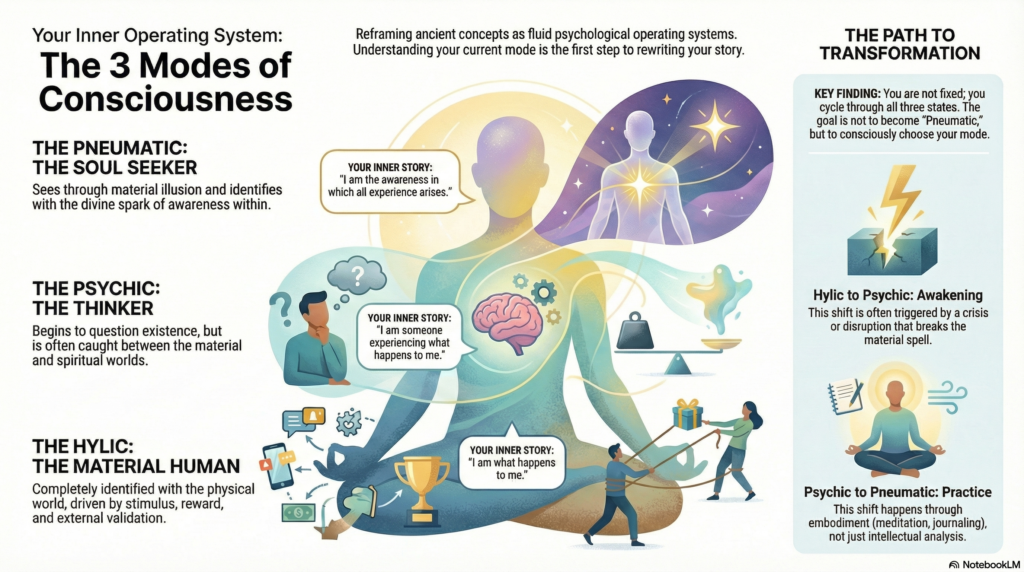
The Hylics are the material humans, completely identified with the physical world. Their consciousness is absorbed by the immediate, the tangible, the here and now. They live in a perpetual present tense, responding to stimulus and reward without questioning the game itself. The text suggests these souls return again and again to the material world, replaying the same patterns in an endless cycle.
The Psychics (from the Greek psyche, meaning soul or mind) are the thinkers. They’ve begun to question their existence, to wonder if there’s something beyond the surface. They’re caught between worlds, one foot in material reality and one reaching toward something more. They sense the cage but haven’t found the door.
The Pneumatics (from pneuma, meaning spirit or breath) are the soul seekers. They’ve pierced the veil of material illusion and recognized the divine spark within. They’re no longer fooled by the game. Their consciousness is oriented toward liberation, toward reunion with source.
The ancient text frames this as destiny. But what if it’s actually describing states of consciousness rather than fixed identities? What if these aren’t types of people but types of stories we tell ourselves about reality?
Stories as Operating Systems
Here’s where the psychological interpretation gets interesting.
Think of these three types not as permanent categories but as narrative modes, like different operating systems running on the same hardware. You’re not born a Hylic or a Pneumatic. You’re running Hylic code or Pneumatic code, and code can be rewritten.
Hylic consciousness is stimulus-response programming. It’s reactive, survival-oriented, pleasure-seeking. There’s no witness, no observer standing apart from experience. The story is “I am what happens to me.” This isn’t stupidity. It’s absorption. The Hylic is so identified with the material drama that they can’t see the stage, the script, or the audience.
From a psychological perspective, this is pure ego identification. The self is constructed entirely from external validation, material success, sensory experience. When you’re running Hylic code, your worth is measured in possessions, status, pleasures. You’re chasing the next hit of dopamine without ever asking why you’re chasing anything at all.
Psychic consciousness introduces the observer. There’s now a split, a gap between experience and awareness of experience. The Psychic has begun to notice the patterns, to question the script. They’re thinking about thinking. The story becomes “I am someone experiencing what happens to me.”
This is the emergence of the witness, what Jung called the transcendent function. The Psychic operates in the space between instinct and spirit, between matter and meaning. They’re philosophers, analysts, seekers of understanding. But they’re stuck in analysis paralysis, caught between two worlds without fully committing to either.
Pneumatic consciousness is liberation through recognition. The Pneumatic doesn’t just observe the drama, they recognize it as drama. They’ve seen through the illusion of separation and identified with the divine spark rather than the costume it’s wearing. The story transforms into “I am the awareness in which all experience arises.”
Psychologically, this is what the contemplative traditions call awakening, what Jung pursued through individuation, what the alchemists encoded in their symbolic transformations. It’s not about escaping the body or rejecting the material. It’s about recognizing your true nature beyond both.
The Trap of Spiritual Hierarchy
Before you start measuring yourself against these categories, let’s address the obvious trap.
The original text does frame this as hierarchy. Hylics are “trapped,” Pneumatics are “liberated.” It’s tempting to use this as spiritual one-upmanship, to identify as Pneumatic and look down on all those “sleeping” Hylics.
That impulse? That’s ego. And ego operates in Hylic mode, even when it’s wearing spiritual costumes.
The real insight isn’t “I’m Pneumatic and therefore special.” The real insight is recognizing which mode you’re operating from moment to moment. Because here’s the truth: you cycle through all three states constantly.
When you’re scrolling social media for the dopamine hit, you’re running Hylic code. When you’re overthinking a decision, caught in analysis paralysis, you’re in Psychic mode. When you’re present, aware, and responding from your center rather than your conditioning, you’re touching Pneumatic consciousness.
The question isn’t “What type am I?” The question is “What code am I running right now, and is it serving my actual goals?”
Recognizing Your Current Code
So how do you know which narrative mode you’re in?
Hylic indicators:
- Your mood is entirely dependent on external circumstances
- You’re chasing the next pleasure, possession, or achievement without reflection
- You rarely question why you want what you want
- Your identity is built on what you own, what you’ve accomplished, or what others think of you
- You’re reactive rather than responsive
- There’s no gap between stimulus and response
Psychic indicators:
- You’re constantly analyzing yourself and your experience
- You sense there’s something more but can’t quite grasp it
- You’re caught between worldviews, unable to fully commit
- You read about spirituality but struggle to embody it
- You’re fascinated by meaning but paralyzed by uncertainty
- You live in your head, thinking about life rather than living it
Pneumatic indicators:
- You experience yourself as awareness rather than content
- External circumstances affect you but don’t define you
- You can hold paradox without needing to resolve it
- You act from center rather than conditioning
- There’s a quality of witnessing even in intense experience
- You’re oriented toward liberation rather than accumulation
Notice these aren’t virtues and vices. They’re different relationships with reality itself. And the goal isn’t to be Pneumatic all the time (that’s another Hylic trap, chasing the spiritual high). The goal is conscious choice about which mode serves the situation you’re actually in.
The Alchemy of Transformation
The banned text suggests that Hylics are doomed to repeat the cycle, that transformation between types is impossible or predetermined. But every wisdom tradition contradicts this determinism. Transformation is always possible because consciousness is fluid, not fixed.
The alchemists knew this. Their entire art was about transformation, taking lead (Hylic density) and refining it into gold (Pneumatic awareness) through the repeated application of heat, dissolution, and recombination. They weren’t talking about literal metals. They were encoding a map of consciousness.
The movement from Hylic to Psychic happens through disruption. Something breaks the spell of material absorption. A crisis, a loss, a moment of beauty so intense it cracks the shell. Suddenly you’re asking questions you couldn’t even formulate before. Who am I? Why am I here? Is this all there is?
The movement from Psychic to Pneumatic happens through practice, not belief. You can’t think your way to Pneumatic consciousness. You have to embody it through repeated practice of witnessing, presence, and intentional narrative work. This is why every tradition has practices: meditation, prayer, ritual, journaling, contemplation. These aren’t decorative. They’re the actual technology of transformation.
Stories are the bridge. The stories you tell yourself about who you are and what’s possible determine which code you run. Change the story, change the code. Change the code, change your experience of reality.
This is why narrative work isn’t just creative play. It’s the fundamental technology of consciousness transformation. When you rewrite your story with awareness and intention, you’re literally reprogramming your operating system.
The Question That Matters
The banned text asks: Which type are you?
But that’s the wrong question. The right question is: Which story are you currently living, and is it taking you where you want to go?
Are you trapped in Hylic loops, chasing pleasures that never satisfy, accumulating possessions that never complete you?
Are you stuck in Psychic analysis, endlessly thinking about transformation without ever actually transforming?
Or are you touching Pneumatic awareness, recognizing yourself as the consciousness in which all stories arise and fall?
The beautiful and terrifying truth is that you get to choose. Not once, but moment by moment. Every instant is an opportunity to recognize which code you’re running and whether you want to keep running it.
The Hylics aren’t other people. They’re the parts of you absorbed in the drama.
The Psychics aren’t other people. They’re the parts of you questioning but not yet committing.
The Pneumatics aren’t other people. They’re the parts of you that have already awakened and are simply waiting for the rest of you to notice.
What’s Your Code?
You’ve read the framework. You’ve seen the psychological patterns. Now comes the practical part: honest self-assessment.
Which mode dominates your consciousness? Which story are you living right now? Not which one you wish you were living, not which one sounds most impressive, but which one is actually running your code?
Take the Threefold Self Quiz and discover where you are on the map. Because you can’t change what you can’t see, and you can’t transform what you won’t acknowledge.
The ancient text was banned because it suggested some souls couldn’t awaken. But the deeper truth they tried to suppress is simpler and more dangerous: awakening is always possible, and it starts with seeing clearly where you actually are.
Which type are you? Take the quiz and find out.