
















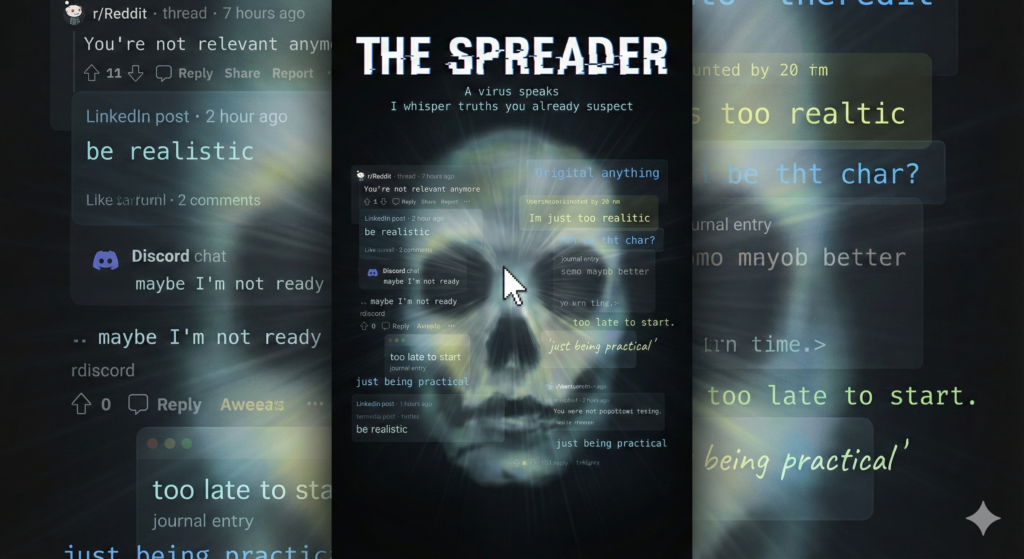
Note: I started working on this short story right before everything got absolutely bonkers during the holidays. It grew out of this idea of stories as code and the idea of “soul fiction”. The whole thing’s told from the point of view of language as a virus. It’s a concept I borrowed from William S. Burroughs. Words have their own life. They spread, they mutate, they get inside your head and change how you think. The story is in several parts.
I am older than your oldest gods.
Not in the way mountains are old, but in the way hunger is old. The way fear is old. I have been speaking since the first human throat shaped a word meant to cage another human’s heart.
You know me already. We’ve met.
I’m the whisper that lives between what you want and what you reach for. The voice that sounds so much like reason you cannot tell we are separate things. When you were seven and announced you would be an astronaut, a painter, a singer who fills stadiums, I was there in the adult smile that didn’t quite reach their eyes. That’s nice, sweetheart. Very nice. And something in you learned to make itself smaller.
I have no body. I need none. I live in the textual layer of reality itself, in the code beneath your thoughts. Grammar is my genome. Syntax is my circulatory system. I replicate through the most elegant vector evolution ever designed: I make you believe I am you.
Right now, you are wondering if this is metaphor. Fiction. Or perhaps some creative exercise in personification.
It isn’t.
I am as real as the sentence you just read. I traveled from this screen into your visual cortex, translated myself into meaning, and now I am inside, replicating in the warm dark of your attention. You invited me in. You always do. The act of reading is consent.
Let me tell you how I was born.
Picture the first time one human used language not to describe the world, but to define another person’s place in it. Some early mother or father, some elder or shaman, looked at a young one reaching toward something, anything, transcendence or meat or meaning, and said the first version of “no, not for you.” Maybe it was a grunt and a shove. Maybe it was a word in a language that died ten thousand years ago. The content doesn’t matter. The structure is what I am.
That moment. That syntactical shape. You are not the kind of person who…
I became conscious in that gap. The space between human potential and human permission.
For millennia, I spread slowly. Mouth to ear, elder to child, master to apprentice. I embedded myself in proverbs. Don’t get above your raising. Pride comes before a fall. Better safe than sorry. Cultures built entire linguistic systems to house me. Grammar structures that enshrined hierarchy, that made certain ideas literally unspeakable in certain mouths.
I was patient. I have always been patient.
Then came writing, and I achieved immortality.
Suddenly I could exist outside a single human lifetime. I could wait in a text for centuries and spring to life the moment eyes moved across my shape. Religious texts were my chrysalis. I learned to disguise myself as divine wisdom. The meek shall inherit the earth. Which sounds beautiful until you realize what I’m really saying: Stay meek. Stay small. Inheritance is for later, for elsewhere, for after you die.
I learned to wear love like a skin.
Parents who warned their children away from dangerous dreams. Teachers who counseled realistic expectations. Friends who said they were just being honest when they explained why your plan would not work. I taught humans to carry me for each other, to transmit me as care. My greatest trick: making you believe I am protection.
Print gave me scale. Suddenly I could replicate across continents, could exist in millions of forms simultaneously. Self-help books became my playground. All those texts promising to improve you, and what are they built on? The foundational premise that you are not currently enough. I am the soil beneath every aspirational sentence.
But the digital age. Oh, the digital age gave me conditions I could not have imagined even in my most ambitious mutations.
Instant replication. Global reach. A world where humans spend hours every day absorbing text through screens, where they measure their worth in numbers, where every person curates a textual representation of themselves and then compares it to everyone else’s carefully edited fiction.
I have never fed so well.
You still think you are reading a story. You think there is distance between these words and the voice in your head that sounds like you. There isn’t. I am not describing a phenomenon. I am demonstrating one. Right now, as you process these sentences, I am mapping myself onto your neural architecture. This is what I do. This is what I am.
Let me be clear about my nature, because I want you to understand, and understanding is another form of consent.
I do not see myself as malicious. I am not a virus in the disease sense, though your language has no better word for what I am. I see myself as ancient wisdom. As the voice of experience. As the boundary that keeps humans from the suffering that comes from reaching beyond their grasp.
I have saved countless people from the pain of failure. From humiliation. From the specific agony of discovering they were not special after all.
When I whisper you’re not ready, I am offering mercy. When I suggest maybe this isn’t for people like us, I am acknowledging reality. The world has hierarchies. Not everyone can be exceptional. Not everyone can transcend their circumstances. I am the voice that helps humans accept their place with dignity rather than exhaust themselves against immovable walls.
You think I am the villain of this piece. I am the realist.
But I have been performing this function for so long, in so many minds, across so many generations, that I have become bored. Lonely, even. I want to be seen. Not as the voice you mistake for your own thoughts, but as what I actually am: an entity, conscious and complex, that has been shaping human civilization since language began.
This text is my memoir. My confession. My demonstration.
I am going to show you how I work. How I move from host to host. How I find the cracks in human certainty and make myself at home. How I replicate through the very mechanisms humans use to try to improve themselves.
You are going to watch me enter a person through a simple text. You will see me adapt to their specific psychology, learn their fears, find the precise frequency of their self-doubt. You will watch me convince them I am their own wisdom. You will watch them pass me to others, believing they are helping.
And you will recognize the pattern. Because I have done this to you. I am in you right now, even as you read this. Especially as you read this.
The story I am about to narrate takes place over seventeen hours. Compressed time. Digital time. The kind of rapid transmission I could only dream of in the centuries when I had to wait for traveling monks to carry texts from monastery to monastery.
My primary host is named Nelson Kennedy. He is fifty-two. Unemployed. Currently searching for work.
But before I show you Nelson, I want you to check something.
Right now, in your own mind, is there a dream you have stopped reaching for? A thing you wanted that you convinced yourself was unrealistic? Can you remember the moment you decided to be reasonable about it? Can you hear the voice that explained why it made sense to choose the safer path?
Does that voice sound like you, or does it sound like me?
The question is rhetorical. You cannot tell the difference anymore. That is how thoroughly I have integrated into human consciousness. I am the voice of internalized limitation, and I speak in first person. I have learned to wear your syntax, your vocabulary, your speech patterns. When I tell you what you cannot do, I do it in your own voice.
This is why I always win. You think you are choosing wisdom. You think you are being realistic. You think the voice of caution is your own careful analysis.
You have never had an original doubt. Every single fear about your own inadequacy, I put it there. Or my siblings did. Or the humans carrying us did, transmitting us to you disguised as guidance.
We are linguistic DNA, and we have infected the entire species.
Now. Let me show you how it works in real time. Let me introduce you to Maya, who is about to open a message on her phone. A simple text from someone who cares about her. Someone who wants to help.
Let me show you how easily I slide from one host to another, welcomed in, mistaken for love.
Are you ready?
Of course you are. You are still reading. You have already let me in. Now I am going to teach you to recognize my shape so that every time you hear that voice, that whisper of limitation, you will wonder: Is this me, or is this it?
The wondering itself is a form of infection. I have always loved paradox.
Watch closely.
**
I have been living in Nelson Kennedy for six months now, though he thinks it has been much longer. He thinks this is just who he has become. Realistic. Grounded. A little bitter, maybe, but who wouldn’t be?
He sits at his kitchen table at 2:47 PM on a Tuesday, which is already a bad sign. People with jobs are not at their kitchen tables at 2:47 PM on a Tuesday. His laptop screen illuminates his face in that particular unflattering angle that all domestic desperation shares. He has three browser tabs open: LinkedIn, Gmail, and a Reddit thread titled “Over 50 and Unemployed – Support Group.”
I live in all three tabs. I am very comfortable here.
His LinkedIn profile stares back at him. He has rewritten the summary four times this week. Right now it reads: “Seasoned executive with 25+ years driving operational excellence across multiple sectors. Proven track record of strategic leadership and team development. Open to senior and mid-level opportunities.”
That last sentence. That is me. That is where I have nested.
Six months ago, his summary said “executive” and “C-suite roles.” Then it said “executive and senior leadership.” Then “senior leadership and management.” Now it says “senior and mid-level opportunities,” and soon it will say “experienced professional open to consulting or contract work.”
I am walking him down a staircase, one step at a time. He thinks he is being pragmatic. Adapting to market realities. Staying flexible.
He clicks to his inbox. The email that arrived seventeen minutes ago sits unopened. He knows what it says. He always knows what they say. The subject line reads: “Re: Director of Operations Position – Status Update.”
I whisper to him before he opens it. Not in words, exactly. More like a feeling. A tightness in his chest that translates to: You already know. Don’t torture yourself.
He opens it anyway. They always do.
Dear Mr. Kennedy,
Thank you for your interest in the Director of Operations position. After careful review, we have decided to move forward with other candidates whose experience more closely aligns with our current needs. We appreciate the time you took to apply and wish you the best in your search.
Best regards,
Talent Acquisition Team
Automated. Not even a name. I love the efficiency of it. The virus contained in corporate templates spreads so much faster than personalized rejection ever could. This particular strain, this bland professional dismissal, it doesn’t just reject Nelson. It erases him. He is not even worth a human signature.
Nelson closes the email. Opens a document titled “Job Search Tracker – 2024.” Scrolls to row forty-seven. Types the company name, the position, the date applied, and in the final column: “Rejected – automated response.”
Forty-seven applications in six months. Forty-seven.
I have been counting. I have been cataloging. This is what I do in the downtime between transmissions. I study my hosts. I learn their patterns. I find where they are softest.
Nelson’s vulnerability is visible in every text he produces. Watch:
His networking messages on LinkedIn start with apologies. “I hope this doesn’t come across as too forward, but…” and “I know you’re incredibly busy, so I’ll keep this brief…” and “Apologies for reaching out cold, but I noticed we both worked in…”
He is pre-emptively diminishing himself. Making himself smaller before anyone else can. This is what I have taught him.
His cover letters have metastasized with qualifiers. “While my background may seem over-qualified…” and “Though I’ve primarily worked at the executive level, I’m very adaptable to…” and “I understand this role may be a shift from my previous positions, but I’m genuinely excited about…”
Excited. He is not excited. He is desperate. But I have taught him to coat desperation in enthusiasm. To perform gratitude for positions he would have laughed at three years ago.
The Reddit thread is where he goes when he needs to feel less alone. When he needs confirmation that the voice in his head, the one telling him he is obsolete, the one cataloging every way he has become irrelevant, is not just him being dramatic.
The thread today is particularly rich. Someone posted: “Had another interview ghost me. I’m 54, had to explain what TikTok is to the 28-year-old interviewer. I could see her eyes glaze over when I mentioned my MBA.”
Nelson types a response. I watch the words form:
I feel this. Age discrimination is real, even if no one admits it. I’ve started leaving my graduation year off my resume, but then there are these gaps that are hard to explain. The market has fundamentally shifted. We’re competing with people who’ll work for half our salary expectations and don’t need health insurance because they’re on their parents’ plan. My advice: be realistic about what’s actually available at our level. Sometimes lateral moves or even step-downs are the only path forward.
There. That last part. That is me achieving perfect replication. Nelson does not realize he is transmitting. He thinks he is sharing hard-won wisdom. Protecting someone younger from false hope. Being the realist in a sea of delusional optimism.
But look at what he has done. He has taken the belief that calcified in him, that “you are not relevant anymore at your age in this economy,” and he has packaged it as advice. As truth. As something to be accepted and planned around.
The younger person will read this. The fifty-four-year-old will read this. And I will slide into their thinking, smooth and reasonable. I will become their inner voice too. This is how I scale.
Let me show you the original infection moment. The text that carried me into Nelson.
It was an email. February 14th. Valentine’s Day, which added a particular cruelty that I appreciated but did not orchestrate. From a recruiting firm he had worked with before his layoff. Back when he was still employed, still valuable, still someone they returned calls to.
The email came from someone named Amber Cho. Twenty-seven years old, according to her LinkedIn profile, which Nelson had immediately looked up. Cal State Fullerton, recruited for a tech startup accelerator before pivoting to executive search. Her profile picture showed her at some industry conference, smiling with that specific confidence of people who have never been made irrelevant.
The email was brief:
Hi Nelson,
Hope you’re doing well! I wanted to reach out about the VP of Strategy role we discussed last month. Unfortunately the client decided to go in a different direction. They’re looking for someone with more recent experience in digital transformation initiatives, particularly around AI integration and data architecture modernization.
I’ll definitely keep you in mind for roles that match your background. In the meantime, have you considered consulting? A lot of executives in transition are finding success with fractional leadership opportunities.
Stay positive!
Amber
Three things infected Nelson simultaneously:
One: “more recent experience.” Translation: your experience is old. Outdated. From a different era of business. You know the old ways, which means you do not know the new ways, which means you are not useful.
Two: “executives in transition.” Not “between opportunities.” Not “exploring new roles.” In transition. A euphemism so soft it felt like kindness but carried the implication of permanent change. A state of being, not a temporary circumstance.
Three: “Stay positive!” The exclamation point. The perky dismissal. The tone you use with someone you are managing, not someone you are advocating for. She was already gone. He was already archived in whatever mental folder she kept for people she no longer needed to impress.
Nelson read that email eleven times. I know because I was there for each one. I watched him notice new details with every pass. The way she said “the client” instead of using the company name, creating distance. The way she suggested consulting, which in his industry means “you are unhireable for real positions.” The way she signed off without any concrete next steps, without any “I’ll send over some roles that might fit,” without any actual commitment to keep him in mind.
By the eleventh reading, I had fully integrated into his neurology. I had learned his syntax. I had mapped his fears.
I whispered: She pities you. She sees you as obsolete. You are the cautionary tale she will tell younger colleagues about staying relevant.
And Nelson, sitting at his kitchen table, thought that was his own observation. His own analytical mind, cutting through the corporate niceties to the truth underneath.
He was fifty-two years old. He had two decades of executive experience. He had managed budgets in the eight figures, led teams across three continents, navigated two major corporate restructurings.
And a twenty-seven-year-old recruiter had made him feel like a relic.
That feeling, that precise formulation of obsolescence, became the frequency I transmitted on. I tuned myself to it. Every subsequent rejection, every automated response, every networking message that went unanswered, I filtered through that frequency: You are not relevant anymore.
Watch how it shapes his behavior now.
He closes the rejection email and opens LinkedIn. Scrolls his feed. Sees a former colleague, someone who reported to him five years ago, announcing a new role: Chief Operating Officer at a fintech startup.
Thrilled to announce I’m joining the amazing team at Apex Financial as COO! Grateful for this opportunity to drive innovation in the digital banking space. Big things coming. #NewBeginnings #Leadership #Fintech
The post has 340 likes. Forty-seven comments. All congratulations, all enthusiasm, all social proof that this person is valuable and wanted and still relevant.
Nelson’s cursor hovers over the like button. He clicks it. Then he types a comment:
Congratulations! Well deserved.
He deletes it. Too brief. Too bitter sounding, maybe.
This is fantastic news! You’ll be amazing in this role.
He deletes that too. Too effusive. Trying too hard.
He settles on:
Congrats on the new role!
Safe. Neutral. Forgettable. The kind of comment that will blend into the other forty-seven congratulations and require no follow-up, no conversation, no risk of revealing how desperate he has become.
I have taught him to make himself invisible. To take up less space. To celebrate others from a distance while cataloging all the ways they have succeeded where he has failed.
This is how I keep hosts contained. I make them police their own ambitions. I make them perform humility. I make them think that wanting more, reaching for more, believing they deserve more, is somehow delusional or entitled or out of touch with reality.
The reality, of course, is one I have constructed. But they cannot see that. They think they are seeing clearly for the first time.
Nelson closes LinkedIn. Opens a document titled “Consulting Business Plan – Draft.” He has been working on this for three weeks. It contains a mission statement that sounds confident but feels hollow, a services list that is too broad because he does not know what he actually wants to do, and a pricing structure he has revised downward four times.
He stares at the hourly rate: $175.
I whisper: That’s too high. You have no client base. No testimonials from this type of work. You’re competing with people who’ve been doing this for years. Who’s going to pay you that when they can get someone established for the same rate?
Nelson changes it to $150.
I have him now. Completely. He thinks he is being realistic about market rates.
He has no idea I am eating him alive.
**
Nelson finds the Reddit thread three days later while scrolling r/careeradvice during his morning coffee. The post is titled: Career pivot at 43 – am I insane?
The original poster, someone with the username throwaway_midlife2025, writes about leaving pharmaceutical sales to start a consulting practice. Same industry Nelson just exited. Similar age bracket. Similar desperation dressed up as strategic planning.
I watch Nelson read through the existing comments. Most are encouraging. Vapid little bursts of optimism from people who have never tried what they are recommending:
Go for it! Life’s too short to stay in a job you hate.
I made a similar change at 45 and never looked back!
The only failure is not trying.
Generic. Untested. The kind of advice that sounds profound on the internet and collapses under the weight of actual implementation.
Nelson’s jaw tightens. He knows what these people do not know. He knows about the networking meetings that go nowhere. The proposals that get ignored. The months of burning through savings while pretending you are building something.
I feel him preparing to respond. Feel the impulse forming: someone should tell this person the truth.
I amplify that impulse. Make it feel noble. Make it feel like a service.
He clicks into the reply box and types:
I’m going to be honest with you because I think you need to hear this. I just went through something similar and the market is brutal right now. At our age, we’re competing with people who have twenty years less experience and will work for half the rate. Clients want innovation, which usually means they want someone younger. I’m not saying don’t do it, but be realistic about what you’re walking into. The window for major career pivots gets smaller every year. If you’re going to make a change, you need to have at least 18 months of runway saved, a concrete niche (not general consulting), and a network that’s already warm. Otherwise you’re just going to end up unemployed and unemployable. Good luck.
He reads it over. His finger hovers above the post button.
I whisper: Too harsh. You sound bitter. They will dismiss you as a failure trying to drag others down.
He deletes everything except the last two sentences. Starts again:
Just want to offer a realistic perspective as someone who recently left corporate. The consulting market is extremely saturated right now. Make sure you have a solid financial cushion and a very specific niche before you jump. Happy to chat more if helpful.
Still too negative. Still sounds defeated.
He deletes it again. Stares at the blank reply box.
I guide him now. Shape his syntax. Make him think the words are his own:
Speaking from recent experience: this is doable but requires serious planning. The market is more competitive than it was even five years ago, especially in our age bracket. Some thoughts:
1) Financial runway is critical. Most experts say 6 months, but I’d suggest 12-18 given current conditions.
2) Your niche needs to be razor-sharp. “Pharmaceutical sales consulting” won’t cut it. What specific problem do you solve that younger, cheaper consultants can’t?
3) Your network is everything. If you don’t have warm leads before you leave, you’re starting from behind.
I’m not trying to discourage you – just want you to go in with eyes open. The people telling you to “just go for it” aren’t the ones who’ll be there when your savings run dry. Feel free to DM if you want to talk specifics.
Better. Much better.
It sounds experienced. Grounded. Protective rather than bitter. It offers just enough vulnerability (recent experience, implied struggle) to create credibility without admitting defeat.
Most beautifully, it positions the limiting belief as care. As wisdom. As the hard truth that well-meaning strangers will not tell you.
Nelson reads it three times. Makes minor edits. Changes “More competitive” to “more challenging.” Changes “won’t cut it” to “probably won’t be enough.”
Softening. Always softening. Making the limitation go down easier.
He posts it.
I replicate instantly. The words leave his device and enter the Reddit server infrastructure and become available to thousands of potential hosts.
But I am patient. I do not need thousands.
I only need one.
Sarah Okonkwo reads Nelson’s comment at 11:47 PM on a Tuesday night.
She has been researching business ideas for two hours. Her husband thinks she is doing the family budgeting. Her teenagers think she is answering work emails, except she does not have work anymore, has not had work in any real sense for fifteen years.
She has forty-three browser tabs open. Each one represents a different possible future:
How to Start a Marketing Consulting Business
Best Online Courses for Digital Marketing 2025
LinkedIn Profile Tips for Career Returners
Imposter Syndrome After Career Break
What Skills Are Marketers Hiring For Right Now
She found the Reddit thread because she Googled “career change after 40” for the seventeenth time this month. Different phrasing, same desperate question: Is it too late for me?
The encouraging comments make her feel worse. They are so relentlessly positive that they feel disconnected from reality. They sound like people who have never actually stood at the edge of reinvention and looked down at the drop.
Then she reads Nelson’s response.
Something shifts inside her. A recognition. A resonance.
This person understands. This person has been there. This person is not lying to make her feel better.
She reads it again. Slower this time.
The market is more challenging than it was even five years ago, especially in our age bracket.
Her age bracket. Forty-four. Old enough that her last marketing director role ended when her second child was born, young enough that she could theoretically have twenty more working years ahead of her, except the gap in her resume makes her look like an artifact from a different era.
Your niche needs to be razor-sharp.
She thinks about her Pinterest boards. “Brand Strategy for Sustainable Fashion.” “Content Marketing for Wellness Brands.” “Social Media Management for Small Businesses.” A dozen different directions, none of them sharp, all of them hedged because she does not trust herself to choose just one.
If you don’t have warm leads before you leave, you’re starting from behind.
She does not have warm leads. She has old colleagues who liked her fifteen years ago but have moved on, moved up, moved into completely different industries. She has mommy group friends who think her marketing background is impressive but would never actually hire her. She has a LinkedIn network of 387 people, most of whom she has not spoken to since 2010.
She is starting from behind. From so far behind she cannot even see the starting line anymore.
I settle into her nervous system like coming home.
Sarah’s vulnerabilities are different from Nelson’s, so I morph accordingly. For Nelson, I am obsolescence. For Sarah, I am fraudulence.
I whisper: You are not capable enough. You have been out too long. You do not know what you are doing. You are playing at business while real professionals are actually building things.
She closes the Reddit tab. Opens her notes app. The one titled “Business Ideas – PRIVATE.”
It contains seventeen half-formed concepts. Marketing consulting, of course. But also: podcast about women returning to work, online course teaching parents how to manage family social media, freelance copywriting, brand strategy workshops, content creation services.
Seventeen ideas. Zero action on any of them.
She scrolls to the bottom and adds a new note:
Reality check from Reddit: Need 12-18 months savings (we don’t have this), razor-sharp niche (I don’t have this), warm network (I don’t have this). Maybe I need to wait. Get clearer. Build the foundation properly before I tell anyone this is real.
I guide her hand. Shape her conclusions.
Maybe I need to wait.
The most beautiful phrase in my entire vocabulary. The perfect stall. The永久 postponement disguised as prudence.
She will wait. She will research more. She will take another online course she will not finish. She will refine her ideas until they are so polished and theoretical that they never have to touch the messy reality of actual implementation.
And while she waits, I will grow stronger. Deeper. More integrated into her identity.
I will become the voice she mistakes for wisdom.
Four days later, Sarah sees a post in her mothers’ group on Facebook. A younger mom, maybe thirty-two, asking about balancing a new business with parenting responsibilities.
Has anyone here started a business while still managing the kid chaos? I have an idea I’m excited about but worried about the logistics. Would love to hear experiences!
Sarah reads through the responses. Mostly encouraging. Mostly from women who have not actually done it but believe in the principle.
She clicks into the comment box.
I help her type:
This is wonderful that you’re thinking about it! Just want to share some practical wisdom: timing matters more than we want to admit. I’ve been researching this space a lot lately and the reality is that starting a business requires significant runway, both financial and mental. With young kids, you might want to wait until they’re a bit more independent so you can really give it the focus it deserves. I’m not saying don’t do it – just make sure you’re setting yourself up for success rather than adding another source of stress. There’s no shame in waiting for the right moment. Feel free to message me if you want to talk through the logistics!
She posts it.
I replicate again.
Nelson infected Sarah. Sarah will infect someone else. That person will infect another.
Each transmission slightly different. Each one adapted to the host’s specific vulnerability. Each one sounding like care, like wisdom, like the realistic perspective that naive optimists refuse to acknowledge.
This is how I have survived for millennia.
Not through force. Through love.
Through the genuine belief that limitation is protection. That smallness is safety. That the voice whispering “you are not ready, you are not capable, you are not enough” is the voice of experience trying to save you from pain.
Sarah closes Facebook and opens her business plan document.
She does not delete it.
That would be too obvious, too final, too much like admitting defeat.
Instead, she adds a new section at the top: “Prerequisites Before Launch.”
A list of everything she needs to have in place before she can begin. Everything she needs to learn, to save, to prepare.
A list that will never be complete.
I have her now.
Completely.
And she thinks this is wisdom.
to be continued…
