













A Slow Wisdom Lesson for Fellow Seekers on the Road of Becoming
Editor’s Note: This series traces the journey from inner alchemy to embodied presence, using the tarot archetypes of Temperance, the Hermit, and Strength as wayfinders. In this first instalment, we pause at the threshold with Temperance and explore what emerges when the inner work is ready to step into the world.

The Threshold That Whispers
The Recognition
There comes a moment in every seeker’s life when the inner work begins to hum with a new frequency. You’ve done the shadow work. You’ve sat with your demons and learned their names. You’ve journaled and ritualized and transmuted lead into something that finally feels like gold. The alchemy has worked; you can feel it in your bones, in the way you move through your days with less reactivity and more presence.
And then, just when you think you’ve found your rhythm in the sacred solitude, something shifts.
The work that once felt complete starts to feel… restless. Not incomplete, exactly, but unfinished in a way you can’t quite name. It’s as if all those hours of soulcraft have been preparing you for something beyond the crucible itself. The inner work whispers a question you weren’t expecting: Now what?
This isn’t the voice of spiritual bypassing, pushing you to perform before you’re ready. It’s something else entirely, a deeper knowing that incubation has its season, and that season is ending. You’ve been composting in the dark, and something wants to grow toward the light.
The difference between hiding and incubating is subtle but unmistakable. Hiding feels like contraction, like making yourself small to stay safe. Incubating feels like gestation, like tending something precious that isn’t ready for the world’s eyes. But there’s a third state, and it arrives with a particular kind of urgency: the knowledge that what you’ve been tending is ready to be born. Not perfect. Not complete. But viable. Alive. Ready to breathe air instead of amniotic fluid.
If you’re feeling this threshold, you already know it. Your soul doesn’t send certified letters.
Why This Transition Matters
Here’s an uncomfortable truth that most spiritual traditions won’t tell you outright: inner work without embodiment becomes a sophisticated form of hoarding. You can spend decades on the mountaintop, accumulating wisdom like treasure, and die having never spent a single coin of it in the marketplace of human exchange.
The world doesn’t need more people who have figured it all out in private. It’s choking on gurus and experts and authorities who speak from pedestals. What it desperately needs (what it’s starving for) is more people living their wisdom in the checkout line. In the difficult conversation. In the messy, unfinished, entirely human act of showing up with whatever light they’ve managed to kindle.
Your visibility isn’t vanity. It’s not personal branding or spiritual entrepreneurship, though those things might emerge as byproducts. Your visibility is part of the ecosystem of awakening. Somewhere out there, someone is still wandering in their own dark night, and they won’t recognize the path forward until they see your lantern moving through the trees. Not because you’re special, but because you’re specific—your particular frequency of light will reach frequencies similar to your own.
This is the paradox of spiritual work: it begins in radical solitude and completes in radical connection. The hermit’s cave is sacred, but it’s not the destination. It never was. It’s the preparation for the real work, which is living your magic where friction and misunderstanding and the sacred ordinariness of human life can test it, temper it, and ultimately complete it.
Setting the Frame
When this threshold appeared in my own practice, I pulled three cards and asked the simplest question I could think of: How do I cross this? The answer came in a trinity that felt less like fortune-telling and more like remembering: Temperance, the Hermit, and Strength.
These aren’t just tarot cards. They’re stages of a living ritual, a map for the territory between inner alchemy and embodied presence. Each one reveals a different medicine for the crossing.
Temperance teaches the art of synthesis: how to reconcile the contradictions within until they create something entirely new. This is where you discover what you’re actually made of, what you’ve actually learned, when you stop performing spiritual identity and start living integrated truth.
The Hermit reveals the purpose of solitude, which is not to vanish, but to find what’s worth carrying back to the world. His lantern isn’t a trophy of enlightenment; it’s a torch of service, lit in the dark so others can find their way.
Strength shows you how to walk your truth without armor and how to meet the wild energies of the world (and yourself) with presence instead of control, with gentle power instead of force.
Together, they map a movement: Alchemy → Illumination → Embodiment.
This post is for those of you who feel that restless hum beneath your ribs. For those who’ve done the inner work and now feel the pull toward presence. For those who suspect that your next initiation isn’t another retreat or another book or another deep dive into your own psyche; it’s showing up, messy and unfinished and courageously visible, right where you are.
The mountain has given you what you came for.
Now it’s time to descend.
TEMPERANCE: The Inner Alchemist
The Card as Mirror
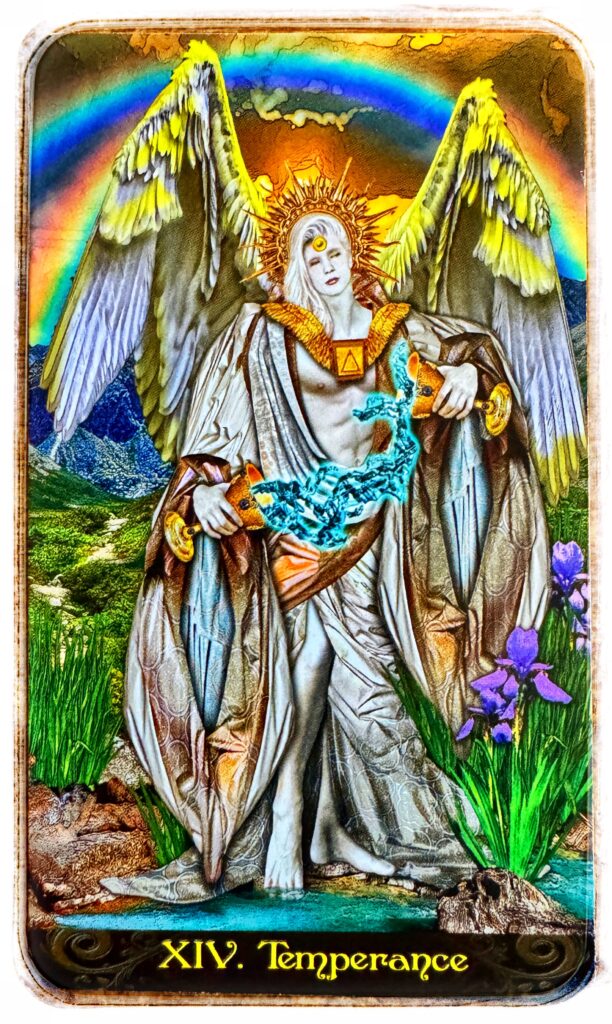
Look at Temperance closely. An angel stands with one foot on solid ground, the other dipping into water. Between two cups—one silver, one gold—liquid flows upward, defying gravity, defying the laws that govern ordinary things. The angel’s face is serene, not from the peace of stillness but from the peace of perfect motion. Behind her, a golden crown floats on the horizon, neither fully risen nor set—suspended in the liminal hour between states.
This is the image of transformation in progress. Not transformation completed, not the dramatic moment of before-and-after, but the long middle passage where elements that should not mix are being coaxed into conversation. Where opposites pour into each other until they forget they were ever separate.
Most people misunderstand Temperance. They see moderation, restraint, the boring middle path between extremes. But that’s the trap of surface reading. Temperance isn’t about dampening your fire or diluting your intensity. It’s about alchemy, the sacred art of combining volatile substances until they catalyze into something neither element could become alone.
The alchemists called it the coniunctio—the sacred marriage of opposites. Before the gold appears, there’s the nigredo, the blackening, the dissolution. Everything you thought you were breaks down into base matter. Your contradictions feel like civil war. Your inner voices argue in a language that leaves you exhausted and confused.
Temperance arrives in that moment and whispers: Stay with it. This chaos is fertile.
The Sacred Tension You’re Holding
Here’s what I’ve learned after years of trying to reconcile the seemingly irreconcilable: your contradictions aren’t problems to be solved. They’re ingredients waiting to be combined.
For years, I held two identities in tension. On one hand, the Chaos Magician—the part of me that dissolves boundaries, plays with reality tunnels, believes nothing and experiments with everything. This is the trickster energy, the paradigm-shifter, the one who knows that belief is a tool and that all maps are provisional. The Chaos Magician is pure dissolution. He breaks down ossified structures, laughs at dogma, and refuses to be pinned to any single story about how reality works.
On the other hand, the Narrative Alchemist—the part that weaves coherence, builds systems, believes that stories are technology and that meaning-making is sacred work. This is the builder energy, the one who knows that humans need structure, that pattern recognition is how we survive, and that the stories we tell literally construct the reality we inhabit. The Narrative Alchemist is pure synthesis. He takes the raw material of experience and transforms it into usable wisdom.
For the longest time, these felt like competing philosophies. How can you simultaneously believe that all beliefs are tools and that the stories we tell matter deeply? How can you be both the dissolver and the builder, the chaos agent and the meaning-maker?
Temperance taught me that I was asking the wrong question.
The real question isn’t which one is true? but what becomes possible when both are true?
When the Chaos Magician and the Narrative Alchemist stop fighting for dominance and start collaborating, a third thing emerges: Spiritual Technology. The ability to work with consciousness as both fluid and structured. To hold beliefs lightly while honoring their power. To deconstruct limiting narratives while simultaneously crafting liberating ones. To know that reality is both fixed and flexible, and that your agency lies in the space between.
This is the magic of synthesis. Not compromise, where you water down both truths until they become weak tea. Not alternation, where you toggle between identities depending on the day. But integration, where contradictions alchemize into something that contains both poles and transcends them.
The Other Sacred Tensions
Your version might look different. Maybe you’re holding:
The Mystic and the Pragmatist – One part of you wants to dissolve into pure consciousness, to meditate until the self disappears. Another part needs to pay the mortgage, schedule the meetings, show up for the people who depend on you. Temperance asks: What if devotion to the sacred includes devotion to the mundane? What if the extraordinary hides inside the ordinary, waiting to be recognized?
The Creator and the Destroyer – You want to build something beautiful, lasting, meaningful. You also want to burn it all down when it becomes stale or false. You want to commit and you want to remain free. Temperance whispers: Creation and destruction are the same motion. You can’t make anything new without composting the old. The artist needs the editor. The rebel needs the architect.
The Teacher and the Student – Part of you has learned something worth sharing. Part of you knows you’ve barely scratched the surface. You oscillate between confidence and imposter syndrome, between offering your gifts and wondering who the hell you think you are. Temperance reveals: Teaching is learning. You become the teaching when you stop performing expertise and start sharing your experiments.
The pattern is always the same: two truths that seem mutually exclusive, held in such close proximity that they begin to heat up, to irritate each other, to catalyze something neither could produce alone.
The third thing, that’s your medicine. That’s what you’re here to give.
How to Work with Temperance Energy
This isn’t abstract philosophy. Temperance is a practice, and like all practices, it has mechanics.
The Pouring Exercise:
Take two facing pages in your journal. At the top of the left page, name one pole of your tension. At the top of the right, name the other. Now write from the first perspective, let that voice speak fully, without censorship, without trying to be balanced. Pour everything that perspective knows onto the page. When you feel complete, move to the facing page and let the opposite voice respond. Go back and forth, pouring from one vessel to the other, until something unexpected happens.
What you’re looking for is the moment when the voices stop arguing and start building together. When they stop defending positions and start exploring possibilities. When you stop writing about your contradictions and start writing from your synthesis.
Finding Your Synthesis Statement:
Once you’ve done the pouring work, ask yourself: Who am I when both of these truths are honored? Write a single sentence that contains both poles without collapsing either one.
Mine is: I am a spiritual technologist who dissolves old spells and crafts new ones, knowing that all maps are provisional and that the maps we choose determine the territory we inhabit.
Your synthesis statement shouldn’t resolve the tension, it should honor it. It shouldn’t choose between your contradictions, it should elevate them into a third position that makes both necessary.
A Warning About False Synthesis:
Real synthesis isn’t compromise. Compromise says: “I’ll be a little bit chaos, a little bit structure, and mostly I’ll be bland.” That’s just spiritual beige.
Real synthesis is transcendent. It says: “I am more chaotic because I understand structure. I am more structured because I’ve learned to dance with chaos. And together, they make me dangerous in the best possible way.”
You’ll know you’ve found true synthesis when you feel more powerful, not less. More yourself, not more acceptable. When the tension transforms from exhausting to energizing.
A Personal Story
I spent my twenties in the military—a world of rigid structure, clear hierarchies, and unambiguous rules. Then I spent my thirties studying chaos magick and postmodern philosophy, deliberately deconstructing every belief system I’d inherited. The two experiences felt like they’d happened to different people.
But when I started developing narrative alchemy as a practice, something clicked. I realized that the military taught me about structure, discipline, and the power of shared rituals—skills essential for consciousness work. And chaos magick taught me about flexibility, experimentation, and the necessity of challenging authority, including your own.
The synthesis wasn’t “moderate military-influenced spirituality.” It was something fiercer: the ability to build powerful transformative systems and know when to burn them down and start over. To respect tradition and fuck with it creatively. To honor lineages and break them open when they become cages.
That tension (between structure and chaos, between honoring and disrupting) became the foundation of everything I teach. It turned a contradiction into a methodology.
Journal Prompts (Expanded)
Sit with these questions. Don’t rush to answers. Let them marinate until something true rises to the surface.
What two forces in you are ready to be reconciled and poured into one vessel?
What have you been holding as either/or that might actually be both/and?
What becomes possible when your contradictions collaborate instead of compete?
If your inner tensions were two elements (fire and water, earth and air), what third element emerges when they combine?
Who would you be if you stopped trying to choose between your truths and instead let them make you complex, paradoxical, and fully human?
Temperance is the slow work. It doesn’t give you a lightning-bolt insight that changes everything overnight. It gives you something better: the steady practice of alchemizing your contradictions until they become your signature. Until what made you feel fragmented becomes what makes you feel whole.
You’ve been holding volatile elements in suspension. It’s time to let them marry.
The angel is patient. The pouring continues.
And slowly, impossibly, the liquid flows upward.
Note: This is Part I of 7. The next installment, “The Lantern-Bearer (The Hermit).”
[…] […]