








Or: What The Matrix Can Teach Us About Conscious Transformation
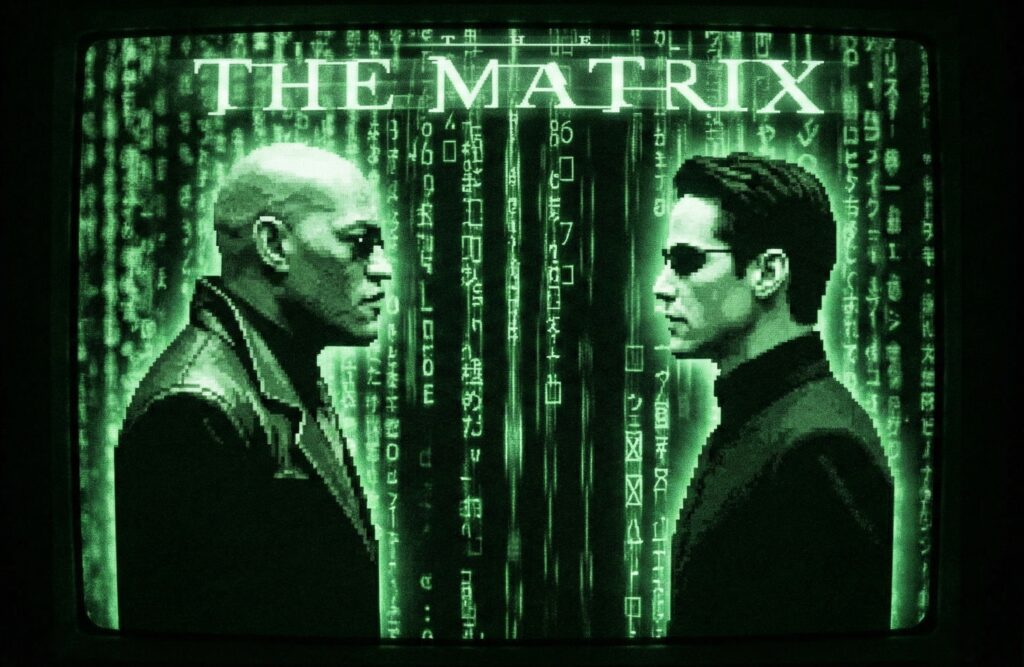
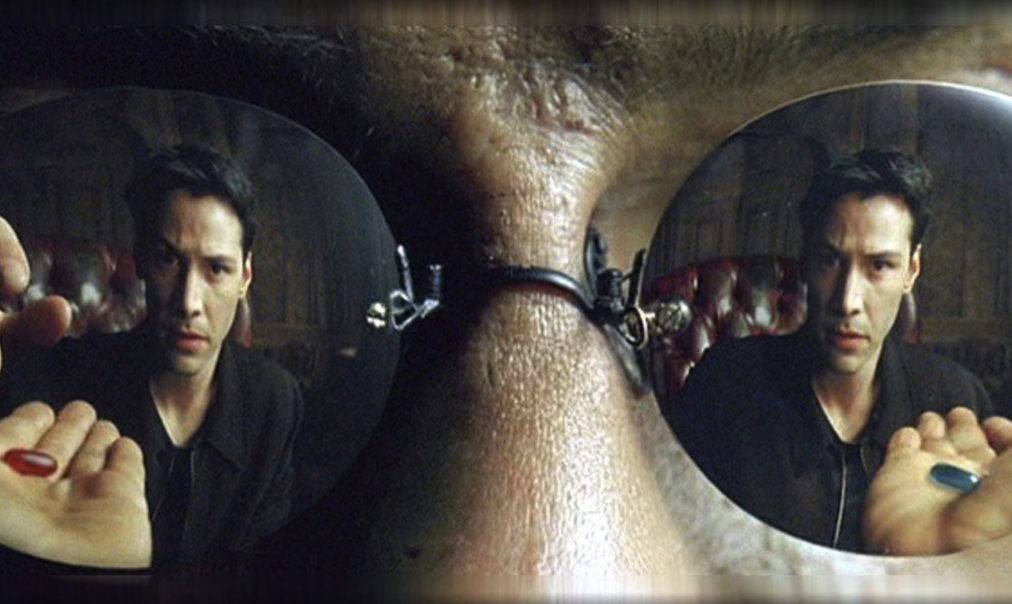
There’s a moment in The Matrix that most people miss. It’s not when Neo stops bullets or when he resurrects from death. It’s quieter, more devastating.
It’s when Morpheus realizes his faith might be wrong.
We tend to remember Morpheus as the unwavering believer, the teacher who never doubts. But that reading misses something crucial about the archetypal relationship between teacher and student, between the one who knows and the one who discovers. Understanding this relationship provides a map for anyone doing consciousness work, narrative alchemy, or any practice aimed at fundamental transformation.
Let me show you what I mean.
The Teacher Who Already Knows
Morpheus operates as what depth psychology calls a psychopomp: a guide who leads souls between worlds. He’s already liberated from the Matrix, already understands its nature, already achieved his own awakening. His function is revelation and initiation. He doesn’t discover truth so much as transmit it.
This makes him extraordinarily powerful and extraordinarily limited.
His power comes from certainty. Morpheus holds an unshakeable vision of what’s possible. When Neo doubts, when Neo fails, when Neo can’t yet see what Morpheus sees, that faith provides the container necessary for transformation. Morpheus creates space for Neo’s awakening by refusing to collapse into doubt himself.
Think about this in your own life. When you’ve undergone genuine transformation, there was likely someone who held a vision of your potential that you couldn’t yet see yourself. They believed in a version of you that didn’t yet exist. That belief functioned as scaffolding, temporary support that allowed you to build something new.
Morpheus’s certainty is also his cage.
He’s complete in his arc. He’s already crossed his threshold and already had his awakening. His journey now is about facilitating another’s transformation rather than achieving his own. This gives him stability but costs him dynamism. He can point to the door but cannot walk through it for Neo. He can describe freedom but cannot experience Neo’s specific version of it.
Morpheus is fixed. And in alchemy, the fixed element alone cannot transform.
The Student Who Must Fail
Neo embodies something entirely different: potential over actuality, becoming over being.
He contains the capacity for transcendence but must actualize it through repeated trials. His knowledge isn’t transmitted but forged. Every realization comes through direct experience, often painful, frequently humiliating. He doubts. He fails spectacularly. He dies.
And this is precisely what makes his awakening real.
Neo represents the hero’s journey in its most essential form: the ordinary person called to extraordinary destiny who initially refuses. His doubt and fear aren’t obstacles to transformation but necessary components of it. They create the friction that generates heat, the resistance that builds strength.
Unlike Morpheus, Neo must choose belief rather than inherit it.
This is a crucial distinction for anyone doing consciousness work. Transmitted knowledge, no matter how profound, remains secondhand until it’s tested in the crucible of lived experience. You can read every book on meditation, study every mystical tradition, memorize every wisdom teaching. None of it matters until you sit with your own mind and discover what happens when you actually practice.
Neo’s arc is dynamic where Morpheus’s is static. He moves, changes, transforms. He becomes something he wasn’t. Morpheus, for all his wisdom, essentially remains who he already is.
But Neo also carries a burden Morpheus never faces: messianic expectation.
The Weight of Prophecy
Others project their salvation onto Neo before he’s earned it. They see him as The One based on prediction rather than demonstration. This creates a peculiar psychological pressure: he must become what others already see him as.
This is the shadow side of having a teacher who believes in you too much. Their faith can feel like a demand. Their vision of your potential can become a weight rather than wings. You’re not just transforming for yourself but carrying the hopes of everyone who’s invested in your awakening.
Neo must actualize a prophecy that exists independent of his will. Morpheus gets to believe in something outside himself. Neo must believe in himself, which is infinitely harder.
Yet paradoxically, Neo’s ultimate realization is that the prophecy matters less than the choice to embody it. The Oracle tells him what he needs to hear, not necessarily what’s true. The power isn’t in being The One but in choosing to act as if he is.
This is straight from Vaihinger’s Philosophy of As If. The useful fiction creates reality. The role, consciously adopted, transforms the actor.
The Alchemical Marriage
Here’s where these two archetypes reveal their deepest teaching: they complete each other.
In classical alchemy, transformation requires two primary elements. Sulphur represents the fixed principle: stable, unchanging, providing structure. Mercury represents the volatile principle: changeable, transformative, capable of changing state.
Morpheus is sulphur. Neo is mercury.
Morpheus provides the container, the stability, the unwavering vision that holds space for transformation. Neo provides the transformative catalyst, the element that actually changes state and transmutes reality.
Neither can complete the Great Work alone.
Morpheus can see truth but cannot fully reshape it. He understands the Matrix but remains bound by its fundamental rules. Neo can reshape reality but initially cannot see it clearly. He has power without understanding.
Together they form a circuit. The teacher requires the student to fulfil his purpose just as the student requires the teacher to begin the journey. This isn’t weakness. It’s how consciousness evolution actually works.
Think about your own practice, whatever it is. You have your stable elements: the frameworks you trust, the practices you return to, the wisdom you’ve earned. These are your Morpheus. They provide structure and continuity.
But you also have your volatile elements: the experiments you run, the edges you test, the territories where you don’t yet know what you’re doing. This is your Neo. This is where actual transformation happens.
Most people mistake spiritual development for accumulating more Morpheus, more certainty, more fixed knowledge. They want to become the teacher who knows. But development requires maintaining Neo, staying volatile, remaining willing to not-know even as understanding deepens.
The Teacher’s Second Threshold
There’s a moment later in the trilogy where Morpheus’s certainty shatters. The prophecy appears wrong. The Architect reveals complexities Morpheus never imagined. His entire framework seems to collapse.
This is his real initiation.
Up until this point, Morpheus has been living on borrowed awakening. He achieved his own liberation, yes, but then ossified into that achievement. He became the holder of fixed truth rather than a perpetual explorer of deepening truth.
When his certainty breaks, he faces a choice: retreat into despair or become a beginner again. This is the teacher’s second threshold, the one most spiritual guides never cross. It requires surrendering the identity of “one who knows” and accepting that every realization is provisional, every understanding incomplete.
Morpheus must become more Neo-like: uncertain, vulnerable, willing to fail.
Simultaneously, Neo must become more Morpheus-like: developing unshakeable faith, learning to hold space for others, transitioning from student to teacher without losing his capacity for learning.
The synthesis both archetypes point toward is this: the awakened teacher who remains perpetually open to deeper awakening. The realized master who hasn’t ossified into mere knowledge holder. The guide who remains willing to be guided.
This is the actual goal of consciousness work, and it’s far more demanding than simply achieving some stable state of enlightenment.
What This Means For Your Practice
If you’re doing any kind of transformative work, narrative alchemy, consciousness exploration, or creative evolution, you’re dancing between these two positions constantly.
You’re Morpheus when you:
- Hold a vision of what’s possible that your current self can’t yet see
- Trust frameworks and practices that have proven effective
- Offer guidance or structure to others
- Maintain faith through periods of doubt
- Provide the stable container for volatile experiments
You’re Neo when you:
- Test new territories without knowing outcomes
- Fail repeatedly and learn from failure
- Question everything, including your most trusted beliefs
- Accept that your current understanding is incomplete
- Choose to embody potential before you have proof it will work
The trap is settling permanently into either role.
Pure Morpheus becomes dogmatic, rigid, and unable to adapt when reality reveals new complexity. You become the teacher who killed their own learning, the guide who no longer travels.
Pure Neo becomes ungrounded, perpetually chaotic, and unable to build on past realizations. You become the eternal student who never develops mastery, the seeker who mistakes movement for progress.
The power lies in consciously moving between both positions.
This is what I mean by treating consciousness work as spiritual technology rather than received wisdom. Technology improves through iteration. You need the stable platform (Morpheus) to test volatile innovations (Neo). You need the experimental results (Neo) to inform platform updates (Morpheus).
Your philosophical council, your established practices, your earned understanding, these provide your Morpheus function. They’re real, valuable, necessary. But they’re not final. They’re the stable base from which you launch into unknown territory.
Your daily experiments, your willingness to be wrong, your comfort with not-knowing even after years of practice, this is your Neo function. This is what keeps your work alive rather than merely preserved.
The Perpetual Threshold
Here’s the deepest teaching: there is no final awakening. There’s only the choice to remain at the threshold, that liminal space between knowing and not-knowing, between mastery and beginner’s mind.
Morpheus teaches us the necessity of faith, structure, and transmitted wisdom. Neo teaches us that no amount of teaching replaces direct experience. Together they teach us that the path is perpetual crossing, constant dying and rebirth, forever trading certainty for deeper uncertainty that paradoxically feels more solid than any fixed belief.
In narrative alchemy work, this means treating every framework as provisional code, functional but improvable. Your stories are spells, yes, but spells can be rewritten. Your understanding is real, yes, but reality has more layers than any single understanding can capture.
Be Morpheus enough to hold space and maintain practice. Be Neo enough to shatter your own certainty when deeper truth demands it. Recognize that the teacher who stops being a student has stopped being a real teacher. The master who won’t return to beginner status has only mastered their own stagnation.
The Matrix isn’t just a movie about breaking free from illusion. It’s a teaching about the relationship between freedom and perpetual choice, between awakening and remaining awake, between the guide and the guided in an eternal dance where both roles transform both dancers.
Your stories are code. But the compiler is consciousness itself, and it’s always upgrading. Stay volatile. Stay fixed. Hold both. Transform.
That’s the real red pill.