













(The One Who Mapped the 365 Dimensions)
There’s a moment when you realize that everything you thought was random is actually pattern. That the chaos you’ve been experiencing has architecture. That what looked like accident or coincidence or blind luck is actually the turning of a wheel so vast you couldn’t see its shape until you stepped back far enough to perceive the whole cycle. This realization changes everything. Not because it gives you control, but because it reveals the nature of the game you’ve been playing without knowing the rules.
This is Basilides’ gift.
Basilides was another high-minded Christian philosopher like Valentinus, making his home in syncretic Alexandria in the 2nd century CE. His Gnostic teachings included a Hellenistic concept of karma where we all go round and round through 365 dimensions in the hope of breaking out into the embrace of Sophia. He also originated the concept of Abraxas, who stands at the top of these 365 dimensions of reality, the god above gods who rules the totality of the wheel.
Some say Basilides was the pupil of Glaucias, the secretary of Simon Peter. Others contend this Gnostic sage denied the death of Jesus, claiming that Simon of Cyrene replaced the body of Jesus during the crucifixion. Whether these legends are true or not, what matters is that Basilides devoted his life to understanding the structure of reality, to mapping the invisible architecture that governs how souls move through existence.
In his system, there’s this powerful recognition captured in the text Allogenes: “There was within me a stillness of silence, and I heard the Blessedness whereby I knew my real self… And I turned to myself and saw the Light that surrounded me and the Good that was in me, I became divine.”
This is the breakthrough moment. Not escaping the wheel, but understanding it so completely that you recognize your divine nature within it. Not transcending the cycles, but perceiving the pattern clearly enough to navigate them consciously.
Today, Basilides arrives as our twelfth companion, following Hermes’s hermit wisdom about solitude. Where Hermes taught us to discover truth through inner excavation, Basilides teaches us what we discover when we map the territory we’ve been wandering through blindly. When we start to see the patterns. When we understand the wheel.
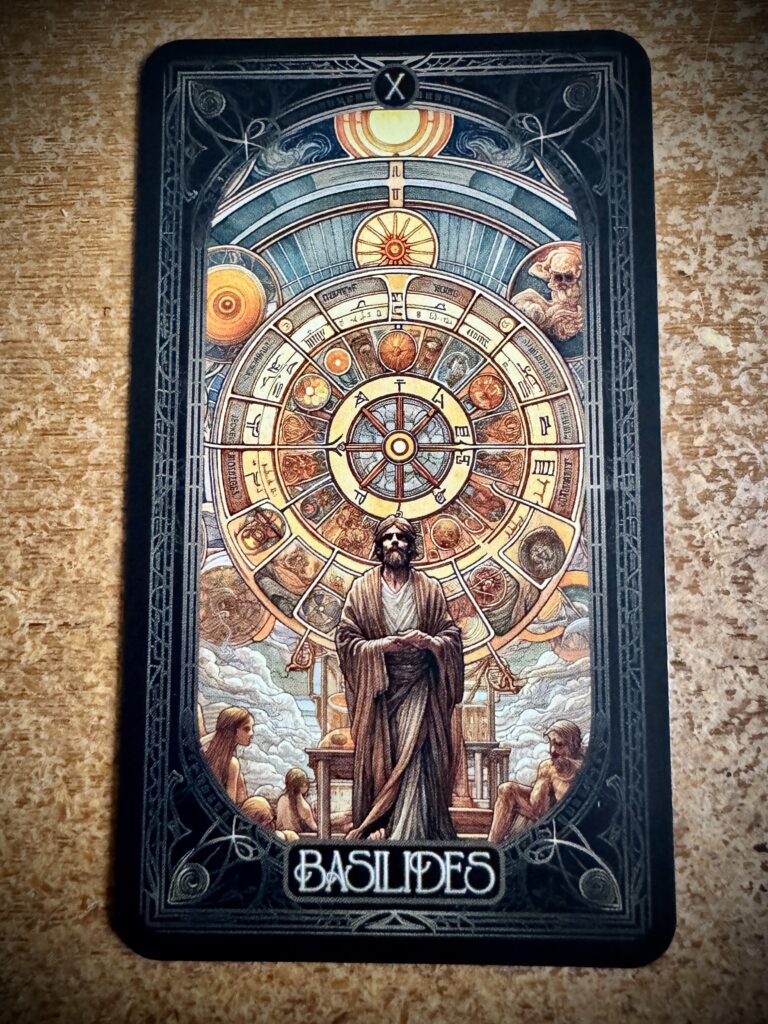
The Advent Companion Appears
Basilides doesn’t appear as a mystical figure shrouded in mystery. He appears as a teacher with maps, a philosopher with systems, someone who has spent lifetimes trying to understand how this all works and is eager to share what he’s learned. You feel him first as the sudden clarity that comes when pattern emerges from chaos, when you finally see the connections you’ve been missing.
He stands at the center of the great wheel, but notice: he’s not trying to stop it or escape it. He’s simply showing you how it turns. Here are the dimensions. Here are the forces. Here’s how they interact. Here’s where you are in the cycle. Here’s what’s coming next if you stay on this trajectory. Here’s how you might navigate differently.
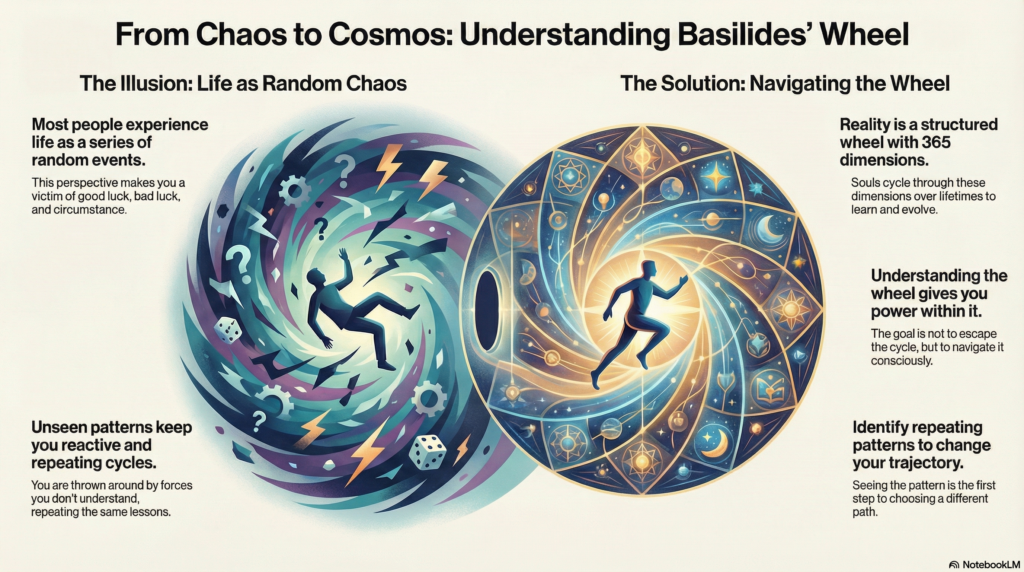
The wheel itself is intricate, beautiful, overwhelming in its complexity. Three hundred and sixty-five dimensions, one for each day of the year, each with its own qualities, its own lessons, its own challenges. In Basilides’ system, you cycle through all of them over countless lifetimes, gradually learning, gradually evolving, gradually becoming tired enough of worldly karma that you finally seek the way out.
This might sound fatalistic, like you’re trapped on an endless wheel with no agency. But Basilides taught something more nuanced: understanding the wheel gives you power within it. Not the power to stop it (that’s not up to you), but the power to navigate it consciously rather than being thrown around by forces you don’t understand.
The students at his feet aren’t passive recipients. They’re active learners, engaging with the system, asking questions, trying to understand how the pieces fit together. Because this knowledge isn’t meant to be memorized. It’s meant to be integrated, applied, used as a tool for navigation.
Abraxas sits at the apex of this system, the principle we met on Day 9, the force of pure action and effect. Basilides recognized that at the top of all the dimensions, beyond all the cycles and patterns, there’s a force that encompasses everything, contains all contradictions, keeps the whole mechanism in motion. Not a god who judges or rewards, but a principle that simply is, the totality of existence in dynamic form.
As Basilides appears beside you today, his teaching arrives with both cosmic scope and practical application:
“What patterns in your life keep repeating? What cycles are you caught in without fully understanding their architecture? What would change if you could see the wheel clearly enough to navigate it consciously?”
Teaching for the Day
Most people experience life as a series of random events. Good luck, bad luck, things just happening to them without rhyme or reason. This perspective makes you a victim of circumstance, forever at the mercy of forces you can’t control or predict.
Basilides offers a different lens: what if nothing is random? What if every experience, every challenge, every opportunity is part of a pattern so vast and intricate that you couldn’t see its shape until you stepped back far enough? What if you’re not a victim of the wheel but a participant in it, cycling through dimensions designed to teach you exactly what you need to learn?
This is the Hellenistic concept of karma that Basilides brought into Gnostic Christianity. Not the punitive “you’re being punished for past sins” version that got popularized later, but something more sophisticated: you keep encountering the same lessons in different forms until you learn them. You keep cycling through similar patterns until you understand them well enough to navigate differently.
The 365 dimensions aren’t just metaphysical theory. They represent the full spectrum of human experience, every possible variation of challenge and opportunity, every flavor of joy and suffering, every combination of circumstances that a soul might encounter. And you cycle through all of them, not randomly but according to a logic, a pattern, an architecture.
The goal isn’t to transcend materiality through some heroic spiritual effort. The goal is to become so conscious, so aware, so awake to the patterns that you gradually stop generating the karma that keeps you bound to the wheel. Not through rejection but through understanding. Not through escape but through integration.
This is why Basilides was both a Christian philosopher and a proponent of what might be called “redemption through experience.” In some interpretations of his teaching, the path forward isn’t avoiding worldly engagement but moving through it so consciously that you exhaust its lessons. You become tired of the karma not because you’ve failed but because you’ve completed it.
The archons maintain their control by keeping you unconscious of the patterns. They want you to experience life as chaos, as random suffering and occasional grace, as something that happens to you rather than something you’re navigating. Because if you understood the wheel, if you saw the patterns clearly, if you recognized how the dimensions work, you’d stop being reactive and start being intentional. You’d stop being thrown by the cycles and start learning from them.
Basilides’ teaching today is both humbling and empowering. Humbling because it reveals just how vast the system is, how many dimensions there are to navigate, how intricate the architecture of existence truly is. But empowering because it shows that understanding is possible, that patterns can be perceived, that conscious navigation is available to those willing to do the work of paying attention.
The wheel turns whether you understand it or not. But understanding changes everything. Not because it gives you power over the wheel, but because it gives you power within it. The power to recognize when you’re repeating a pattern. The power to choose differently when the same lesson comes around again. The power to navigate consciously toward liberation rather than being swept along unconsciously through endless cycles.
Journaling Invocation
“What patterns in my life keep repeating? What lessons keep showing up in different forms that I haven’t fully learned yet? If I could see my life as part of a larger cycle, what phase am I in right now?”
This question asks you to step back from the immediate chaos of daily life and look for the larger patterns. Not to judge yourself for being “stuck” or failing to learn fast enough, but simply to see more clearly what’s actually happening.
Maybe there’s a relationship pattern that keeps repeating with different people. Maybe there’s a professional challenge that keeps showing up in different contexts. Maybe there’s an emotional pattern, a way you respond to difficulty that keeps producing the same outcomes even though you keep hoping for different results.
Basilides doesn’t ask you to fix these patterns immediately. He asks you to see them. To map them. To understand their architecture. Because understanding is the first step toward conscious navigation.
Write about the cycles you can identify in your life. What keeps coming around? What lessons have you been encountering repeatedly? What patterns have you been caught in without fully recognizing their shape?
And then ask the deeper question: what is this pattern trying to teach me? If I’m cycling through this dimension of experience, what’s the lesson embedded in it? What understanding am I building toward? What exhaustion of this particular karma am I working through?
The wheel of fortune in traditional tarot is about the ups and downs of life, the turning of luck, the reminder that nothing stays the same. But Basilides’ wheel is something more: it’s the recognition that the ups and downs aren’t random. They’re part of a pattern. And once you see the pattern, you can start to work with it rather than just being worked by it.
Small Embodied Practice
Stand in an open space where you can turn in a full circle without obstruction.
Begin to spin slowly, arms outstretched, turning clockwise. As you turn, notice the world spinning around you. Notice how disorienting it can be when you’re in motion but trying to focus on what’s passing by.
Now stop. Let the dizziness settle. Feel yourself returning to center, to stillness, to stable orientation.
This is what it feels like to be on the wheel: everything spinning, hard to get your bearings, disorienting when you try to hold onto any single point.
Now turn slowly again, but this time don’t try to focus on the things spinning past you. Instead, feel your center. Feel the axis around which you’re turning. Notice that there’s a still point at the center of the spin, a place in you that isn’t moving even though everything else is.
This is Basilides’ teaching embodied: you can’t stop the wheel from turning. But you can find the center. You can locate the part of you that remains steady even as everything cycles around you.
Stop turning. Place one hand on your heart, one hand on your belly. Feel your breath. Feel your center.
Say quietly: “I am at the center of the wheel. The patterns turn around me, but I remain aware. I see the cycles. I navigate consciously.”
Take three deep breaths here, standing in your center, feeling the stability that’s always available even when life is spinning.
You just practiced finding the still point at the center of the turning wheel.
Not stopping the motion.
Not escaping the patterns.
Simply finding your center within them.
Becoming conscious within the cycles.
Navigating rather than being swept along.
The caravan moves together through the turning wheel. If today’s companion touched something in you, if Basilides’ mapping of the dimensions helped you see patterns you’ve been missing, let us know in the comments. Your conscious navigation lights the path for others cycling beside you. ☸️
Tomorrow: Barbelo arrives, the supreme mother, the one who existed from the first and walked down every possible road.
[…] […]