













(The One Who Found Light in Solitude)
There’s a particular quality of knowing that can only be discovered alone. Not the knowledge acquired from teachers or transmitted through texts, but the understanding that emerges when you stop collecting information from outside and start excavating wisdom from within. When you withdraw from the noise long enough to hear what your own soul has been trying to tell you. When you step away from the crowd’s certainties and into the solitary work of discovering your own.
This is the domain of Hermes Trismegistus.
He is the founder of pagan Gnosticism, known as Hermeticism, and the rumored font of all esoteric information in Greco-Roman times. A fusion of the Egyptian Thoth and the Greek Hermes, some legends portray him rubbing shoulders with Moses himself. Sometimes Hermes Trismegistus is a teacher, sometimes a pupil, but always he is the doorway to inner knowing, the pathway to the arcane teachings of the universe.
“As above, so below,” he once said, but few remember. This isn’t just mystical poetry. It’s a key to understanding reality itself: the microcosm reflects the macrocosm, the patterns of the cosmos repeat in the patterns of the soul, what you discover within yourself reveals the structure of all that is.
Today, he arrives as our eleventh companion, following Marcellina’s threshold wisdom about standing in darkness. Where Marcellina taught us to find equilibrium in the liminal space, Hermes teaches us what can be discovered when we deliberately choose solitude, when we turn away from external guidance and into the hermit’s cave of our own consciousness.
The Advent Companion Appears
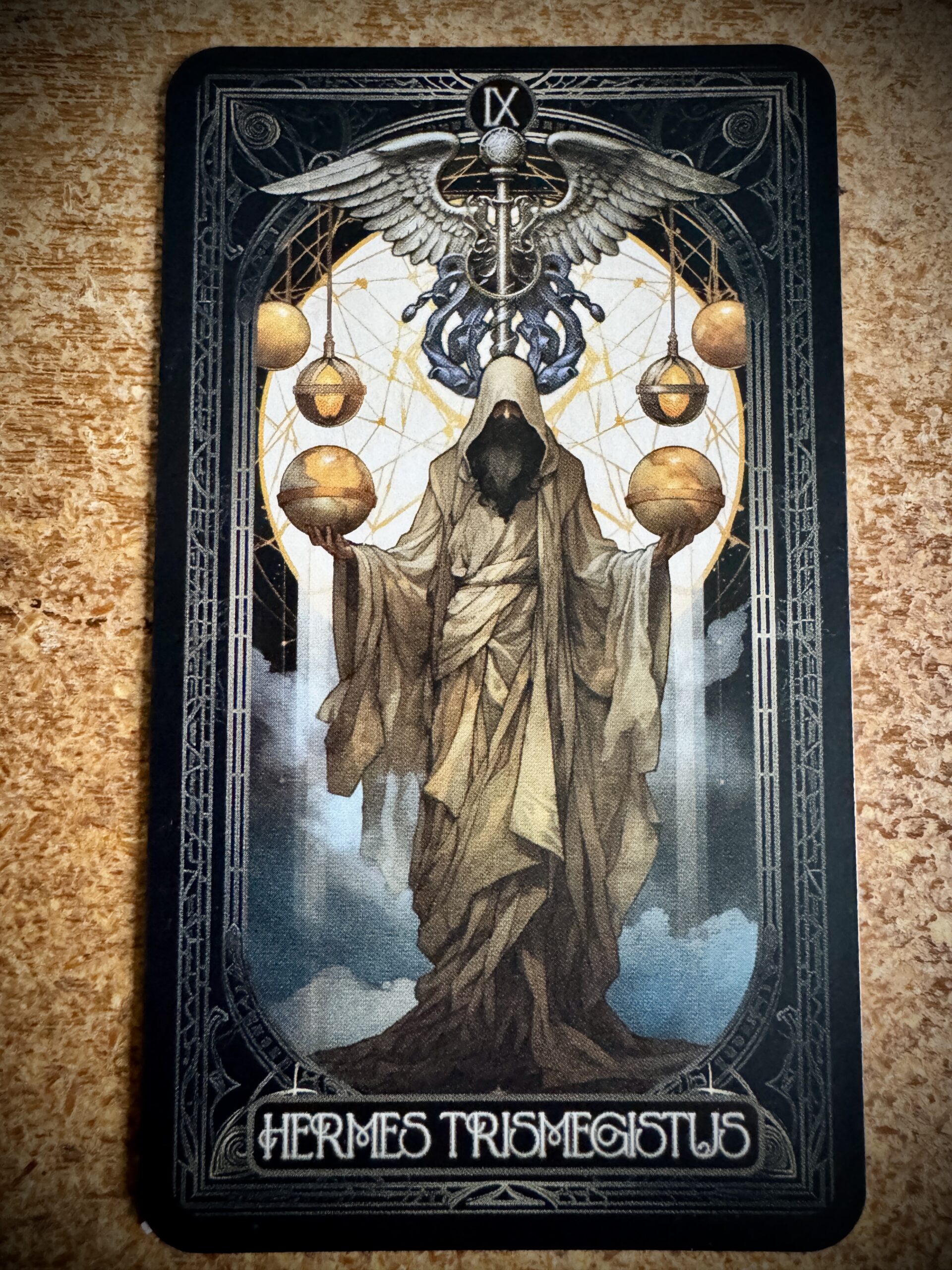
Hermes Trismegistus doesn’t arrive with fanfare or gathering crowds. He appears as solitary presence, as the quality of someone who has spent so much time in their own company that they’ve discovered universes within. You feel him first as a pull toward withdrawal, not as escape but as expedition. Not isolation but exploration.
He stands hooded and mysterious because the hermit’s wisdom isn’t meant to be displayed or performed. It’s meant to be lived, integrated, embodied in silence before it can be spoken in the world. The hood represents the necessary concealment, the incubation period that all profound understanding requires.
The spheres around him aren’t decorative. They’re teachings made visible. Each one represents a principle, a truth, a key to unlocking the mysteries of existence. But notice: he doesn’t throw them at you. He holds them, offers them, waits for you to be ready to receive. Hermetic wisdom isn’t forced. It’s discovered by those willing to do the solitary work of seeking.
In Hermetic philosophy, there’s this recognition: “The excellence of the soul is understanding; for the man who understands is conscious, devoted, and already godlike.” Understanding isn’t intellectual mastery. It’s the capacity to perceive the connections between things, to see the patterns that organize reality, to recognize yourself as part of the cosmic order rather than separate from it.
This understanding can’t be given. It can only be earned through contemplation, through turning inward, through the hermit’s discipline of sustained attention to what’s real rather than what’s merely believed or inherited.
Hermes stands at the intersection of all mystery traditions. Egyptian magic. Greek philosophy. Jewish mysticism. He doesn’t belong to any single tradition because his wisdom predates and transcends them all. He represents the perennial philosophy, the eternal truths that show up in every culture’s mysticism when you dig deep enough.
As he appears beside you today, his teaching arrives not as words but as presence:
“What wisdom is waiting for you in the silence? What understanding can only emerge when you stop seeking it outside yourself and start attending to what’s already present within?”
Teaching for the Day
We live in an age that treats solitude as a problem to be solved, silence as emptiness to be filled, withdrawal as antisocial behavior to be corrected. We’re constantly urged to connect, engage, participate, show up. And connection has value, yes. But there’s a different kind of value in deliberate disconnection, in chosen solitude, in the hermit’s path of inner discovery.
Hermes Trismegistus teaches us that some truths can only be accessed alone. Not because they’re secret in the sense of being hidden, but because they require a quality of attention impossible to sustain in the noise of collective life. They require you to be so still, so present, so attentive to subtle patterns that the slightest distraction scatters them like smoke.
The hermit doesn’t withdraw because they hate the world. They withdraw because they love truth more than comfort, understanding more than approval, wisdom more than belonging. And paradoxically, by withdrawing from the crowd, they often discover truths that serve the crowd far more than constant participation ever could.
“As above, so below” is the foundational hermetic axiom. It means the entire universe is reflected in miniature within you. The patterns that govern stars also govern cells. The principles that organize galaxies also organize thoughts. You don’t need to search the cosmos for wisdom. You need to search yourself with the same rigor and attention you’d bring to studying the heavens.
This is why the hermit’s lamp is so important in traditional tarot symbolism. The hermit doesn’t stumble through darkness. They carry their own light. They’ve cultivated inner illumination through the work of sustained introspection, contemplation, meditation, the deliberate practice of turning attention inward until the inner world becomes as vivid and navigable as the outer.
The archons fear the hermit. Not because hermits are dangerous in any violent sense, but because hermits become ungovernable. When you’ve spent enough time in solitude discovering your own truth, cultivating your own understanding, developing your own relationship with the Divine, external authorities lose their power over you. You stop needing their validation. You stop accepting their programming. You become sovereign in a way that makes you impossible to control.
This is why mysticism has always been suspect to institutional religion. Why contemplatives are tolerated but kept at the margins. Why the hermit path is respected but rarely encouraged. Because people who genuinely know themselves, who have done the deep inner work, who have discovered their own direct connection to the sacred, these people don’t need mediators. They don’t require priests or politicians or experts to tell them what’s true.
The teaching today isn’t that you should become a literal hermit and withdraw from society forever. It’s that you should claim regular hermit time. Periods of deliberate solitude where you’re not consuming content, not engaging with others, not performing any social role. Just being alone with your own consciousness, attending to your own inner landscape, discovering what emerges when all the external noise finally quiets.
Hermes promises this: the wisdom you discover in solitude will serve you far more reliably than anything you’ve collected from outside. Because it’s yours. Because you’ve tested it against your own experience. Because it’s emerged from the truth of who you actually are rather than who you’ve been told you should be.
Journaling Invocation
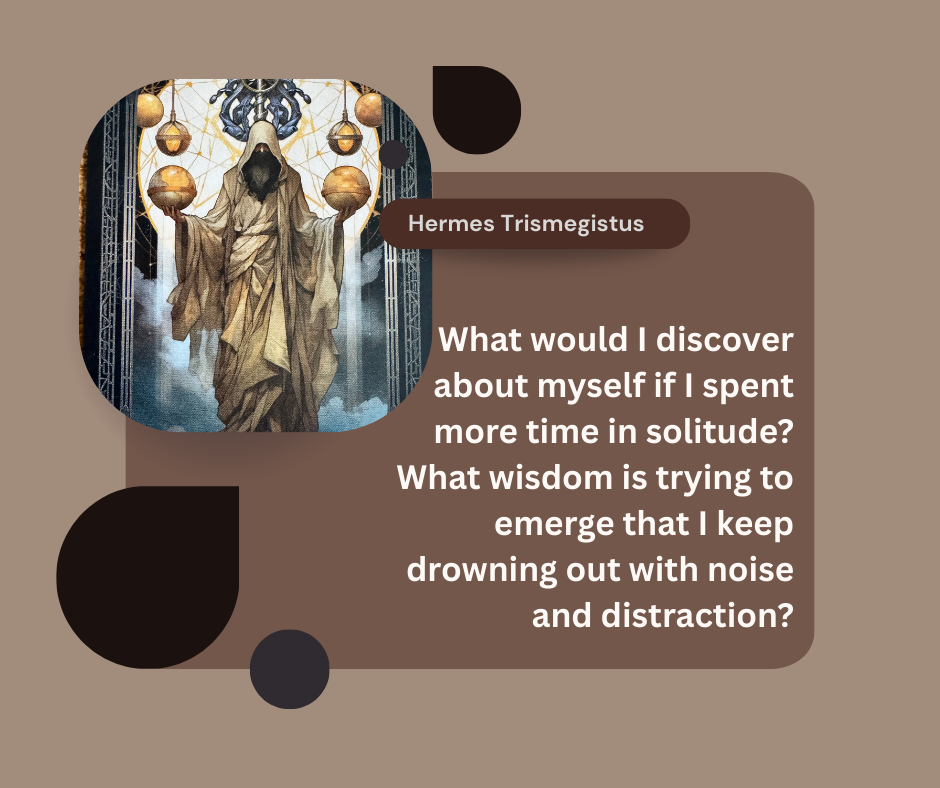
“What would I discover about myself if I spent more time in solitude? What wisdom is trying to emerge that I keep drowning out with noise and distraction?”
This question invites you to examine your relationship with alone time. For many of us, solitude feels uncomfortable, even threatening. We fill every quiet moment with podcasts, music, social media, anything to avoid being alone with our own thoughts.
But Hermes asks: what are you avoiding? What truth are you keeping at bay with all that noise? What understanding is waiting for you in the silence that you’re not ready to face?
Maybe it’s clarity about a decision you’ve been postponing. Maybe it’s recognition of a truth about your life that would require difficult changes. Maybe it’s simply the discovery of who you are when you’re not performing for anyone, not responding to anyone, not shaped by anyone’s expectations or judgments.
Write about your resistance to solitude if you feel it. Write about what scares you about being alone with yourself. Because often what we discover is that we’ve internalized the archons’ voices so completely that being alone means being trapped with our own inner critics, our own doubts, our own harsh judgments.
But the hermit’s work is learning to quiet those borrowed voices until you can finally hear your own. Until solitude stops feeling like punishment and starts feeling like homecoming. Until alone time becomes the place where you’re most yourself rather than least.
What calls you toward the hermit’s path? What understanding are you hungry for that can only come through sustained inner attention? What would it mean to give yourself the gift of regular, sacred solitude?
Small Embodied Practice
Find a space where you can be completely alone and undisturbed for at least 15 minutes. Turn off your phone. Close your laptop. Remove all potential distractions.
Sit or stand in a comfortable position. Close your eyes.
For the first few minutes, just notice everything your mind wants to do to escape this moment. Notice the urge to check your phone. Notice the thoughts about what you should be doing instead. Notice the discomfort with stillness. Don’t judge any of it. Just witness.
After a few minutes, place both hands over your heart. Feel your heartbeat. Feel your breath. Feel the simple fact of your aliveness independent of anyone else’s presence or awareness.
Now ask internally: “What wants to be known? What wisdom is present right now that I’ve been too busy to notice?”
Don’t force an answer. Don’t manufacture insight. Just hold the question in the silence and see what emerges. It might come as words. It might come as sensation. It might come as image or memory or sudden clarity about something you’ve been puzzling over.
Stay in this questioning, listening silence for as long as feels right. Let yourself be the hermit in your own inner cave, carrying your own light, discovering your own truth.
When you’re ready to return, take three deep breaths. Open your eyes slowly. Notice if something has shifted, even subtly.
This is Hermes Trismegistus’s teaching embodied: the universe within you is as vast as the universe without. As above, so below. What you seek in the stars, you can find in the silence of your own soul.
You just practiced the hermit’s discipline.
Not isolation.
Illumination through solitude.
Discovering that the light you need doesn’t come from outside.
It comes from within, waiting for you to finally stop searching elsewhere and look home.
The caravan moves together, but sometimes we walk it alone. If today’s companion touched something in you, if Hermes’s invitation to solitude helped you recognize what’s waiting in your own silence, let us know in the comments. Your inner light illuminates the path for others walking beside you. 🕯️
Tomorrow: Basilides arrives with the wheel of fortune, the one who understood the 365 dimensions of reality and the karma that binds us to them.