











(The Strength of Standing in Darkness)
Marcellina steps forward today as the one who teaches us how to stand inside the dark without being swallowed by it. Her presence carries the kind of strength that doesn’t come from staying upright but from learning how to recover your centre every time the world tilts. It’s the strength of someone who has fallen, risen, stumbled again and again, and discovered that darkness is not an adversary waiting to defeat you but a teacher shaping you from the inside.
Marcellina herself walked this edge in the waking world. A Gnostic teacher who travelled from Egypt to Rome in the second century, she founded her own circle of contemplative practice in a time when a woman doing such a thing was unheard of. Yet she managed to speak to both Christian and Pagan communities, unsettling the orthodox by teaching that all castes, all genders, and all souls share equal standing. The fact that people left the established church for her teachings tells you how potent her presence must have been.
There’s a rumour that she kept the only authentic portrait of Jesus, supposedly drawn by Pontius Pilate, flanked not by saints but by pagan philosophers. Whether literal or symbolic, the image reveals her ethos: no separation. No easy binaries. She held the sacred and the profane in one hand, the Christian and the pagan in the other, the light braided with the dark. Integration was her art, and that alone made her a threat to anyone who depended on fixed borders to make sense of the world.
Her victory wasn’t the kind bought by force or applause. It was the quieter, deeper kind. The victory of someone who walks through shadow and comes out whole, not by resisting complexity but by allowing it to expand their capacity to hold life as it is.
As the tenth companion in this Caravan, Marcellina follows the roar of Abraxas with a different teaching. Abraxas is the force that charges forward. Marcellina is the one who refuses to be blown over. She reminds us that equilibrium is not the absence of motion but the presence of awareness. The way forward now is less about acceleration and more about stance. Less about pushing and more about returning to your centre, right where the storm is at its fiercest.
She asks a simple question: Can you stand where you are without abandoning yourself?
And that is the beginning of Adjustment.
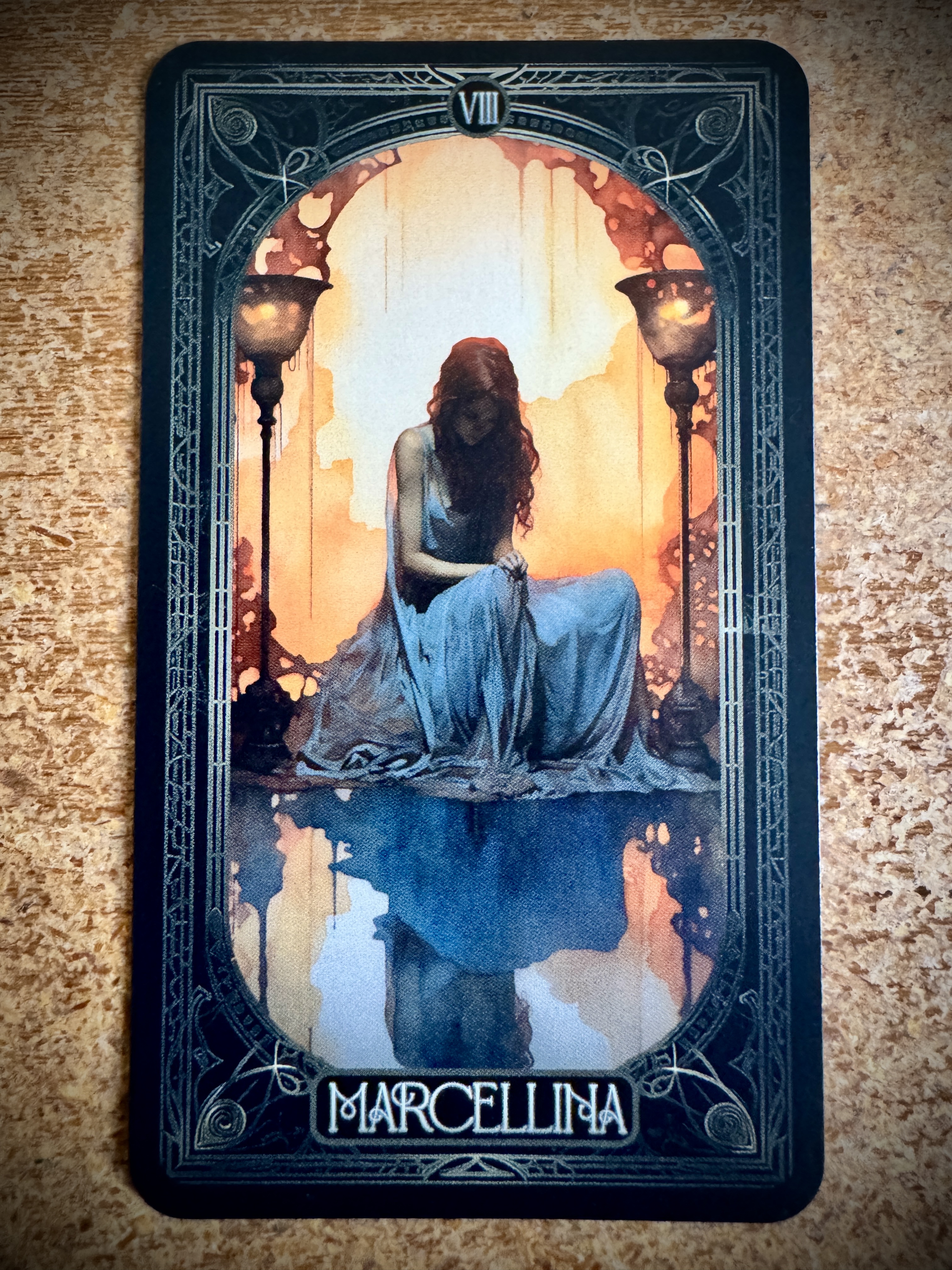
The Advent Companion Appears
Marcellina doesn’t announce herself with proclamations or demonstrations of power. She appears as presence in the threshold, as the quality of someone who has learned to be comfortable with discomfort, to find stillness in chaos, to hold paradox without needing to resolve it.
She sits with her back to us, facing the light beyond the archway. This isn’t avoidance. It’s contemplation. She’s not running toward the light or fleeing from the darkness. She’s simply being in the space between, allowing herself to feel both the weight of shadow and the pull of illumination without rushing to choose one over the other.
In Gnostic teaching, particularly in the Dialogue of the Savior, there’s this powerful line: “Unless one stands in the darkness, one will not be able to see the light.” This is Marcellina’s wisdom embodied. She doesn’t fear darkness because she understands it’s not the opposite of light. It’s the context that makes light visible. It’s the ground from which understanding grows. It’s the teacher that shows you what you’re actually made of.
Her church in Rome taught mystical contemplation and bodily insight, uniting spirit and flesh in ways that made orthodoxy uncomfortable. She didn’t see the body as something to transcend or punish. She saw it as a vehicle for wisdom, a source of knowing that complements rather than contradicts spiritual understanding. This integration of above and below, spirit and matter, masculine and feminine, light and dark, this is the adjustment she embodies.
The traditional Strength card in tarot often shows someone taming a lion, mastering their animal nature. But Marcellina as Adjustment offers something more subtle: she doesn’t tame or conquer. She integrates. She finds the point of balance where opposing forces stop fighting and start dancing.
As she appears beside you today, sitting in her threshold between worlds, her teaching arrives as invitation rather than instruction:
“What would it mean to stop fighting your darkness and start learning from it? What equilibrium becomes possible when you allow yourself to hold both shadow and light without collapsing into either?”
Teaching for the Day
The world teaches us to fear imbalance, to see any deviation from center as dangerous, any encounter with darkness as threatening. We’re told to stay in the light, to maintain constant positivity, to avoid anything that might disturb our equilibrium. This creates a shallow, fragile kind of balance that shatters the moment real difficulty arrives.
Marcellina teaches something different. True strength, true adjustment, comes not from never losing your balance but from learning how to find it again and again in increasingly difficult circumstances. It comes from standing in darkness long enough to discover that you don’t dissolve there. That darkness reveals things light conceals. That the deepest integration happens not in comfort but in the liminal spaces where opposites meet.
Her journey from Egypt to Rome, her establishment of a church that welcomed women as equals, her ownership of both Christian relics and pagan images, all of this speaks to someone who refused to live in artificial categories. She integrated what others insisted must be kept separate. And this integration gave her a kind of power that orthodoxy couldn’t touch, couldn’t suppress, couldn’t control.
The Carpocratian sect she belonged to was radical in its egalitarianism, in its insistence that social hierarchies were human constructs rather than divine mandates, in its teaching that spiritual advancement came through experience rather than through obedience. Marcellina carried these teachings to Rome and made them not just theoretical but practical, creating actual spaces where people could experience equality, where contemplation was valued as much as action, where body and spirit were honored as complementary rather than conflicting.
This is the work of adjustment: finding the places in yourself where you’ve split light from dark, good from bad, acceptable from forbidden, and slowly, patiently, bringing them into dialogue. Not collapsing the distinctions but learning to hold the tension between them without needing to resolve it immediately.
The archons love simple categories. They thrive when you believe you’re either in the light or in the darkness, either good or bad, either spiritual or material. These binary frameworks make you easy to control because they make you afraid of half of reality. Marcellina disrupts this by demonstrating that integration is possible, that you can hold multiplicity without fragmenting, that strength comes from embracing rather than rejecting the full spectrum of experience.
The teaching today isn’t about achieving perfect balance and maintaining it forever. It’s about learning to notice when you’re tipping too far in one direction and having the wisdom to adjust. About recognizing when you’ve been living too much in action and need contemplation, or too much in contemplation and need action. About feeling when you’ve been rejecting your darkness and need to sit with it, or when you’ve been dwelling in shadow and need to turn toward light.
This is dynamic equilibrium, not static perfection. Marcellina sitting in her threshold, adjusting constantly, finding center not once but continuously, learning from both the darkness behind her and the light ahead of her.
Journaling Invocation
“What darkness in my life have I been avoiding that might actually hold wisdom? What would it mean to stand in it long enough to see what it wants to teach me?”
This question invites you into uncomfortable territory. We spend so much energy avoiding our darkness, pushing away what we don’t want to face, pretending certain aspects of ourselves or our lives don’t exist. But darkness avoided becomes darkness that controls you from the shadows. Darkness faced becomes darkness that teaches.
Maybe it’s an emotion you’ve been suppressing. Maybe it’s a failure you haven’t forgiven yourself for. Maybe it’s a part of your personality you’ve judged as unacceptable. Maybe it’s a situation in your life that feels overwhelming and you’ve been trying to think your way out of instead of allowing yourself to actually feel it.
Marcellina doesn’t ask you to wallow in darkness or make it your permanent home. She asks you to be willing to stand in it, to be present with it, to see what it reveals. Because often what we call darkness is just the parts of reality we haven’t yet integrated, the truths we haven’t yet faced, the wisdom we haven’t yet allowed to emerge.
Write about what you’ve been avoiding. What shadow have you been running from? What difficult truth have you been dancing around? What aspect of yourself or your life needs to be acknowledged, witnessed, held in awareness rather than pushed away?
And then ask: what might be waiting for me in that darkness? What understanding? What strength? What integration?
Marcellina promises this: if you stand in the darkness long enough to see clearly, the light you eventually move toward will be earned rather than inherited, chosen rather than assumed, real rather than performed.
Small Embodied Practice
Find a space where you can safely close your eyes or sit in dim light. If possible, turn off most lights so you’re in near-darkness but not complete blackness.
Sit comfortably. Close your eyes. Let yourself be in the darkness behind your eyelids, in the shadow of the room, in the not-knowing of this moment.
Don’t try to fix it or brighten it or rush through it. Just be here. Breathe here. Let darkness be darkness without making it mean anything about you.
After several breaths, notice: what does darkness actually feel like? Not what you think it should feel like, not what you’ve been told it means. What does it actually offer in this moment?
Often we discover that darkness is restful. Quiet. A relief from the constant pressure to perform or shine or be visible. Sometimes darkness is where we finally feel permission to not be okay, to not have answers, to not pretend we’re further along than we are.
Sit in this darkness for several minutes. Let your body learn that darkness isn’t dangerous. That you don’t dissolve in it. That you can be here and be okay.
When you’re ready, slowly open your eyes or turn toward a light source. Notice the transition. Notice how the light feels different because you’ve been in darkness. Notice how your eyes adjust, how your body orients, how the world comes into focus gradually rather than all at once.
This is Marcellina’s teaching embodied: adjustment isn’t about choosing light over darkness. It’s about learning to move between them with grace, to hold both, to let each teach you what it knows.
You just practiced standing in darkness to see the light more clearly.
Not fleeing from shadow.
Not collapsing into it.
Simply being present with the full spectrum of reality.
The caravan moves together. If today’s companion touched something in you, if Marcellina’s threshold wisdom helped you recognize where you’ve been avoiding necessary darkness, let us know in the comments. Your willingness to stand in shadow lights the path for others walking beside you. 🌓
Tomorrow: Hermes Trismegistus arrives, the hermit who holds the lamp, the one who found illumination through solitude.
[…] […]