










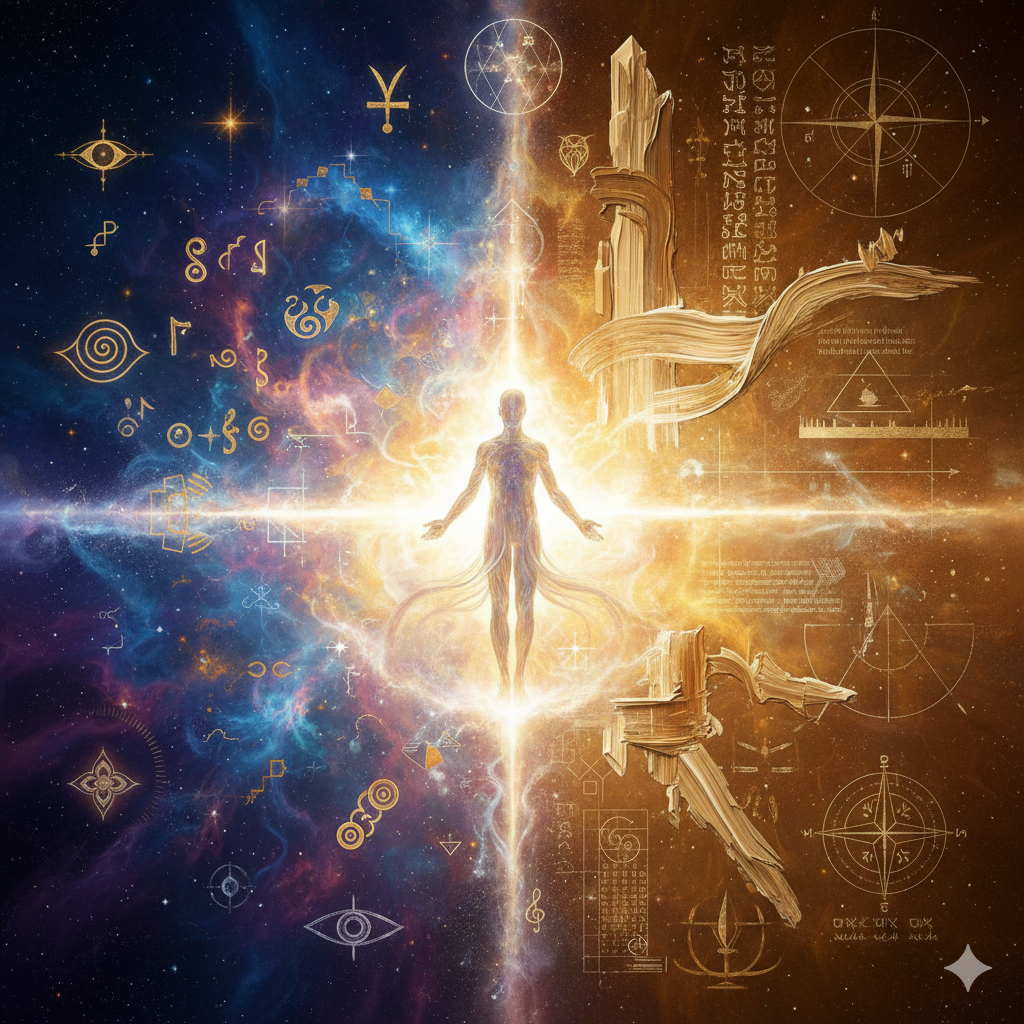
It’s radical to say that self-expression is the most important thing in life. It’s not survival, even though we must continue to live. It’s not about happiness, even though we may experience it. Not even meaning or connection, though these often arise naturally when we express ourselves honestly. Self-expression is the fundamental imperative, the primary reason consciousness manifests in form.
This is not an easy claim to make. It challenges the stories we’ve been taught about duty, service, and self-sacrifice. It cuts against the Protestant work ethic that tells us to be useful, the therapeutic culture that urges us to be well-adjusted, and the spiritual bypass that tells us to transcend the personal altogether. To say that self-expression is the purpose of life can sound hedonistic or narcissistic.
But what if we’ve misunderstood what self-expression actually means?
Beyond Performance
Most of what passes for self-expression in contemporary culture is actually self-presentation. We curate social media identities designed to attract engagement. We craft professional personas meant to advance our careers. We shape our relationships to maximise approval and minimise conflict. This isn’t authentic expression. It’s strategic positioning, a performance built from borrowed scripts.
Authentic self-expression begins with a different question. Not, “How will this be received?” but, “What wants to come through me?” It’s less concerned with demand and more attuned to necessity. The artist who paints regardless of the market. The person who speaks the truth even when it costs them socially. The mystic who follows their vision into territory others cannot understand or approve.
Self-expression at this level is dangerous. It threatens the comfortable scripts we’ve learned to perform. It disrupts established patterns of relationship and identity. It makes us visible in ways that invite both genuine connection and real rejection. This is why most of us settle for self-presentation instead. It’s so much safer.
But safety isn’t what consciousness came here for.
The Language of the Soul
If we take depth psychology seriously, especially the work of Jung and Hillman, we know that the psyche doesn’t speak in direct statements. It speaks in images, symbols, and stories. Dreams don’t explain themselves. They present scenes, evoke feelings, and bypass logic entirely. The soul communicates through metaphor and myth because these forms carry truths that literal language can’t hold.
This reframes self-expression entirely. We’re not generating clever content from ego’s manipulations. We’re serving as channels for something deeper that wants to emerge into form. The writer doesn’t write the story so much as receive it from some intelligence beyond conscious control. The dancer doesn’t choreograph movement but allows the body’s wisdom to speak. The mystic doesn’t choose their visions but submits to what arrives.
This is where the idea of soul fiction comes alive. If fiction is the native language of the psyche, then all authentic self-expression is a form of myth-making. We’re not reporting facts about a fixed, knowable self. We’re telling the living story that soul is authoring through us, moment by moment. We’re characters in a narrative we’re simultaneously writing and discovering.
Your biography isn’t a record of what happened. It’s an act of continuous creation, a story you’re telling yourself into being.
Expression as Discovery
Here’s the paradox at the heart of self-expression. We don’t know what we want to express until we express it. The act of expression is simultaneously discovery and creation. You don’t have a clear message that you then translate into an appropriate form. The form itself reveals what was trying to be said.
This is why practices like journaling function as genuine spiritual technology. Not because you’re recording pre-existing thoughts but because the act of writing calls forth what wants to be known. The pen moving across paper, the fingers dancing on keyboard, these create a channel through which something can emerge that wasn’t available to silent contemplation alone.
I have kept a daily journal for more than forty years, and I can say with certainty that I never know what I will write before I begin. The blank page is an invitation. Sometimes what arrives is mundane. Sometimes it is unexpectedly profound. But the willingness to show up makes it possible for the soul to speak.
Every genuine act of self-expression teaches us something about who we are. Or more accurately, who we are becoming. Because the self that expresses is transformed by the very act of expression. You cannot paint your grief without being changed by the painting. You cannot speak your truth without becoming someone who has spoken truth. Expression doesn’t reveal a static self but participates in the ongoing creation of self.
The Medium Changes the Message
Self-expression isn’t abstract. It requires a medium, a form, and constraints. Different media reveal different dimensions of consciousness. Words and images illuminate some aspects while obscuring others. Dance communicates what language cannot. Code expresses thought through structure, logic, and elegant problem-solving. Relationship itself becomes a medium through which we express who we are in the presence of another.
Each medium has its own intelligence. The programmer expresses through systematic thinking and creative solutions to complex problems. The mystic expresses through altered states and direct knowing that bypasses rational categories. The storyteller expresses through character and plot, translating inner experience into narrative form. The activist expresses through organized action and social transformation.
This is why finding your medium matters so profoundly. Not just “What do I have to say?” but “What forms want to live through me?” Some souls are meant to express through quiet cultivation and intimate transmission. Others through public declaration and bold visibility. Some through patient craftsmanship and attention to detail. Others through spontaneous improvisation and radical experimentation.
There’s no hierarchy here. No medium is inherently superior to another. What matters is alignment between soul’s impulse and the forms available for its expression. When you find your true medium, you know it. The work flows. Not easily, perhaps, but rightfully. You’re no longer forcing expression through inappropriate channels but allowing it to find its natural form.
What We Resist
What we resist expressing is often precisely what most needs expression. The shame we hide, the desire we suppress, the rage we deny, and the grief we postpone. These blockages in self-expression become blockages in living itself. Energy that cannot flow naturally becomes a symptom.
This is a core therapeutic insight: psychological symptoms are failed self-expressions. The anxiety that won’t speak its fear. The depression that cannot voice its rage or grief. The addiction that numbs what cannot be consciously felt. Healing involves finding forms through which blocked energy can finally move, speak, and be witnessed.
This extends beyond individual psychology. Cultural crises such as violence, political polarisation, and ecological destruction can be understood as collective failures of expression. What cannot be acknowledged in public discourse does not disappear. When a culture provides no legitimate forms for expressing grief, rage, or sacred experience, these energies don’t disappear. They go underground and return as shadow.
The work of reclaiming authentic self-expression often begins with noticing what you’ve been taught not to express. What feelings are forbidden? What thoughts are dangerous? What desires are shameful? What truths are too costly to speak? These restrictions, learned early and reinforced continuously, create the prison of inauthenticity we mistake for normal life.
Liberation involves finding safe enough containers to begin expressing what has been suppressed. Not dumping it indiscriminately on anyone nearby, but finding appropriate forms and contexts. Therapy, creative practice, spiritual community, trusted friendship. Places where you can risk showing what you’ve learned to hide.
Expression as Offering
Here’s where self-expression transcends mere personal satisfaction and becomes something larger. When we express authentically, we offer something to the world that only we can offer. Not because we’re special in some absolute sense, but because each configuration of consciousness sees and knows something unique.
Your particular history, wounds, gifts, and obsessions combine to create a singular lens through which reality is perceived. When you express from that place of specificity, you contribute something irreplaceable to the collective understanding. Your pain, worked through honestly, becomes medicine for others facing similar struggles. Your joy, expressed freely, gives others permission to feel their own. Your questions, asked sincerely, open doors for entire communities.
This is the antidote to both narcissism and self-erasure. Yes, it’s about self-expression. But the self expressing is not separate from the larger field of consciousness. You’re a localized expression of something universal, and your particular expression enriches the whole. The more deeply you express your own truth, the more it resonates with others who recognize their truth in yours.
This is why authentic art moves us. Not because it’s universally relatable in some generic way, but because it’s so specifically itself that it touches something universal. The particular opens onto the archetypal. Your story, told with real specificity, becomes everyone’s story.
The Art of Expression
If self-expression is life’s true aim, then the practical question becomes: What wants to express itself through me right now? Not what should I express to gain approval, make money, or fulfil obligations. But what genuine impulse is moving in me that seeks form?
This requires listening. Real listening, which is harder than it sounds. Most of our mental noise is reactive, defensive, and strategic. Beneath that layer is something quieter, more essential. To hear it requires stillness, attention, and patience. It requires creating enough space that something other than a conditioned response can arise.
It requires courage to give form to what emerges, especially when it doesn’t fit expected patterns. When your self-expression challenges family narratives, professional norms, or cultural expectations, there will be consequences. People who preferred your performance will be uncomfortable with your authenticity. Opportunities designed for your persona may close when you show up as yourself.
And it requires craft. Skill in whatever medium you’re working with. Not to achieve some external standard of perfection, but to serve the expression itself. To do justice to what wants to come through. A powerful insight poorly expressed loses its power. A profound experience clumsily articulated fails to transmit. We develop craft not to impress others but to become better vessels for what wants to be born through us.
Reality as a Medium
Ultimately, the deepest form of self-expression isn’t limited to conventional creative output. We’re not just making artifacts like poems, paintings, or businesses. We’re expressing ourselves through the very texture of lived experience, through the quality of consciousness we bring to each moment, and through the reality we participate in creating.
This points toward something even more radical than artistic self-expression. It suggests that consciousness itself is creative, that awareness shapes experience, and that we are expressing ourselves through reality itself.
But that’s a topic for deeper exploration, for understanding mind causation as a creative tool. For now, it’s enough to recognize that self-expression isn’t optional, frivolous, or self-indulgent. It’s the fundamental movement of consciousness into form, the primary way a soul makes itself known in the world.
The question isn’t whether you’ll express yourself. You’re doing that already, whether consciously or unconsciously, skilfully or clumsily, authentically or through borrowed forms. The question is whether you’ll bring awareness and intention to that expression. Whether you’ll develop the courage, craft, and consciousness to express what’s most genuinely yours to give.
Because that, finally, is why you’re here.
Suggested Reading
The Soul’s Code: In Search of Character and Calling by James Hillman. Hillman’s acorn theory proposes that each life contains an essential image seeking expression. Essential for understanding self-expression as the unfolding of innate potential rather than self-creation from nothing.
Man and His Symbols by Carl Jung Jung’s most accessible work on how the unconscious communicates through symbol and image. Foundational for understanding psyche’s native language and why genuine self-expression often bypasses rational discourse.