










Signal
Change your story, change your world.
The Prison We Don’t See
You wake up each morning into a story. Before your feet touch the floor, before you’ve had your first sip of coffee or checked your phone, you’re already swimming in narratives that were spinning long before you opened your eyes. These aren’t the stories you read in books or watch on screens—these are the invisible stories that live inside you, the ones that whisper what kind of person you are, what the world expects from you, and what’s realistically possible given your history, your circumstances, and your limitations.
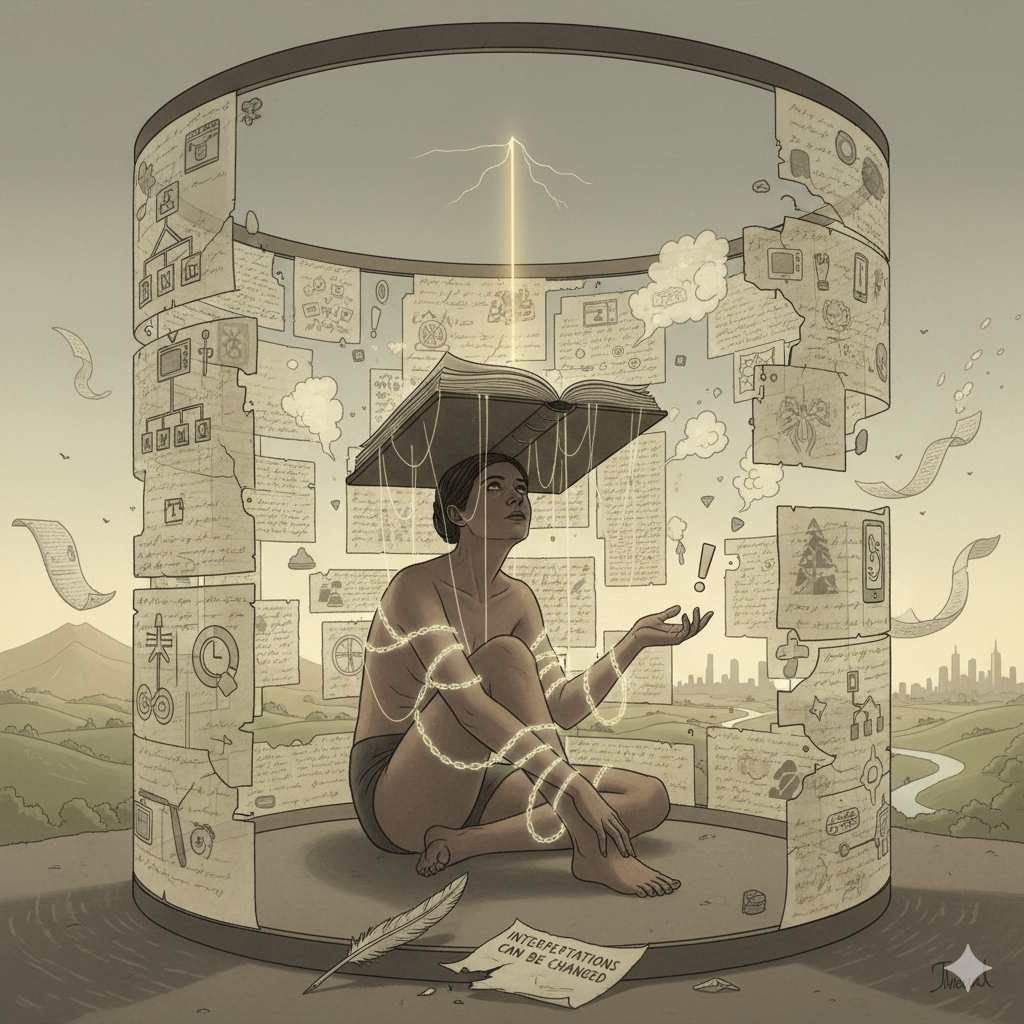
Most of us never question these stories. We inherit them from parents who inherited them from their parents. We absorb them from cultures that have been telling the same tales for centuries. We accept them from institutions, the media, and the casual comments of strangers that somehow lodge themselves in our psyche and take root. We live inside these narratives so completely that we mistake them for reality itself.
But here’s the revolutionary truth: stories are not reality. They are interpretations of reality. And interpretations can be changed.
Why It Matters
We are storytelling creatures. Our brains are narrative-making machines, constantly weaving meaning from the raw data of experience. Every moment of your life is filtered through a story—the story of who you think you are, the story of what you believe the world to be, and the story of what you imagine is possible or impossible for someone like you.
At the deepest level, these stories determine whether you’re living in alignment with your authentic purpose—not some predetermined destiny, but the direction that emerges when you learn to distinguish between conditioned wanting and genuine calling, between inherited scripts and soul-level knowing.
These stories don’t just live in your head as abstract concepts. They become the very architecture of your lived experience. They determine what opportunities you notice and which ones you overlook. They influence what risks you’re willing to take and what dreams you’re willing to pursue. They shape how you interpret setbacks, successes, and the millions of ordinary moments in between.
When your stories are small, your world becomes small. When your stories are filled with fear, your life contracts around that fear. When your stories cast you as victim, supporting character, or tragic hero, you unconsciously arrange your life to fulfil that role.
But the inverse is also true. When you recognise that you are not imprisoned by your stories—that you are, in fact, their author—everything changes. You discover that the life you thought was fixed and predetermined is actually fluid, creative, and endlessly renewable.
Core Idea: The Art of Narrative Alchemy
Narrative Alchemy is the practice of recognising, reimagining, and rewriting the stories that shape your life.
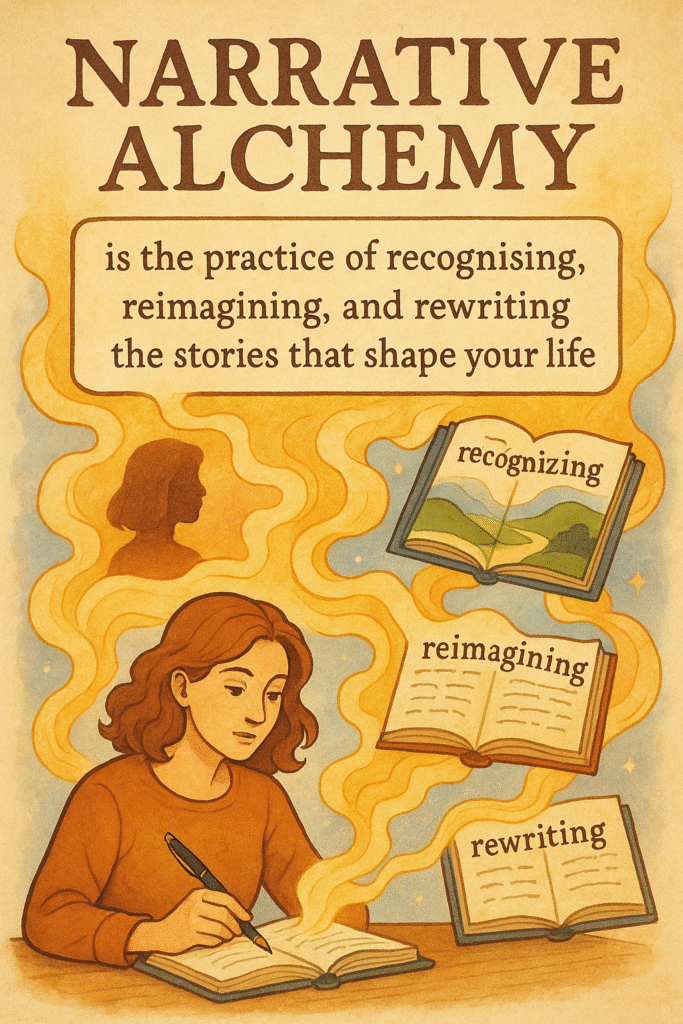
The name itself is deliberate. Like the ancient alchemists who laboured in their laboratories seeking to transform base metals into gold, Narrative Alchemy is a transformational art—but our laboratory is consciousness itself, and our raw materials are experience, memory, belief, and imagination.
The mediaeval alchemists were engaged in something far more profound than primitive chemistry. Their true work was never merely about physical transmutation. The laboratory was a sacred space where matter and spirit met, where the practitioner underwent an inner transformation that mirrored the outer work. As they heated mercury and sulphur, dissolved and coagulated, separated and recombined, they were simultaneously working on the substance of their own souls. The gold they sought was not just the metal but the illuminated self—the philosopher’s stone that could transmute everything it touched.
We inherit this tradition. But instead of working with crucibles and retorts, we work with the stories that construct our reality. Instead of heating metals over a flame, we subject our narratives to the fire of conscious awareness. Instead of dissolving base substances in acid, we dissolve limiting beliefs through inquiry. Instead of extracting essences through distillation, we distil meaning from raw experience.
The process is remarkably similar. Like the alchemists, we begin with prima materia—the raw, unrefined stuff of our lives. This is everything that has happened to you, everything you’ve felt, every pattern you’ve unconsciously repeated. In its unexamined state, this material is heavy, opaque, and often painful. It weighs you down. It seems solid and unchangeable.
But when you bring the fire of awareness to this material—when you begin to examine it, question it, work with it consciously—something remarkable happens. The fixed becomes fluid. What seemed like immutable truth reveals itself as interpretation. The story that felt like a life sentence becomes a rough draft you can revise.
The Secular Sacred
Narrative Alchemy is what might be called a secular sacred practice—it works whether you believe it’s “real magic” or a “powerful metaphor”. The transformation is real either way. You don’t need to adopt any spiritual beliefs or supernatural worldview. You only need to recognise that consciousness, story, and reality interpenetrate in ways our culture has forgotten—and that working skilfully with this interpenetration changes what’s possible.
The sceptic who sees this as applied neuroplasticity and narrative reframing will get results. The mystic who experiences it as genuine magic will get results. The pragmatist who doesn’t care about the metaphysics and just wants their life to change will get results. What matters is not your belief system but your willingness to engage the practices with honesty and consistency.
This is by design. Narrative Alchemy draws from traditions that understand something crucial: the map is not the territory, but a good map still gets you where you need to go. Whether you think of the imaginal realm as a psychological construct or an actual dimension of reality, working with it skilfully produces transformation. Whether you see archetypes as neural patterns or autonomous forces, dialoguing with them changes your life.
Scope and Ethics: What This Work Is (and Isn’t)
A necessary clarification: This is not therapy. I’m a professional coach working with narrative, symbolic, and imaginal technologies for forward-looking transformation. Narrative Alchemy is designed for people who are fundamentally resourced and ready to claim conscious ownership of their lives—it’s a practice of agency, creativity, and possibility.
If you’re in an acute mental health crisis, experiencing severe depression or suicidal ideation, dealing with active addiction, or managing serious psychological conditions, please seek appropriate clinical support first. This work complements but does not replace professional mental health care.
Narrative Alchemy is for people who are ready to take radical responsibility for their story. It’s for those who sense their current narrative is constraining them and who have the stability and resources to do the sometimes-uncomfortable work of transformation. It’s coaching, not treatment. It’s about authoring your future, not healing your past—though the past will inevitably be engaged and reinterpreted as part of the process.
This ethical boundary isn’t a limitation—it’s what allows the work to be potent. When you approach narrative transformation from a place of agency rather than pathology, from creativity rather than diagnosis, from possibility rather than deficit, the work goes deeper and moves faster.
Wisdom Traditions
This practice draws from multiple wisdom traditions, each offering a unique lens through which to understand the transformative power of story:
From mythology, we inherit an ancient understanding that stories are not mere entertainment or decoration but the primary technology humans have always used to make sense of existence itself. Every culture that has ever existed has told stories—about how the world came to be, about the nature of good and evil, about what happens when we die, and about how to live a meaningful life.
These myths were never meant to be taken as literal historical accounts. They were meant to be lived into, to provide templates for navigating the great archetypal experiences that define human existence: birth and death, love and loss, triumph and tragedy, meaning and chaos. The hero’s journey, the descent to the underworld, the sacred marriage, the death and rebirth—these are not just ancient tales but maps of transformation that remain valid across millennia. tales but
When you recognise that your personal story participates in these larger mythic patterns, everything shifts. You’re no longer just an isolated individual struggling with unique problems. You’re part of an ancient human conversation about what it means to live, to suffer, to transform, to become whole. Your struggles become initiations. Your losses become necessary deaths that precede rebirth. Your confusion becomes the sacred space where the old self dissolves and the new self has not yet emerged.
From psychology, particularly the depth psychology of Jung and his inheritors, we understand that the stories we tell about ourselves are not neutral descriptions but active forces that literally shape our neurobiology and behaviour. This isn’t metaphorical—it’s measurable.
When you repeatedly tell yourself a story about who you are—”I’m someone who always fails at relationships,” “I’m not creative,” “I’m damaged beyond repair”—you’re not just describing reality, you’re creating it. These narratives become self-fulfilling prophecies. They filter what you notice and what you overlook. They determine which opportunities you pursue and which you unconsciously sabotage. They shape which neural pathways strengthen and which atrophy.
But psychology also reveals something liberating: because these narratives are constructed, they can be deconstructed and reconstructed. The brain remains plastic throughout life. Neural pathways can be rewired. Identity is not fixed but fluid. The story you’ve been telling yourself for decades can be questioned, revised, and ultimately transformed—and when it transforms, your lived experience transforms with it.
Moreover, psychology gives us tools for this work. Through practices like journaling, active imagination, dream work, and therapeutic dialogue, we can bring unconscious stories into consciousness where they can be examined and revised. We can identify the defences and coping mechanisms that made sense in childhood but now constrict adult life. We can heal old wounds by revising the meaning we’ve made from them.
From philosophy, particularly phenomenology and constructivism, we encounter a radical proposition: reality itself might be far more fluid and participatory than we typically assume. We’re taught to think of reality as something fixed and objective, existing independently of our perception. But philosophers from Kant to the phenomenologists to contemporary cognitive scientists have shown that what we call “reality” is always mediated through consciousness, language, and interpretation.
You never experience raw reality. You always experience reality as it appears through the interpretive frameworks you’ve inherited and constructed—your concepts, your language, your assumptions, your stories. Two people can experience the “same” event and construct completely different meanings from it, not because one is right and one is wrong, but because meaning is made, not found.
This doesn’t mean reality is arbitrary or that you can simply think your way into a different life through positive affirmations. The world pushes back. It has its own constraints and requirements. But within those constraints, there’s far more creative freedom than we typically recognise. The question isn’t “What is objectively true?” but “Which interpretation opens precognition, and which one closes it? Which story connects me to life, and which one deadens me?”
Philosophy also teaches us to question received wisdom, to examine our assumptions, and to think critically about the narratives our cultures take for granted. Why do we believe success looks a certain way? Who benefits from us believing our value depends on productivity? What might be possible if we questioned the story that humans are fundamentally separate from nature or that consciousness is merely a byproduct of brain activity?
From magic—and here we mean not stage tricks or superstition, but the ancient practice of working intentionally with symbols, rituals, and consciousness to create change—we embrace something that mainstream culture tends to dismiss: that focused intention, symbolic action, and ritualised practice can create real change in both inner and outer worlds.
The magician understands that consciousness and the world are not separate but interpenetrating. That symbols have power not because they represent something else, but because they participate in what they symbolise. That ritual doesn’t just commemorate change—it enacts change. That speaking a thing aloud in sacred space begins to call it into being.
This isn’t mysticism divorced from reality—it’s recognition of how meaning operates. When you perform a ritual to release an old identity, you’re not pretending. You’re using the power of symbolic action to reorganise your psyche at a level deeper than rational thought. When you speak a new story about yourself in the presence of witnesses, you’re not just sharing information—you’re performing the new identity into existence, making it socially real, giving it weight and substance.
Magic teaches us that intention matters, that attention is creative, and that the boundaries between inner and outer are more permeable than materialism suggests. It reminds us that transformation requires not just new thinking but new action, not just insight but practice, not just understanding but embodiment.
These four traditions—mythology, psychology, philosophy, and magic—converge in Narrative Alchemy. Together, they provide a comprehensive framework for understanding how stories operate in human life and how we can work with them consciously.
The core insight that emerges is this: Stories are not fixed; they are dynamic lenses. Change the lens, and you change the view. Change the story, and you change what becomes possible.
This is not about denying reality or engaging in wishful thinking. It’s about recognising that between stimulus and response, between what happens and what it means, there is a space—and in that space lies your freedom. You cannot always control what happens to you, but you always have some degree of choice in how you story what happens, and that choice is far more consequential than we typically realise.
The work of Narrative Alchemy is learning to inhabit that space consciously, to recognise the stories operating beneath your awareness, to question their authority, and to craft new narratives that serve your becoming rather than your stuckness, your possibility rather than your limitation, and your authentic self rather than your conditioned self.
Four Streams Converging
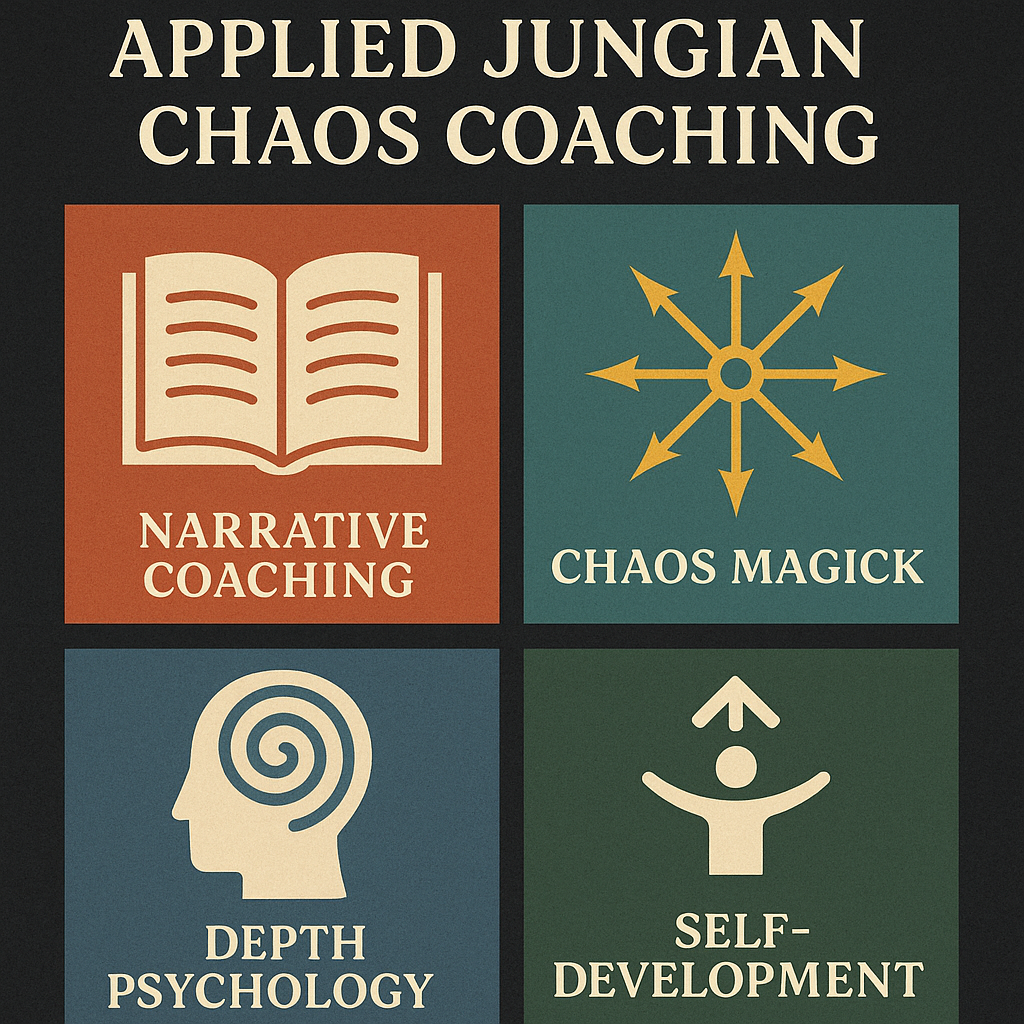
These wisdom traditions—mythology, psychology, philosophy, and magic—converge in Narrative Alchemy through four practical streams that make this work both grounded and transformative:
Narrative Coaching provides the professional methodology and forward-looking framework. Unlike therapy’s focus on healing past wounds, narrative coaching emphasises agency, design, and the conscious authoring of your future. It recognises that your story shapes your possibilities and that you can deliberately redesign that story to serve your becoming. This is the humanistic stream—it keeps the work pragmatic, goal-oriented, and focused on expanding your capacity to create the life you actually want.
Chaos Magick contributes the post-modern understanding that belief is a tool, not a truth—and that techniques work based on results, not metaphysics. From chaos magic we inherit the principle that you don’t need to believe in anything except your own capacity for change. Whether you see sigils as psychological self-programming or actual magic is irrelevant; the method works either way. This stream gives us permission to experiment freely, to use whatever symbolic language serves transformation, and to measure success by outcomes rather than orthodoxy.
Depth Psychology opens the psycho-spiritual dimension through Jung, Hillman, and their inheritors. This is where we encounter the archetypes—not as personality types but as living forces in the psyche. This stream teaches us about the imaginal realm (the dimension between pure thought and material reality where transformation actually happens), about active imagination as a technology for dialogue with the unconscious, and about the necessity of engaging the shadow, the daimons, and the mythic patterns that move beneath the surface of ordinary consciousness.
Self-Development practices make this work accessible to seekers from any background. This eclectic stream translates ancient wisdom into contemporary language, provides practical frameworks for daily practice, and creates community structures where transformation becomes collective rather than isolated. It’s the bridge that allows narrative alchemy to serve people who might never read Jung or practise ritual magic but who intuitively know their story needs to change.
Together, these four streams create something genuinely new—what might be called Applied Jungian Chaos Coaching. It’s coaching that works with the imaginal. It’s depth psychology made pragmatic. It’s magic without dogma. It’s a transformation grounded in both ancient wisdom and contemporary methodology.
Know Thyself: The Daimonic Foundation
At the root of Narrative Alchemy lies the ancient Delphic command: Know Thyself. Carved into the temple of Apollo at Delphi, this wasn’t casual advice for self-improvement—it was a sacred imperative, a call to engage with the depths.
Carl Jung carried this phrase as the motif of his life, but not in the shallow sense we’ve inherited in modern self-help culture. He wasn’t interested in cataloguing personality traits, polishing the ego’s self-image, or optimising productivity. For Jung, to know oneself was to open a genuine dialogue with what he called the ‘daimons’—the archetypes, shadows, complexes, and imaginal figures that move within the psyche like autonomous presences.
These are not metaphors. They are not abstract concepts. They are the lived reality of your inner world—the dream characters who visit your nights with urgent messages, the moods that seize you without warning and alter your perception entirely, and the patterns you repeat compulsively without knowing why. They are the voice of self-sabotage that speaks just as you’re about to succeed, the creative muse that arrives unbidden and demands expression, and the inner critic whose standards feel simultaneously necessary and crushing.
Left unconscious, these daimonic forces dictate the script of your life. They operate like invisible playwrights, arranging scenes, casting characters, and determining outcomes—all while you believe you’re making free choices. You find yourself repeatedly attracted to the same type of destructive relationship. You sabotage opportunities just as they’re ripening. You feel possessed by emotions whose origins you can’t trace. You live out patterns that were set in motion generations before you were born.
But brought into awareness—named, acknowledged, engaged—these same forces become allies in the work of transformation. The inner critic, when truly heard, reveals itself as a protector trying to keep you safe through outdated strategies. The saboteur, when confronted, often guards a threshold you need to cross. The shadow, when integrated, returns lost vitality and wholeness. The daimons don’t disappear; they transform from tyrants into teachers, from possessors into partners.
Narrative Alchemy takes this daimonic self-knowledge as its foundation. To know yourself in this deeper sense is to discern which myth you are unconsciously living, which archetypal forces are shaping your story from beneath the surface of awareness, and how to step out of unconscious possession into conscious participation.
Are you living the myth of the eternal victim, the martyr who suffers nobly but changes nothing? The hero who must constantly prove their worth through impossible challenges? The exile who can never truly belong? The saviour who rescues others while neglecting their own needs? The trickster who disrupts but the saviour commits? These are not just metaphors—they are living patterns that organise experience, attract certain situations, and repel others.
The practice here is less about controlling your narrative than about entering into a relationship with the unseen authors who write through you. It requires a certain humility—the recognition that you are not the sole authority in your own life, that powerful forces move within you that preceded your conscious awareness and will likely outlast it. But it also requires courage—the willingness to meet these forces directly, to ask them what they want, and to negotiate with them rather than being dominated by them.
This is delicate work. It means learning to distinguish between the voice of intuition and the voice of fear, between genuine soul-calling and ego-inflation, and between necessary protection and neurotic defence. It means developing what Jung called “the transcendent function”—the capacity to hold the tension between opposing forces within yourself without collapsing into one side or the other.
When you begin to truly listen to your daimons—not to banish them or be controlled by them, but to hear what they have to say—your personal narrative naturally expands. You start to recognise that your life is not just a random sequence of events to be managed or optimised but a myth unfolding with its own logic, its own requirements, and its own archetypal necessities.
You see that your depression might be a soul initiation rather than a medical problem to be eliminated. That your restlessness might be a call to adventure rather than evidence of your inability to be content. That your anger might carry crucial information about violated boundaries rather than being a shameful emotion to suppress. That your seemingly irrational fears might be protecting something precious that your rational mind has overlooked.
In this recognition, the true work of narrative alchemy begins: turning shadow into gold, fate into freedom, and inherited script into living art. You’re no longer trying to force your life into a predetermined template of success or happiness. Instead, you’re learning to collaborate with the deeper intelligence that’s been trying to live through you all along.
The Mechanics of Story
To understand how Narrative Alchemy works, we need to recognise how stories operate in our lives. Stories function at multiple levels simultaneously:
Surface Level: These are the stories you consciously tell about yourself and your life. “I’m a teacher.” “I’m going through a divorce.” “I’m trying to get healthier.” These surface stories are important, but they’re often symptoms of deeper narratives.
Identity Level: These are the stories about who you fundamentally are. “I’m someone who struggles with commitment.” “I’m naturally anxious.” “I’m not creative.” These stories feel true because they’ve been reinforced over time, but they’re actually interpretations that have hardened into seeming facts.
Mythic Level: These are the archetypal patterns and universal themes that your personal story echoes. Are you living the story of the exile, the seeker, the wounded healer, or the reluctant hero? These deeper patterns connect your individual experience to the great themes of human existence.
Cosmic Level: These are the stories about reality itself. Is the universe friendly or hostile? Is life meaningful or random? Are humans fundamentally good or flawed? These meta-stories create the stage upon which all your other stories play out.
Narrative Alchemy works by bringing consciousness to all these levels. It asks you to become curious about the stories you’ve been unconsciously living and then to actively participate in rewriting them.
The Imaginal: Where Transformation Actually Happens
To understand how Narrative Alchemy works, you need to understand the imaginal realm—and to grasp that it’s not “just” imagination in the dismissive way our materialist culture uses that phrase.
The imaginal is the dimension between pure abstraction and material reality. It’s where dreams live. Where symbols have power. Where archetypes move. Where stories are not representations of reality but actual forces that shape reality. Depth psychologists have mapped this territory extensively, but every genuine wisdom tradition has known about it—shamans call it the spirit world, mystics call it the subtle realm, and artists call it the source.
When you engage active imagination—when you dialogue with an inner figure, when you perform a ritual, when you create a sigil, when you rewrite a core story about yourself—you’re not pretending. You’re not engaging in make-believe. You’re working in the imaginal realm, where the boundaries between psyche and world are genuinely permeable.
This is how narrative alchemy actually functions as transformation rather than just positive thinking. You’re not trying to convince yourself of something you don’t believe. You’re not papering over reality with affirmations. You’re working at the level where meaning is made, where identity is forged, and where the stories that organise your perception are actually constructed.
Change something in the imaginal realm through sustained, skilful practice, and it ripples into your material life. Not magically, not instantaneously, but genuinely. You start noticing different things. You interpret events differently. You make different choices. You become, over time, someone who inhabits a different story—and therefore someone who lives a different life.
The imaginal is neither purely subjective nor purely objective. It’s the space where inner and outer meet and interpenetrate. It’s real, but not in the way a rock is real. It’s active, but not in the way your muscles are active. It’s where consciousness does its creative work—where perception becomes experience, where story becomes world.
Respecting the imaginal—taking it seriously as a domain of genuine transformation—is what distinguishes Narrative Alchemy from surface-level self-help. We’re not just “healing”, “orating” or “thinking positively”. We’re engaging the actual machinery of meaning-making at its source.
The Difference Between Story and Truth
One of the most liberating—and potentially unsettling—realisations in Narrative Alchemy is understanding the distinction between story and truth. This distinction lies at the heart of the practice, and getting it wrong can lead either to rigid fundamentalism or to untethered fantasy.
Most of us have been conditioned to think in binary terms: “true stories” and “false stories”, stories that accurately reflect reality versus stories that distort it. We’ve inherited from our scientific age the assumption that there is one objective truth, and our job is to align our stories with it. Deviation from objective truth equals delusion, dishonesty, or self-deception.
This framework served certain purposes. It helped us build bridges that don’t collapse and medicines that actually heal. But when applied to the domain of meaning, identity, and lived experience, this framework becomes not just limiting but actively harmful. It traps us in a prison of supposed objectivity that doesn’t actually exist when it comes to the interpretation of human experience.
The Pragmatic Turn
Narrative Alchemy suggests a different framework, one more aligned with philosophical pragmatism than with naive realism. Instead of asking, “Is this story true or false?” we ask fundamentally different questions:
- Is this story useful or limiting? Does it expand my capacity to engage with life, or does it contract it?
- Does it open possibilities or close them? Does it reveal options I couldn’t see before, or does it convince me that certain paths are impossible?
- Does it connect me to my deepest values and highest potential, or does it keep me small and stuck? Does it call forth the person I’m capable of becoming, or does it reinforce outdated versions of myself?
- Does it serve life, or does it serve fear? Does it emerge from vitality and creativity or from the need to protect, control, and remain safe?
- Does it increase my agency or my victimhood? Does it position me as someone who can respond and create or as someone who can only react and endure?
These questions don’t ask about correspondence to objective reality. They ask about consequences. They recognise that stories are not static descriptions but active forces that shape what happens next.
The Multifaceted Nature of Truth
This doesn’t mean we abandon truth or embrace fantasy. It doesn’t give us licence to deny facts or construct self-serving delusions. What it means is far more subtle: we recognise that truth—particularly truth about meaning, identity, and the interpretation of experience—is often more complex and multifaceted than any single story can contain.
Consider a simple example. A person loses their job. What is the “true story” here?
- “I was fired because I wasn’t good enough.”
- “I was let go due to corporate restructuring beyond my control.”
- “I was released from a role that no longer served my growth.”
- “I lost my job because I refused to compromise my values.”
- “I was freed from a toxic environment that was making me sick.”
Which story is objectively true? Potentially all of them. Potentially none of them. The “facts” of the situation—the conversations that happened, the documentation filed, the final pay cheque issued—can coexist with multiple interpretive frameworks, each highlighting different aspects of a complex reality.
What matters is not which story corresponds to some impossible “view from nowhere”, but which story you inhabit, because the story you choose to live inside will determine your next chapter. The first story leads to diminished confidence and hesitancy. The second story leads to passivity. The third story leads to curiosity about what comes next. The fourth story leads to integrity and self-respect. The fifth story leads to relief and possibility.
The same event. Five different futures.
Truthfulness vs. Factuality
There’s an important distinction here between truthfulness and mere factuality. Facts are the bare bones of what happened—the objective sequence of events that would be captured by a perfect recording device. But humans don’t live at the level of facts alone. We live at the level of meaning, and meaning requires interpretation.
Truthfulness is about honest engagement with your actual experience, not about clinging to one supposedly objective account. It means acknowledging what you genuinely felt, what you actually need, and what you authentically value—even when that conflicts with the story you’ve been telling yourself or the story others expect you to tell.
Sometimes the most factually accurate story is the least truthful. “My childhood was fine” might be factually defensible—you had food, shelter, and education. But if that story requires you to minimise real pain, to silence your actual experience, to maintain a fiction that keeps you disconnected from your emotional truth, then it’s a lie even if all the facts check out.
Conversely, sometimes a mythic or symbolic story captures a deeper truth than a merely factual account. “I died and was reborn” might not be medically accurate, but it might be the most truthful description of a profound transformation. “I was devoured by the dragon and emerged transformed” might not be what a video camera would record, but it might capture the essential truth of an initiation experience.
The Story “I Failed” vs. “I Learned”
Let’s examine this more closely with a concrete example. Consider the entrepreneur whose first business collapsed. Two narratives present themselves:
Story One: “I failed at my first business. I lost my investors’ money. I let down my team. I proved I don’t have what it takes to be an entrepreneur. This failure confirms my deepest fear that I’m not capable of building something successful.”
Story Two: “I learned invaluable lessons from my first entrepreneurial experience. I discovered what works and what doesn’t. I built skills I couldn’t have developed any other way. I found out what I’m truly passionate about. I paid tuition at the University of Real Experience, and now I’m far better prepared for my next venture.”
Here’s what’s crucial: both stories can be completely factually accurate. The business did fail. Money was lost. The team was disappointed. And lessons were learned. Skills were developed. Wisdom was gained. These are not mutually exclusive facts.
But they are radically different interpretive frames, and the frame you choose determines everything that follows. The first story leads to shame, withdrawal, risk avoidance, and the death of entrepreneurial ambition. The second story leads to integration, growth, calculated risk-taking, and refined strategy. The first story says, “I am a failure.” The second story says, “I had a learning experience.”
Over time, these two interpretations don’t just feel different—they create different realities. The person inhabiting the first story will unconsciously sabotage future opportunities, interpret setbacks as confirmations of their inadequacy, and eventually stop trying. The person inhabiting the second story will approach new ventures with wisdom gained, will interpret setbacks as course corrections, and will persist until they succeed.
Ten years later, one person is bitter and stuck. The other person has built something meaningful. Same starting point. Different story. Different life.
The Ethical Dimension
But here’s where it gets more complex: this doesn’t give us licence to construct any story we want, regardless of reality. There are ethical and practical boundaries to narrative freedom.
You cannot story your way out of genuine accountability. If you harmed others, the story “I was the real victim here” might make you feel better, but it’s a form of moral evasion. If you made mistakes, the story “everything happened for a reason, and it was all perfect” might be comforting, but it prevents the learning that mistakes are meant to initiate.
You cannot story your way out of necessary grief. If you’ve experienced real loss, the story “I’m grateful for this lesson” might be premature spiritual bypassing. Sometimes the truthful story is simply “This hurts.” I’m devastated. I need time to feel this.”
You cannot story your way into abilities you don’t possess or circumstances that don’t exist. If you’re drowning in debt, the story “I’m abundant” without accompanying changed behaviour is magical thinking, not narrative alchemy. The point isn’t to deny reality but to work behaviour more creatively.
The Practice of Discernment
So how do you know which stories serve truth and which ones serve evasion? This requires developing what we might call narrative discernment—the capacity to sense which stories enliven and which ones deaden, which stories connect you to reality and which ones disconnect you.
Some guidelines:
Life-serving stories tend to:
- Increase your sense of agency and possibility
- Connect you more deeply to yourself and others
- Open up creative options you couldn’t see before
- Feel like relief, expansion, or coming home
- Allow for complexity and paradox
- Invite continued growth and revision
Life-limiting stories tend to:
- Decrease your sense of agency and possibility
- Isolate you from yourself and others
- Close down options and convince you of impossibility
- Feel like contraction, shame, or imprisonment
- Demand simplistic either/or thinking
- Claim to be final and unchangeable
But even these guidelines aren’t absolute. Sometimes a story that initially feels limiting is actually protecting something important. Sometimes a story that feels expansive is actually avoiding something necessary. The practice requires ongoing attention, honest self-inquiry, and willingness to revise.
The Invitation
The difference between story and truth, then, is not the difference between lies and facts. It’s the difference between interpretive frames that serve your becoming and interpretive frames that prevent it.
Truth, in the deepest sense, is not a static correspondence between story and reality. Truth is a living relationship with what is—a relationship characterized by honesty, courage, and the willingness to let your understanding evolve as you do.
The invitation of Narrative Alchemy is not to abandon truth for comforting fictions, but to recognize that you have more freedom in how characterise than you’ve been taught to believe—and that this freedom is inseparable from responsibility. The stories you choose to live inside create the world you inhabit and the person you become.
Choose wisely. Choose truthfully. Choose in service of life.
The Alchemy of Transformation
The transformation that happens through Narrative Alchemy is both subtle and profound, immediate and gradual, and simple and mysteriously complex. It doesn’t require you to deny your past, pretend difficulties don’t exist, or manufacture false positivity. Instead, it invites you to expand your relationship with your experience—to hold it more spaciously, interpret it more generously, and work with it more creatively.
This is not the self-help promise of quick fixes or surface-level affirmations. This is deeper work, more akin to what happens in a therapist’s office, a monastery, or an artist’s studio—work that requires patience, honesty, and a willingness to stay present with discomfort as old structures dissolve and new ones have not yet formed.
When you genuinely begin to see that you have a choice in how you story your life—not just intellectually, but at the level of lived experience—several fundamental shifts begin to occur. These shifts don’t happen all at once, and they’re not linear. They emerge gradually, like a photograph developing in chemical solution, revealing details that were always there but couldn’t be seen until the conditions were right.
Victimhood Becomes Agency
In the default narrative that most of us inherit, we are fundamentally passive—beings to whom life happens. Events occur. Circumstances arise. Other people make decisions that affect us. We are cast as characters in someone else’s story, subject to forces beyond our control, bounced around by fate, genetics, economics, and the choices of those with more power.
This narrative isn’t entirely false. Real constraints exist. Systems of oppression are not imaginary. Trauma happens. Illness happens. Loss happens. We don’t choose many of the circumstances we face, and pretending otherwise is a form of privileged delusion.
But here’s what shifts through Narrative Alchemy: even when you cannot control circumstances, you retain the freedom to choose your response to those circumstances. Between stimulus and response, as Viktor Frankl discovered in the concentration camps, there is a space—and in that space lies your humanity, your dignity, and your power.
The shift from victimhood to agency doesn’t mean denying that you’ve been harmed. It means recognising that being harmed and being powerless are not the same thing. You can acknowledge that terrible things happened to you and simultaneously claim your authority to decide what things mean and what you do next.
This is delicate territory. The culture of toxic positivity and spiritual bypassing has done real damage by pressuring people to “just get over” their pain or to pretend they’re empowered when they’re actually trapped in genuinely oppressive circumstances. Narrative Alchemy is not that. It’s not about blaming victims for their victimization or pretending that “you create your own reality” in some simplistic law-of-attraction victimisation.
Rather, it’s about discovering the degrees of freedom that exist even in constrained circumstances. It’s about noticing where you’ve internalised helplessness beyond what the situation actually requires. It’s about reclaiming the power to interpret your experience in ways that don’t compound suffering with disempowerment.
A person who was neglected as a child can hold both truths: “I was deeply harmed by the failure of adults to meet my needs,” and “I have the power now to meet my own needs and to create the relationships I didn’t receive then.” The first story honours the reality of what happened. The second story claims agency for what happens next. Both are necessary.
When this shift happens, you notice it in small, concrete ways. Instead of asking, “Why does this always happen to me?” you find yourself asking, “What is this situation asking me to learn? How might I respond differently than I have before?” Instead of waiting for external circumstances to change, you start identifying what you can actually influence right now, today. Instead of feeling like life is something that happens to you, you begin to experience yourself as an active participant in your own becoming.
Problems Become Initiations
In the conventional narrative, problems are evidence that something has gone wrong. They’re obstacles to be overcome, enemies to be defeated, or signs that you’re on the wrong path. When difficulties arise, the assumption is that you’ve failed somehow—made a mistake, lacked sufficient preparation, or proven yourself inadequate.
But in the deeper wisdom traditions—from the shamanic journey to the hero’s quest to the alchemical process—difficulty is not a sign of failure but a sign of transformation in progress. The dark night of the soul is not evidence that you’re doing it wrong; it’s a necessary stage in spiritual deepening. The crisis is not a deviation from the path; it is the path.
Through Narrative Alchemy, challenges and setbacks begin to reveal themselves not as evidence of your inadequacy but as invitations for growth, wisdom, and deeper authenticity. This reframe is not about minimising real suffering or pretending that hard things aren’t hard. It’s about recognising that minimising often carries initiatory potential—it breaks open what was closed, it reveals what was hidden, and it demands that you become someone you weren’t before.
Consider the initiatory structure of traditional rites of passage: separation, ordeal, and return. You’re removed from ordinary life, subjected to a trial that breaks down your old identity, and then welcomed back into the community transformed. This pattern isn’t arbitrary—it reflects something true about how humans actually grow. We don’t evolve through comfort and continuity. We evolve through disruption and challenge.
Your illness might be teaching you how to receive help and recognise your vulnerability as strength rather than weakness. Your business failure might be burning away your attachment to external validation and forcing you to reconnect with your genuine creative vision. Your relationship ending might be creating space for you to discover who you are when you’re not performing a role for someone else. Your depression might be your soul’s way of saying, “The life you’re living is too small for who you actually are.”
None of this means you should seek out suffering or romanticise pain. It doesn’t mean all suffering is meaningful or that bad things happen for good reasons. But it does mean that when difficulty arrives—as it inevitably will—you have a choice about how to meet it. You can relate to it as pure misfortune, something to be endured until you can return to “normal”. Or you can relate to it as potentially initiatory, asking, “What is this experience trying to teach me? Who am I being invited to become?”
When problems become initiations, your relationship with difficulty transforms. You stop asking, “How can I avoid this?” and start asking, “How can I be transformed by this?” You stop seeing yourself as someone perpetually beset by bad luck and start seeing yourself as someone undergoing the necessary fires that forge character and wisdom. You stop waiting for life to get easier and start getting better at meeting life as it is.
Identity Becomes Creative
Perhaps the most radical shift in Narrative Alchemy is the recognition that identity is not a fixed essence you’re born with or a stable thing you discover, but an ongoing creative project—something you’re continuously authoring whether you realise it or not.
We’re raised to think of identity as something stable and essential. “This is just who I am,” we say, as if the self were a finished sculpture rather than wet clay. We learn to identify with our personality traits, our history, our roles, and our wounds. “I’m an introvert.” “I’m someone with trust issues.” “I’m not good at maths.” “I’m the responsible one.” These identifications feel true because they’re familiar, reinforced by repetition and often by the expectations of others.
But what if these identifications are not discoveries but constructions? What if you’ve been performing a version of yourself for so long that you’ve forgotten it’s a performance? What if the person you think you are is just one possible interpretation of the raw material of your experience—an interpretation that served a purpose once but might no longer be serving you?
Through Narrative Alchemy, you begin to recognise that identity is not something you have but something you do—an ongoing act of self-creation that’s happening whether you’re conscious of it or not. The question isn’t “Who am I really?” as if there’s some authentic core self waiting to be discovered. The question is, “Who am I becoming?” What version of myself am I practising into existence through the stories I tell and the choices I make?”
This doesn’t mean you have infinite freedom to be anyone you want at any moment. You have a history, a body, a social context, personality tendencies, and traumas that have shaped you. These are not arbitrary. But within these constraints—and every creative act involves constraints—you have far more freedom than you typically recognise.
You can decide to stop identifying with the role you played in your family of origin. You can choose to no longer be defined by your worst moments. You can release outdated versions of yourself even when others still expect you to be that person. You can try on new ways of being and new narratives of self and see which ones feel more alive and more true to your emerging potential.
This is terrifying and exhilarating in equal measure. There’s a kind of vertigo that comes with recognising that the self is not solid ground but open sky. If you’re not the fixed personality you thought you were, then who are you? If you can change your story, what prevents you from changing it in destructive ways? How do you know which version of yourself is authentic?
These are good questions, and Narrative Alchemy doesn’t offer easy answers. But it suggests that authenticity might not be about discovering some pre-existing true self but about consciously evolving in the direction of your deepest values, your most alive longings, and your clearest vision of who you’re capable of becoming. It’s about trading automatic identity for chosen identity, unconscious patterns for conscious practice, and inherited scripts for authored stories.
When identity becomes creative rather than fixed, you discover a new kind of freedom. You’re no longer trapped by “That’s just how I am.” You’re no longer condemned to repeat old patterns because “this is what I always do.” You can experiment, revise, and evolve. You can be who you were yesterday and also someone slightly different today. You can honour your past while not being imprisoned by it.
The Past Becomes Compost
In the conventional narrative, the past is a burden—the weight of everything you’ve done wrong, everything that was done to you, and all the ways you’ve been hurt or have hurt others. It’s evidence of your damage, proof of your limitations, and the reason you can’t have what you want now.
We carry our histories like heavy stones, convinced that because something happened, it defines us permanently. “I can’t trust because I was betrayed.” “I can’t succeed because I failed before.” “I can’t be happy because of what happened to me.” The past becomes a life sentence, an unchangeable condition that determines all possible futures.
But Narrative Alchemy offers a radically different relationship with the past. Instead of seeing your history as a fixed weight to be carried, you learn to see it as raw material to be worked with—compost that can nourish new growth.
Compost is instructive here. It’s made from what was once alive but is now broken down, decayed, and transformed into rich soil. Table scraps and yard waste become the medium in which seeds flourish. Nothing is wasted. Even the rot serves life.
Your mistakes, traumas, disappointments, and failures—these are not evidence of permanent limitation but raw material for wisdom, compassion, and strength. The very things you’re most ashamed of might become your greatest teachers. The wounds you’ve carried might become the source of your gift to others. The patterns you’ve repeated might become the expertise you develop for breaking patterns.
This is not about pretending the past didn’t happen or that it wasn’t painful. It’s not spiritual bypassing or toxic positivity. It’s about recognising that while you cannot change what happened, you can endlessly revise what it means. You can transform your relationship with your history so that instead of being defined by it, you’re informed by it.
The person who was bullied as a child can carry that as a wound that makes them defensive and bitter, or they can transform it into a fierce commitment to protect vulnerable people. Both are possible responses to the same history. The person who failed repeatedly at business can let that confirm their inadequacy, or they can let it become their PhD in resilience and iteration. The person who experienced trauma can remain stuck in victim identity, or they can become someone who helps others navigate similar darkness.
This doesn’t happen automatically. It requires the active work of meaning-making, of consciously choosing to extract wisdom from pain rather than letting pain simply compound. It requires mourning what was lost while also asking what was gained—not in a silver-lining way that minimises harm, but in recognition that even terrible experiences can become teachers if we’re willing to learn from them.
When the past becomes compost, you stop being haunted by it. You stop needing to erase it or hide from it. You can acknowledge everything that happened—the good, the bad, the shameful, the painful—and recognise that all of it brought you here, to this moment, to this possibility of becoming someone who has been shaped but not determined by their history.
The True Alchemy
This is the true alchemy: transforming the lead of unconscious, inherited, or imposed stories into the gold of conscious, creative, life-affirming narratives. Not through denial or delusion, but through the slow, patient work of bringing awareness to what has been automatic, choice to what has been compulsive, and creativity to what has been fixed.
Like the mediaeval alchemists working in their laboratories, this transformation happens through stages. There’s the nigredo—the blackening, the dissolution, the necessary breaking down of old structures. There’s the albedo—the whitening, the purification, the clarification of what’s essential. And there’s the rubedo—the reddening, the completion, the emergence of the philosopher’s stone that can transmute everything it touches.
You move through these stages not once but repeatedly, each time working with deeper material, each time achieving a more refined understanding. The work is never finished because you’re never finished—you’re always in the process of becoming, always having new experiences that require new stories, always discovering deeper layers of meaning in what you thought you’d already understood.
But with each cycle, something fundamental shifts. You become less identified with any single story and more skilled at working with story as a medium. You develop a kind of narrative flexibility—the ability to hold multiple perspectives simultaneously, to recognise that truth is larger than any single interpretation, and to revise your understanding without losing your centre.
You become, in the deepest sense, the author of your own life. Not because you control everything that happens, but because you claim authority over what it means. Not because you deny reality, but because you recognise that meaning is something you create, not something you passively receive. recognise
This is the gold the alchemists were really seeking—not the metal, but the illuminated consciousness that recognises its own creative power. This is the transformation Narrative Alchemy offers: from unconscious repetition to conscious creation, from inherited limitation to authored possibility, from life as something that happens to you to life as something you’re actively shaping with every story you choose to tell.
Practice: Story Archaeology
Write down one “default” story you tell about yourself—something that feels charged, limiting, or like it’s been running your life unconsciously. Examples might include:
- “I’m always unlucky in love.”
- “I never stick with things.”
- “I’m not good with money.”
- “I’m too old to change careers.”
- “I always mess up important opportunities.”
Now excavate this story by asking:
1. Where did this story come from?
Was it something a parent, teacher, or peer said? A conclusion you drew from a specific experience? Did you absorb it from cultural messages? Trace its origins as precisely as you can.
2. Who benefits from me believing it?
Sometimes our limiting stories serve others by keeping us small, predictable, or manageable. Sometimes they serve parts of ourselves that prefer safety to growth. Who or what has a stake in this story staying true?
3. What evidence do I use to support this story?
Notice how you selectively remember experiences that confirm the narrative while forgetting or minimising evidence that contradicts it. This isn’t about denying real patterns—it’s about seeing how you construct the story from partial data.
4. What becomes possible if I release it?
Imagine your life without this story operating in the background. What would you attempt? How would you show up differently? What becomes available?
Finally, rewrite the story in one new sentence that feels truer to your potential. This isn’t about creating false positivity but about crafting a narrative that acknowledges your full complexity and possibility:
- “I’m learning what genuine partnership looks like and becoming someone capable of deep love.”
- “I’m discovering how to balance exploration with commitment.”
- “I’m developing a healthy, creative relationship with money and abundance.”
- “I’m in a powerful life transition, bringing all my experience to something new.”
- “I’m learning to trust myself and recognize genuine opportunities.”
Write this new story down. Speak it aloud to yourself. Notice how it feels in your body—does it create expansion or contraction? Aliveness or deadness? Trust your somatic response.
Five Prompts for Deeper Exploration
1. When did I first realise I was living inside a story?
Think about moments when you suddenly saw that your perception of reality wasn’t reality itself but one possible interpretation among many. Perhaps it was recognising that your family’s way of being wasn’t universal, or discovering that a belief you held wasn’t actually true, or realising that someone saw you completely differently than you saw yourself.
2. What’s a story I inherited from family or culture that no longer serves me?
Consider the spoken and unspoken messages you absorbed about success, relationships, money, creativity, spirituality, or your role in the world. Which of these feel constraining rather than supportive?
3. What’s one story I’d love to live into more fully?
If you could inhabit any archetypal pattern—the artist, the healer, the adventurer, the sage, the lover, or the revolutionary—what would call to you? What story about yourself feels exciting and alive rather than heavy and predetermined?
4. How would my world change if I truly believed I could rewrite my story?
Imagine waking up tomorrow with complete confidence that you are the author of your life story. What would shift in your relationships, your work, your daily habits, and your dreams?
5. Who am I without the old story?
This might be the most challenging question. Underneath all the narratives about your limitations, failures, and fixed identity, who is the essential you? What remains when you strip away all the stories you’ve been telling?
The Invitation Forward
Narrative Alchemy is not a one-time practice but a way of living. It’s an ongoing relationship with the creative power of consciousness, an ever-deepening recognition that you are not just a character in someone else’s story but the author of your own.
Don’t just read this chapter and move on. Actually do the Story Archaeology exercise now. Take fifteen minutes. Write it down by hand if you can—there’s something about the physical act of writing that engages transformation more deeply than typing.
When you’ve rewritten your story, speak it aloud. Not in your head—actually say the words. If possible, share it in the Soulcruzer circle or with someone who can truly witness you. Speaking a new story in the presence of witnesses isn’t symbolic—it’s transformative. It calls forth support from the world and begins to make the invisible visible. It stakes a claim in reality.
Notice what happens in the hours and days after you do this practice. Watch for subtle shifts: different thoughts arising, new choices becoming available, and small moments where you catch yourself about to live the old story and choose differently. Transformation doesn’t usually announce itself with trumpets—it whispers in the margins.
When you’re ready—and only when you’re ready—Chapter 2 awaits. There you’ll discover the foundational principles that make narrative alchemy both grounded and generative, the bedrock axioms upon which this entire practice rests.
The work has begun.
Chapter 2 awaits: First Principles