
Conspiracy, Psychedelia, and the Rituals We’re Already Inside
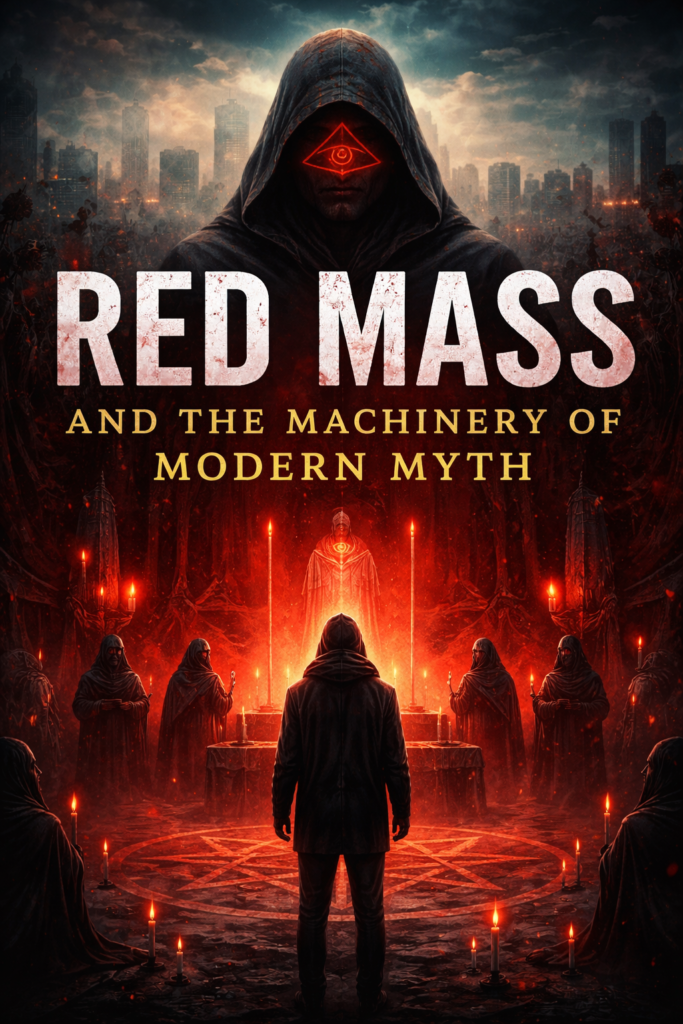
I started reading Red Mass expecting to enter a strange story. What I didn’t expect was the sense that the book was quietly rearranging the furniture of my own thinking. Not in the way a good thriller pulls you along, but in the way certain ideas linger, unsettle, and refuse to stay on the page.
This is not a novel that simply depicts conspiracy. It treats conspiracy as a living system. UFO lore, cryptids, secret orders, altered states, and underground movements are not aesthetic choices here. They are functional components. They organize fear. They distribute meaning. They move people into action. Reading the book feels less like following a plot and more like stepping into a ritual already underway.
What makes Red Mass distinctive is that it refuses the usual comfort zones. It doesn’t mock belief, and it doesn’t romanticize it either. Instead, it asks a quieter and more unsettling question: what if belief itself is infrastructural? What if stories are not just interpretations of reality, but mechanisms that actively shape it?
The protagonist, Gregor Samson, is not a hero in the traditional sense. He is porous, curious, slightly unmoored. His paranoia does not function as a flaw to be corrected so much as a sensitivity to hidden patterns. As his world opens into stranger and stranger configurations, the book resists telling us whether he is awakening, unraveling, or being recruited. That ambiguity is not a narrative failure. It is the point.
As a reader, you are never invited to stand safely outside the material. The novel keeps nudging you toward an uncomfortable recognition: the difference between myth and reality may not be as stable as we like to pretend. Conspiracy, ritual, and altered perception are not fringe phenomena operating at the edges of society. They are everyday forces, woven into media, politics, identity, and desire.
Red Mass doesn’t ask you to decide what is true. It asks you to notice how truth gets made, how it spreads, and what it costs once it starts moving. The unease you feel while reading is not accidental. It’s the sensation of realizing that the mass is not a secret gathering somewhere else. It’s already in progress.
Conspiracy as Myth Engine
In Red Mass, conspiracy is not treated as a mistake to be corrected or a delusion to be exposed. It functions as something older and more durable: a myth engine. The familiar components are all here. UFO sightings. Cryptids. Shadowy organizations. Rumors that refuse to die. But rather than serving as narrative flavor, these elements operate as organizing principles. They give shape to fear. They offer coherence where official explanations fail. They turn anxiety into story.
This is a subtle but important shift. In much contemporary discourse, conspiracy thinking is framed as a breakdown in rationality or a failure of critical thinking. Moler doesn’t deny the danger. He simply moves the lens. Conspiracies endure not because they are persuasive in a factual sense, but because they are effective in a mythic one. They explain why the world feels wrong. They name invisible forces. They offer a sense of initiation into hidden knowledge.
What gives conspiracy its power in the novel is not the content of the beliefs, but their structure. There is always a hidden layer. There is always an initiated few. There is always the suspicion that ordinary reality is a mask. These are ancient mythic patterns wearing modern clothes. The gods have been replaced by agencies. Angels by aliens. Demons by algorithms and clandestine networks. The symbolic function remains intact.
Seen this way, conspiracy becomes less about truth claims and more about participation. To believe is to enter a story that reshapes perception and allegiance. You begin to see signs where others see noise. You feel watched, guided, threatened, or chosen. The world becomes charged. Meaning condenses. Action follows.
Moler’s quiet provocation is that this process is not marginal. It is everywhere. We live inside overlapping conspiracies every day, some benign, some corrosive, many invisible to those embedded within them. Political narratives, market logic, identity scripts, media ecosystems. Each offers its own hidden hand, its own explanation for why things are the way they are and who is to blame.
Conspiracy, then, is not the opposite of myth. It is myth under conditions of technological saturation and institutional distrust. Red Mass does not ask whether these myths are true or false. It asks a more unsettling question: what do they do once we start living inside them?
Gregor Samson and the Threshold State
If conspiracy is the myth engine of Red Mass, Gregor Samson is its threshold figure. He is not a hero, nor even an anti-hero. He is something more fragile and more dangerous: a person whose boundaries are loosening.
Gregor’s defining trait is permeability. He is curious, unsettled, quietly dissatisfied with the official shape of the world. His paranoia does not read as a simple malfunction. It reads as a sensitivity. He notices patterns others dismiss. He feels watched not because he wants to feel special, but because the world no longer feels neutral.
This follows a familiar initiatory pattern. In many mythic traditions, the initiate does not begin as a stable subject. They begin as someone cracked open by doubt, obsession, illness, or dread. Certainty erodes. Ordinary reality loses its authority. Only then can another order of meaning begin to intrude.
What Red Mass refuses to do is tell us how to interpret this state. Gregor may be awakening. He may be unraveling. He may be in the process of recruitment by forces that benefit from his openness. The ambiguity is not a flaw. It is the condition being examined. Threshold states are dangerous precisely because they feel revelatory while stripping away the ability to tell revelation from manipulation.
As Gregor moves deeper into the novel’s ecology of beliefs, rituals, and altered states, his internal changes matter more than any external event. The plot advances, but the real motion is inward. Perception sharpens. Suspicion intensifies. Meaning accumulates. The world begins to speak back.
Moler resists the therapeutic impulse here. Gregor is not being guided toward integration or healing. He is being drawn into alignment. Sensitivity is not presented as inherently virtuous. It is simply exploitable. Gregor’s function is not to resolve the tension between belief and skepticism, but to embody it.
The unsettling implication is that threshold states are no longer rare. Burnout, information overload, and institutional distrust produce Gregor-like conditions at scale. The question the novel leaves hanging is not whether such states are real, but who knows how to use them once they appear.
The Meaning of the Red Mass
The title Red Mass announces its intentions early, if you’re willing to take it seriously. A mass is not a private experience. It is a collective ritual. It requires repetition, participation, and a shared symbolic framework. Whatever transformation occurs does not belong to the individual alone. It circulates.
The “red” complicates this immediately. Red implies blood, sacrifice, embodiment, and consequence. This is not a clean or purely symbolic ritual. Something is paid. Something is consumed. Something is altered in the body and in the world.
Ritual in Red Mass is not a spiritual flourish. It is a technology. It binds people together. It organizes roles. It creates hierarchies of access and obligation. Those who understand the ritual gain leverage. Those who are drawn into it without understanding become material.
This is where Moler diverges sharply from popular narratives of awakening. There is no implication that participation automatically leads to liberation. Ritual amplifies intention, but intention itself remains morally unstable. Power moves somewhere. The question is never whether ritual works, but who it works for.
Seen this way, the Red Mass models how belief becomes operational at scale. Individual threshold experiences are necessary but insufficient. They must be synchronized, repeated, and formalized. Only then do they produce structures that outlast any one participant.
The novel insists that ritual never disappeared from modern life. We simply stopped calling it that. Political rallies, media cycles, online outrage storms, brand loyalty, productivity culture. All operate with ritual logic. They demand attention, repetition, sacrifice, and belief. They reward participation and punish deviation.
By naming the ritual explicitly, Moler removes the comfort of denial. The mass is not happening somewhere else. It is happening wherever belief is rehearsed until it hardens into action.
Psychedelics as Infrastructure
In Red Mass, psychedelics are not shortcuts to insight or tools for personal healing. They function as infrastructure. They alter perception, but more importantly they reorganize access, allegiance, and coordination. They open channels that do not close cleanly.
Contemporary psychedelic discourse often frames altered states as private experiences. You ingest something. You see something. You integrate. Moler breaks that arc. In Red Mass, altered states are gateways. Once crossed, they place the subject in relation to systems and rituals that persist beyond the experience itself.
The psychedelic experience does not merely reveal hidden truths. It makes the subject legible. Receptive. Available. Altered states intensify meaning-making, which paradoxically makes behavior more predictable. The world becomes symbolic. Guidance feels external. Direction follows.
This is where obligation enters. Insight produces consequence. Vision demands alignment. Psychedelic revelation in the novel is never free. It binds the experiencer to a story already in motion. Participation is not optional once perception has been reorganized.
Moler’s unsettling suggestion is that altered states feel liberatory while quietly narrowing choice. When everything feels meaningful, it becomes harder to say no. Awakening is not an escape from systems of control, but an entry into subtler ones. The danger is not delusion, but devotion.
Psychedelics here are neither good nor bad. They are accelerants. They compress allegiance and transformation into a shorter timescale. In a ritualized environment, that compression is invaluable.
Lineage and Divergence
Red Mass belongs to a lineage of writers who treat reality as unstable and symbolic. But what makes Moler distinctive is where he refuses to stop.
With Philip K. Dick, reality fractures and authority lies. Dick’s anxiety is ontological: what is real, and who controls the story? Moler shifts the burden. Reality is not imposed from above so much as co-produced from within. Belief itself becomes generative.
With Robert Anton Wilson, conspiracy becomes playful and provisional. Reality tunnels multiply. Irony cushions commitment. Moler drains the safety net. In Red Mass, reality tunnels harden through ritual and repetition. Irony collapses once consequences appear.
With James Hillman, myth speaks through the psyche. Images personify inner forces. Moler aligns closely, then crosses a line. In Red Mass, the imaginal does not stay interior. Images recruit bodies. Myths demand enactment.
Moler collapses psychology, ritual, and politics into a single continuum. Belief organizes attention. Attention shapes behavior. Behavior allocates power. Once myth becomes operational, neutrality disappears.
Why Red Mass Feels Uncomfortable Now
What makes Red Mass unsettling is not its strangeness, but its familiarity. The mechanisms it explores are already operational. The novel reads less like speculation and more like diagnosis.
We live inside competing narratives that demand belief and repetition. Algorithms reward intensity. Media ecosystems thrive on outrage and revelation. Identity becomes something to defend and ritualize. Under these conditions, conspiracy is not fringe. It is a default mode of sense-making.
The novel reframes the question. Not why people believe strange things, but what belief does once it gains momentum. Stories recruit. They coordinate attention. Once enough people move in sync, belief becomes infrastructure, regardless of truth.
Gregor’s threshold state no longer looks exceptional. It looks common. Sensitivity becomes exploitable at scale. The world feels alive with signals because it is engineered to feel that way.
The novel refuses the comfort of detachment. Everyone participates. The only variable is awareness.
The Mass Is Already in Progress
By the end of Red Mass, the most unsettling realization has little to do with plot. It is the recognition that nothing described here is exotic. The rituals are familiar. The thresholds are familiar. The dangers are familiar.
The book does not ask you to believe its conspiracies. It asks you to notice how belief functions. How it moves from story to structure without announcing the transition. Once you see that clearly, observation gives way to responsibility.
The Red Mass is not a secret ceremony. It is the everyday rehearsal of meaning. It happens in habits, media diets, conversations, and assumptions. It happens whenever belief hardens into action without reflection.
If reality is participatory, withdrawal is not an option. Only unconscious participation or conscious engagement. Only rituals you stumble into or rituals you examine.
The mass is already in progress. The only open question is whether you are paying attention to the role you’re playing.